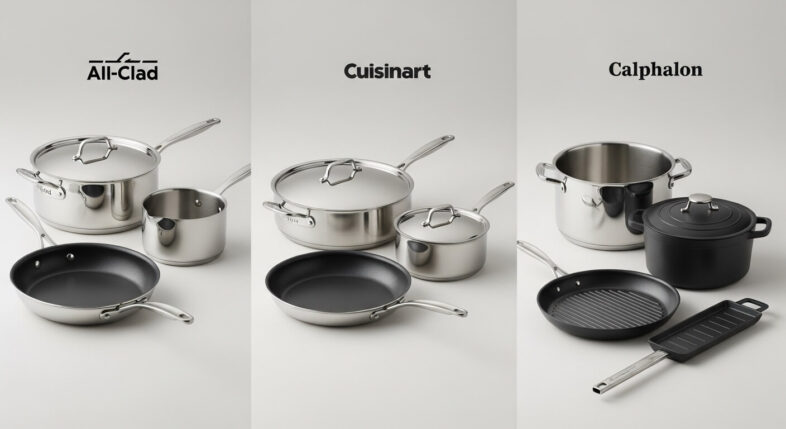
All-Clad wins on raw performance and longevity, Cuisinart wins on value for money, and Calphalon lands right in the middle — solid construction, reasonable price, slightly lower oven-safe ceiling than the other two. That’s the quick answer. Now let’s get into why.
Brand
Construction
Core
Price (12pc set)
Oven Safe
Warranty
All-Clad (D3)
3-ply bonded
Aluminum
$700–1,000+
600°F
Limited lifetime
Cuisinart (MultiClad Pro)
Tri-ply
Aluminum
$300–400
500°F
Lifetime
Calphalon (Premier)
3-ply (some 5-ply)
Aluminum
$300–450
450–500°F*
Lifetime
*Calphalon’s oven-safe rating gets a little inconsistent across listings — more on that below.
So which one should you actually buy? Depends on your budget, honestly, and how much you care about the difference between “good” and “best.” Keep reading.
What Separates All-Clad, Cuisinart, and Calphalon Cookware Sets
The biggest difference between these three brands comes down to metal thickness and manufacturing rigor — not some secret ingredient one brand has and the others don’t.
Construction Quality and Manufacturing
All-Clad uses heavier gauge stainless steel than either competitor, full stop. Every piece, in every line, gets inspected at multiple stages of production. That’s expensive. That’s also why a single All-Clad frying pan can run a few hundred dollars on its own, while a Cuisinart or Calphalon set with a dozen pieces costs less than that.
Cuisinart’s MultiClad Pro line is genuinely tri-ply — aluminum core, stainless on both sides — same basic recipe as All-Clad’s D3. The difference isn’t the formula. It’s execution and metal thickness. Calphalon’s Premier line does something similar, mostly 3-ply, though they’ve got a 5-ply Premier option too that bumps things closer to All-Clad D5 territory, at least on paper.
Does More Layers Actually Mean Better Cooking?
Here’s the thing though — more layers doesn’t automatically mean better cooking. It usually means better heat retention and fewer hot spots. Whether that’s worth the price jump depends entirely on what you’re cooking and how often.
All-Clad Cookware Set: Strengths and Weaknesses
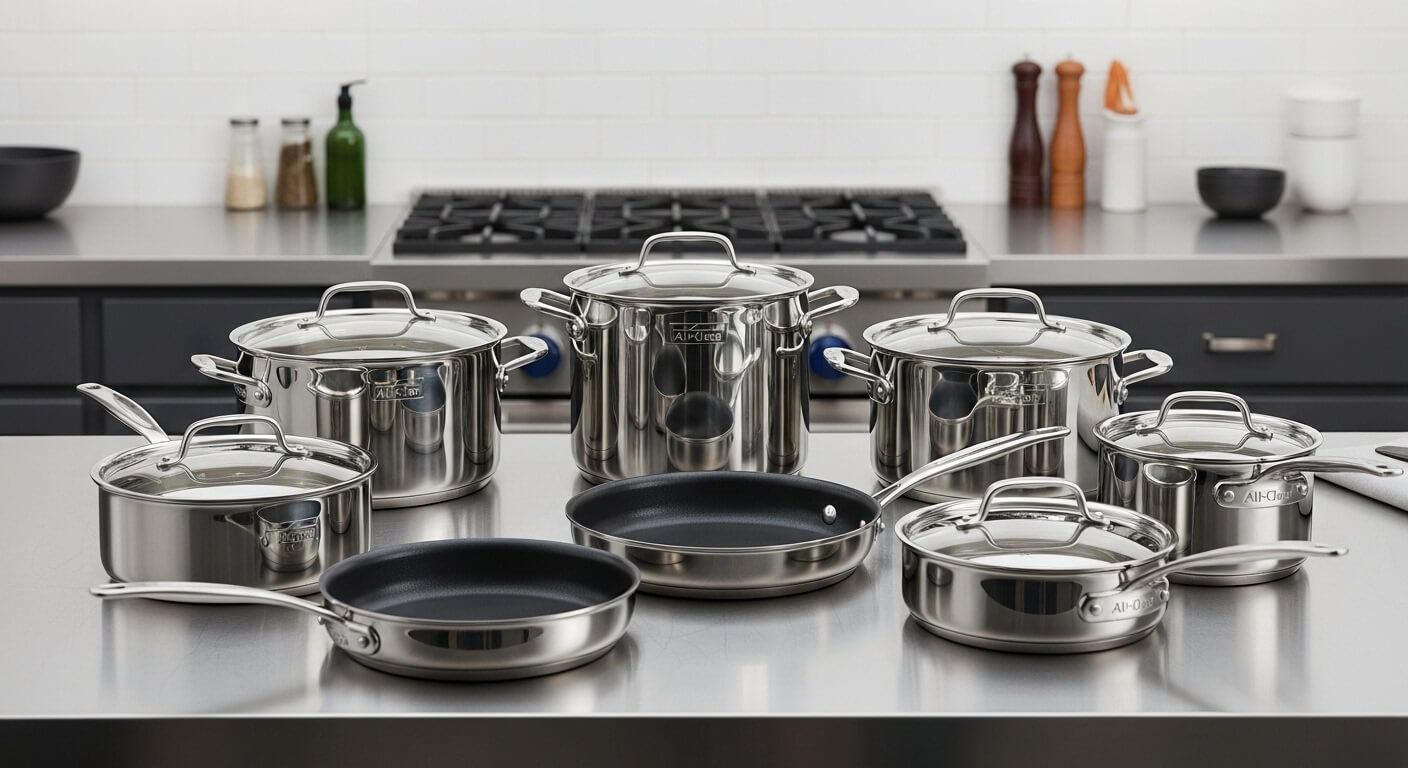
All-Clad cookware uses 18/10 stainless steel for the cooking surface — top-tier stuff, mirror-polished, the kind of finish that looks as good sitting on your stove as it performs while you’re cooking on it.
Materials and Build Quality
The aluminum core runs through the base and up the sidewalls (not just the bottom, which matters, because that’s where a lot of cheaper cookware cuts corners).
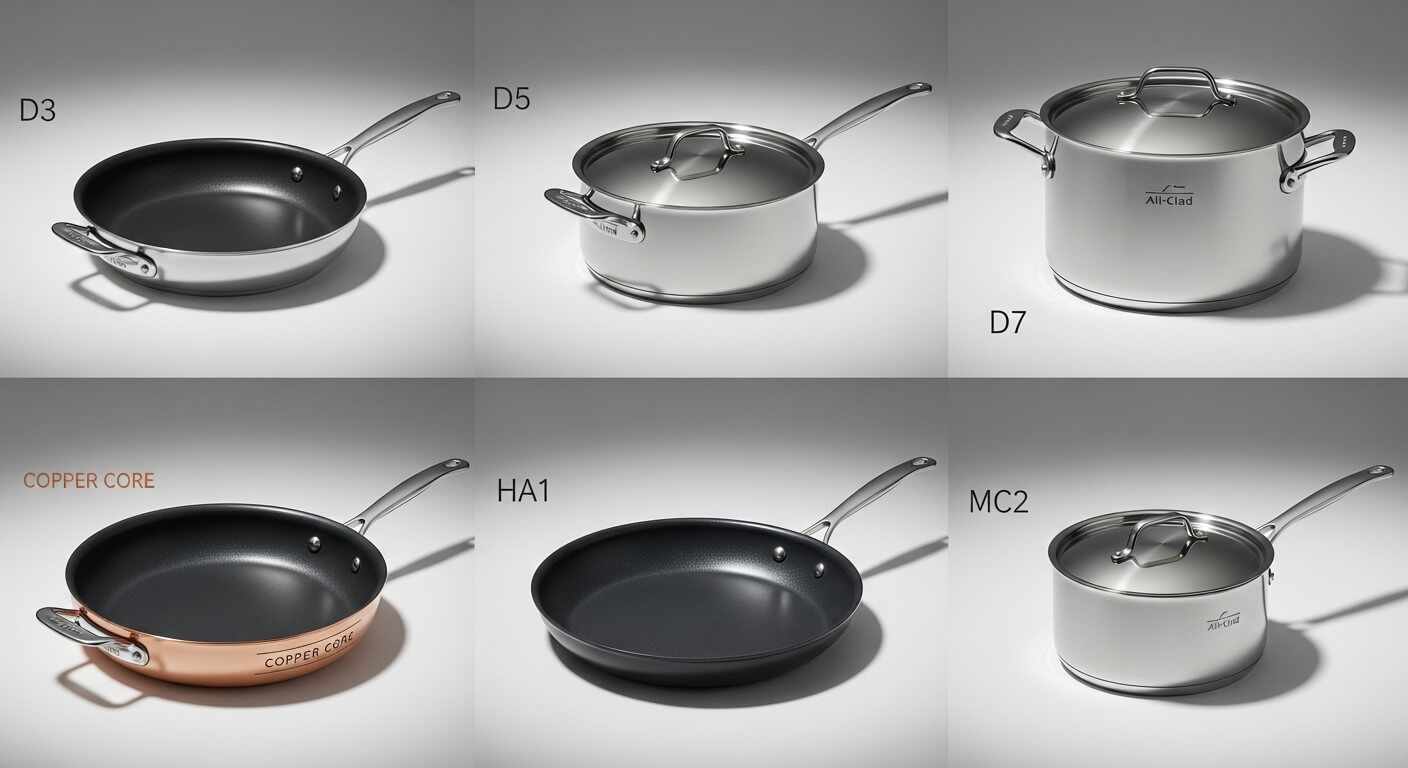
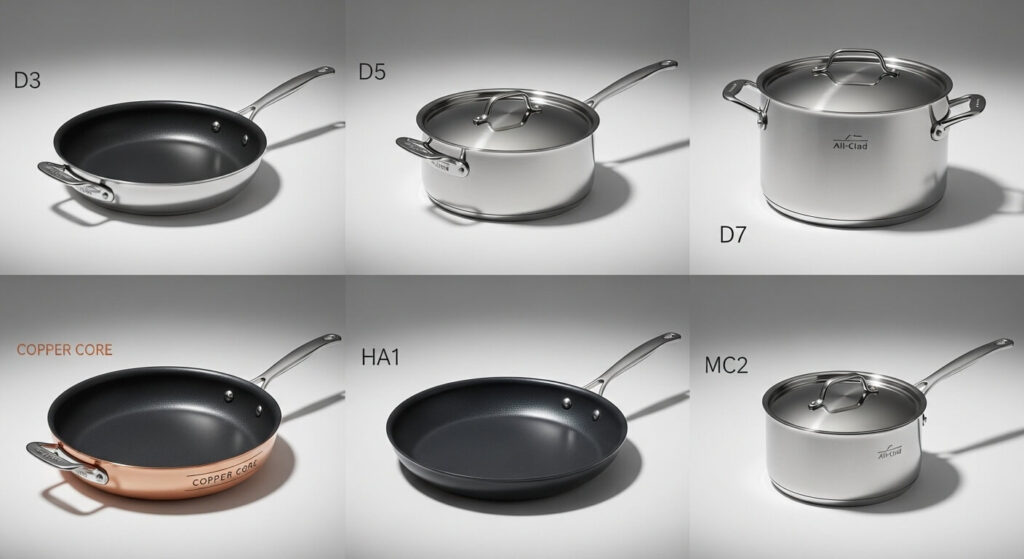
Quick correction on something you might’ve read elsewhere: not every All-Clad pan is bare stainless. All-Clad does make nonstick lines — HA1, Essentials Nonstick — that have an actual coating. But D3, D5, D7, and Copper Core? Bare stainless, no coating, none. If a product description tells you your D3 skillet has a “non-stick finish,” that’s just wrong. Worth knowing before you start scrubbing a perfectly good pan looking for a coating that was never there.
Heat Performance and Handle Design
Performance-wise, All-Clad is consistently excellent. Fast, even heating. Handles riveted on with corrosion-resistant stainless rivets, designed to stay reasonably cool (though “cool” is relative — you’ll still want a towel for anything that’s been on high heat a while). Oven and broiler safe up to 600°F across the major lines, which beats both competitors here by a real margin.
Price, obviously. And weight — All-Clad pans are heavier than most people expect, which some cooks love (feels substantial) and others find tiring after a long cooking session.
Cuisinart Cookware Set: Strengths and Weaknesses
Cuisinart’s flagship stainless line is the MultiClad Pro — tri-ply construction, aluminum core, brushed stainless exterior.
What’s Included in the Cuisinart MultiClad Pro Set
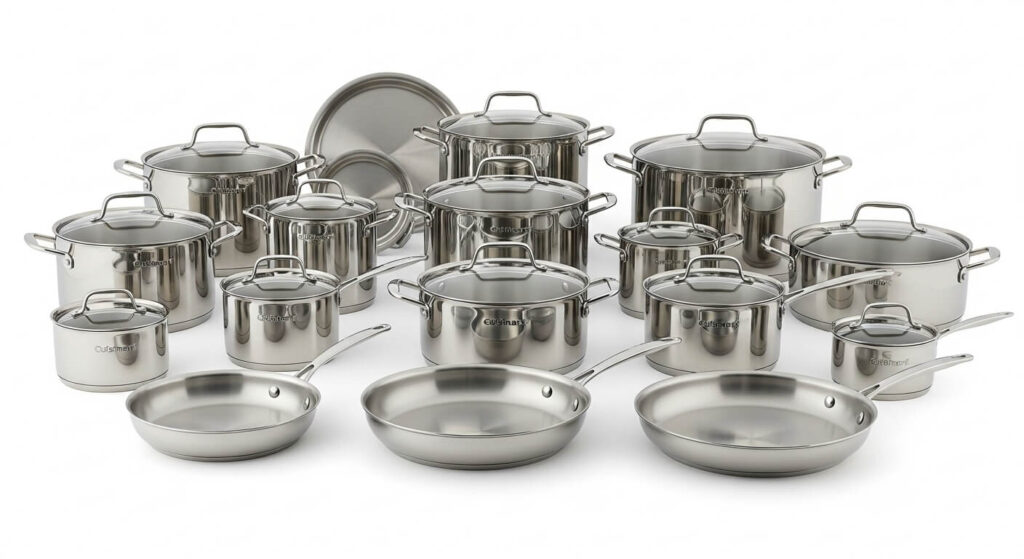
The 12-piece set typically includes a 1.5-quart and 3-quart saucepan, a 3.5-quart sauté pan, an 8-quart stockpot, 8-inch and 10-inch skillets, and a steamer insert. That’s a genuinely complete starter-to-intermediate lineup, and it runs a fraction of what a comparable All-Clad set costs.
Heat Distribution and Everyday Performance
Heat Surround technology (Cuisinart’s branding for even heat distribution up the sidewalls, not just the base) does a solid job avoiding hot spots. Cool Grip handles are riveted and stay reasonably comfortable. Oven safe to 500°F — lower ceiling than All-Clad, but plenty for most home cooking, including a quick broil finish on most dishes.
Long-Term Durability Concerns
Here’s where it gets honest, though. Long-term owner reports (and there are a lot of them — this set’s been around for over a decade) mention two recurring issues: bonded-base separation after years of heavy daily use, and dishwasher-related erosion at the rims, where the exposed aluminum core can wear down over repeated dishwasher cycles even though the set is technically labeled dishwasher safe. Cuisinart’s own guidance about avoiding lemon-based detergents is, frankly, a little vague and inconsistently communicated. Hand-washing avoids the issue entirely, for what it’s worth — same advice that applies to basically every brand on this list.
Is the set still worth it after all that? For the price, yes. Genuinely. You’re trading some long-term durability margin for a price that’s roughly a third of All-Clad’s, and for most home cooks, that trade makes sense.
Calphalon Cookware Set: Strengths and Weaknesses
Calphalon’s comparable line is Premier Stainless Steel, and here’s where things get a little murky — Calphalon sells both a 3-ply and a 5-ply version of Premier, and the specs genuinely differ between listings depending on which version (and sometimes even which retailer) you’re looking at.
Construction and Oven-Safe Ratings
The 3-ply Premier sets typically list oven-safe at 450°F. Some 5-ply Premier listings bump that to 500°F. Both use a heavy-gauge aluminum core, both claim even heat distribution via Calphalon’s “Turbo Temp” branding, and both carry a lifetime warranty.
What’s Included in the Calphalon Premier Set
The 13-piece set commonly includes a 10-inch and 12-inch fry pan, two saucepans, a 5-quart sauté pan, and an 8-quart multi-pot with a pasta insert and steamer insert — genuinely useful extras that neither of the other two brands’ standard sets include.
Build Quality and Common Complaints
Build quality gets generally good marks from owners, with the standard caveat that applies to every stainless set on this list: there’s a real learning curve before food stops sticking, and that’s not a manufacturing flaw, that’s just bare stainless steel doing what bare stainless steel does. A few owners report issues with the glass lid rings degrading over time, and a handful of damaged-in-shipping complaints, though that’s more a fulfillment issue than a cookware quality one.
Bottom line on Calphalon: solid mid-range performer, comparable to Cuisinart in most respects, with a slightly lower oven-safe ceiling being the most consistent drawback across listings.
All-Clad vs Cuisinart: Which Stainless Steel Cookware Set Wins
All-Clad wins on construction quality and heat performance, no real contest there. Heavier gauge steel, more consistent manufacturing, a higher oven-safe ceiling. If money’s not the deciding factor, All-Clad takes this one.
Performance and Price Tradeoffs
But Cuisinart wins on value, and it’s not particularly close. You’re getting roughly 70-80% of the performance for 30-40% of the price. For most home kitchens — not professional ones, not people running a restaurant out of their house — that ratio makes Cuisinart the smarter buy.
Who Should Choose Each Brand
Who should choose All-Clad over Cuisinart? Cooks who use their cookware daily, for years, and want the extra margin of durability and heat ceiling that comes with thicker metal. Who should choose Cuisinart instead? Almost everyone else, honestly. Including people who cook seriously but don’t need restaurant-grade gear to do it well.
All-Clad vs Calphalon: Which Stainless Steel Cookware Set Wins
Same basic shape as the Cuisinart comparison. All-Clad’s construction and oven-safe rating both come out ahead — 600°F vs. Calphalon’s 450-500°F range, and noticeably thicker stainless throughout.
Set Composition Advantage
Calphalon’s advantage is the set composition. That pasta insert and steamer insert combo in the 13-piece set gives you functionality All-Clad’s standard sets don’t bundle in, and the price gap here is even bigger than the Cuisinart comparison in some configurations.
Who Should Choose Each Brand
Who should choose All-Clad over Calphalon? Same answer as above — frequent cooks who want the performance ceiling. Who should choose Calphalon? Cooks who specifically want that broader piece variety (steamer, pasta insert) without paying All-Clad prices for it.
Cuisinart vs Calphalon: Which Mid-Range Cookware Set Wins
This one’s genuinely close. Both are tri-ply, aluminum core, lifetime warranty, similar price range.
Where Each Brand Pulls Ahead
Cuisinart edges ahead on oven-safe temperature (500°F standard vs. Calphalon’s more common 450°F rating). Calphalon edges ahead on set composition, with those extra inserts in its larger sets.
Honestly? Pick based on which set’s specific piece lineup matches what you actually cook, more than brand loyalty. They’re closer in real-world performance than either brand’s marketing wants you to believe.
Set Composition and Piece Options Across All Three Brands
All-Clad offers the widest individual-piece range of the three — frying pans from 7 inches up to 14, saucepans from 1 quart up to 4, plus sauté pans, stockpots, Dutch ovens, steamers, and casserole pans sold separately or in sets. That flexibility lets you build exactly the kitchen you need, piece by piece, if you’re not buying a full set at once.
Cuisinart and Calphalon both sell primarily as fixed sets, with somewhat less à la carte flexibility, though both offer individual replacement pieces if something breaks or you want to expand later.
All three brands offer lifetime warranties against manufacturing defects, so on paper, coverage looks identical. In practice, claims and real-world durability tell a slightly different story.
How Each Brand Holds Up Over Years of Use
All-Clad’s heavier construction generally means fewer warranty claims over the long haul — there’s just more material there to wear down before something fails. Cuisinart’s bonded-base separation issue, mentioned earlier, shows up often enough in long-term owner reviews to be worth flagging, especially after 8-10 years of frequent use. Calphalon sits somewhere in between, with occasional lid and rim-related complaints but generally solid base construction.
None of this means Cuisinart or Calphalon are bad buys. It means All-Clad’s extra cost buys real, measurable durability margin — and whether that margin matters to you depends on how hard you’re going to use this stuff.
Cleaning and Maintenance Differences
All three brands technically claim dishwasher-safe status. All three brands’ own communities and reviewers will tell you to hand-wash anyway, and for the same reasons every time: harsher detergents dull the finish, and in Cuisinart’s case specifically, repeated dishwasher cycles have been linked to actual erosion at the exposed aluminum rim edges.
The Cleaning Routine That Works Across All Three Brands
Mild soap, warm water, a non-abrasive sponge, dry immediately — that routine works across all three brands, regardless of price tier. If you’ve got an All-Clad set and want the complete cleaning breakdown (stuck-on food, discoloration, what to avoid entirely), we’ve got a full guide on how to clean the All-Clad pots and pans cookware set that walks through it step by step.
Who Should Buy All-Clad, Cuisinart, or Calphalon
Best Choice for Serious, Frequent Cooks
All-Clad makes sense for serious home cooks and anyone who treats their kitchen like a long-term investment. If you’re cooking daily, pushing high heat regularly, and want cookware that’ll genuinely outlast a decade of hard use without complaint — this is the buy.
Best Choice for Value-Conscious Buyers
Cuisinart is the value pick, plain and simple. Comparable performance to All-Clad for a fraction of the cost, with a few known long-term quirks that proper hand-washing mostly sidesteps. Great for home cooks who want real tri-ply performance without the premium price tag.
Best Choice for First-Time Set Buyers
Calphalon fits a similar budget tier to Cuisinart but edges in front for anyone who wants that broader set composition — the pasta insert and steamer insert combo in particular. Good pick if you’re building a first “real” cookware set and want a bit more versatility baked into the box.