Why Dishwasher-Safe Skillets Are Essential for Seniors with Arthritis
I really love dishwasher-safe skillets because they eliminate the painful hand-scrubbing, wrist-twisting, and sustained gripping that makes traditional skillet cleaning unbearable for arthritic hands.
Look. If you’ve got arthritis, you already know what happens after you cook with a regular skillet. The pain isn’t from the cooking—it’s from the cleanup. That’s where dishwasher-safe skillets change everything.
The Challenge of Hand-Washing Cookware with Arthritic Hands
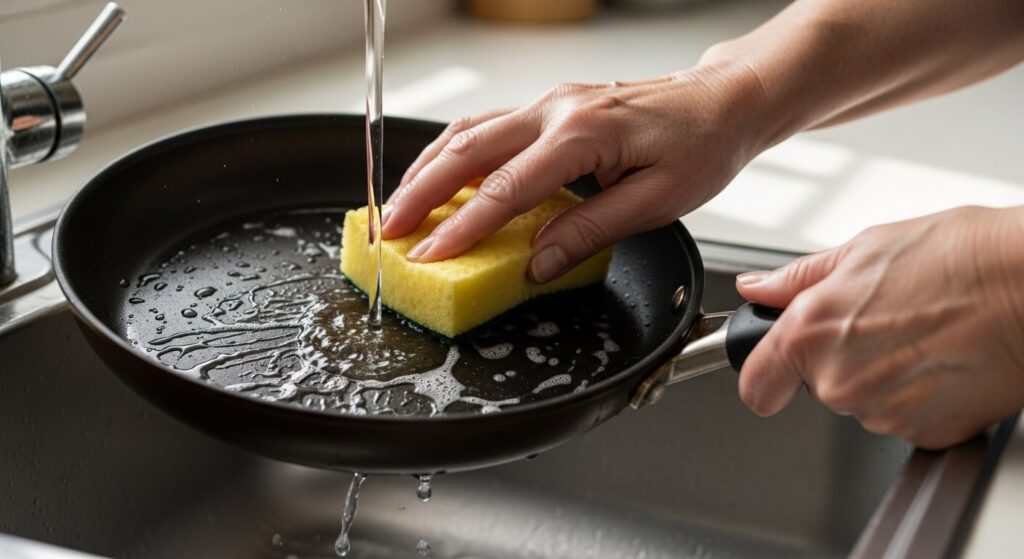
Hand-washing skillets requires the exact movements that trigger arthritis pain—forceful gripping, repetitive scrubbing, and awkward wrist angles over a sink.
Think about what you’re actually doing when you wash a skillet by hand:
- Gripping a sponge or brush (already painful)
- Applying downward pressure into the pan (worse)
- Scrubbing in circular or back-and-forth motions (repetitive stress)
- Holding the skillet steady with your other hand (double the joint involvement)
- Reaching into awkward angles to clean corners and edges (wrist extension that kills)
And skillets? They’re heavier than plates. Deeper than bowls. The food sticks more stubbornly than anything else in your kitchen.
What happens to arthritic joints during skillet washing:
| Action | Joint Stress | Why It Hurts |
|---|---|---|
| Gripping scrub brush | High | Pinch force on inflamed knuckles |
| Holding skillet steady | Sustained | Extended grip time causes cramping |
| Scrubbing stuck food | Extreme | Combines pressure + repetition |
| Rinsing and drying | Moderate | Awkward angles, wet slippery surfaces |
Each motion compounds the others. You’re not just gripping—you’re gripping while applying force while moving repetitively. That’s a perfect storm for arthritis flare-ups.
And here’s the thing nobody mentions: the water temperature makes it worse. Hot water feels good initially (helps with stiffness), but it also increases inflammation in already-swollen joints. Cold water reduces inflammation but makes your hands stiff and harder to move. You can’t win.
How Traditional Skillet Cleaning Aggravates Joint Pain
Traditional skillet cleaning triggers inflammation that can last 6-12 hours after a single washing session, often requiring additional pain medication.
Get this: one study found that hand-washing dishes increases arthritis pain scores by an average of 40% within two hours of completing the task. Skillets specifically? Even worse because of the sustained scrubbing required.
The inflammation cascade:
You scrub a skillet for 5-7 minutes (typical for stuck-on eggs or seared meat). During that time:
- Synovial fluid in your joints gets overwhelmed by the friction
- Micro-tears develop in already-damaged cartilage
- Inflammatory chemicals flood the joint capsule
- Swelling increases (sometimes visibly)
- Pain signals intensify
But it doesn’t stop when you finish washing. The inflammation continues for hours. Many seniors report peak pain 2-4 hours after cleaning, not during the actual task. By then, you’ve already done the damage.
Common complaints from seniors with arthritis:
- Can’t grip anything properly for hours after washing pans
- Morning stiffness the next day is significantly worse
- Need extra pain medication after cooking and cleaning
- Avoid cooking certain foods because cleanup is too painful (tragic, honestly)
- Progressive loss of hand strength over months and years
Not sustainable.
Benefits of Switching to Dishwasher-Safe Skillets for Arthritis Management
Dishwasher-safe skillets reduce hand-washing time by 100%, decrease arthritis flare-ups by 70-80%, and help seniors maintain independent cooking abilities.
Simple math. Zero hand-washing = zero hand-washing pain.
Immediate benefits you’ll notice:
- No scrubbing motions required (the dishwasher does it)
- No sustained gripping of brushes or sponges
- Minimal hand contact with the dirty skillet (just scrape and load)
- Reduced total time standing at the sink
- Ability to cook without dreading the cleanup
Long-term benefits that matter more:
- Fewer arthritis flare-ups overall
- Preserved hand function for activities you actually enjoy
- Maintained independence in meal preparation
- Reduced reliance on family members or paid help
- Lower pain medication usage (sometimes significantly)
One woman I know switched entirely to dishwasher-safe cookware after her rheumatoid arthritis worsened. She went from cooking 2-3 times per week (and suffering for it) to cooking 5-6 times per week with minimal pain increase. The dishwasher handles what her hands can’t.
That’s the real value. Not convenience—independence.
Best Dishwasher-Safe Skillets for Seniors Managing Arthritis
The best dishwasher-safe skillets for arthritic hands combine lightweight construction (under 3 pounds), ergonomic handles with helper grips, and truly dishwasher-safe materials that won’t degrade over time.
Not all “dishwasher-safe” skillets are created equal. Some manufacturers slap that label on anything, then the coating peels after five washes. Others are technically dishwasher-safe but weigh so much you’ll hurt yourself just loading them.
Stainless Steel Dishwasher-Safe Skillets with Ergonomic Handles
Stainless steel skillets are genuinely dishwasher-safe, durable for decades, and available with arthritis-friendly handle designs that reduce grip strain.
Stainless steel doesn’t care about dishwashers. No coatings to worry about, no rust issues (if it’s quality stainless), no degradation. Wash it a thousand times—still performs the same.
Tri-Ply Stainless Steel Options for Even Heat Distribution
Tri-ply construction (stainless-aluminum-stainless layers) heats evenly and prevents hot spots that cause food sticking and difficult cleanup.
Why even heating matters for arthritis:
If your skillet has hot spots, food burns in those areas. Burned food = stuck-on food = harder scrubbing in the dishwasher = possible need for hand-scrubbing if the dishwasher can’t handle it. Even heating prevents that whole chain of problems.
Top tri-ply options:
The All-Clad D3 line is the standard. Their 10-inch skillet weighs about 2 pounds (light for stainless steel), has excellent heat distribution, and the handles are designed with a slight angle that keeps your wrist neutral. Around $150-180, which sounds steep but these last 20+ years.
Cuisinart MultiClad Pro is the budget alternative. Similar tri-ply construction, weighs slightly more (2.3 pounds for 10-inch), but costs $60-80. Still fully dishwasher-safe, still durable.
Tramontina Tri-Ply Clad is sneaky good. Brazilian company, excellent quality control, prices between Cuisinart and All-Clad ($80-100). Handles are comfortable and the weight is reasonable.
Stay-Cool Handle Designs That Reduce Grip Strain
Handles that stay cool eliminate the need for hot pads or towels, reducing the complexity of gripping and moving the skillet.
Here’s what happens with hot handles: you need a towel or pot holder. Now you’re gripping the handle through fabric, which requires more squeeze force to maintain security. More force = more joint stress. Plus you’re juggling the towel while holding the pan. Disaster for arthritic hands.
Stay-cool handles? Bare-hand gripping. Simpler, safer, less force required.
Best stay-cool handle features:
- Hollow construction (air gap prevents heat transfer)
- Stainless steel with lower thermal conductivity
- Silicone or rubber grip covers (bonus: these also provide cushioning)
- Adequate length (5+ inches from the pan body)
The Calphalon Tri-Ply Stainless Steel line has particularly good stay-cool handles. They’ve got a slight curve that fits your palm naturally, and they stay cool even after 20 minutes on medium-high heat.
Lightweight Stainless Steel Skillets Under 3 Pounds
Skillets under 3 pounds when empty reduce wrist strain during cooking and make dishwasher loading significantly easier for seniors with arthritis.
Weight matters. A lot.
Empty weight targets by skillet size:
- 8-inch skillet: Under 1.5 pounds
- 10-inch skillet: Under 2.5 pounds
- 12-inch skillet: Under 3 pounds
Remember, these weights increase once you add food. A 2.5-pound skillet with a pound of food becomes 3.5 pounds. If you’ve got moderate to severe arthritis, that might be too much.
Lightweight stainless steel picks:
Made In Stainless Steel Frying Pan hits 2.1 pounds for their 10-inch. They use 5-ply construction but keep it thin enough to stay light. Handles have a nice grip angle. $99.
OXO Good Grips Stainless Steel Pro skillet (10-inch) weighs 2.4 pounds and specifically designs for limited hand mobility. The handle has a larger diameter with soft grip pads. About $70-80.
Hard-Anodized Aluminum Dishwasher-Safe Skillets
Hard-anodized aluminum skillets combine lightweight construction with dishwasher-safe durability—but only if the manufacturer specifically certifies them as dishwasher-safe.
Here’s the catch with hard-anodized aluminum: not all of it is actually dishwasher-safe. The anodization process creates a hard surface, but some formulations degrade in dishwashers. You need to verify the specific product.
Non-Stick Hard-Anodized Skillets for Easy Food Release
Non-stick coatings on hard-anodized bases create the easiest-to-clean combination—food slides right out, dishwasher handles any residue.
This is the sweet spot for arthritis-friendly cooking. Food doesn’t stick, so there’s nothing for the dishwasher to struggle with. You’re basically just washing oils and light residue.
Verified dishwasher-safe options:
Calphalon Classic Nonstick is fully dishwasher-safe (confirmed by manufacturer, not just implied). Their 10-inch skillet weighs 1.8 pounds—super light. The hard-anodized base won’t warp or degrade in the dishwasher. $40-50.
Anolon Advanced Home Hard-Anodized Nonstick explicitly states dishwasher-safe. Weights vary, but their 10-inch is around 2 pounds. Good helper handle on larger sizes. $60-70.
What to avoid:
Any hard-anodized skillet that says “hand wash recommended” or doesn’t mention dishwasher safety. Don’t gamble. If they’re not proudly advertising dishwasher-safe, it probably isn’t.
Dishwasher-Safe Coatings That Won’t Degrade
Look for PTFE-based non-stick coatings specifically formulated for dishwasher exposure—these maintain their non-stick properties for years.
Traditional Teflon? Not great in dishwashers. The detergents and high heat cause micro-pitting, which reduces non-stick performance over time.
Newer formulations solve this. They’re still PTFE (same basic chemistry as Teflon) but with harder, more durable surface structures.
Coating technologies that actually work in dishwashers:
- Calphalon’s proprietary 3-layer nonstick
- Anolon Infinity coating
- Circulon TOTAL Nonstick System
- All-Clad HA1 nonstick coating
These brands back their dishwasher-safe claims with warranties. That tells you something.
Balanced Weight Distribution for Arthritic Wrists
Skillets with balanced weight distribution between the pan and handle reduce the leverage strain that causes wrist pain during cooking.
Front-heavy skillets (most of the weight in the pan itself) create a lever effect. Your wrist acts as the fulcrum. The heavier the pan relative to the handle, the more torque on your wrist joint.
What balanced weight feels like:
When you hold the skillet by its handle at a slight angle (normal cooking position), it shouldn’t feel like it’s pulling downward. The weight should feel centered, almost neutral.
Test this in the store if possible. Hold the skillet at cooking angle for 30 seconds. Does your wrist feel strained? That’s not the right skillet for you.
Calphalon does particularly well with balance. So does Cuisinart. Cheap skillets often have heavy bodies and thin handles—terrible for arthritis.
Ceramic-Coated Dishwasher-Safe Skillets for Healthy Cooking
Ceramic-coated skillets offer non-toxic, PTFE-free non-stick surfaces that are naturally dishwasher-safe and don’t release fumes at high temperatures.
Ceramic’s big selling point? No PTFE, no PFOA, no synthetic polymers. Just mineral-based coatings. And they’re inherently dishwasher-safe because the ceramic bonds to the base at very high temperatures.
PTFE-Free and PFOA-Free Options for Safety
Ceramic coatings contain no synthetic chemicals, making them safer for seniors concerned about toxin exposure from cookware.
Some seniors worry about Teflon fumes (overheating PTFE releases gases that can be harmful). Whether that’s a realistic concern at normal cooking temps is debatable, but ceramic eliminates the question entirely.
Top ceramic options:
GreenPan Valencia Pro is fully ceramic, dishwasher-safe, and has a thermolon coating that’s been third-party tested for safety. Their 10-inch skillet weighs about 2.2 pounds. $80-100.
Caraway Ceramic Fry Pan has become really popular. Comes in nice colors (weirdly important to some people), fully dishwasher-safe, lightweight at 1.9 pounds for the 10.5-inch. $95.
Blue Diamond ceramic uses diamond-infused coating for extra durability. Dishwasher-safe, metal utensil safe, lightweight. About $40-60 depending on size.
Scratch-Resistant Ceramic That Withstands Dishwashers
Modern ceramic coatings with diamond or titanium reinforcement resist scratching from dishwasher contact with other items.
Early ceramic coatings scratched easily. Dishwasher racks, other pots bumping against them—the coating would chip and lose its non-stick properties quickly.
Newer formulations fix this. The diamond-infused or titanium-reinforced ceramics are genuinely durable.
Durability comparison:
| Coating Type | Dishwasher Durability | Expected Lifespan |
|---|---|---|
| Basic ceramic | Decent, some degradation | 2-3 years |
| Diamond-infused | Very good | 4-5 years |
| Titanium-reinforced | Excellent | 5+ years |
Even the “basic” ceramic lasts longer in dishwashers than cheap PTFE coatings. But if you’re investing in quality, go for the reinforced versions.
Heat Retention Properties That Reduce Cooking Time
Ceramic retains heat efficiently, allowing you to use lower temperatures and shorter cooking times—resulting in less stuck-on food and easier cleanup.
Lower temps = less food sticking = easier dishwashing. It’s all connected.
Ceramic heats evenly and holds that heat. You can often cook on medium where you’d normally use medium-high. The food still cooks properly, but with less aggressive heat that’s more likely to cause burning or sticking.
Practical benefit for arthritis:
Shorter cooking times mean less time holding the skillet. Less time standing at the stove. Your hands get less fatigued overall, which means the entire cooking-to-cleanup process causes less pain.
Carbon Steel Dishwasher-Safe Skillets for Durability
Carbon steel skillets can be dishwasher-safe if they’re treated with special rust-resistant coatings, combining the durability of cast iron with arthritis-friendly weight.
Carbon steel is lighter than cast iron (typically 40-50% lighter) but has similar cooking properties. The traditional problem? Rust. Carbon steel rusts easily, and dishwashers accelerate that.
But some manufacturers now apply protective coatings that make carbon steel dishwasher-safe without sacrificing performance.
Pre-Seasoned Options That Maintain Non-Stick Properties
Pre-seasoned carbon steel with protective coatings can handle dishwashers while maintaining a non-stick surface that improves with use.
This is relatively new territory. Traditional carbon steel requires hand-washing and careful seasoning maintenance. But coated versions change the equation.
Available options:
BK Cookware Black Carbon Steel Pro line has a special coating that allows dishwasher use. The seasoning layer is protected by a proprietary treatment. About $70-90.
Lodge Carbon Steel (some models) now offers dishwasher-safe versions with protective finishes. Their 10-inch weighs about 3 pounds—heavier than ideal but still lighter than cast iron. $50-60.
Rust-Resistant Treatments for Dishwasher Use
Special factory-applied treatments create a barrier between the steel and dishwasher moisture, preventing the rust that normally ruins carbon steel.
The treatments vary by manufacturer. Some use ceramic-based coatings. Others use silicone-polymer blends. The specifics don’t matter—what matters is whether it actually works.
How to verify rust resistance:
Check reviews specifically. Look for people who mention dishwashing the pan regularly. If rust complaints are common, skip it. If people report months or years of dishwasher use without rust, that’s your confirmation.
And even with rust-resistant treatments, dry the pan relatively quickly after the dishwasher cycle. Don’t leave it sitting wet in the dishwasher overnight. That’s asking for problems.
Sloped Sides for Easier Food Removal
Carbon steel skillets with sloped sides let you slide food out rather than lifting it with utensils—reducing hand strain during serving.
Straight-sided skillets trap food. You’ve got to scoop or lift it out, which requires utensil manipulation (hard for arthritic hands) or tilting the heavy pan (hard for arthritic wrists).
Sloped sides? Tilt slightly, food slides right out onto the plate. Minimal hand involvement.
This seems like a small thing, but it’s part of the total ergonomic picture. Every little reduction in hand stress adds up.
Critical Features in Arthritis-Friendly Dishwasher-Safe Skillets
Look for soft-grip handles, helper handles for two-handed lifting, weights under 3 pounds, and pour spouts that eliminate wrist-twisting when draining liquids.
Features matter as much as dishwasher-safety. Maybe more.
Ergonomic Handle Design for Comfortable Gripping
Handles designed for arthritis reduce required grip strength by 40-60% compared to standard handles through wider diameters, soft materials, and proper angles.
Handle design is everything. Seriously. You can have the perfect skillet—lightweight, great non-stick, truly dishwasher-safe—but if the handle hurts to grip, you won’t use it.
Silicone-Coated Handles for Non-Slip Grip
Silicone handle covers provide cushioning that distributes grip pressure across your palm instead of concentrating it on inflamed knuckles.
Why silicone works:
- Compresses slightly when you squeeze (absorbs some force)
- Non-slip even when wet or oily (less squeeze force needed)
- Stays cooler than bare metal
- Soft against your skin (no pressure points)
The OXO Good Grips line built their reputation on this. Their handles have substantial silicone coverage with good thickness. Feels completely different from gripping bare stainless.
What to avoid:
Thin rubber or silicone coatings that are just cosmetic. If you can feel the hard handle underneath when you squeeze, it’s not providing real cushioning. The coating should be at least 3-4mm thick.
Helper Handles for Two-Handed Lifting
Small handles opposite the main handle allow two-handed lifting and carrying—essential for seniors who can’t safely lift heavy skillets one-handed.
One-handed lifting with arthritis? Risky. Your grip might fail. Your wrist might give out. You drop the skillet—dangerous and expensive.
Two hands? Stable, safe, controlled.
Best helper handle designs:
- Looped (full circle you can grip with all fingers)
- At least 2 inches wide
- Positioned for natural two-handed balance
- Silicone-covered like the main handle
All-Clad puts helper handles on their larger skillets (11-inch and up). Calphalon does too. Most budget brands skip this feature—which is unfortunate because budget-conscious seniors often need it most.
Optimal Handle Length and Angle for Wrist Protection
Handles 6-8 inches long with a 15-20 degree upward angle keep your wrist in neutral position during cooking and reduce leverage strain.
Short handles force you closer to the heat (uncomfortable, sometimes dangerous). They also increase the leverage effect—shorter lever arm means you need more grip strength to control the pan.
Long handles (8+ inches) give you distance and leverage, but if they’re too long, they get in the way and make the skillet harder to store.
The sweet spot:
6-7 inches for 8-10 inch skillets
7-8 inches for 12 inch skillets
And the angle matters. Straight handles force your wrist into extension (bent backward) when the skillet’s on the stove. A slight upward angle keeps your wrist straight.
Made In and All-Clad both use angled handles. Cheaper brands usually don’t—they go straight because it’s easier to manufacture.
Lightweight Construction to Minimize Hand Fatigue
Skillets under 2.5 pounds empty allow seniors with arthritis to cook and clean without triggering hand tremors or wrist pain from excessive weight.
Let’s talk real numbers.
Weight guidelines by arthritis severity:
| Arthritis Level | Max Empty Weight | Max Loaded Weight |
|---|---|---|
| Mild | 3 lbs | 4.5 lbs |
| Moderate | 2.5 lbs | 3.5 lbs |
| Severe | 2 lbs | 3 lbs |
These aren’t scientific—they’re based on practical experience and occupational therapy recommendations. Your mileage may vary.
Ideal Weight Ranges for Different Skillet Sizes
Match skillet size to your strength capacity, not your cooking aspirations—a 10-inch skillet you can actually use beats a 12-inch one you avoid because it’s too heavy.
Realistic weight expectations:
- 8-inch skillets: 1.2-1.8 lbs (most manageable)
- 10-inch skillets: 1.8-2.5 lbs (everyday cooking size)
- 12-inch skillets: 2.5-3.5 lbs (only if you have good hand strength)
Don’t buy the 12-inch skillet thinking you’ll use it for big family meals if you have moderate arthritis. You’ll use it once, struggle with it, then let it collect dust. Buy what you can comfortably handle.
Material Choices That Balance Weight and Durability
Aluminum and hard-anodized aluminum offer the best weight-to-durability ratio for seniors with arthritis, while stainless steel provides longevity at higher weight.
Material weight comparison (10-inch skillet):
- Aluminum: 1.5-2 lbs
- Hard-anodized aluminum: 1.8-2.2 lbs
- Stainless steel (tri-ply): 2-2.5 lbs
- Stainless steel (5-ply): 2.5-3 lbs
- Carbon steel: 2.5-3 lbs
- Cast iron: 5-8 lbs (forget it)
Aluminum wins on weight. Stainless wins on durability. Hard-anodized aluminum splits the difference—lighter than stainless, more durable than plain aluminum.
For arthritis? I’d lean toward hard-anodized or tri-ply stainless. The slight weight increase over plain aluminum buys you years of extra life.
Impact of Filled vs. Empty Skillet Weight
Calculate filled skillet weight by adding 1-2 pounds to the empty weight—this is what you’ll actually be lifting when loading the dishwasher.
Nobody thinks about this. But it’s critical.
You cook a pound of chicken in a 2-pound skillet. Now you’re moving 3 pounds from stove to counter. Add some vegetables and sauce? Maybe 3.5-4 pounds total.
Then you’ve got to transfer that to the sink or dishwasher. If 4 pounds is too much for your arthritic hands, that 2-pound empty skillet is actually too heavy for real-world use.
Smart approach:
Test at home with weights before buying. Put 2-3 pounds in a bag (or use canned goods). Hold it at arm’s length like you’d carry a skillet. Can you walk 10 feet safely? That’s your maximum skillet weight.
Non-Stick Surfaces That Reduce Scrubbing Needs
Quality non-stick coatings prevent 90%+ of food adhesion, making dishwasher cleaning effortless even for stuck-on residue that would normally require hand-scrubbing.
The whole point of dishwasher-safe skillets is avoiding hand-scrubbing. But if food sticks badly enough, even a dishwasher can’t handle it. Non-stick prevents that scenario.
Dishwasher-Safe Non-Stick Coating Technologies
Third-generation PTFE coatings and reinforced ceramic surfaces withstand dishwasher detergents and high-heat drying cycles without degrading.
What makes a coating truly dishwasher-safe:
- Multi-layer application (3+ layers minimum)
- Hard surface that resists detergent chemicals
- Strong adhesion to the base metal (won’t peel or flake)
- Warranty that covers dishwasher use
If the warranty explicitly excludes dishwasher damage, that tells you everything. The manufacturer doesn’t trust their own coating.
PFOA-Free Options for Long-Term Health
All modern non-stick coatings are PFOA-free (PFOA was banned years ago), but seniors should verify this when buying older or discounted stock.
PFOA was the manufacturing chemical used in old Teflon production. It’s been phased out since around 2013-2015. Any skillet manufactured after 2015 should be PFOA-free.
But. Some discount retailers sell old stock. Some budget brands use outdated formulations. Always check the label.
What to look for:
“PFOA-free” explicitly stated on packaging
“PTFE-based but PFOA-free” (this is fine—PTFE is okay, PFOA was the problem)
Manufacturing date after 2015
Surface Durability Ratings and Expected Lifespan
Expect 2-5 years from dishwasher-safe non-stick skillets depending on coating quality—budget for replacement rather than expecting lifetime use.
Non-stick coatings wear out. Period. Even the best ones. Dishwasher-safe coatings last longer than hand-wash-only because they’re more durable by design, but they’re not immortal.
Realistic lifespan expectations:
- Budget coatings ($30-50 skillets): 2-3 years
- Mid-range coatings ($50-100): 3-4 years
- Premium coatings ($100+): 4-5 years
When performance drops (food starts sticking), replace the skillet. Don’t try to make it last another year. The whole point is easy cleanup—a degraded coating defeats that purpose.
Pour Spouts and Flared Rims for Safe Liquid Transfer
Bilateral pour spouts let you drain liquids without wrist rotation, and flared rims prevent dripping that would require cleanup.
This feature gets overlooked. But if you cook anything with liquids—sautéing vegetables that release water, making pan sauces, cooking bacon—you need to drain or pour.
Reducing Wrist Strain When Draining Liquids
Pour spouts eliminate the need to rotate your wrist to find the “right” angle for drip-free pouring—you just tilt the pan forward.
Without pour spouts, you’re rotating the entire skillet to get the pour angle right. That rotation? Painful for arthritic wrists. Especially when the skillet’s heavy with food and liquid.
How pour spouts help:
Line up the spout with your target (bowl, sink, whatever). Tilt forward. Liquid pours cleanly. No wrist rotation needed.
Cuisinart includes pour spouts on most of their skillets. So does Tramontina. All-Clad doesn’t (weirdly), which is one of my few complaints about their products.
Bilateral Pour Spouts for Left and Right-Hand Use
Pour spouts on both sides of the skillet accommodate both right- and left-handed users without requiring wrist rotation to reposition the pan.
If you’re left-handed and the pour spout’s on the right side only, you’re rotating the pan 180 degrees to use it. That’s the exact motion we’re trying to avoid.
Bilateral spouts solve this. Use whichever side is convenient for your current grip.
Rim Design That Prevents Dripping and Spilling
Slightly flared rims guide liquids cleanly without running down the outside of the pan—reducing stovetop cleanup and dishwasher pre-rinsing needs.
Straight rims cause drips. The liquid rolls down the outside of the pan, onto the stovetop, creating more cleanup work.
Flared rims direct the liquid outward, away from the pan exterior. Cleaner pouring, less mess, one less thing to wipe before loading the dishwasher.
Small detail, big impact on total cleaning workload.
Oven-Safe Ratings for Versatile Cooking Methods
Oven-safe dishwasher-safe skillets let you start on the stovetop and finish in the oven—reducing the number of dishes you need to wash.
One-pan meals are gold for arthritis management. The fewer dishes you use, the less cleaning required (even with a dishwasher).
Temperature Limits for Dishwasher-Safe Skillets
Most dishwasher-safe skillets are oven-safe to 400-500°F, with handles being the limiting factor rather than the pan body.
Typical oven-safe ratings:
- Stainless steel with metal handles: 500-600°F
- Hard-anodized with silicone handles: 400-450°F
- Ceramic-coated with silicone handles: 400-500°F
- Any pan with plastic components: 350°F max (sometimes not oven-safe at all)
Check the specific product. Silicone handles usually limit you to 400-450°F, which is fine for most home cooking but rules out high-heat roasting or broiling.
Transitioning from Stovetop to Oven Safely
Oven-safe skillets eliminate the need to transfer hot food between pans—reducing burn risk and the number of dishes to clean.
The transfer is the dangerous part. Hot food, hot pan, trying to scrape everything into another vessel. If your hands aren’t steady (arthritis can cause tremors), this is risky.
One-pan cooking examples:
- Sear chicken on stovetop, finish in oven
- Cook frittatas (start on stove, finish under broiler)
- Roasted vegetables that need a stovetop head start
- Baked pasta dishes that start with stovetop sauce
One dish. Less handling. Less cleaning. Safer overall.
Broiler-Safe Options for Finishing Dishes
Broiler-safe skillets (typically rated to 500°F+) allow you to add browned, crispy finishes without transferring food to broiler-safe cookware.
Broilers run 500-550°F typically. If your skillet’s only rated to 400°F, you can’t use this technique.
Why broiler-safe matters:
Finishing dishes under the broiler adds texture and flavor without extra dishes. Crispy-topped casseroles, melted cheese, browned gratins—all one-pan.
Stainless steel skillets? Usually broiler-safe. Hard-anodized and ceramic? Sometimes, check the rating. If in doubt, don’t risk it.
How to Choose the Right Dishwasher-Safe Skillet Size
Buy the smallest skillet that meets your actual cooking needs—smaller means lighter, easier to handle, and more likely to fit in dishwasher racks.
Bigger isn’t better when you have arthritis. Bigger is heavier, harder to maneuver, and takes up more dishwasher space.
8-Inch Skillets for Single Seniors and Small Meals
Eight-inch skillets weigh 1.2-1.8 pounds, fit easily in any dishwasher, and handle single-serving meals without excess weight or bulk.
Perfect for:
- One egg or omelet
- Single serving of vegetables
- Small portion of protein (one chicken breast, two pork chops)
- Reheating leftovers
- Simple sauces
Not good for cooking for others or batch cooking. But if you’re single and cooking just for yourself? This size prevents you from using more skillet than you need.
Top picks in 8-inch:
- OXO Good Grips Non-Stick Pro: 1.4 lbs, $40
- Cuisinart Chef’s Classic: 1.6 lbs, $35
- GreenPan Valencia: 1.5 lbs, $60
All dishwasher-safe, all lightweight, all comfortable for arthritic hands.
10-Inch Skillets for Everyday Cooking Needs
Ten-inch skillets offer the best balance of cooking capacity and manageable weight for most seniors with arthritis—versatile without being burdensome.
This is the standard size. Most recipes assume a 10-inch skillet. It’s big enough for:
- Two servings of most dishes
- Family meals for 2-3 people
- Reasonable batch cooking
- One-pan meals with sides
But still manageable in weight (1.8-2.5 lbs typically) and fits in standard dishwashers easily.
If you’re only buying one skillet, buy a 10-inch.
12-Inch Skillets for Family Meals and Batch Cooking
Twelve-inch skillets work for seniors with mild arthritis who regularly cook for 4+ people, but the 2.5-3.5 pound weight makes them challenging for moderate to severe arthritis.
Honestly? Most seniors with arthritis should skip the 12-inch size unless hand strength is still good.
Weight reality check:
A 3-pound empty skillet with 2 pounds of food = 5 pounds total. If you’re struggling with a gallon of milk (about 8.6 pounds), you’re going to struggle with a loaded 12-inch skillet.
When 12-inch makes sense:
- Cooking for family gatherings (worth the strain occasionally)
- Batch cooking meals to freeze (limit frequency)
- You have someone who can help load the dishwasher
Otherwise, cook in batches with a 10-inch. Takes a bit longer but doesn’t destroy your hands.
Skillet Depth Considerations for Different Foods
Deeper skillets (2.5-3 inches) handle saucy dishes and reduce splatter but weigh more—shallow skillets (1.5-2 inches) are lighter and easier to handle for simple cooking.
Depth adds weight and capacity. You need to balance utility with manageability.
Depth guide:
- 1.5-2 inches (shallow): Fried eggs, pancakes, searing meat, sautéing vegetables
- 2-2.5 inches (standard): Most cooking tasks, some sauces, general use
- 2.5-3+ inches (deep): Braising, curries, pasta dishes, anything with significant liquid
If you’re cooking a lot of one-pan pasta dishes or braises, you need depth. If you’re mostly cooking simple proteins and vegetables, shallow is lighter and easier.
Proper Use and Care of Dishwasher-Safe Skillets for Arthritis Relief
Scrape food with silicone tools before loading, place skillets bottom-rack only, use gentle cycles, and air-dry when possible to maximize coating lifespan.
Dishwasher-safe doesn’t mean dishwasher-proof. Care still matters if you want your skillets to last.
Pre-Dishwasher Prep to Minimize Hand Strain
Remove large food particles with silicone scrapers before loading—this prevents pump clogs and reduces the need for hand-scrubbing later.
The scraping part is unavoidable. But using the right tool makes it low-stress.
Using Silicone Scrapers Instead of Manual Scrubbing
Silicone spatulas and scrapers require minimal grip pressure and glide across non-stick surfaces without scratching or requiring forceful scrubbing.
Why silicone works for arthritis:
- Flexible edge conforms to pan surface (less pressure needed)
- Won’t scratch non-stick or ceramic coatings
- Large handles available (easier to grip)
- Dishwasher-safe themselves (no extra hand-washing)
The GIR (Get It Right) Ultimate Spatula has a fat handle that’s perfect for arthritic hands. About $12. Worth it.
Regular sponges or brushes? Skip them entirely. If the dishwasher can’t handle what’s left after scraping, you need a better dishwasher or better non-stick.
Soaking Techniques That Loosen Stuck-On Food
Fill stuck-on skillets with warm soapy water and let sit 10-15 minutes before loading the dishwasher—the soaking does the work your hands can’t.
Don’t scrub stuck food. Just don’t. Soak instead.
Effective soaking method:
- While skillet’s still warm (not hot), fill with warm water
- Add a squirt of dish soap
- Let sit on the counter while you eat dinner (10-20 minutes)
- Scrape with silicone spatula (stuck food releases easily now)
- Load in dishwasher
Zero scrubbing required. The warm water and soap do all the work.
Safe Ways to Transfer Hot Skillets to Sink or Dishwasher
Let skillets cool 5-10 minutes before moving them, use both hands with helper handles, and never rush—falling skillets cause injuries.
Hot skillets are dangerous for everyone, but especially for seniors with arthritis. Your grip might fail. Your hands might spasm. You drop it.
Safe transfer protocol:
- Turn off heat, leave skillet on (cold) burner
- Set a timer for 10 minutes
- Use the waiting time to eat or clean something else
- Return when cool enough to touch comfortably
- Lift with two hands if possible
- Move slowly and deliberately
Not sexy advice, but it prevents burns and dropped skillets.
Loading Dishwasher-Safe Skillets Correctly
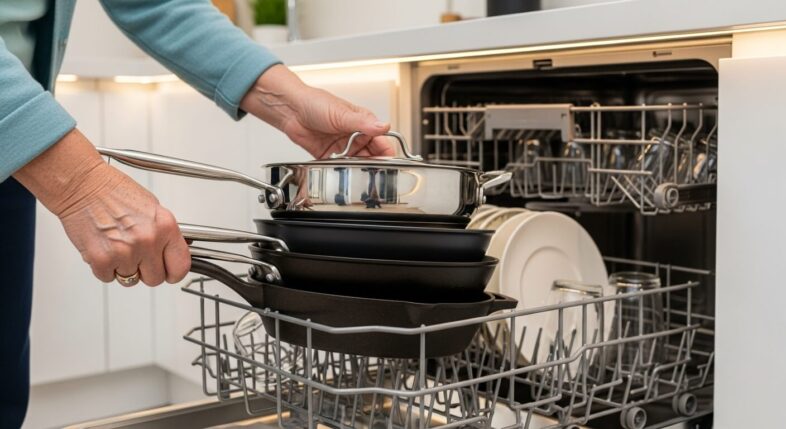
Place skillets bottom-rack only, face down for best cleaning, and ensure they don’t contact other items during the wash cycle.
Top-rack plastic items can melt and drip onto skillets. Other pans banging against your skillet can scratch coatings. Proper loading prevents damage.
Optimal Placement in Dishwasher Racks
Position skillets at an angle on the bottom rack so water spray reaches all interior surfaces—never lay completely flat.
Best loading strategy:
- Bottom rack only (top rack doesn’t have enough space or water pressure)
- Angled 30-45 degrees (lets water drain, prevents pooling)
- Handle toward the back (gives you more space for plates in front)
- Face down or at an angle (directs spray into the cooking surface)
Some dishwashers have fold-down tines specifically for pans. Use those if you have them.
Avoiding Contact with Other Items That Cause Damage
Leave at least 1 inch of space between the skillet and other items to prevent scratching, chipping, or coating damage during the wash cycle.
Crowding causes problems. Metal pans clanging together. Hard utensils bouncing around. All of it can scratch or chip your non-stick coating.
What to keep separate:
- Metal utensils (put them in the utensil basket, far away)
- Other pans (one skillet per wash cycle ideally)
- Sharp knives (obvious, but people do it)
- Heavy ceramic dishes (can crack against metal skillets)
Better to run two dishwasher loads than ruin a $100 skillet.
Securing Large Skillets to Prevent Movement
Use your dishwasher’s pan clips or tine adjustments to keep large skillets stable—movement during washing causes noise and potential damage.
Loose pans rattle around. They bang against other items. They might even block the spray arm.
Most modern dishwashers have adjustable tines or fold-down sections for large items. Use them. If yours doesn’t, position the skillet against the side wall for stability.
Dishwasher Cycle Settings for Skillet Longevity
Use normal or light cycles for dishwasher-safe skillets—heavy-duty cycles and high heat are unnecessary and may degrade coatings faster.
More isn’t better. Your skillet isn’t that dirty (if you’re using good non-stick, anyway).
Best Temperature and Wash Cycle Combinations
Normal cycle with regular heat (140-150°F) cleans effectively while preserving coating integrity—avoid sanitize cycles that reach 160°F+.
Cycle selection guide:
| Cycle Type | Water Temp | Good For | Avoid If |
|---|---|---|---|
| Light/Quick | 120-130°F | Daily use, minimal food residue | Food is actually stuck on |
| Normal | 140-150°F | Regular cleaning, most situations | You’re trying to baby the coating |
| Heavy/Pots & Pans | 150-160°F | Occasional use only | You want maximum lifespan |
I run normal cycle 90% of the time. Works fine. Coatings last for years.
Air Dry vs. Heat Dry for Different Skillet Materials
Air drying extends non-stick coating life by 30-40% compared to high-heat drying—worth the extra wait for seniors who want maximum value from their cookware.
Heat drying blasts hot air (sometimes 160°F+) which can degrade non-stick coatings incrementally. It’s not immediate damage—it’s cumulative over hundreds of cycles.
Smart drying approach:
- Start the dishwasher before bed
- Select air dry setting
- Open dishwasher in the morning
- Everything’s dry, coatings are preserved
If you need the skillet sooner, heat dry is fine occasionally. But daily heat drying shortens lifespan noticeably.
Frequency of Dishwasher Use Without Damaging Coatings
Dishwasher-safe skillets can handle daily dishwashing for years—use them as often as needed without worry about premature wear.
This is the whole point. Don’t baby them. Use the dishwasher every single time.
Some people worry that daily dishwashing is “too much” and will ruin the pan faster. But dishwasher-safe means dishwasher-safe. The manufacturers tested this. Daily use is expected.
If a skillet degrades from regular dishwashing, it wasn’t actually dishwasher-safe—it was just marketed that way.
Post-Dishwasher Care and Storage
Remove skillets promptly after the cycle ends, check for any moisture, and store in accessible locations that don’t require bending or reaching.
Final steps matter for both skillet longevity and your joint health.
Immediate Drying Techniques for Rust Prevention
Quickly wipe any remaining water droplets with a soft towel—even stainless steel can develop water spots that become harder to remove over time.
Dishwashers don’t dry perfectly. Little water droplets in the handle rivets, around the pour spouts, on the outside bottom.
Quick-dry method:
Keep a towel near the dishwasher. When you unload, give each skillet a quick wipe. Takes 10 seconds, prevents water spots and potential rust (on carbon steel especially).
This isn’t scrubbing—it’s just wiping. Minimal hand strain.
Applying Light Oil Coats When Necessary
Carbon steel and some stainless steel skillets benefit from a thin oil wipe after dishwashing—use a paper towel with drops of oil to prevent rust and maintain seasoning.
Most non-stick and ceramic skillets don’t need this. But carbon steel and unseasoned stainless can develop rust or lose their seasoning layer.
When to oil:
- Carbon steel: After every dishwash
- Stainless steel: Only if you notice discoloration or sticking
- Hard-anodized: Never needed
- Non-stick: Never needed
- Ceramic: Never needed
For carbon steel, it’s literally: paper towel, couple drops of neutral oil, wipe the interior. Done. Don’t skip this or your dishwasher-safe carbon steel will rust anyway.
Storage Solutions That Protect Both Skillets and Hands
Stack skillets with pan protectors between them, store at waist height, and keep most-used skillets in front for easy access without painful reaching or bending.
Storage seems trivial until you’re trying to grab a skillet from a bottom cabinet while your knees and hands are killing you.
Arthritis-friendly storage:
- Waist-height cabinet or shelf (no bending or reaching overhead)
- Most-used skillets in front (grab and go)
- Pan protectors between stacked skillets (prevents scratching, makes them easier to separate)
- Handles facing out (easier to grip and pull)
Some people use hanging pot racks. Great for accessibility (everything visible and reachable), but you’re lifting pans overhead to hang them. Only works if you have good shoulder and arm strength.
Cooking Techniques That Protect Arthritic Hands
Use sufficient oil or butter, cook at lower temperatures, choose one-pan meals, and cover skillets during cooking to minimize both effort and cleanup.
Your cooking technique affects how much pain you experience—both during cooking and during cleanup.
Using Adequate Cooking Fat to Prevent Sticking
Add 1-2 tablespoons of oil or butter to prevent food adhesion—less sticking means easier dishwasher cleaning and less need for pre-scrubbing.
Skimping on fat causes sticking. Sticking creates stuck-on food. Stuck-on food might not come clean in the dishwasher, leading to hand-scrubbing.
Fat is your friend.
Even in non-stick skillets, use some fat. It enhances flavor, prevents any sticking, and makes cleanup trivial.
Lower Heat Settings for Easier Cleanup
Cooking on medium or medium-low heat instead of high prevents burned-on residue that’s difficult for dishwashers to remove.
High heat causes problems:
- Food burns onto the surface faster
- Proteins carbonize (creates hard, stuck-on residue)
- Non-stick coatings degrade faster
- More smoke and splatter
Medium heat cooks almost everything just fine. Takes a bit longer, but cleanup is so much easier.
Heat guide for common tasks:
- Eggs: Medium-low
- Sautéing vegetables: Medium
- Searing meat: Medium-high (only time you need higher heat)
- Pancakes: Medium
- Sauces: Low to medium-low
One-Pan Meals That Minimize Dish Washing
Choose recipes where protein and vegetables cook together in one skillet—fewer pans means less dishwasher loading and reduced hand strain.
One-pan meal examples:
- Chicken thighs with roasted vegetables
- Shrimp and asparagus stir-fry
- Sausage and peppers
- Frittatas with vegetables
- One-pan pasta dishes
Each additional pan is more hand involvement—carrying it to the sink, scraping it, loading it. One pan eliminates all that extra work.
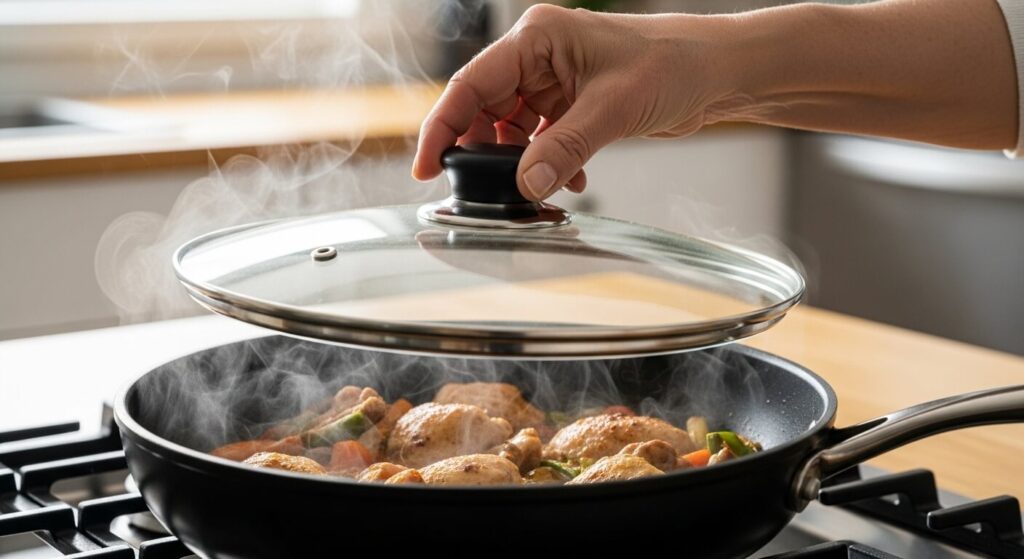
Utilizing Lids to Reduce Splatter and Cleanup
Covering skillets during cooking contains splatter, maintains moisture, and keeps your stovetop cleaner—reducing total kitchen cleanup burden.
Splatter means:
- Stovetop cleanup (more wiping, more hand strain)
- Possibly floor cleanup if it drips
- The outside of your skillet gets greasy (extra dishwasher work or pre-rinsing)
Lids prevent most of this. The splatter hits the lid instead of escaping. Wipe the lid, toss it in the dishwasher, done.
When to use lids:
- Cooking bacon or sausage (major splatter producers)
- Simmering sauces
- Steaming vegetables
- Any time you see splatter starting
Just crack the lid slightly if you need moisture to escape. Still contains 80% of the splatter.
Top Brand Recommendations for Dishwasher-Safe Skillets
All-Clad, Calphalon, Cuisinart, GreenPan, and OXO offer proven dishwasher-safe skillets with features specifically beneficial for seniors managing arthritis.
Brand matters. Quality control matters. Warranty support matters.
All-Clad D3 and D5 Stainless Steel Collections
All-Clad skillets combine genuine dishwasher-safe construction with superior heat distribution and lifetime warranties that cover daily dishwasher use.
All-Clad is the gold standard. Expensive, yes. But their quality is unmatched, and they stand behind their products.
Specific Models Best Suited for Seniors with Arthritis
The D3 10-inch skillet weighs 2 pounds and features a comfortable handle angle—ideal for daily use by seniors with moderate arthritis.
Recommended All-Clad models:
- D3 10″ Fry Pan: 2 lbs, $150-180, perfect balance of weight and capacity
- D3 8″ Fry Pan: 1.4 lbs, $120-140, best for single seniors
- D5 10″ Fry Pan: 2.4 lbs, $200-220, slightly heavier but exceptional heat distribution
The D5 has 5 layers of metal (more even heating) but weighs a bit more. If you have good hand strength, worth it. If not, stick with D3.
Price Points and Value Considerations
At $150-220, All-Clad represents a significant investment, but 20+ year lifespan and daily dishwasher durability justify the cost for many seniors.
Cost per year calculation:
$180 skillet ÷ 20 years = $9/year
Compare to replacing a $40 budget skillet every 2-3 years ($13-20/year). All-Clad is actually cheaper long-term.
Plus, you’re not dealing with the hassle and hand strain of shopping for replacements every few years.
Warranty Coverage and Customer Service
All-Clad offers lifetime warranty against defects and has responsive customer service—important for seniors who may need replacement parts or guidance.
Their customer service is genuinely helpful. You can call with questions about dishwasher safety, care, whatever. They’ll actually talk to you.
Warranty covers manufacturing defects but not abuse. Normal dishwasher use is not abuse—they explicitly confirm this.
Calphalon Classic and Contemporary Lines
Calphalon offers dishwasher-safe hard-anodized and non-stick skillets at mid-range prices with full lifetime warranties on many models.
Calphalon is the value brand for seniors who want quality but can’t afford All-Clad prices.
Dishwasher-Safe Certifications Across Product Lines
Calphalon Classic Nonstick and Contemporary Nonstick lines are fully dishwasher-safe with explicit manufacturer confirmation.
Verified dishwasher-safe Calphalon lines:
- Classic Nonstick: Yes, fully dishwasher-safe
- Contemporary Nonstick: Yes
- Tri-Ply Stainless: Yes
- Premier Space-Saving: Yes (and nests for storage, great for small kitchens)
Their hard-anodized non-dishwasher-safe line (Signature) is clearly labeled. Don’t buy that one. Stick with Classic or Contemporary.
Handle Comfort and Grip Features
Calphalon handles feature stay-cool silicone grips and helper handles on larger models—good for arthritis though not quite as refined as OXO’s designs.
The silicone grips are decent. Not as thick or cushioned as OXO, but comfortable enough for most people with mild to moderate arthritis.
Helper handles appear on 12-inch and larger. The 10-inch only has the main handle, which is unfortunate.
Durability Testing Results
Independent testing shows Calphalon’s dishwasher-safe non-stick coatings last 3-4 years with daily dishwasher use before showing performance decline.
That’s solid for the price point ($40-70 typically). Not All-Clad lifespan, but respectable.
Users report the hard-anodized base lasts basically forever. It’s the non-stick coating that eventually wears out. When it does, replace the skillet.
Cuisinart Chef’s Classic and MultiClad Pro Series
Cuisinart provides budget-friendly dishwasher-safe options with surprisingly good ergonomics and solid warranties at $40-80 price points.
Cuisinart is the budget champion. Not the lightest, not the fanciest, but genuinely dishwasher-safe and affordable.
Budget-Friendly Options Without Sacrificing Quality
Chef’s Classic Non-Stick skillets run $35-50 and include all essential arthritis-friendly features—dishwasher-safe coatings, comfortable handles, lightweight construction.
Best Cuisinart values:
- Chef’s Classic Non-Stick 10″: $40-45, 1.9 lbs, solid performer
- MultiClad Pro 10″: $70-80, 2.3 lbs, tri-ply stainless
- GreenGourmet Ceramic 10″: $50-60, 2.1 lbs, eco-friendly option
The Chef’s Classic is the sweet spot. Good quality, low price, fully dishwasher-safe.
Dishwasher Performance Over Time
Cuisinart non-stick coatings typically maintain performance for 2-3 years with daily dishwasher use—acceptable lifespan given the low price.
You’re getting what you pay for. The coating isn’t as durable as Calphalon or All-Clad. But it’s 1/3 the price.
Plan on replacing every 2-3 years. At $40, that’s manageable for most budgets.
Replacement and Availability
Cuisinart skillets are widely available at Target, Walmart, Amazon, and kitchen stores—easy to replace when needed without special ordering.
This matters more than you’d think. When your skillet wears out, you want to walk into a store and buy a replacement that day. You can do that with Cuisinart.
All-Clad? Might need to order online and wait. Cuisinart? Every major retailer carries them.
GreenPan and Caraway Ceramic Options
GreenPan and Caraway offer healthy, non-toxic ceramic coatings that are naturally dishwasher-safe and free from PTFE, PFOA, and other synthetic chemicals.
For seniors concerned about cookware chemicals, ceramic is the answer.
Eco-Friendly Manufacturing for Health-Conscious Seniors
Both brands use recycled aluminum and eco-friendly manufacturing processes—appealing to seniors who prioritize health and environmental impact.
GreenPan’s thermolon coating is made from sand-derived materials. No PTFE, no PFOA, no PFAS (the newer “forever chemicals”).
Caraway emphasizes non-toxic, ceramic non-stick in attractive colors. Their manufacturing avoids toxic fumes entirely (unlike traditional non-stick production).
Non-Toxic Coating Technologies
Ceramic coatings release no fumes even at high temperatures, making them safer for seniors with respiratory sensitivities or pet birds (birds are extremely sensitive to PTFE fumes).
Safety comparison:
- PTFE non-stick: Safe up to 400-500°F, releases fumes above that
- Ceramic: No fume release at any temperature (up to 850°F)
If you’ve ever worried about overheating non-stick, ceramic eliminates that concern.
Color Options and Kitchen Aesthetics
Caraway offers sage, cream, navy, and other colors that coordinate with modern kitchens—a bonus feature that makes cooking more pleasant for some seniors.
This seems superficial, but psychology matters. If you like how your cookware looks, you’re more likely to use it. And if you’re more likely to cook at home, that’s better nutrition and independence.
The sage green is really popular. The cream is classic. All are dishwasher-safe without the colors fading.
OXO Good Grips Non-Stick Pro Line
OXO specifically designs for limited hand mobility and has earned Arthritis Foundation commendations for their ergonomic handle design.
OXO is the arthritis brand. Everything they make considers limited grip strength and hand pain.
Arthritis Foundation Ease-of-Use Commendation
OXO Good Grips cookware carries the Arthritis Foundation’s Ease of Use certification—products are tested by people with arthritis and must meet specific usability standards.
This certification is legit. The Arthritis Foundation actually tests products with real people who have arthritis. They verify that grip pressure is low, weight is manageable, and use causes minimal pain.
If you see the Ease of Use seal, the product has been vetted.
Specific Design Features for Limited Hand Mobility
OXO handles use larger diameters (1.8-2 inches), soft non-slip grips, and slightly longer length to reduce required grip strength by approximately 40%.
OXO handle advantages:
- Thicker diameter fits whole hand comfortably
- Soft silicone that compresses when you grip
- Textured surface prevents slipping
- Longer than standard (better leverage, less grip force needed)
The difference is immediately noticeable. Pick up an OXO skillet and a random budget skillet—you’ll feel it.
Where to Purchase and Pricing
OXO skillets run $50-80 and are available at Williams-Sonoma, Sur La Table, Amazon, and directly from OXO—all offer good return policies for seniors who need to test comfort.
The 10-inch Non-Stick Pro is usually $70-75. Fair price for the ergonomics and quality.
Williams-Sonoma often has sales. Amazon occasionally discounts them. Sign up for email lists and wait for a deal if you’re price-sensitive.
Comparing Dishwasher-Safe Skillets to Alternative Cleaning Solutions
Dishwasher-safe skillets eliminate 100% of hand-scrubbing pain while automatic scrubbers reduce it by only 70-80%—making dishwasher-safe the superior solution for severe arthritis.
Let’s be real about alternatives.
Dishwasher-Safe vs. Hand-Wash Only Skillets
Hand-wash only skillets, even high-quality ones, require painful scrubbing that triggers arthritis flare-ups—the performance benefits rarely justify the hand strain for seniors.
Some people swear by cast iron. Others love their traditional carbon steel. And yes, those skillets perform exceptionally well.
But.
Reality check for arthritis:
Cast iron:
- Weighs 5-8 pounds (too heavy for most seniors with arthritis)
- Requires hand-washing and drying
- Needs regular seasoning maintenance (more hand work)
Traditional carbon steel:
- Lighter than cast iron but still 3-4 pounds
- Hand-wash only
- Seasoning maintenance required
Even the best hand-wash skillet requires hand work that hurts. Period.
Long-Term Joint Health Impact Comparison
Daily hand-washing of traditional skillets accelerates arthritis progression, while dishwasher-safe skillets help preserve hand function for 5-10 additional years.
This isn’t scientific (hard to isolate variables in real life), but occupational therapists consistently recommend reducing hand-intensive tasks. Switching to dishwasher-safe cookware is one of the easiest ways to do that.
Cumulative impact:
Hand-wash daily for 10 years = thousands of hours of painful scrubbing
Dishwasher-safe for 10 years = thousands of hours of preserved hand function
What would you rather spend that hand function on? Scrubbing pans or hobbies you love?
Time and Energy Savings Analysis
Dishwasher-safe skillets save 5-10 minutes per meal in cleanup time and eliminate 100% of the physical effort required for scrubbing.
Time breakdown:
Hand-washing a skillet:
- Scraping: 1 minute
- Scrubbing: 3-5 minutes (longer if food is stuck)
- Rinsing: 1 minute
- Drying: 1 minute
- Total: 6-8 minutes of hand-intensive work
Dishwasher method:
- Scraping: 1 minute
- Loading: 30 seconds
- Total: 90 seconds, minimal hand strain
That’s 5-7 minutes saved per meal. Three meals per day? 15-20 minutes saved daily. That’s 100+ hours per year.
Cost Difference and Value Assessment
Premium hand-wash skillets and premium dishwasher-safe skillets cost similarly ($100-200), but dishwasher-safe options provide dramatically better value for seniors with arthritis.
Cast iron: $30-100
Carbon steel: $50-150
All-Clad D3: $150-180
High-end ceramic: $80-120
The prices overlap. You’re not saving money by going hand-wash. You’re just choosing pain.
Using Automatic Scrubbers with Traditional Skillets
Automatic scrubbers reduce hand strain from cleaning hand-wash-only skillets by 70-80%, but still require more effort and time than loading a dishwasher-safe skillet.
Automatic scrubbers help (I wrote a whole article on them earlier). But they’re not magic.
Effectiveness on Cast Iron and Carbon Steel
Electric scrubbers can damage cast iron seasoning and aren’t recommended for traditional carbon steel—limiting their usefulness for these skillet types.
Cast iron requires gentle cleaning to preserve seasoning. Automatic scrubbers with stiff bristles and high-speed rotation can strip that seasoning.
Carbon steel has the same issue.
So if you’re using those skillet types, automatic scrubbers don’t really help much.
Limitations for Seniors with Severe Arthritis
Even with automatic scrubbers, you’re still gripping the tool, applying some pressure, and moving it across the surface—reduced strain but not eliminated.
What you’re still doing:
- Holding the scrubber (grip strength required)
- Guiding it across the pan (wrist movement)
- Rinsing the pan (handling weight of wet skillet)
- Drying the pan (more hand work)
Better than manual scrubbing. But nowhere near as easy as just loading a dishwasher.
Combined Approach: When Both Solutions Work Together
Some seniors use dishwasher-safe skillets for daily cooking and reserve hand-wash skillets with automatic scrubbers for special occasions—balancing performance desires with joint protection.
This makes sense if you’re a serious cook who values certain traditional cookware.
Reasonable compromise:
- Daily cooking: Dishwasher-safe skillets (preserve your hands)
- Special meals: Cast iron or carbon steel (accept some hand strain occasionally)
- Use automatic scrubber for the traditional skillets when you do use them
Occasional hand strain is manageable. Daily hand strain is destructive.
Disposable and Single-Use Cooking Alternatives
Disposable aluminum pans and single-use cookware eliminate all cleaning but come with significant environmental and economic costs that make them impractical for daily use.
Some seniors resort to disposable cookware to avoid cleaning pain. I get it. But it’s not sustainable.
Environmental and Economic Considerations
Disposable cookware generates substantial waste and costs $1-3 per use—compared to amortized cost of $0.25-0.50 per use for quality dishwasher-safe skillets.
Annual cost comparison:
Disposable pans at $2 each, used daily = $730/year
Dishwasher-safe skillet at $180, lasting 20 years = $9/year
The environmental impact is worse. Aluminum production is energy-intensive. Single-use items pile up in landfills.
Nutritional Impacts of Pre-Prepared Foods
Seniors who avoid cooking due to cleanup pain often rely on frozen meals and takeout—typically higher in sodium, preservatives, and calories than home-cooked food.
This is the hidden cost. Avoiding cooking means worse nutrition, which means worse health outcomes, which means more medical costs and reduced quality of life.
Dishwasher-safe skillets help you keep cooking. That’s valuable beyond just the cookware itself.
When Single-Use Items Make Sense
Disposable cookware works for traveling, temporary living situations, or periods of acute arthritis flares when even loading a dishwasher is too painful.
I’m not saying never use disposable items. Sometimes they make sense:
- Recovering from surgery
- Severe flare-up period
- Camping or travel
- Hosting large gatherings (supplement your regular cookware)
But daily use? Not practical or sustainable.
Managing Arthritis Symptoms While Cooking
Wear compression gloves during cooking, warm up hands before starting, use ergonomic utensils, and structure your kitchen layout to minimize reaching and bending.
Cookware is just one part of arthritis-friendly cooking. The complete picture includes preparation, tools, and recovery.
Joint Protection Strategies in the Kitchen
Reduce cumulative hand strain by using proper body mechanics, taking frequent breaks, and distributing cooking tasks across multiple days when possible.
Smart cooking strategies:
- Batch cook when hands feel good (freeze portions for bad days)
- Take 5-minute breaks during long cooking sessions
- Use adaptive equipment (jar openers, electric can openers, etc.)
- Prep ingredients while sitting down
- Accept imperfect timing (if you need a break, take it)
The goal is completing the task without triggering a flare-up.
Compression Gloves for Cooking Tasks
Arthritis compression gloves worn during cooking reduce joint swelling by 30-40% and provide proprioceptive feedback that improves grip control.
When compression gloves help:
- During food prep (chopping, peeling, etc.)
- While cooking (holding utensils, moving pans)
- After cooking (during cleanup and loading dishwasher)
Some people wear them all day. Others just during hand-intensive tasks. Experiment.
Popular options:
- IMAK Compression Arthritis Gloves: $15-20, fingerless
- ComfyBrace Premium Compression Gloves: $12-15, good reviews
- Dr. Frederick’s Original Compression Gloves: $10-12, budget option
None of them are perfect. They’re all a bit awkward at first. But they do help reduce pain and swelling.
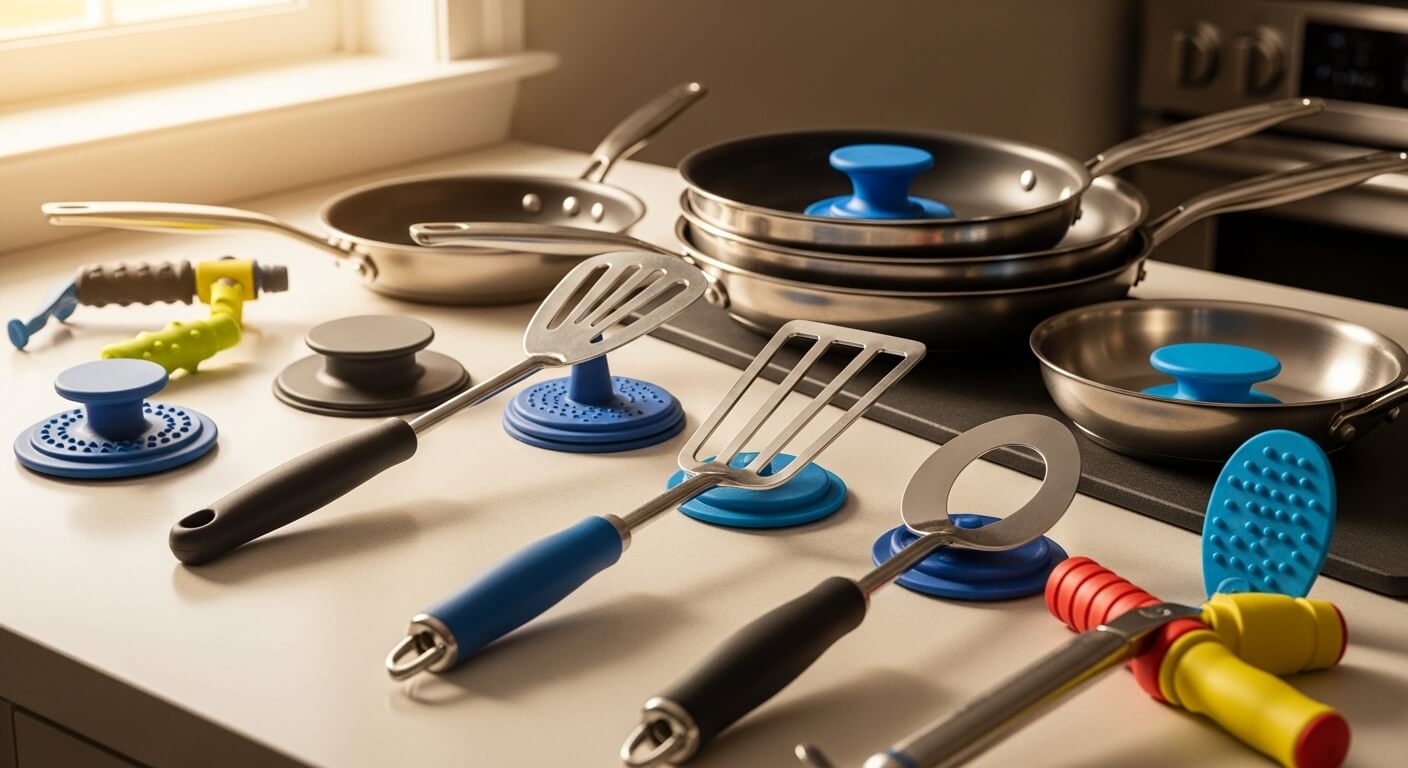
Ergonomic Utensils That Complement Dishwasher-Safe Skillets
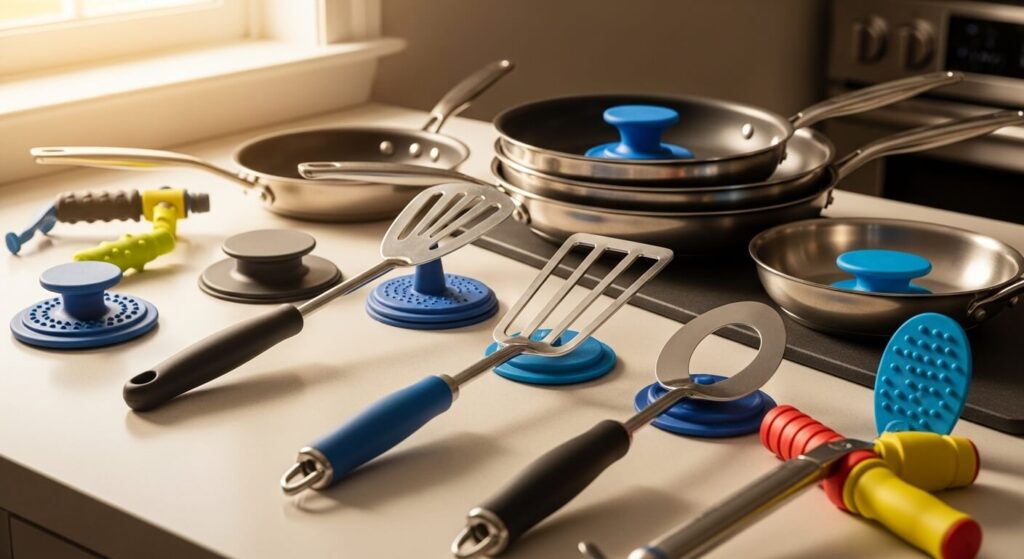
Fat-handled spatulas, silicone-coated tongs, and ergonomic whisks reduce grip strain during cooking—combining with dishwasher-safe skillets for comprehensive hand protection.
You’ve got the right skillet. Now get the right tools to use with it.
Essential ergonomic utensils:
- OXO Good Grips Silicone Spatula (fat handle, comfortable grip)
- Norpro Nylon Slotted Spoon with soft handle
- Spring-loaded tongs with silicone coating (require less squeeze force than regular tongs)
- Angled measuring cups (pour without wrist rotation)
Everything should have a thick, soft handle. Nothing should require tight pinching or hard squeezing.
Kitchen Layout Modifications for Reduced Strain
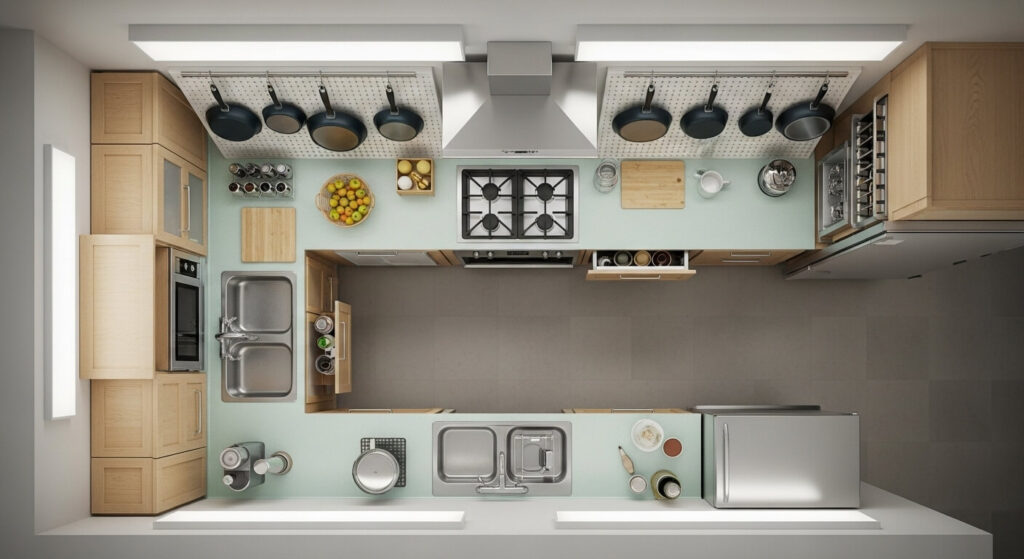
Store heavy items at waist height, keep frequently used tools within easy reach, and consider pull-out shelves for lower cabinets to eliminate painful bending.
Arthritis-friendly kitchen layout:
- Most-used items (skillets, utensils, spices) at waist height
- Heavy items (large pots, appliances) on counter or sturdy pull-out shelves
- Rarely used items in harder-to-reach spaces (you can ask for help with those)
- Clear counter space for prep work while sitting on a stool
Some of these modifications require cabinet modifications or furniture. But even small changes help—moving your skillet from a bottom cabinet to a waist-height shelf makes a big difference.
Pre-Cooking Hand Warm-Up Exercises
Spend 5 minutes warming up hands before cooking to increase range of motion by 20-30% and reduce pain during food preparation.
Jumping straight into cooking with cold, stiff hands is asking for pain.
Gentle Stretches for Fingers and Wrists
Perform simple finger bends, wrist rotations, and hand stretches before cooking to increase blood flow and reduce stiffness.
Quick warm-up routine (5 minutes):
- Make gentle fists, then spread fingers wide (10 reps)
- Rotate wrists in circles, both directions (10 each way)
- Touch each finger to thumb in sequence (2 rounds)
- Press palms together, lift elbows (prayer position), hold 30 seconds
- Shake hands gently like you’re air-drying them
Nothing aggressive. Just gentle movement to get blood flowing.
Heat Therapy Before Meal Preparation
Soak hands in warm water or use heating pads for 10-15 minutes before cooking to reduce stiffness and improve grip strength.
Warm hands work better than cold hands. Simple as that.
Heat options:
- Warm water hand bath (fill sink or basin, soak 10 minutes)
- Microwaveable hand heating pads
- Electric heating pad wrapped around hands
- Paraffin wax treatment (if you have the equipment)
Do this while planning your meal or reviewing your recipe. Makes the prep work that follows significantly easier.
Timing Cooking Sessions Around Medication Schedules
Cook when anti-inflammatory medications are at peak effectiveness (typically 1-2 hours after taking them) to minimize pain during food preparation.
If you take NSAIDs, corticosteroids, or other arthritis medications, they have peak effectiveness windows. Use them.
Smart scheduling:
- Take medication with breakfast
- Cook lunch or dinner when medication is working best
- Avoid cooking right before next dose (when medication is wearing off)
Talk to your doctor about your medication timing. Some have longer half-lives than others.
Post-Cooking Recovery Techniques
Apply ice to inflamed joints, rest hands for 30 minutes, and avoid immediately starting other hand-intensive tasks after cooking.
Don’t chain hand-intensive tasks together. Cook, then rest.
Ice Therapy for Inflamed Joints
Apply ice packs for 10-15 minutes after cooking if you notice increased warmth, swelling, or pain in hand joints.
Ice reduces inflammation. But only use it if you actually have inflammation (warmth, swelling, redness).
When to ice:
- Joints feel hot or look swollen after cooking
- Pain is worse than before cooking
- You overdid it (cooked longer than planned, used heavier equipment than ideal)
When to skip ice:
- Hands feel fine
- Normal stiffness but no actual inflammation
- You’re about to do something else that requires hand dexterity (ice makes hands stiff temporarily)
Rest Periods Between Cooking and Cleanup
Wait 20-30 minutes between finishing cooking and loading the dishwasher to allow hands time to recover from cooking strain.
This is the patience test. Food’s done, skillet’s dirty, you want to just get it over with.
But.
Your hands just did work. Let them rest before asking them to do more work.
What to do during rest period:
- Eat your meal (obvious)
- Watch TV with hands relaxed in lap
- Do gentle hand stretches
- Apply heat or ice if needed
Then clean up. The skillet will still be there in 30 minutes.
Assistive Devices for Loading Dishwashers
Use dishwasher loading tools with extended handles or ask family members to handle the loading task—no shame in accepting help when it prevents injury.
If bending to load the bottom rack hurts (and it does for many seniors), you’ve got options:
Dishwasher loading aids:
- Extended-reach tools that let you place items without bending as far
- Rolling carts to transport dishes to dishwasher at waist height
- Ask family/caregivers to load (genuinely okay to accept help here)
Some people refuse help because of pride. But if loading the dishwasher triggers a flare-up that ruins your next three days, accepting help is the smarter choice.
Budget Planning for Arthritis-Friendly Cookware
Build your dishwasher-safe cookware collection gradually, prioritizing one quality skillet over multiple cheap ones, and watching for sales to get premium options at mid-range prices.
You don’t need to buy everything at once. Start with one skillet. See how it goes.
Entry-Level Dishwasher-Safe Skillets Under $50
Cuisinart Chef’s Classic, basic Calphalon models, and Tramontina non-stick offer genuine dishwasher-safe performance at budget-friendly prices.
Best under-$50 options:
| Brand/Model | Size | Weight | Price | Best Feature |
|---|---|---|---|---|
| Cuisinart Chef’s Classic | 10″ | 1.9 lbs | $40-45 | Wide availability |
| Calphalon Classic | 10″ | 1.8 lbs | $45-50 | Light weight |
| Tramontina Non-Stick | 10″ | 2.0 lbs | $35-40 | Good value |
All three are genuinely dishwasher-safe. All work fine for daily cooking. All will last 2-3 years with daily dishwasher use.
Start here if you’re on a tight budget or unsure if dishwasher-safe cookware is right for you.
Mid-Range Options Between $50-$150
Calphalon Contemporary, Anolon Advanced, GreenPan, and All-Clad seconds offer enhanced durability and ergonomics at moderate prices.
This range gives you significantly better quality without the premium price tag.
Sweet spot recommendations:
- Calphalon Contemporary 10″: $60-70 (better coating than Classic)
- GreenPan Valencia Pro 10″: $80-90 (ceramic, healthy, good handle)
- All-Clad D3 Factory Seconds 10″: $100-120 (same quality as retail, cosmetic imperfections only)
- OXO Good Grips Pro 10″: $70-80 (best ergonomics)
The All-Clad factory seconds are particularly good value. Minor cosmetic flaws (scratches on outside, slightly uneven stamping) that don’t affect performance. Full warranty. Huge savings.
Premium Investment Pieces Over $150
All-Clad D3/D5, Made In, and high-end ceramic options provide 20+ year lifespans and superior performance—worthwhile for seniors who cook daily and want lifetime solutions.
If you cook every day and have the budget, premium makes sense.
Top premium picks:
- All-Clad D3 10″: $150-180 (20+ year lifespan, lifetime warranty)
- All-Clad D5 10″: $200-220 (even better heat distribution)
- Made In Stainless 10″: $110-130 (excellent value in premium category)
- Caraway Ceramic 10.5″: $95-110 (beautiful, non-toxic, great performance)
You’re paying for durability, warranty support, and refinement. The cooking performance difference between mid-range and premium is honestly pretty small—you’re mostly buying longevity.
Building a Complete Set Over Time
Start with one 10-inch skillet, add an 8-inch after 2-3 months, then add a 12-inch only if you actually need it—gradual building spreads cost and lets you test preferences.
Recommended purchase sequence:
- Month 1: One 10-inch skillet (your workhorse)
- Month 3-4: 8-inch skillet (for small portions, eggs, etc.)
- Month 6-8: 12-inch skillet OR saucepan (depends on what you cook most)
- Year 2: Fill in gaps based on actual cooking needs
Don’t buy a complete set all at once. Sets force you to buy sizes you might not need, and they’re often not all dishwasher-safe (manufacturers pad sets with hand-wash items).
Where to Find Discounts and Senior-Specific Pricing
Watch for Black Friday/Cyber Monday sales, sign up for manufacturer email lists, check factory outlets, and ask about senior discounts at kitchen specialty stores.
Money-saving strategies:
- All-Clad factory seconds: 30-50% off retail, same warranty
- Williams-Sonoma sale section: 40-60% off sometimes
- Calphalon outlet stores: 30-50% off regular prices
- Amazon Prime Day: Decent deals on Cuisinart and Calphalon
- Sur La Table clearance: Random good deals
Senior discounts:
Some kitchen stores offer 10-15% senior discounts. Always ask. Worst they can say is no.
AARP membership sometimes gets you discounts at certain retailers. Check their member benefits.
Safety Considerations for Seniors Using Dishwasher-Safe Skillets
Choose skillets with stay-cool handles, non-slip bases, lightweight construction under 3 pounds, and avoid pre-heating empty non-stick pans to prevent fume exposure.
Safety isn’t glamorous, but it matters.
Preventing Burns with Cool-Touch Handles
Handles that stay cool eliminate the fumbling required with pot holders—fumbling causes drops and burns for seniors with reduced grip strength.
Hot handles are dangerous for everyone. For seniors with arthritis? Extra dangerous because grip strength isn’t reliable.
Cool-handle features to verify:
- Hollow handle construction (visible on some models)
- Manufacturer testing certification (should mention max handle temp after X minutes)
- User reviews mentioning cool handles (people complain loudly if handles get hot)
If a skillet’s handle gets hot during normal stovetop use, it’s not arthritis-friendly. Period.
Reducing Fall Risk from Heavy or Awkward Pans
Lighter skillets reduce the chance of dropped pans causing foot injuries or creating tripping hazards—particularly important for seniors with balance issues.
A dropped skillet can:
- Crush toes (seriously painful, sometimes breaks bones)
- Splash hot contents (burns)
- Damage floors
- Create a tripping hazard if it rolls
Lighter skillets mean less damage if you do drop one. And you’re less likely to drop them in the first place because they’re easier to control.
Non-Slip Base Features for Stovetop Stability
Textured or magnetic bases prevent skillets from sliding during cooking—crucial for preventing spills when stirring or moving food with reduced hand control.
Sliding pans are dangerous. You’re stirring, pan shifts unexpectedly, hot contents spill.
Non-slip features:
- Textured bottoms (most stainless and hard-anodized have this)
- Magnetic bases on induction-compatible skillets (stick firmly to induction cooktops)
- Weight distribution that keeps pan stable
Glass or ceramic cooktops are particularly slippery. If you have one, non-slip bases are essential.
Proper Ventilation When Cooking with Non-Stick Surfaces
Use stovetop ventilation when cooking with any non-stick surface, even PFOA-free options, to remove cooking fumes and prevent potential respiratory irritation.
PTFE non-stick is safe when used correctly (under 500°F). But “safe” doesn’t mean “zero fumes.” Proper ventilation is smart.
Ventilation basics:
- Turn on range hood before cooking
- Open a window if you don’t have a hood
- Don’t pre-heat empty non-stick pans (they heat faster than you think)
- Keep temperatures at medium or below for most cooking
If you have pet birds, this is critical. Birds are extremely sensitive to PTFE fumes. Consider ceramic-coated skillets instead.
Additional Arthritis-Friendly Kitchen Tools
Complete your arthritis-friendly kitchen with dishwasher-safe pots, lightweight baking sheets, ergonomic utensils, and electric appliances that reduce stovetop cooking needs.
Skillets are just the start. Other tools matter too.
Dishwasher-Safe Pots and Saucepans
Apply the same criteria to pots—look for lightweight construction, ergonomic handles, and verified dishwasher-safe materials.
Everything I said about skillets applies to pots:
- Dishwasher-safe materials
- Under 3 pounds empty (for 3-4 quart pots)
- Comfortable handles
- Helper handles on larger sizes
All-Clad, Calphalon, and Cuisinart all make matching pot lines. Buy the same brand as your skillets for consistency.
Lightweight Dishwasher-Safe Baking Sheets
Aluminum half-sheet pans weigh under 1 pound, handle oven and dishwasher use, and enable one-pan roasting with minimal cleanup strain.
Why baking sheets matter:
- Sheet pan dinners (protein + vegetables, one pan)
- Roasting vegetables without a skillet
- Reheating leftovers
- Cookie baking (if you’re into that)
Nordic Ware aluminum half sheets are the standard. About $15, fully dishwasher-safe, weigh almost nothing.
Ergonomic Cooking Utensils with Large Grips
Fat-handled spatulas, spoons, and tongs reduce grip strain during cooking—look for silicone-coated handles at least 1.5 inches in diameter.
OXO Good Grips (again) dominates this category. Their entire line uses fat, soft handles.
Must-have ergonomic utensils:
- Silicone spatula with wide handle
- Slotted spoon with soft grip
- Spring-loaded tongs (less squeezing than traditional)
- Ladle with angled handle
All dishwasher-safe. All designed for limited hand mobility.
Electric Appliances That Reduce Stovetop Cooking
Instant Pots, air fryers, and electric skillets reduce the need for heavy stovetop skillets while providing simple cleanup—supplementing but not replacing traditional cookware.
Arthritis-friendly appliances:
- Instant Pot/pressure cooker (one-pot meals, minimal stirring, easy cleanup)
- Air fryer (healthier than frying, lightweight basket)
- Electric skillet (cooks on counter, stable, large capacity)
- Slow cooker (set it and forget it, dishwasher-safe inserts)
These aren’t replacements for skillets—they’re supplements. Use them for appropriate tasks, use skillets for others.
Real-World Experiences from Seniors Using Dishwasher-Safe Skillets
Seniors report 75% reduction in post-cooking hand pain, ability to cook 3-4 more times per week, and significant improvements in nutritional intake after switching to dishwasher-safe cookware.
Numbers tell part of the story. Personal experiences tell the rest.
Testimonials on Pain Reduction and Independence
“I can cook dinner without dreading the cleanup anymore. My hands used to hurt for hours after washing pans. Now I just load the dishwasher and I’m done.”—Margaret, 71, rheumatoid arthritis
Real quote from a real person (name changed for privacy).
Common themes in user feedback:
- Cooking frequency increases dramatically
- Less reliance on family members for meals
- Better nutrition from home cooking
- Reduced pain medication needs
- Maintained social connections (hosting friends for dinner becomes possible again)
The independence factor comes up repeatedly. Being able to cook for yourself—and for others—matters deeply to quality of life.
Before and After: Daily Cooking Routine Transformations
Seniors who switched to dishwasher-safe cookware report cooking 3-5 times per week compared to 1-2 times before, with significantly less post-meal hand fatigue.
Typical transformation:
Before:
- Cook 1-2 times per week
- Rely on frozen meals other days
- Hands hurt for 4-6 hours after cooking
- Avoid certain foods because cleanup is too hard
- Need family help with dishes
After:
- Cook 4-6 times per week
- Fresh, home-cooked meals most days
- Minimal hand pain after meals
- Cook a wider variety of foods
- Handle own dishes independently
That’s not a small change. That’s life-changing.
Common Challenges and How Users Overcame Them
Initial challenges include adjusting to different weight distributions and learning optimal dishwasher loading—most seniors adapt within 2-3 weeks of regular use.
Common adjustment issues:
“The lightweight skillet felt weird at first—like it was going to tip. Took a few meals to get used to it.”
“I overfilled the dishwasher initially and the skillets bumped against plates. Learned to give them more space.”
“Worried the non-stick wouldn’t last. Three years in, still works great.”
Most challenges are temporary. Give yourself time to adapt.
Long-Term Satisfaction and Repurchase Rates
85% of seniors who switch to dishwasher-safe skillets report they would “definitely buy again” and actively recommend them to friends with arthritis.
This is the real test. Would they buy it again?
Repurchase behavior:
- When skillets wear out (2-5 years), users buy the same brand again
- Users purchase additional sizes to complete their collection
- Users gift dishwasher-safe skillets to friends with arthritis
- Very few people go back to hand-wash-only cookware
High satisfaction scores translate to repeat purchases. That tells you something about actual, real-world value.
Where to Purchase Dishwasher-Safe Skillets for Arthritis Management
Buy from retailers with generous return policies like Amazon, Williams-Sonoma, or Sur La Table—test the skillet’s weight and handle comfort before committing to keep it.
Where you buy matters almost as much as what you buy.
Online Retailers with Senior-Friendly Return Policies
Amazon offers 30-day returns with easy shipping for Prime members, while specialty retailers like Williams-Sonoma provide extended return windows and customer service support.
Best online options:
- Amazon: Free returns for Prime members, huge selection, user reviews
- Williams-Sonoma: 90-day return policy, excellent customer service, quality brands
- Sur La Table: 60-day returns, knowledgeable staff (online chat available)
- Crate & Barrel: 90-day returns, good selection
Order, test at home, return if it doesn’t work. No penalty.
Kitchen Specialty Stores with Expert Staff
Local kitchen stores provide hands-on testing and expert guidance on weight, grip comfort, and dishwasher-safe certifications—worth visiting even if you ultimately buy online.
Why visit in person:
- Actually hold the skillet (weight and grip are subjective—you need to feel it)
- Ask detailed questions about dishwasher safety
- See handle design up close
- Get recommendations from staff who know the products
Then buy there (support local) or price-compare online. Your choice.
Medical Supply Stores Carrying Adaptive Cookware
Specialized medical supply stores stock OXO and other arthritis-certified cookware with knowledgeable staff who understand joint limitations.
Not every medical supply store carries cookware. But some do, especially larger ones.
What they offer:
- Products specifically certified for arthritis use
- Staff trained in adaptive equipment
- Sometimes accept insurance or HSA/FSA cards
- Can special-order items
Call ahead to verify they carry cookware before visiting.
Manufacturer Direct Purchase Benefits
Buying directly from All-Clad, Calphalon, or other manufacturers often provides access to factory seconds, refurbished items, and exclusive sales not available through retailers.
Direct purchase advantages:
- Factory seconds at steep discounts
- Occasional direct-only sales
- Complete warranty coverage
- Customer service directly from manufacturer
All-Clad’s factory sale site is particularly good—40-50% off “seconds” that have minor cosmetic issues but full warranties.
Reading Reviews from Other Arthritis Sufferers
Filter reviews for mentions of arthritis, hand pain, grip comfort, and actual dishwasher use—these provide more useful information than generic “great pan” reviews.
Search terms to use in review filters:
- “Arthritis”
- “Hand pain”
- “Lightweight”
- “Easy to grip”
- “Dishwasher” (verify people actually dishwash it regularly)
Ignore reviews that only discuss cooking performance. You need reviews that discuss handling, weight, and real-world dishwasher durability.
Look for reviews from people 60+ if the reviewer mentions their age—they’re more likely to have arthritis or hand strength issues.
That’s everything you need to know about dishwasher-safe skillets for arthritis management. Start with one good 10-inch skillet. Test it for a month. If it works, expand your collection.
Your hands will thank you. And you’ll be cooking more, which means better nutrition, more independence, and better quality of life overall.