The three things that actually matter when buying stainless steel cookware are the core material, the stainless grade, and how many layers the pan is built from — get those three right and you’ll end up with cookware that performs well and lasts decades, regardless of which brand’s name is stamped on the handle.
That’s the short version. Here’s everything else you need to know before you spend real money on a set.
Quick context first: a lot of people are landing on stainless steel right now because of growing concerns around Teflon and other nonstick coatings. Makes sense. Bare stainless has no coating to flake, degrade, or worry about in the first place — it’s just metal, doing what metal does. But “just buy stainless” isn’t quite enough advice on its own, because not all stainless cookware is built the same. Not even close.
Why Buy Stainless Steel Over Nonstick or Other Materials
Stainless wins on a few fronts that matter for everyday cooking, and it’s worth understanding why before you start comparing specific sets.
Health and Safety Considerations
There’s no coating to break down here. Period. Nonstick pans rely on a surface treatment that can degrade over time — scratch it, overheat it, use the wrong utensil, and you’re dealing with a pan that’s past its prime. Bare stainless doesn’t have that problem because there’s nothing applied to the surface to begin with. It’s the metal, full stop.
Durability That Actually Lasts
Good stainless cookware can last a lifetime. Seriously — people hand this stuff down. You can use metal utensils without worrying about scratching a coating into oblivion (because, again, there’s no coating), and stainless doesn’t corrode or stain under normal use. Low maintenance, in the grand scheme of kitchen tools.
Corrosion Resistance, Explained Simply
The reason stainless steel resists rust comes down to chromium. It forms an invisible protective layer on the surface that fights off corrosion. That’s the whole “stainless” part of stainless steel — without enough chromium, you’d just have steel, and steel rusts.
Understanding Stainless Steel Grades: 18/0 vs 18/8 vs 18/10
So what do those numbers mean — 18/10, 18/8, 18/0? You’ll see them everywhere once you start shopping, and most product pages don’t bother explaining them.
What the Numbers Actually Mean
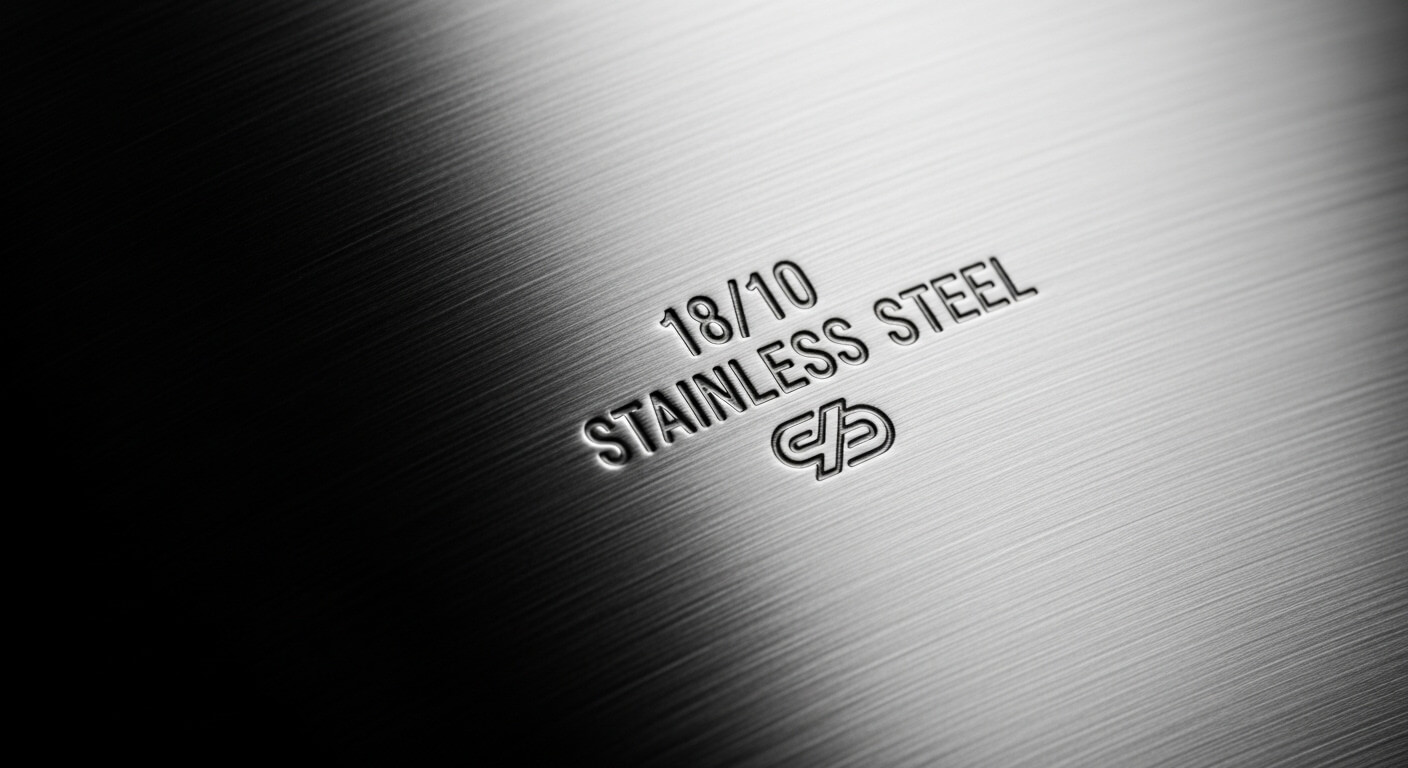
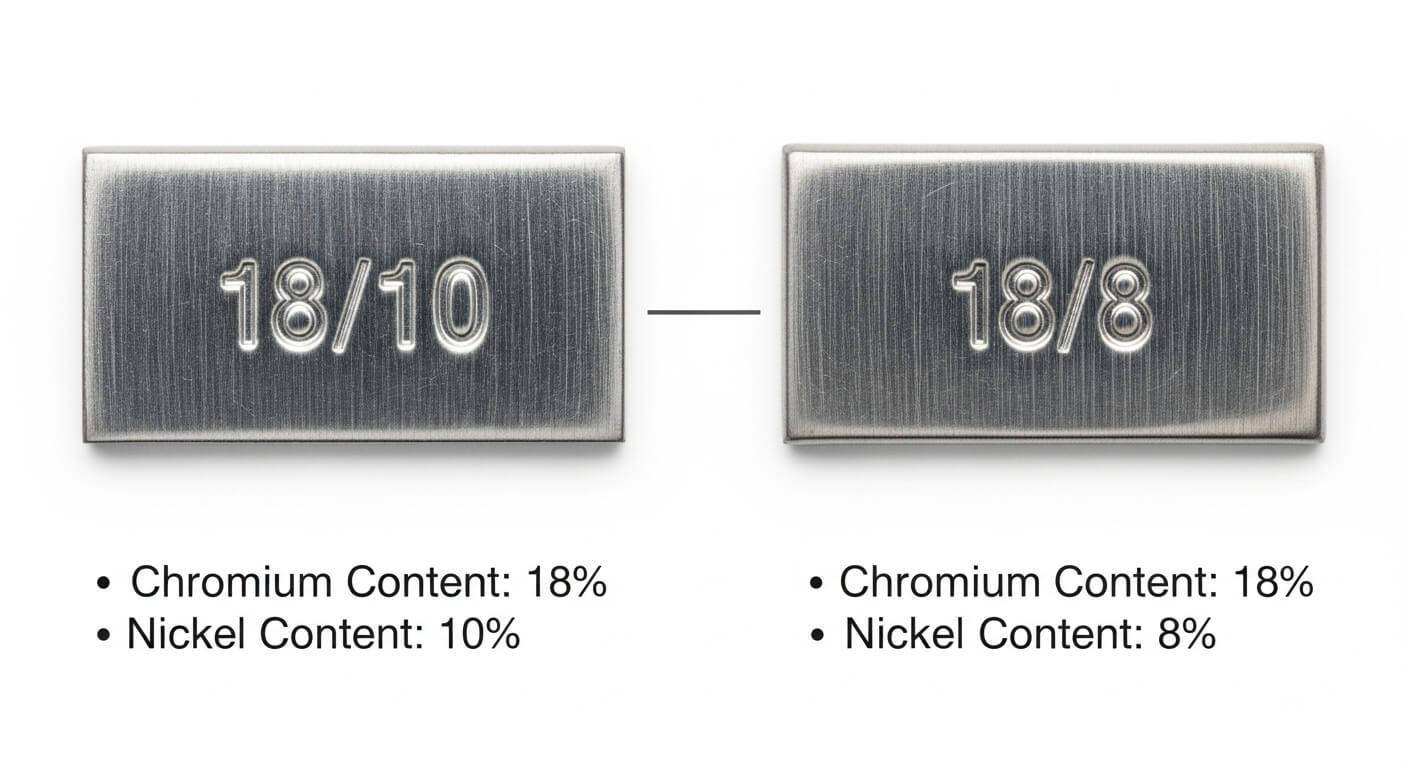
First number is chromium percentage. Second number is nickel percentage. That’s it. 18/10 stainless steel has 18% chromium and 10% nickel.
Here’s something worth correcting, because it trips people up constantly: nickel content has nothing to do with how thick or heavy the metal is. Nothing. Gauge (thickness) and nickel percentage are two completely separate specs, and a lot of buying guides conflate them — implying that 18/0 stainless is automatically “thinner” cookware. It’s not. You could have thick 18/0 stainless or thin 18/10 stainless. Thickness is its own measurement, totally independent of the grade.
18/10: The Premium Standard
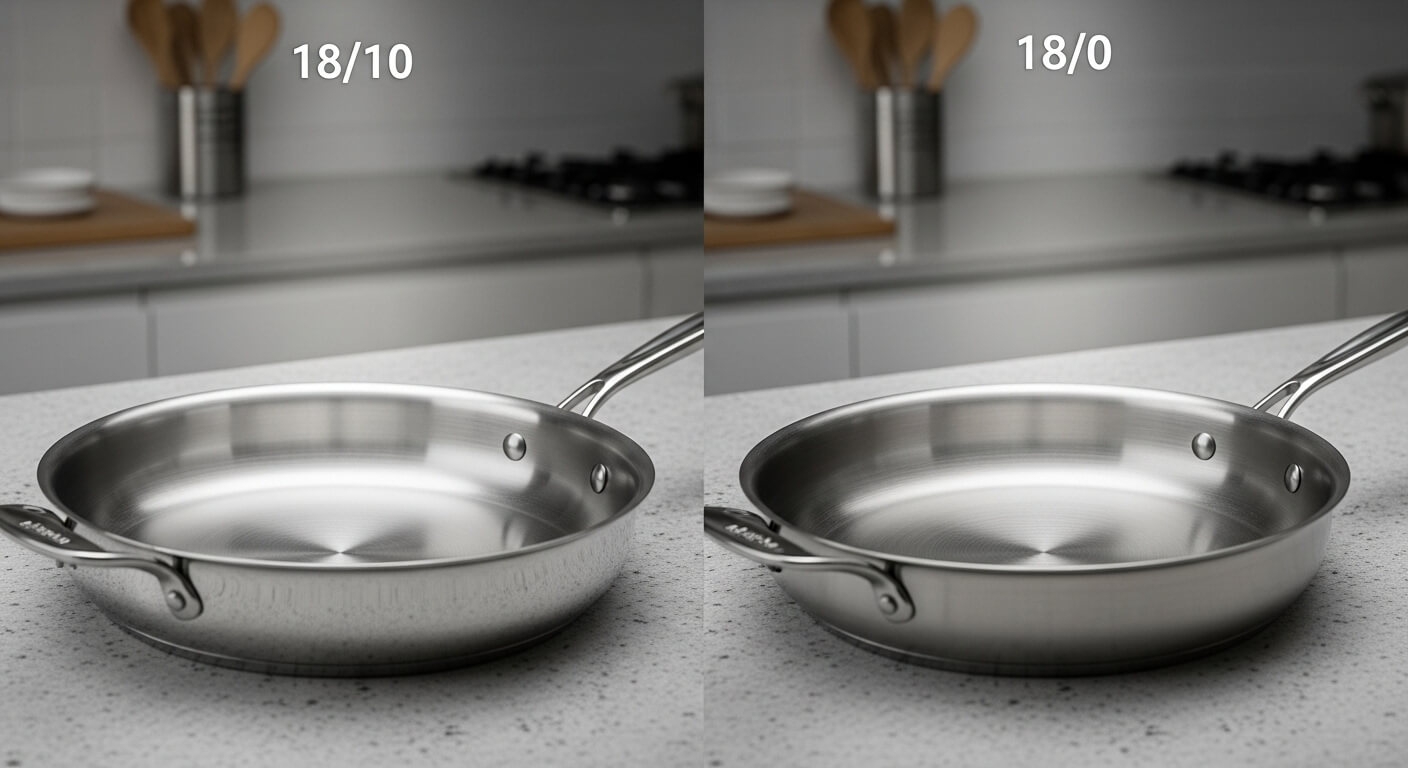
18/10 is generally considered the best all-around grade for cookware, and it’s what most premium brands use for their cooking surface. More nickel means better shine, slightly improved corrosion resistance over the long haul, and that mirror-polish look everyone associates with high-end stainless.
18/8: The Solid Middle Ground
Slightly less nickel than 18/10, still performs well, and shows up a lot in mid-range cookware. Honestly? Most home cooks would struggle to tell the difference between 18/8 and 18/10 in actual use. The gap is real but it’s not dramatic.
18/0: No Nickel, Different Tradeoffs
Now here’s where a lot of older buying guides get it wrong. You’ll read that 18/0 is “only good for pasta pots and steamers” — that’s an oversimplification bordering on false. 18/0 stainless has no nickel, which means it’s a little more prone to minor surface discoloration over time and slightly less corrosion-resistant in extreme conditions. But it’s still durable, it’s still widely used (flatware is almost always 18/0, plus plenty of cookware components), and it’ll serve you fine for a lot of cooking tasks. It’s not garbage. It’s just a different tradeoff.
Why Core Material Matters More Than Grade Alone
Here’s the thing nobody tells you upfront: stainless steel grade is honestly the less important spec. What actually determines how your cookware cooks is the core material underneath that shiny surface.
Bare Stainless Is a Bad Heat Conductor
Stainless steel, on its own, conducts heat poorly. That’s just physics. Cook with a single layer of plain stainless and you’ll get hot spots — uneven cooking, scorched centers, undercooked edges. Not great.
Aluminum Core vs. Copper Core
So manufacturers sandwich a better conductor in the middle. Aluminum is the common choice — heats up fast, keeps the price reasonable, does the job well. Copper is the upgrade: even faster heat response, more even distribution, but it costs more and the cookware tends to weigh more too.
| Core Type | Heat Speed | Price Impact | Best For |
|---|---|---|---|
| Aluminum | Fast | Lower | Everyday cooking, most home kitchens |
| Copper | Fastest | Higher | Precision cooking, sauce work, serious home cooks |
| None (bare stainless) | Slow, uneven | Lowest | Steamers, pasta pots — not general cooking |
The Sidewall Test: How to Check Construction Quality
Here’s a detail that separates good cookware from cheap cookware, and it’s easy to check before you buy: does the core run all the way up the sides, or just sit in the base?
Disc-bottom construction (core only in the base) cooks fine at the bottom and unevenly everywhere else. Fully clad construction — core extending up the sidewalls — gives you even heating across the whole pan, not just the floor of it. Pick the pan up, look at the bottom edge where the layers meet the sidewall. If you can see the bonded layers continuing up, you’re looking at the real deal.
How Many Layers Should Stainless Steel Cookware Have
More layers, generally, means better heat retention. But “generally” is doing a lot of work in that sentence, so let’s break it down.
3-Ply (Tri-Ply): The Standard Starting Point
Aluminum or copper core, sandwiched between two layers of stainless. That’s tri-ply, and it’s the most common fully-clad construction you’ll find — affordable, effective, and honestly all most people need.
5-Ply and 7-Ply: Diminishing Returns Territory
Add more layers and you generally get better heat retention and more even temperature across the cooking surface. All-Clad’s own lineup is a good illustration here: their D3 line uses 3-ply construction and sits at the cheapest end of their catalog, while D5 and Copper Core step up to 5-ply, and D7 goes all the way to 7-ply.
Does that mean D7 cooks dramatically better than D3? Not really, not for most home cooking. The improvements get smaller with each additional layer — you’re paying more for incremental gains, not a night-and-day difference. Worth it if you’re cooking constantly and chasing precision. Overkill if you’re making dinner for the family a few nights a week.
What Stainless Steel Cookware Is Best For (and What It’s Not)
Let’s talk honestly about what this stuff is actually good at, because the marketing doesn’t always tell you where the limits are.
Browning, Searing, and Building Fond
This is stainless’s home turf. Browning meat, building a proper sear, getting that caramelized crust on the bottom of the pan (the fond) that becomes the base of a great sauce — stainless does this better than nonstick, full stop. Deglaze that pan with a splash of wine or stock, scrape up the fond, and you’ve got the start of something genuinely good. Nonstick coatings actively work against this kind of cooking. Stainless leans into it.
Where Stainless Has a Real Learning Curve
Now the honest part. Eggs stick. Fish sticks, at first. Bare stainless needs proper preheating (the water-bead test — drop water in a dry pan and watch it bead up rather than evaporate instantly — tells you when it’s ready) and a reasonable amount of fat before food releases cleanly. That’s not a defect. That’s just how uncoated metal behaves. Give it a few tries and your hands figure it out. Skip the technique and you’ll be scrubbing eggs off a pan, wondering why everyone loves this stuff.
Buying a Full Set vs. Individual Pieces
So, set or à la carte? Both have real advantages depending on what you’re trying to do.
Why a Full Set Makes Sense for Most Buyers
A matched set looks better in the kitchen, plain and simple — no mismatched handles, no five different finishes competing for attention. Sets also tend to deliver better overall value than buying every piece separately, since manufacturers price bundles to move volume. And most sets are scaled to common household sizes, so you’re not guessing at what you need.
What’s Usually Included
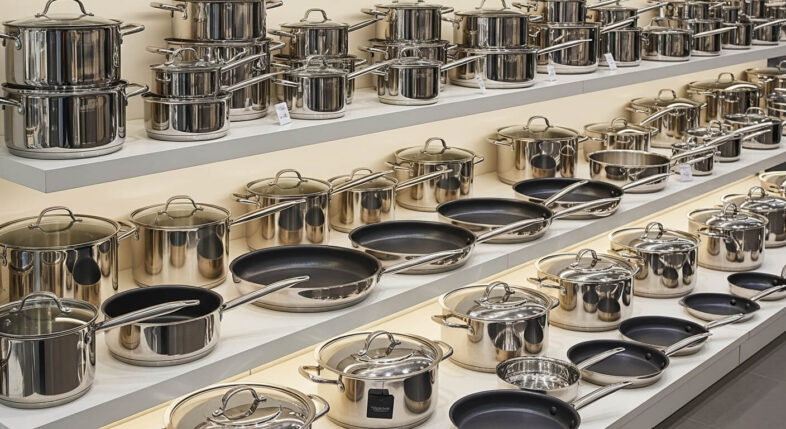
A standard set typically gets you covered saucepans (often two sizes), one or two skillets, a covered sauté pan, a covered stockpot, and sometimes a steamer insert. Bigger sets might throw in a Dutch oven or an extra pan size or two.
When Buying Individual Pieces Wins
Replacing one damaged pan from an existing set? Buy the piece. Building something custom around your specific cooking habits — maybe you need three saucepans and zero interest in a Dutch oven? Individual pieces let you skip the stuff you’ll never use.
How to Evaluate Build Quality Before You Buy
A few details separate genuinely well-made cookware from stuff that looks nice in photos and falls apart in three years.
Riveted Handles vs. Everything Else
Riveted handles — physically fastened through the pan body with metal rivets — hold up far better over years of heavy use than welded or bolted alternatives. Check for visible rivets on the inside of the pan. If you don’t see them, ask what’s actually holding that handle on.
Lid Fit and Material
Tight-fitting lids trap moisture and help with self-basting during cooking. Some designs use slightly vented lids instead, which is a different (also valid) approach depending on what you’re cooking. Glass lids let you peek without lifting; stainless lids tend to be more durable long-term.
Signs of Quality You Can Check in Person
Pick the thing up. Quality cookware has real heft to it — not heavy for the sake of heavy, but substantial in a way that signals actual metal thickness. Look at the seam where layers meet at the rim and base. Clean, consistent bonding, no visible gaps or rough edges. A finish that looks even, not patchy or inconsistently polished.
Stovetop and Oven Compatibility
Before you buy anything, check it actually works with the stove you’ve got at home. Sounds obvious. Gets overlooked constantly.
Induction Compatibility Isn’t Universal
Induction cooktops need magnetic stainless steel on the exterior to work at all. Not all stainless cookware qualifies — some traditional copper-heavy designs, for instance, need a special interface disc to function on induction. If you’ve got (or are planning to get) an induction range, confirm compatibility before you buy. Don’t assume “stainless” automatically means “induction-ready.”
Oven and Broiler Ratings Vary by Brand
This one’s genuinely inconsistent across the market. Some premium lines rate up to 600°F oven and broiler safe. Plenty of mid-range sets cap out around 450-500°F. If you like finishing dishes under a broiler or doing stovetop-to-oven cooking, check this spec specifically — it’s not universal, and assuming otherwise can warp a lid or damage a handle that wasn’t built for that heat.
Caring for Stainless Steel Cookware to Protect Your Investment
You just spent real money on this. Don’t wreck it with the wrong sponge.
What Actually Damages the Finish
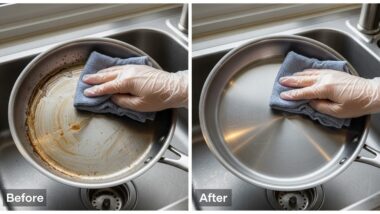
Steel wool. Scouring pads. Harsh chemical cleaners, especially anything with bleach. All of it scratches the surface at a microscopic level, and those scratches compound over time into a dull, pitted finish that no amount of polishing brings back. Mild soap, a non-abrasive sponge, that’s genuinely all you need for 90% of your cleaning.
If you’ve got an All-Clad set specifically and want the complete cleaning rundown — stuck-on food, discoloration, the works — check out our guide on how to clean the All-Clad pots and pans cookware set.
How Much Should You Spend on Stainless Steel Cookware
Budget’s the question everyone’s actually asking, even if they phrase it as “which brand is best.”
Why Buying the Best You Can Afford Pays Off
You’re going to be cooking with this stuff for years, maybe decades. Buy genuinely cheap stainless and you’ll likely replace it within 5-10 years as warping, hot spots, or handle failures pile up. Stretch your budget toward better construction now, and the cost-per-year math works out in your favor every single time.
Comparing Price Tiers Across the Market
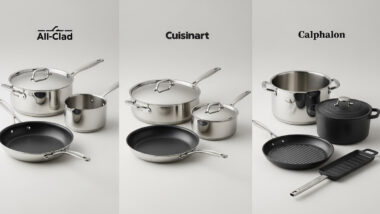
At the premium end, you’ve got brands like All-Clad, with prices reflecting heavier gauge metal and rigorous manufacturing inspection at every stage. Mid-range brands like Cuisinart and Calphalon offer genuinely solid tri-ply construction at a fraction of the cost — not quite the same heat ceiling or long-term durability margin, but plenty good for most home kitchens. We’ve actually broken this comparison down in detail in our All-Clad vs Cuisinart vs Calphalon cookware set guide, if you want the specifics side by side.
And if you’re specifically deciding between All-Clad’s own internal lineup — D3 versus D5 versus D7 versus Copper Core and beyond — our All-Clad D3 vs D5 vs D7 vs Copper Core vs HA1 vs MC2 comparison chart walks through exactly where each line lands.