Skillet Comparisons
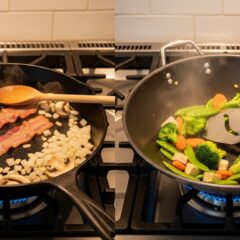
Skillet vs Wok: Which Pan Should You Choose for Your Kitchen?
The main differences between the skillet and wok are shape, heat distribution, and what they're built to do — a skillet is flat-bottomed with low sides, built for even searing, browning, and Western cooking, while a wok is deep and curved, built for high-heat stir-frying, tossing, and Asian cuisine. That's the short version. But which […]
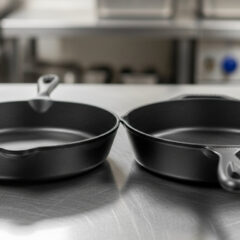
French Skillet vs Regular Skillet: Understanding the Key Differences
The main differences between the French skillet and the regular skillet come down to side shape, cooking technique, and who's holding the pan — a French skillet has dramatically flared, outward-curving sides built for tossing and fast evaporation, while a regular skillet has straight or gently angled sides designed to contain food and liquids for […]
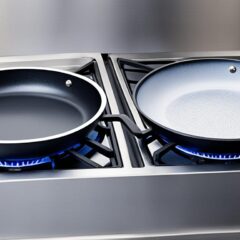
Ceramic Skillet vs Teflon: Which is Better for Cooking?
Find out about the pros and cons of ceramic skillet vs Teflon in my comprehensive comparison. Find out which cookware is best for your kitchen needs and cooking style.
HexClad Hybrid vs Misen Carbon Steel Fry Pan
The main differences between the HexClad Hybrid and Misen Carbon Steel Fry Pans are their nonstick technology, price, and maintenance requirements — HexClad uses a laser-etched ceramic coating over tri-ply stainless steel and is dishwasher-safe, while Misen uses a coating-free nitrided carbon steel surface that's completely PFAS-free but requires hand washing. Both pans sell in […]
Caraway vs Ninja Ceramic Pro Ceramic Fry Pan
The main differences between the Caraway and Ninja Ceramic Pro ceramic fry pans are price, coating durability, weight, cleaning requirements, and whether you get an actual nonstick guarantee. Ninja runs about half the cost, weighs nearly half as much, handles the dishwasher, is metal utensil safe, and gives you a 10-year guarantee. Caraway wins on […]