Yes — ceramic electric skillets are safe to use. They’re free of PTFE and PFOA, the synthetic chemicals found in traditional nonstick coatings that raise health concerns. That said, there’s a bit more to the story.
Most people asking this question have one real worry: are they accidentally poisoning their family every time they cook eggs? The short answer is no. But understanding why ceramic is safer — and where it still has limits — helps you make better decisions in the kitchen.
Nonstick cookware generally falls into two camps: PTFE-based (think Teflon) and ceramic-based. They both reduce sticking, but they’re built differently and behave differently at high heat.
Traditional nonstick skillets use PTFE — polytetrafluoroethylene — a synthetic polymer. Works great. But when overheated (above 500°F), PTFE can break down and release fumes that are harmful to birds and, in high concentrations, uncomfortable for people too. PFOA was used in the manufacturing process until it was largely phased out around 2013, but its legacy left a bad taste in consumers’ mouths.
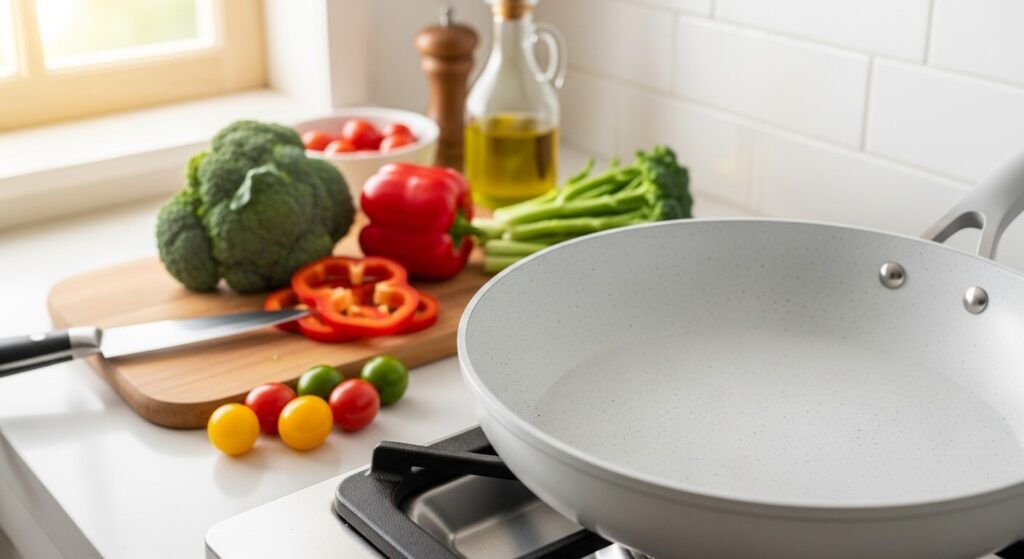
Ceramic coatings are different. They’re made from inorganic, mineral-based materials — no PTFE, no PFOA. That’s the main safety distinction.
Here’s how the two stack up at a glance:
Feature
Ceramic
Traditional PTFE
PTFE-free
✓ Yes
✗ No
PFOA-free
✓ Yes
Mostly yes (post-2013)
Safe at high heat
Up to ~450°F
Up to ~500°F
Eco-friendlier
Generally
Less so
Durability
Moderate
Good
How Ceramic Coatings Are Made
Ceramic coatings aren’t actually solid ceramic — they’re a sol-gel coating applied to a metal base (usually aluminum). The sol-gel process uses silicon dioxide, derived from sand, to create a hard, smooth surface that releases food naturally.
No heavy metals. No synthetic polymers. Just a silica-based layer baked onto the pan at high temperatures. That’s it.
Some manufacturers add additional layers for scratch resistance or heat distribution. GreenPan, for example, uses their Thermolon™ coating, which they claim emits 60% less CO₂ during manufacturing than traditional PTFE coatings. Whether that specific number holds up across the industry is debatable — but the general principle is solid. Ceramic production is less chemically intensive.
One thing worth knowing: “ceramic” in cookware is a marketing term as much as a material description. Not all ceramic coatings are created equal. Some are thicker, some bond better to the base metal, some degrade faster with metal utensils or high heat. Quality varies a lot by brand.
There are some genuine upsides here — not just marketing fluff.
No toxic fumes at normal cooking temps. Even if you accidentally crank the heat too high, ceramic doesn’t off-gas the way PTFE does. Peace of mind, especially if you have birds in the house.
PTFE-free and PFOA-free by design. Not something that was fixed later — it was never part of the formula.
Easy food release when new. Fresh ceramic surfaces are impressively slick. Eggs slide around like they’re on ice.
Easier cleanup. Less scrubbing. Food doesn’t bond to the surface the way it does with stainless or cast iron.
Works well at moderate heat. Great for eggs, fish, pancakes, sautéed vegetables. Anything that benefits from gentle, even heat.
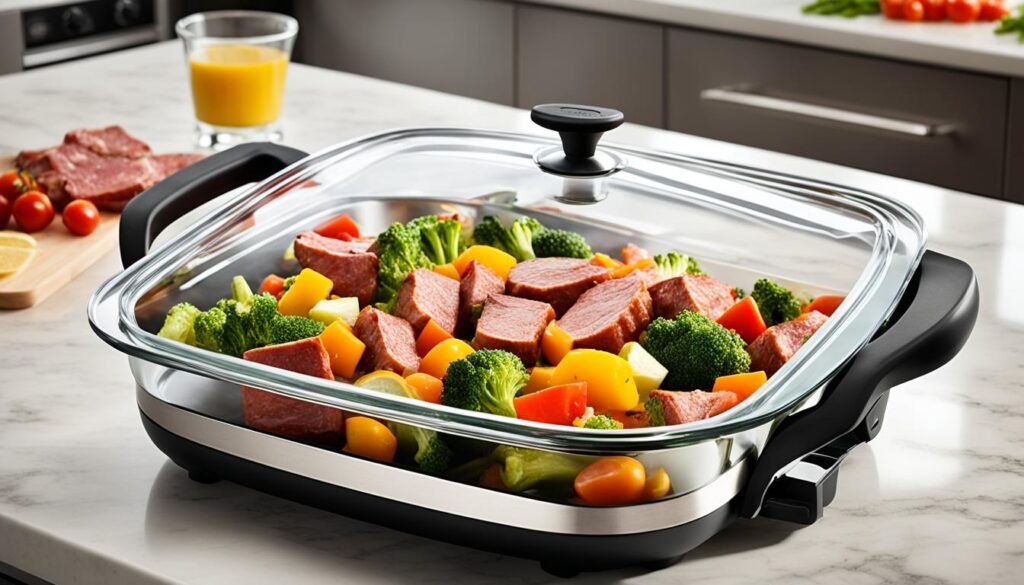
The electric skillet part adds its own benefits too — precise temperature control, portability, no dependence on a stovetop burner. Good for dorms, RVs, or cooking at the table.
Potential Drawbacks of Ceramic Electric Skillets
Okay, here’s where people get surprised. Ceramic isn’t perfect. Not even close.
Durability is the big one. Ceramic coatings wear down faster than PTFE. Use metal utensils once, and you’ve already started the clock on degradation. Stack it with other pans without protection? Same result.
A few more honest limitations:
Nonstick performance fades over time — usually faster than traditional nonstick
Can’t handle very high heat well (above 450°F, degradation accelerates)
Scratch-prone compared to harder coatings
Some cheaper ceramic pans have uneven heat distribution
Not usually dishwasher-safe (even if labeled as such — hand washing extends life significantly)
And one more thing people don’t mention enough: once a ceramic coating starts chipping or flaking, you should replace the pan. The coating itself isn’t toxic if ingested in tiny amounts, but a degraded surface means you’ve lost the nonstick benefit entirely — and uneven flaking looks bad regardless.
Versatility of Ceramic Electric Skillets
More capable than most people expect. That’s the honest assessment.
You can use a ceramic electric skillet for:
Breakfast foods — scrambled eggs, pancakes, French toast, bacon
Stir-fries — the large flat surface and even heat work really well here
Shallow frying — chicken cutlets, fish fillets, tofu
Braising — the lid and temperature control make it surprisingly solid for low-and-slow cooking
Sauces and gravies — yes, really. The even heat prevents scorching.
The large cooking surface (most are 12–16 inches) is genuinely useful when cooking for more than two people. Way easier to cook a full batch of pancakes at once than to do multiple rounds on a standard 10-inch stovetop pan.
Durable and Long-Lasting Construction
“Durable” is relative with ceramic. Let’s be real about that.
Compared to cast iron or stainless steel? Ceramic coatings don’t even come close in longevity. But compared to cheap traditional nonstick? A well-made ceramic skillet holds up decently — if you treat it right.
What actually determines how long your ceramic coating lasts:
Coating thickness — thicker is almost always better
Base metal quality — thick aluminum distributes heat more evenly and prevents hot spots that degrade coatings faster
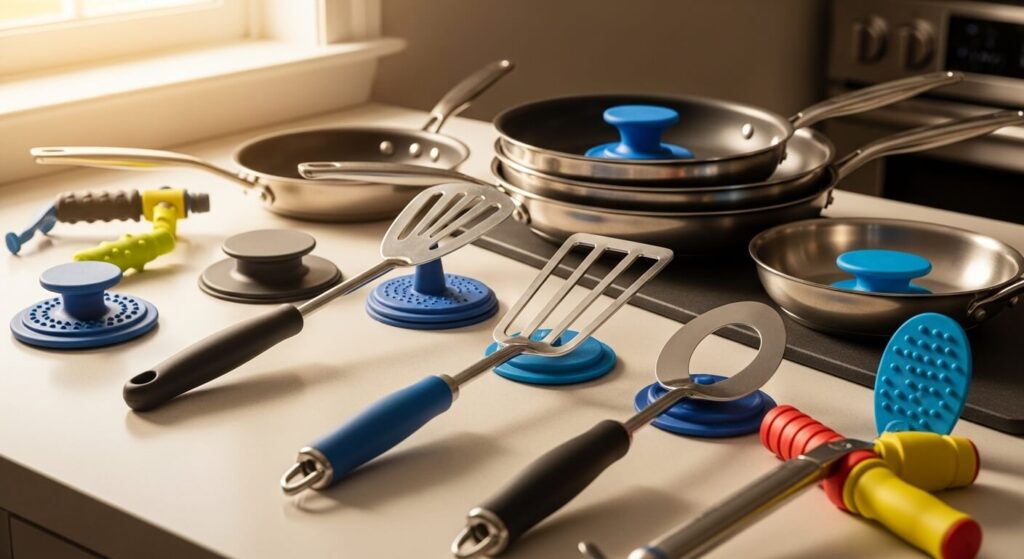
Utensil habits — silicone or wood only, period
Washing method — hand wash every time, gentle soap
Storage — pan protectors between stacked pans, or hang it
Most ceramic electric skillets from reputable brands will hold their nonstick properties for 1–3 years with proper care. Some longer. Some much shorter if you’re rough on them.
The electric skillet housing itself — the base, thermostat, handles — tends to outlast the coating. You might get 5+ years out of the appliance overall, even if the cooking surface starts underperforming before that.
Healthy and Eco-Friendly Cooking
Two things worth separating here: health claims and environmental claims.
Health side: Ceramic coatings don’t leach chemicals into food under normal cooking conditions. No PTFE breakdown. No PFOA exposure. If you’re cooking at appropriate temperatures (under 450°F), you’re not introducing synthetic compounds into your meals. That’s legitimate.
You also need less oil with a ceramic surface — which is a real health benefit for people watching fat intake. Not a huge deal, but worth mentioning.
Eco side: More nuanced. Ceramic coatings are produced without PFOA and with fewer harsh chemicals than PTFE manufacturing. Some brands market this heavily. The manufacturing footprint is genuinely lower in some cases. But “eco-friendly” is a spectrum, and no cookware is truly zero-impact.
The aluminum base common in these skillets has its own environmental cost to produce. Longevity matters too — a pan you replace every year isn’t more eco-friendly than a cast iron pan that lasts 50 years, even if the individual coating is cleaner.
Buy quality. Make it last. That’s the most eco-friendly move.
Comparing Ceramic and Traditional Nonstick Skillets
Straight comparison. No fluff.
Category
Ceramic
Traditional Nonstick (PTFE)
Safety at high heat
Better
Worse (fumes above 500°F)
Initial nonstick performance
Excellent
Excellent
Long-term nonstick performance
Degrades faster
More durable
Chemical concerns
None significant
Mostly resolved post-2013
Scratch resistance
Lower
Higher
Price range
Comparable
Comparable
Eco-friendlier production
Generally yes
Less so
Here’s the honest take: if you’re careful with your cookware and prioritize chemical peace of mind, ceramic wins. If you want something that stays nonstick for years with minimal fuss, traditional PTFE from a quality brand is harder to beat on raw performance.
Neither is perfect. Both have real trade-offs.
Choosing the Right Ceramic Electric Skillet
A few things actually matter here. A lot of the spec sheet stuff is noise.
Size first. Most ceramic electric skillets run between 12 and 16 inches. Cooking for one or two? A 12-inch is plenty. Family of four or five? Go 16-inch. The bigger surface is worth it.
Temperature range and control. Look for a thermostat that goes up to at least 400°F with precise settings in between. Cheap models have vague “low/medium/high” dials. Better models let you dial in 250°F for warming or 375°F for frying. That precision matters.
Coating quality. This is hard to judge from a product listing. Best bet: look at verified buyer reviews after 6–12 months of use. Does the nonstick hold up? That’s your real indicator.
Other things worth checking:
Removable temperature probe (makes washing easier)
Tempered glass lid (you want to see what’s cooking)
Depth — deeper sides (2+ inches) give you more braising and sauce capacity
Drip-free pour spout — underrated feature if you’re making gravies or sauces
Things that matter less than you think: brand logos on the exterior, color options, “dishwasher safe” labels (hand wash anyway).
Care and Maintenance Tips
This is where most people go wrong. Not in choosing the pan — in treating it after the fact.
The non-negotiables:
Silicone or wood utensils only. Metal scratches ceramic. Every time. No exceptions.
Hand wash with soft sponge. Even “dishwasher safe” ceramic degrades faster in the dishwasher. Hot water, gentle soap, done.
Let it cool before washing. Thermal shock — going from hot to cold water fast — can cause micro-cracks in the coating over time.
Avoid cooking spray. Aerosol sprays (like PAM) leave a residue that builds up and makes ceramic surfaces sticky over time. Use a tiny bit of butter or liquid oil instead.
Store carefully. If stacking, put a soft cloth or pan protector between skillets.
Seasoning ceramic — some manufacturers recommend lightly oiling the surface before first use and occasionally thereafter. It won’t restore a degraded coating, but it does help maintain a slicker surface on a newer pan.
And if the coating starts visibly chipping or flaking extensively? Replace it. Don’t talk yourself into continuing to use a pan that’s well past its useful life.
Top Recommended Ceramic Electric Skillets
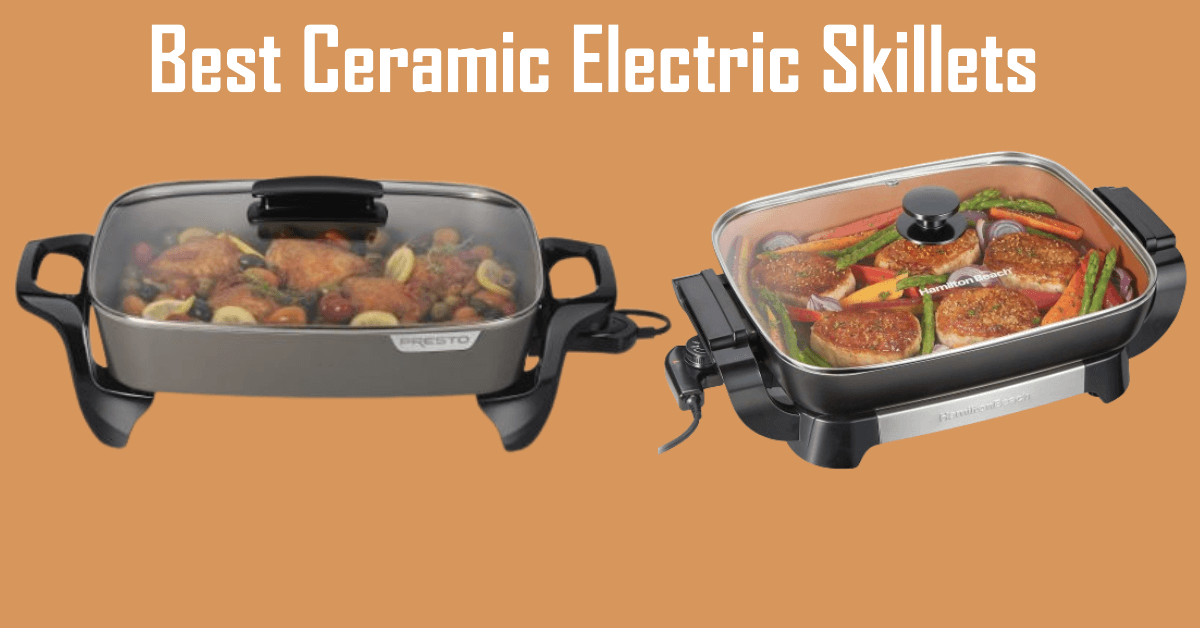
If you want a starting point, the Presto 16-Inch Ceramic Electric Skillet is one of the more consistently well-reviewed options on the market. Large surface, solid temperature control, reasonable price point.
Beyond that, a few names worth looking at:
GreenPan Ceramic Electric Skillet — premium option, Thermolon coating, strong brand reputation for ceramic specifically
Cuisinart CSK-150 — mid-range, reliable thermostat, good size options
Presto 06857 — budget-friendly, widely available, decent performance for the price
What to avoid: generic no-name options under $25. The coating quality on rock-bottom-priced ceramic skillets is usually poor, and you’ll be replacing them within a year. Spend a bit more upfront. It’s worth it.
Ceramic electric skillets are a solid choice — genuinely safer from a chemical standpoint than older nonstick options, versatile enough for most everyday cooking tasks, and easier to clean than almost anything else. They’re not bulletproof, and the coating won’t last forever. But treated well, they’re one of the better tools you can have in a modern kitchen.