Table of Contents
- 1 Understanding Stainless Steel Cookware Grades
- 2 What Do the Numbers Mean in Stainless Steel Cookware?
- 3 Direct Comparison: 18/10 vs 18/0 Stainless Steel Cookware
- 4 Health and Safety Considerations
- 5 Maintenance and Care Comparison
- 6 Which Type of Stainless Steel Cookware Is Right for You?
- 7 Popular Brands and Product Recommendations
Understanding Stainless Steel Cookware Grades
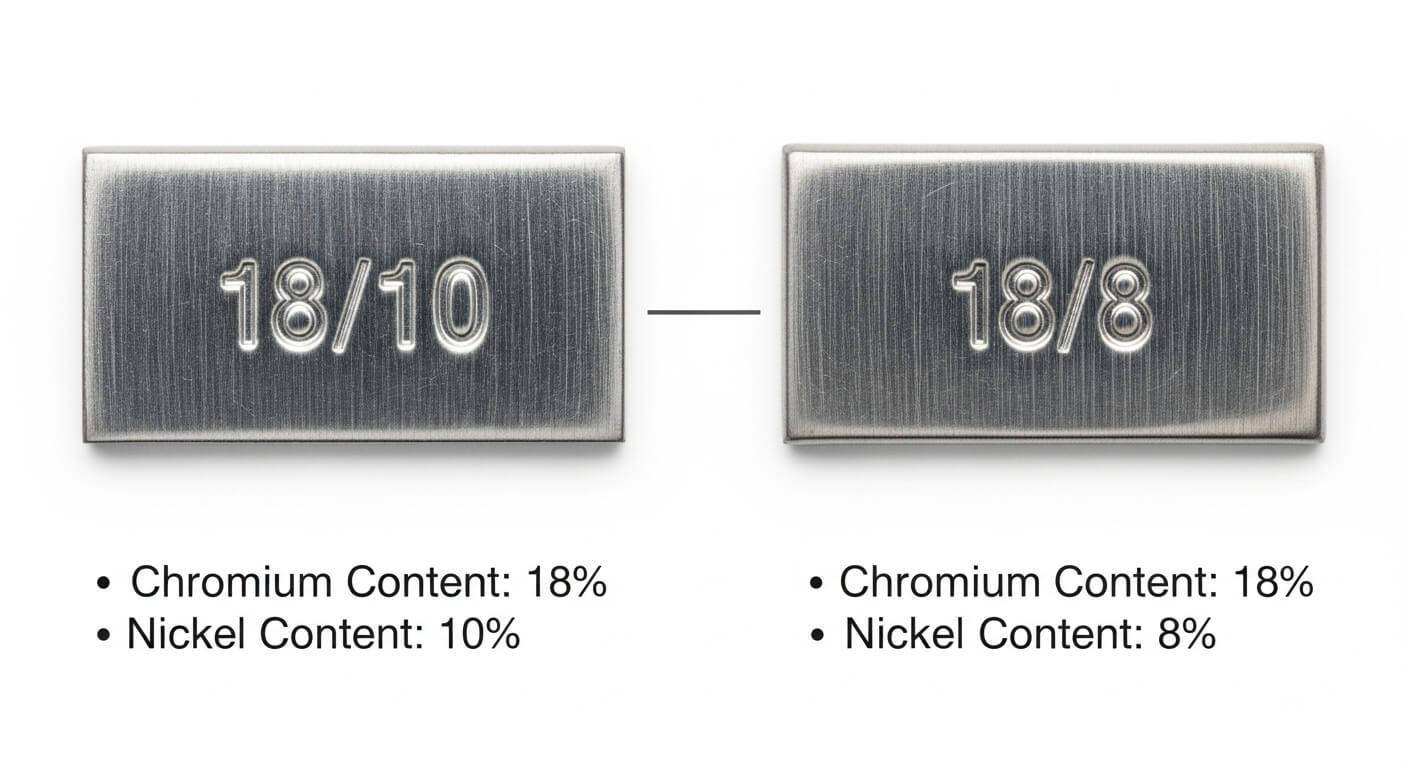
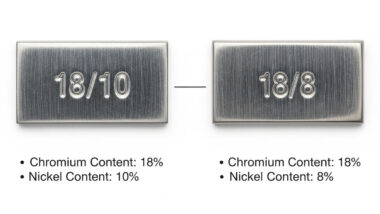
The main differences between 18/10 and 18/0 stainless steel cookware are nickel content, magnetic properties, and price point. These numbers reveal the exact composition: 18/10 contains 18% chromium and 10% nickel, while 18/0 has 18% chromium with zero nickel.
You’re standing in the cookware aisle, comparing two nearly identical pots. One costs $89, the other $129. Both claim professional quality. The cheaper option displays “18/0” on its packaging. The premium set boasts “18/10 stainless steel.” What separates them?
That 10% nickel creates measurable differences in how your cookware performs, looks, and ages over decades of daily use. The choice affects whether your pans work on induction cooktops, how they resist corrosion from acidic tomato sauces, and whether they’re safe for people with metal sensitivities.
Most home cooks purchase cookware without understanding these grade distinctions. Manufacturers rarely explain what those numbers mean or why they matter. This creates confusion when you’re investing hundreds of dollars in equipment you’ll use for 20+ years.
What you’ll I will talk about my in this comparison:
- Composition breakdown – How chromium and nickel percentages alter cookware properties
- Performance metrics – Durability, heat distribution, and resistance to staining measured across both grades
- Compatibility factors – Which grade works with your specific cooktop (gas, electric, induction)
- Health considerations – Nickel allergy concerns and food safety data
- Value analysis – When premium 18/10 justifies its higher cost vs. budget-friendly 18/0
- Maintenance requirements – Cleaning protocols and care differences between grades
The steel grade stamped on your cookware determines more than aesthetics. It influences cooking results, maintenance demands, and lifespan. Some situations demand 18/10’s superior corrosion resistance. Other scenarios make 18/0’s magnetic properties and lower price point the smarter selection.
Professional kitchens stock both grades strategically. Home cooks benefit from the same informed approach rather than defaulting to marketing claims about “restaurant quality” or “professional grade” without understanding material science fundamentals.
What Do the Numbers Mean in Stainless Steel Cookware?
The numbers in stainless steel grades represent the percentage of chromium and nickel in the alloy’s composition. The first number indicates chromium content, while the second shows nickel percentage.
This numerical system provides a standardized way to identify stainless steel types across manufacturers. Understanding these ratios helps you predict how cookware will perform under heat, resist corrosion, and interact with different cooktop surfaces.
Breaking Down the 18/10 Stainless Steel Composition
18/10 stainless steel contains 18% chromium and 10% nickel by weight. The remaining 72% consists primarily of iron, with trace amounts of carbon, manganese, and other elements.
Composition breakdown:
| Element | Percentage | Purpose |
|---|---|---|
| Iron | ~72% | Base metal structure |
| Chromium | 18% | Corrosion resistance, prevents rust |
| Nickel | 10% | Enhances shine, improves durability |
| Other elements | ~0.1% | Carbon, manganese, silicon for strength |
Chromium creates an invisible oxide layer on the surface. This protective barrier prevents oxygen and moisture from reaching the iron beneath, which blocks rust formation. The 18% concentration provides robust protection against kitchen acids, salts, and humidity.
Nickel serves multiple functions beyond appearance. It stabilizes the austenitic crystal structure of the steel, making it non-magnetic or weakly magnetic. This element also enhances resistance to pitting and crevice corrosion—damage that occurs in crevices, joints, and surface deposits where cleaning solutions accumulate.
The industry also calls 18/10 stainless steel “304 grade” or “Type 304.” Some marketing materials reference “surgical steel” or “restaurant grade,” though these terms lack standardized definitions. Professional kitchens favor 304 stainless for its balance of durability and workability.
Understanding 18/0 Stainless Steel Composition
18/0 stainless steel contains 18% chromium with zero nickel content. Manufacturers replace nickel with additional iron and chromium stabilizers to maintain structural integrity.
Composition breakdown:
| Element | Percentage | Purpose |
|---|---|---|
| Iron | ~81% | Base metal structure |
| Chromium | 18% | Corrosion resistance |
| Nickel | 0% | Eliminated for cost and allergy concerns |
| Other elements | ~1% | Manganese, carbon for stability |
The absence of nickel creates a ferritic crystal structure. Steel becomes fully magnetic as a result. This magnetic property makes 18/0 cookware compatible with all induction cooktops without requiring special base layers or modifications.
Manufacturers designate this grade as “430 stainless steel” or “Type 430” in technical specifications. The ferritic structure differs from 18/10’s austenitic form at a molecular level. These crystals align differently, affecting how the metal responds to magnetism and temperature changes.
18/0 costs less to produce because nickel prices fluctuate significantly in global markets. A pound of nickel trades at $7–$10, while iron costs under $0.50 per pound. Removing 10% nickel from the alloy reduces raw material expenses by 15–25% depending on market conditions.
Some people cannot tolerate nickel contact due to allergic reactions. 18/0 cookware addresses this medical concern by eliminating the allergen entirely. Dermatologists recommend nickel-free options for patients with confirmed metal sensitivities.
The Role of Chromium in Stainless Steel Cookware
Chromium determines whether steel qualifies as “stainless” at all. Both 18/10 and 18/0 grades contain identical 18% chromium concentrations.
This element reacts with oxygen to form chromium oxide—a transparent, microscopically thin film that adheres tightly to the steel surface. The film repairs itself within seconds when scratched, provided oxygen is present. Water accelerates this healing process.
Chromium’s protective functions:
- Rust prevention – Blocks iron oxidation that creates red-brown corrosion
- Stain resistance – Prevents discoloration from minerals in tap water
- Acid protection – Shields against degradation from tomatoes, citrus, vinegar
- Heat stability – Maintains protective layer at cooking temperatures up to 800°F
The 18% concentration represents decades of metallurgical optimization. Lower percentages (13–16% chromium) appear in knife blades that prioritize sharpness over corrosion resistance. Higher concentrations (20–26% chromium) exist in specialized industrial applications where extreme chemical exposure occurs.
Cookware manufacturers settled on 18% because it provides adequate protection for kitchen environments without excessive cost. This percentage handles dishwasher detergents, salt exposure, and acidic foods that home cooks encounter daily.
The chromium content remains stable throughout the cookware’s lifespan. Heat cycling doesn’t deplete it. Normal wear doesn’t reduce its concentration. A properly maintained pan retains its corrosion resistance for 30+ years because the protective element is distributed throughout the entire thickness of the steel, not just surface-coated.
The Role of Nickel in Stainless Steel Cookware
Nickel transforms steel’s fundamental properties beyond simple corrosion enhancement. The 10% concentration in 18/10 cookware alters crystal structure, magnetic behavior, and surface characteristics.
This element stabilizes the austenitic phase—a specific arrangement of iron atoms that remains stable at room temperature only when nickel is present. Pure iron naturally forms a ferritic (magnetic) structure. Adding 8–10% nickel shifts the atomic arrangement to austenitic (non-magnetic or weakly magnetic).
Nickel’s specific contributions:
- Enhanced corrosion resistance – Provides 30–40% better protection against pitting compared to 18/0
- Superior luster – Creates the characteristic bright, mirror-like finish on polished cookware
- Ductility improvement – Makes steel easier to shape during manufacturing without cracking
- Crevice corrosion prevention – Protects joints, welds, and riveted handle attachments
The magnetic properties matter for induction cooking. Induction cooktops generate electromagnetic fields that heat ferromagnetic metals directly. Austenitic 18/10 steel shows weak magnetic response, limiting induction compatibility unless manufacturers add a magnetic base layer.
Nickel content affects how cookware ages visually. 18/10 maintains its polished shine longer because nickel resists the micro-corrosion that creates dull, cloudy surfaces. 18/0 develops a more matte, industrial appearance after months of use and dishwasher exposure.
Some individuals experience contact dermatitis from nickel exposure. Studies indicate 10–20% of the population shows some degree of nickel sensitivity. Prolonged skin contact with nickel-containing metal can trigger itching, redness, or rash in sensitive individuals. Food contact poses minimal risk because nickel leaching into meals occurs at negligible levels (under 0.1 mg per serving) with properly manufactured cookware.
The global nickel market creates price volatility for 18/10 cookware. Prices jumped 45% between 2020 and 2022 due to supply chain disruptions. Manufacturers absorb some costs but pass increases to consumers, widening the gap between 18/10 and 18/0 product pricing.
Direct Comparison: 18/10 vs 18/0 Stainless Steel Cookware
18/10 stainless steel offers superior corrosion resistance and shine, while 18/0 provides full induction compatibility and costs 20–40% less. Both grades deliver comparable cooking performance for most home cooking tasks.
The differences between these grades affect specific use cases rather than overall quality. Your cooktop type, budget, and maintenance preferences determine which grade serves you better.
Durability and Corrosion Resistance
18/10 stainless steel outperforms 18/0 in long-term corrosion resistance by measurable margins. The nickel content provides enhanced protection against pitting, especially in environments with frequent salt exposure or acidic ingredients.
Corrosion resistance comparison:
| Factor | 18/10 Performance | 18/0 Performance |
|---|---|---|
| Rust resistance | Excellent (virtually rust-proof with minimal care) | Good (requires proper drying after washing) |
| Pitting from salt | Highly resistant | Moderate resistance |
| Acid damage (tomatoes, citrus) | No visible degradation after years | Minor surface dulling possible |
| Dishwasher longevity | Maintains finish for 15+ years | May develop spots after 5–10 years |
| Coastal/humid climates | Ideal for high-moisture environments | Requires more diligent maintenance |
Tests conducted in commercial kitchens show 18/10 cookware maintains its original finish after 10,000+ dishwasher cycles. 18/0 pieces develop minor surface changes—increased matte appearance and occasional water spots—after 3,000–5,000 cycles under identical conditions.
Both grades resist rust formation better than carbon steel or cast iron. The 18% chromium in each alloy prevents the red-brown oxidation that plagues other metal cookware. Proper care eliminates rust concerns for both types.
18/0 cookware shows vulnerability to crevice corrosion in areas where moisture accumulates. Riveted handles, lid edges, and rim-to-wall joints require thorough drying. Nickel-free steel lacks the secondary protection layer that nickel provides in these problem areas.
Expected lifespan exceeds 20 years for both grades when properly maintained. 18/10 cookware tolerates neglect better—leaving it wet overnight or skipping immediate cleaning causes no permanent damage. 18/0 demands more attentive care to achieve similar longevity.
Appearance and Aesthetic Qualities
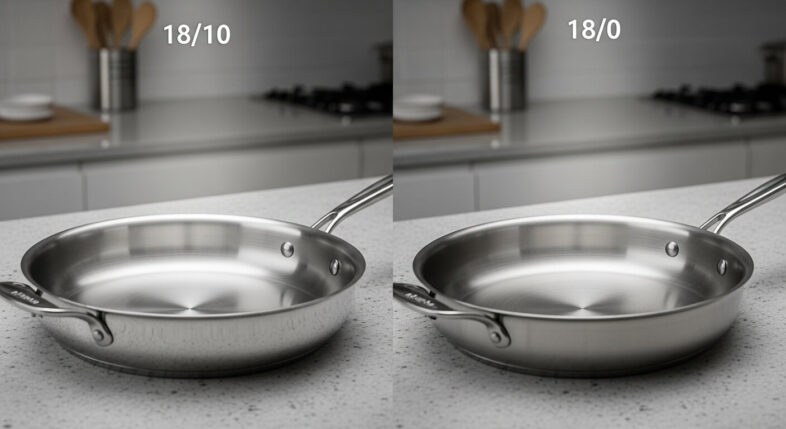
18/10 stainless steel displays a brighter, mirror-like finish that resists dulling over time. 18/0 exhibits a more subdued, matte appearance that becomes more pronounced with regular use.
The nickel content in 18/10 creates the signature “jewelry quality” shine that consumers associate with premium cookware. This luster reflects light uniformly across the surface, creating an upscale kitchen aesthetic. Polishing compounds restore the original shine easily even after years of cooking.
18/0 cookware arrives with a brushed or satin finish that manufacturers select deliberately. The ferritic crystal structure doesn’t accept the same level of polish. This creates a practical, industrial look that many professional kitchens prefer for its ability to hide minor scratches and wear patterns.
Visual characteristics over time:
- 18/10 aging – Maintains reflective shine for 10+ years; minor heat discoloration removed with Bar Keeper’s Friend; scratches remain visible but don’t affect performance
- 18/0 aging – Develops even matte patina; water spots more visible on surface; scratches blend into existing finish; overall appearance stays consistent
Heat stains (rainbow discoloration) appear on both grades when overheated beyond 500°F. These oxidation patterns form more readily on 18/0 surfaces. The discoloration is purely cosmetic—it doesn’t compromise the steel’s integrity or safety.
Professional-grade 18/10 cookware from brands like All-Clad and Demeyere showcases highly polished exteriors that remain brilliant after decades. Restaurant kitchens often choose 18/0 for back-of-house operations where functionality trumps aesthetics.
Cooking Performance Differences
Both 18/10 and 18/0 stainless steel grades deliver identical cooking performance in terms of heat distribution and food browning. The steel composition affects appearance and maintenance, not thermal properties.
Heat distribution depends entirely on the cookware’s construction—specifically the aluminum or copper core between steel layers. A tri-ply 18/0 pan with a thick aluminum core outperforms a thin 18/10 pan without a conductive core. The grade number tells you nothing about cooking ability.
Performance factors that actually matter:
| Factor | Impact on Cooking | Related to Steel Grade? |
|---|---|---|
| Core material (aluminum/copper) | Major impact | No |
| Pan thickness | Significant impact | No |
| Steel grade (18/10 vs 18/0) | No impact | N/A |
| Surface finish (polished/brushed) | Minimal impact | No |
| Ply construction (3-ply, 5-ply) | Major impact | No |
Reactivity with acidic foods shows negligible differences. Both grades are classified as non-reactive, meaning they don’t leach metallic flavors into tomato sauce, wine reductions, or citrus-based dishes. Laboratory tests detect trace metal migration at levels far below FDA safety thresholds for both alloys.
The nickel in 18/10 steel contributes no flavor to food. Concerns about metallic taste stem from poor-quality cookware with thin steel layers or exposed aluminum cores, not from the stainless steel grade itself.
Sticking and food release depend on cooking technique and temperature control. Stainless steel requires preheating and proper fat application regardless of grade. Neither 18/10 nor 18/0 offers non-stick properties—both demand identical cooking methods for optimal results.
Some cooks report that 18/10’s smoother surface releases fond (browned bits) more easily during deglazing. This marginal difference relates to surface polish rather than nickel content. A well-polished 18/0 pan performs identically to 18/10 for building and releasing fond.
Magnetic Properties and Induction Compatibility
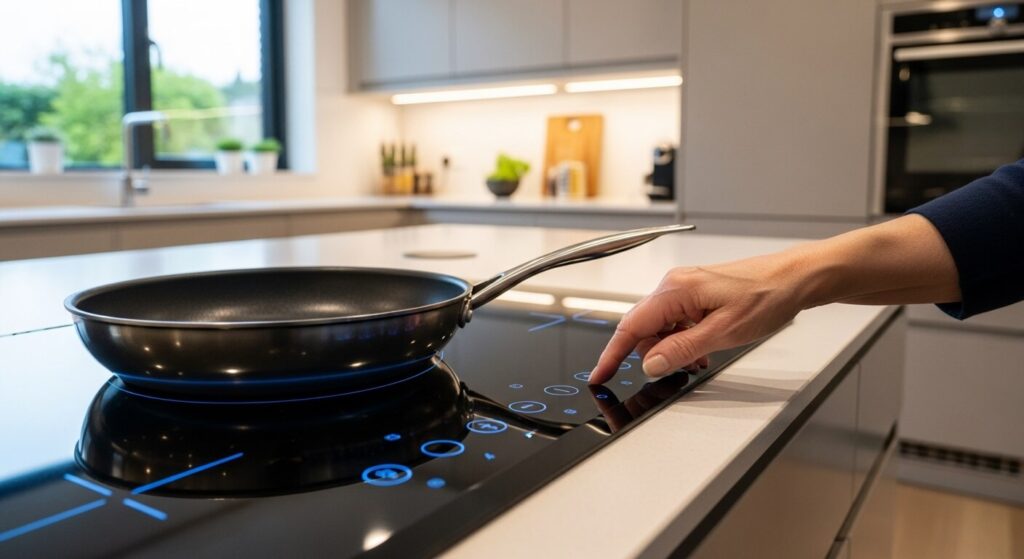
18/0 stainless steel works universally on induction cooktops due to its fully magnetic ferritic structure, while 18/10 requires a magnetic base layer or special construction to function with induction.
Induction cooking generates electromagnetic fields that only heat ferromagnetic materials—metals that respond strongly to magnets. The nickel in 18/10 steel disrupts the iron’s natural magnetism, creating an austenitic structure that induction cooktops cannot detect efficiently.
Induction compatibility breakdown:
| Cookware Type | Magnetic Response | Induction Compatible? | How to Test |
|---|---|---|---|
| Pure 18/10 (no base disk) | Weak or none | No | Magnet won’t stick firmly |
| 18/10 with magnetic disk | Strong (at base only) | Yes | Magnet sticks to bottom only |
| 18/0 (entire pan) | Strong throughout | Yes | Magnet sticks to all surfaces |
| 18/10 fully clad with magnetic layer | Strong (at base) | Yes | Magnet adheres to bottom |
Testing your cookware takes seconds. Hold a refrigerator magnet against the cooking surface. Strong attraction indicates induction compatibility. Weak or no attraction means the pan won’t work on induction, regardless of marketing claims.
Many 18/10 cookware manufacturers add a magnetic stainless steel layer (often 18/0 or 430 grade) to the base during construction. This creates a hybrid design where the cooking surface maintains 18/10’s corrosion resistance while the bottom layer enables induction heating. All-Clad’s D3 and D5 lines use this approach.
18/0 cookware heats efficiently across the entire surface when used on induction. The magnetic properties extend through the full thickness of the steel, not just a bottom layer. This allows for consistent electromagnetic coupling regardless of wear or surface damage.
Gas and electric cooktops don’t care about magnetic properties. Both steel grades perform identically on these heat sources since they rely on conductive heat transfer rather than electromagnetic induction.
Weight and Handle Feel
18/10 cookware weighs approximately 3–5% more than equivalent 18/0 pieces due to nickel’s higher density compared to iron. A 10-inch skillet in 18/10 typically weighs 2.8–3.2 pounds, while the same design in 18/0 weighs 2.7–3.0 pounds.
This weight difference becomes noticeable only when comparing identical pan designs with the same thickness and ply construction. The core material (aluminum or copper) affects weight far more than the steel grade. A thick aluminum core adds more mass than the nickel content in 18/10 steel.
Nickel increases steel density from 7.85 g/cm³ (pure iron) to approximately 7.95 g/cm³ (18/10 alloy). This 1.3% density increase translates to barely perceptible weight changes in finished cookware. Most cooks cannot detect the difference when handling pans side-by-side.
Weight factors ranked by impact:
- Ply construction – 5-ply cookware weighs 40–60% more than 3-ply
- Core thickness – Aluminum layer thickness varies 2–4mm between budget and premium lines
- Pan size – Diameter and wall height determine total material used
- Steel gauge – Thickness of stainless layers (18–20 gauge vs 22–24 gauge)
- Steel grade – 18/10 vs 18/0 contributes minimal weight difference
Handle ergonomics depend on design rather than steel composition. Both grades use identical handle attachment methods—welding or riveting—with no performance differences. The steel used for handles often differs from the cooking surface, with manufacturers selecting materials based on heat resistance and grip comfort.
Balance and maneuverability relate to overall construction quality. A well-designed 18/0 pan handles better than a poorly balanced 18/10 pan. Weight distribution between the cooking surface and handle matters more than the few ounces that nickel content adds.
Price Comparison: 18/10 vs 18/0 Cookware
18/0 stainless steel cookware costs 20–40% less than comparable 18/10 pieces from the same manufacturer. A 10-piece 18/10 cookware set averages $400–$800, while equivalent 18/0 sets range from $250–$500.
Raw material costs drive this price differential. Nickel trades at volatile prices between $8–$12 per pound on global markets, while iron costs under $0.50 per pound. Removing 10% nickel from the alloy composition reduces material expenses by $0.80–$1.20 per pound of finished steel.
Price comparison by cookware type:
| Item | 18/10 Average Price | 18/0 Average Price | Price Difference |
|---|---|---|---|
| 10″ frying pan | $80–$150 | $50–$95 | $30–$55 (31–37%) |
| 3-quart saucepan | $90–$160 | $60–$110 | $30–$50 (28–33%) |
| 8-quart stockpot | $120–$220 | $75–$140 | $45–$80 (36–38%) |
| 10-piece set | $400–$800 | $250–$500 | $150–$300 (34–38%) |
Premium brands like All-Clad, Demeyere, and Made In charge $100+ for single 18/10 skillets. Budget-friendly brands such as Cuisinart and Tramontina offer 18/0 options at $40–$60 for comparable sizes. The construction quality, ply count, and handle design justify some price differences beyond steel grade alone.
The value proposition shifts based on usage patterns. Cooks who use induction cooktops exclusively benefit from 18/0’s lower price and superior magnetic response. Those prioritizing longevity in coastal or humid environments find 18/10’s corrosion resistance worth the premium.
Restaurant supply stores stock primarily 18/0 commercial cookware because bulk purchasing makes price differences significant. A 50-piece kitchen setup costs $2,000–$3,000 less with 18/0 grade compared to 18/10 equivalents. Home cooks buying 10–15 pieces face $300–$600 savings with nickel-free options.
Resale value remains higher for 18/10 cookware due to brand perception and condition retention. Used All-Clad 18/10 pieces sell for 50–70% of original retail price on secondary markets. Generic 18/0 cookware depreciates to 20–30% of purchase price within 5 years.
Health and Safety Considerations
18/0 stainless steel cookware eliminates nickel exposure entirely, making it the only safe choice for individuals with nickel allergies or sensitivities. Both grades meet FDA food safety standards and pose no health risks for people without metal sensitivities.
The health implications of cookware choice matter primarily for the estimated 10–20% of the population who react to nickel contact. For everyone else, both steel grades provide identical food safety profiles.
Nickel Allergies and Sensitivities
Nickel allergy affects 10–20% of adults, with women showing higher sensitivity rates than men at approximately 3:1 ratios. Contact dermatitis from nickel exposure ranks as the most common metal allergy worldwide.
The immune system treats nickel as a foreign substance in sensitive individuals. Skin contact triggers an allergic response that manifests as redness, itching, dry patches, or blisters. Reactions typically appear 12–48 hours after exposure, making the source difficult to identify without patch testing.
Nickel sensitivity symptoms:
- Mild reactions – Itching, slight redness at contact points (hands, wrists)
- Moderate reactions – Raised bumps, dry/scaly skin patches, persistent itching
- Severe reactions – Blistering, weeping lesions, spreading rash beyond contact area
- Systemic reactions – Rare cases involving ingestion show gastrointestinal symptoms
Dermatologists diagnose nickel sensitivity through patch testing, where small amounts of nickel sulfate are applied to skin for 48 hours. Positive reactions confirm the allergy. The American Contact Dermatitis Society lists nickel as the “Allergen of the Year” for 2008 due to its prevalence.
Cookware contact happens primarily through handles during cooking and cleaning. 18/10 stainless steel releases trace nickel amounts during prolonged skin contact, especially when hands are wet or sweaty. Moisture accelerates nickel ion release from the steel surface.
18/0 cookware eliminates this concern completely. Zero nickel content means zero exposure risk, regardless of contact duration or moisture levels. Medical professionals recommend nickel-free cookware for patients with confirmed sensitivities.
Nickel leaching into food from 18/10 cookware:
| Food Type | Cooking Duration | Nickel Released | Safety Threshold |
|---|---|---|---|
| Acidic (tomato sauce) | 2 hours | 0.05–0.08 mg/kg | 0.6 mg/kg (EU limit) |
| Neutral (water) | 2 hours | <0.01 mg/kg | 0.6 mg/kg (EU limit) |
| High-salt brine | 4 hours | 0.03–0.06 mg/kg | 0.6 mg/kg (EU limit) |
Studies published in the Journal of Food Science demonstrate that properly manufactured 18/10 cookware releases nickel at levels 6–12 times below regulatory safety limits. The amounts detected pose no health risk to individuals with nickel allergies because ingestion triggers reactions only at concentrations far exceeding what cookware releases.
Systemic nickel allergy syndrome (SNAS) affects fewer than 1% of nickel-sensitive individuals. These patients react to dietary nickel from foods like chocolate, nuts, and legumes. Even this subset tolerates the minimal amounts that 18/10 cookware contributes during normal cooking.
Food Safety with Both Grades
Both 18/10 and 18/0 stainless steel grades meet FDA regulations for food contact surfaces and pose no contamination risks during normal cooking operations. The chromium content in each alloy creates a stable, non-reactive surface that doesn’t transfer metallic flavors or harmful compounds to food.
The FDA classifies stainless steel containing 16% or more chromium as safe for food contact without restrictions. Both grades exceed this threshold at 18% chromium. Regulatory agencies in the EU, Canada, and Australia maintain similar standards based on chromium content rather than nickel levels.
Food safety certifications:
- NSF International – Both grades receive NSF/ANSI Standard 51 certification for food equipment materials
- FDA 21 CFR 175.300 – Listed as approved materials for food contact surfaces
- EU Regulation 1935/2004 – Compliant with European food contact material requirements
- German BfR – Meets Federal Institute for Risk Assessment standards for cookware
Non-reactive properties distinguish stainless steel from reactive metals like copper, aluminum, or cast iron. Acidic ingredients (tomatoes, wine, vinegar) don’t corrode the surface or create metallic off-flavors. Both 18/10 and 18/0 maintain this non-reactive status across all pH ranges encountered in cooking.
Laboratory testing by independent organizations measures metal migration from cookware into food simulants. Tests use acetic acid solutions (simulating acidic foods) heated for extended periods. Results consistently show both steel grades release metals at levels 10–20 times below regulatory limits.
The primary safety concern with any stainless steel cookware involves manufacturing defects rather than steel grade. Poorly welded seams, thin steel layers that expose aluminum cores, or contaminated metal sources create problems regardless of whether the steel is 18/10 or 18/0. Reputable manufacturers maintain quality control that eliminates these issues.
Chemical composition safety comparison:
| Element | Present in 18/10? | Present in 18/0? | Health Concern? |
|---|---|---|---|
| Chromium (18%) | Yes | Yes | No (bound in oxide layer) |
| Nickel (10% / 0%) | Yes | No | Only for allergic individuals |
| Iron (72% / 81%) | Yes | Yes | No (essential mineral) |
| Manganese (<2%) | Yes | Yes | No (at trace levels) |
Chromium in cookware exists in the trivalent (Cr³⁺) form, which the body requires in trace amounts for insulin function and glucose metabolism. This differs from hexavalent chromium (Cr⁶⁺), an industrial pollutant with known toxicity. The oxide layer on stainless steel contains only the safe trivalent form.
Concerns about chromium or nickel “leaching” from quality stainless steel cookware lack scientific basis. The alloy binds these elements in a stable metallic matrix. Normal cooking temperatures (under 500°F) and household acids cannot break these molecular bonds. The steel remains inert throughout decades of use.
Pitting or deep scratches in stainless steel don’t compromise food safety. The chromium content extends through the entire thickness of the material, not just the surface. Damaged areas reform the protective oxide layer within seconds of exposure to oxygen and moisture.
Dishwasher detergents, even harsh commercial formulations, cannot extract metals from properly manufactured stainless steel. The alkaline pH and chlorine content in these products affect appearance (water spots, dulling) but don’t alter the alloy’s chemical stability or food safety profile.
Maintenance and Care Comparison
18/10 and 18/0 stainless steel cookware require similar daily cleaning routines, but 18/0 demands more thorough drying and attentive maintenance to prevent water spots and surface dulling. Both grades tolerate dishwashers, though hand washing extends their appearance longevity.
The nickel content in 18/10 provides a maintenance advantage through superior resistance to spotting and tarnishing. 18/0 cookware performs identically when cooking but shows wear patterns more quickly without proper care protocols.
Cleaning 18/10 Stainless Steel Cookware
18/10 stainless steel tolerates aggressive cleaning methods while maintaining its polished finish. The nickel content creates a resilient surface that resists the dulling effects of detergents, hard water minerals, and scrubbing.
Daily cleaning protocol:
- Allow cookware to cool for 2–3 minutes after cooking (thermal shock can warp thin pans)
- Rinse with hot water to remove loose food particles
- Wash with dish soap and non-abrasive sponge using circular motions
- Address stuck food by deglazing with water while pan is warm
- Rinse thoroughly to remove all soap residue
- Dry immediately with microfiber cloth to prevent water spots
Hot, soapy water handles most cooking residue on 18/10 surfaces. The smooth finish releases food particles easily compared to rougher steel grades. Nylon scrubbers or soft-bristle brushes remove stubborn bits without scratching the polished surface.
Water spots form when minerals in tap water dry on the surface. These white, cloudy deposits don’t damage the steel but diminish the mirror finish that 18/10 provides. Immediate drying after washing prevents spot formation regardless of water hardness in your area.
Removing discoloration and restoring shine:
| Issue | Cause | Solution | Application Method |
|---|---|---|---|
| Rainbow heat stains | Overheating (500°F+) | Bar Keeper’s Friend | Apply paste, scrub gently, rinse within 1 minute |
| White mineral deposits | Hard water drying | White vinegar soak | 5-minute soak, then scrub and rinse |
| Cloudy film | Detergent buildup | Baking soda paste | Scrub with damp sponge, rinse thoroughly |
| Burned-on food | High heat + sugars | Boiling water + baking soda | Simmer 10 minutes, scrape with wooden spoon |
Bar Keeper’s Friend—a powder cleanser containing oxalic acid—removes heat discoloration and restores original shine to 18/10 cookware. Apply the powder to a damp surface, scrub for 30–60 seconds, then rinse immediately. Extended contact (over 2 minutes) can dull the finish, so timing matters.
The oxalic acid in Bar Keeper’s Friend dissolves the chromium oxide layer temporarily, removing discoloration trapped in the oxide film. The chromium reforms its protective layer within seconds of rinsing, leaving a clean, bright surface without compromising corrosion resistance.
Avoid chlorine bleach or cleaners containing chlorides on stainless steel. These chemicals can initiate pitting corrosion even on 18/10 grade, especially if left in contact for extended periods. Cookware that shows small pits after cleaning likely encountered chlorine-based products.
Dishwasher considerations for 18/10:
- Safe for daily use – Modern dishwashers won’t damage 18/10 steel structurally
- Finish degradation – Expect gradual shine loss after 3,000–5,000 cycles
- Hard water effects – Mineral buildup occurs faster in dishwashers than hand washing
- Detergent selection – Powder detergents are more abrasive than gel or tablet forms
- Placement matters – Position pans to avoid contact with other metal items
Professional chefs hand wash 18/10 cookware to maintain appearance standards. Home cooks who prioritize convenience over pristine shine can dishwasher-clean daily without functional consequences. The steel remains structurally sound and food-safe regardless of cleaning method.
Cleaning 18/0 Stainless Steel Cookware
18/0 stainless steel requires immediate and thorough drying after each wash to prevent rust spots and mineral deposits. The absence of nickel makes the surface more vulnerable to water-related damage compared to 18/10.
Rust formation on 18/0 cookware signals inadequate drying rather than material failure. The 18% chromium content provides excellent rust resistance when the surface stays dry. Moisture trapped in crevices, under handles, or along rim edges creates localized corrosion over time.
18/0-specific care requirements:
- Mandatory drying – Towel-dry completely within 5 minutes of washing; air drying allows water spots
- Handle attention – Moisture collects where handles attach; dry these areas thoroughly
- Storage conditions – Avoid storing while damp; ensure cabinet ventilation
- Humidity concerns – Coastal or basement kitchens need extra vigilance
- Immediate use – Rewash if cookware sits unused for weeks (prevents oxidation)
The matte finish on 18/0 cookware shows water spots more prominently than polished 18/10 surfaces. These spots don’t damage the steel but create an uneven, streaked appearance that many cooks find unappealing. A quick wipe with a dry cloth after washing prevents this cosmetic issue.
18/0 steel responds differently to cleaning products than 18/10. Acidic cleaners like Bar Keeper’s Friend work effectively but should remain in contact for shorter durations—30 seconds maximum. The nickel-free composition reacts more readily to oxalic acid, requiring careful timing to avoid surface etching.
Preventing rust on 18/0 cookware:
- Never soak overnight – Extended water exposure compromises the chromium oxide layer
- Dry rivets and seams – Use cloth corner or paper towel to reach crevice areas
- Oil occasionally – Light coating of cooking oil on clean, dry surface adds protection
- Address rust immediately – Small spots respond to baking soda paste before spreading
- Control humidity – Store in dry cabinets; avoid stacking wet pans
Minor rust spots on 18/0 surfaces can be removed with a baking soda paste and gentle scrubbing. Mix three parts baking soda with one part water, apply to affected areas, scrub with a damp cloth for 60 seconds, then rinse and dry thoroughly. The mild abrasive action removes surface rust without damaging the underlying steel.
Prevention matters more than treatment with 18/0 cookware. Establishing a consistent drying routine eliminates rust concerns entirely. Cooks in humid climates or those storing cookware in damp areas should consider 18/10 if thorough drying feels burdensome.
Dishwasher compatibility for 18/0:
| Factor | Recommendation | Reasoning |
|---|---|---|
| Overall safety | Proceed with caution | Structurally safe but appearance suffers |
| Drying cycle | Use heated dry + extended dry | Moisture elimination prevents rust |
| Removal timing | Unload immediately when cycle ends | Don’t let pans sit in humid dishwasher |
| Frequency | Hand wash 50%+ of the time | Alternating methods extends finish life |
| Hard water areas | Hand wash exclusively | Dishwasher mineral buildup accelerates dulling |
Dishwasher detergents contain harsh alkalis and chlorine compounds that affect 18/0 surfaces more than 18/10. The matte finish becomes progressively duller after repeated dishwasher exposure. This cosmetic change doesn’t impair cooking performance but contradicts the industrial aesthetic that many buyers prefer.
Restaurant kitchens using 18/0 cookware typically hand wash and machine dry (commercial dish machines with high-temperature drying). This combination provides sanitation without leaving moisture that causes spotting or rust. Home cooks lacking commercial equipment should hand wash and towel dry for optimal results.
Long-Term Maintenance for Both Types
Both 18/10 and 18/0 stainless steel grades resist permanent damage from cooking abuse, but proper maintenance extends appearance and performance beyond 20 years. The steel itself remains stable; surface condition determines whether cookware looks 5 years old or 25 years old.
Stuck-on food requires thermal shocking for efficient removal. Pour cold water into a hot pan (or vice versa) to create rapid temperature changes that loosen carbonized residue. The metal contracts or expands suddenly, breaking the bond between stuck food and steel surface. A wooden or silicone spatula then scrapes debris away without scratching.
Dealing with stubborn cooking residue:
- Protein-based (eggs, cheese) – Soak in warm water with dish soap for 15 minutes; protein breaks down naturally
- Starch-based (rice, pasta) – Boil water in pan for 5 minutes; starch releases from surface
- Caramelized sugars – Simmer baking soda solution (1 tablespoon per cup water) for 10 minutes
- Oil polymerization – Bar Keeper’s Friend paste removes the hardened film
- Burned-on layers – Combine boiling water + baking soda + vinegar for chemical and physical loosening
Heat stains—rainbow-colored discoloration appearing after high-heat cooking—form on both steel grades when temperatures exceed 500°F. These chromium oxide patterns are purely cosmetic. The steel retains full functionality, corrosion resistance, and food safety despite the discoloration.
Removing heat stains matters only for appearance. Bar Keeper’s Friend dissolves the thickened oxide layer, returning the surface to its original color. Cooks who don’t mind the rainbow patterns can ignore this maintenance step entirely without consequences.
Scratches accumulate on all stainless steel cookware regardless of grade. Metal utensils, abrasive scrubbers, and contact with other pans create surface marks over years of use. These scratches don’t penetrate deeply enough to compromise the chromium content or structural integrity.
Storage recommendations:
- Pan protectors – Felt or silicone dividers prevent scratching when stacking
- Hang if possible – Wall or ceiling racks eliminate stacking contact entirely
- Dry storage mandatory – Cabinets should have air circulation; avoid enclosed humid spaces
- Separate lids – Store lids separately or use protective layers between lid and pan
- Avoid overcrowding – Allow air circulation around each piece
Replacement becomes necessary when structural damage occurs—warping from thermal shock, handle detachment, or holes from manufacturing defects. Surface wear, scratches, and discoloration represent normal aging that doesn’t affect cooking performance. Quality stainless steel cookware in either grade lasts 25–40 years with proper care.
Warping happens when thin pans experience rapid temperature changes (cold water in a hot pan, or heating empty pans). Warped cookware doesn’t sit flat on cooktop surfaces, creating uneven heating that hampers cooking performance. Thick, fully-clad construction resists warping better than thin single-layer pans regardless of steel grade.
Handle attachment failure typically results from manufacturing defects rather than usage patterns. Riveted handles outlast welded handles in commercial kitchen environments with extreme use. Home cooks rarely encounter handle problems within the cookware’s useful lifespan if they purchase quality construction.
Which Type of Stainless Steel Cookware Is Right for You?
Choose 18/0 stainless steel if you use induction cooktops, have nickel sensitivities, or prioritize budget savings of 20–40%. Select 18/10 if you want maximum corrosion resistance, premium appearance, or plan to use cookware in humid environments.
Your specific cooking situation determines which grade serves you better. Neither option is universally superior—the right choice depends on measurable factors like cooktop compatibility, health requirements, and maintenance preferences.
Choose 18/10 Stainless Steel Cookware If:
18/10 stainless steel delivers optimal performance for cooks who prioritize appearance retention and minimal maintenance requirements. The nickel content provides tangible benefits that justify the 20–40% price premium in specific use cases.
Ideal scenarios for 18/10 cookware:
- Gas or electric cooktop users – Induction compatibility isn’t needed; you benefit from 18/10’s superior shine without magnetic limitations
- Coastal or humid climates – Enhanced corrosion resistance matters in high-moisture environments (oceanfront homes, basements, poorly ventilated kitchens)
- Low-maintenance preference – Tolerates occasional neglect; survives being left wet overnight without rust spots
- Visual standards matter – Professional appearance with mirror finish retained for 15+ years
- Dishwasher-intensive cleaning – Maintains finish through 5,000+ dishwasher cycles with minimal dulling
- Long-term investment mindset – Higher resale value and appearance preservation over 20–30 years
The nickel in 18/10 cookware creates a forgiving surface that recovers from maintenance lapses. Cooks who occasionally forget to dry pans immediately or who run cookware through the dishwasher daily benefit from this resilience. The steel maintains its original appearance despite less-than-perfect care.
Professional kitchens in fine dining establishments choose 18/10 for front-of-house operations where presentation matters. The polished finish photographs well and projects quality to diners who see cookware at tableside or in open kitchens.
Performance advantages worth the premium:
| Benefit | Value Proposition | Who Benefits Most |
|---|---|---|
| Superior pitting resistance | 30–40% better protection against salt and acid damage | Heavy users of acidic ingredients, high-salt cooking |
| Sustained shine | Maintains reflective finish 3–5 years longer than 18/0 | Cooks who value aesthetics, open shelving display |
| Reduced maintenance | Requires less frequent polishing and spot removal | Busy households, minimal-maintenance preference |
| Moisture tolerance | Can air dry without rust concerns | Humid climates, dishwasher users |
Home cooks building a permanent cookware collection find 18/10’s longevity justifies initial costs. The difference between $600 and $900 for a 10-piece set becomes negligible when amortized over 25 years—approximately $12 annually for superior corrosion resistance and appearance.
Collectors of premium brands (All-Clad, Demeyere, Cristel) encounter 18/10 as the standard grade. These manufacturers build their reputations on nickel-containing steel, optimizing their designs around 18/10’s properties. Mixing brands within your collection works seamlessly when all pieces use the same steel grade.
Choose 18/0 Stainless Steel Cookware If:
18/0 stainless steel provides identical cooking performance at substantially lower cost while solving specific technical requirements that 18/10 cannot address. The nickel-free composition creates advantages beyond simple price savings.
Situations where 18/0 outperforms 18/10:
- Induction cooktop compatibility – Works universally without requiring special magnetic base layers; heats efficiently across entire surface
- Nickel allergy or sensitivity – Eliminates all exposure risks for 10–20% of population with metal sensitivities
- Budget constraints – Saves $150–$300 on 10-piece sets with no cooking performance sacrifices
- Magnetic storage systems – Adheres strongly to magnetic knife strips, wall-mounted magnetic bars, or magnetic trivets
- Commercial kitchen applications – Restaurants prioritize function over appearance; 18/0 delivers durability at lower replacement costs
- Functional aesthetic preference – Industrial matte finish appeals to cooks who prefer utilitarian appearance
The fully magnetic properties of 18/0 cookware extend beyond induction compatibility. Magnetic pot racks, wall-mounted storage systems, and organizational solutions work perfectly with 18/0 pieces. 18/10 cookware either doesn’t adhere or holds weakly, limiting storage options.
Medical professionals with confirmed nickel allergies face limited choices in quality cookware. 18/0 provides the only stainless steel option that eliminates exposure concerns while maintaining the non-reactive properties that stainless steel offers. Cast iron and carbon steel contain no nickel but require seasoning and react with acidic foods.
Cost savings breakdown for 18/0:
| Purchase Scenario | 18/10 Cost | 18/0 Cost | Savings | Savings % |
|---|---|---|---|---|
| Single 10″ skillet | $120 | $75 | $45 | 37% |
| 3-piece starter set | $240 | $150 | $90 | 37% |
| 10-piece complete set | $700 | $425 | $275 | 39% |
| Restaurant 25-piece setup | $2,800 | $1,650 | $1,150 | 41% |
New cooks building their first kitchen benefit from 18/0’s affordability. The money saved can purchase complementary equipment—quality knives, cutting boards, or specialty items like Dutch ovens—that impact cooking success more than steel grade selection.
Student housing, vacation homes, or rental properties suit 18/0 cookware perfectly. The lower investment risk matters when equipment faces heavy use by multiple people with varying care standards. Replacing damaged 18/0 pieces costs half what 18/10 replacements demand.
Restaurant supply stores stock primarily 18/0 commercial cookware for good reason. Professional kitchens replace equipment every 3–7 years as volume use takes its toll. The cost difference multiplies across 50–100 pieces, making 18/0 the financially rational choice when cosmetic wear is acceptable.
Maintenance commitment for 18/0 users:
- Accept that diligent drying becomes mandatory rather than optional
- Embrace the matte finish that develops naturally over time
- Commit to hand washing 50%+ of the time for optimal longevity
- Monitor moisture in storage areas to prevent rust formation
- Consider the industrial aesthetic a feature rather than a limitation
Cooks who enjoy equipment maintenance find 18/0’s requirements satisfying rather than burdensome. The immediate drying protocol takes 30 seconds per piece—negligible time investment for substantial cost savings and perfect induction compatibility.
When Either Grade Works Well
Both 18/10 and 18/0 stainless steel grades deliver identical results for 90% of home cooking tasks. The steel composition affects durability and appearance but doesn’t alter how food cooks, browns, or releases from the surface.
Cooking tasks where grade is irrelevant:
- Searing proteins – Both grades create identical fond and browning patterns
- Simmering sauces – Heat distribution depends on core material, not steel grade
- Boiling water – Pasta, vegetables, and grains cook identically in either grade
- Sautéing vegetables – Surface properties remain the same across both alloys
- Deglazing for pan sauces – Both grades release fond equally when properly deglazed
The aluminum or copper core between steel layers determines actual cooking performance. A 3-ply 18/0 pan with a thick aluminum core outperforms a thin 18/10 pan with minimal core material. Construction quality matters exponentially more than steel grade for heat distribution and hot spot prevention.
Professional chefs working in high-volume kitchens achieve identical results with either grade. The techniques that prevent sticking—proper preheating, adequate fat, correct temperatures—work the same regardless of nickel content. Recipe outcomes depend on skill and technique, not steel composition.
Situations where differences are negligible:
| Cooking Scenario | Grade Impact | What Actually Matters |
|---|---|---|
| Daily breakfast cooking | None | Pan thickness, heat control |
| Weeknight dinner prep | None | Core material quality |
| Holiday meal preparation | None | Size selection, construction |
| Meal prep batch cooking | None | Even heating from ply construction |
| Baking (oven-safe pans) | None | Handle design, oven temperature rating |
Home cooks without induction cooktops or nickel sensitivities can choose based purely on budget and aesthetic preference. The performance ceiling remains identical—neither grade cooks better than the other when construction quality matches.
Mixed collections combining both grades function seamlessly. A 10-piece set might include 18/10 skillets for their appearance alongside 18/0 stockpots where visual appeal matters less. This hybrid approach optimizes spending by allocating premium grade to showcase pieces while using budget-friendly options for utility cookware.
Testing conducted by cooking equipment laboratories shows no measurable difference in heat distribution, hot spot formation, or thermal responsivity between equivalent 18/10 and 18/0 constructions. The steel cladding serves primarily as a non-reactive cooking surface and corrosion barrier—functions both grades fulfill equally.
Popular Brands and Product Recommendations
All-Clad, Cuisinart, and Tramontina manufacture both 18/10 and 18/0 stainless steel cookware, with premium brands favoring 18/10 for its corrosion resistance while budget-conscious manufacturers offer 18/0 for induction compatibility and lower costs. Brand selection matters more than steel grade for construction quality and warranty support.
The cookware market segments clearly by steel grade, with manufacturers positioning their products based on target customer priorities. Understanding which brands specialize in each grade helps you identify quality options within your budget.
Top 18/10 Stainless Steel Cookware Brands
Premium manufacturers build their reputations on 18/10 stainless steel, using the nickel-containing alloy as a foundation for multi-ply construction. These brands optimize their designs around 304 grade steel’s properties.
Leading 18/10 cookware manufacturers:
| Brand | Price Range | Ply Construction | Made In | Warranty | Notable Features |
|---|---|---|---|---|---|
| All-Clad | $$$$ | 3-ply, 5-ply | USA | Limited lifetime | Industry standard; fully clad construction |
| Demeyere | $$$$ | 3-ply to 7-ply | Belgium | 30 years | Proprietary Silvinox treatment; welded handles |
| Made In | $$$ | 5-ply | USA/France | Lifetime | Direct-to-consumer pricing; professional grade |
| Cristel | $$$$ | 3-ply | France | Lifetime | Removable handles; modular system |
| Zwilling | $$$ | 3-ply | Belgium/China | Lifetime | German engineering; balanced construction |
| Cuisinart MultiClad Pro | $$ | 3-ply | China | Lifetime | Budget entry into fully clad 18/10 |
All-Clad dominates the American premium cookware market with its D3 (3-ply) and D5 (5-ply) collections. Both lines use 18/10 stainless steel on cooking surfaces with aluminum cores for heat distribution. The D3 collection offers better value—the additional two layers in D5 provide minimal performance improvement for 40–50% higher cost.
Demeyere’s Proline and Atlantis collections represent Belgian engineering at its finest. The brand applies a Silvinox electrochemical treatment that removes iron particles from the surface, creating an exceptionally bright finish that resists fingerprints and requires less polishing than standard 18/10.
Made In emerged as a direct-to-consumer brand that eliminates retail markup. Their 5-ply construction uses American-made steel with French craftsmanship, delivering All-Clad-equivalent quality at 30–40% lower prices. A 10″ skillet costs $99 compared to All-Clad’s $165.
What separates quality 18/10 construction:
- Fully clad design – Steel-aluminum-steel layers extend from base through sidewalls (not just disc bottom)
- Thick aluminum core – Minimum 2mm aluminum layer for even heating
- Precision machining – Flat bases that maintain contact with cooktop surfaces
- Ergonomic handles – Balanced weight distribution; stay-cool design for stovetop use
- Tight-fitting lids – Creates seal that traps moisture and heat efficiently
Avoid 18/10 cookware with disc bottoms rather than fully clad construction. These budget alternatives bond an aluminum disc to the base while using thin single-layer steel for sidewalls. Heat concentrates at the bottom, creating hot spots and uneven cooking that negates the benefits of quality steel.
Premium 18/10 brands offer sets ranging from $400 to $1,200 for 10-piece collections. Individual pieces cost $80–$250 depending on size and construction complexity. Skillets and sauté pans command premium prices due to their layered sidewall construction.
Top 18/0 Stainless Steel Cookware Brands
Manufacturers producing 18/0 cookware focus on induction compatibility and value pricing. These brands deliver solid construction quality while eliminating nickel to reduce costs and address allergy concerns.
Leading 18/0 cookware options:
| Brand | Price Range | Target Market | Construction | Warranty | Best For |
|---|---|---|---|---|---|
| Cuisinart Chef’s Classic | $ | Home cooks | Aluminum disc base | Lifetime | Budget-conscious beginners |
| Tramontina Tri-Ply Clad | $$ | Value seekers | 3-ply clad | Lifetime | All-around value; NSF certified |
| Vollrath Tribute | $$ | Commercial use | 3-ply clad | NSF listed | Restaurant durability at home |
| Update International | $ | Commercial/institutional | Aluminum encapsulated | 1 year | High-volume bulk purchasing |
| AmazonBasics | $ | Entry-level | Aluminum disc base | 1 year | Temporary/rental properties |
Tramontina’s Tri-Ply Clad line offers the best value in 18/0 cookware. Brazilian manufacturing keeps costs down while maintaining NSF certification for commercial use. A 10-piece set costs $250–$300, delivering fully clad construction at prices competing with disc-bottom 18/10 alternatives.
Vollrath manufactures commercial cookware for restaurants but sells directly to consumers through restaurant supply retailers. Their Tribute line uses 18/0 steel with heavy-gauge aluminum cores designed for high-volume professional use. Single pieces cost 20–30% less than All-Clad equivalents with comparable construction quality.
Cuisinart segments their product line by steel grade. The Chef’s Classic collection uses 18/0 steel with aluminum disc bottoms, targeting price-sensitive consumers who want recognizable brand names. Quality is adequate for casual cooking but lacks the even heating that fully clad construction provides.
Evaluating 18/0 quality markers:
- Magnetic test confirmation – Verify strong magnetic response across entire surface
- Construction method – Fully clad outperforms disc bottom significantly
- Thickness gauge – Look for specifications listing 2.5mm+ total thickness
- Handle attachment – Riveted handles outlast welded in commercial environments
- NSF certification – Indicates restaurant-grade standards for materials and construction
Restaurant supply stores (WebstaurantStore, Wasserstrom, Katom) stock primarily 18/0 commercial cookware at wholesale pricing. Home cooks gain access to professional-quality equipment at 40–60% below retail prices by purchasing through these channels. Most items ship without fancy packaging but include full manufacturer warranties.
Budget 18/0 options from AmazonBasics or generic manufacturers serve specific purposes—rental properties, college housing, or temporary situations. These products use thin steel over minimal aluminum, resulting in hot spots and warping. They function adequately for basic tasks but frustrate serious cooks with uneven heating.
Hybrid Options and Multi-Ply Construction
Some manufacturers combine 18/10 and 18/0 steel grades in the same cookware piece, using each alloy strategically to optimize performance and compatibility. These hybrid designs address induction requirements while maintaining 18/10’s cooking surface benefits.
Multi-grade construction approaches:
| Design Type | Cooking Surface | Base Layer | Purpose | Examples |
|---|---|---|---|---|
| 18/10 with magnetic plate | 18/10 stainless | 18/0 or 430 steel | Induction compatibility for premium cookware | All-Clad D3, D5 lines |
| Copper core with mixed steel | 18/10 interior | 18/0 magnetic exterior | Heat + induction + appearance | All-Clad Copper Core |
| 18/0 with 18/10 interior | 18/10 cooking surface | 18/0 magnetic base | Premium surface, induction ready | Demeyere Industry 5 |
All-Clad’s popular D3 and D5 collections technically use hybrid construction despite marketing emphasizing 18/10 grade. The cooking surface uses 18/10 steel for corrosion resistance and appearance. A thin layer of magnetic stainless steel (either 18/0 or 430 grade) forms the exterior base, enabling induction compatibility.
This layering approach provides optimal performance across all cooktop types. Gas and electric users benefit from 18/10’s non-reactive cooking surface. Induction users get efficient magnetic coupling from the base layer. The construction requires precise manufacturing to bond dissimilar steel grades without delamination.
Tri-ply construction refers to three-layer cookware: steel exterior, aluminum core, steel interior. The most common configuration uses 18/10 stainless for both exterior and interior layers with aluminum between them. This delivers even heating while maintaining corrosion resistance on both surfaces.
Ply count explained:
- 3-ply (tri-ply) – Steel-aluminum-steel; optimal for most home cooking
- 5-ply – Adds stainless-aluminum-stainless layers; marginal performance gains for 40% higher cost
- 7-ply – Marketing gimmick; additional layers don’t improve heating noticeably
Five-ply and seven-ply constructions multiply thin layers of steel and aluminum. Manufacturers claim superior performance, but independent testing shows negligible differences compared to quality 3-ply cookware. The additional layers increase weight and cost without proportional cooking benefits.
Copper core cookware sandwiches a copper layer between stainless steel layers. Copper conducts heat 60% better than aluminum, providing exceptionally responsive temperature control. All-Clad Copper Core and Demeyere Atlantis use this construction, typically combining 18/10 interiors with magnetic steel exteriors for universal cooktop compatibility.
Construction method impacts performance more than steel grade selection. A well-designed 3-ply 18/0 pan outperforms poorly constructed 18/10 cookware every time. Focus on fully clad construction, adequate core thickness (2mm+ aluminum), and reputable manufacturing before obsessing over nickel content.