Table of Contents
- 1 Understanding the Skillet vs Griddle Debate
- 2 What Is a Skillet?
- 3 What Is a Griddle?
- 4 Skillet vs Griddle: Key Differences Explained
- 5 When to Use a Skillet Over a Griddle
- 6 When to Use a Griddle Over a Skillet
- 7 Skillet vs Griddle: Pros and Cons Comparison
- 8 Material Considerations: Skillet vs Griddle Options
- 9 Cooking Performance: Skillet vs Griddle Head-to-Head
- 10 Size and Storage: Practical Considerations
- 11 Price Comparison: Skillet vs Griddle Investment
- 12 Skillet vs Griddle: Which Should You Choose?
Understanding the Skillet vs Griddle Debate
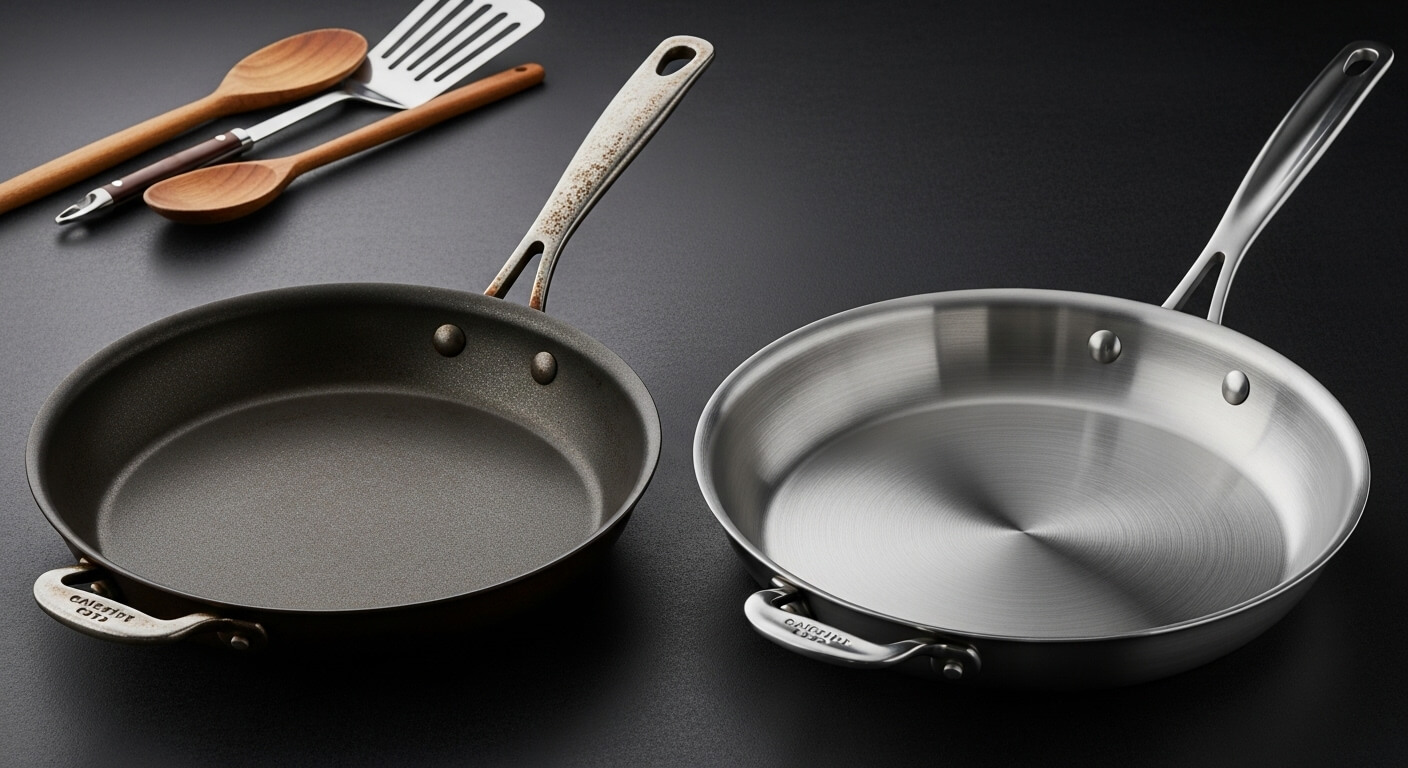
The main differences between skillets and griddles come down to their sides, cooking surface area, and liquid-handling capabilities. Skillets feature raised sides (1.5-3 inches) that contain sauces and liquids, while griddles offer a flat or minimally-raised surface that maximizes cooking space. This fundamental design distinction determines which tool works best for specific dishes.
Most home cooks own a skillet. Far fewer have invested in a griddle. The choice between these two cooking surfaces affects everything from your weekend pancake production to weeknight stir-fry preparation. A skillet excels at sautéing vegetables in butter or searing steaks with pan sauces. Griddles, by contrast, shine when you need to flip multiple pancakes simultaneously or cook an entire package of bacon without crowding.
What you’ll learn in this guide:
- Precise definitions and characteristics of both cooking surfaces
- When each tool outperforms the other
- Material options (cast iron, non-stick, stainless steel) and their impact on performance
- Storage, maintenance, and price considerations
- Whether your kitchen needs one or both
The wrong choice means struggling with tasks your cookware wasn’t designed to handle. Trying to flip pancakes in a 12-inch skillet with 2-inch sides creates unnecessary difficulty. Conversely, attempting to cook curry on a flat griddle results in sauce spilling onto your stovetop. Understanding these tools prevents such frustrations.
Your cooking habits should drive this decision. Someone who prepares breakfast for a family of five faces different requirements than a person who primarily makes one-pan dinners. This comparison breaks down the practical differences to match cookware with cooking style.
What Is a Skillet?
A skillet is a round, flat-bottomed pan with raised sides ranging from 1.5 to 3 inches high and a long handle for stovetop cooking. The sides slope outward at an angle, which distinguishes skillets from straight-sided sauté pans. This design creates a cooking vessel that contains liquids while still allowing steam to escape and spatulas to reach underneath food.
Skillet Definition and Basic Characteristics
Core design features:
- Diameter: 8 to 14 inches (measured across the top rim)
- Depth: Sides measure 1.5 to 3 inches from cooking surface to rim
- Shape: Circular with sloped sides at roughly 45-degree angles
- Handle: Single long handle (6-10 inches), larger models include a helper handle opposite the main grip
- Bottom: Flat surface that sits directly on burners or heating elements
The sloped sides serve multiple functions. They allow you to slide a spatula under eggs or fish fillets without obstruction. Steam escapes more readily than in straight-sided pans, which promotes browning rather than steaming. Liquids stay contained during cooking, making skillets suitable for dishes with sauces or when deglazing becomes necessary.
Most skillets feature a single piece of material from base to rim. This construction eliminates seams where food particles might collect. The long handle remains cooler than the pan body during stovetop cooking, though oven-safe models require potholders once transferred to high heat.
Types of Skillets
| Skillet Type | Material Properties | Best Uses | Maintenance Level |
|---|---|---|---|
| Cast Iron | Exceptional heat retention, naturally non-stick when seasoned, oven-safe to 500°F+ | Searing steaks, cornbread, dishes requiring stovetop-to-oven transfer | High (requires seasoning, hand washing, immediate drying) |
| Non-Stick | PTFE or ceramic coating prevents sticking, lightweight, heats quickly | Eggs, delicate fish, low-fat cooking, easy cleanup | Low (no seasoning required, dishwasher-safe in many cases) |
| Stainless Steel | Durable, non-reactive with acidic foods, develops fond for pan sauces | Pan sauces, deglazing, high-heat cooking, acidic dishes | Medium (requires proper preheating, occasional polishing) |
| Carbon Steel | Lighter than cast iron, develops seasoning, responsive to temperature changes | Stir-fries, crepes, professional-style cooking | High (similar seasoning requirements to cast iron) |
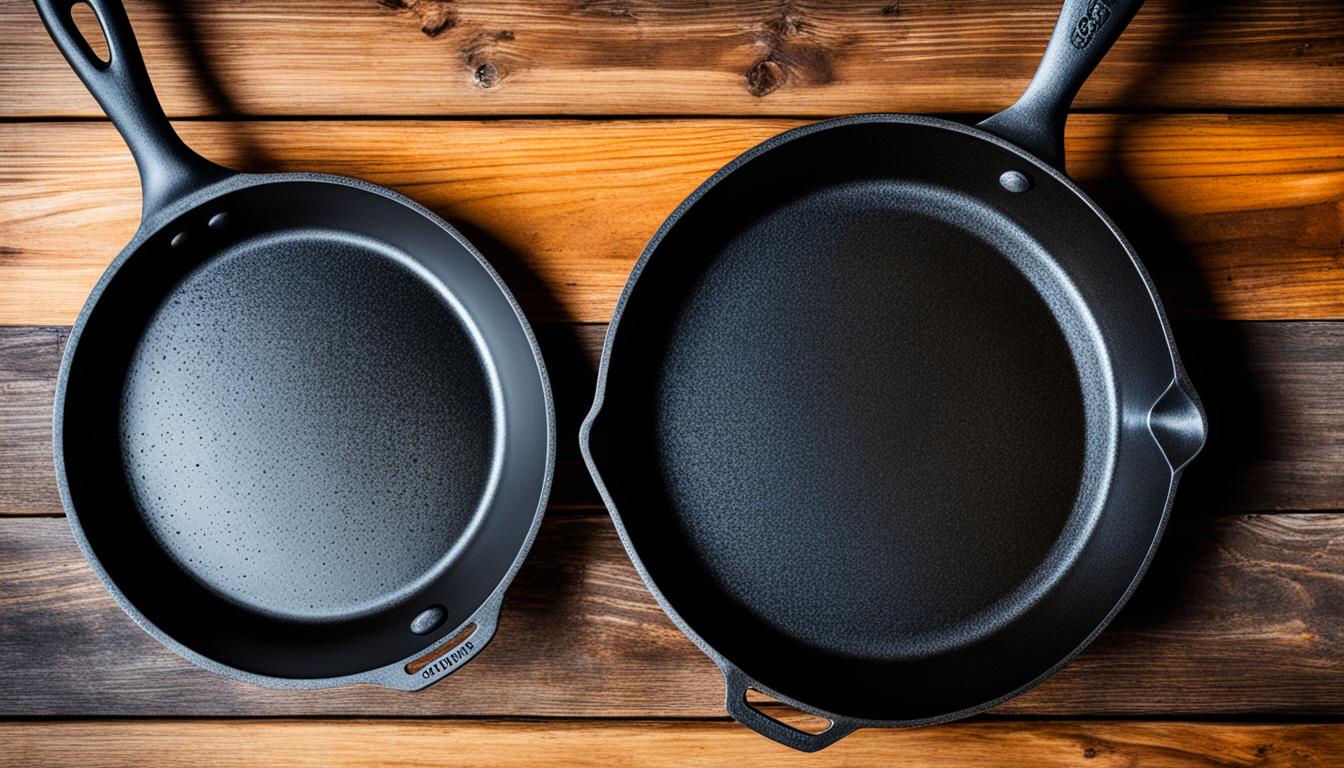
Cast iron skillets weigh 5-8 pounds for a 12-inch model. The weight contributes to superior heat retention but makes tossing food difficult. These skillets were manufactured by Lodge, Griswold, and Wagner historically. Modern options include bare cast iron and enameled versions that eliminate seasoning requirements.
Non-stick skillets use either PTFE (Teflon) or ceramic coatings applied to aluminum or stainless steel bases. The coating degrades at temperatures above 400-500°F, limiting their versatility. Replacement becomes necessary every 3-5 years as the surface wears. Brands like T-fal, Calphalon, and GreenPan dominate this category.
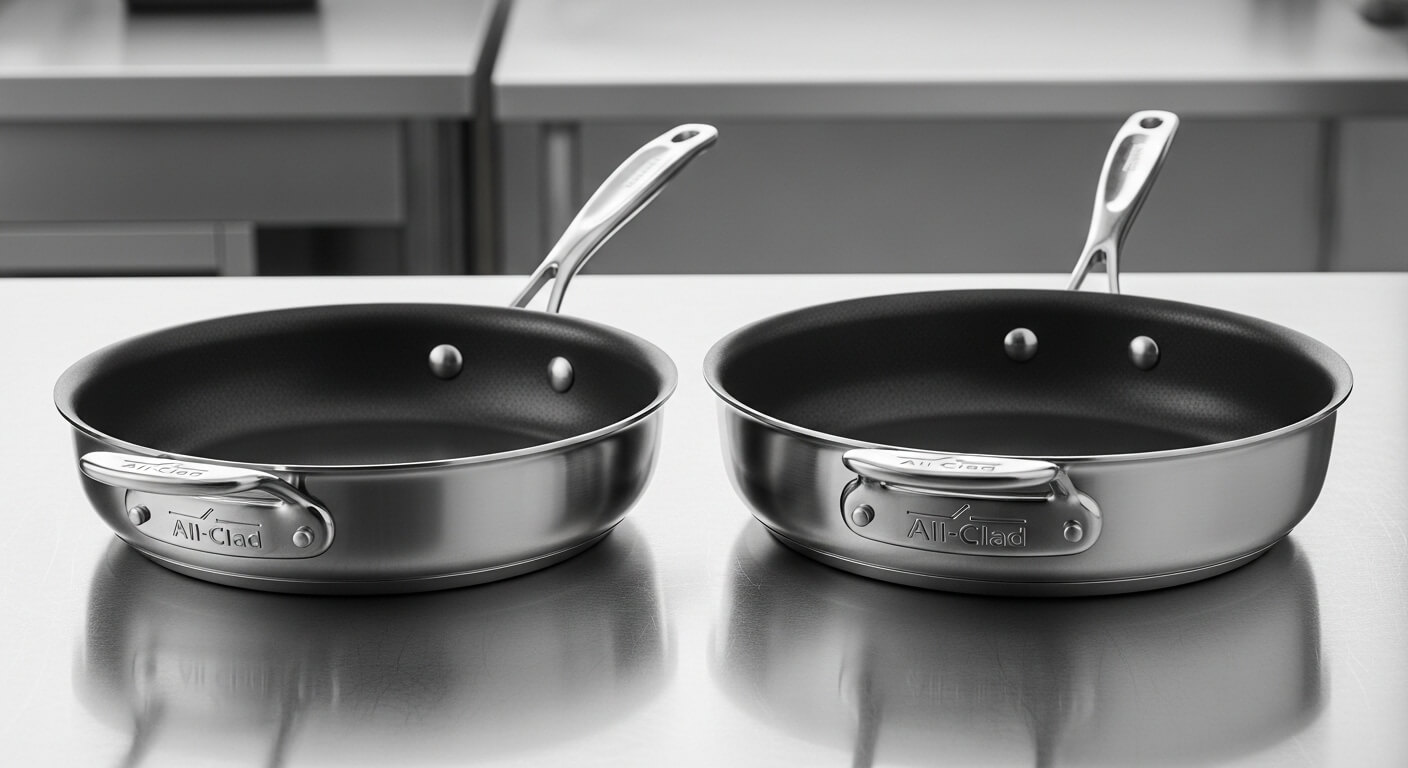
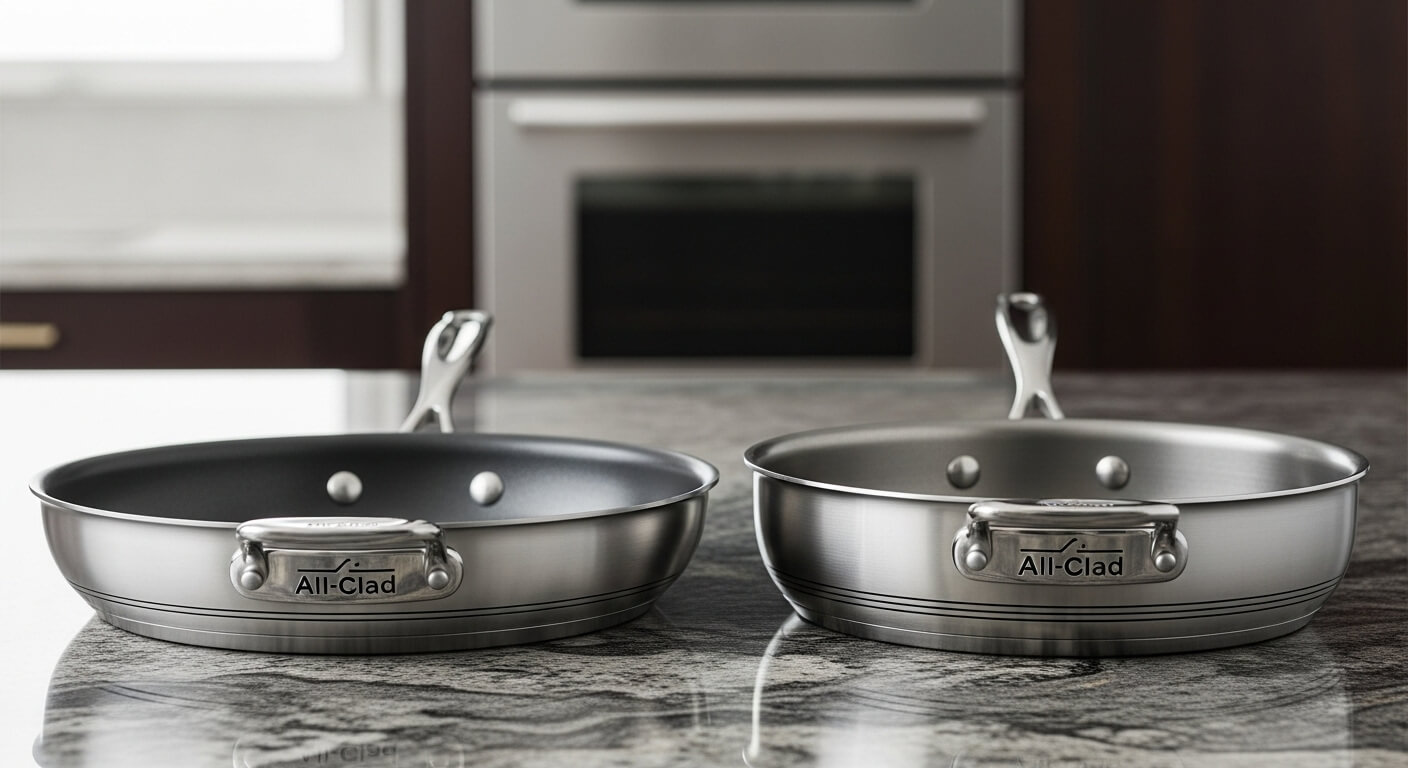
Stainless steel skillets often feature aluminum or copper cores sandwiched between steel layers. This tri-ply or five-ply construction distributes heat more evenly than single-layer steel. All-Clad pioneered this construction method. Food sticks to the surface initially but releases once proper browning occurs—a feature that creates flavorful fond for sauces.
Carbon steel skillets bridge the gap between cast iron and stainless steel. French and Chinese cooking traditions rely heavily on carbon steel due to its responsiveness and light weight (3-4 pounds for a 12-inch pan). The material requires seasoning like cast iron but heats and cools more quickly.
What Is a Griddle?
A griddle is a flat cooking surface with no sides or minimal raised edges (less than 0.5 inches) designed to maximize usable cooking area for foods that require easy flipping and sliding. The expansive flat surface allows you to cook multiple items simultaneously without the spatial constraints that skillet sides create. Most griddles feature rectangular or square shapes rather than the circular design common to skillets.
Griddle Definition and Basic Characteristics
Core design features:
- Surface area: 200-400 square inches of usable cooking space (10×20 inches to 20×20 inches typical)
- Edge height: Completely flat or raised edges of 0.25 to 0.5 inches
- Shape: Rectangular (most common), square, or round
- Handles: Two short handles on opposite sides or integrated into the frame
- Heat source: Electric models have built-in heating elements; stovetop versions span 1-2 burners
The absence of sides transforms cooking dynamics. Spatulas slide under food from any angle without obstruction. You can flip pancakes, rotate bacon strips, or remove finished items without navigating around raised edges. This design prioritizes accessibility over liquid containment.
Stovetop griddles rest directly on gas or electric burners, spanning either one large burner or two adjacent burners. Electric griddles plug into standard outlets and regulate temperature through built-in thermostats. Some models include grease channels and drip trays that collect fat runoff—a feature absent from traditional skillets.
The flat surface creates uniform contact with food. Pancakes brown evenly across their entire bottom surface. Bacon strips cook at consistent rates regardless of placement. This differs from skillets, where the curved sides receive less direct heat than the flat bottom.
Types of Griddles
| Griddle Type | Heat Source | Temperature Control | Cooking Surface | Portability |
|---|---|---|---|---|
| Stovetop Griddle | Gas or electric burners | Manual (burner adjustment) | 200-300 sq inches | High (no cord, lightweight) |
| Electric Griddle | Built-in heating element | Thermostat (200-450°F) | 150-400 sq inches | Low (requires outlet, countertop space) |
| Cast Iron Griddle | Gas or electric burners | Manual (burner adjustment) | 150-250 sq inches | Medium (heavy but no cord) |
| Non-Stick Griddle | Varies by model | Depends on type | 200-350 sq inches | Varies |
Stovetop griddles bridge two burners for maximum surface area. Lodge manufactures reversible cast iron griddles with flat surfaces on one side and raised grill ridges on the other. Aluminum models with non-stick coatings weigh less but lack heat retention. These griddles work on gas, electric, and induction cooktops when constructed from magnetic materials.
Electric griddles plug into wall outlets and heat through embedded electric coils. The Presto 07061 and BlackRock models offer thermostatic control that maintains precise temperatures between 200-450°F. Removable drip trays collect grease during cooking. Most electric griddles feature non-stick surfaces that simplify cleanup. Commercial restaurant griddles use this design scaled up to 24-36 inches wide.
Cast iron griddles provide superior heat retention compared to aluminum alternatives. A 20-inch cast iron griddle weighs 15-20 pounds—triple the weight of comparable aluminum models. The material distributes heat evenly across the surface once preheated for 8-10 minutes. Seasoning creates a naturally non-stick surface that improves with repeated use.
Non-stick griddles apply PTFE or ceramic coatings to aluminum or steel bases. Cuisinart, Hamilton Beach, and Oster produce electric non-stick griddles. Stovetop versions include products from Calphalon and T-fal. The coating eliminates the need for seasoning but limits maximum cooking temperatures to 400°F to prevent coating degradation. Replacement becomes necessary when the coating scratches or peels—typically after 2-4 years of regular use.
Double-burner griddles span 18-20 inches in length. This dimension matches the distance between standard range burners (roughly 8-9 inches center-to-center). Single-burner griddles measure 10-12 inches and fit over one burner, offering less cooking area than double-burner models but easier storage.
Skillet vs Griddle: Key Differences Explained
The fundamental differences between skillets and griddles center on their sides, cooking surface area, heat distribution patterns, and versatility for various cooking techniques. A 12-inch skillet provides roughly 113 square inches of cooking space, while a comparable griddle spanning two burners offers 250-300 square inches. The skillet’s raised sides contain liquids but reduce accessible cooking area; the griddle’s flat surface maximizes space but cannot hold sauces or prevent spills.
Cooking Surface Area
Usable space comparison:
| Cookware | Dimensions | Total Area | Usable Flat Area | Area Lost to Sides |
|---|---|---|---|---|
| 10-inch skillet | 10″ diameter | 79 sq inches | 60-65 sq inches | 15-20% |
| 12-inch skillet | 12″ diameter | 113 sq inches | 90-95 sq inches | 15-20% |
| Double-burner griddle | 10″ x 20″ | 200 sq inches | 190-200 sq inches | 0-5% |
| Electric griddle | 12″ x 18″ | 216 sq inches | 210-216 sq inches | 0-3% |
Skillets lose 15-20% of their circular area to sloped sides. A 12-inch skillet measured at the rim actually provides only 9-10 inches of flat cooking surface at the base. This reduction matters when cooking multiple items. Four burger patties fit comfortably on a griddle; the same quantity crowds a 12-inch skillet and causes uneven browning.
Griddles maximize every inch of their rectangular footprint. The flat surface extends to the edges with no curves or angles reducing placement options. You can arrange 8-10 strips of bacon across a 20-inch griddle; a 12-inch skillet accommodates 4-5 strips before overlapping occurs.
Batch cooking amplifies these differences. Making pancakes for four people requires 12-16 individual pancakes. A griddle cooks 6-8 simultaneously; a skillet handles 2-3. The time savings compound—20 minutes on a griddle versus 40-50 minutes using a skillet for the same quantity.
Sides and Edges
The presence or absence of raised sides determines which cooking methods work effectively. Skillet sides ranging from 1.5 to 3 inches create barriers that trap liquids and prevent spills. Griddles with edges below 0.5 inches or completely flat surfaces offer no containment.
How sides affect cooking:
- Liquid containment: Skillets hold pan sauces, braising liquids, and butter without spillage; griddles allow any liquid to run off the edge
- Flipping accessibility: Griddle edges permit spatula entry from any direction; skillet sides require angled approaches that complicate flipping
- Steam management: Skillet sides trap some steam and moisture; griddle openness promotes faster evaporation and crisper results
- Food removal: Sliding food off a griddle requires minimal lifting; extracting items from skillets demands vertical clearance over the rim
Pan sauces demonstrate this contrast clearly. Deglazing a skillet after searing steak adds wine or broth that stays contained while reducing to a concentrated sauce. Attempting the same technique on a griddle sends liquid cascading onto the stovetop and burners.
Flipping eggs illustrates the opposite scenario. A griddle allows you to slide a spatula completely under an egg from any angle, then flip with a quick wrist motion. Skillet sides force you to tilt the pan and maneuver the spatula at awkward angles to achieve the same result. Beginners break more yolks in skillets than on griddles for this reason.
The sides also affect browning rates. Food placed against skillet sides receives less direct heat than items in the center, creating hot and cool zones. Griddles maintain more consistent temperatures across their entire surface since no vertical walls block heat flow.
Heat Distribution
Skillets concentrate heat in their center bottom, with temperatures decreasing toward the edges and up the sides. A 12-inch cast iron skillet preheated over medium heat shows center temperatures of 400°F while edge readings drop to 350°F—a 50-degree variance. Griddles spanning two burners create two distinct heat zones but maintain more uniform temperatures within each zone.
Temperature consistency factors:
- Single vs. multiple burners: Skillets use one burner; double-burner griddles draw heat from two sources
- Material thickness: Thicker materials (cast iron at 0.25 inches) distribute heat more evenly than thin aluminum (0.125 inches)
- Surface area to heat source ratio: Skillets contact one burner across their entire base; griddles bridge the gap between burners with a cooler center zone
- Vertical heat loss: Skillet sides radiate heat upward; griddles have no vertical surfaces to lose heat through
Cast iron skillets overcome some temperature variance through superior heat retention. Once properly preheated for 8-10 minutes, the thick material maintains consistent temperatures even when cold food hits the surface. Thin stainless steel or aluminum skillets lose heat rapidly, creating temperature drops of 100°F or more when cold ingredients are added.
Electric griddles solve the distribution problem through embedded heating elements that span the entire cooking surface. Built-in thermostats cycle power on and off to maintain selected temperatures within 10-15 degrees. This precision exceeds what most stovetop skillets or griddles achieve without constant burner adjustment.
Stovetop griddles spanning two burners create three zones: hot areas directly over each burner and a cooler center section between them. This arrangement suits foods requiring different temperatures—searing proteins over the burners while keeping toast warm in the middle. Skillets offer no such zone control.
Versatility
Skillets handle a broader range of cooking techniques than griddles due to their liquid containment and oven-safe construction. Sautéing, braising, shallow frying, sauce reduction, and stovetop-to-oven recipes all require raised sides that griddles lack. Griddles excel at specific tasks—breakfast foods, smash burgers, quesadillas—but cannot replicate skillet versatility.
Technique compatibility:
| Cooking Method | Skillet Performance | Griddle Performance | Winner |
|---|---|---|---|
| Sautéing with sauces | Excellent (contains liquids) | Poor (sauce runs off) | Skillet |
| Pan-searing steaks | Excellent (high heat, fond development) | Good (high heat, limited fond use) | Skillet |
| Pancakes/French toast | Fair (limited quantity) | Excellent (batch cooking) | Griddle |
| Stir-frying | Excellent (tossing contained) | Poor (food falls off) | Skillet |
| Bacon (8+ strips) | Poor (crowding issues) | Excellent (ample space) | Griddle |
| Braising | Excellent (oven-safe, liquid retention) | Impossible (no sides, not oven-safe) | Skillet |
| Smash burgers | Good (limited quantity) | Excellent (multiple burgers) | Griddle |
| Shallow frying | Excellent (oil containment) | Dangerous (oil spills) | Skillet |
Oven-safe skillets transition from stovetop to oven for dishes like frittatas, cornbread, or finishing thick steaks. Cast iron and stainless steel models withstand temperatures up to 500°F. Most griddles—particularly electric models—cannot enter ovens at all. Stovetop griddles may survive oven heat but their flat design provides no advantage for oven cooking.
The curved sides that limit skillet cooking area prove essential for tossing and stirring. Stir-fries require constant motion to prevent burning; skillet sides keep ingredients contained during vigorous tossing. A griddle cannot contain foods during these aggressive cooking motions. Vegetables tumble off the edges within seconds.
Griddles counter with superior batch-cooking capabilities. Preparing breakfast for 4-6 people becomes efficient rather than frustrating. You can cook eggs, pancakes, bacon, and hash browns simultaneously on different griddle zones. A skillet forces sequential cooking—one item at a time—that extends meal preparation by 20-30 minutes.
When to Use a Skillet Over a Griddle
Use a skillet when your recipe requires liquid containment, high-heat searing with fond development, or stovetop-to-oven cooking methods that griddles cannot accommodate. The raised sides prevent sauces from spilling during reduction, trap steam for proper sautéing, and allow you to toss ingredients without losing them over the edge. Dishes involving butter, wine, broth, or any deglazing liquid demand a skillet’s containment capabilities.
Best Cooking Methods for Skillets
Techniques that require skillet sides:
- Sautéing: High-heat cooking with small amounts of fat where ingredients must be tossed or stirred vigorously without escaping
- Pan-searing: Creating a caramelized crust on proteins while containing rendered fats and juices for sauce-making
- Deglazing: Adding liquid to dissolve browned bits (fond) stuck to the pan bottom—impossible on flat griddles where liquid runs off
- Braising: Partial submersion cooking that transitions from stovetop to oven (requires liquid containment and oven-safe construction)
- Sauce reduction: Simmering liquids to concentrate flavors without spillage
- Shallow frying: Cooking in 0.5-1 inch of oil that must stay contained for safety and effectiveness
- Stir-frying: Continuous tossing at high heat where sides prevent ingredients from flying out
Pan sauces rely entirely on skillet architecture. After searing a steak, the browned bits adhering to the pan bottom contain concentrated flavor compounds. Adding wine deglazes these bits into liquid form. The sauce then reduces by half as steam escapes over the sides while the bulk remains contained. Attempting this on a griddle results in wine flowing directly onto your stovetop.
Stir-fries generate enough motion to launch ingredients into the air. A proper stir-fry tosses vegetables and proteins continuously for 3-5 minutes at high heat. Wok-style cooking in a skillet keeps everything contained; the same technique on a griddle scatters food across your cooking surface and floor.
Oven-finishing transforms skillet versatility. Thick pork chops sear for 3 minutes per side on the stovetop, then transfer to a 400°F oven for 6-8 minutes to reach proper internal temperature. The skillet accompanies the meat into the oven. Frittatas start on the stovetop until edges set, then bake under the broiler for 2-3 minutes. These techniques cannot be replicated with electric griddles, which melt or malfunction in ovens.
Ideal Foods for Skillet Cooking
| Food Category | Why Skillets Work Better | Specific Examples |
|---|---|---|
| Proteins with pan sauces | Sides contain deglazing liquid and reduction | Chicken piccata, steak au poivre, pork chops with apple cider sauce |
| One-pan pasta dishes | Liquid stays contained during absorption | Pasta primavera, one-pot mac and cheese, pasta puttanesca |
| Eggs with runny yolks | Butter pools in center, sides prevent spreading | Sunny-side up eggs, over-easy eggs, basted eggs |
| Curries and braised dishes | Sauce coverage requires depth | Chicken curry, braised short ribs, shakshuka |
| Stir-fried vegetables | Tossing stays contained | Broccoli with garlic, mixed vegetable stir-fry, bok choy |
| Shallow-fried foods | Oil containment for safety | Breaded chicken cutlets, fish fillets, potato pancakes |
Proteins requiring searing and sauce:
Steaks develop proper crusts when moisture evaporates rapidly. A preheated cast iron skillet at 450°F creates the Maillard reaction within 3-4 minutes per side. After removing the steak, add shallots and deglaze with red wine—the fond dissolves into a concentrated pan sauce. Griddles can sear but the sauce step becomes impossible as liquid flows away from the cooking zone.
Chicken breasts benefit from the same treatment. Sear skin-side down for 5 minutes until golden, flip for 3 minutes, then finish in a 375°F oven for 8-10 minutes. Deglaze with white wine and chicken stock, add capers and lemon for piccata. The entire process occurs in one vessel that moves from stovetop to oven and back.
Dishes with substantial liquid content:
One-pan pasta recipes add dry pasta directly to the skillet with stock, wine, or water. The pasta absorbs liquid while starches thicken the remaining sauce. This method requires 2-3 cups of liquid contained within skillet sides during the 10-12 minute cooking time. A griddle cannot hold this volume without immediate overflow.
Shakshuka poaches eggs in tomato sauce—the sauce must maintain 1-2 inches of depth to properly cover the eggs. The skillet holds sauce and eggs together during the 8-10 minute simmer. This Middle Eastern dish demonstrates how vertical space matters beyond simple surface area.
High-heat techniques requiring containment:
Blackened fish uses extremely high heat (500°F+) with butter and Cajun spices. The butter liquefies and smokes while coating the fish. Skillet sides trap this smoking butter around the protein. The same technique on a griddle sends burning butter dripping onto burners, creating smoke and potential fire hazards.
Fried rice tosses day-old rice with vegetables, egg, and sauce at high heat. The constant stirring and flipping motion requires sides that catch airborne rice grains. Restaurant woks have curved sides for this reason. Home skillets provide a similar (though less pronounced) containment that griddles completely lack.
When to Use a Griddle Over a Skillet
Use a griddle when you need to cook multiple portions of flat foods simultaneously, prepare breakfast items that require easy flipping, or want direct access to the entire cooking surface without navigating raised sides. The expansive flat area accommodates 6-8 pancakes at once compared to a skillet’s 2-3, cutting breakfast preparation time by more than half. Foods that benefit from sliding rather than lifting—grilled cheese sandwiches, quesadillas, smash burgers—perform better on griddles where spatulas access the entire perimeter without obstruction.
Best Cooking Methods for Griddles
Techniques that maximize griddle advantages:
- Batch cooking: Preparing 6-12 identical items simultaneously instead of cooking in multiple rounds
- Contact grilling: Pressing foods flat against the surface for maximum browning (smash burgers, grilled sandwiches)
- Easy-flip foods: Items requiring frequent turning where griddle accessibility simplifies the motion
- Low-liquid breakfast cooking: Eggs, pancakes, and French toast where minimal butter or oil suffices
- Multi-item cooking: Preparing complete meals with proteins and sides occupying different temperature zones
- Crispy-bottom foods: Hash browns, potato pancakes, and other items where moisture must evaporate quickly
Smash burgers exemplify griddle superiority. Place a 2-ounce beef ball on the hot surface, then smash it flat with a spatula or burger press. The meat spreads to 4-5 inches in diameter, creating maximum contact with the cooking surface. This technique generates a deeply caramelized crust within 2 minutes per side. A skillet’s curved bottom limits smashing area and reduces the number of burgers you can cook simultaneously from 6-8 down to 2-3.
Pancake production becomes systematic rather than chaotic. Pour batter for 6-8 pancakes across the griddle surface, wait 2-3 minutes for bubbles to form, flip all pancakes within 30 seconds, cook another 2 minutes, and remove. The entire family eats hot pancakes together instead of watching one person cook while others wait. This batch efficiency matters during weekday mornings when time constraints exist.
Grilled cheese sandwiches benefit from the sliding technique. Butter the bread, place sandwiches on the preheated surface, cook for 3-4 minutes until golden, then slide a wide spatula completely under each sandwich and flip in one smooth motion. The absence of sides allows you to approach from any angle and slide finished sandwiches directly onto plates without lifting over barriers.
Ideal Foods for Griddle Cooking
| Food Category | Why Griddles Work Better | Cooking Advantage |
|---|---|---|
| Pancakes and crepes | Batch capacity (6-8 vs. 2-3) | Reduces cooking time by 60% |
| Bacon strips | Flat layout (10-12 strips vs. 4-5) | Even cooking, easier grease management |
| Breakfast eggs | Multiple styles simultaneously | Cook scrambled, fried, and over-easy together |
| Smash burgers | Maximum surface contact | Superior crust development |
| Quesadillas | Easy flipping, multiple portions | 3-4 quesadillas vs. 1 in a skillet |
| Grilled sandwiches | Even pressing, batch cooking | Consistent browning across 4-6 sandwiches |
| Hash browns | Large surface area, moisture evaporation | Crispier results from better steam escape |
| French toast | 4-6 slices simultaneously | Hot breakfast for entire household |
Breakfast foods requiring batch preparation:
A family of four consuming pancakes needs 12-16 total. A griddle completes this in two batches (8 minutes total cooking time plus prep). A skillet requires 4-5 batches at 4 minutes each—20+ minutes of active cooking. The person operating the skillet eats cold pancakes while everyone else finishes.
French toast shows similar patterns. Standard sandwich bread slices measure 4×4 inches. A 20-inch griddle accommodates 6 slices; a 12-inch skillet fits 2 slices with careful arrangement. The griddle finishes 12 slices in 8 minutes (two batches at 4 minutes per side). The skillet requires 24 minutes for the same quantity (six batches).
Bacon strips lie flat on griddles without curling or overlapping. Ten strips arrange in parallel rows with 0.5-inch spacing between each. The rendered fat collects in grease channels (on models equipped with them) or drains to one edge where paper towels absorb it. Skillets force bacon into curved arrangements that promote uneven cooking—the center strips cook faster than those touching the sides.
Foods requiring direct surface contact:
Hash browns demand maximum surface contact for proper crisping. Shredded potatoes spread 0.25 inches thick across a 12-inch circle on a griddle. Moisture evaporates through the top while the bottom develops a golden-brown crust. The lack of sides allows steam to escape freely. Skillet sides trap some moisture, creating softer results with less pronounced crisping.
Potato pancakes (latkes) follow the same principle. Each patty needs direct contact across its entire bottom surface. A griddle accommodates 8-10 latkes simultaneously. The flat surface allows you to press each patty with a spatula to ensure even thickness and contact. Skillet capacity drops to 3-4 latkes, and the curved bottom creates uneven pressure during pressing.
Sandwiches and pressed foods:
Quesadillas require flipping once during cooking. The tortilla-cheese-tortilla assembly measures 10-12 inches in diameter—nearly the full width of a 12-inch skillet. Flipping this unwieldy circle in a confined space risks spillage. A griddle provides approach angles from all sides, and the flip occurs over a flat surface rather than within raised barriers.
Grilled sandwiches benefit from weighted pressing. Place sandwiches on the griddle, top with a bacon press or second pan, and apply 5-10 pounds of pressure. The weight creates even contact between bread and surface. Melted cheese fuses the layers while both bread sides brown uniformly. This technique works in skillets but the sides interfere with press placement and limit batch size to 1-2 sandwiches instead of 4-6.
Proteins suited to griddle cooking:
Breakfast sausages (links and patties) cook more evenly on griddles. Eight sausage links roll freely as you rotate them for browning on all sides. The flat surface prevents them from clustering in the skillet center. Four sausage patties fit on a griddle with space for simultaneous egg cooking; a skillet handles two patties and requires a second round.
Thin pork chops or chicken cutlets (0.5 inches thick or less) cook through in 3-4 minutes per side on a griddle. The flat surface ensures even contact and uniform browning. These proteins don’t require sauce development or fond scraping, eliminating the skillet’s containment advantages. You can prepare four cutlets in one batch versus two in a skillet.
Skillet vs Griddle: Pros and Cons Comparison
Skillets offer superior versatility and liquid containment while griddles provide unmatched batch-cooking capacity and accessibility—each tool’s strengths directly oppose the other’s limitations. A skillet’s raised sides enable 15+ cooking techniques but reduce usable surface area by 20%; a griddle’s flat design maximizes space but eliminates the ability to cook anything involving sauces or liquids. Understanding these trade-offs determines which tool suits your cooking patterns.
Skillet Advantages
What skillets do better than griddles:
- Liquid containment: Holds sauces, braising liquids, and pan drippings without spillage during reduction or deglazing
- High-heat searing: Develops fond (browned bits) on the pan surface that becomes the foundation for rich pan sauces
- Oven compatibility: Cast iron and stainless steel models withstand 500°F+ temperatures for stovetop-to-oven recipes
- Technique versatility: Handles sautéing, braising, shallow frying, stir-frying, and sauce-making that griddles cannot accommodate
- Compact storage: 12-inch diameter footprint requires less cabinet space than 10×20-inch griddles
- Ingredient containment: Sides keep tossed or stirred foods from escaping during vigorous cooking motions
The ability to build pan sauces separates skillets from all other cooking surfaces. Sear chicken thighs skin-side down for 6 minutes, flip and cook 4 more minutes, remove the chicken, pour off excess fat, add shallots and garlic, deglaze with wine, reduce by half, mount with butter. This sequence creates restaurant-quality results at home. Griddles eliminate steps three through six entirely—the sauce simply runs off the cooking surface.
Oven-safe construction extends functionality beyond stovetop limits. Thick steaks or bone-in pork chops require internal temperatures of 135-145°F but develop proper crusts in just 3-4 minutes per side on the stovetop. The solution involves searing at high heat, then transferring the skillet to a 400°F oven for 6-10 minutes. The meat finishes cooking while the crust remains intact. Electric griddles melt in ovens; stovetop griddles offer no advantage for oven cooking.
Storage efficiency matters in standard kitchens. A 12-inch skillet nests inside a 14-inch skillet, and both stack with lids in a single cabinet section measuring 15x15x8 inches. A 20-inch griddle requires dedicated storage space—either hanging vertically or consuming an entire shelf. Apartment dwellers and those with limited cabinet space face genuine constraints.
Skillet Disadvantages
Where skillets fall short:
- Limited cooking area: 12-inch skillets provide only 90-95 square inches of flat cooking surface versus 200+ square inches on griddles
- Batch cooking inefficiency: Preparing breakfast for 4+ people requires multiple cooking rounds that extend meal prep by 20-30 minutes
- Flipping difficulty: Raised sides force angled spatula approaches that complicate turning pancakes, eggs, or sandwiches
- Breakfast limitations: Cannot cook 8-10 bacon strips or 6-8 pancakes simultaneously
- Edge temperature variance: Food placed against sides receives 25-50°F less heat than center items
Pancake production exposes skillet limitations ruthlessly. A family eating 16 pancakes requires six separate cooking rounds in a 12-inch skillet (2-3 pancakes per batch). Each round takes 5-6 minutes—30+ minutes of continuous cooking. The first pancakes cool to room temperature before the last batch finishes. A griddle completes the same quantity in two rounds lasting 10 minutes total.
The curved sides that enable sauce-making create obstacles during flipping. Sliding a spatula under a fried egg requires tilting the skillet and approaching at a 30-40 degree angle. The rim blocks direct perpendicular entry. Beginners break yolks or tear egg whites during this awkward maneuver. A griddle allows perpendicular spatula insertion from any direction—no tilting or angling required.
Temperature zones within skillets create uneven results. A 12-inch cast iron skillet preheated over medium heat shows center temperatures of 425°F while readings 1 inch from the sides drop to 375°F. Bacon strips placed at the edges cook 2-3 minutes slower than center strips. This variance forces rotation during cooking or produces inconsistent doneness.
Griddle Advantages
What griddles do better than skillets:
- Massive cooking surface: 200-400 square inches accommodates 6-8 pancakes, 10-12 bacon strips, or 4-6 grilled sandwiches simultaneously
- Batch cooking efficiency: Reduces breakfast preparation time by 50-60% compared to sequential skillet cooking
- 360-degree accessibility: Flat surface allows spatula entry from any angle without obstruction
- Even heat distribution: Consistent temperatures across the entire surface eliminate hot and cool zones
- Easy food removal: Sliding items off the edge requires minimal lifting compared to extracting from skillet depths
- Moisture evaporation: Lack of sides allows steam to escape freely, producing crispier hash browns and bacon
Breakfast preparation transforms from tedious to streamlined. A Saturday morning meal for six people requires 18-24 pancakes, 12-15 bacon strips, 8-10 eggs, and hash browns. A griddle cooks everything in 20-25 minutes with overlapping cook times. Bacon cooks on one zone while pancakes occupy another and eggs fry in a third section. The same meal in skillets requires 45-60 minutes of sequential cooking—bacon first, then eggs, then pancakes in multiple batches.
The flat surface eliminates spatial reasoning challenges. You don’t calculate whether items fit within a circular area or worry about sides interfering with spatula angles. Place food anywhere on the griddle, flip when ready, slide onto plates. This simplicity benefits beginners who struggle with skillet maneuvering.
Commercial restaurant efficiency becomes achievable at home. Diners cook 20-30 orders simultaneously on 36-inch griddles. Home griddles scale this approach to family portions. The workflow mirrors professional kitchens—multiple items cooking at different stages with systematic flipping and removal.
Griddle Disadvantages
Where griddles fall short:
- No liquid containment: Cannot hold sauces, braising liquids, or any cooking method requiring depth
- Limited technique range: Eliminates sautéing, braising, deglazing, sauce reduction, and shallow frying from your repertoire
- Storage challenges: 20-inch griddles require 400+ square inches of cabinet or hanging space
- No oven capability: Electric griddles malfunction in ovens; stovetop griddles offer no oven-cooking advantages
- Grease management: Fat and oil run off the surface onto stovetops or counters without proper channels
- Single-purpose design: Excels at breakfast and sandwiches but handles limited dinner applications
The inability to contain liquids eliminates entire categories of cooking. Chicken piccata, beef stroganoff, pasta primavera, curry dishes, pan-seared fish with butter sauce—none work on griddles. The sauce component requires containment that flat surfaces cannot provide. This limitation restricts griddles to dry-cooking methods or foods with minimal liquid content.
Storage becomes problematic in compact kitchens. A 10×20-inch griddle won’t fit in standard 12-14 inch cabinets. Options include hanging vertically on wall-mounted racks, storing horizontally on a dedicated shelf, or leaving it on the stovetop permanently. Each solution consumes space that smaller skillets would share with other cookware.
Electric griddles require permanent counter space or storage in a pantry or closet rather than with other cookware. The built-in cord and heating element prevent nesting or stacking with other items. This standalone characteristic suits households with abundant storage but challenges those in apartments or smaller homes.
Temperature control on stovetop griddles spanning two burners creates complications. Gas burners cycle on and off; electric coils heat in waves. Maintaining consistent 375°F across the entire surface requires constant monitoring and adjustment of both burners. Electric griddles solve this through thermostatic control but introduce the storage and counter-space issues mentioned above.
Material Considerations: Skillet vs Griddle Options
Material selection affects heat retention, maintenance requirements, weight, and cooking performance more than the skillet vs griddle distinction itself—a cast iron griddle and cast iron skillet share more similarities than a cast iron skillet and non-stick skillet. The material determines preheating time, temperature consistency, seasoning obligations, and longevity. Both skillets and griddles come in cast iron, non-stick, and stainless steel variations, each offering distinct trade-offs.
Cast Iron: Skillets vs Griddles
Performance characteristics:
| Feature | Cast Iron Skillet | Cast Iron Griddle | Comparison |
|---|---|---|---|
| Weight | 5-8 lbs (12-inch) | 15-20 lbs (20-inch) | Griddles weigh 2-3x more |
| Heat retention | Excellent (maintains temp after food added) | Excellent (same material properties) | Equal |
| Preheat time | 8-10 minutes | 10-12 minutes | Griddles require longer due to size |
| Seasoning needs | Required (hand wash, oil after each use) | Required (identical maintenance) | Equal |
| Oven-safe temp | 500°F+ | 500°F+ (stovetop models only) | Equal for stovetop griddles |
| Price range | $25-60 | $40-80 | Griddles cost 50% more |
Cast iron delivers identical heat retention whether formed into a skillet or griddle. The 0.25-inch thick material stores thermal energy that maintains cooking temperatures when cold ingredients hit the surface. A preheated cast iron skillet drops only 30-40°F when you add a cold steak; thin stainless steel drops 100°F or more. This property applies equally to griddles—the material composition determines performance, not the shape.
Seasoning requirements remain constant across both forms. Wash with hot water immediately after cooking, dry thoroughly with a towel or over low heat, apply a thin layer of oil while still warm. This process prevents rust and builds the naturally non-stick patina that improves over years of use. Both skillets and griddles require identical maintenance schedules—neglect either and rust appears within days.
Weight creates the primary distinction. A 12-inch Lodge cast iron skillet weighs 8 pounds; a 20-inch Lodge reversible griddle weighs 20 pounds. The griddle’s size and mass make it awkward to lift, flip, or move during cooking. You place it on the stovetop and leave it there until cooking completes. Skillets allow one-handed manipulation for tossing or tilting despite their substantial weight.
The seasoning surface area differs dramatically. A 12-inch skillet has roughly 200 square inches of surface (including sides); a 20-inch griddle has 400+ square inches. More surface means more oil consumed during seasoning and more area where seasoning can fail if maintenance lapses. This doesn’t affect cooking performance but impacts the work required to maintain the cookware.
Non-Stick: Skillets vs Griddles
Coating performance and limitations:
| Feature | Non-Stick Skillet | Non-Stick Griddle | Comparison |
|---|---|---|---|
| Temperature limit | 400-500°F (coating degrades above) | 400-500°F (same coating types) | Equal |
| Cleaning ease | Excellent (dishwasher-safe often) | Excellent (some models dishwasher-safe) | Equal |
| Lifespan | 3-5 years with proper use | 2-4 years (more coating wear from larger surface) | Skillets last slightly longer |
| Metal utensil tolerance | Poor (scratches coating) | Poor (same coating vulnerability) | Equal |
| Seasoning required | None | None | Equal |
| Price range | $20-80 | $35-120 | Griddles cost 40-60% more |
PTFE (Teflon) and ceramic coatings function identically on skillets and griddles. The coating prevents food adhesion, eliminates seasoning requirements, and simplifies cleaning. Eggs slide freely across the surface without butter or oil. Pancakes release effortlessly after browning. This convenience appeals to cooks who want minimal maintenance obligations.
Temperature restrictions apply equally to both forms. PTFE coatings begin breaking down at 500°F, releasing fumes that cause flu-like symptoms in humans and can kill pet birds. Ceramic coatings lose their non-stick properties above 450°F even without harmful fumes. These limits prevent high-heat searing techniques that cast iron handles easily. You cannot achieve proper steak crusts or wok-level stir-fry temperatures on non-stick surfaces.
The coating wears faster on griddles due to increased surface area and usage patterns. Griddles often cook bacon, which involves scraping with metal spatulas to flip 10-12 strips multiple times. Each scraping motion degrades the coating microscopically. A skillet cooking 3-4 strips involves less total scraping. Over time, this accumulated wear shows up as bare spots where the coating has been removed.
Electric griddles almost universally feature non-stick surfaces. The built-in heating elements cannot tolerate the thermal shock of cast iron seasoning (oil smoking at 400-500°F repeatedly). Manufacturers apply PTFE or ceramic coatings that allow lower-temperature cooking suitable for pancakes and eggs. This limits electric griddles to gentle cooking methods incompatible with high-heat techniques.
Stainless Steel and Other Materials
Alternative material options:
- Stainless steel skillets: Tri-ply or five-ply construction with aluminum cores for heat distribution; durable and non-reactive with acidic foods; food sticks initially but releases once properly seared; oven-safe to 500°F+; dishwasher-safe; price range $50-300
- Stainless steel griddles: Rare in consumer market; mostly found in commercial settings; same non-reactive properties as skillets; requires oil to prevent sticking; difficult to find for home use under $150
- Carbon steel skillets: Lighter than cast iron (3-4 lbs for 12-inch); requires seasoning like cast iron; heats and cools faster than cast iron; responsive temperature control; common in professional kitchens; price range $30-80
- Carbon steel griddles: Extremely rare in home market; used in commercial settings (Mongolian BBQ restaurants); requires seasoning; responsive heat control; difficult to source for home cooks
- Aluminum griddles: Lightweight (3-5 lbs); usually non-stick coated; heats quickly but loses heat rapidly; affordable ($25-60); common in electric griddle construction
Stainless steel skillets dominate the premium cookware market through brands like All-Clad, Demeyere, and Made In. The multi-ply construction sandwiches aluminum or copper between stainless steel layers. This design distributes heat evenly while maintaining stainless steel’s non-reactive surface. Tomato sauce, wine, and citrus juice don’t interact with stainless steel the way they react with cast iron (stripping seasoning) or aluminum (causing metallic flavors).
The learning curve for stainless steel exceeds cast iron or non-stick. Food sticks aggressively to cold pans or pans that haven’t reached proper temperature. The technique involves preheating for 3-5 minutes, adding oil, heating until the oil shimmers, then adding food. Proteins initially stick but release naturally once the Maillard reaction completes and a crust forms. Patience separates successful stainless steel cooking from frustrating experiences.
Carbon steel bridges cast iron and stainless steel characteristics. French chefs use carbon steel for crepes; Chinese restaurants use it for wok cooking. The thinner material (0.125 inches vs. cast iron’s 0.25 inches) responds quickly to burner adjustments. Reduce heat and the pan cools within 30 seconds; increase heat and temperatures rise in under a minute. Cast iron’s thermal mass makes such rapid adjustments impossible.
Aluminum appears primarily in non-stick skillets and electric griddles as the base material under coatings. Bare aluminum reacts with acidic foods and imparts metallic flavors. Hard-anodized aluminum addresses these issues through surface treatment that creates a harder, non-reactive layer. This material fills the budget-friendly niche—lighter than cast iron, less expensive than stainless steel, but without the extreme durability of either.
Cooking Performance: Skillet vs Griddle Head-to-Head
Cooking performance differences between skillets and griddles center on heat retention during food addition, temperature recovery speed, and accessibility for flipping or removing items rather than pure cooking capability. A cast iron skillet retains heat better than an aluminum griddle regardless of shape; material matters more than form. Performance comparisons must account for both the tool design (sides vs. flat) and construction material (cast iron, stainless steel, non-stick) to provide meaningful conclusions.
Heat Retention and Distribution
Temperature maintenance during cooking:
| Scenario | Skillet Performance | Griddle Performance | Winner |
|---|---|---|---|
| Adding cold ingredients | Drops 30-50°F (cast iron) or 80-120°F (thin metals) | Drops 30-50°F (cast iron) or 80-120°F (thin metals) | Tie (material-dependent) |
| Recovery time | 45-90 seconds to regain temperature | 60-120 seconds (larger mass to reheat) | Skillet |
| Edge-to-center consistency | 25-50°F variance in 12-inch skillets | 15-30°F variance across zones | Griddle |
| Multi-zone cooking | Single temperature zone only | 2-3 distinct zones possible | Griddle |
Heat retention depends entirely on material mass and thickness. A 12-inch cast iron skillet at 0.25 inches thick holds temperature when you add a cold steak because the metal’s thermal mass exceeds the energy required to heat the meat. The temperature drops from 450°F to 410°F, then recovers to 440°F within 60 seconds. A thin aluminum non-stick skillet drops from 400°F to 280°F under identical conditions—a loss that prevents proper searing.
This principle applies equally to griddles. A cast iron griddle maintains temperatures during food addition; an aluminum non-stick griddle loses heat rapidly. The shape doesn’t determine retention—the material does. Griddles take longer to recover because their larger surface area requires more energy to reheat. A 20-inch griddle has twice the surface area of a 12-inch skillet, meaning each burner must heat double the material.
Temperature distribution across the surface creates genuine performance differences. Skillets concentrate heat in the center where the burner makes contact. The curved sides extend away from the heat source, receiving warmth primarily through conduction from the base. This creates cooler zones at the pan edges. Griddles spanning two burners create hot zones over each burner with a cooler bridge section in between—a different pattern but still featuring variance.
Electric griddles solve distribution problems through embedded heating elements that span the entire cooking surface. Thermostatic controls maintain selected temperatures within 10-15°F across all zones. This consistency exceeds what gas or electric stovetops achieve with either skillets or stovetop griddles. The trade-off involves maximum temperature limits (most electric griddles max at 400-425°F) that prevent high-heat searing.
Ease of Use and Learning Curve
Beginner-friendliness comparison:
Griddles require less technique mastery than skillets for basic breakfast cooking. Flipping pancakes on a flat surface involves sliding a spatula underneath and rotating your wrist—a motion that succeeds on the first attempt. Flipping pancakes in a skillet requires tilting the pan, angling the spatula past the raised rim, and coordinating both hands. Beginners tear or fold pancakes during this awkward maneuver until they develop the necessary coordination.
Temperature management challenges differ between the two tools. Skillets respond faster to burner adjustments due to smaller thermal mass. Reduce heat and the pan cools within 60-90 seconds; increase heat and temperatures rise in similar timeframes. Griddles spanning two burners require adjusting both controls and exhibit slower response times due to larger mass. The learning curve involves understanding these lag times to prevent overcooking or undercooking.
Common mistakes with each tool:
- Skillet errors: Overcrowding the cooking surface (reduces temperature, prevents browning); attempting to flip foods too early (leads to tearing); using metal utensils on non-stick coatings (scratches surface); failing to preheat adequately (causes sticking)
- Griddle errors: Pouring excess batter that runs together (merges pancakes); uneven burner settings creating hot/cold zones; neglecting to rotate foods between zones (inconsistent doneness); expecting sauce containment (creates stovetop messes)
Sticking issues plague inexperienced cooks using both tools. Food adheres to stainless steel or unseasoned cast iron when surfaces haven’t reached proper temperature or lack sufficient fat. The solution involves preheating for 5-8 minutes and using adequate oil or butter. Non-stick surfaces eliminate this learning curve but introduce temperature restrictions that prevent high-heat techniques.
Spatial awareness matters more with skillets. You must judge whether four burger patties fit within the flat bottom area while accounting for the sloped sides that reduce usable space. Griddles eliminate this calculation—if items fit on the flat surface without touching, they fit. This simplicity benefits those who struggle with spatial reasoning or lack cooking experience.
Cleaning and Maintenance
Daily care requirements:
| Maintenance Task | Skillet | Griddle | Time Difference |
|---|---|---|---|
| Surface area to clean | 150-200 sq inches | 350-450 sq inches | Griddles take 2x longer |
| Grease removal | Contained in pan bottom | Spreads across entire surface | Similar difficulty |
| Seasoning (cast iron) | Hand wash, dry, oil application | Hand wash, dry, oil application | Equal process, more area |
| Dishwasher compatibility | Non-stick models only | Non-stick models only | Equal |
| Deep cleaning frequency | Monthly for baked-on residue | Monthly for baked-on residue | Equal |
Non-stick coatings simplify cleaning regardless of shape. Wipe the surface with a sponge and dish soap, rinse, dry. Food residue slides off without scrubbing. Both non-stick skillets and griddles complete cleaning in 2-3 minutes. The larger griddle surface requires more wiping motions but not more effort per square inch.
Cast iron maintenance demands more attention. After cooking, rinse with hot water while the pan remains warm (this timing applies to both skillets and griddles). Stubborn residue comes off with a stiff brush or chainmail scrubber. Dry thoroughly—either with towels or by placing over low heat for 2 minutes. Apply a thin oil layer while still warm, wipe off excess, and store. This process takes 5-7 minutes for a skillet; 8-12 minutes for a larger griddle due to increased surface area.
Stainless steel permits dishwasher cleaning but hand washing produces better results. Bar Keeper’s Friend or similar oxalic acid cleaners remove heat staining and discoloration. The cleaning difficulty matches between skillets and griddles—both require the same scrubbing effort, just across different surface areas.
Long-term care distinctions:
Cast iron develops better seasoning on skillets than griddles due to usage patterns. Skillets cook with fats daily—butter for eggs, oil for vegetables, pan drippings from meats. Each cooking session adds microscopic layers to the seasoning. Griddles often cook pancakes with minimal fat, or bacon where rendered fat gets absorbed by paper towels rather than baked into the surface. This difference means skillet seasoning improves faster than griddle seasoning over equivalent time periods.
Re-seasoning requirements arise every 6-12 months for both tools. Strip the old seasoning in a self-cleaning oven cycle or with lye-based cleaners. Apply 3-5 thin coats of oil (flaxseed, grapeseed, or vegetable), baking at 450-500°F for one hour per coat. This intensive process takes 4-6 hours total. The griddle’s larger surface consumes more oil but follows identical steps. Most cooks delay this maintenance longer than recommended, allowing seasoning to deteriorate gradually rather than addressing it proactively.
Size and Storage: Practical Considerations
Storage space requirements differ dramatically between skillets and griddles—a 12-inch skillet occupies 113 square inches of cabinet space while a 20-inch griddle demands 200+ square inches and cannot nest with other cookware. Skillets stack vertically with minimal wasted space; griddles require dedicated horizontal storage or wall-mounted hanging systems. Kitchen layouts with limited cabinet depth (12-14 inches standard) accommodate skillets easily but force griddles into awkward diagonal placement or alternative storage solutions.
Kitchen Space Requirements
Storage footprint comparison:
| Cookware | Dimensions | Storage Area Required | Nesting Capability | Storage Location Options |
|---|---|---|---|---|
| 10-inch skillet | 10″ diameter x 2″ deep | 79 sq inches | Nests inside larger skillets | Cabinets, drawers, hanging racks |
| 12-inch skillet | 12″ diameter x 2.5″ deep | 113 sq inches | Nests inside 14″ skillets | Cabinets, drawers, hanging racks |
| Double-burner griddle | 10″ x 20″ x 0.5″ | 200 sq inches | Cannot nest | Cabinets (dedicated shelf), vertical hanging |
| Electric griddle | 12″ x 18″ x 3″ | 216 sq inches + cord | Cannot nest or stack | Counter, pantry, closet storage |
Cabinet organization favors skillets through nesting and stacking. A 10-inch skillet nests inside a 12-inch model, which nests inside a 14-inch version. Three skillets consume the vertical space of one while occupying just 154 square inches of shelf area (the 14-inch diameter). Add lids and the stack reaches 8-10 inches tall but still fits in standard 12-inch deep cabinets.
Griddles resist efficient storage solutions. A 10×20-inch stovetop griddle won’t fit in cabinets narrower than 20 inches—standard base cabinets measure 12, 15, 18, 21, or 24 inches wide. The griddle only fits in 21-inch or larger cabinets, and it consumes an entire shelf without sharing space with other items. Diagonal placement in 18-inch cabinets works but creates awkward retrieval and wastes corner space.
Electric griddles introduce additional complications through non-removable power cords and legs. The appliance measures 12×18 inches with 2-3 inch legs that prevent flat storage under other items. The cord adds 24-36 inches that must coil somewhere. These griddles typically live on countertops permanently, get stored in pantries, or occupy closet space alongside small appliances like toasters and blenders.
Counter space considerations:
Electric griddles require 18-24 inches of continuous counter space during use—space that remains unavailable for cutting boards, ingredient prep, or other cooking activities. Small kitchens with 36-48 inches of total counter space lose 40-50% to the griddle alone. This real estate cost explains why many cooks reserve electric griddles for weekend breakfast preparation rather than daily use.
Stovetop skillets and griddles occupy burners but leave counters free for prep work. This distinction matters in kitchens where counter space limits meal preparation more than cooking surface availability. The stovetop already serves as cooking space; electric griddles colonize additional territory.
Portability and Flexibility
Movement and positioning:
Skillets move freely between burners during cooking. Start a steak in a cast iron skillet on high heat for searing, then shift to a cooler burner for gentle finishing. This flexibility allows temperature control beyond simple burner adjustment. The single-handle design permits one-handed movement even with 8-pound cast iron models, though two hands provide more control and safety.
Griddles lock into position once placed. A double-burner griddle spans two burners with specific spacing requirements—typically 8-9 inches center-to-center. Moving it during cooking means removing all food first, which defeats the purpose of batch cooking multiple items simultaneously. The two-handle design requires both hands for lifting, and the 15-20 pound weight (for cast iron) makes frequent repositioning impractical.
Outdoor cooking applications:
Camp stoves and portable burners accommodate skillets without modification. A 12-inch skillet sits on a single burner camp stove and functions identically to home cooking. Campers, RV owners, and tailgaters rely on cast iron skillets for outdoor meal preparation. The versatility extends from stovetop to campfire—cast iron handles open flame cooking that destroys non-stick coatings.
Griddles require dual-burner setups that most portable cooking systems lack. Camp Chef and similar manufacturers produce specialized dual-burner camp stoves, but these systems weigh 30-40 pounds and serve primarily RV or basecamp cooking rather than backpacking. Single-burner griddles exist but sacrifice the batch-cooking advantage that makes griddles appealing.
Electric griddles demand 120V AC power—available at campgrounds with electrical hookups but absent in wilderness settings. This limitation restricts electric griddles to RV cooking, tailgating near vehicles with power inverters, or outdoor parties with access to outlets. Battery-powered or propane alternatives don’t exist in consumer markets.
Travel and temporary kitchens:
Vacation rentals and temporary housing often lack comprehensive cookware. Bringing a 12-inch skillet in luggage or a vehicle provides enough cooking capability for most meals. The single pan handles eggs, vegetables, proteins, and one-pan pasta dishes. Airlines permit cast iron skillets in checked luggage; the weight counts against baggage limits but transportation poses no restrictions.
Griddles create packing challenges through size and weight. A 20-inch griddle exceeds carry-on dimensions for air travel and adds 15-20 pounds to checked baggage. Road trips accommodate griddles more easily, but the question becomes whether the specialized breakfast capability justifies the space consumption. Most travelers prioritize versatile tools over specialized ones when packing is constrained.
College dorm rooms and small apartments with limited storage penalize large cookware. Students typically own 1-2 pans total due to space restrictions. A 10-inch or 12-inch skillet serves as the universal cooking tool. Adding a griddle means dedicating scarce storage to breakfast-specific equipment that sits unused most days.
Permanent countertop placement:
Some households designate permanent counter space for electric griddles, treating them as built-in appliances rather than stored cookware. This approach works in kitchens with 8+ feet of continuous counter space where dedicating 18-24 inches doesn’t create functional problems. The griddle stays plugged in and ready for immediate use—advantageous for daily breakfast preparation.
Permanent placement eliminates storage challenges but creates cleaning obligations. Countertop surfaces accumulate dust, grease splatter from nearby cooking, and general kitchen grime. A griddle living on the counter requires weekly cleaning even when unused. Stored cookware remains clean until retrieved for cooking. This maintenance trade-off favors storage for occasional-use items and permanent placement only for daily-use tools.
Price Comparison: Skillet vs Griddle Investment
Griddles cost 30-60% more than comparably-sized skillets across all material categories due to increased surface area and material requirements—a 12-inch cast iron skillet retails for $25-35 while a 20-inch cast iron griddle costs $40-65. Electric griddles command premium prices ($50-150) compared to stovetop versions because built-in heating elements and thermostatic controls add manufacturing complexity. Budget-conscious buyers get more versatility per dollar with skillets; those prioritizing batch-cooking efficiency justify griddle premiums through time savings.
Budget-Friendly Options
Entry-level pricing by type:
| Product Category | Price Range | Specific Examples | Value Assessment |
|---|---|---|---|
| Basic cast iron skillet | $20-35 | Lodge 12″ ($28), Utopia Kitchen 10″ ($22) | Best budget value for versatility |
| Non-stick skillet | $15-40 | T-fal 12″ ($25), AmazonBasics 10″ ($18) | Affordable but 3-5 year lifespan |
| Cast iron griddle | $35-60 | Lodge 10.5″ x 20″ ($45), Camp Chef 16″ x 38″ ($55) | Higher entry cost than skillets |
| Non-stick griddle | $25-50 | Cuisinart GR-11 ($35), Presto 07211 ($30) | Budget electric options available |
| Electric griddle | $30-70 | Presto 07061 22″ ($45), Hamilton Beach 38518R ($35) | Most affordable griddle category |
Lodge Manufacturing dominates the budget cast iron market. Their 12-inch skillet costs $28-32 at major retailers and includes pre-seasoning that makes it usable immediately. The same brand’s 10.5×20-inch reversible griddle retails for $45-50—a 60% premium for roughly double the cooking surface. The math shows griddles cost more per square inch of cooking area.
Non-stick skillets from T-fal, Calphalon, and store brands occupy the $15-40 range. A 12-inch non-stick skillet averages $25-30. Comparable non-stick griddles—either stovetop or electric—start at $30-35, maintaining the 20-30% price premium pattern. The lifespan issue affects both equally; non-stick coatings wear out in 3-5 years regardless of shape, requiring replacement at similar intervals.
Electric griddles offer the best value within the griddle category. Presto’s 22-inch electric griddle at $45 provides 308 square inches of cooking surface with thermostatic control. Cast iron griddles of similar size cost $50-65 without temperature control. The electric version trades portability and stovetop flexibility for lower price and precise temperature management—a worthwhile trade for buyers who prioritize breakfast cooking.
Where to find deals:
- Lodge Factory Seconds: Cosmetically imperfect cast iron at 30-40% discounts (sold through Lodge outlet stores and website)
- Restaurant supply stores: Commercial-grade aluminum griddles at $40-60, more durable than consumer non-stick versions
- Black Friday sales: Non-stick skillets and electric griddles commonly discounted 40-50% in November
- Thrift stores: Cast iron skillets often available for $5-15, requiring only cleaning and re-seasoning to restore functionality
Thrift stores and estate sales provide exceptional cast iron deals. A rusty Lodge skillet purchased for $8 becomes fully functional after stripping and re-seasoning—a 3-hour process that saves $20-25 compared to new retail. Griddles appear less frequently in secondhand markets because fewer households owned them originally, making thrift store finds rare.
Premium Options
High-end pricing tiers:
| Premium Category | Price Range | Representative Brands | Performance Gains |
|---|---|---|---|
| Tri-ply stainless skillet | $100-200 | All-Clad D3 ($150), Made In ($120) | Superior heat distribution, lifetime durability |
| Copper-core skillet | $200-350 | All-Clad Copper Core ($280), Hestan CulCore ($300) | Fastest heat response, best temperature control |
| Premium cast iron skillet | $150-300 | Finex ($200), Butter Pat Industries ($250) | Smoother machined surfaces, lighter weight |
| Premium electric griddle | $150-400 | Blackstone E-Series ($180), Wolf Gourmet ($350) | Commercial-grade construction, precise controls |
| Built-in griddle | $800-2000 | Thermador, Viking (professional range components) | Integrated with cooktop, restaurant capability |
All-Clad represents the premium skillet benchmark. Their D3 stainless steel 12-inch skillet costs $150-170 and features tri-ply bonded construction (stainless-aluminum-stainless) that distributes heat evenly from base through sidewalls. This even heating eliminates the hot spots common in single-layer stainless steel or thin aluminum. The pans last 20+ years with proper care, justifying the premium through longevity.
Premium cast iron from Finex or Butter Pat Industries costs 5-8x more than Lodge but offers machined cooking surfaces that rival vintage Griswold smoothness. The octagonal Finex design provides more pouring spouts and a spring handle that stays cooler during cooking. These features appeal to cast iron enthusiasts but don’t fundamentally change cooking performance—a $200 Finex cooks identically to a $30 Lodge after both develop proper seasoning.
Electric griddles reach premium territory through commercial-grade construction and expanded features. Wolf Gourmet’s precision griddle at $350 includes digital temperature control accurate to 5°F, a stainless steel cooking surface (no non-stick coating), and restaurant-quality build. This targets serious home cooks who want professional results. Budget electric griddles at $40-60 handle pancakes and bacon adequately; the premium versions offer durability and precision rather than new capabilities.
When Premium Is Worth the Investment
Professional cooking scenarios:
Home cooks preparing meals daily for 4+ people justify premium cookware through durability and performance consistency. An All-Clad skillet used 5-7 days weekly for 15 years costs $10 per year amortized. A $25 non-stick skillet replaced every 4 years costs $6.25 annually—cheaper per year but the All-Clad provides superior performance throughout its lifespan while non-stick degrades progressively.
The calculation shifts for griddles because usage patterns differ. Most households cook breakfast 2-3 times weekly, not daily. A premium $180 electric griddle used twice weekly for 10 years averages $18 per year. A budget $45 griddle lasting 6 years costs $7.50 annually. The premium version must deliver 2.4x better performance to justify the cost—achievable through precise temperature control and durability but not necessary for casual users.
Material-specific value propositions:
Copper-core skillets at $250-350 suit professionals or dedicated home cooks who demand instant temperature response. Copper conducts heat 25x better than stainless steel. Reduce burner heat and copper-core pans cool within 15-20 seconds; aluminum-core pans take 45-60 seconds; cast iron requires 2-3 minutes. This responsiveness matters when cooking delicate proteins or sauces requiring precise temperature control. Casual cooks won’t notice or utilize this advantage enough to justify the premium.
Premium electric griddles with stainless steel surfaces instead of non-stick coatings appeal to cooks avoiding PTFE or ceramic. The stainless surface requires oil or butter for release but tolerates metal utensils and high-temperature cooking without coating degradation. This addresses the 3-5 year replacement cycle that budget non-stick griddles require. The upfront premium ($150-200 more) gets recovered after the second replacement cycle (6-10 years).
Quality indicators worth paying for:
- Riveted handles vs. welded: Riveted construction provides stronger attachment that survives decades of use
- Thickness: 2.5mm+ tri-ply construction distributes heat better than 2mm budget versions
- Flat bases: Premium skillets maintain perfectly flat contact with cooktops; cheap pans develop warping
- Polished interiors: Smooth surfaces reduce sticking and simplify cleaning compared to rough finishes
- Oven-safe temperatures: Premium handles tolerate 500°F+; budget handles fail at 350-400°F
Warping destroys cookware functionality. Budget aluminum and stainless skillets warp within 1-2 years when subjected to high heat followed by cold water. The base develops a concave or convex curve that creates uneven contact with the burner. Food cooks faster in areas with direct contact and slower where air gaps exist. Premium cookware uses thicker materials (2.5-3mm vs. 2mm) that resist warping through thermal cycling. This single factor justifies premium pricing for cooks who routinely use high heat.
Skillet vs Griddle: Which Should You Choose?
Choose a skillet if you cook diverse meals requiring sauces, sautéing, or oven-finishing more than three times weekly; choose a griddle if you prepare breakfast for 3+ people at least twice weekly or prioritize batch cooking efficiency over technique versatility. Your decision should reflect actual cooking patterns rather than aspirational habits—the tool gathering dust in storage provides zero value regardless of its theoretical capabilities.
Decision Framework
Assess your most common cooking tasks:
Track what you actually cook over two weeks. Write down every meal preparation session and categorize by technique: sautéing with sauce, pan-searing proteins, breakfast foods, sandwiches, stir-fries, braised dishes, batch cooking. The category appearing most frequently determines your primary tool need.
| Cooking Pattern | Primary Tool | Reasoning |
|---|---|---|
| Dinner proteins with pan sauces 4+ times/week | Skillet | Requires liquid containment and deglazing capability |
| Weekend breakfast for 4-6 people | Griddle | Batch cooking saves 30-40 minutes |
| Quick weeknight stir-fries and sautés | Skillet | Tossing technique requires raised sides |
| Daily eggs and bacon for 1-2 people | Skillet | Small portions don’t justify griddle size |
| Weekly pancake/waffle breakfasts for families | Griddle | Simultaneous cooking prevents food from cooling |
Someone cooking chicken piccata, steak with red wine reduction, and vegetable stir-fries during a typical week relies on techniques that griddles cannot accommodate. The skillet handles all these tasks plus occasional breakfast preparation. Conversely, a household making weekend pancake breakfasts for six people suffers through 45-minute cooking sessions with a skillet when a griddle completes the same meal in 15 minutes.
Consider your kitchen space limitations:
Measure available storage before purchasing. Standard base cabinets offer 12-14 inches of depth. A 20-inch griddle won’t fit without diagonal placement that wastes space and complicates retrieval. Kitchens with limited cabinet space (under 20 linear feet of base cabinets) should prioritize versatile tools that nest efficiently.
Space availability checklist:
- Cabinet depth: Can accommodate 20-inch griddles with diagonal placement? (requires 18+ inch depth)
- Dedicated shelf space: Can spare entire shelf for griddle storage? (200+ square inches)
- Counter space: Can leave electric griddle out permanently? (needs 18-24 continuous inches)
- Hanging options: Wall space for pot racks or pegboard mounting available?
Apartments and condos average 8-12 linear feet of base cabinet space. This constraint forces prioritization. A nesting set of 10-inch and 12-inch skillets consumes 113 square inches and handles 80% of cooking tasks. Adding a griddle means dedicating 200 square inches to specialized equipment used weekly at most. The math favors skillets for space-constrained kitchens.
Homes with 15+ linear feet of cabinet space or dedicated pantries accommodate both tools without compromise. Storage ceases being a decision factor when space abundance exists.
Evaluate your household size and batch cooking needs:
| Household Size | Breakfast Frequency | Recommended Tool | Alternative Approach |
|---|---|---|---|
| 1-2 people | Daily or occasional | 10-12″ skillet | Griddle unnecessary—small portions |
| 3-4 people | 2-3 times weekly | Griddle valuable | Skillet workable but slower |
| 5+ people | 2+ times weekly | Griddle essential | Skillet creates 40+ minute sessions |
| 1-2 people | Rarely | Skillet only | Griddle wastes storage space |
Single people or couples rarely justify griddle purchases. Cooking 2-4 pancakes or 4-6 bacon strips doesn’t overwhelm a 12-inch skillet. The time savings (5 minutes) don’t outweigh storage consumption and limited use cases. Families with four or more members experience genuine frustration cooking breakfast in batches—the first person finishes eating before the last person receives food.
Batch cooking extends beyond breakfast. Households preparing weekly meal prep (cooking 8-12 chicken breasts or burgers at once) benefit from griddle capacity. A double-burner griddle cooks eight 4-ounce chicken cutlets simultaneously in 12 minutes total. A 12-inch skillet requires three batches at 12 minutes each—36 minutes for identical results.
Recommendations by Cooking Style
For the breakfast enthusiast:
Griddles transform breakfast preparation from tedious to efficient for anyone cooking pancakes, French toast, or full breakfast spreads more than once weekly. The ability to cook eggs, bacon, hash browns, and toast simultaneously on different temperature zones eliminates the sequential cooking bottleneck that skillets create.
Ideal griddle buyer profile:
- Prepares weekend breakfast for 3+ people regularly
- Makes pancakes, French toast, or crepes monthly or more
- Cooks bacon in quantities exceeding 6 strips
- Has adequate storage space (200+ square inches available)
- Values time savings over tool versatility
Electric griddles with thermostatic controls suit breakfast specialists who want set-it-and-forget-it temperature management. Cast iron stovetop griddles appeal to those who already own cast iron and understand seasoning maintenance. Non-stick options serve cooks prioritizing easy cleanup over longevity.
For the sauce and sauté lover:
Skillets remain irreplaceable for cooks who regularly prepare pan sauces, braise meats, or sauté vegetables with butter and wine. These techniques require liquid containment that flat griddles cannot provide. Anyone cooking chicken marsala, steak au poivre, or vegetable stir-fries weekly depends on skillet architecture.
Ideal skillet buyer profile:
- Prepares dinner proteins with pan sauces 3+ times weekly
- Makes stir-fries, curries, or braised dishes regularly
- Values cooking technique versatility over batch capacity
- Limited storage space (under 15 linear feet of cabinets)
- Cooks for 1-3 people typically
Cast iron skillets suit high-heat cooking and oven-finishing. Stainless steel handles acidic sauces and develops fond for deglazing. Non-stick serves egg and fish preparations. Most serious home cooks own 2-3 skillets in different materials rather than a single griddle because technique requirements vary by dish.
For the all-around home cook:
Start with a 12-inch skillet in your preferred material. This single tool handles 70-80% of home cooking tasks: eggs, proteins, vegetables, one-pan pastas, shallow frying, and oven-finished dishes. Add a griddle only after identifying specific frustrations with batch-cooking breakfast or sandwiches.
First purchase priority ranking:
- 12-inch skillet (cast iron, stainless steel, or non-stick based on preference): Handles widest technique range
- 10-inch skillet (different material than first): Covers secondary techniques (non-stick for eggs if primary is stainless, or vice versa)
- Griddle (electric or stovetop): Addresses batch-cooking bottlenecks after basic cookware established
- Specialty items: Only after core tools prove insufficient for specific recurring tasks
The second skillet typically costs $20-40. This investment provides more cooking versatility than a $40-80 griddle because different materials handle different techniques. A cast iron skillet sears steaks; a non-stick skillet cooks eggs without sticking. Two complementary skillets cover more ground than any single griddle.
The Verdict: Do You Need Both?
Cases where one tool suffices:
Single-person households cooking dinner primarily need only a 10-inch skillet. Breakfast for one person (2 eggs, 2-3 bacon strips) fits comfortably in this size. The griddle adds batch-cooking capacity that solo diners never utilize. Storage space goes to more versatile tools instead.
Couples without children manage breakfast efficiently with a 12-inch skillet. Four pancakes or six bacon strips cook in acceptable timeframes (8-10 minutes). The 3-5 minute time savings a griddle provides don’t justify the storage consumption unless the couple entertains frequently with breakfast gatherings.
Budget-constrained cooks allocating $50-100 for cookware should purchase a quality 12-inch skillet rather than splitting funds between a budget skillet and budget griddle. One excellent versatile tool outperforms two mediocre specialized tools. Upgrade to a griddle later after establishing core cookware capability.
When owning both makes sense:
Families with 4+ members preparing weekend breakfasts weekly benefit from dedicated griddle ownership. The time savings (20-30 minutes per breakfast session) multiplied by 50+ breakfasts annually equals 16-25 hours saved. This justifies storage space and the $40-150 investment.
Home cooks who both prepare elaborate dinners (requiring skillets for sauces and sautéing) and host breakfast gatherings (requiring griddles for batch cooking) utilize each tool’s strengths. Neither substitutes for the other in these distinct use cases. Storage space permitting, both tools earn their place through regular deployment.
Households with abundant storage (20+ linear feet of cabinets, walk-in pantries, or dedicated storage rooms) face no opportunity cost from griddle ownership. When space constraints disappear, specialized tools become viable additions rather than forced trade-offs.
Alternative solutions and compromises:
Reversible cast iron griddles provide dual functionality. One side features a flat griddle surface; the opposite includes raised grill ridges for indoor grilling. Lodge’s 10.5×20-inch reversible griddle costs $45-50 and serves both griddle and grill duties. This reduces the specialized-tool count from two to one.
Large electric skillets (14-16 inches) bridge the gap between traditional skillets and griddles. They offer more cooking surface than 12-inch skillets while maintaining raised sides for limited sauce capability. Presto’s 16-inch electric skillet at $40-50 accommodates 6-8 pancakes or 8-10 bacon strips—approaching griddle capacity while preserving some skillet versatility.
Restaurant griddle visits satisfy occasional batch-cooking cravings without ownership obligations. Diners and breakfast restaurants prepare pancakes and bacon on commercial griddles. Eating out twice monthly costs $40-80 depending on household size—equivalent to griddle purchase price within 1-2 months. Frequent breakfast restaurant visitors may not need home griddles at all.
Borrowing or renting griddles for special occasions (holiday brunches, birthday breakfast gatherings) provides access without permanent storage commitment. Friends or family members who own griddles often loan them for events. This occasional-use approach works for households hosting large breakfast gatherings just 2-4 times yearly.