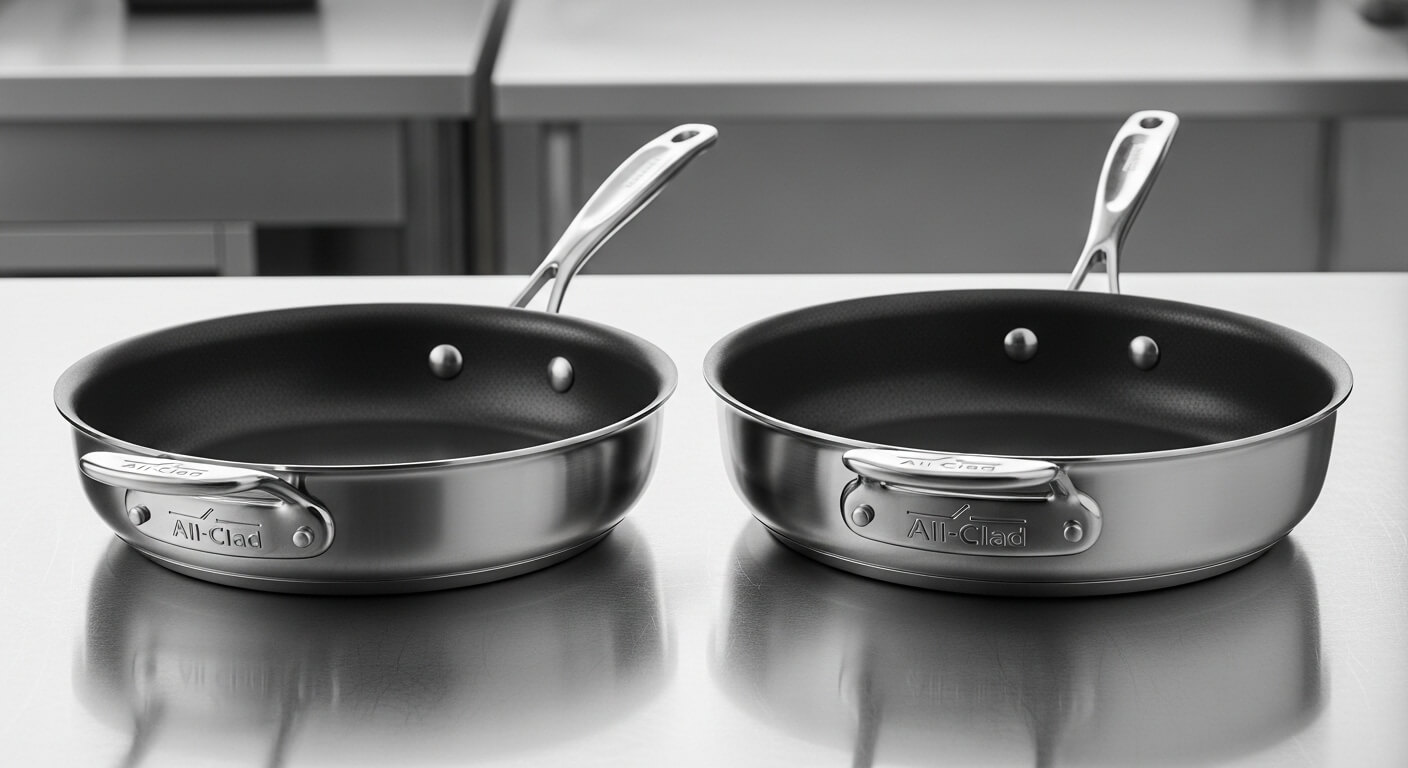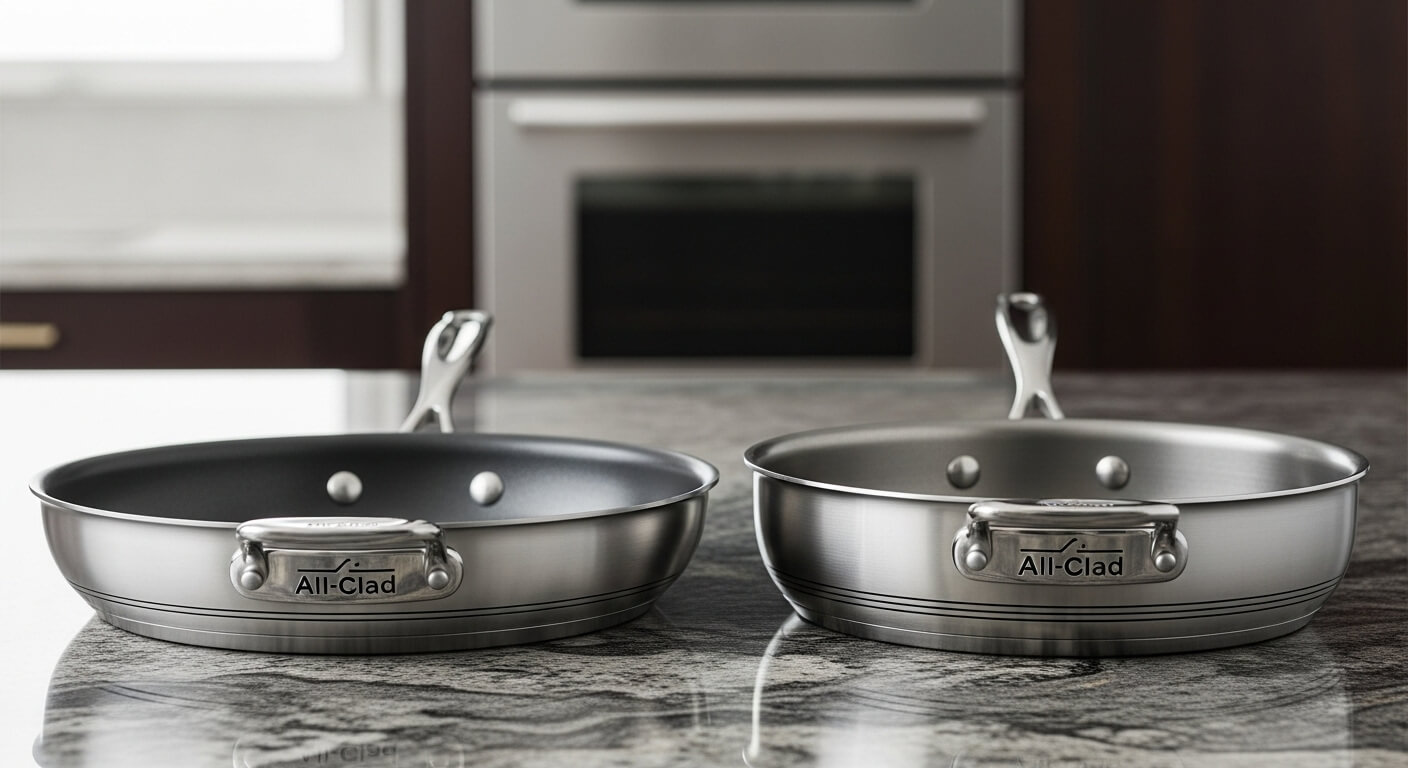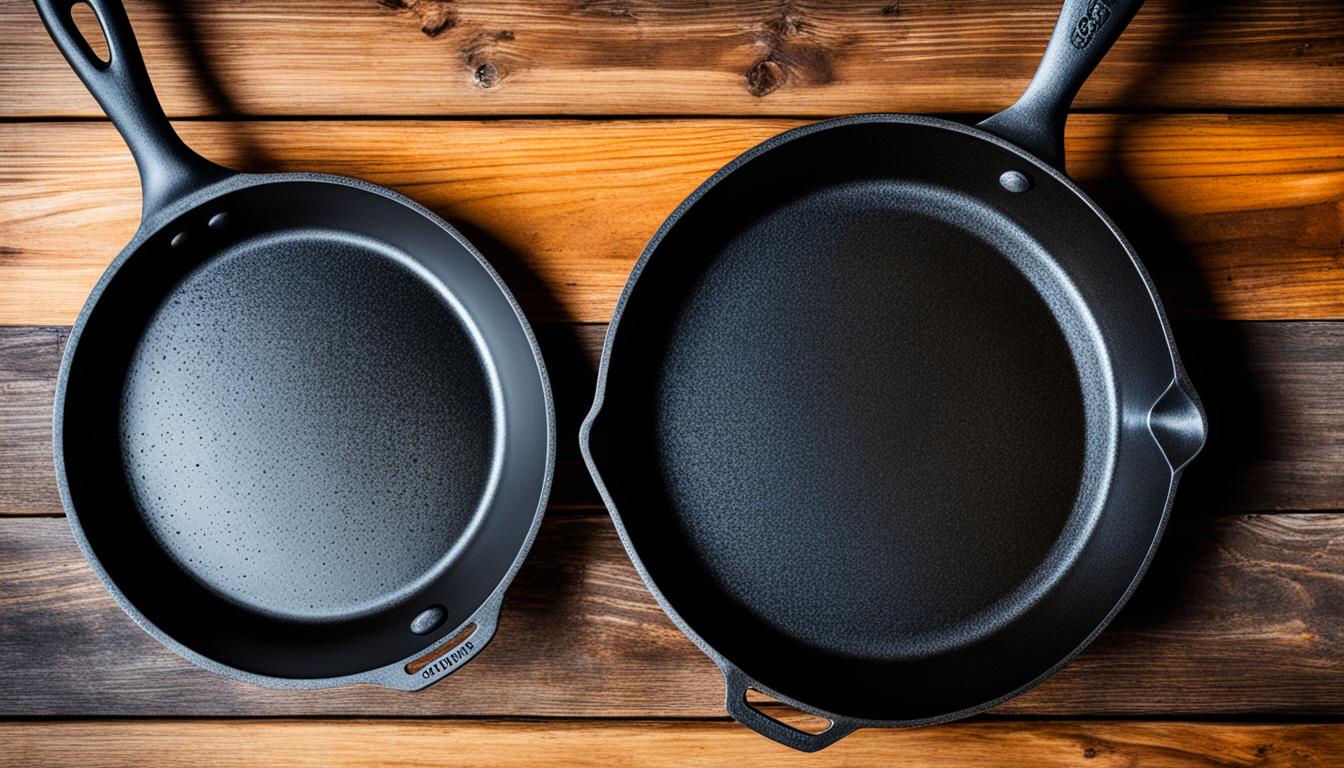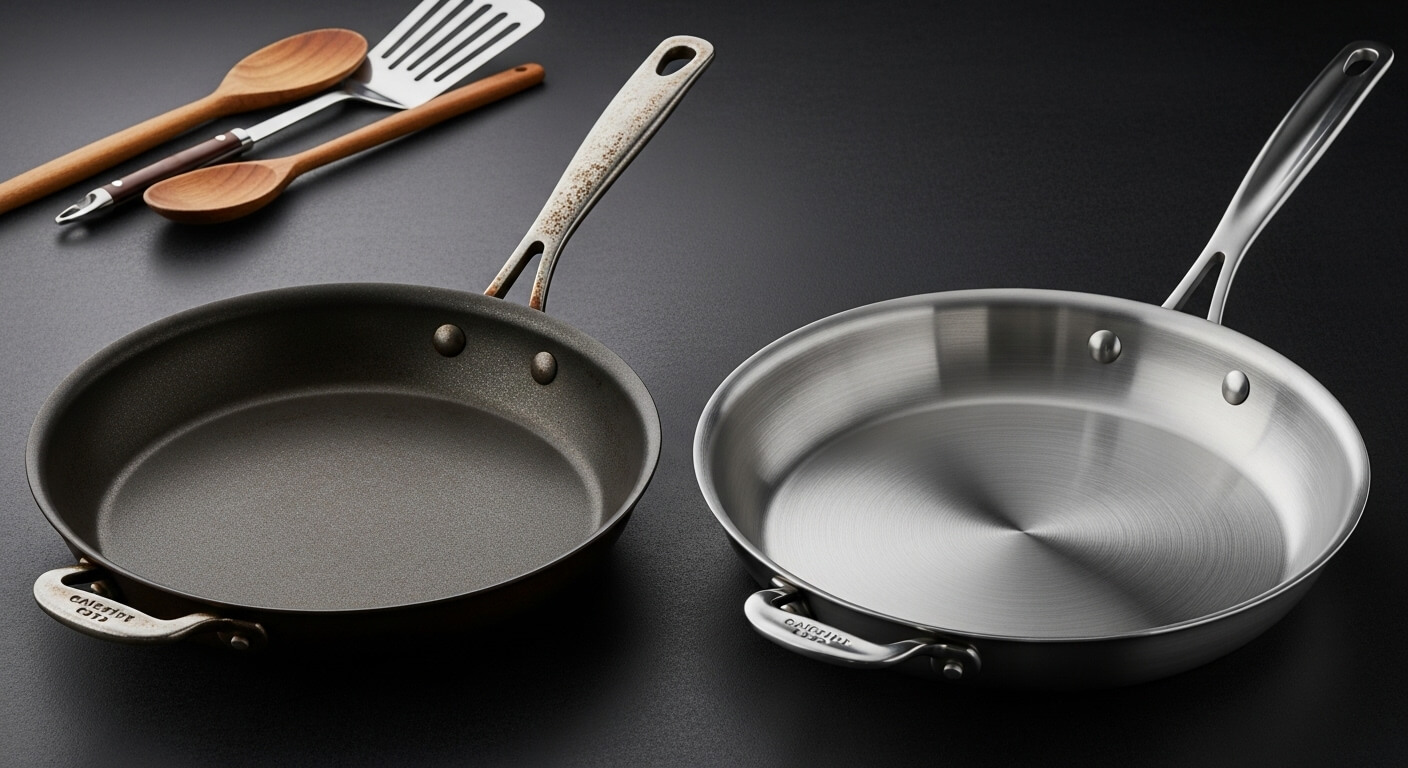
Skillet vs Wok Which Pan Should You Choose for Your Kitchen

Skillet vs Wok: Which Pan Should You Choose for Your Kitchen?

Skillet vs Wok – Understanding the Key Differences

The main differences between skillets and woks are their shape, heat distribution, and intended cooking methods—skillets feature flat bottoms with shallow sides for even contact cooking, while woks have deep, curved bowls designed for high-heat tossing and stir-frying.

Most home cooks face this decision when upgrading their cookware. You might excel at searing steaks but struggle with stir-fries, or perhaps your Asian-inspired dishes never achieve that restaurant-quality char. The pan you choose determines which techniques you can master.

This comparison covers:

  • Design differences that affect how each pan cooks
  • Optimal cooking techniques for skillets versus woks
  • Stovetop compatibility and heat requirements
  • Practical factors like storage, maintenance, and cost
  • Specific foods that perform better in each pan

Skillets deliver consistent results for Western cooking methods—searing, pan-frying, and sauce-making benefit from their flat, stable surface. A 12-inch cast iron skillet browns proteins evenly because every inch touches the cooking surface. The shallow sides (typically 2-3 inches) allow easy flipping with spatulas.

Woks solve different problems. Their 14-inch curved bowls concentrate intense heat at the bottom while cooler zones up the sides give you temperature control. This design enables the constant tossing motion that defines stir-frying. Professional wok cooking happens at temperatures exceeding 750°F, creating the smoky “wok hei” flavor impossible to achieve in flat pans.

The cooking styles you prefer will determine which pan earns a permanent spot on your stovetop. Both tools have distinct advantages that become clear once you understand how their designs influence technique.

Quick Answer: Should You Choose a Skillet or Wok?

Choose a skillet if you primarily cook Western dishes, need versatile oven-to-stovetop functionality, and want even browning for proteins—it’s the better all-purpose pan for most American kitchens.

Choose a wok if you:

  • Cook Asian cuisine regularly (stir-fries, fried rice, noodle dishes)
  • Have a gas stove with high BTU output
  • Prefer quick, high-heat cooking methods
  • Need to toss ingredients frequently during cooking
  • Want to deep-fry with less oil

Choose a skillet if you:

  • Make pan sauces, sear steaks, or cook eggs daily
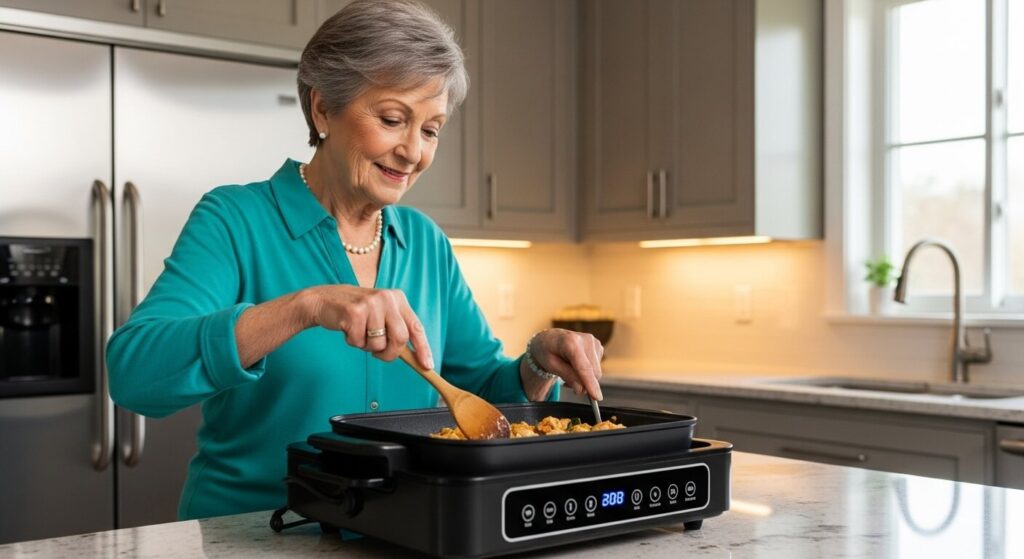
  • Own an electric or induction stovetop
  • Bake or finish dishes in the oven
  • Cook delicate foods that require gentle, even heat
  • Have limited storage space
Factor Skillet Wins Wok Wins
Best For Searing, pan-frying, baking Stir-frying, deep-frying, steaming
Heat Style Even, consistent across surface Concentrated bottom heat, cooler sides
Ideal Stove Any type (gas, electric, induction) Gas with high BTU preferred
Learning Curve Beginner-friendly Requires technique practice
Versatility Oven-safe, multiple techniques Specialized for Asian cooking

The cooking methods you use most often should drive this decision. A skillet handles 80% of Western recipes without compromise. Pancakes, chicken breasts, and sautéed vegetables all benefit from the flat cooking surface and moderate sides.

Woks excel at tasks skillets struggle with—rapid stir-frying demands the curved shape that allows continuous ingredient movement. The high sides prevent food from flying out during aggressive tossing. Home cooks attempting stir-fries in skillets often end up with steamed vegetables instead of properly seared ones because skillets lack the concentrated heat zone woks provide.

Most serious home cooks eventually own both. Start with a quality 12-inch skillet if you cook diverse cuisines. Add a 14-inch carbon steel wok later when you want to master stir-frying techniques. Your stovetop type matters—electric stove owners get better results from skillets, while gas burners unlock a wok’s full potential.

What Is a Skillet?

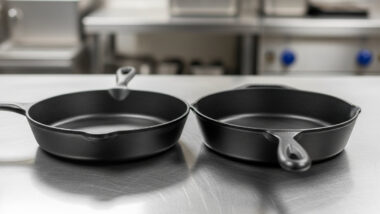
A skillet is a flat-bottomed frying pan with low, gently sloped sides (typically 1.5-3 inches tall) designed for even heat distribution and stable contact cooking. The wide, flat cooking surface makes skillets ideal for searing, browning, and pan-frying foods that benefit from consistent surface contact.

Design and Construction of Skillets

Skillets feature a broad, level base that sits flush against stovetops. This geometry ensures maximum contact between the heat source and cooking surface. The shallow, angled sides allow easy access with spatulas while preventing splatter during cooking.

Common skillet dimensions:

Size Diameter Best For
Small 8 inches Single servings, eggs, small portions
Medium 10 inches 2-3 servings, most everyday cooking
Large 12 inches 4-6 servings, family meals, batch cooking
Extra-Large 14 inches Large gatherings, one-pan meals

Material options affect performance:

  • Cast iron – Retains heat exceptionally well, develops natural non-stick patina, weighs 5-8 pounds, requires seasoning maintenance
  • Stainless steel – Non-reactive surface for acidic foods, oven-safe to 500°F+, develops fond for pan sauces, requires oil to prevent sticking
  • Non-stick (PTFE/ceramic) – Releases food easily, requires less oil, cannot withstand high heat above 400°F, coating degrades over time
  • Carbon steel – Heats quickly, lighter than cast iron (3-4 pounds), develops seasoning like cast iron, responsive to temperature changes

Most skillets include a single long handle (8-10 inches) for one-handed maneuvering. Larger 12-14 inch models often add a helper handle opposite the main handle for two-handed lifting when full. The handle material determines oven safety—metal handles withstand any temperature, while silicone or wooden handles limit oven use.

Premium skillets feature thick bases (3-5mm) that prevent hot spots and warping. Thinner pans heat faster but create uneven cooking zones. The base thickness directly impacts how well a skillet maintains temperature when cold ingredients hit the surface.

What Skillets Are Best For

Skillets dominate Western cooking techniques that demand stable, flat-surface contact. The design supports specific methods that woks cannot replicate effectively.

Optimal skillet cooking methods:

  • Searing proteins – Flat surface creates maximum contact for Maillard browning on steaks, pork chops, and chicken breasts
  • Pan-frying – Shallow oil cooking for breaded cutlets, fish fillets, and fritters stays contained within low sides
  • Deglazing and sauce-making – Wide, flat bottom captures fond (browned bits) that becomes the base for pan sauces
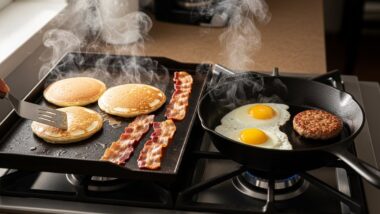
  • Eggs and breakfast foods – Even heat prevents hot spots that cause uneven cooking in omelets, scrambled eggs, and pancakes
  • Delicate foods – Gentle heat control suits fish, crepes, and foods that break apart easily

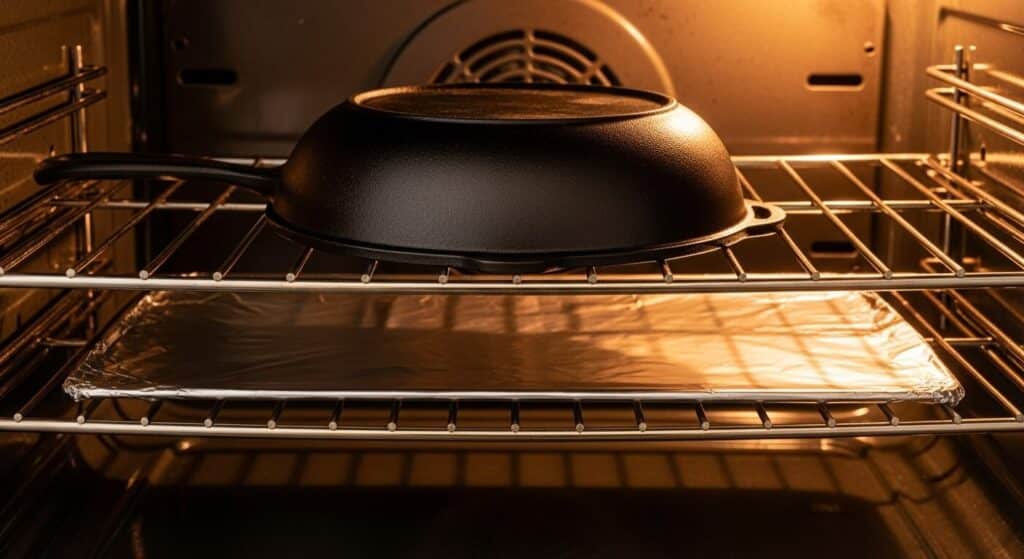
The oven-safe construction of most skillets enables techniques impossible with woks. You can sear chicken thighs on the stovetop, then transfer the entire pan to a 425°F oven to finish cooking. Frittatas, cornbread, and roasted vegetables benefit from this stovetop-to-oven versatility.

Skillets excel at tasks requiring undisturbed cooking. A ribeye steak left alone in a screaming-hot cast iron skillet develops a superior crust compared to constantly moving it. The flat geometry keeps food stationary while heat works from below—the opposite of wok cooking philosophy.

What Is a Wok?

A wok is a deep, bowl-shaped pan with high, sloping sides (4-6 inches tall) and a rounded or flat bottom designed for high-heat cooking and constant ingredient movement. The curved interior creates multiple heat zones—intensely hot at the center, progressively cooler up the sides—enabling the tossing technique central to stir-frying.

Design and Construction of Woks

The distinctive concave shape differentiates woks from all other cookware. This geometry concentrates heat at a small bottom point while the wide, flared sides provide ample space for tossing and flipping ingredients without spillage.

Wok bottom styles:

Type Best For Considerations
Round bottom Gas stoves with wok rings Traditional design, maximum heat concentration, unstable on flat surfaces
Flat bottom Electric and induction stoves 4-6 inch flat base for stability, slightly less heat intensity than round

Standard wok diameters range from 12 to 16 inches measured at the rim. A 14-inch wok handles most home cooking tasks—large enough for family portions but manageable on residential stovetops. Restaurant woks often reach 18-20 inches for high-volume cooking.

Material construction:

  • Carbon steel – Industry standard, heats rapidly, lightweight (2-4 pounds), develops non-stick patina through seasoning, requires maintenance to prevent rust
  • Cast iron – Superior heat retention, extremely heavy (8-12 pounds), slow to heat and cool, uncommon for woks due to weight
  • Stainless steel – Easy maintenance, no seasoning required, poor heat conductivity creates hot spots, food sticks without adequate oil

Wall thickness matters significantly. Professional carbon steel woks measure 1.5-2mm thick—thin enough to heat instantly but substantial enough to withstand high temperatures without warping. Thicker woks (3mm+) lose the quick temperature responsiveness that makes wok cooking effective.

Handle configurations:

  • Single long handle – Cantonese style, 12-14 inches long, enables one-handed tossing and maneuvering
  • Two loop handles – Mandarin style, small metal loops on opposite sides, requires two hands, better for steaming and braising
  • Combination – One long handle plus one helper loop, offers versatility for different techniques

The long handle on Cantonese woks stays cooler than the pan body because it extends away from the heat source. This design allows cooks to grip the handle firmly while executing the rapid wrist-flicking motion that tosses ingredients up the wok’s sides.

What Woks Are Best For

Woks solve problems that flat pans cannot address. The shape enables cooking methods dependent on extreme heat and constant motion.

Primary wok cooking techniques:

  • Stir-frying (chao) – Continuous tossing at 700-900°F sears ingredients in seconds while preventing burning through constant movement
  • Deep-frying – Curved sides require less oil than straight-sided pots; 2-3 cups of oil in a wok achieve the same depth as 6-8 cups in a Dutch oven
  • Steaming – Bamboo steamers sit on the wok’s rim above simmering water, cooking dumplings, buns, and vegetables
  • Smoking – Tea leaves and sugar at the wok bottom generate smoke that flavors foods on an elevated rack
  • Braising and stewing – Deep bowl holds liquids for red-cooked meats and clay pot-style dishes

The sloped sides create a cooking gradient absent in skillets. Vegetables start at the scorching bottom for initial sear, then get pushed up the cooler sides while proteins take their turn at maximum heat. This zone control allows simultaneous cooking of ingredients with different requirements.

Wok hei—the elusive “breath of the wok” flavor—occurs only when food makes brief contact with metal exceeding 750°F. The combination of extreme heat, rapid tossing, and slight charring creates complex, smoky flavors impossible to replicate in other cookware. Home stoves producing 12,000-15,000 BTU can achieve approximations of wok hei with proper technique.

The high sides contain oil splatter during deep-frying while using 60-70% less oil than traditional deep fryers. A wok’s curved bottom naturally pools oil at the center, creating sufficient depth for frying with minimal volume. Four chicken thighs fry completely in just 3 cups of oil.

Skillet vs Wok: Head-to-Head Comparison

Skillets and woks differ fundamentally in shape, heat distribution, and cooking methodology—skillets provide even, stable heat across a flat surface for Western techniques, while woks concentrate intense heat at the bottom with cooler zones up curved sides for Asian stir-frying methods.

Shape and Design Differences

The geometric contrast between these pans determines which cooking techniques succeed or fail. A skillet’s flat base spans 8-12 inches of level cooking surface. Food sits stationary, maintaining constant contact with the heated metal. The shallow sides (1.5-3 inches) angle outward at roughly 45 degrees, providing splash protection without impeding spatula access.

Woks curve inward from a small bottom point (4-6 inches on flat-bottom models) to a wide rim 12-16 inches across. This creates a bowl shape with 4-6 inch tall sides that rise at steep angles. The curvature means only ingredients at the very bottom touch the hottest zone—everything else rests on sloped surfaces at varying temperatures.

Surface area comparison:

Pan Type Bottom Contact Area Total Cooking Surface Depth
12″ Skillet ~113 sq inches ~120 sq inches 2 inches
14″ Wok ~19 sq inches (flat bottom) ~180 sq inches 5 inches

A 12-inch skillet offers six times more flat surface area than a comparable wok. This matters when searing multiple steaks simultaneously—they all receive identical heat. Woks sacrifice bottom surface area for vertical capacity, holding 2-3 quarts more volume than similarly sized skillets.

The shape dictates ingredient behavior during cooking. Skillet walls prevent excessive movement, keeping food in the hot zone for browning. Wok walls become part of the cooking process—ingredients slide up and down the curve during tossing, spending brief moments at maximum heat before cooling slightly on the ascent.

Heat Distribution: Skillet vs Wok

Skillets distribute heat horizontally across the entire base. A quality skillet maintains temperature variance of less than 25°F from center to edge. Cast iron and thick aluminum bases prevent hot spots that cause uneven cooking. When you place a chicken breast in a preheated skillet, every inch browns at the same rate.

Woks intentionally create temperature gradients. The bottom reaches 750-900°F on gas burners, while the upper sides stay 200-300°F cooler. Carbon steel’s thin walls (1.5-2mm) respond instantly to flame adjustments—remove from heat and the wok cools within seconds, return it and temperatures spike immediately.

Temperature zones by pan type:

  • Skillet heating pattern – Uniform 400-500°F across flat surface, slight cooling (25-50°F) near walls, excellent heat retention when ingredients added
  • Wok heating pattern – Concentrated 700-900°F at bottom, graduated cooling up sides (600°F at mid-point, 400°F at rim), rapid temperature recovery

The thick base of a cast iron skillet (5mm+) stores thermal energy. Adding cold vegetables drops the surface temperature by only 50-75°F, and the pan recovers quickly. Thin carbon steel woks lose heat faster but regain it almost instantly on high-BTU burners—this responsiveness suits the stop-start nature of stir-frying.

Electric stoves compromise wok performance because flat heating elements cannot concentrate intense heat at the curved bottom. The temperature differential that makes woks effective gets lost. Skillets perform identically on electric and gas because their flat bottoms match the heat source geometry.

Cooking Techniques: What Each Pan Does Best

The physical differences between skillets and woks enable distinctly different cooking methods. Attempting the wrong technique in either pan produces mediocre results.

Best Techniques for Skillets

Searing and browning – The Maillard reaction demands sustained contact between protein and hot metal. Skillets keep steaks, chops, and chicken stationary at 450-500°F for the 3-4 minutes required to develop a caramelized crust. Moving the protein interrupts this process.

Pan-frying with consistent contact – Breaded cutlets, fish fillets, and potato pancakes need even heat from below without disturbance. The flat surface ensures the entire breaded coating touches hot metal simultaneously. Shallow oil (1/4 inch) stays level in a skillet rather than pooling as it would in a wok.

Making eggs and pancakes – These delicate foods spread into thin, even layers on flat surfaces. Pancakes form perfect circles because batter doesn’t run downhill. Omelets fold easily when cooked on a level plane. The low sides grant access for sliding spatulas underneath without tearing.

Reducing sauces – Wide, flat bottoms maximize evaporation surface area. Pan sauces made from deglazing fond reduce faster in skillets because more liquid touches hot metal. The shallow depth allows easy stirring and monitoring of consistency changes.

Best Techniques for Woks

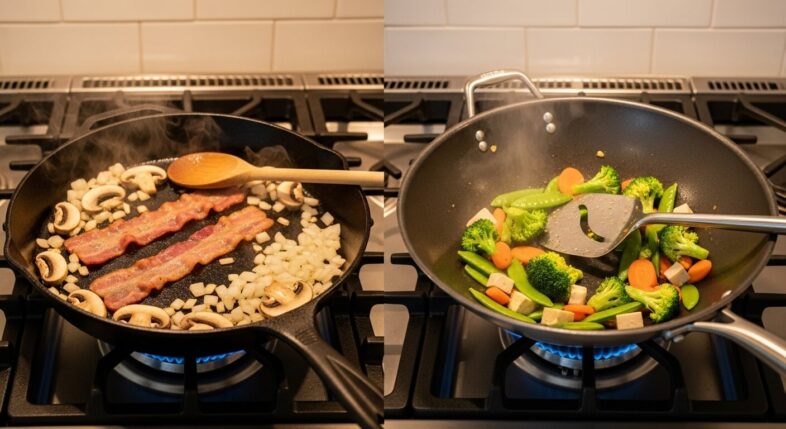
High-heat stir-frying – This technique requires ingredients to tumble and flip continuously at extreme temperatures. The curved shape catches tossed food that would fly out of a skillet. Vegetables hit the 800°F bottom for instant searing, then slide up cooler sides while proteins take their turn at maximum heat. The motion prevents burning while building flavor through rapid, repeated contact with scorching metal.

Tossing and continuous motion cooking – Wok cooking involves constant movement—the curved sides make this possible. A flick of the wrist sends ingredients up one side of the bowl and back down the other. This technique evenly distributes sauces and prevents any single piece from sitting too long in the hot zone.

Deep-frying efficiently – The tapered shape requires far less oil than straight-sided pots. Three cups of oil in a wok creates 3-4 inches of depth sufficient for frying chicken or spring rolls. The wide top rim allows easy access for adding and removing food with spider strainers.

Steaming and braising – Bamboo steamers rest perfectly on the wok’s curved rim above simmering water. The deep bowl holds enough liquid for long braises without risk of boiling dry. These techniques leverage the wok’s volume rather than its heat concentration.

Versatility: Skillet vs Wok for Different Cuisines

Skillets handle the breadth of Western cooking without compromise. French, Italian, and American recipes assume flat-pan cooking—sautéed mushrooms, pan-seared salmon, and frittatas all require the stable surface skillets provide. The oven-safe design extends utility to baked dishes, roasted vegetables, and desserts like skillet cookies.

Chinese, Thai, Vietnamese, and other Asian cuisines developed around wok cooking. Authentic stir-fries, fried rice, and pad thai achieve proper texture only when cooked with wok techniques. The equipment matches the methodology—you cannot properly execute chow mein in a skillet because the noodles need to be tossed repeatedly through high heat.

Cuisine compatibility:

Cuisine Type Skillet Performance Wok Performance
American/European Excellent Poor to fair
Chinese/Asian Fair to good Excellent
Mexican Excellent Fair
Indian Good to excellent Good
Mediterranean Excellent Fair

Skillets adapt more readily to unfamiliar recipes. A home cook can make passable fried rice in a skillet by increasing heat and working in batches. Attempting to sear a ribeye steak properly in a wok proves far more difficult—the curved bottom prevents adequate contact for crust development.

Most American households get more daily use from skillets because Western recipes dominate home cooking. Woks become specialized tools for those who regularly prepare Asian dishes or want to master stir-frying technique.

Ease of Use and Learning Curve

Skillets require minimal technique—heat the pan, add oil, place food, flip once. The forgiving nature suits beginners. Temperature mistakes rarely ruin dishes because the even heat distribution prevents dramatic hot spots. You can walk away briefly without immediate consequences.

Wok cooking demands practice and coordination. The tossing motion feels awkward initially—ingredients scatter across the stovetop until muscle memory develops. Timing becomes critical because foods cook in 2-3 minutes at extreme heat. Sauce components must be premixed because there’s no time to measure during cooking. The learning curve steepens significantly compared to skillet techniques.

Skill requirements comparison:

  • Skillet mastery – Understanding heat levels, knowing when to flip, deglazing technique
  • Wok mastery – Tossing coordination, multi-zone heat management, rapid mise en place, high-heat timing

Round-bottom woks add another complexity—they wobble on flat surfaces without wok rings. Flat-bottom models solve stability issues but sacrifice some traditional heat concentration. Gas stoves provide instant heat adjustments that wok cooking requires; electric stoves lag in response time, making temperature control harder to master.

Most cooks achieve competent skillet results within weeks. Wok proficiency takes months of regular practice to develop the hand-eye coordination and heat intuition that produces restaurant-quality stir-fries.

Skillet vs Wok: Practical Considerations

Practical factors like stovetop compatibility, storage space, maintenance requirements, and cost significantly impact whether a skillet or wok suits your kitchen better—skillets work on all heat sources and store easily, while woks demand specific stove types and care routines to perform optimally.

Stovetop Compatibility

The heat source in your kitchen determines which pan will deliver better results. This factor alone can make the choice between a skillet and wok for you.

Using a Skillet on Different Stovetops

Skillets function identically across all cooking surfaces. The flat bottom matches the geometry of every heat source manufactured—gas burners, electric coils, glass-top electric, and induction cooktops all transfer heat efficiently to skillet bases.

Skillet performance by stove type:

Stove Type Skillet Compatibility Notes
Gas Excellent Even flame distribution, instant heat control
Electric coil Excellent Full contact with heating element
Glass-top electric Excellent Flat bottom prevents scratching
Induction Excellent Requires magnetic steel base (cast iron, carbon steel, some stainless)

Cast iron and stainless steel skillets work on induction cooktops because magnetic fields pass through these materials. Aluminum and copper skillets require a steel disc bonded to the base for induction compatibility. The flat geometry ensures the magnetic field contacts the maximum surface area for efficient heating.

Heat adjustment responsiveness varies by stove, not by the skillet. Gas and induction respond instantly to temperature changes. Electric coils and glass tops lag by 30-60 seconds but heat the skillet evenly once stabilized.

Using a Wok on Different Stovetops

Woks perform best on specific equipment. The traditional round-bottom design assumes a heat source that can concentrate flame at a single point—something only gas stoves with wok rings provide.

Wok performance by stove type:

Stove Type Round-Bottom Wok Flat-Bottom Wok Effectiveness
Gas (standard) Poor (wobbles) Good 70-80% of ideal
Gas (with wok ring) Excellent Excellent 95-100% of ideal
Electric coil Unusable Fair 40-50% of ideal
Glass-top electric Unusable Fair 40-50% of ideal
Induction Unusable Good 60-70% of ideal

Gas stoves with high-output burners (15,000+ BTU) unlock wok cooking potential. The open flame wraps around the curved bottom, heating a larger surface area than flat electric elements can reach. Professional wok burners in restaurants produce 50,000-100,000 BTU—home cooks work with significantly less power but can still achieve good results on residential gas ranges.

Wok rings solve the stability problem for round-bottom woks on gas stoves. These circular metal frames hold the wok steady while allowing flame access to the curved bottom. The ring elevates the wok closer to the burner, intensifying heat concentration.

Flat-bottom woks compromise traditional design for practicality on modern stoves. The 4-6 inch flat base sits securely on electric and induction surfaces. Heat transfers efficiently through the bottom but cannot wrap around the curve as gas flames do. This limitation reduces the temperature differential that makes wok cooking effective—the cooler zones up the sides become less pronounced.

Electric stoves create the most significant challenges for wok cooking. Coils and glass tops heat only the small flat bottom while the curved sides receive minimal energy. Stir-fries become steam-cooking rather than high-heat searing because the pan cannot reach or maintain 750°F+ temperatures. Many electric stove owners get better Asian cooking results from skillets than from woks.

Induction woks require carbon steel construction with flat bottoms. The magnetic field generates heat only where the wok base contacts the cooktop—typically a 5-6 inch circle. This concentration point works adequately for small-batch stir-fries but lacks the surrounding heat envelope that gas provides.

Storage and Kitchen Space

Physical dimensions determine whether these pans fit in your cabinets and drawers. Storage requirements influence purchasing decisions for space-constrained kitchens.

Storage footprint comparison:

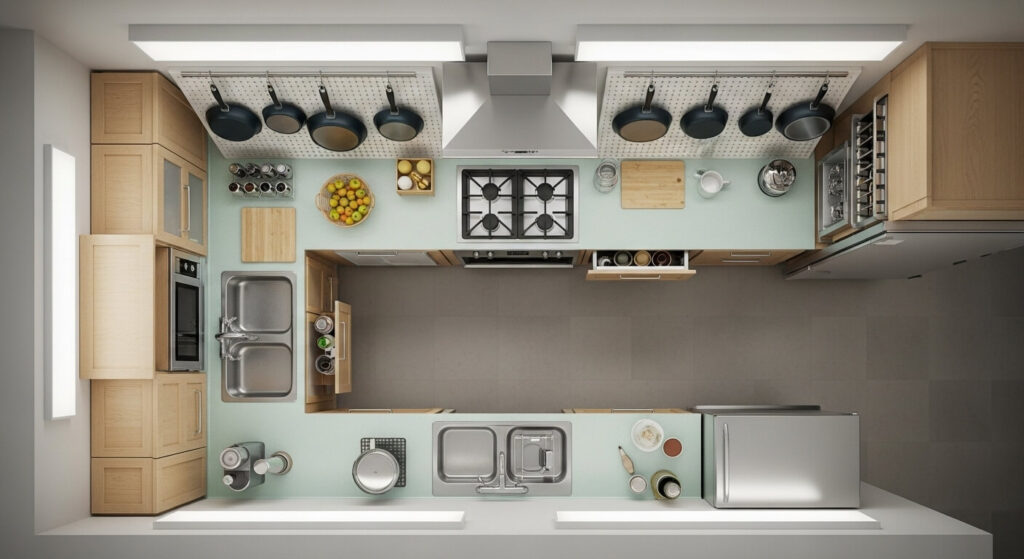
  • Skillets – Stack flat in 3-4 inch vertical space, nest inside each other, hang from wall-mounted racks, store in drawers
  • Woks – Require 6-8 inches vertical clearance, bowl shape prevents stacking, hang from hooks or pot racks, awkward in standard cabinets

A 12-inch skillet occupies minimal space because it sits flat. Multiple skillets nest together—a 12-inch, 10-inch, and 8-inch skillet stack in the space of a single tall pot. Cabinet organizers and drawer inserts accommodate skillets easily.

Woks demand vertical storage due to their bowl shape. A 14-inch wok stands 6-7 inches tall and cannot nest with other cookware. The curved bottom makes shelf storage unstable—woks roll unless positioned carefully. Most cooks hang woks from hooks or ceiling-mounted pot racks.

Small kitchens favor skillets for spatial efficiency. Apartment dwellers with limited cabinet space find woks harder to accommodate. The bowl shape wastes vertical storage area that could hold multiple flat pans. Urban kitchens often lack the hook space or pot rack infrastructure for hanging large woks.

Cleaning and Maintenance

Daily care requirements differ substantially between skillets and woks. Material composition dictates maintenance intensity more than pan shape.

Caring for Your Skillet

Cleaning procedures vary by skillet material. Each type demands different approaches to maintain performance and longevity.

Cast iron skillets resist soap historically but modern dish soap no longer harms seasoning. Rinse after use, scrub with hot water and a stiff brush, dry completely over low heat, apply thin oil layer. Seasoning builds over time through cooking fats—properly maintained cast iron develops a slick, natural non-stick surface. Rust forms if left wet or stored in humid conditions.

Stainless steel skillets tolerate aggressive cleaning. Scrub with abrasive pads to remove stuck fond, use Bar Keeper’s Friend for discoloration, dishwasher-safe but hand washing preserves appearance longer. Food sticks more readily than in seasoned or non-stick pans—deglazing with liquid during cooking prevents excessive buildup.

Non-stick skillets require gentle handling. Use only soft sponges, avoid metal utensils that scratch coating, never heat above 400°F which degrades PTFE, hand wash to extend coating life (dishwashers accelerate breakdown). Quality non-stick surfaces last 3-5 years with careful use before replacement becomes necessary.

Carbon steel skillets follow cast iron protocols—season regularly, avoid prolonged water exposure, dry immediately after washing, re-oil after each use. The thinner material rusts faster than cast iron if neglected but also seasons more quickly.

Caring for Your Wok

Traditional carbon steel woks develop character through use. The maintenance routine becomes second nature after establishing proper habits.

Seasoning carbon steel woks creates the non-stick patina essential for performance. New woks arrive with factory coating—burn this off over high heat, scrub away residue, heat until smoking, add oil, swirl to coat all surfaces, heat until oil polymerizes into a dark layer. This initial seasoning takes 30-45 minutes. Each cooking session adds layers to the patina.

Quick cleaning after stir-frying maintains the seasoning. Rinse the hot wok immediately with water (the temperature shock loosens food particles), scrub with bamboo brush or non-abrasive pad, return to burner to evaporate moisture, wipe thin oil coat on interior surface. The entire process takes 2-3 minutes—woks should never soak.

Maintaining the wok’s patina requires protecting the seasoned surface. Avoid cooking acidic foods (tomatoes, vinegar) frequently—they strip seasoning. Don’t use soap unless absolutely necessary. Store in dry locations to prevent rust. Deep black patina develops over months of regular use, becoming naturally non-stick and adding subtle flavor to stir-fries.

Stainless steel woks eliminate seasoning requirements but sacrifice the flavor-building properties and non-stick qualities that make carbon steel preferable. Most serious wok cooks accept the maintenance tradeoff for superior cooking performance.

Price Comparison: Skillet vs Wok

Cost ranges from budget-friendly to premium for both pan types. Material and construction quality drive prices more than whether something qualifies as a skillet or wok.

Price ranges by quality tier:

Quality Level Skillet Cost Wok Cost What You Get
Budget $15-$30 $20-$35 Thin materials, basic construction, shorter lifespan
Mid-Range $40-$80 $35-$60 Quality materials, even heating, 10+ year durability
Premium $100-$200 $70-$120 Professional-grade, superior heat retention, lifetime warranty
Luxury $250-$500+ $150-$300 Artisan craftsmanship, copper core, collectible brands

Budget skillets from Lodge (cast iron) or Tramontina (non-stick) deliver solid performance at $20-$30. These entry-level options suit beginners testing their interest before investing heavily. The materials perform adequately but lack the refined heat distribution of premium models.

Mid-range skillets ($40-$80) from brands like Cuisinart, Calphalon, or Victoria achieve the sweet spot of quality and value. A well-made stainless steel or carbon steel skillet in this range lasts decades with proper care. The construction quality prevents warping and maintains even heating.

Premium skillets justify higher costs through superior engineering. All-Clad stainless ($150-$200) features three-ply construction with aluminum cores for exceptional heat distribution. Le Creuset enameled cast iron ($200-$300) combines performance with aesthetics. These investments make sense for serious home cooks who use skillets daily.

Wok pricing follows different patterns. Professional-quality carbon steel woks cost $25-$45—less than comparable skillets because the simple construction requires less material and engineering. Hand-hammered woks from specialty manufacturers run $60-$120. Stainless steel woks reach $80-$150 but remain less popular than carbon steel.

The budget advantage goes to woks. A $30 carbon steel wok from a restaurant supply store performs identically to models costing three times more. Skillets show greater quality variation across price points—cheap skillets heat unevenly while expensive ones justify costs through better materials.

Best value recommendations:

  • Budget skillet – Lodge 12″ cast iron ($25), Tramontina 10″ non-stick ($20)
  • Budget wok – Craft Wok 14″ carbon steel ($35), restaurant supply store woks ($25-$30)
  • Mid-range skillet – Cuisinart MultiClad Pro 12″ stainless ($70), Made In 12″ carbon steel ($80)
  • Mid-range wok – Joyce Chen 14″ carbon steel ($40), Wok Shop hand-hammered ($60)

Most home cooks should start in the budget-to-mid-range categories. The performance difference between $30 and $150 woks remains minimal for beginners still developing technique. Skillets show more pronounced quality gaps where mid-range investment produces noticeably better results than budget options.

Which Foods Cook Better in a Skillet vs Wok?

Thick proteins, delicate foods, and dishes requiring even browning cook better in skillets, while thinly sliced meats, crisp vegetables, and foods needing constant motion perform better in woks—the pan choice directly affects texture, flavor development, and cooking speed for different ingredients.

Proteins: Skillet vs Wok Performance

The thickness and preparation of proteins determines which pan produces superior results. Cut size matters more than the protein type itself.

Thick cuts and whole pieces favor skillets. A 1.5-inch ribeye steak requires sustained contact at 500°F for 4-5 minutes per side to develop a proper crust while maintaining a medium-rare center. The flat skillet surface ensures every millimeter touches hot metal simultaneously. Woks cannot provide this level contact—the curved bottom means only a portion of the steak surface receives direct heat, resulting in uneven cooking and poor crust formation.

Bone-in chicken thighs, pork chops, and salmon fillets similarly demand flat-surface stability. These proteins benefit from being left undisturbed to develop fond on the bottom before flipping once. A skillet’s geometry supports this hands-off approach. The ability to transfer the entire pan to a 425°F oven finishes thick cuts perfectly without stovetop monitoring.

Thinly sliced meats excel in woks. Beef sliced 1/8-inch thick for stir-fries cooks in 45-60 seconds at wok temperatures. The rapid tossing motion exposes all surfaces to intense heat briefly—enough to sear without overcooking. Chicken breast cut into 1/2-inch strips browns quickly while staying tender through constant movement up and down the wok’s curve.

The slicing pattern matters significantly. Proteins cut against the grain into thin strips tumble easily during tossing. Large pieces lodge at the wok bottom and scorch before the exterior develops color. Chinese restaurant technique calls for velveteen—coating proteins in cornstarch slurry—which creates a protective layer that browns beautifully in woks but gums up skillets.

Protein performance comparison:

Protein Cut Best Pan Reason
Whole steaks (1″+ thick) Skillet Needs sustained flat contact for crust
Thin-sliced beef/pork Wok Benefits from rapid tossing and high heat
Chicken breasts (whole) Skillet Even thickness requires stable cooking
Chicken (bite-sized) Wok Small pieces suit constant motion
Fish fillets Skillet Delicate texture breaks apart with tossing
Shrimp Either Works well in both (whole in skillet, chopped in wok)
Ground meat Skillet Needs to brown undisturbed before breaking up

Shrimp represents the crossover category—large whole shrimp sear beautifully in skillets where they sit flat, while medium shrimp tossed in woks cook evenly through constant movement. The preparation style dictates pan selection more than the ingredient itself.

Ground beef for tacos or Bolognese requires skillet treatment. The meat must sit undisturbed for 3-4 minutes to develop brown fond before breaking into smaller pieces. Constant stirring in a wok produces gray, steamed meat without the Maillard reaction that creates depth of flavor.

Vegetables: Skillet vs Wok Comparison

Vegetable preparation methods and desired textures determine optimal cookware. The distinction between roasting and stir-frying drives this choice.

Roasting and caramelizing vegetables in skillets produces deep, concentrated flavors through sustained heat exposure. Brussels sprouts halved and placed cut-side down in a cast iron skillet at 450°F develop crispy, caramelized surfaces after 8-10 minutes undisturbed. The flat bottom keeps all sprouts in contact with the pan simultaneously.

Mushrooms benefit tremendously from skillet cooking. Their high water content requires time at consistent heat to evaporate moisture before browning begins. A crowded wok steams mushrooms through trapped moisture and constant movement. A skillet allows mushrooms to sit in a single layer, releasing water that evaporates quickly against the hot surface.

Root vegetables—carrots, parsnips, turnips—roast successfully in oven-safe skillets. Cut into uniform pieces, they brown on the stovetop before finishing in the oven at 400°F. The skillet-to-oven workflow produces caramelized exteriors and tender interiors impossible to achieve through wok tossing alone.

Quick-cooking crisp vegetables in woks maintain texture and vibrant color through rapid high-heat exposure. Snap peas, bok choy, and bean sprouts need 60-90 seconds of cooking time. The wok’s extreme heat sears surfaces while the brief cooking time preserves crunch. Moving vegetables constantly up the cooler sides prevents overcooking.

Bell peppers, onions, and broccoli cut into thin, uniform pieces benefit from wok treatment when crisp-tender texture is desired. The graduated heat zones allow precise control—vegetables start at the scorching bottom, get pushed up the sides to slow cooking, then return for final searing. This cannot be replicated in a flat pan.

Leafy greens like spinach and Chinese cabbage require the wok’s high sides. Large volumes wilt down dramatically—what starts as an overflowing wok reduces to 2 cups of cooked greens. Skillets lack the capacity to hold uncooked leafy vegetables before they wilt.

Vegetable cooking method guide:

Vegetable Type Skillet Method Wok Method Best Choice
Root vegetables Roast for caramelization Stir-fry briefly Skillet
Mushrooms Sauté until golden Quick stir-fry Skillet
Leafy greens Wilt in batches Wilt in large volume Wok
Snap peas, green beans Pan-fry for char Flash stir-fry Wok
Bell peppers Sauté for softness Stir-fry for crunch Depends on desired texture
Zucchini/squash Sauté for browning Quick stir-fry Skillet

Texture preference guides the choice. Soft, deeply caramelized vegetables come from skillets. Crisp, lightly seared vegetables with bright color come from woks. The same ingredient yields entirely different results based on pan selection and technique.

Rice and Noodles: Skillet vs Wok

Fried rice represents the clearest distinction between skillet and wok capabilities. Traditional fried rice demands a wok for proper texture and that characteristic slightly smoky flavor.

Fried rice excels in woks because the technique requires constant tossing at extreme heat. Day-old rice grains must separate and crisp without becoming mushy—this happens when rice hits 800°F metal briefly before being flipped away. The wok’s curve allows the scooping-and-tossing motion that distributes soy sauce and keeps grains moving.

Skillet fried rice becomes sticky and clumpy. The flat surface causes rice to sit in sauce rather than tumble through it. Without the ability to toss effectively, cooks must stir with spatulas—this breaks grains and creates an inferior texture. Restaurant-quality fried rice cannot be achieved in skillets regardless of heat level.

The wok’s high sides prevent rice from flying across the kitchen during aggressive tossing. A proper fried rice flip sends the entire contents 6-8 inches into the air—impossible in a skillet without creating a mess.

Pan-fried noodles work in both pans with different approaches. Crispy chow mein benefits from skillet treatment—fresh noodles pressed flat against hot metal develop a golden, crunchy bottom while the top stays slightly chewy. This dish sits still while cooking, making the wok’s tossing capability unnecessary.

Lo mein and other sauce-coated noodles require wok treatment similar to fried rice. The noodles must be lifted and flipped to coat evenly without clumping. Skillets force you to stir, which tangles long noodles and prevents proper sauce distribution.

Risotto and other rice dishes in skillets leverage the pan’s strengths—wide surface area for evaporation and easy stirring access. Risotto demands frequent stirring and gradual liquid addition. The skillet’s flat bottom allows you to see when the pan bottom becomes visible between stirs—the visual cue for adding more stock. Wok walls obscure this indicator.

Spanish rice, pilaf, and rice casseroles all benefit from skillet geometry. These dishes cook through absorption rather than tossing, making flat surfaces ideal. Many recipes call for starting rice on the stovetop, then finishing in the oven—woks cannot transition to oven cooking due to wooden handles and unsuitable shape.

Rice and noodle recommendations:

  • Fried rice → Wok exclusively for authentic texture
  • Crispy pan-fried noodles → Skillet for better browning
  • Lo mein/chow fun → Wok for tossing and coating
  • Risotto → Skillet for proper evaporation and stirring
  • Rice pilaf → Skillet for even cooking and oven finishing
  • Pad thai → Wok for traditional preparation (skillet acceptable)

One-Pan Meals

Complete dinners cooked in a single vessel showcase the versatility differences between skillets and woks. The dishes possible in each pan reflect their fundamental design purposes.

Skillet dinners accommodate Western one-pan concepts. Proteins and vegetables cook together through browning, simmering, or baking—techniques that require stable, flat surfaces. A typical skillet dinner involves searing chicken thighs, removing them temporarily, sautéing vegetables in the remaining fond, returning the chicken, adding liquid, and finishing everything together in the oven.

Sheet pan dinner components can often transfer to large skillets—roasted chicken with potatoes and carrots, for instance. The skillet’s oven-safe construction enables this flexibility. Frittatas and baked pasta dishes capitalize on skillet geometry that woks cannot replicate.

Wok meals follow Asian one-pan traditions where ingredients cook sequentially at high heat before being combined. A complete stir-fry involves cooking proteins first, setting them aside, stir-frying aromatics and vegetables in stages based on cooking time, then returning everything for final tossing with sauce. The deep bowl holds all components without crowding.

Braised dishes work surprisingly well in woks despite their association with high-heat cooking. The curved bowl holds 3-4 quarts of liquid for red-cooked pork belly or clay pot chicken. The high sides prevent evaporation and splatter during long simmers.

Weeknight meal flexibility tilts toward skillets for most American households. The recipes people cook regularly—pasta dishes, chicken dinners, taco fillings, breakfast scrambles—all suit skillet treatment. A single 12-inch skillet handles 75% of weeknight cooking needs without requiring specialized technique.

Woks serve households where Asian cuisine appears weekly. If stir-fries, fried rice, or noodle dishes comprise regular dinner rotation, the wok becomes essential rather than optional. The tool matches the cooking style—neither is inherently more versatile, but each excels within its culinary tradition.

Skillet vs Wok: Heat Requirements and Energy Efficiency

Skillets work effectively on standard home stoves producing 9,000-12,000 BTU, while woks achieve optimal performance only with high-output burners exceeding 15,000 BTU—this fundamental difference in heat requirements determines whether your current kitchen setup can properly utilize each pan type.

BTU and Heat Output Needs

British Thermal Units (BTU) measure the heat energy cooking equipment produces per hour. Standard residential gas ranges deliver 9,000-12,000 BTU through their main burners. This output suits skillet cooking perfectly—cast iron and stainless steel pans reach 450-500°F within 5-7 minutes at these levels.

Electric stoves convert watts to heat rather than measuring in BTU. A typical electric burner produces equivalent energy to 7,000-10,000 BTU. The lower output matters less for skillets because the flat contact surface transfers available heat efficiently. Preheating takes slightly longer than gas but achieves comparable cooking temperatures.

Woks demand substantially higher heat for authentic results. Traditional Chinese restaurant wok burners produce 50,000-100,000 BTU—five to ten times residential burner output. This massive heat creates the rapid temperature recovery and intense searing that defines proper stir-frying. Home cooks cannot replicate these conditions but can approximate the effect with high-output residential equipment.

Outdoor wok burners designed for home use generate 65,000-160,000 BTU, bringing restaurant-level performance to backyards. These specialized burners cost $100-$300 and require propane tanks. Serious wok enthusiasts invest in outdoor setups when indoor stoves prove inadequate.

Heat output requirements by cooking method:

Cooking Method Minimum BTU Ideal BTU Pan Type
Searing steaks 9,000 12,000-15,000 Skillet
Sautéing vegetables 7,000 9,000-12,000 Skillet
Pan-frying 8,000 10,000-12,000 Skillet
Basic stir-frying 12,000 15,000-20,000 Wok
Authentic wok cooking 20,000 50,000+ Wok
Deep-frying 10,000 12,000-15,000 Either

Induction cooktops measure power in watts—1,800-3,700 watts translates to approximately 6,000-12,600 BTU equivalent. High-end induction burners reach 3,700 watts (boost mode), delivering heat that rivals gas for skillets. Woks on induction face the same limitation as on electric—adequate heat but poor distribution due to flat contact points.

The curved wok bottom needs flame to wrap around its surface. Gas burners accomplish this naturally—the flame spreads outward, heating a larger area than just the bottom contact point. Electric elements heat only the flat portions that touch the cooktop, leaving much of the wok’s cooking surface cooler than intended.

Cooking Speed Comparison

Time from storage to serving differs substantially between skillet and wok preparations. The equipment and techniques involved affect total cooking duration.

Preheating time varies by material and burner output. Cast iron skillets require 5-7 minutes to reach proper searing temperature on standard gas burners. The thick metal (5mm base) absorbs heat slowly but retains it excellently once hot. Stainless steel skillets heat faster—3-5 minutes to working temperature due to aluminum core construction that conducts heat rapidly.

Carbon steel woks heat in 2-3 minutes on gas burners despite their size. The thin walls (1.5-2mm) respond almost instantly to flame. This rapid heating allows cooks to preheat quickly between dishes when cooking multiple courses.

Actual cooking time depends more on technique than equipment. A steak in a skillet takes 8-10 minutes including rest time regardless of whether you use cast iron or stainless steel. The cooking method—searing undisturbed—sets the duration. Thickness and desired doneness matter more than pan material.

Stir-fries in woks cook in 3-5 minutes once ingredients hit the pan. The extreme heat and constant motion accelerate cooking dramatically compared to other methods. Vegetables reach crisp-tender in 90 seconds. Proteins sear and cook through in 2-3 minutes. The entire process from first ingredient to plated dish spans under 6 minutes—but only when proper preparation precedes cooking.

Total meal preparation comparison:

Dish Type Skillet Total Time Wok Total Time Notes
Stir-fry with prep 25-30 min 20-25 min Wok saves time if all prep done first
Seared protein + veg 20-25 min N/A Skillet optimal method
Fried rice 25-30 min 15-20 min Wok significantly faster
Pan-fried fish 15-20 min N/A Skillet only option
One-pan pasta 25-30 min N/A Skillet required

Wok cooking appears faster in execution but demands extensive mise en place—everything sliced, measured, and arranged before heating begins. Professional kitchens prep ingredients hours ahead, making cook times genuinely rapid. Home cooks doing prep and cooking sequentially find the time advantage diminishes.

Skillet cooking allows more flexibility. You can chop vegetables while proteins sear, adjust seasonings mid-cooking, and add ingredients gradually. The forgiving nature of lower-heat skillet methods tolerates interruptions that would ruin a wok dish.

Which is faster for weeknight meals? Skillets win for most households. The ability to multitask during cooking and the lack of intensive prep requirements make dinner happen quicker despite longer cooking times. A chicken and vegetable skillet dinner takes 25 minutes with minimal advance preparation.

Woks become faster only when you’ve mastered the technique and commit to full prep before cooking starts. Experienced cooks who slice all ingredients and premix sauces can execute stir-fries in under 20 minutes total. The learning period eliminates any time advantage—beginners take longer with woks than skillets.

Energy efficiency tilts toward woks in terms of cooking time but toward skillets for overall fuel consumption. A wok at maximum gas flame for 4 minutes uses less total energy than a skillet at medium-high flame for 12 minutes. The preheating phase alters this calculation—heating cast iron for 7 minutes before cooking consumes significant energy. Carbon steel woks reach working temperature so quickly that total fuel usage remains lower for comparable dishes.

Electric stoves make efficiency comparisons more complex. Flat skillets transfer nearly all element heat into the pan. Woks waste energy because curved surfaces don’t contact heating elements fully—much of the generated heat escapes unused around the gap between wok and cooktop.

Can You Use a Skillet as a Wok (or Vice Versa)?

You can use a skillet for basic stir-frying with modified technique, but a wok cannot effectively sear thick proteins or create dishes requiring flat, stable cooking surfaces—each pan’s fundamental geometry limits how well it can substitute for the other.

Using a Skillet for Stir-Frying

Skillets can produce acceptable stir-fries when you adapt technique to work within the pan’s limitations. The results won’t match authentic wok cooking but can satisfy weeknight dinner requirements.

What works in skillet stir-frying:

  • Small batch cooking – Stir-fry 2-3 servings maximum to prevent overcrowding
  • High heat – Preheat skillet to maximum temperature (cast iron works best)
  • Constant stirring – Use spatula to keep ingredients moving rather than tossing
  • Quick-cooking ingredients – Thin-sliced proteins and vegetables that need minimal time
  • Reduced liquid sauces – Less sauce than traditional recipes to prevent steaming

The flat bottom provides more contact area than a wok’s small base. This advantage becomes a disadvantage during stir-frying—food sits in one plane rather than tumbling through heat zones. Ingredients at the center receive more heat than those near the edges, creating uneven cooking.

Cast iron skillets retain heat better than stainless steel when cold ingredients hit the surface. A 12-inch Lodge cast iron preheated for 7-8 minutes maintains temperature adequately for small stir-fries. The heavy pan stays above 400°F even when vegetables cause initial temperature drop.

What doesn’t work well:

  • Tossing motion – Low sides cause ingredients to scatter across the stovetop
  • Large portions – Crowding the flat surface steams food instead of searing
  • Sauce distribution – Flat geometry causes pooling rather than coating
  • High-volume leafy greens – Cannot fit unwilted spinach or bok choy
  • Authentic wok hei – Impossible to achieve the smoky char flavor

Tips for Successful Stir-Fries in a Skillet

Technique adjustments compensate for the skillet’s design limitations. These modifications improve results significantly.

Work in smaller batches. Cook proteins first, remove to a plate, cook aromatics and vegetables in stages, then combine everything for final tossing with sauce. This sequential approach prevents overcrowding that drops pan temperature below searing threshold.

Use maximum heat without exception. Gas burners should run at full output. Electric stoves should be set to high and given extra preheating time. The skillet must be hot enough that a water droplet sizzles and evaporates within 1-2 seconds.

Cut ingredients uniformly thin—1/4 inch slices for vegetables, 1/8 inch for proteins. Thinner cuts cook faster and more evenly in the limited time available before the pan cools. Matchstick cuts work better than chunks.

Premix all sauce components in a small bowl before cooking starts. Once ingredients hit the hot skillet, cooking happens too fast to measure and mix liquids. Have everything within arm’s reach—cooking time rarely exceeds 4-5 minutes total.

Stir constantly with a metal spatula rather than attempting to toss. Scrape the bottom to prevent sticking and redistribute ingredients from hot center to cooler edges. The motion mimics the effect of wok tossing within the constraints of a flat pan.

Performance comparison table:

Stir-Fry Element Wok Performance Skillet Performance Workaround
High heat Excellent Good Maximize burner output, preheat longer
Tossing ability Excellent Poor Use spatula stirring instead
Batch capacity Large (4-6 servings) Small (2-3 servings) Cook in multiple batches
Wok hei flavor Achievable Not possible Accept different but still good result
Sauce coating Even distribution Pools at bottom Use less sauce, stir vigorously

Limitations to Be Aware Of

Certain dishes cannot be successfully adapted to skillet cooking regardless of technique modifications. Understanding these boundaries prevents frustration and disappointing results.

Fried rice fails in skillets because the grains clump together in the flat pan. The inability to toss causes rice to sit in liquid rather than tumble through it. Even with constant stirring, skillet fried rice develops a mushy, sticky texture instead of the distinct separated grains that define proper execution.

Large vegetable volumes exceed skillet capacity. A pound of snow peas overflows a 12-inch skillet, forcing you to cook in shifts. Each batch cools the pan, extending total cooking time and producing inconsistent results—some pieces overcook while others remain raw.

Noodle dishes tangle when stirred rather than tossed. Lo mein and chow fun require lifting and flipping to coat strands evenly with sauce. Spatula stirring wraps long noodles around themselves, creating clumps that heat unevenly.

The skillet remains the superior choice for its intended purposes. Attempting to force it into wok roles produces mediocre approximations at best. Home cooks seeking authentic Asian results should invest $30-40 in a proper wok rather than fighting against skillet limitations.

Using a Wok for Western-Style Cooking

Woks can handle certain Western preparations but struggle with techniques requiring flat-surface stability. The curved shape creates problems that cannot be overcome through skill alone.

Deep sides become a disadvantage for dishes needing easy spatula access. Scrambled eggs slide to the wok bottom where the cooking surface spans only 4-5 inches. You must continuously scrape eggs from this small area while much of the wok interior goes unused. A skillet’s flat expanse allows eggs to spread naturally into thin, even layers.

Searing challenges in a wok stem from inadequate contact area. A 10-ounce ribeye steak propped in the wok bottom touches metal at only one edge or a small center point. The curved surface prevents the full steak from laying flat. Without complete contact, proper crust development cannot occur—you end up with one charred strip and the rest barely seared.

Bacon strips slide to the wok center and pile up rather than laying flat. Only the bottom pieces cook while the top layers steam from released moisture. Skillets keep bacon flat and separated, allowing each strip to crisp evenly.

When a wok can substitute effectively:

  • Sautéing onions and aromatics – Works fine for ingredients that don’t require flat contact
  • Boiling pasta – The deep bowl holds plenty of water, handles this task adequately
  • Making sauces – Stirring and reducing work in woks despite unusual shape
  • Deep-frying – Actually superior to skillets due to oil efficiency and high sides
  • Steaming – Bamboo steamers sit perfectly on wok rims

Attempting to make an omelet in a wok produces frustration. The eggs run to the lowest point, creating an uneven thickness impossible to fold properly. Pan-roasted potatoes roll to the center instead of browning evenly. Delicate fish fillets cannot sit flat and risk breaking when turned.

The wok’s specialization makes it less adaptable to foreign cooking methods. A tool designed for constant motion and graduated heat zones cannot replicate the stable, even heating that Western cooking assumes. Unlike skillets making acceptable stir-fries, woks produce genuinely poor results when forced into flat-pan roles.

Substitution success rates:

Western Dish Wok Suitability Issues
Steaks/chops Poor Cannot lay flat, uneven contact
Scrambled eggs Poor Gather at bottom, awkward access
Pancakes Unusable Batter runs to center
Pan sauces Fair Works but shape awkward for whisking
Bacon Poor Slides to center, uneven cooking
Sautéed mushrooms Fair Workable but inconvenient
Deep-frying Excellent Actually superior to skillets

Home cooks should use each pan for its intended purpose rather than forcing substitutions. The $25-30 cost of adding either a basic wok or budget skillet to your kitchen eliminates the need for awkward workarounds. Having both pans available ensures you always use the right tool for the technique required.

Best Skillet and Wok Options for Your Kitchen

The best skillets include Lodge cast iron ($25), All-Clad stainless steel ($150-200), and Tramontina non-stick ($20-30), while top woks are Craft Wok carbon steel ($35), Joyce Chen flat-bottom ($40), and Wok Shop hand-hammered models ($60-80)—these options balance performance, durability, and value across different price points and cooking styles.

Top Skillet Recommendations

Quality skillets span a wide price range with legitimate performance differences justifying costs. Material choice determines which skillet suits your cooking priorities.

Best Cast Iron Skillet

Lodge 12-inch Cast Iron Skillet – $25-30

Cast iron remains the timeless choice for heat retention and versatility. Lodge produces pre-seasoned skillets ready for immediate use, eliminating the tedious seasoning process required by vintage cast iron. The 12-inch size handles family meals without overwhelming stovetops or ovens.

Why cast iron excels:

  • Retains heat exceptionally—temperature drops only 50-75°F when cold food added
  • Develops natural non-stick patina through use and proper seasoning
  • Oven-safe to any temperature for stovetop-to-oven recipes
  • Lasts generations with basic maintenance (dry thoroughly, apply oil after washing)
  • Adds trace iron to food (beneficial for those with deficiencies)

The 5mm thick bottom prevents warping and distributes heat evenly despite cast iron’s reputation for hot spots. Modern Lodge skillets feature helper handles on larger sizes for safer two-handed maneuvering when full.

Drawbacks to consider: Weight (7.5 pounds empty) challenges those with limited grip strength. Requires ongoing seasoning maintenance. Reacts with acidic foods like tomatoes if cooked for extended periods.

Best Stainless Steel Skillet

All-Clad D3 12-inch Stainless Steel Skillet – $150-180

Tri-ply construction sandwiches an aluminum core between stainless steel layers. This engineering delivers superior heat distribution without the weight or maintenance of cast iron. The non-reactive surface handles acidic ingredients without issue.

Stainless steel advantages:

  • Even heating prevents hot spots common in single-layer pans
  • Non-reactive surface works for all foods including tomato sauces and wine reductions
  • Oven and broiler safe to 600°F
  • Dishwasher safe (though hand washing preserves appearance)
  • Develops fond easily for deglazing pan sauces
  • Induction compatible

The cooking surface requires oil or butter to prevent sticking—not a defect but a characteristic. Food releases easily once properly seared and a crust develops. The sticking that occurs initially allows fond formation that creates flavorful pan sauces.

All-Clad alternatives: Cuisinart MultiClad Pro ($70) offers 80% of All-Clad performance at half the price. Tramontina Tri-Ply Clad ($50) provides budget three-layer construction with solid results.

Best Non-Stick Skillet

Tramontina Professional Non-Stick 10-inch – $20-25

PTFE coating allows cooking with minimal oil and effortless cleanup. This budget option performs identically to $100+ non-stick pans during its 3-5 year lifespan. The coating degrades eventually regardless of price—buying inexpensive models makes replacement affordable.

Non-stick benefits:

  • Eggs, fish, and delicate foods release without sticking
  • Requires less oil than stainless or cast iron
  • Cleanup takes seconds with soft sponge
  • Lightweight construction (2-3 pounds) suits all cooks
  • Ideal for low-fat cooking methods

Critical limitations: Never heat above 400°F—higher temperatures degrade PTFE coating and release fumes harmful to pet birds. Metal utensils scratch the surface. Dishwashers accelerate coating breakdown. Cannot develop fond for pan sauces.

Use non-stick for specific tasks (eggs, fish, pancakes) rather than as an all-purpose pan. Pair with cast iron or stainless steel to cover all cooking techniques properly.

Premium non-stick option: Made In Non-Stick ($80) features thicker aluminum construction and more durable coating lasting 5-7 years with care.

Top Wok Recommendations

Carbon steel dominates professional and home wok cooking for valid reasons. The material heats rapidly, develops seasoning, and costs significantly less than stainless alternatives.

Best Carbon Steel Wok

Craft Wok Traditional Hand Hammered Carbon Steel Wok – $35-45 (14-inch)

Hand-hammered construction creates slight surface irregularities that help develop superior seasoning compared to machine-pressed woks. The 1.5mm carbon steel heats in 2-3 minutes and responds instantly to burner adjustments. Available in both flat and round bottom configurations.

Why carbon steel works for woks:

  • Rapid heating and cooling matches stir-fry technique requirements
  • Develops natural non-stick patina through seasoning (improves with use)
  • Lightweight (3-4 pounds) allows easy tossing and maneuvering
  • Withstands extreme temperatures without warping
  • Professional choice across Chinese restaurants worldwide

The flat-bottom version (with 5-inch base) works on all stovetops including electric and induction. Round-bottom models require wok rings for stability on gas stoves but provide slightly better heat concentration.

Seasoning instructions: Burn off factory coating over high heat, scrub residue, heat until metal turns blue-black, add oil and swirl to coat, heat until smoking, wipe excess. Repeat 2-3 times. Seasoning improves with each use.

Alternative carbon steel woks: Joyce Chen Carbon Steel Wok ($30-40) offers machine-pressed construction at lower cost. Helen’s Asian Kitchen ($25) provides entry-level quality adequate for beginners.

Best Wok for Electric Stoves

Joyce Chen 14-inch Flat Bottom Carbon Steel Wok – $35-45

Electric and induction cooktops demand flat-bottom woks for stable contact with heating elements. Joyce Chen pioneered this design modification for Western stoves. The 6-inch flat base maximizes heat transfer while maintaining enough curve for proper stir-frying technique.

Electric stove considerations:

  • Round-bottom woks wobble and heat poorly on flat surfaces
  • Flat base must be wide enough (5-6 inches minimum) for adequate heat transfer
  • Expect less intense heat than gas—requires preheating 4-5 minutes
  • Cannot achieve authentic wok hei but produces good stir-fries

This model includes a long wooden handle that stays cool during cooking. The helper loop opposite aids two-handed lifting when full. The carbon steel construction seasons identically to round-bottom woks.

Glass-top electric stoves scratch easily—ensure the wok bottom is completely smooth before sliding across the surface. Lift rather than drag to prevent damage.

Best Budget Wok

Restaurant Supply Store Carbon Steel Wok – $20-30

Restaurant supply stores sell commercial-grade woks at wholesale prices. These no-frills pans match professional kitchen quality without retail markup. Look for 14-inch diameter, 1.5-2mm wall thickness, and welded handles (more durable than riveted).

What you get at budget prices:

  • Identical carbon steel composition as premium woks
  • Hand-hammered or machine-pressed construction (both work fine)
  • Bare metal requiring initial seasoning
  • No packaging or marketing costs
  • Same performance as $60-80 specialty woks

The lack of branding doesn’t indicate inferior quality. Professional chefs use these same woks in restaurant kitchens generating hundreds of orders daily. The simple design proves more durable than consumer products with complicated coatings or non-stick surfaces.

Where to find them: Restaurant supply stores (physical or online), Asian grocery stores, commercial kitchen suppliers. Brands matter less than specifications—prioritize proper size, material, and construction over names.

Wok comparison chart:

Wok Model Price Bottom Type Best For Key Feature
Craft Wok Hand-Hammered $35-45 Flat or round Gas stoves, authenticity Hand-hammered texture
Joyce Chen Flat Bottom $35-45 Flat (6″) Electric/induction Wide flat base for stability
Restaurant Supply $20-30 Usually round Budget-conscious, gas stoves Professional quality, wholesale price
Wok Shop Hand-Hammered $60-80 Flat or round Enthusiasts Premium craftsmanship
Helen’s Asian Kitchen $20-25 Flat Beginners, testing interest Entry-level adequate quality

Material and Construction Quality Markers

Recognizing quality indicators helps you evaluate options beyond brand recognition and marketing claims.

Skillet quality markers:

  • Base thickness – 3-5mm for cast iron, 2.6mm+ for tri-ply stainless (measure with calipers if possible)
  • Weight distribution – Should feel balanced, not handle-heavy
  • Handle attachment – Welded or cast-in handles outlast riveted
  • Cooking surface – Smooth finish on stainless, slight texture acceptable on cast iron
  • Edge construction – Rolled edges prevent chips and cracks

Wok quality markers:

  • Wall thickness – 1.5-2mm carbon steel (thinner than 1.5mm warps, thicker than 2mm heats slowly)
  • Handle attachment – Welded handles stronger than riveted (check for clean, complete welds)
  • Surface texture – Hand-hammered shows slight dimples, machine-pressed perfectly smooth (both work)
  • Rim construction – Rolled rim adds strength, prevents warping at top edge
  • Weight – 14-inch carbon steel wok should weigh 3-4 pounds (heavier indicates thicker walls)

Avoid woks with non-stick coatings—they cannot withstand the high heat required for proper stir-frying. Stainless steel woks look attractive but heat unevenly and food sticks excessively. Cast iron woks (10-12 pounds) prove too heavy for comfortable tossing despite excellent heat retention.

The best value appears in mid-range pricing ($30-50 for woks, $50-80 for skillets). Premium prices above these points buy incremental improvements rather than transformative performance gains. Budget options below these thresholds often sacrifice durability through thin materials or poor construction.

Previous Post
The Science of Polymerization How Heat Actually Turns Oil into Skillet Seasoning
How to Season

The Science of Polymerization: How Heat Actually Turns Oil into Skillet Seasoning

Next Post

French Skillet vs Fry Pan: Understanding the Key Differences Between These Essential Cookware Pieces

error: Content is protected !!