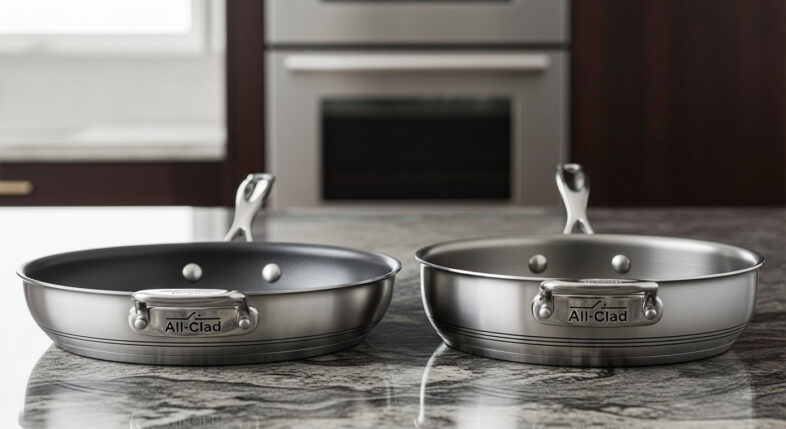
All-Clad French Skillet vs Sauté Pan Which Should You Buy

All-Clad French Skillet vs Sauté Pan: Which Should You Buy?

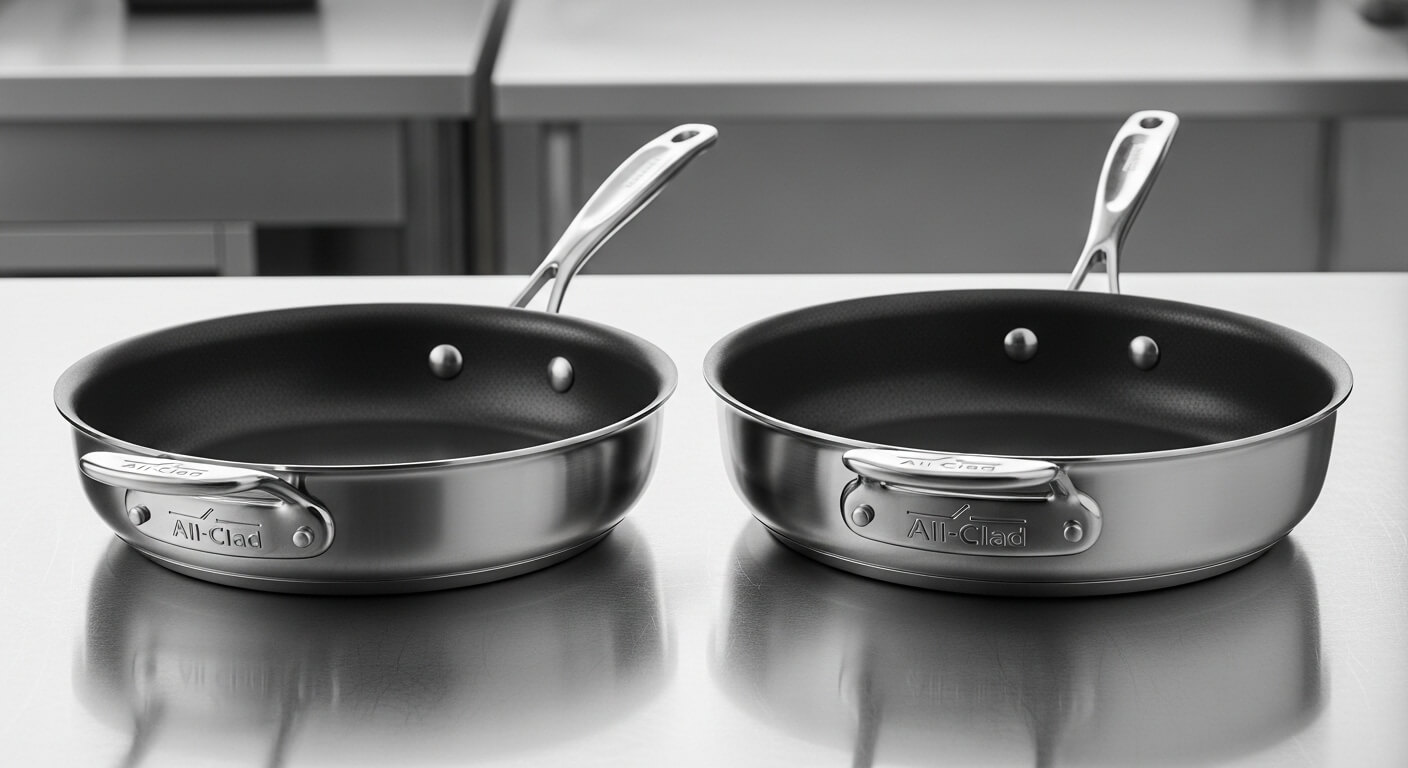
The main differences between All-Clad French skillets and All-Clad sauté pans come down to sidewall design, liquid capacity, and lid availability. French skillets feature sloped sides that curve gently outward, while sauté pans have straight, vertical walls. This seemingly minor distinction drastically changes how each pan performs in your kitchen.

You’ve probably stood in the cookware aisle wondering which pan deserves space in your cabinet. Both look remarkably similar at first glance. Both carry the All-Clad name and premium price tag. The choice becomes clearer once you understand how sidewall angles affect cooking techniques.

What you’ll I will talk about my in this comparison:

  • Design differences that impact cooking performance
  • Specific scenarios where each pan excels
  • Capacity and depth measurements that matter
  • Price considerations across All-Clad product lines
  • Practical guidance on which pan fits your cooking style

French skillets offer superior maneuverability for tossing and flipping food. The sloped sides make it effortless to slide a spatula under proteins or shake vegetables while sautéing. Sauté pans excel at containing liquids and come standard with fitted lids, making them ideal for braising and sauce-heavy dishes.

Most home cooks need only one of these pans. Choosing the wrong one means struggling with recipes that don’t match your cookware’s strengths. A French skillet can’t hold the liquid volume needed for proper braising. A sauté pan’s straight walls make quick stir-frying techniques awkward and inefficient.

The right pan depends entirely on what you cook most often. This guide breaks down every factor worth considering before you invest in All-Clad’s premium stainless steel construction.

Quick Answer: Key Differences Between All-Clad French Skillet and Sauté Pan

The All-Clad French skillet has sloped sides measuring approximately 2.5 inches tall, while the sauté pan features straight vertical walls ranging from 2.75 to 3.5 inches in height depending on capacity.

Feature All-Clad French Skillet All-Clad Sauté Pan
Sidewall Design Sloped, curved outward Straight, vertical
Typical Depth 2.5 inches 2.75–3.5 inches
Cooking Surface 10-inch or 12-inch diameter 8-inch to 10-inch diameter
Capacity 2.5–3.5 quarts 3–6 quarts
Lid Included Rarely (sold separately) Yes, fitted lid standard
Best for Liquids Under 2 cups 2–4 cups or more
Weight (12-inch/4-qt) 3.2 lbs 4.5 lbs

Size and Capacity Comparison

French skillets come in two standard sizes: 10-inch and 12-inch diameter measurements. The 10-inch model holds approximately 2.5 quarts, while the 12-inch version accommodates 3.5 quarts. These capacities work well for most stovetop cooking but limit your ability to braise larger cuts of meat.

Sauté pans offer more variety in sizing. The 3-quart model measures 10 inches across. A 4-quart version stretches to roughly 11 inches in diameter. The largest 6-quart option provides ample space for family-size portions and batch cooking. Each size was designed with specific cooking volumes in mind rather than just pan diameter.

Practical capacity differences:

  • French skillet (12-inch): Fits 4 chicken breasts with minimal liquid
  • Sauté pan (4-quart): Accommodates 4 chicken breasts submerged in braising liquid
  • French skillet: Handles stir-fries for 4 people comfortably
  • Sauté pan: Manages risotto or paella for 6 people

Sidewall Design: The Defining Difference

The angle of the sidewalls determines how each pan functions. French skillets slope outward at approximately 45 degrees from the base. This gradual curve creates an open cooking environment where steam escapes freely and food slides easily up the sides.

Sauté pan walls rise at 90 degrees, creating a enclosed cooking chamber. Liquids stay contained even when the pan sits at maximum capacity. The vertical design traps moisture and heat, which proves essential for braising and reducing sauces. Flipping food becomes more challenging since the straight walls block natural tossing motions.

Lid Compatibility

Most All-Clad French skillets ship without lids. You must purchase compatible covers separately, which adds $30–$60 to the total cost. Universal lids fit loosely and allow excessive steam to escape during cooking.

Every All-Clad sauté pan includes a fitted stainless steel lid. The tight seal regulates moisture and temperature throughout the cooking process. This becomes critical when braising meats for 1–2 hours or simmering delicate sauces. The lid also converts your sauté pan into a shallow Dutch oven for one-pot meals that start on the stovetop and finish in the oven.

What Is an All-Clad French Skillet?

An All-Clad French skillet is a hybrid pan that combines the flat cooking surface of a traditional skillet with the sloped sides of a sauté pan and the depth of a saucier. The design originated in France as a versatile alternative to standard frying pans.

Design Features of the All-Clad French Skillet

All-Clad constructs French skillets using their signature bonded tri-ply construction. An aluminum core sits between two layers of stainless steel. The exterior layer provides magnetic properties for induction cooking, while the interior offers a nonreactive cooking surface that won’t discolor acidic foods.

Construction specifications:

  • Base thickness: 2.6mm across all models
  • Cooking surface: 18/10 stainless steel
  • Heat conductivity: Aluminum extends through sidewalls
  • Handle material: Stainless steel riveted at two points
  • Oven-safe temperature: Up to 600°F (lid sold separately rated to 500°F)

The sloped sides rise at approximately 45 degrees from the cooking surface. This angle creates a smooth transition that food slides across without catching. The curved design also reduces the pan’s overall weight compared to sauté pans of similar capacity. A 12-inch French skillet weighs 3.2 pounds, making it manageable for one-handed maneuvering.

The long handle measures 9.5 inches and stays cool during stovetop cooking. Heat distributes through the aluminum core rather than conducting up the handle. Some models include a helper handle on the opposite side, though this feature appears primarily on pieces from the D5 collection.

Best Uses for the All-Clad French Skillet

French skillets excel at high-heat searing techniques. The broad, flat surface accommodates four 6-ounce chicken breasts or three 8-ounce steaks without crowding. Proteins develop deep caramelization because excess moisture evaporates quickly over the sloped sides.

Stir-frying becomes effortless in this pan style. You can toss vegetables with a flick of the wrist, and the curved walls guide food back to the center. The technique that works in a wok translates directly to a French skillet’s design. Asian-inspired dishes that require constant motion benefit from the open architecture.

Cooking techniques suited to French skillets:

  • Pan-frying: Cutlets, fish fillets, and vegetables in minimal oil
  • Sautéing: Quick cooking of aromatics, proteins, and vegetables
  • Shallow braising: Short braises with 1–1.5 cups of liquid
  • One-pan dinners: Proteins plus vegetables finished together
  • Frittatas and omelets: Eggs that slide easily onto plates
  • Pan sauces: Deglazing and reducing 0.5–1 cup of liquid

The shallow depth works well for dishes that finish quickly. You can sear scallops, deglaze with wine, and reduce the liquid to a sauce in under 10 minutes. The sloped sides promote rapid evaporation, concentrating flavors without prolonged simmering.

All-Clad French Skillet Models Available

The D3 (tri-ply) collection offers French skillets in 10-inch and 12-inch sizes. These represent the most affordable entry point into All-Clad’s French skillet lineup. Prices range from $130 for the 10-inch to $165 for the 12-inch model. Both sizes feature the standard three-layer construction that made All-Clad’s reputation.

Available product lines:

Collection Layers 10-Inch Price 12-Inch Price Special Features
D3 Stainless 3-ply $130 $165 Standard tri-ply, best value
D5 Brushed 5-ply $200 $245 Extra steel layers, heavier
Copper Core 5-ply $320 $380 Copper core, premium heat control

The D5 collection adds two extra layers of stainless steel around the aluminum core. This creates a five-ply construction that retains heat longer. The additional mass makes these pans 40% heavier than D3 models. Cooks who want superior heat retention for searing thick steaks prefer this option.

Copper Core represents All-Clad’s premium line. A copper layer replaces the standard aluminum core, providing 20% better heat conductivity. The copper responds faster to temperature changes on the burner. This precision matters most to experienced cooks who demand immediate heat adjustments. The price reflects this performance advantage, with models costing 2–3 times more than D3 equivalents.

What Is an All-Clad Sauté Pan?

An All-Clad sauté pan is a wide, deep cooking vessel with straight vertical sides and a fitted lid designed specifically for cooking techniques that involve both browning and liquid. The straight walls distinguish this pan from skillets and enable proper braising and sauce reduction.

Design Features of the All-Clad Sauté Pan

All-Clad sauté pans use the same bonded tri-ply construction as their French skillets. The aluminum core extends through the base and up the vertical sidewalls without interruption. This continuous layer eliminates hot spots that commonly appear in pans with disc bottoms.

Construction specifications:

  • Base thickness: 2.6mm standard across collections
  • Wall height: 2.75 inches (3-quart) to 3.5 inches (6-quart)
  • Interior surface: 18/10 stainless steel, polished finish
  • Lid material: Stainless steel with stay-cool handle
  • Oven-safe temperature: 600°F including lid
  • Induction compatible: Yes, across all models

The vertical walls rise perpendicular to the cooking surface. This 90-degree angle creates maximum volume within a compact footprint. A 4-quart sauté pan measures 11 inches in diameter but holds 33% more liquid than a 12-inch French skillet. The enclosed design traps moisture and maintains consistent cooking temperatures.

Each sauté pan ships with a domed stainless steel lid. The dome shape allows condensation to drip back onto food rather than pooling on a flat surface. A phenolic handle on the lid stays cool during stovetop use. The lid fits snugly enough to retain steam but isn’t designed for pressure cooking.

The main handle extends 10 inches from the pan body. A helper handle appears on all models 4-quart and larger. This second grip point becomes essential when moving a full pan weighing 8–10 pounds from stovetop to oven.

Best Uses for the All-Clad Sauté Pan

Sauté pans perform best when recipes require both searing and simmering. You can brown chicken thighs at high heat, then add wine and broth for braising. The straight walls contain splatter during the initial sear and retain liquid during the 45-minute simmer that follows.

Risotto relies on the sauté pan’s shape for proper results. The wide surface allows rice to spread in a thin layer, ensuring even cooking. You add broth gradually while stirring, and the vertical walls prevent liquid from sloshing over the edge. A French skillet’s sloped sides would reduce the effective cooking area by 30%.

Cooking techniques suited to sauté pans:

  • Braising: Searing proteins then cooking in 2–4 cups of liquid with lid
  • Pan sauces: Deglazing and reducing while containing steam
  • Risotto and paella: Dishes requiring controlled liquid absorption
  • Shallow poaching: Cooking fish or chicken in simmering liquid
  • One-pot pasta: Cooking pasta directly in sauce with measured liquid
  • Batch cooking: Preparing 6–8 servings of stews or curries

The lid transforms this pan into a versatile workhorse. You can sear pork chops, add vegetables and broth, cover the pan, and move everything into a 350°F oven. The enclosed environment creates a mini-braising chamber that tenderizes tough cuts over 90–120 minutes.

Sauce reduction works efficiently in this design. The straight walls create a tall column of liquid that reduces predictably. You can measure depth with a ruler and calculate when the sauce reaches the desired concentration. French skillets allow too much surface area exposure, causing sauces to reduce unevenly.

All-Clad Sauté Pan Models Available

The D3 collection offers sauté pans in three capacities: 3-quart, 4-quart, and 6-quart. The 3-quart model serves 2–3 people for most recipes. A 4-quart pan handles family dinners for 4–5 people comfortably. The 6-quart version suits batch cooking or entertaining groups of 6–8.

Available product lines:

Collection Layers 3-Quart Price 4-Quart Price 6-Quart Price Weight (4-qt)
D3 Stainless 3-ply $180 $230 $295 4.5 lbs
D5 Brushed 5-ply $280 $330 $420 6.2 lbs
Copper Core 5-ply $425 $500 $625 6.8 lbs

D3 models provide the standard performance most home cooks require. The three-layer construction heats evenly and responds quickly to temperature adjustments. All sizes include fitted lids and helper handles where appropriate. These represent the most common choice for building a core cookware collection.

D5 sauté pans add two stainless steel layers for enhanced heat retention. The extra mass maintains temperature stability when you add cold ingredients to a hot pan. This proves valuable when searing multiple batches of meat without significant temperature drops between batches. The increased weight requires more strength to maneuver.

Copper Core sauté pans feature a copper layer that responds to heat changes within 3–5 seconds. Professional chefs appreciate this responsiveness for recipes requiring precise temperature control. The copper core costs approximately double the D5 equivalent. For most home cooking applications, the performance gain doesn’t justify the price premium unless you regularly prepare temperature-sensitive sauces.

All-Clad French Skillet vs Sauté Pan: Detailed Comparison

The All-Clad French skillet provides 20% more flat cooking surface than a same-diameter sauté pan, while the sauté pan holds 40–60% more liquid volume due to its straight vertical walls.

Cooking Surface Area

A 12-inch French skillet offers approximately 113 square inches of flat cooking surface. The sloped sides begin their curve immediately at the base edge, maximizing contact area for browning. Four chicken breasts can lie flat without overlapping, ensuring even searing across all pieces.

A 4-quart sauté pan measures roughly 11 inches in diameter, providing 95 square inches of flat surface. The straight walls rise vertically from the base, creating a smaller footprint but compensating with added depth. Three chicken breasts fit comfortably, though a fourth piece starts crowding the pan’s center.

Surface area comparison:

Pan Type Diameter Flat Surface Area Ideal for Searing
French Skillet 12-inch 12 inches ~113 sq inches 4 proteins (6–8 oz each)
Sauté Pan 4-quart 11 inches ~95 sq inches 3 proteins (6–8 oz each)
French Skillet 10-inch 10 inches ~78 sq inches 2–3 proteins
Sauté Pan 3-quart 10 inches ~78 sq inches 2–3 proteins

The sloped design of French skillets creates accessible surface area up the sides. You can push vegetables halfway up the curve while keeping proteins centered on the base. Sauté pans concentrate all cooking activity on the flat bottom, which limits multitasking within a single pan.

Volume and Depth

French skillets measure 2.5 inches deep from base to rim. This shallow profile works for dishes using 1–2 cups of liquid maximum. The sloped sides reduce actual liquid capacity by approximately 25% compared to advertised volume. A 12-inch French skillet holds 3.5 quarts measured to the brim but functions best with 2.5 quarts or less.

Sauté pans range from 2.75 inches (3-quart) to 3.5 inches (6-quart) in wall height. The vertical construction means advertised capacity matches functional capacity. A 4-quart sauté pan comfortably holds 4 quarts of liquid without risk of spillage during stirring or moving.

Capacity comparison for common cooking scenarios:

  • Braising 4 chicken thighs: French skillet accommodates 1.5 cups liquid; sauté pan holds 3 cups
  • Making risotto for 4: French skillet manages 1.5 cups rice + 4.5 cups broth (tight fit); sauté pan handles 2 cups rice + 6 cups broth comfortably
  • Pan sauce: French skillet reduces 1 cup wine in 4 minutes; sauté pan reduces 1 cup wine in 6 minutes
  • Pasta for 4: French skillet cannot cook pasta in sauce; sauté pan cooks 12 oz pasta with 4 cups sauce

The depth difference affects evaporation rates dramatically. French skillets expose more liquid surface area to air, causing faster moisture loss. This proves advantageous for achieving fond and developing concentrated flavors. Sauté pans retain moisture, which becomes critical for long braises requiring 90+ minutes of cooking time.

Heat Distribution and Performance

Both pans use identical tri-ply construction with aluminum cores extending through the sidewalls. Heat spreads evenly across the base regardless of sidewall angle. The difference emerges in how each design manages heat retention and distribution up the sides.

French skillet walls curve outward, creating thinner material at the rim compared to the base. Heat dissipates faster at the top edge, producing a natural temperature gradient. Food pushed up the sides experiences slightly lower temperatures than items resting on the base. This gradient provides built-in heat zones within a single pan.

Sauté pan walls maintain consistent thickness from base to rim. The vertical design creates uniform temperature throughout the cooking chamber. Food touching the sidewalls receives the same heat intensity as food on the bottom. This uniformity matters most for dishes requiring even cooking, such as rice-based recipes where uneven heat causes burning.

Performance with specific techniques:

Technique French Skillet Performance Sauté Pan Performance
High-heat searing Excellent – rapid evaporation Good – some steam buildup
Deglazing Excellent – easy scraping Good – corners harder to reach
Long braising Limited – liquid evaporates too quickly Excellent – lid maintains moisture
Stir-frying Excellent – easy tossing motion Fair – straight walls impede movement
Sauce reduction Fast – 4–5 minutes per cup Moderate – 6–8 minutes per cup

The aluminum core responds to temperature changes within 10–15 seconds in both designs. Adjusting burner heat produces noticeable effects almost immediately. Neither pan shows significant advantage in heat responsiveness since they share identical core construction.

Ease of Flipping and Tossing Food

French skillets enable one-handed flipping with minimal wrist rotation. The sloped sides guide food in an arc that returns ingredients to the pan’s center. You can flip diced vegetables, shake stir-fry components, or turn small proteins without tools. The technique mirrors wok cooking and becomes second nature after a few uses.

Sauté pans require two hands for most flipping operations. The straight walls block the natural arc food takes when tossed. You must lift the pan higher and rotate more aggressively to clear the rim. Most cooks resort to using spatulas or wooden spoons instead of attempting to toss ingredients.

Flipping efficiency comparison:

  • Diced vegetables (1-inch pieces): French skillet flips cleanly with wrist motion; sauté pan requires spatula
  • Small proteins (shrimp, scallops): French skillet handles 6–8 pieces per toss; sauté pan manages 2–3 pieces with spatula
  • Stir-fry ingredients: French skillet keeps 90% in pan during tossing; sauté pan loses 20–30% over rim
  • Frittata sliding: French skillet releases with 30-degree tilt; sauté pan requires 45-degree tilt plus spatula assist

The weight difference compounds this issue. A 12-inch French skillet weighs 3.2 pounds empty, making one-handed maneuvers manageable. A 4-quart sauté pan weighs 4.5 pounds before adding food or liquid. Attempting to flip ingredients with 6+ pounds of total weight strains the wrist.

Liquid and Sauce Management

French skillets promote rapid evaporation through their open design. A cup of wine reduces to 1/4 cup in approximately 4 minutes over medium-high heat. The sloped sides create maximum surface exposure to air. This works perfectly for pan sauces that should coat a spoon but not pool on the plate.

Sauté pans slow evaporation through their enclosed chamber. The same cup of wine takes 7–8 minutes to reduce to 1/4 cup under identical heat. The vertical walls trap steam, which condenses and falls back into the liquid. Covering with a lid extends braising times by maintaining consistent moisture levels.

Evaporation rates (1 cup liquid at medium-high heat):

Pan Type Time to Reduce to 1/2 Cup Time to Reduce to 1/4 Cup Steam Escape
French Skillet 2–3 minutes 4–5 minutes Immediate
Sauté Pan (uncovered) 3–4 minutes 7–8 minutes Moderate
Sauté Pan (covered) 8–10 minutes 15–18 minutes Minimal

Splatter control differs significantly between designs. French skillets allow liquids to escape more easily during vigorous stirring or boiling. Oil splatters travel up the sloped sides and can clear the rim. Sauté pans contain splatter within the vertical walls even during aggressive stirring or high-heat cooking.

The lid on sauté pans provides temperature and moisture regulation impossible with French skillets. You can build steam pressure to cook vegetables faster or maintain precise humidity for delicate fish. French skillets require foil covers purchased separately, which never fit as precisely as purpose-built lids.

Versatility in the Kitchen

French skillets handle 70% of common stovetop cooking tasks effectively. They excel at quick-cooking techniques requiring high heat and minimal liquid. Searing, sautéing, shallow frying, and making pan sauces represent their core competencies. The design falters when recipes demand liquid management or extended cooking times.

Sauté pans cover 80% of stovetop techniques including everything French skillets do plus braising, poaching, and one-pot meals. The included lid expands functionality into territory typically reserved for Dutch ovens or stockpots. You sacrifice some maneuverability but gain capacity for complex, multi-step recipes.

Versatility breakdown by recipe type:

  • Quick weeknight dinners: Both handle equally well
  • One-pan meals with vegetables: French skillet better for roasting; sauté pan better for steaming
  • Protein + sauce dishes: French skillet for thin sauces; sauté pan for substantial sauces
  • Rice and grain dishes: Sauté pan exclusively
  • Braises under 30 minutes: French skillet adequate; sauté pan ideal
  • Braises over 45 minutes: Sauté pan exclusively
  • Batch cooking: Sauté pan due to capacity

French skillets transition from stovetop to oven more efficiently due to lower weight. You can start chicken on the burner, then transfer the pan to a 425°F oven to finish. The lighter weight makes this move easier with one hand. Sauté pans require two hands and more caution when moving from stovetop to oven rack.

When to Choose the All-Clad French Skillet

Choose the All-Clad French skillet when your cooking focuses on high-heat searing, quick sautés, and recipes using less than 2 cups of liquid. The sloped sides make this pan ideal for cooks who prefer traditional skillet techniques with enhanced capacity.

Ideal Cooking Scenarios

High-heat searing produces the best results in a French skillet’s open design. You can achieve temperatures above 450°F without liquid pooling around proteins. Moisture escapes quickly over the sloped sides, allowing proper browning instead of steaming. Steaks develop a dark crust in 3–4 minutes per side, and chicken breasts caramelize without releasing excessive moisture.

Recipes requiring frequent tossing suit the French skillet’s curved architecture. Stir-fried vegetables flip cleanly with wrist movements. Diced potatoes turn without a spatula. Hash browns crisp evenly because you can shake the pan vigorously without ingredients escaping over the rim.

Scenarios where French skillets excel:

  • Weeknight proteins: Searing 2–4 chicken breasts, pork chops, or fish fillets in under 15 minutes
  • Vegetable sautés: Cooking Brussels sprouts, green beans, or bell peppers at high heat
  • Breakfast dishes: Making omelets, scrambled eggs, or hash browns that slide easily
  • Quick pan sauces: Deglazing with wine and reducing to 1/4 cup in 5 minutes
  • Shallow frying: Cooking breaded cutlets in 1/4 inch of oil
  • Stir-fries: Preparing Asian-style dishes with constant tossing motion

Shallow braising works when cooking times stay under 30 minutes. You can brown pork medallions, add 1 cup of broth with herbs, and simmer covered with foil for 20 minutes. The French skillet handles this technique adequately despite lacking a fitted lid. Longer braises cause too much evaporation.

Recipe Types Best Suited for French Skillets

Stir-fries translate directly from wok to French skillet. The sloped sides replicate the wok’s curve on a smaller scale. You can cook beef and broccoli, cashew chicken, or pad thai using identical tossing techniques. The flat base provides more contact area than a wok’s rounded bottom, actually improving searing on standard stovetops.

Pan-roasted dishes that finish in the oven suit this pan’s lightweight design. Sear chicken thighs skin-side down for 5 minutes, flip them, add quartered potatoes around the edges, and transfer everything to a 425°F oven. The French skillet heats faster than heavier alternatives and moves from stovetop to oven with minimal effort.

Recipe categories ideal for French skillets:

  • Protein-focused meals: Chicken piccata, pork schnitzel, seared salmon, pan-seared scallops
  • Egg dishes: Frittatas, Spanish tortilla, shakshuka (with careful liquid monitoring)
  • Quick vegetable sides: Sautéed spinach, caramelized mushrooms, charred broccolini
  • Simple pasta: Aglio e olio, carbonara, or any pasta tossed with minimal sauce
  • Pan-seared and roasted: Bone-in chicken pieces, duck breast, thick fish steaks
  • Asian-inspired: Lo mein, fried rice, vegetable stir-fries, teriyaki dishes

Frittatas and omelets release cleanly from the sloped surface. You can slide a rubber spatula around the edges without fighting against vertical walls. The entire frittata loosens with minimal effort and slides directly onto a serving plate. This proves particularly valuable for delicate egg dishes that tear easily.

One-pan dinners work when vegetables and proteins cook in similar timeframes. Sausage with peppers and onions cooks entirely in the French skillet. Shrimp with cherry tomatoes and spinach finishes in 12 minutes. The design accommodates combinations that don’t require extended simmering or large liquid volumes.

Cook Types Who Prefer French Skillets

Home cooks accustomed to traditional skillets adapt immediately to French skillets. The cooking techniques remain identical—the only difference comes from the added depth. Anyone comfortable flipping eggs or sautéing vegetables in a standard frying pan will find the French skillet familiar yet more capable.

Single cooks and couples benefit from the 10-inch French skillet’s compact size. This model prepares 2–3 servings without excess capacity taking up burner space. The lighter weight makes it approachable for cooks with limited hand strength or wrist mobility. At 2.4 pounds empty, the 10-inch model maneuvers more easily than larger alternatives.

Cook profiles suited to French skillets:

  • Weeknight dinner cooks: Those preparing simple proteins and vegetables in 20–30 minutes
  • Skillet enthusiasts: Cooks comfortable with traditional frying pan techniques
  • Space-conscious kitchens: Anyone preferring lighter, more maneuverable cookware
  • High-heat cooking fans: Those who prioritize searing and browning over braising
  • Minimalist cooks: People wanting one versatile pan for most stovetop tasks
  • Budget-minded buyers: Cost-conscious shoppers seeking premium quality at the lowest entry price

Budget-conscious buyers find better value in French skillets compared to sauté pans. A 12-inch D3 French skillet costs $165, while a comparable 4-quart D3 sauté pan runs $230. That $65 difference represents a 40% savings for similar cooking capacity. The French skillet covers 70% of cooking tasks at significantly lower cost.

Apartment dwellers with limited storage appreciate the French skillet’s streamlined shape. The sloped sides allow nesting with other pans more efficiently than sauté pans’ straight walls. Three French skillets stack in the same vertical space as two sauté pans. This matters in kitchens where cabinet space comes at a premium.

When to Choose the All-Clad Sauté Pan

Choose the All-Clad sauté pan when your cooking regularly involves braising, simmering sauces, or recipes requiring more than 2 cups of liquid. The straight walls and fitted lid make this pan essential for multi-step dishes that combine browning and liquid-based cooking.

Ideal Cooking Scenarios

Braising meats demands the sauté pan’s liquid retention and lid. You can brown short ribs at high heat, add 3 cups of wine and broth, cover the pan, and simmer for 2 hours. The enclosed environment maintains consistent moisture levels throughout the cooking process. The lid traps steam that would otherwise escape, keeping meat submerged and tender.

Simmering sauces for pasta or protein dishes requires controlled evaporation. Marinara sauce reduces predictably in a sauté pan’s vertical chamber. You can measure liquid depth and calculate reduction time accurately. The straight walls prevent sauce from climbing up and burning at the edges, a common problem in sloped pans.

Scenarios where sauté pans excel:

  • Long braises: Cooking tough cuts like chuck roast, lamb shanks, or pork shoulder for 90+ minutes
  • Risotto and rice dishes: Managing gradual liquid absorption with constant stirring
  • One-pot pasta: Cooking pasta directly in sauce with measured liquid
  • Shallow poaching: Simmering fish or chicken in 2–3 cups of liquid
  • Batch cooking: Preparing curries, stews, or chili for 6–8 servings
  • Sauce reduction: Reducing stock or wine to concentrate flavors while maintaining control

Rice-based dishes require the sauté pan’s precise liquid management. Risotto demands specific ratios of rice to liquid, added gradually over 25–30 minutes. The wide surface spreads rice in a thin layer while the straight walls contain broth additions. You achieve the proper creamy consistency because evaporation rates stay consistent throughout cooking.

Recipe Types Best Suited for Sauté Pans

Chicken piccata exemplifies dishes that need both searing and sauce development. You brown chicken cutlets in butter, remove them temporarily, deglaze the pan with wine and lemon juice, reduce the liquid by half, and return the chicken to simmer in the sauce. The sauté pan handles every step without spillage or excessive evaporation.

Paella and similar grain dishes spread evenly across the sauté pan’s broad base. The 4-quart model accommodates 2 cups of rice plus saffron broth, vegetables, and proteins. Everything cooks in a single layer, ensuring even heat distribution. The straight walls contain occasional bubbling without creating mess on the stovetop.

Recipe categories ideal for sauté pans:

  • Classic braises: Coq au vin, osso buco, beef bourguignon, lamb tagine
  • Italian favorites: Chicken marsala, veal piccata, cacciatore, Sunday gravy
  • Rice dishes: Risotto, paella, jambalaya, pilaf, biryani
  • One-pot meals: Chicken and rice, sausage with beans, shakshuka with extra sauce
  • Indian curries: Butter chicken, tikka masala, korma, vindaloo
  • Sauce-heavy pasta: Bolognese, puttanesca, vodka sauce, clam sauce

Curries develop complex flavors through extended simmering in the covered sauté pan. You can toast spices, brown onions and garlic, add tomatoes and coconut milk, then simmer proteins in the sauce for 45 minutes. The lid maintains moisture while allowing some evaporation to concentrate flavors. This technique produces restaurant-quality results at home.

One-pot pasta revolutionizes weeknight cooking by eliminating separate pots. You sauté aromatics, add dried pasta, pour in measured broth or water, cover the pan, and simmer for 12–15 minutes. The pasta absorbs liquid while releasing starch that creates a silky sauce. This method only works in pans with fitted lids and adequate capacity.

Cook Types Who Prefer Sauté Pans

Home chefs who embrace complex, multi-step recipes rely on sauté pans daily. Anyone making restaurant-style dishes at home appreciates the pan’s ability to handle elaborate techniques. The investment pays off when you can brown, deglaze, reduce, and braise without transferring food between vessels.

Families cooking for 4–6 people require the sauté pan’s capacity. A 4-quart model prepares chicken and rice for five people in a single batch. The 6-quart version handles Sunday dinner for eight without crowding ingredients. This eliminates the need to cook proteins and sides separately, saving both time and cleanup effort.

Cook profiles suited to sauté pans:

  • Braising enthusiasts: Cooks who regularly prepare pot roasts, short ribs, or lamb shanks
  • Sauce makers: Those who build complex pan sauces, gravies, or reductions
  • One-pot cooking advocates: People who want complete meals from a single vessel
  • Batch cookers: Anyone preparing large quantities for meal prep or entertaining
  • Rice and grain lovers: Cooks who make risotto, paella, or pilaf weekly
  • Technique-focused cooks: Those willing to manage heavier cookware for superior results

Meal preppers benefit from cooking large batches of protein and grains simultaneously. You can brown 3 pounds of chicken thighs, add vegetables and rice, pour in broth, cover the pan, and produce eight portions in 40 minutes. The sauté pan’s capacity turns meal prep from a multi-pot operation into a streamlined process.

Entertaining hosts use sauté pans to prepare dishes that hold well. Braises and stews can simmer gently for hours, developing flavor while staying warm until guests arrive. The pan moves directly from stovetop to table for family-style serving. This presentation style works particularly well for rustic European dishes meant to be shared.

Technique-focused cooks accept the sauté pan’s added weight in exchange for precision. The 4.5-pound heft of a 4-quart model provides stability during aggressive stirring. The mass retains heat when you add cold ingredients, maintaining searing temperatures throughout cooking. This matters most when preparing dishes where temperature control affects final texture.

All-Clad French Skillet vs Sauté Pan: Pros and Cons

The French skillet offers superior maneuverability and faster cooking times, while the sauté pan provides better liquid control and greater versatility for complex recipes requiring lids.

French Skillet Advantages

The lightweight construction enables one-handed cooking techniques. A 12-inch French skillet weighs 3.2 pounds, allowing you to flip vegetables or shake the pan without straining your wrist. This becomes significant during 20-minute cooking sessions where you’re constantly adjusting ingredients.

Quick cooking techniques finish faster in the open design. Moisture evaporates immediately over the sloped sides, concentrating flavors in 4–5 minutes instead of 8–10. Pan sauces reduce to the proper consistency while proteins rest, streamlining dinner preparation.

Key advantages of All-Clad French skillets:

  • Easier tossing: Sloped sides enable wok-style flipping without tools
  • Faster evaporation: Reduces sauces and achieves fond 40% faster than enclosed pans
  • Lower entry price: Costs $65–115 less than comparable sauté pans
  • Better searing: Open design prevents steam buildup during high-heat cooking
  • Simplified cleanup: Curved transition from base to sides eliminates hard-to-reach corners
  • Lighter weight: 30% lighter than sauté pans of similar capacity
  • More cooking surface: 15–20% more flat area for browning proteins

The price advantage makes French skillets accessible to budget-conscious cooks. A D3 12-inch model costs $165 compared to $230 for a 4-quart D3 sauté pan. You save $65 while still accessing All-Clad’s tri-ply construction and lifetime warranty. This difference often determines which pan enters a starter cookware collection.

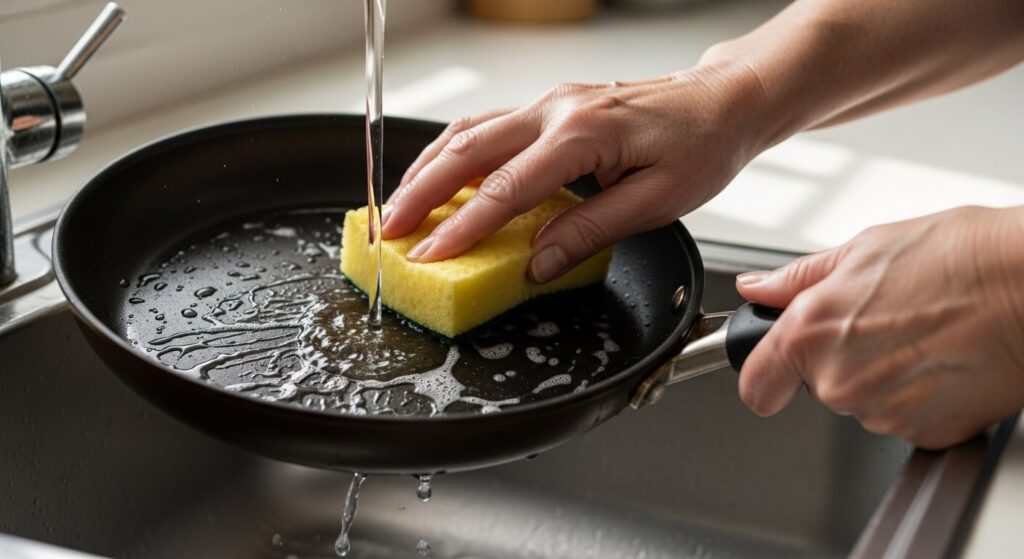
Cleaning requires less effort due to the curved interior. Food particles slide down the sloped sides during washing instead of lodging in corners. A sponge follows the natural curve without catching on sharp angles. Most residue rinses away with hot water and minimal scrubbing.

French Skillet Disadvantages

Limited liquid capacity restricts recipe options. The 12-inch model holds 3.5 quarts measured to the brim but functions best with 2 cups or less. Recipes calling for 3+ cups of broth or sauce won’t work properly. The sloped sides allow excessive evaporation during extended cooking times.

Lid options remain inadequate compared to purpose-built alternatives. Universal lids fit loosely, allowing steam to escape around the edges. This compromises braising and prevents proper heat retention during covered cooking. You must purchase lids separately, adding $40–60 to the total investment.

Key disadvantages of All-Clad French skillets:

  • Braising limitations: Cannot maintain proper liquid levels for 60+ minute braises
  • No included lid: Must buy separately and fit remains imperfect
  • Reduced capacity: Holds 40% less liquid than same-diameter sauté pans
  • Splatter issues: Open design allows oil and liquid to escape during vigorous cooking
  • Poor for rice dishes: Insufficient depth and liquid control for risotto or paella
  • Limited batch cooking: Cannot prepare 6+ servings of stews or curries

Braising tough cuts becomes impractical in the French skillet’s shallow profile. Short ribs require 2–3 cups of liquid to stay submerged during 90-minute cooking. The French skillet loses too much moisture even when covered with foil. You’ll need to add liquid repeatedly, disrupting the cooking process and diluting flavors.

Rice dishes fail consistently without proper liquid management. Risotto requires precise broth additions that the sloped sides can’t accommodate. The shallow depth causes uneven cooking, with edges drying out before the center absorbs sufficient liquid. Paella spreads too thin and burns around the perimeter.

Sauté Pan Advantages

The fitted lid transforms cooking capabilities immediately. You control moisture levels precisely, enabling proper braising, steaming, and simmering. The tight seal traps heat and humidity, creating an environment similar to a Dutch oven. This single feature justifies the price premium for cooks who make sauce-heavy dishes regularly.

Superior liquid retention accommodates complex recipes. The 4-quart model holds a full quart of sauce plus proteins and vegetables without risk of overflow. You can simmer, stir aggressively, and move the pan without spillage. This capacity enables one-pot meals that feed families without requiring multiple cooking vessels.

Key advantages of All-Clad sauté pans:

  • Included fitted lid: Enables braising, steaming, and moisture control unavailable in French skillets
  • Greater capacity: Holds 40–60% more liquid for sauces, braises, and stews
  • Better for rice: Straight walls provide even heat distribution for risotto and paella
  • Batch cooking: 4-quart and 6-quart sizes prepare meals for 6–8 people
  • Splatter containment: Vertical walls trap oil and sauce during vigorous stirring
  • Professional results: Design matches restaurant equipment for complex techniques
  • Versatile cooking: Handles everything from searing to braising to poaching

The straight walls contain splatter during high-heat searing. Oil stays inside the pan when you flip chicken pieces or stir-fry vegetables. This keeps stovetops cleaner and reduces safety hazards. The enclosed design also traps aromatic compounds, concentrating flavors that would escape from open pans.

Batch cooking becomes efficient in larger sauté pan models. The 6-quart version prepares curry for eight people or enough bolognese sauce for three pounds of pasta. This eliminates multiple cooking sessions for meal prep or entertaining. The capacity also allows proper ingredient spacing, preventing overcrowding that causes steaming instead of browning.

Sauté Pan Disadvantages

Heavier construction demands two-handed operation. A 4-quart D3 sauté pan weighs 4.5 pounds empty, reaching 8–10 pounds when filled with food and liquid. Moving this weight from stovetop to oven requires caution and strength. One-handed flipping becomes impossible, eliminating certain cooking techniques.

Higher prices limit accessibility for budget-conscious buyers. The D3 4-quart sauté pan costs $230 compared to $165 for a 12-inch French skillet. That $65 difference represents a 40% price increase. The Copper Core 4-quart model reaches $500, pricing it beyond most home cooking budgets.

Key disadvantages of All-Clad sauté pans:

  • Significantly heavier: 40% more weight makes maneuvering difficult
  • Higher cost: $65–115 more expensive than comparable French skillets
  • Awkward for tossing: Straight walls prevent natural flipping motions
  • Overkill for simple tasks: Too much capacity and weight for quick sautés
  • Slower evaporation: Takes 60% longer to reduce sauces to proper consistency
  • Storage bulk: Straight walls prevent efficient nesting with other cookware
  • Less browning area: Vertical walls reduce usable flat cooking surface by 15–20%

Flipping and tossing require tools instead of wrist motion. The straight walls block ingredients from arcing naturally back into the pan. You must use spatulas or wooden spoons for tasks that French skillets handle through simple shaking. This adds steps to quick-cooking techniques and slows overall preparation time.

Simple recipes become cumbersome in the sauté pan’s substantial build. Cooking scrambled eggs or sautéing spinach in a 4.5-pound pan feels excessive. The heat-up time takes 30 seconds longer than lighter alternatives. For everyday tasks requiring minimal liquid, the sauté pan introduces unnecessary complexity and cleanup effort.

Price Comparison: All-Clad French Skillet vs Sauté Pan

All-Clad French skillets cost $130–$165 for D3 models, while comparable D3 sauté pans range from $180–$295, making French skillets 20–40% less expensive depending on size and collection.

French Skillet Price Ranges

D3 French skillets represent the most affordable entry into All-Clad’s product lineup. The 10-inch model retails for $130, while the 12-inch version costs $165. Both prices include All-Clad’s lifetime warranty and tri-ply construction but exclude lids, which must be purchased separately for $40–60.

All-Clad French skillet pricing by collection:

Collection 10-Inch Price 12-Inch Price Cost Per Quart Lid Included
D3 Stainless $130 $165 $47–$66 No
D5 Brushed $200 $245 $80–$98 No
Copper Core $320 $380 $91–$109 No

D5 models add $70–80 to the base price for five-layer construction. The 10-inch D5 French skillet costs $200, while the 12-inch reaches $245. The added stainless steel layers provide better heat retention but identical cooking surface quality. Most home cooks find the D3 performance adequate for daily use.

Copper Core French skillets command premium prices starting at $320 for the 10-inch size. The 12-inch model reaches $380, making it 130% more expensive than the D3 equivalent. The copper core responds to temperature changes 3–5 seconds faster than aluminum, a benefit that matters primarily to experienced cooks making temperature-sensitive sauces.

Sauté Pan Price Ranges

D3 sauté pans start at $180 for the 3-quart model and scale up to $295 for the 6-quart version. The most popular 4-quart size costs $230, representing a $65 premium over the 12-inch French skillet. Each model includes a fitted stainless steel lid, adding value that French skillets lack.

All-Clad sauté pan pricing by collection:

Collection 3-Quart Price 4-Quart Price 6-Quart Price Cost Per Quart Lid Included
D3 Stainless $180 $230 $295 $49–$60 Yes
D5 Brushed $280 $330 $420 $70–$93 Yes
Copper Core $425 $500 $625 $83–$142 Yes

D5 sauté pans range from $280 to $420 depending on capacity. The 4-quart D5 model costs $330, a $100 increase over the D3 version. The heavier construction retains heat longer during batch searing, though this benefit applies mainly to high-volume cooking sessions where you’re adding cold ingredients repeatedly.

Copper Core sauté pans reach luxury pricing territory. The 4-quart model costs $500, while the 6-quart version hits $625. These prices put All-Clad’s premium line in competition with specialty European brands. The copper core provides exceptional heat control for dishes like risotto where temperature precision affects texture dramatically.

Value for Money Analysis

French skillets deliver lower cost per use for cooks making simple proteins and vegetables. A $165 investment in the 12-inch D3 model divides across potentially 1,000+ cooking sessions over the pan’s lifetime. At $0.17 per use, the value proposition works for anyone cooking 3+ times weekly. The lighter weight also extends comfortable usage years compared to heavier alternatives.

Sauté pans justify higher prices through expanded functionality. A $230 investment in the 4-quart D3 model includes the lid, which would cost $50 separately for a French skillet. The effective price difference shrinks to $15 when accounting for the lid. The added capacity enables one-pot meals that reduce overall cookware requirements, potentially eliminating the need for a separate braiser or small stockpot.

Value comparison scenarios:

Cooking Style Best Value Choice Reasoning
Quick weeknight meals French skillet Lower price, adequate for 70% of tasks
Sauce-heavy dishes Sauté pan Included lid and capacity justify premium
Budget under $200 French skillet Meets price point with room for other essentials
One-pan cooking focus Sauté pan Eliminates need for multiple specialized pans
High-heat searing priority French skillet Performs equally well at lower cost
Batch cooking/meal prep Sauté pan Capacity reduces total cooking time

Long-term durability remains identical across both designs. All-Clad warranties cover both pans for life against manufacturing defects. The tri-ply construction withstands decades of daily use without warping or degrading. Neither pan type shows advantage in longevity, making the initial price difference the primary financial consideration.

Return on investment shifts based on cooking frequency and recipe preferences. Cooks making braised dishes twice weekly recoup the sauté pan’s premium through superior results and time savings. The fitted lid alone saves 15–20 minutes per braise by maintaining proper moisture levels. Those preparing quick sautés and seared proteins find better ROI in the French skillet’s lower entry cost.

Resale value holds steady across All-Clad’s product lines. Used D3 French skillets sell for 50–60% of retail price in good condition. D3 sauté pans command 55–65% of original cost on secondary markets. The slight advantage for sauté pans reflects demand for the included lid and greater versatility. Both designs retain value better than most cookware brands.

Sales and discounts appear more frequently on French skillets. Retailers mark down these models 20–30% during holiday promotions, bringing the 12-inch D3 to $115–130. Sauté pans rarely see discounts exceeding 15–20%, keeping the 4-quart D3 above $185 even during major sales events. Patient buyers can close the price gap by shopping strategically.

Care and Maintenance: French Skillet vs Sauté Pan

Both All-Clad French skillets and sauté pans require identical cleaning methods since they share the same stainless steel construction, though the sloped versus straight sidewalls affect how easily you can scrub away stuck-on food.

Cleaning Differences

The French skillet’s curved interior simplifies hand washing. A sponge follows the natural slope from base to rim without encountering sharp angles or corners. Food residue slides down during rinsing instead of collecting in crevices. Most cleanup requires only hot water, dish soap, and 30–45 seconds of scrubbing.

Sauté pans feature 90-degree angles where the base meets the sidewalls. These corners trap food particles and caramelized bits that require targeted scrubbing. A sponge or brush must reach into each corner deliberately. The extra effort adds 15–20 seconds to cleaning time compared to French skillets.

Cleaning method comparison:

Cleaning Task French Skillet Sauté Pan
Daily washing 30–45 seconds 45–60 seconds
Removing fond Deglazes easily with smooth curve Requires scraping corners
Stuck-on food Bar Keeper’s Friend + 2 minutes Bar Keeper’s Friend + 3 minutes
Hard water stains Vinegar removes in 60 seconds Vinegar + corner attention needed
Dishwasher result Comes out spotless May need corner touch-up

Both pans are dishwasher safe according to All-Clad specifications. The high-heat cycle and detergent won’t damage the stainless steel or compromise the bonded layers. Repeated dishwasher use may dull the exterior finish over time, though this affects appearance rather than performance. Hand washing preserves the polished look longer.

Removing stuck-on food requires Bar Keeper’s Friend for both designs. Sprinkle the powder on stubborn spots, add water to form a paste, and scrub with a non-abrasive sponge for 2–3 minutes. The oxalic acid dissolves carbonized food without scratching the stainless steel surface. Soaking either pan in hot soapy water for 15 minutes before scrubbing loosens most residue.

The sauté pan’s lid adds a separate cleaning component. The stainless steel lid collects condensation and grease on the interior surface. A quick wipe with soapy water after each use prevents buildup. The phenolic handle requires gentler treatment than the pan body—avoid abrasive scrubbers that can scratch the finish.

Storage Considerations

French skillets nest efficiently with other cookware due to their sloped profile. The curved sides allow stacking three French skillets in approximately 8 inches of vertical space. You can place pot protectors between pans to prevent scratching, though the stainless steel surface resists damage from metal-on-metal contact.

Sauté pans require more vertical clearance because of their straight walls. Two 4-quart models stack in roughly 7 inches of space, and adding a third brings the total to 10.5 inches. The wider diameter also demands more cabinet footprint—an 11-inch sauté pan occupies 95 square inches compared to a 12-inch French skillet’s more efficient nesting shape.

Storage space requirements:

  • French skillet (12-inch): 12-inch diameter, 2.5-inch height, nests easily
  • Sauté pan (4-quart): 11-inch diameter, 3.5-inch height, wider footprint
  • Stacking three French skillets: ~8 inches vertical space
  • Stacking three sauté pans: ~10.5 inches vertical space
  • Lid storage: Sauté pan lids need additional 3 inches clearance or separate storage

Protecting cooking surfaces matters more during storage than during use. Place felt or silicone pot protectors between stacked pans to prevent scratches. The stainless steel interior can develop fine scratches from friction, particularly around high-use areas in the pan’s center. These surface marks don’t affect cooking performance but may bother cooks who value pristine appearance.

Hanging storage works well for French skillets under 4 pounds. A sturdy pot rack supports the 12-inch model without strain. Sauté pans weighing 4.5+ pounds require reinforced hanging systems. The 6-quart model at 6+ pounds demands commercial-grade racks designed for heavy cookware. Most home pot racks specify 5-pound maximum weight limits per hook.

The sauté pan lid requires dedicated storage space. Stacking lids separately in a vertical organizer saves cabinet space. Some cooks store the lid on top of the pan, though this adds 2 inches to the storage height. The lid’s phenolic handle prevents stacking other items on top without risking damage.

Longevity and Durability

All-Clad backs both French skillets and sauté pans with a limited lifetime warranty. The coverage protects against manufacturing defects including separation of the bonded layers, warping, and defective rivets. Normal wear such as scratches, staining, or discoloration from heat doesn’t qualify for warranty replacement. Registration isn’t required, though All-Clad recommends keeping purchase receipts.

Warranty and durability comparison:

Feature French Skillet Sauté Pan Notes
Warranty coverage Lifetime Lifetime Manufacturing defects only
Expected lifespan 20–30+ years 20–30+ years With proper care
Handle durability Rivets may loosen after 15 years Rivets may loosen after 15 years Can be re-tightened
Surface scratching Moderate resistance Moderate resistance Cosmetic only
Warping resistance Excellent (tri-ply prevents) Excellent (tri-ply prevents) Avoid thermal shock

Expected lifespan exceeds 20–30 years for both designs with proper maintenance. The bonded construction prevents the warping and hot spots that plague cheaper cookware. Professional kitchens report All-Clad pans remaining in service for 15+ years despite daily high-volume use. Home cooks using pans 3–5 times weekly should expect decades of reliable performance.

Maintenance for lasting performance requires minimal effort. Avoid thermal shock by not plunging hot pans into cold water—this can eventually compromise the bonded layers. Allow pans to cool naturally for 2–3 minutes before washing. Use appropriate burner sizes that don’t extend beyond the pan’s base, preventing unnecessary heat exposure to the sidewalls and handles.

The stainless steel surface develops a patina over time. This natural discoloration from heat exposure doesn’t affect cooking performance. Some cooks embrace the worn appearance as evidence of a well-used pan. Others maintain the original shine through regular cleaning with Bar Keeper’s Friend every 10–15 uses.

Handle rivets may loosen slightly after years of thermal expansion and contraction. The stainless steel handles expand at different rates than the pan body during heating cycles. A Phillips head screwdriver tightens loose rivets in under 60 seconds. This minor maintenance extends the pan’s usable life indefinitely without requiring professional repair.

Neither design shows durability advantages over the other. Both fail at identical rates when exposed to extreme abuse like heating empty pans above 600°F or dropping from counter height. The tri-ply construction provides equal strength regardless of sidewall angle. Your choice between French skillet and sauté pan won’t affect how long the cookware lasts in your kitchen.

Previous Post
what is a cast iron skillet used for
Skillet Basics

What Is a Cast Iron Skillet Used For?

Next Post
Best Rachael Ray Knife Sets
Rachael Ray

Best Rachael Ray Knife Sets

error: Content is protected !!