Skillet vs Saucepan Which Pan Should You Use (Complete Guide)

Skillet vs Saucepan: Which Pan Should You Use? (Complete Guide)

The main differences between skillets and saucepans come down to shape and function: skillets feature wide, flat bottoms with shallow slanted sides (1-2 inches) designed for browning and searing, while saucepans have tall straight sides (4-6 inches) with smaller diameters built for cooking liquids and sauces.

Pick up the wrong pan, and your sauce reduces too quickly or your chicken breast steams instead of getting that golden crust. Most home cooks own both pans but still reach for the wrong one out of habit.

Why these pans matter more than you think:

  • Surface area determines cooking method – A 12-inch skillet provides roughly 113 square inches of cooking surface, while a 3-quart saucepan offers only about 28 square inches
  • Side height controls moisture – Shallow skillet walls encourage evaporation; tall saucepan sides trap steam and liquid
  • Heat distribution varies dramatically – Skillets spread heat horizontally across food; saucepans concentrate heat vertically through liquids

This guide breaks down exactly when to grab each pan. You’ll learn which specific dishes work best in skillets versus saucepans, how design affects your cooking results, and whether you actually need both pans (spoiler: probably yes).

What you’ll find in this comparison:

Topic What We Cover
Design differences How shape, sides, and dimensions affect performance
Best uses Specific dishes and techniques for each pan type
Material options Cast iron, stainless steel, and non-stick considerations
Substitution rules When you can swap one pan for the other
Buying advice Which pan to purchase first based on cooking style

The skillet excels at high-heat cooking where you want maximum surface contact. Saucepans dominate any task involving liquids or gentle simmering. Understanding these distinctions transforms your cooking efficiency.

Skillet vs Saucepan: The Main Differences

Skillets and saucepans differ primarily in their sidewall height and cooking surface width: a standard 10-inch skillet has sides measuring 1.5-2 inches with a broad flat base, while a 2-quart saucepan features 4-5 inch straight walls with a narrower 6-inch diameter bottom.

Design and Structure

The architectural contrasts between these pans determine everything about how they cook.

Skillet construction characteristics:

  • Wide, expansive cooking surface (8-14 inch diameter typical)
  • Shallow, slanted sidewalls angled at 45-80 degrees
  • Ratio of base width to wall height approximately 6:1
  • Single long handle (8-10 inches) for one-handed maneuvering
  • Optional helper handle on larger models (12+ inches)
  • Often sold without lids

Saucepan construction characteristics:

  • Compact base diameter (5-8 inches for most sizes)
  • Tall, vertical walls (90-degree angle to base)
  • Ratio of base width to wall height approximately 1.5:1
  • Long main handle plus optional smaller grip handle
  • Always includes fitted lid for moisture retention
  • Capacity measured in quarts (1-4 qt standard range)
Feature Skillet Saucepan
Base diameter 10-12 inches (most common) 6-7 inches (most common)
Wall height 1.5-2.5 inches 4-6 inches
Wall angle Slanted (flared outward) Straight (vertical)
Typical capacity 2-3 quarts when full 2-4 quarts
Surface area 78-113 sq inches (10-12″) 28-38 sq inches (6-7″)
Lid included Rarely Always

Cooking Surface Area

Surface area creates the fundamental performance gap between skillets and saucepans.

A 12-inch skillet provides 113 square inches of direct heat contact. This expanse allows you to sear four chicken thighs simultaneously without crowding. The same amount of chicken crammed into a 3-quart saucepan (roughly 38 square inches) would stack and steam instead of brown.

How expanded surface area benefits cooking:

  • Faster moisture evaporation from food surfaces
  • Room for proper spacing between ingredients (prevents steaming)
  • Multiple items cook simultaneously at consistent temperatures
  • Browning reactions (Maillard effect) occur across entire food surface

Saucepans sacrifice horizontal space for vertical capacity. That 3-quart saucepan holds 12 cups of liquid in its tall cavity—the same volume that would overflow most skillets. The narrow base concentrates ingredients, making saucepans perfect for dishes where food should be submerged or surrounded by liquid.

Heat Distribution

Heat moves differently through each pan’s distinct geometry.

Skillets spread thermal energy horizontally across their wide base. A gas flame or electric element heats the entire bottom surface, then conducts that heat laterally. This pattern creates consistent temperatures across the cooking zone. Your vegetables sauté uniformly because each piece contacts the same heated surface.

Saucepans channel heat vertically through liquids and ingredients. The burner warms the small base area intensely, then convection currents circulate hot liquid upward through the tall chamber. This vertical distribution works perfectly for simmering soups or cooking rice—the bubbling action distributes heat throughout the pot’s contents.

Material thickness affects both pan types:

  • Thin bases (2-3mm): Heat quickly but create hot spots; common in budget cookware
  • Medium bases (3-4mm): Balanced heating for most cooking tasks; standard for quality pans
  • Thick bases (5mm+): Slow, even heating; premium stainless steel and cast iron

Cast iron skillets retain heat longer than stainless steel saucepans due to material density, not design. However, the skillet’s shape still promotes different cooking results. That retained heat spreads across 100+ square inches for searing, while a saucepan’s heat concentrates in a smaller footprint for controlled simmering.

The design differences compound when you consider evaporation rates. A skillet’s open, shallow profile exposes maximum liquid surface to air, reducing a pan sauce in 3-4 minutes. That same sauce simmered in a tall saucepan requires 10-15 minutes to achieve the same concentration because only the top liquid surface contacts air.

What Is a Skillet? (Definition and Features)

A skillet is a flat-bottomed pan with short, sloped sides designed for high-heat cooking techniques like searing, sautéing, and pan-frying. The slanted walls (typically 1-2 inches tall) allow easy access with spatulas and enable food to slide out smoothly.

Skillet Design Elements

The skillet’s form follows a specific function that hasn’t changed much in 200 years.

Core structural components:

  • Cooking surface: Flat, wide base ranging from 8 inches (individual portions) to 14 inches (family meals)
  • Sidewalls: Gently sloped at 45-80 degree angles to facilitate flipping and turning
  • Wall height: Short profile (1-2.5 inches) maximizes air circulation around food
  • Handle design: Long metal or heat-resistant handle extending 8-12 inches for balance
  • Weight distribution: Heavier base with lighter walls for stability during stovetop use
Skillet Size Base Diameter Typical Use Servings
8 inch 6.5 inches Single eggs, small omelets 1 person
10 inch 8 inches 2-3 chicken breasts, couple’s breakfast 2 people
12 inch 10 inches 4 pork chops, family stir-fry 3-4 people
14 inch 12 inches Large batches, party cooking 5-6 people

The sloped sidewalls serve a practical purpose beyond aesthetics. When you tilt a skillet to flip an omelet or slide hash browns onto a plate, that angle guides food smoothly over the rim. Vertical walls would trap food and require a spatula for removal.

Most skillets feature a single long handle positioned opposite the cooking surface for leverage. Larger models (12-14 inches) often include a small helper handle on the opposite side. This dual-handle design becomes critical when the pan weighs 4-5 pounds loaded with food.

Material construction varies by cooking preference:

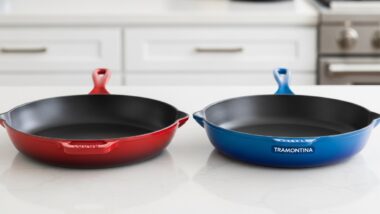
  • Cast iron: 5-8 pounds empty, retains heat exceptionally well, requires seasoning maintenance
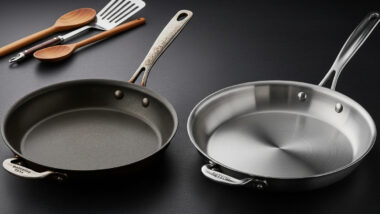
  • Stainless steel: 2-4 pounds, works with metal utensils, oven-safe to 500°F+
  • Non-stick aluminum: 1.5-3 pounds, easy food release, limited to 400-450°F maximum
  • Carbon steel: 3-5 pounds, develops natural non-stick patina, professional choice for high heat
  • Copper core: Premium option with superior heat response, expensive ($150-400)

Types of Skillets

Not all skillets follow identical designs. Variations address specific cooking scenarios.

Standard skillet (frying pan):
The most versatile option with gently sloped sides and no lid. Use this for everyday searing, sautéing, and pan-frying. The open design promotes browning through moisture evaporation.

Cast iron skillet:
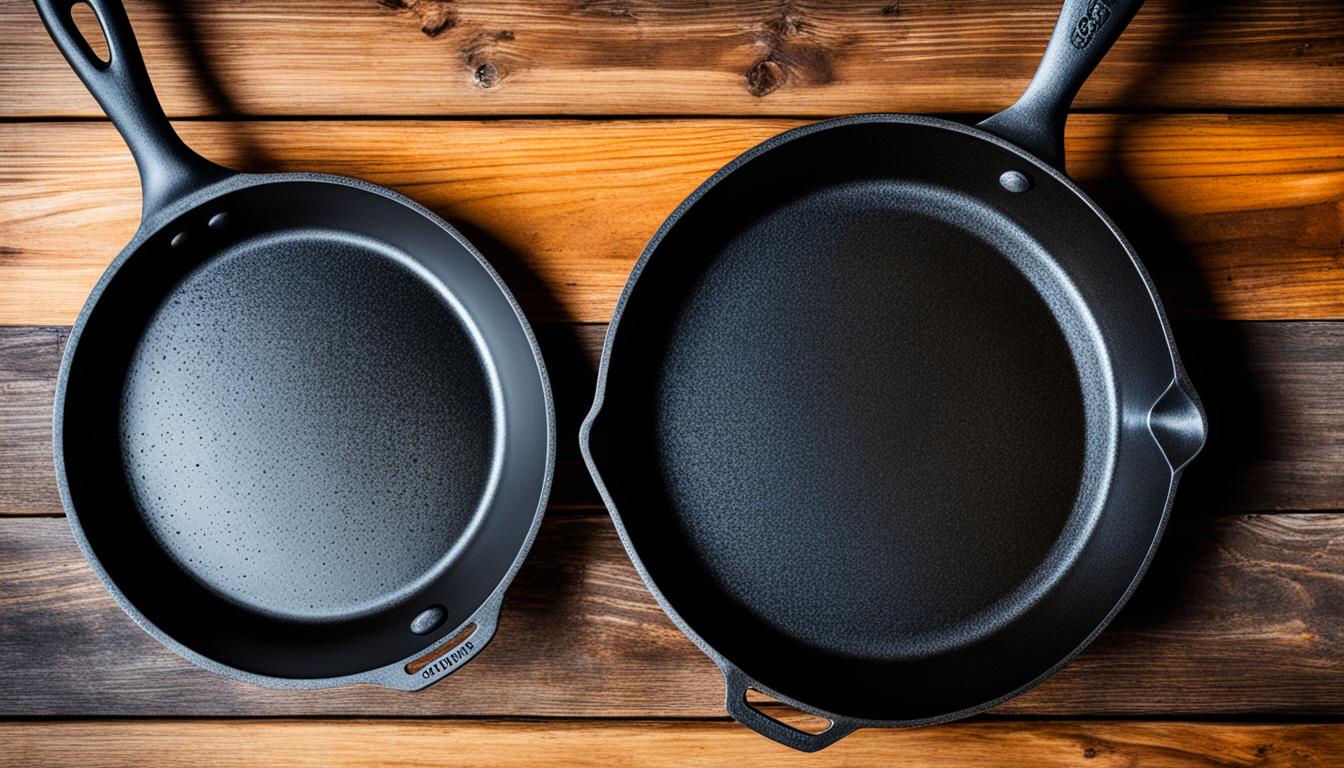
Heavy construction (5-10 pounds) provides exceptional heat retention and naturally non-stick surface when properly seasoned. These pans transition seamlessly from stovetop to oven. Cornbread, frittatas, and seared steaks benefit from cast iron’s ability to maintain steady temperatures.

Non-stick skillet:
Coated with PTFE (Teflon) or ceramic for effortless food release. Eggs, delicate fish, and pancakes slide out without sticking. The coating limits maximum temperature to 400-450°F, making these unsuitable for high-heat searing that requires 500°F+.

Sauté pan (straight-sided skillet variant):
Features vertical sides (2.5-3 inches tall) instead of sloped walls, with the same wide base as standard skillets. The taller walls contain splatter better and hold more liquid. This design bridges the gap between traditional skillets and saucepans, though the straight sides make flipping more difficult.

Skillet Type Weight Best For Price Range
Non-stick aluminum 1.5-3 lbs Eggs, pancakes, delicate fish $25-80
Stainless steel 2-4 lbs Searing, deglazing, versatile use $50-200
Cast iron 5-8 lbs High-heat cooking, oven use $30-100
Carbon steel 3-5 lbs Restaurant-style cooking, wok alternative $40-120
Sauté pan 3-5 lbs Dishes with sauce, braising $60-180

Each skillet type delivers different performance characteristics. A 3-pound stainless steel skillet heats up in 2-3 minutes, while an 8-pound cast iron model requires 8-10 minutes to reach proper searing temperature. That thermal mass difference affects daily cooking—the lighter pan suits quick weeknight meals, while cast iron excels at extended cooking sessions where heat retention matters.

What Is a Saucepan? (Definition and Features)

A saucepan is a deep cooking vessel with tall, straight sides and a flat bottom, specifically designed for preparing sauces, boiling liquids, and simmering foods that require moisture retention. The vertical walls (4-6 inches) minimize evaporation and contain liquids efficiently.

Saucepan Design Elements

Saucepans prioritize depth over width to handle liquid-based cooking tasks.

Essential structural features:

  • Base diameter: Compact 5-8 inch footprint fits easily on burners
  • Sidewalls: Perfectly vertical (90-degree angle) to maximize liquid capacity
  • Wall height: 4-6 inches tall creates deep cooking chamber
  • Capacity measurement: Sold by volume (1, 2, 3, or 4 quarts most common)
  • Handle configuration: Long main handle with optional helper grip on larger sizes
  • Lid inclusion: Tight-fitting lid comes standard to trap steam and moisture
Saucepan Size Base Diameter Wall Height Best For Liquid Capacity
1 quart 5-5.5 inches 3.5-4 inches Melting butter, small sauces 4 cups
2 quart 6-6.5 inches 4-4.5 inches Oatmeal, rice for 2-3 people 8 cups
3 quart 7-7.5 inches 5-5.5 inches Pasta sauce, soups, general use 12 cups
4 quart 8-8.5 inches 6 inches Large batches, cooking pasta 16 cups

The straight vertical walls serve a critical purpose in liquid management. When you boil water or simmer soup, these walls contain splatter and prevent spillover. The narrow opening relative to base size reduces evaporation by limiting exposed liquid surface area.

Saucepan lids fit snugly around the rim to create a sealed cooking environment. This seal traps steam, which condenses back into the pan rather than escaping. Rice cooked in a covered saucepan absorbs water efficiently because minimal moisture is lost to evaporation—a covered skillet loses roughly 40% more moisture during the same cooking time.

Construction materials by performance:

  • Stainless steel with aluminum core: Industry standard for even heating, dishwasher-safe, lasts decades
  • Hard-anodized aluminum: Lightweight (1.5-2.5 lbs), naturally non-stick surface, scratch-resistant
  • Copper with stainless interior: Superior heat response for delicate sauces, requires polishing, premium pricing
  • Enameled cast iron: Excellent heat retention, no seasoning required, heavy (4-6 lbs), chips if dropped
  • Non-stick aluminum: Budget-friendly option for sticky foods like oatmeal, limited lifespan (2-3 years)

Types of Saucepans

Three distinct saucepan variations address different cooking challenges.

Standard saucepan:
The workhorse design with straight sides and flat base. Use this for everyday tasks—boiling eggs, heating soup, cooking grains, making gravy. The 2-3 quart sizes handle most household requirements. A quality stainless steel model costs $60-120 and performs reliably for 15-20 years.

Windsor pan (flared saucepan):
Features slightly angled sides that flare outward at the top rim. This traditional French design makes whisking easier because the whisk reaches into corners more effectively. The flared opening also facilitates pouring. Pastry chefs prefer Windsor pans for custards and pastry cream because the shape promotes even stirring.

Saucier (rounded saucepan):
Eliminates sharp 90-degree corners by curving the transition between base and walls. This rounded profile prevents food from sticking in corners and allows whisks to reach every surface. The curved design excels at reducing sauces and making risotto, where constant stirring is required. Professional kitchens often choose sauciers over standard saucepans for sauce work.

Saucepan Type Wall Shape Unique Advantage Ideal Tasks Price Range
Standard Straight vertical Maximum capacity, versatile General cooking, boiling, simmering $40-150
Windsor Slightly flared Easy pouring, better whisking Custards, sauces, reductions $70-180
Saucier Curved bottom No stuck corners, constant stirring Risotto, polenta, delicate sauces $80-250

Handle design varies between manufacturers but follows consistent principles. Smaller saucepans (1-2 quarts) typically have a single long handle. Larger models (3-4 quarts) add a short helper handle opposite the main grip because a full 4-quart pan weighs 8-10 pounds and becomes difficult to pour safely with one hand.

The lid’s importance cannot be overstated for saucepan functionality. Simmering without a lid wastes energy as heat escapes and requires constant water additions. A properly fitted lid maintains consistent temperature with 30-40% less burner output. Glass lids allow visual monitoring without releasing steam, though metal lids conduct heat more efficiently and prove more durable long-term.

Most quality saucepans feature encapsulated bases—a thick aluminum or copper disc sandwiched between stainless steel layers. This tri-ply construction eliminates hot spots that would scorch sauces or burn rice. The conductive core spreads heat evenly across the base, then the stainless steel walls conduct that heat upward through the cooking liquid.

Skillet vs Saucepan: Best Uses for Each Pan

Skillets work best for dry-heat cooking methods that require direct surface contact—searing, sautéing, and pan-frying—while saucepans excel at liquid-based techniques like boiling, simmering, and sauce-making. The shape of each pan dictates which cooking methods produce optimal results.

When to Use a Skillet

The wide, shallow design makes skillets indispensable for techniques that depend on moisture evaporation and surface browning.

Searing and Browning Proteins

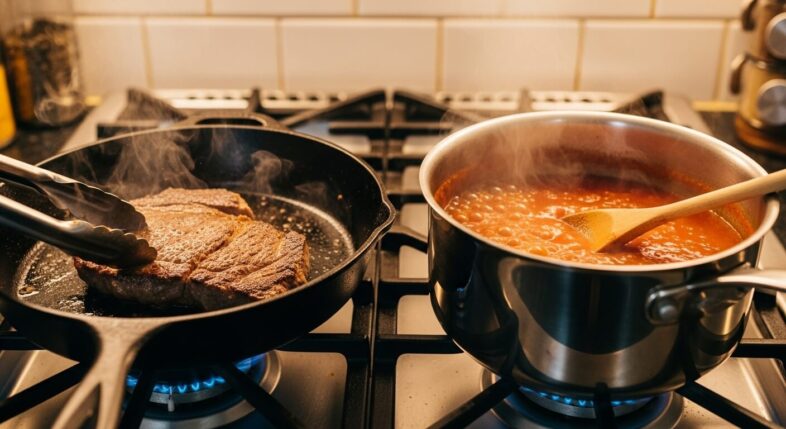
Skillets create the deep golden crust on steaks, chicken, and pork through direct high-heat contact. A 12-inch skillet accommodates four 6-ounce chicken breasts with proper spacing (1 inch between pieces). This separation allows steam to escape instead of collecting between proteins, which would cause steaming rather than searing.

Optimal searing temperatures and timing:

  • Steaks: 450-500°F surface temp, 3-4 minutes per side for medium-rare
  • Chicken breasts: 375-400°F, 6-7 minutes per side until 165°F internal
  • Pork chops: 400-425°F, 4-5 minutes per side for 1-inch thick cuts
  • Fish fillets: 375-400°F, 3-4 minutes skin-side down, 1-2 minutes flesh-side

Sautéing Vegetables

The expansive surface area allows vegetables to make direct pan contact rather than piling up and steaming. Sliced mushrooms release moisture when heated—a skillet’s shallow profile lets that water evaporate in 2-3 minutes. The same mushrooms in a saucepan would stew in their own liquid for 8-10 minutes.

Bell peppers, onions, and zucchini develop caramelization only when spread across a hot surface. A 10-inch skillet handles 2-3 cups of sliced vegetables comfortably. Attempting this in a saucepan results in uneven cooking because only vegetables touching the small base receive direct heat.

Pan-Frying Foods

Shallow frying requires just 1/4 to 1/2 inch of oil—enough to cover food halfway without submerging it completely. Skillets hold this oil level perfectly while providing easy access for flipping.

Foods that demand skillet pan-frying:

  • Eggs (sunny-side up, over-easy, fried): Cook in 2-3 minutes with crispy edges
  • Pancakes and French toast: Even browning across entire surface, easy flipping
  • Bacon strips: Lay flat without overlapping, render fat uniformly
  • Hash browns: Form crispy crust on bottom, flip without breaking apart
  • Breaded cutlets: Schnitzel, chicken cutlets, pork milanese get golden coating

Stir-Frying and Tossing

The sloped sides enable the tossing motion essential to stir-frying. You can slide a spatula under ingredients and flip them with a wrist flick. Vertical saucepan walls prevent this technique—food hits the wall and falls straight down instead of flipping.

Stir-fry cooking requires constant motion to prevent burning at high heat (450-500°F). A 14-inch skillet provides enough room to toss 4-5 cups of cut vegetables and protein without spilling over the sides.

Reducing Sauces Quickly

Pan sauces benefit from rapid evaporation that concentrates flavors. After searing meat, deglaze the skillet with 1 cup of wine or stock. The wide surface exposes maximum liquid to air, reducing the sauce to 1/3 cup in 3-4 minutes. Intensity builds as water evaporates and flavors concentrate.

A saucepan holding the same liquid would require 12-15 minutes to achieve similar reduction because only the top surface contacts air. The deep vessel traps moisture below.

One-Pan Complete Meals

Skillets accommodate layered dishes that combine proteins, vegetables, and starches. Frittatas, shakshuka, and skillet pasta dishes utilize the broad cooking surface for even ingredient distribution.

A Spanish tortilla (potato omelet) works specifically because the 10-inch skillet shape matches the finished dish diameter. The sloped sides help you slide the cooked tortilla onto a plate for flipping and returning to the pan.

When to Use a Saucepan

Tall walls and compact bases make saucepans the correct choice for any cooking task involving significant liquid volume or requiring moisture retention.

Making Sauces and Gravies

The narrow, deep shape concentrates ingredients and prevents excessive evaporation. A béchamel sauce starts with a roux (butter and flour), then requires gradual milk addition while whisking constantly. The saucepan’s vertical walls contain splatter as you whisk vigorously.

Sauces that demand saucepan preparation:

  • Béchamel (white sauce): Requires constant whisking in contained space
  • Hollandaise: Gentle heat control prevents curdling, tall sides contain emulsion
  • Tomato sauce: Long simmering (45-60 minutes) without excessive reduction
  • Caramel: Sugar syrup boils at 340°F, tall walls prevent dangerous splatter
  • Gravy: Whisking flour into hot liquid creates smooth consistency without lumps

Boiling Water and Foods

Saucepans bring water to a boil efficiently because the deep cavity traps heat. A 3-quart saucepan holds 8 cups of water for boiling eggs, blanching vegetables, or cooking small pasta portions (8 ounces dry).

The tall walls prevent boilover that occurs when starchy pasta water foams up. A skillet boiling pasta would spill over the low sides within minutes. The saucepan contains this foam safely 2-3 inches below the rim.

Simmering Soups and Stews

Gentle simmering (180-200°F) develops flavors without aggressive evaporation. A 4-quart saucepan holds 12 cups of soup, enough for 4-6 servings. The lid traps moisture during 30-45 minute simmer times, preventing the soup from reducing by more than 10-15%.

The vertical design promotes convection currents—hot liquid rises from the bottom, cooler liquid sinks from the top. This circulation distributes heat evenly throughout the pot without constant stirring.

Cooking Grains and Starches

Rice, quinoa, oatmeal, and polenta all require specific water-to-grain ratios. Saucepans maintain these ratios because the lid minimizes evaporation. Rice cooked covered in a 2-quart saucepan absorbs 90-95% of added water. The same rice in an uncovered skillet would require 50% more water to compensate for evaporation.

Grain Type Water Ratio Saucepan Size Cook Time
White rice 1:1.5 (rice:water) 2 qt for 1-2 cups dry 18-20 min
Brown rice 1:2 3 qt for 1.5-2 cups dry 45-50 min
Quinoa 1:2 2 qt for 1 cup dry 15-18 min
Oatmeal 1:2 1-2 qt for 1 cup dry 5-7 min
Polenta 1:4 3 qt for 1 cup dry 30-40 min

Reheating Leftovers

Soups, stews, chili, and curry reheat better in saucepans than skillets. The tall walls contain liquid and prevent splatter during stirring. A lid accelerates heating by trapping steam—leftovers reach serving temperature (165°F) in 6-8 minutes versus 12-15 minutes uncovered.

Blanching Vegetables

Blanching requires rapid boiling water (212°F) to quickly cook vegetables while preserving color and nutrients. Drop green beans into 6-8 cups of boiling water in a 3-quart saucepan, cook for 2-3 minutes, then transfer to ice water.

The deep saucepan keeps vegetables fully submerged for even cooking. A shallow skillet leaves vegetables partially exposed, creating uneven results where some pieces overcook while others stay raw.

Cooking Method Best Pan Choice Why It Matters
Searing meat Skillet Wide surface creates crust, not steam
Boiling pasta Saucepan Tall walls contain boiling water and foam
Stir-frying Skillet Sloped sides enable tossing motion
Making risotto Saucepan (saucier) Controlled evaporation, constant stirring
Pan-frying eggs Skillet Shallow oil depth, easy flipping access
Simmering soup Saucepan Lid traps moisture, prevents over-reduction
Reducing wine sauce Skillet Maximum evaporation surface for fast reduction
Cooking rice Saucepan Maintains precise water ratio with lid

The pan choice directly impacts cooking success. Attempting to boil 8 ounces of pasta in a 12-inch skillet requires excessive water (12+ cups) to keep pasta submerged, wasting energy and time. A 3-quart saucepan achieves the same result with 8 cups of water and reaches boiling temperature 5 minutes faster due to smaller volume and contained heat.

Skillet vs Saucepan: Cooking Technique Comparison

Skillets promote rapid evaporation and high-heat browning through their wide, shallow design, while saucepans retain moisture and provide gentle, controlled heat through tall, enclosed sides. These opposing characteristics make each pan suited to completely different cooking techniques.

Evaporation and Moisture Control

The rate at which moisture leaves your food determines texture, flavor concentration, and cooking time.

A 12-inch skillet exposes roughly 113 square inches of cooking surface to air. When you add 1 cup of liquid to deglaze after searing, that liquid spreads thin across the pan bottom. The extensive air contact causes evaporation at approximately 2-3 tablespoons per minute at medium-high heat (325-350°F). Your pan sauce reduces from 1 cup to 1/3 cup in just 3-4 minutes.

The same cup of liquid in a 3-quart saucepan (38 square inch base) creates a pool 1.5 inches deep. Only the top surface contacts air, limiting evaporation to roughly 1 tablespoon per minute at the same temperature. Reducing to 1/3 cup requires 12-15 minutes. The tall walls trap steam that condenses back into the liquid rather than escaping.

How moisture control affects specific dishes:

Dish Type Preferred Pan Moisture Goal Result
Pan-seared steak Skillet Maximum evaporation Dry surface browns quickly, forms crust
Braised chicken Saucepan/covered Moisture retention Meat stays tender in liquid environment
Stir-fried vegetables Skillet Rapid moisture release Crisp texture, not soggy or steamed
Simmered tomato sauce Saucepan Controlled reduction Flavors concentrate slowly over 45-60 min
Hash browns Skillet Surface drying Crispy exterior develops from released potato starch
Risotto Saucepan Gradual absorption Creamy consistency from slow liquid incorporation

Vegetables demonstrate the moisture difference dramatically. Sliced mushrooms contain 90% water by weight. When cooked in a skillet at medium-high heat, that water releases and evaporates within 2-3 minutes, allowing the mushroom surfaces to brown. Transfer those mushrooms to a saucepan and they’ll stew in their own liquid for 8-10 minutes before browning begins.

Temperature Control

Heat management separates mediocre cooking from restaurant-quality results.

Skillets excel at high-temperature cooking (400-500°F) because their wide, flat bases make direct contact with burners. A 10-inch skillet on a standard gas burner receives heat across 80-90% of its surface area. This broad heating pattern creates consistent temperatures perfect for searing proteins. The low sidewalls allow excess heat to escape rather than building up.

Preheat times reflect this efficient heating. A stainless steel skillet reaches 400°F in 3-4 minutes on medium-high heat. Cast iron requires 8-10 minutes but then maintains that temperature rock-steady for superior browning.

Saucepans provide precise low-to-medium temperature control (180-250°F) for delicate tasks. The small base diameter concentrates burner output, while tall walls trap heat that circulates through liquids via convection. This contained environment prevents hot spots that would scorch sauces or curdle eggs.

Temperature requirements by cooking method:

  • Hard searing (steaks, tuna): 450-500°F surface temp — skillet required
  • Sautéing vegetables: 350-400°F — skillet works best
  • Simmering sauces: 180-200°F — saucepan maintains consistency
  • Melting chocolate: 110-120°F — saucepan prevents burning
  • Boiling water: 212°F — saucepan reaches boiling faster with less energy
  • Pan-frying: 325-375°F — skillet depth controls oil temperature

Temperature recovery speed matters when adding cold ingredients. Drop four cold chicken breasts into a preheated skillet and the pan temperature drops 75-100°F. The skillet’s thermal mass and direct burner contact restore cooking temperature within 60-90 seconds. A saucepan would recover more slowly because liquid must reheat before transferring thermal energy to food.

Ease of Stirring and Flipping

Physical access to cooking food determines which utensils work and how much effort cooking requires.

Skillets provide unrestricted access from the top. The sloped sides create a wide opening that accommodates spatulas, tongs, and wooden spoons at any angle. When flipping an omelet or turning chicken breasts, you can slide tools under food and lift without hitting walls. The shallow depth (1-2 inches) means your hand stays a safe distance from the heat source while remaining in complete control.

Skillet advantages for food manipulation:

  • Spatulas slide cleanly under food without wall interference
  • Tossing motion possible with wrist flick (stir-fry technique)
  • Easy flipping for pancakes, eggs, and hash browns
  • Food slides out directly onto plates using pan tilt
  • Visual monitoring without leaning over deep walls

The pan flip—where you jerk the handle to flip food in mid-air—works only in skillets. The sloped sides guide food up and over in a smooth arc. Attempt this in a saucepan and food hits the vertical wall, breaking apart or spilling.

Saucepans require different manipulation techniques suited to their depth. Whisks reach all the way to the bottom for smooth sauce preparation without hitting walls. Long-handled spoons stir to full depth without hands getting too close to steam. The narrow opening contains splatter when stirring vigorously.

Saucepan advantages for liquid-based cooking:

  • Whisk reaches all surfaces for lump-free sauces
  • Splatter containment during vigorous boiling or stirring
  • Ladle fits through opening for serving soups
  • Tall walls prevent liquid from sloshing out during stirring
  • Steam stays contained under lid for efficient heating

A balloon whisk measuring 10 inches long fits perfectly in a 3-quart saucepan, allowing figure-eight motions that incorporate air and prevent lumps. That same whisk in a 12-inch skillet would scrape across a shallow puddle ineffectively. The tool-to-pan matching affects cooking efficiency.

Stirring frequency requirements differ between pans. Risotto demands constant stirring every 30-60 seconds as you gradually add liquid—the saucepan’s shape makes this repetitive motion comfortable. A shallow skillet would require awkward reaching and provide less effective stirring because the rice layer is too thin to create proper convection currents.

Handling Differences Between Pans

Weight distribution and balance affect daily cooking ease.

A 10-inch stainless steel skillet weighs 2-3 pounds empty and balances naturally in one hand using the long handle. The weight centers over the stovetop burner, requiring minimal effort to hold steady. Add 1 pound of chicken and the total weight of 3-4 pounds remains manageable for quick pan movements—tilting to collect juices, sliding food onto plates, or tossing vegetables.

A 3-quart saucepan weighs 2-3 pounds empty but becomes front-heavy when filled with liquid. Eight cups of soup adds 4 pounds concentrated in the deep cavity. The long handle provides leverage, though pouring requires two hands for safety. Quality saucepans include a helper handle opposite the main grip specifically for this pouring motion.

Pan Type Empty Weight Typical Full Weight One-Hand Maneuverable?
10″ skillet 2-3 lbs 3-5 lbs (with food) Yes
12″ skillet 3-4 lbs 5-7 lbs (with food) With practice
14″ skillet 4-5 lbs 7-9 lbs (with food) No, use helper handle
2 qt saucepan 1.5-2 lbs 5-6 lbs (filled) Empty yes, full no
3 qt saucepan 2-3 lbs 8-9 lbs (filled) No, use both handles
4 qt saucepan 3-4 lbs 11-12 lbs (filled) Never

Cast iron changes these calculations entirely. A 12-inch cast iron skillet weighs 8 pounds empty—manageable for flipping but requiring two hands for safe carrying when loaded. The extreme weight provides thermal benefits but demands different handling. Most cooks keep cast iron skillets on the stove rather than storing them in cabinets.

The saucepan lid adds functional complexity absent in skillet cooking. Lifting a lid mid-cooking releases accumulated steam and drops internal temperature by 15-20°F. This disruption extends cooking time and affects moisture-sensitive dishes like rice. Skillet cooking proceeds without this concern because the pan stays uncovered throughout.

Capacity and Volume: Skillet vs Saucepan

Saucepans hold 2-4 times more liquid than skillets of similar diameter due to their tall, vertical walls—a 3-quart saucepan with a 7-inch base holds 12 cups, while a 12-inch skillet with triple the surface area holds only 8-10 cups when filled to the rim. Height determines volume capacity far more than width.

Liquid Capacity

The vertical dimension creates dramatic volume differences between these pan types.

A standard 3-quart saucepan measures roughly 7 inches in diameter with 5-inch tall walls. This compact footprint holds 12 cups (3 quarts/2.8 liters) of liquid comfortably, with the lid preventing spillage. The tall cylinder shape maximizes volume in minimal stovetop space.

Compare this to a 12-inch skillet with 113 square inches of base area—nearly 3 times the saucepan’s surface. Despite the massive size advantage, the skillet’s 2-inch walls limit capacity to just 8-10 cups when filled completely. Cooking with liquid near the rim causes frequent splatter and spillover because the shallow walls provide no buffer zone.

Practical liquid capacity by pan:

Pan Type & Size Base Diameter Wall Height Maximum Capacity Usable Capacity
1 qt saucepan 5.5 inches 3.5 inches 4 cups 3.5 cups (safe level)
2 qt saucepan 6.5 inches 4.5 inches 8 cups 7 cups
3 qt saucepan 7.5 inches 5.5 inches 12 cups 10 cups
4 qt saucepan 8.5 inches 6 inches 16 cups 14 cups
10″ skillet 10 inches 2 inches 6 cups 4 cups
12″ skillet 12 inches 2 inches 10 cups 6 cups
14″ skillet 14 inches 2.5 inches 14 cups 8 cups

The “usable capacity” reflects realistic cooking levels. Filling a skillet more than 60-70% full creates splatter during stirring or boiling. Saucepans accommodate 85-90% fill safely because the tall walls contain bubbling and foam.

This capacity difference determines which dishes each pan can accommodate. Cooking 1 pound of pasta requires 4-5 quarts of boiling water—possible only in large saucepans or stock pots. A skillet attempting this task would need to be filled to overflowing, creating dangerous conditions and uneven cooking as pasta pieces extend above the water line.

Food Quantity

Volume capacity directly impacts how many servings you can prepare in a single batch.

Saucepan serving capacity:

A 2-quart saucepan handles 2-3 servings of soup (2 cups per serving), 4 servings of cooked rice (1/2 cup dry rice per person), or oatmeal for 2-3 people. The confined space actually benefits certain dishes—cooking 1 cup of dry rice in a 2-quart pan creates the right liquid-to-rice ratio with proper steam circulation. That same cup of rice in a 4-quart saucepan would spread too thin across the bottom.

A 3-quart saucepan represents the most versatile size for households of 3-4 people. It makes 6-8 servings of soup, cooks 2 cups of dry rice (6-8 servings), and handles most sauce recipes that yield 3-4 cups.

Skillet serving capacity:

A 10-inch skillet accommodates 2-3 chicken breasts (6 ounces each), 4-5 eggs, or 3 cups of sliced vegetables for sautéing. The limitation comes from surface area, not depth. Overcrowding causes steaming instead of browning because moisture cannot evaporate efficiently when food pieces touch.

A 12-inch skillet steps up to 4 chicken breasts, 6-8 eggs, or 4-5 cups of vegetables. This size handles family dinners for 4 people comfortably. Professional cooks often use 14-inch skillets for batch cooking or restaurant service, though these large pans require significant storage space and strong burners.

Dish Type 10″ Skillet 12″ Skillet 2 Qt Saucepan 3 Qt Saucepan
Chicken breasts 2-3 pieces 4 pieces Not suitable Not suitable
Eggs (fried) 4-5 eggs 6-8 eggs 2 eggs max 3-4 eggs (poached)
Soup servings Not practical Not practical 2-3 servings 4-6 servings
Rice (cooked) Not recommended Not recommended 4 servings 6-8 servings
Pasta sauce 2 cups max 3-4 cups 3 cups 4-6 cups
Vegetables (sautéed) 3 cups sliced 4-5 cups sliced 1-2 cups 2 cups

Cooking for Different Numbers of People

Matching pan size to household needs prevents constant batch cooking or wasted capacity.

Single-person households function well with an 8-10 inch skillet and 1-2 quart saucepan. These sizes prepare individual portions without leftovers. A 10-inch skillet sears one steak perfectly, while a 2-quart saucepan makes 2 servings of soup or cooks 1/2 cup of rice.

Two-person households benefit from a 10-12 inch skillet paired with a 2-3 quart saucepan. The skillet handles two servings of protein with sides, while the saucepan covers most liquid-based meals without excessive volume. Cooking rice for two in a 3-quart pan works fine, though a 2-quart pan provides better proportions.

Families of 4-5 people require a 12-14 inch skillet and 3-4 quart saucepan as minimum sizes. A 12-inch skillet barely accommodates four chicken breasts with proper spacing. A 3-quart saucepan makes 6-8 servings of soup or 8 servings of rice—enough for dinner with some leftovers.

Batch cooking considerations:

Preparing multiple meals for freezing demands larger capacities. A 4-quart saucepan makes 12-16 servings of soup, enough to freeze in 4-cup portions for future meals. The taller walls prevent boilover during extended simmering that smaller pans cannot handle safely.

Skillets rarely work for true batch cooking because their shallow design limits stacking. A 14-inch skillet might hold 8 chicken thighs in a single layer, but cooking 12-15 pieces requires multiple batches. The wide diameter also creates hotspot issues on standard home burners—the outer edges receive less heat than the center when pan size exceeds burner diameter by 3+ inches.

Optimal Food-to-Pan Ratios

Proper proportions affect cooking efficiency and results quality.

For skillets: Food should cover 60-75% of the base surface with space between pieces. Pack a skillet more densely and you create a steaming environment rather than a searing one. The gaps between chicken breasts or vegetable pieces allow steam to escape upward and outward, keeping surfaces dry enough to brown.

A 12-inch skillet has 113 square inches of base area. Four 6-ounce chicken breasts occupy roughly 60 square inches (each breast is approximately 15 square inches). This leaves 53 square inches for heat circulation and moisture evaporation—the ideal ratio for proper browning.

For saucepans: Liquids should fill 60-85% of total height, depending on boiling intensity. Pasta water can reach 75-80% because vigorous boiling requires expansion room. Simmering soup sits comfortably at 85% because gentle bubbling produces minimal foam.

Rice requires specific water depth for proper steaming. One cup of dry rice in a 2-quart saucepan with 1.5 cups of water creates a 1.5-inch deep cooking layer. This depth allows steam to circulate effectively while keeping rice submerged. Spread that same rice in a 12-inch skillet and the layer measures only 0.25 inches—too thin for even cooking, with edges drying out before the center finishes.

The pan-to-burner ratio also affects efficiency. A 12-inch skillet on an 8-inch burner wastes the outer 2 inches of cooking surface, which receive indirect heat only. A 3-quart saucepan with a 7-inch base matches most standard burners perfectly, maximizing heat transfer and minimizing energy waste.

Material Options for Skillets and Saucepans

Both skillets and saucepans are manufactured in stainless steel, cast iron, aluminum, and copper, but material choice affects each pan type differently—skillets prioritize heat retention for searing while saucepans require responsive temperature control for delicate sauces. The same material performs distinct functions depending on pan shape.

Cast Iron

Heavy, dense construction makes cast iron ideal for skillets but impractical for most saucepan applications.

Cast iron skillet advantages:

A 12-inch cast iron skillet weighs 8-10 pounds and retains heat exceptionally well once preheated. The thermal mass maintains surface temperatures above 450°F even when cold steaks hit the pan. This heat retention creates restaurant-quality searing at home. The material also transitions seamlessly from stovetop to oven—cornbread, frittatas, and Dutch baby pancakes benefit from this versatility.

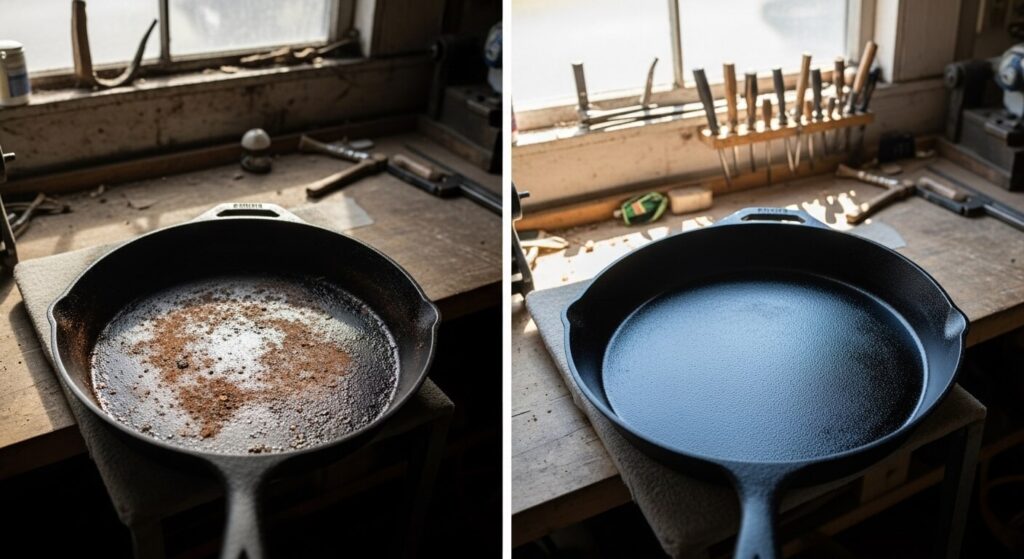
Cast iron develops a natural non-stick patina through seasoning (coating with polymerized oil). Well-maintained skillets release food as effectively as chemical non-stick coatings without temperature limitations. You can heat cast iron to 500°F+ for hard searing without damaging the surface.

Maintenance requirements:

  • Hand wash only (dishwasher strips seasoning)
  • Dry immediately and apply thin oil layer after each use
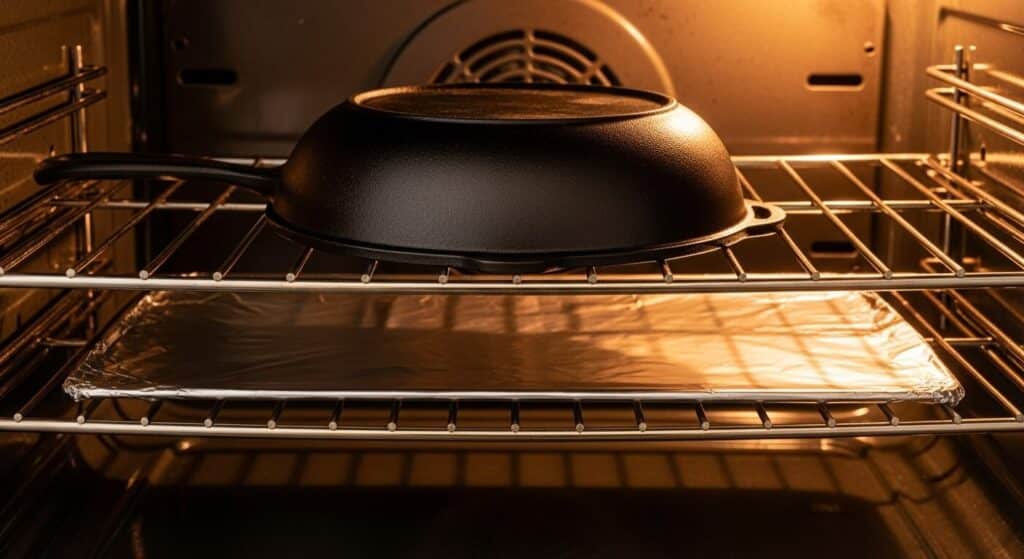
  • Re-season every 6-12 months by baking with oil at 450°F
  • Avoid cooking acidic foods (tomatoes, vinegar) for extended periods
  • Expected lifespan: 50+ years with proper care

Why cast iron saucepans are uncommon:

Cast iron saucepans exist but remain niche products. The 6-8 pound weight makes pouring difficult and dangerous when filled with hot liquid. The material’s slow heat response works against saucepan functionality—reducing a sauce requires quick temperature adjustments that cast iron cannot provide. Most cooks choose enameled cast iron (like Le Creuset) for Dutch ovens rather than traditional saucepans, gaining the heat retention without seasoning requirements.

Stainless Steel

The professional standard for both skillets and saucepans due to durability, versatility, and non-reactive properties.

Stainless steel alone conducts heat poorly, creating severe hot spots. Quality cookware solves this through tri-ply or multi-ply construction—layers of aluminum or copper sandwiched between stainless steel. The conductive core spreads heat evenly while stainless steel provides the cooking surface and exterior.

Stainless steel skillet performance:

A 12-inch tri-ply stainless skillet weighs 3-4 pounds and heats evenly across the entire base. The material tolerates metal utensils, high heat (600°F+), and oven use without restrictions. Food browns beautifully but sticks unless the pan is properly preheated and adequate fat is used. The sticking actually benefits pan sauces—those browned bits (fond) deglaze into flavorful reductions.

Stainless steel saucepan performance:

Saucepans benefit even more from stainless steel’s responsive temperature control. When you reduce heat under a simmering sauce, the pan responds within 30-45 seconds. This responsiveness prevents scorching delicate preparations like hollandaise or custards. The non-reactive surface handles acidic ingredients (tomatoes, wine, citrus) without metallic flavors or discoloration.

Stainless Steel Feature Skillet Benefit Saucepan Benefit
Even heating Prevents hot spots during searing Eliminates scorching in sauces
Oven-safe Finish proteins in oven after searing Transfer rice to oven for even cooking
Metal utensil safe Scrape fond without damage Whisk vigorously without scratching
Non-reactive Cook tomato-based pan sauces Prepare acidic sauces without metallic taste
Dishwasher-safe Easy cleanup after high-heat cooking Remove milk residue and stuck rice
Durability Lasts 15-20+ years Maintains even heating indefinitely

Price ranges for quality stainless steel:

  • Budget (thin base): $40-70 per pan
  • Mid-range (tri-ply): $80-150 per pan
  • Premium (5-ply or copper core): $180-350 per pan

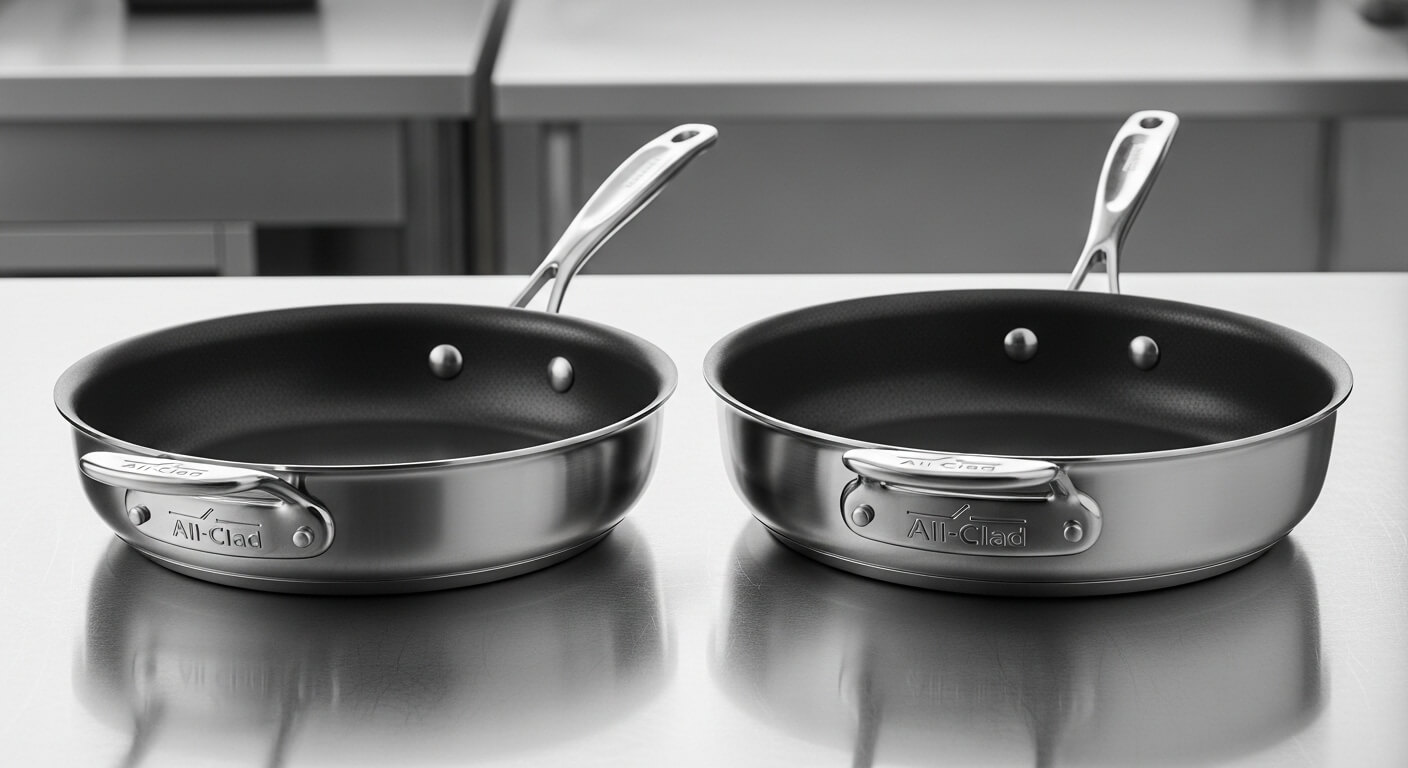
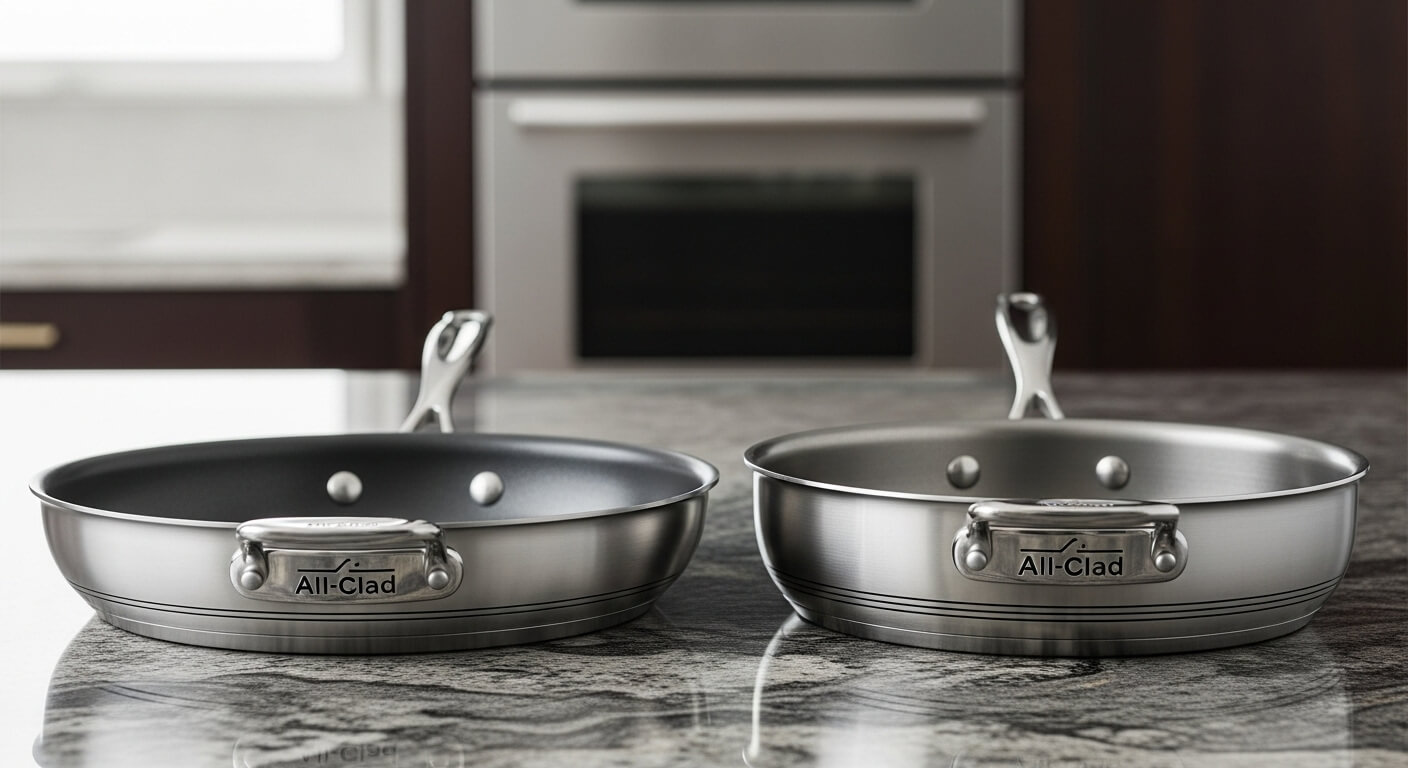
The investment pays off through longevity. A $120 All-Clad stainless steel skillet performs identically in year 15 as it did new. Cheap stainless pans develop warping and hot spots within 2-3 years.

Non-Stick Coatings

Chemical coatings (PTFE/Teflon) or ceramic surfaces eliminate sticking but impose temperature and durability limitations.

Non-stick skillet applications:

Eggs, pancakes, and delicate fish benefit enormously from non-stick surfaces. A non-stick 10-inch skillet allows you to cook omelets with minimal butter and flip them without tearing. The coating prevents protein adhesion, eliminating the need for aggressive scraping.

The critical limitation: maximum temperature of 400-450°F before coating degradation begins. This restriction makes non-stick skillets unsuitable for high-heat searing that requires 500°F+ surface temperatures. A steak cooked in a non-stick pan will never develop the crust achieved in stainless steel or cast iron.

Non-stick saucepan applications:

Saucepans face fewer temperature constraints because simmering and boiling occur at 212°F maximum. Non-stick saucepans excel at cooking sticky foods—oatmeal, risotto, polenta, cheese sauces—that would cement to stainless steel. Cleanup requires only a quick rinse rather than aggressive scrubbing.

Non-stick durability concerns:

  • PTFE coatings last 2-4 years with proper care (no metal utensils, hand washing)
  • Ceramic coatings degrade faster: 1-2 years before sticking returns
  • Cannot restore worn coatings—replacement required
  • Budget-friendly for frequent replacement: $25-60 per pan
Non-Stick Type Temperature Limit Lifespan Best For
PTFE (Teflon) 400-450°F 3-4 years Eggs, pancakes, fish
Ceramic 400-500°F 1-2 years Low-acid foods, gentle cooking
Reinforced PTFE 450-500°F 4-5 years Higher heat tolerance, premium price

Other Materials

Alternative materials serve specialized purposes in skillet and saucepan construction.

Carbon steel skillets:

Similar to cast iron but lighter (4-5 pounds for 12-inch) and more responsive to temperature changes. Professional kitchens favor carbon steel for its combination of heat retention and maneuverability. The material requires seasoning like cast iron but develops a non-stick surface faster. Carbon steel works almost exclusively for skillets—the shape leverages the material’s searing capabilities.

Carbon steel heats faster than cast iron (4-5 minutes to reach 450°F versus 8-10 minutes) while maintaining most of the heat retention benefits. This makes it practical for weeknight cooking rather than just special occasions.

Copper saucepans:

Copper conducts heat 25 times better than stainless steel, providing unmatched temperature responsiveness. The moment you adjust the burner, a copper saucepan responds. This precision matters critically for delicate sauces where temperature fluctuations cause curdling or separation.

Professional pastry chefs use copper for making caramel, custards, and candy because the material prevents hot spots that create crystallization or scorching. The material costs significantly more: $200-500 for quality copper saucepans versus $80-150 for comparable stainless steel.

Copper requires regular polishing to maintain appearance (develops green patina otherwise) and most pieces feature stainless steel or tin-lined interiors to prevent copper from reacting with acidic foods. Copper skillets exist but provide less practical benefit—searing doesn’t require the temperature precision that sauce-making demands.

Aluminum saucepans:

Hard-anodized aluminum offers lightweight construction (1.5-2.5 pounds for a 3-quart saucepan) with decent heat distribution. The anodization process creates a non-reactive, scratch-resistant surface harder than stainless steel. These pans heat quickly and cost less than tri-ply stainless ($50-90 for quality pieces).

The material works better for saucepans than skillets because the lower cooking temperatures suit aluminum’s properties. High-heat searing can warp untreated aluminum, and the material cannot match cast iron or carbon steel for browning performance.

Material selection guide by cooking style:

Cooking Priority Best Skillet Material Best Saucepan Material
High-heat searing Cast iron or carbon steel Not applicable
Versatility Tri-ply stainless steel Tri-ply stainless steel
Delicate foods Non-stick PTFE Non-stick PTFE
Precision sauce work Stainless steel Copper or stainless steel
Budget cooking Non-stick aluminum Hard-anodized aluminum
Heirloom quality Cast iron Stainless steel (5-ply)

Most experienced cooks own multiple pans in different materials rather than committing to a single type. A cast iron skillet for searing, a non-stick skillet for eggs, and a stainless steel skillet for pan sauces covers 95% of skillet tasks. On the saucepan side, stainless steel handles nearly everything, with an optional non-stick piece for sticky grains and oatmeal.

Skillet vs Saucepan: Pros and Cons

Skillets excel at browning and high-heat cooking with wide surface access, while saucepans dominate liquid-based tasks through moisture retention and tall walls—each pan’s strengths directly oppose the other’s weaknesses. Understanding these trade-offs guides proper pan selection.

Skillet Advantages

The wide, shallow design creates specific performance benefits that saucepans cannot replicate.

Superior Browning and Searing

Skillets develop deep caramelization and Maillard reactions through direct surface contact at high temperatures. A 12-inch skillet heated to 450°F creates consistent browning across four chicken breasts simultaneously. The flat base ensures every protein section touches the hot surface equally, producing uniform golden crusts in 6-7 minutes per side.

Steaks seared in skillets develop restaurant-quality crusts because moisture evaporates instantly rather than pooling. The temperature differential between the 500°F pan surface and the cold meat triggers immediate browning reactions.

Better for High-Heat Cooking

Most skillets tolerate temperatures exceeding 500°F without warping or damage. Cast iron and carbon steel maintain these extreme temperatures throughout cooking, even when cold ingredients hit the surface. This heat retention makes skillets the only practical choice for techniques like blackening fish or charring vegetables.

Stir-frying requires constant 450-500°F heat with rapid ingredient movement. The skillet’s sloped sides and broad base accommodate this aggressive cooking style, while tall saucepan walls would obstruct the tossing motion.

Easier Food Access and Flipping

Shallow 1-2 inch walls provide unrestricted spatula access from any angle. You can slide tools under eggs or pancakes without scraping against vertical barriers. The sloped sides guide food smoothly when flipping omelets or transferring hash browns to plates.

Tossing vegetables with a wrist flick works only in skillets. The angled walls create a ramp that directs food upward and over in a controlled arc. Saucepan walls block this motion entirely.

Faster Moisture Evaporation

Wide surface exposure accelerates liquid reduction by 3-4 times compared to saucepans. A pan sauce reduces from 1 cup to 1/3 cup in just 3-4 minutes at medium-high heat. This rapid concentration builds intense flavors without extended cooking times.

Vegetables release water when heated—skillets evaporate this moisture in 2-3 minutes, allowing surfaces to brown. The same vegetables in a saucepan would steam in their own liquid for 8-10 minutes before browning begins.

Skillet Advantage Specific Benefit Example Application
Wide cooking surface 113 sq inches (12″ pan) accommodates multiple items Sear 4 pork chops without crowding
High heat tolerance Maintains 500°F+ for hard searing Perfect steak crust in 3-4 min per side
Sloped sides Enables flipping and tossing motions Flip omelets, toss stir-fry vegetables
Open design Maximum air circulation around food Crispy bacon, hash browns with texture
Rapid evaporation Reduces sauces 3x faster than saucepans Pan sauce ready in 4 minutes

Skillet Disadvantages

The design optimized for browning creates limitations in liquid-based cooking scenarios.

Limited Liquid Capacity

A 12-inch skillet holds only 8-10 cups when filled to the rim—barely enough for cooking 8 ounces of pasta. The shallow 2-inch walls mean food extends above the liquid line, causing uneven cooking. Attempting to boil potatoes or make soup in a skillet requires constant liquid additions as water evaporates.

The broad base spreads liquids thin across 100+ square inches. Simmering 4 cups of tomato sauce in a skillet creates a layer only 0.5 inches deep, which scorches easily on the bottom while the surface bubbles.

Splatter Issues Without High Sides

Frying bacon or searing marinated meat generates significant grease splatter. The low skillet walls contain almost nothing—hot oil droplets shoot 6-12 inches in all directions, coating the stovetop and nearby surfaces. Cleanup time increases substantially compared to the contained environment of a saucepan.

Boiling water or simmering vigorous sauces in skillets creates dangerous situations. The bubbling action sends hot liquid over the 2-inch walls, especially when stirring. A saucepan’s 5-inch walls keep this activity safely contained 2-3 inches below the rim.

Not Ideal for Boiling or Simmering Deep Liquids

Boiling requires submerging food completely in water. A skillet’s limited depth makes this impractical for most ingredients. Blanching vegetables, cooking pasta, or boiling eggs demands more vertical space than skillets provide.

The wide opening accelerates evaporation during extended simmering. A soup simmered for 45 minutes in a skillet loses 40-50% of its liquid volume, requiring constant monitoring and water additions. The same soup in a covered saucepan loses only 10-15%.

Skillet Disadvantage Specific Problem Impact on Cooking
Shallow depth Maximum 2-2.5 inches usable Cannot boil pasta or make soup effectively
No lid Heat and moisture escape constantly 3x longer to bring water to boil
Wide opening Maximum evaporation surface exposed Sauces reduce too quickly, require attention
Splatter exposure Low walls contain nothing Stovetop cleanup adds 5-10 minutes
Poor for submersion Items sit partially above liquid Uneven cooking, dry spots on food

Saucepan Advantages

Tall, narrow construction creates optimal conditions for liquid-based cooking methods.

Excellent for Liquids and Sauces

The 4-6 inch tall walls hold substantial liquid volume in a compact footprint. A 3-quart saucepan with a 7-inch base contains 12 cups comfortably, enough for 6-8 servings of soup or 4 cups of rice with cooking liquid.

Whisking sauces in the vertical chamber prevents splatter while allowing complete ingredient incorporation. The narrow diameter focuses whisking motion efficiently—a 10-inch whisk reaches all surfaces in a 3-quart saucepan without wasted movement.

Minimal Evaporation and Splatter

The fitted lid traps steam and moisture, maintaining precise liquid ratios. Rice cooked in a covered saucepan loses less than 5% of water to evaporation. The same rice in an open skillet requires 50% additional water to compensate for moisture loss.

High walls contain boiling water and simmering sauces entirely. Pasta water boils vigorously without spilling because the foam rises only to the 3-4 inch level, still 2 inches below the rim. The contained environment keeps stovetops clean.

Better for Simmering and Boiling

The small base-to-height ratio creates ideal conditions for convection currents. Hot liquid rises from the heated bottom, cooler liquid descends from the top, creating natural circulation that distributes heat evenly throughout the contents.

Boiling water reaches 212°F faster in saucepans than skillets because the small opening reduces heat loss to air. A 3-quart saucepan brings 8 cups of water to a boil in 8-10 minutes, while a 12-inch skillet requires 15-18 minutes for the same volume due to excessive heat escape.

Efficient Heat for Vertical Cooking

The concentrated base diameter matches standard burner sizes (6-8 inches) perfectly, maximizing heat transfer efficiency. No heat escapes around the edges. This focused heating reduces energy consumption by 30-40% compared to oversized skillets that extend beyond burner diameters.

Tall foods like asparagus spears or corn on the cob fit vertically in saucepans with proper water coverage. These items would require sideways placement in skillets, creating uneven cooking where submerged portions overcook while exposed sections stay raw.

Saucepan Advantage Specific Benefit Example Application
Tall vertical walls Holds 12 cups in 7″ diameter Make soup for 6 people in compact pan
Tight-fitting lid Retains 95% of moisture Perfect rice every time, no water loss
Contained cooking Zero splatter outside pan Boil pasta without stovetop mess
Convection circulation Even heat distribution without stirring Simmer tomato sauce for 60 min unattended
Energy efficient Matches burner size exactly Boils water 40% faster than oversized pans

Saucepan Disadvantages

The design optimized for liquids creates significant limitations in dry-heat cooking applications.

Limited Surface Area for Browning

The 6-7 inch base diameter of most saucepans provides only 28-38 square inches of cooking surface. This space accommodates one chicken breast or 1 cup of vegetables maximum. Attempting to brown multiple items results in stacking and steaming rather than proper searing.

The small contact area prevents Maillard reactions from developing properly. Proteins release moisture when heated—without adequate space for evaporation, that moisture pools and prevents browning. Chicken browned in a saucepan turns gray and steamed rather than golden and crisp.

Difficult to Flip or Toss Food

Vertical walls block spatula access at shallow angles. You must lift tools straight up to clear the rim, making smooth flipping motions impossible. Omelets tear when lifted vertically rather than sliding along sloped surfaces.

The narrow opening prevents tossing motions entirely. Attempting to flip food with a wrist jerk causes items to hit the wall and fall back down or spill over the rim. This restriction eliminates stir-frying and many sautéing techniques.

Not Ideal for High-Heat Searing

The small base cannot maintain high temperatures when cold food is added. A single steak dropped into a preheated saucepan covers 60-70% of the base area, causing temperature to plummet by 100-150°F. Recovery takes 2-3 minutes, during which the meat steams rather than sears.

The tall walls trap steam around cooking food. Even when moisture evaporates from the food surface, it condenses on the walls and drips back down. This moisture cycle prevents the dry environment necessary for crust development.

Reduced Evaporation Rate

The narrow opening exposes minimal liquid surface to air. A sauce that reduces in 4 minutes in a skillet requires 12-15 minutes in a saucepan to achieve the same concentration. This extended reduction time can overcook delicate ingredients or develop bitter flavors.

Pan sauces made after searing proteins benefit from rapid reduction that concentrates fond and deglazing liquid quickly. The saucepan’s slow evaporation means these sauces take 3-4 times longer to reach proper consistency, during which the cooked protein cools.

Saucepan Disadvantage Specific Problem Impact on Cooking
Small base area Only 28-38 sq inches (6-7″ diameter) Fits 1 chicken breast maximum
Vertical walls Block sloped spatula access Cannot flip eggs or omelets smoothly
Steam trapping Moisture condenses on walls, drips back Prevents crispy textures and browning
Slow evaporation Takes 3-4x longer to reduce sauces Pan sauces require 15+ minutes
Poor heat recovery Temperature drops 150°F when adding food Searing becomes steaming instead

Direct comparison summary:

Feature Skillet Performance Saucepan Performance
Searing proteins Excellent – maintains 450°F+ Poor – temperature drops, traps steam
Making sauces Good – rapid reduction Excellent – controlled simmering
Boiling pasta Poor – insufficient depth Excellent – proper submersion
Sautéing vegetables Excellent – space for evaporation Poor – vegetables pile and steam
Cooking rice Challenging – moisture escapes Excellent – lid maintains water ratio
Pan-frying eggs Excellent – easy flipping Difficult – vertical walls obstruct
Simmering soup Impractical – splatter and evaporation Excellent – contained, minimal loss
Stir-frying Excellent – tossing motion possible Impossible – walls block movement

The opposing strengths and weaknesses explain why most functional kitchens contain both pan types. A skillet handles 100% of high-heat browning tasks but manages only 20-30% of liquid-based cooking. A saucepan excels at 100% of boiling and simmering but fails at 90% of searing applications. The two pans complement rather than compete with each other.

Care and Maintenance: Skillet vs Saucepan

Skillets require more intensive cleaning due to stuck-on browned food from high-heat cooking, while saucepans face challenges with scorched liquids and starches that cement to the bottom during simmering. Material type determines care requirements more than pan shape.

Cleaning Differences

The cooking methods each pan performs create distinct cleaning challenges.

Skillet Cleaning Challenges

High-heat searing leaves carbonized protein residue (fond) cemented to skillet surfaces. Steak seared at 500°F creates brown bits that bond to metal through caramelization. These deposits require soaking and scrubbing to remove completely.

Effective skillet cleaning methods by material:

  • Stainless steel skillets: Soak with hot water and dish soap for 10-15 minutes, then scrub with Bar Keeper’s Friend or baking soda paste. The abrasive powder removes stuck fond without scratching the surface. Particularly stubborn spots respond to boiling water in the pan for 5 minutes to loosen residue.

  • Cast iron skillets: Scrub with coarse salt and minimal water while still warm. Avoid soap entirely or use sparingly (modern dish soap won’t strip seasoning despite old advice). Dry immediately over low heat to prevent rust, then apply a thin oil layer. Stuck food lifts more easily when the pan remains warm rather than cooling completely.

  • Non-stick skillets: Wipe with a soft sponge and mild soap. The coating releases food easily but scratches from abrasive scrubbers or steel wool. Most stuck residue comes from cooking sprays that polymerize over time rather than actual food particles.

Pan sauces made after searing create concentrated sugars that caramelize onto pan surfaces. Deglazing with wine or stock during cooking helps lift these deposits, making post-meal cleanup 50% faster. A skillet that’s been properly deglazed requires only a basic soap wash.

Saucepan Cleaning Challenges

Scorched milk creates the most difficult saucepan cleaning scenario. Milk proteins denature and bind to metal at temperatures above 180°F, forming a cement-like layer on the bottom. This burnt layer requires 20-30 minutes of soaking in hot water with baking soda before scrubbing becomes effective.

Common saucepan cleaning problems:

  • Stuck rice: Grains cement to the base when water fully evaporates before cooking completes. Soak overnight with water and dish soap. The rice absorbs water and releases naturally without aggressive scrubbing that could scratch the pan.

  • Scorched tomato sauce: Acidic foods etch into certain metals and create dark stains. Boil a solution of 2 cups water with 2 tablespoons baking soda for 10 minutes. The alkaline solution neutralizes acid residue and lifts burnt particles.

  • Oatmeal residue: Forms a sticky, gluey coating that hardens as it cools. Fill the pan with hot water immediately after serving. The oatmeal dissolves within 5 minutes before solidifying, eliminating scrubbing entirely.

  • Hard water deposits: Mineral buildup creates white, chalky rings at the water line. Boil equal parts water and white vinegar for 5 minutes to dissolve calcium and magnesium deposits.

Saucepans with encapsulated bases (tri-ply construction) clean more easily than single-layer pans. The even heat distribution prevents hot spots that cause localized scorching. Budget aluminum pans develop burnt spots that become permanent discoloration over time.

Material-Specific Care

Each cookware material demands different maintenance approaches regardless of pan shape.

Material Daily Cleaning Deep Cleaning Must Avoid
Stainless steel Dish soap and sponge Bar Keeper’s Friend for stains Bleach-based cleaners (cause pitting)
Cast iron Hot water and stiff brush Salt scrub for stuck food Dishwasher, extended soaking
Non-stick Soft sponge, mild soap Baking soda paste (very gentle) Metal utensils, abrasive scrubbers
Carbon steel Hot water rinse while warm Coarse salt scrub Dish soap (strips seasoning over time)
Copper Soap and water inside Copper polish outside Dishwasher, harsh abrasives
Hard-anodized aluminum Dish soap and soft cloth Non-abrasive powder cleaner Metal scouring pads

Dishwasher compatibility:

Only stainless steel pans tolerate dishwasher cleaning without damage. The high heat and harsh detergents strip seasoning from cast iron and carbon steel, warp thin aluminum, and accelerate non-stick coating breakdown. Even stainless steel benefits from hand washing because dishwasher detergent dulls the finish over time.

Storage Considerations

Physical dimensions and protective requirements vary significantly between skillets and saucepans.

Space Requirements for Each Pan Type

Skillets consume substantial cabinet space due to their wide diameter. A 12-inch skillet occupies a 12×12 inch footprint (144 square inches) but stands only 3-4 inches tall with handle. These pans store poorly in standard cabinets with 10-12 inch depth because handles extend beyond cabinet fronts.

The long handle adds 8-10 inches to total length. A 12-inch skillet with handle measures 20-22 inches end-to-end, forcing awkward diagonal placement in most cabinets or requiring dedicated drawer storage.

Practical storage solutions for skillets:

  • Hang from wall-mounted racks using handle holes (saves 100% of cabinet space)
  • Store vertically in narrow slots (prevents stacking damage)
  • Dedicate a deep drawer with dividers (accommodates handles)
  • Use pegboard organizers in deep cabinets (customizable spacing)

Saucepans stack efficiently due to their vertical design. Three saucepans (1, 2, and 3 quart) nest inside each other, consuming only 8 inches of horizontal space. The tapered shape allows the smaller pan to sit inside the next size up, though this practice can scratch non-stick interiors.

The compact 6-8 inch diameter means saucepans fit easily in standard cabinets without protruding handles blocking doors. Most cabinet depths of 12-14 inches accommodate saucepan storage with room to spare.

Protecting Non-Stick Surfaces

Non-stick coatings scratch easily when pans stack directly on top of each other. The bottom of an upper pan grinds against the cooking surface below, creating microscopic scratches that accumulate into visible damage over 6-12 months.

Protection methods for non-stick pans:

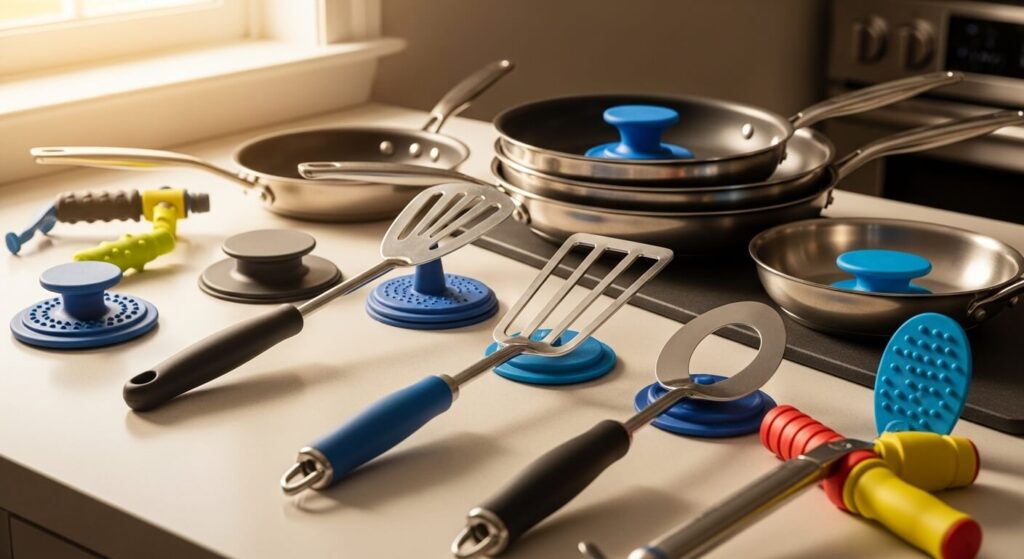
  • Pan protectors: Fabric or silicone discs placed between stacked pans (cost $10-15 for a set of 5)
  • Paper towel layers: Free solution using folded paper towels as barriers
  • Hanging storage: Eliminates contact entirely, extending coating life by 2-3 years
  • Separate stacking: Store non-stick pans away from metal cookware

Cast iron and stainless steel tolerate stacking without protection. The durable surfaces resist scratching from metal-on-metal contact. Some cooks prefer pan protectors even for these materials to prevent cosmetic scratches on exterior finishes.

Nesting Options

Strategic pan sizing enables efficient nested storage. A 1-quart saucepan fits inside a 2-quart, which fits inside a 3-quart. This configuration occupies the same footprint as the largest pan alone.

Skillets nest less effectively due to minimal height difference between sizes. An 8-inch skillet barely fits inside a 10-inch (only 1 inch of clearance), and sloped sides prevent stable stacking. Most kitchens store skillets side-by-side rather than nested.

Storage Method Skillets Saucepans Space Saved
Nested stacking Poor fit, unstable Excellent, 3 pans in one footprint 60-70% (saucepans only)
Side-by-side Standard method Works but wastes space 0%
Hanging racks Ideal for skillets Works but underutilizes vertical space 100% cabinet space
Vertical dividers Excellent solution Unnecessary complexity 40-50%
Deep drawer Best for handles Wastes vertical space 30%

Longevity and Durability

Construction quality and material type determine functional lifespan more than frequency of use.

Expected Lifespan for Each Pan Type

High-quality cookware lifespans:

  • Stainless steel (tri-ply or better): 15-25 years for both skillets and saucepans. The material doesn’t degrade and maintains even heating indefinitely. All-Clad pans commonly function for 20+ years before replacement.

  • Cast iron: 50-100+ years when properly maintained. Vintage cast iron from the 1950s still performs excellently. The material improves with age as seasoning builds. Lodge cast iron skillets often outlive their owners.

  • Carbon steel: 20-30 years with proper care. Similar durability to cast iron but lighter weight makes warping possible if overheated when empty. Professional kitchens replace carbon steel pans due to abuse rather than age.

  • Non-stick (PTFE): 2-4 years regardless of care quality. The coating degrades from heat exposure and chemical breakdown. Premium non-stick brands ($80-120) last 4-5 years maximum before food starts sticking.

  • Non-stick (ceramic): 1-2 years before significant performance loss. Ceramic coatings break down faster than PTFE despite marketing claims of superior durability.

  • Hard-anodized aluminum: 8-12 years for quality pieces. The anodized surface resists scratching better than bare aluminum but eventually develops worn spots from metal utensil contact.

Budget cookware lifespans:

Thin stainless steel (under $40): 3-5 years before warping and hot spots develop. Single-ply aluminum: 2-3 years before bottoms warp from heat cycling. Budget non-stick: 1-2 years before coating fails.

The quality gap appears most dramatically in saucepans. Cheap saucepans with thin bases scorch every sauce and burn rice consistently after 1-2 years of use. Quality tri-ply saucepans maintain perfect heat distribution for decades.

When to Replace Your Skillets and Saucepans

Visual and performance indicators signal when replacement becomes necessary.

Replace skillets when:

  • Warped bottom: Pan rocks on flat surface, creating uneven heating and hot spots
  • Cracked non-stick coating: Black coating flakes into food (health concern)
  • Severe pitting: Stainless steel develops holes from salt or acidic corrosion
  • Handle looseness: Rivets or welds fail, creating safety hazard for hot pan
  • Rust penetration: Surface rust on cast iron is fixable, but rust holes through metal are not

A warped skillet develops a convex or concave bottom that doesn’t sit flat. This warping occurs from thermal shock (cold water hitting hot pan) or overheating empty pans. Once warped, the pan concentrates heat in the center while edges never reach proper temperature.

Replace saucepans when:

  • Bottom separation: Multi-ply layers delaminate, creating rattling noise and uneven heating
  • Persistent scorching: Even at low heat, food burns in specific spots (failed heat distribution)
  • Handle failure: Cannot safely lift pan full of hot liquid
  • Lid warping: Lid no longer seals properly, allowing excessive steam escape
  • Non-stick complete failure: Food sticks despite proper oil use and preheating

The most critical saucepan failure is bottom delamination in tri-ply construction. The aluminum core separates from stainless steel layers, creating an air gap that blocks heat transfer. This failure manifests as sudden scorching where the pan previously cooked perfectly.

Investment Quality Pieces

Premium cookware delivers superior performance and decade-spanning lifespans that justify higher initial costs.

Cost-per-year analysis:

A $120 All-Clad stainless steel skillet lasting 20 years costs $6 per year. A $30 budget skillet replaced every 3 years costs $10 per year with inferior performance throughout its lifespan. The premium option provides better results at lower long-term cost.

Non-stick pans represent the exception where premium pricing doesn’t extend lifespan proportionally. A $100 non-stick skillet lasts 4-5 years while a $40 version lasts 2-3 years. The premium pan costs $20-25 per year versus $13-20 per year for the budget option—minimal difference for a coating that eventually fails regardless.

Recommended investment priorities:

Priority Level Pan Type Material Justification
Highest 3 qt saucepan Tri-ply stainless steel Daily use, lasts 20+ years, critical for sauces
High 12″ skillet Tri-ply stainless steel Versatile workhorse, handles most tasks
High 10-12″ skillet Cast iron Unmatched heat retention, lifetime tool
Medium 2 qt saucepan Tri-ply stainless steel Smaller tasks, supplements 3 qt pan
Medium 10″ skillet Non-stick Eggs and delicate foods, accept short lifespan
Low 1 qt saucepan Any material Specialized use only, not essential

Quality cookware maintains resale value. Used All-Clad pieces sell for 40-60% of retail price on secondary markets. A $150 skillet retains $60-90 of value after 10 years of use. Budget pans have zero resale value because they show significant wear after minimal use.

The handle attachment method affects longevity dramatically. Riveted handles (metal pins through the pan wall) last indefinitely and can be tightened if they loosen. Welded handles fail eventually as thermal cycling weakens the weld joint. Screwed handles loosen frequently and strip threads after repeated tightening.

Professional-grade cookware (used in restaurant kitchens) withstands abuse that would destroy consumer pieces. These pans cost 2-3x retail prices but survive commercial use for 10-15 years, suggesting a 30-40 year home lifespan. Most home cooks find mid-range quality ($80-150 per pan) provides optimal value without overpaying for commercial durability they’ll never require.

Previous Post

Skillet vs Sauté Pan: Key Differences and Which One You Need

Next Post
best ways to season a cast iron skillet
Cast Iron Skillets

Best Ways to Season a Cast Iron Skillet

error: Content is protected !!