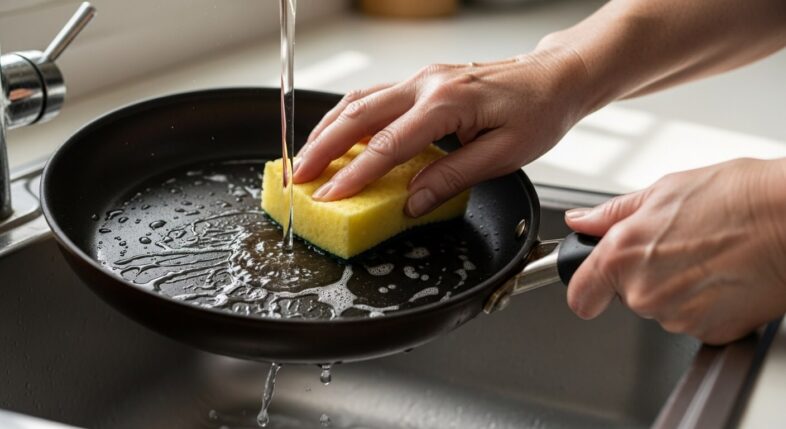
Understanding the Challenge: Arthritis and Skillet Maintenance for Needs
Seniors with arthritis can maintain skillets without painful scrubbing by using heat-based cleaning methods, long-handled tools, and preventive cooking techniques that let chemistry and time do the heavy lifting instead of their joints.
Here’s the thing. Traditional skillet cleaning destroys arthritic hands. The gripping. The pressure. The repetitive scrubbing motion that feels like you’re grinding glass into your knuckles.
Not happening anymore.
Why Traditional Skillet Cleaning Causes Joint Pain
Your fingers and wrists weren’t designed for the torque that skillet scrubbing demands—especially when arthritis has already compromised the cartilage protecting those joints.
The circular scrubbing motion? It forces you to grip a sponge or brush while simultaneously applying downward pressure and rotating your wrist. That’s three different stress vectors hitting inflamed joints at once. Add hot water (which feels good temporarily but increases blood flow to already-swollen tissue), and you’re setting yourself up for a flare-up that’ll last two days.
What’s actually happening in your joints:
- Inflamed synovial tissue gets compressed with each scrubbing stroke
- Bone spurs (if you’ve got them) grind against surrounding tissue
- Weakened ligaments stretch beyond their comfortable range
- Reduced cartilage means bone-on-bone contact increases
The grip strength required to hold a scrubber firmly enough to remove baked-on food ranges from 15-25 pounds of force. Most people with moderate to severe hand arthritis can only comfortably sustain 5-10 pounds. You’re asking damaged joints to perform at 2-3 times their comfortable capacity.
Wrong approach entirely.
The Connection Between Grip Strength and Arthritis Progression
Grip strength doesn’t just indicate how bad your arthritis is—it actually affects how fast the disease progresses.
When you force arthritic hands to grip hard repeatedly (like during aggressive skillet scrubbing), you’re creating micro-tears in already compromised joint structures. Your body responds with more inflammation. More inflammation means more joint damage. More joint damage means less grip strength. You see where this goes.
Studies show that people with rheumatoid arthritis who regularly perform high-grip activities lose grip strength 12-18% faster than those who modify their hand use. Osteoarthritis follows a similar pattern—overuse accelerates cartilage breakdown.
But here’s what matters for skillet cleaning: every time you scrub hard, you’re potentially accelerating your arthritis by months. Not worth it for a clean pan.
Common Skillet Types and Their Cleaning Demands
Different materials demand different approaches (and different levels of joint punishment).
Cast iron: Seasoned cast iron can be the easiest or the absolute worst. Well-maintained seasoning means food slides right off—barely any cleaning needed. Neglected cast iron with damaged seasoning? You might as well be scrubbing concrete.
Stainless steel: These pans love to hold grudges. Food welds itself to the surface at a molecular level (okay, not literally, but it feels that way). They need either strong chemical cleaners or serious elbow grease. Your elbows don’t have grease to spare.
Non-stick: Should be easy. Often are when new. But once that coating starts breaking down—even microscopically—food finds every tiny scratch to stick in. And you can’t scrub hard because you’ll make it worse.
Carbon steel: Acts like cast iron’s fussier cousin. Needs seasoning, loses it faster, rusts if you look at it wrong.
The good news? Every single one of these can be cleaned without scrubbing. Period.
Immediate Solutions: Arthritis-Friendly Cleaning Techniques That Eliminate Scrubbing
You can clean any skillet without applying significant pressure to your joints by using heat, time, and chemistry instead of mechanical force.
Skip the scrubbing entirely. Here’s how.
The Deglazing Method: Using Heat and Liquid to Loosen Food
Deglazing means adding liquid to a hot pan and letting temperature and chemistry dissolve stuck-on food—professional chefs do this constantly, and it works just as well for cleaning as it does for making pan sauces.
Basic deglazing process:
- Don’t let the pan cool completely after cooking (warm, not hot enough to burn you)
- Pour in about 1/2 cup of liquid (water, broth, even wine)
- Return pan to medium heat for 2-3 minutes
- Watch the stuck food literally bubble off the surface
- Pour everything out, wipe with a soft cloth
Zero scrubbing. Chemistry does everything.
The heat causes stuck proteins and starches to release their grip on the metal surface. The liquid rehydrates dried food particles. Together they create what’s essentially a self-cleaning reaction. You’re just supervising.
How to Deglaze Cast Iron Skillets Safely
Cast iron loves this method—but you can’t use anything acidic if you want to preserve your seasoning.
Stick to water or broth. Add liquid while the pan’s still warm (you should be able to hold your hand 2 inches above the surface for 3-4 seconds—if you can’t, it’s too hot). The water will sizzle and steam immediately. Good. That steam is lifting food particles.
Let it simmer for 2-3 minutes. The stuck bits will either float free or turn into a soft sludge that wipes away with paper towels. No brush needed.
If something’s really stuck, add a tablespoon of coarse salt to the water while it’s simmering. The salt acts as a gentle abrasive without requiring any pressure from your hands—the bubbling water agitates it for you.
Dry immediately after wiping. Cast iron and standing water are enemies.
Deglazing Stainless Steel and Non-Stick Pans
Stainless steel can handle acidic liquids (and actually responds really well to them).
Try this: after cooking, add 1/4 cup white vinegar and 1/4 cup water to the warm pan. The vinegar breaks down protein bonds and cuts through polymerized fats. Bring it to a simmer for about 4-5 minutes. Most food residue will lift off on its own.
For non-stick pans, skip the vinegar—it can degrade the coating over time. Plain water works fine. These pans don’t usually get seriously stuck food anyway (if they do, the coating’s probably shot and you need a new pan).
The key with non-stick: don’t overheat during deglazing. Medium-low heat max. High heat damages the coating even without food in the pan.
Best Liquids for Effective Deglazing
Water works. Everything else works better for specific situations.
| Liquid | Best For | Why It Works | Avoid With |
|---|---|---|---|
| Plain water | Cast iron, daily cleaning | Universal solvent, can’t damage any surface | Nothing (safe everywhere) |
| White vinegar solution | Stainless steel, burnt-on proteins | Acid breaks down protein bonds | Non-stick, cast iron seasoning |
| Baking soda solution | Stainless steel, stubborn grease | Alkaline cuts grease, gentle abrasion | Aluminum pans |
| Broth or stock | Any pan type | Contains natural acids and fats that help lift food | Nothing (but seems wasteful) |
Honestly? Water handles 80% of deglazing jobs. The others are for when you’ve really made a mess.
The Soaking Strategy: Time as Your Cleaning Ally
Soaking is the ultimate arthritis-friendly cleaning method because it requires literally zero effort beyond adding water and waiting—time dissolves what scrubbing would normally remove.
Fill the pan with warm (not hot) water immediately after cooking. Add a squirt of dish soap. Walk away. That’s it.
30 minutes handles light residue. 2-3 hours for moderate stuck food. Overnight for the disasters.
What’s happening chemically? Water molecules work their way between the food particles and the metal surface, breaking the adhesive bonds. Soap reduces surface tension, letting water penetrate faster. Given enough time, almost anything will soften to the point where it wipes away with a cloth.
Optimal Soaking Times for Different Food Residues
Eggs: 30-45 minutes. Cooked eggs bond to metal fast, but the bonds are protein-based and break down quickly in soapy water.
Cheese: 1-2 hours minimum (sometimes longer). Melted cheese creates a plastic-like polymer that’s stubborn. But it will eventually soften.
Caramelized or burnt sugar: 3-4 hours or overnight. Sugar caramelization creates actual new chemical compounds that bond hard to metal. Time breaks them down, pressure doesn’t help much anyway.
Starches (rice, pasta, potatoes): 1 hour. Starches form a glue-like paste but rehydrate easily.
Meat proteins with fat: 2-3 hours. The fat component makes these water-resistant, needs extra time for soap to penetrate.
If you’re not sure? Go longer. You can’t over-soak (unless you’ve got cast iron, then max 2-3 hours or you’ll get rust).
Adding Dish Soap and Baking Soda to Soaking Water
Regular dish soap in warm water handles most soaking jobs—use about a tablespoon per pan, more if the water’s really dirty.
But for extra cleaning power without extra effort: add 2-3 tablespoons of baking soda to the soapy water. The alkalinity boosts the soap’s effectiveness against grease. Plus baking soda creates a mildly abrasive solution that works without you having to scrub.
Don’t combine baking soda with vinegar in the soaking water (I know, everybody wants to do this because it fizzes). The fizzing looks cool but actually neutralizes both ingredients—you end up with slightly salty water that doesn’t clean as well as either ingredient alone would have.
Use one or the other. Soap + baking soda for grease. Straight vinegar water for proteins and mineral deposits.
When to Use Hot vs. Warm Water for Soaking
Warm water (comfortable to touch) is better for most soaking because it won’t damage non-stick coatings or cause thermal shock to any pan material.
Hot water (too hot to touch comfortably) works faster for dissolving grease specifically—fats melt at higher temperatures. But it has downsides:
- Can set protein stains (like egg) permanently
- May damage non-stick coatings gradually
- Creates more steam (potential minor burn risk)
- Cools to warm anyway within 15-20 minutes
My take? Warm water for everything unless you’re dealing with pure grease and nothing else. The speed difference isn’t worth the trade-offs.
Cold water though? Skip it. Doesn’t dissolve fats at all, slows down every chemical process. Pointless for cleaning.
The Boiling Water Technique for Stubborn Residue
When soaking alone won’t cut it but you still can’t scrub, boiling water in the pan combines heat and agitation to remove stuck food—this method is sneaky good for the worst messes without requiring any hand strength.
Step-by-Step Boiling Method for Skillets
Fill the dirty skillet about halfway with water. Add a tablespoon of dish soap or baking soda (your choice based on what’s stuck). Place on the stove over medium-high heat.
Bring to a full boil. Not a simmer—you want aggressive bubbling. Let it boil for 5-10 minutes. The combination of heat, steam, and the physical movement of boiling water will dislodge most stuck food.
Watch for food particles floating to the surface. That’s success.
Turn off heat. Let it cool for 5-10 minutes (don’t try to handle immediately). Pour out the water—most of the loosened food goes with it. What’s left will wipe away with a soft sponge or cloth. No pressure needed.
For really stubborn spots that survive boiling, try this: while the water’s still hot (but not boiling), use a wooden spatula or spoon to gently nudge the softened food. It should slide right off. Still no joint-stressing scrubbing required.
Safety Precautions for Seniors When Boiling Water in Pans
Boiling water is hot. Duh. But when you’ve got arthritis and potentially reduced sensation in your hands, you need extra precaution.
Don’t rush the cooling period. I know you want to finish the job, but trying to pour out boiling water with arthritic hands that might not grip properly is how accidents happen. Wait 10 minutes. The pan will still be warm but manageable.
Use both hands to lift the pan. Even if one hand could technically handle it. Two-handed lifting distributes weight and reduces joint stress. Plus it’s more stable.
Pour away from your body (always, but especially with boiling water). Lean the pan forward over the sink before tilting to pour.
Consider keeping a pair of heat-resistant gloves near the stove—not oven mitts (too bulky, reduce grip), but thin heat-resistant gloves designed for handling hot cookware. They give you better control than mitts while protecting against accidental contact.
If you’ve got severe hand arthritis and shaky grip, honestly? Ask someone else to do the pouring step. No shame in it. Better than a burn.
Which Skillet Materials Can Handle Boiling
Cast iron: Yes. Boiling won’t hurt it at all. Just dry it thoroughly afterward.
Stainless steel: Absolutely. These pans are built for high heat and water.
Carbon steel: Yes, same as cast iron. Dry immediately to prevent rust.
Non-stick (Teflon/PTFE): Technically yes, but I wouldn’t do it regularly. Sustained boiling can reach temperatures that start degrading the coating (above 500°F if the water fully evaporates and you don’t notice). If you’re going to boil water in non-stick, watch it carefully and don’t let the pan boil dry.
Ceramic non-stick: Generally safe for boiling. More heat-stable than Teflon.
Aluminum (bare): Fine for boiling water. The pan might discolor but won’t be damaged.
Copper: Check if it’s lined. Lined copper (usually with stainless steel) is fine. Bare copper can react with alkaline cleaning solutions—stick to plain water if you’re boiling to clean copper.
Adaptive Tools and Equipment for Pain-Free Skillet Maintenance
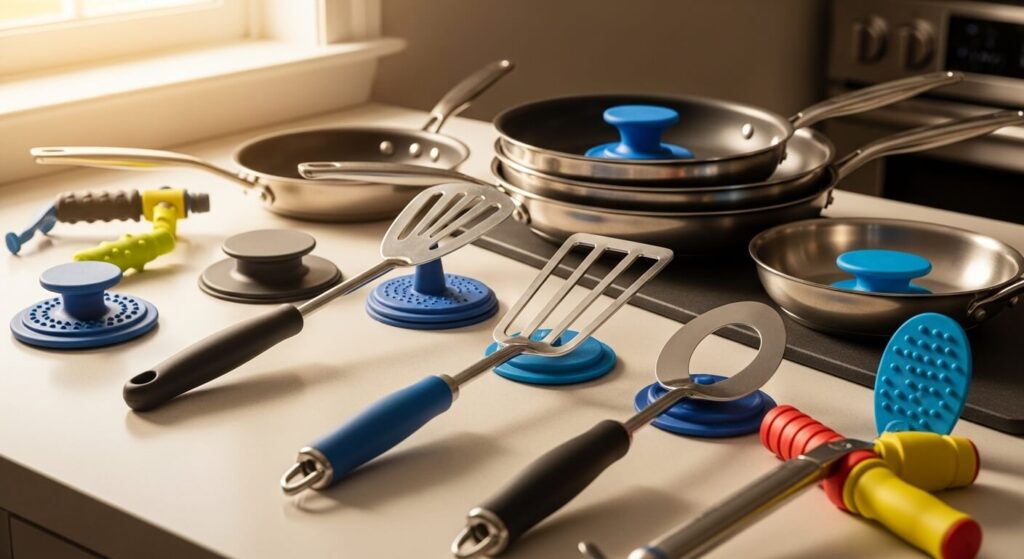
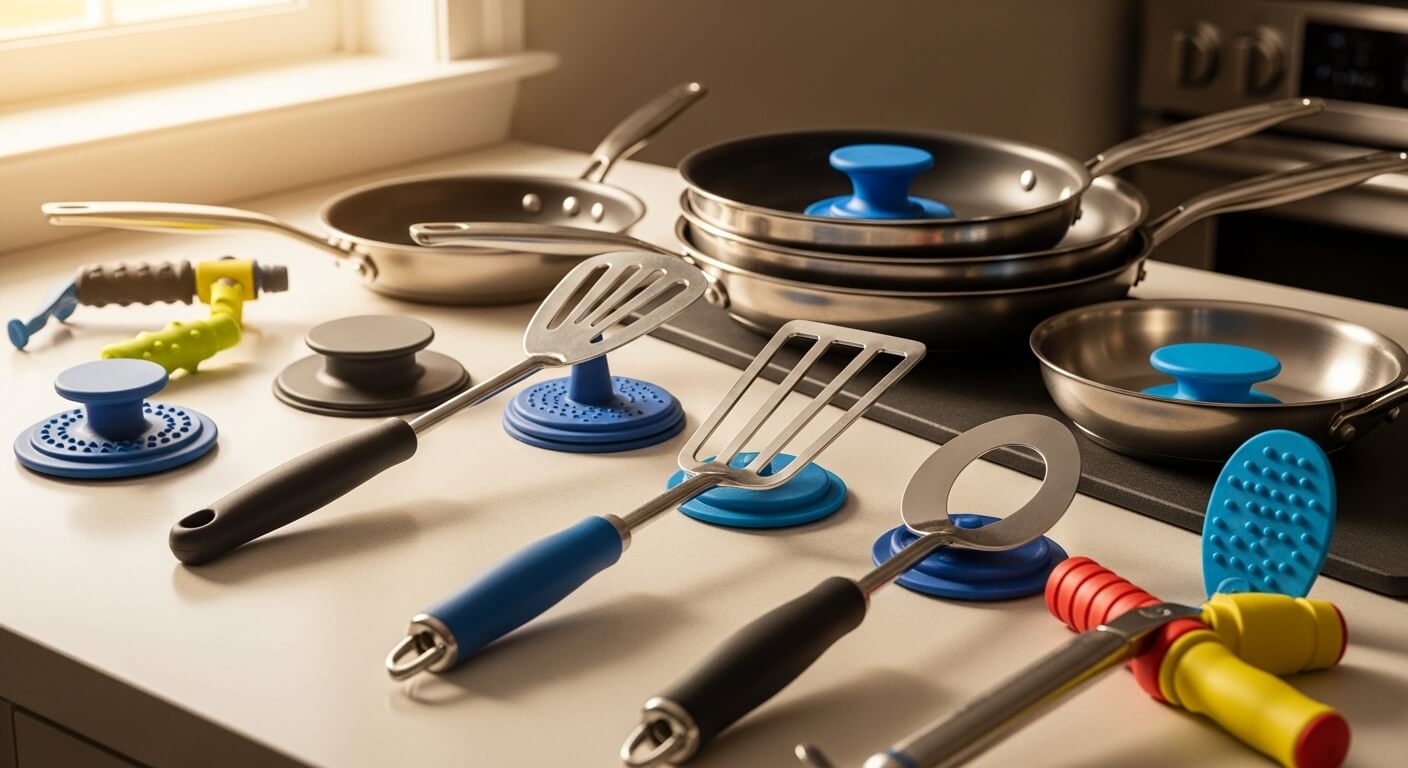
Long-handled brushes with ergonomic grips allow seniors with arthritis to clean skillets using arm and shoulder muscles instead of relying on weak, painful hand and wrist joints.
Tools matter. A lot. The right brush turns an impossible task into an easy one.
Ergonomic Scrubbers Designed for Arthritic Hands
“Ergonomic” gets slapped on everything these days. Most products lie. But some cleaning tools actually are designed around how arthritic hands work (and don’t work).
Long-Handled Dish Brushes with Cushioned Grips
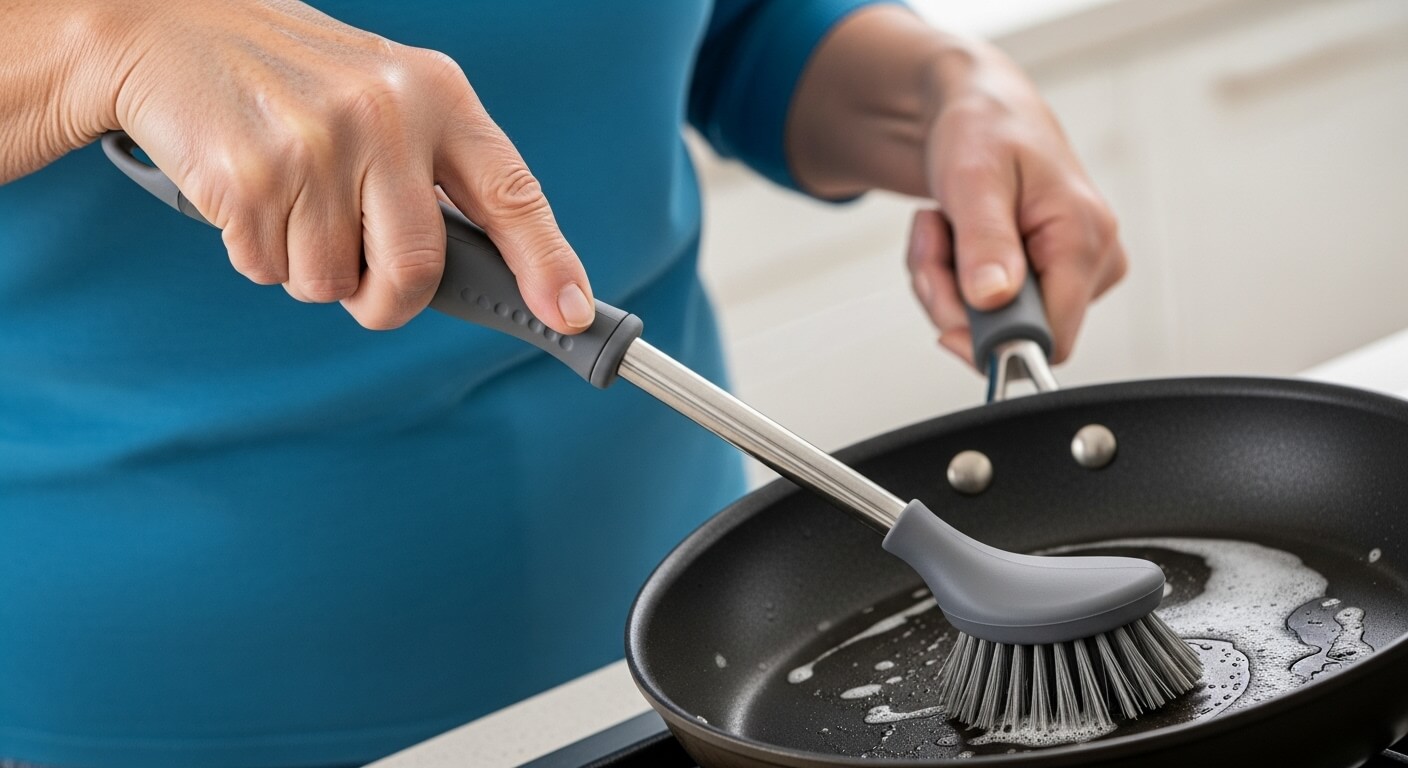
A brush with a 9-12 inch handle changes everything because you’re using your whole arm to create cleaning motion, not just your wrist.
Look for handles that are:
- Thick (1.5-2 inches in diameter): Requires less grip strength to hold
- Slightly curved: Follows natural hand position
- Covered in soft rubber or foam: Prevents slipping without requiring a death grip
The brush head should be firm enough to clean but not so stiff that you need to press hard. Medium-soft nylon bristles work for most jobs.
Specific features that matter:
- Angled brush head (lets you reach pan surfaces without bending your wrist awkwardly)
- Hanging hole at the end (so you don’t have to grip it to put it away)
- Replaceable heads (saves money and reduces waste)
OXO Good Grips line actually lives up to the name for this stuff. Their handles are genuinely designed for limited hand function. Not sponsored—they just don’t suck.
Silicone Scrubbers vs. Traditional Sponges
Silicone scrubbers are better for arthritis. Period.
Traditional sponges require constant squeezing to work—that’s literally the worst motion for inflamed finger joints. Silicone scrubbers don’t absorb water, so there’s nothing to squeeze. You just hold them (lightly) and move them across the surface.
Plus they last forever, don’t smell disgusting after three days, and can go in the dishwasher.
Best silicone scrubber styles for arthritis:
- Oversized (palm-sized) silicone scrubbing pads—easier to grip than small sponges
- Silicone gloves with scrubbing nubs on the palms—you don’t even have to grip anything, just wear them
- Long silicone brushes with extended handles
The downsides? Silicone doesn’t scrub quite as aggressively as traditional green scrubby pads. But remember—if you’re doing the soaking and deglazing methods right, you don’t need aggressive scrubbing anyway.
Electric Spin Scrubbers for Minimal Effort Cleaning
These are basically electric toothbrushes for your kitchen. A rechargeable battery powers a spinning brush head. You guide it, it does the work.
Sounds gimmicky. Actually works.
The spinning motion (300-400 RPM typically) provides consistent cleaning pressure without requiring any force from your hands. You’re just steering, not scrubbing. Your joints move through their comfortable range of motion while the motor handles the actual work.
Most models come with multiple brush head attachments. The flat, soft brush head works great for skillet surfaces. Avoid the super-stiff bristle attachments—they’re overkill and can damage pan surfaces.
Drawbacks to consider:
- Cost ($25-60 for decent ones)
- Need to remember to charge them
- Add another gadget to store
- Overkill for quick daily cleaning
But for someone with severe hand arthritis who’s been avoiding cooking because they can’t face the cleanup? Worth every penny.
Specialized Cleaning Tools That Reduce Hand Strain
Beyond basic brushes, there are tools specifically designed to clean pans without the grip strength or pressure traditional scrubbing requires.
Chain Mail Scrubbers for Cast Iron (Minimal Pressure Required)
Chain mail scrubbers look medieval—because they basically are, stainless steel rings linked together into a flexible square of metal mesh.
For cast iron specifically, these are brilliant. The metal links physically scrape off stuck food without requiring you to press hard at all. The weight of the chain mail itself provides enough contact pressure. You’re just moving it around the pan surface in gentle circles.
Unlike steel wool (which can damage seasoning and requires pressure to work), chain mail preserves your pan’s seasoning while removing stuck food. It’s also reusable forever—just rinse it off and hang it up.
How to use with minimal joint stress:
- Hold it loosely in your palm (don’t grip)
- Add a tiny bit of coarse salt to the pan as a gentle abrasive helper
- Use slow, wide circular motions with your whole arm (not just wrist movement)
- Let the weight of the chain mail do the scraping
These cost $10-20. If you cook with cast iron regularly and have arthritis, stop reading and go buy one now.
Scraper Tools with Extended Handles
Plastic or silicone pan scrapers remove stuck food through shearing action rather than abrasion—meaning you’re pushing along the pan surface, not scrubbing in circles.
The extended handle versions (8-10 inches long) are better for arthritis because you can use a gross motor movement (whole arm pushing) instead of a fine motor movement (wrist rotating).
Best scraper designs:
- Flexible edge (conforms to curved pan surfaces)
- Squared-off handle (easier to grip than round)
- Heat-resistant material (can use on warm pans)
Use these on soaked or deglazed pans. The food is already loosened; you’re just helping it along. Almost no force required.
Leverage-Based Tools That Multiply Cleaning Power
Tools designed with mechanical advantage let you clean effectively while applying minimal joint-straining force.
Pan Cleaning Brushes with Built-In Scrapers
Some dish brushes integrate a firm silicone or plastic scraper edge into the brush head design. This dual functionality means you can scrape and brush without switching tools (fewer grip transitions = less joint stress).
The scraper edge should be on the opposite side from the bristles. You flip the brush in your hand to switch functions—but here’s the key: you don’t have to flip it with your fingers. Just rotate your whole arm. Same loose grip throughout.
Look for brushes where the scraper edge is at least 2 inches wide. Wider edges distribute force better, requiring less pressure per square inch to remove stuck food.
Drill-Powered Brush Attachments for Seniors
If you own a cordless drill (or know someone who’d let you borrow one), drill brush attachments are legitimately useful for people with severe arthritis.
These are brush heads designed to fit into a drill chuck. The drill spins them at high speed (adjustable, usually 200-800 RPM). You hold the drill, guide the spinning brush across the pan surface, and let the motor do all the work.
Why this works for arthritis:
- Requires almost no grip strength (just loosely hold the drill handle)
- No repetitive wrist motion
- Cleaning time reduced by 60-70%
- Can clean from a more comfortable standing position
Important points:
- Use the drill’s lowest speed setting for pans (high speed can damage surfaces)
- Get nylon bristle attachments (softer, safer for cookware)
- Don’t use on non-stick pans (too aggressive)
- Wear safety glasses (food particles fly off at speed—trust me on this one)
This is admittedly an unusual solution. But it works. And if you’ve got a drill sitting in the garage doing nothing, the brush attachments cost about $10-15.
Countertop Brush Holders for Stable Scrubbing
Here’s a low-tech solution that actually helps: mounting or suction-cupping a brush holder to your counter or sink wall so the brush stays in place while you move the pan across it.
Instead of holding the brush and scrubbing (high grip strength required), you hold the pan with both hands and drag it across the stationary brush. Much easier on your joints.
DIY version: Use a sturdy suction cup hook to mount a long-handled brush horizontally at counter height. Position it over your sink or a towel on the counter. Hold your pan with both hands and move it back and forth across the bristles.
The pan is heavier than the brush, so it provides all the pressure needed. Your hands are just guiding motion, not gripping and scrubbing simultaneously.
Sounds weird. Totally works.
Preventive Measures: Reducing the Need for Difficult Skillet Cleaning
Proper preheating and using adequate cooking fat prevents most food from sticking to skillets in the first place, eliminating 70-80% of the situations that would require painful scrubbing.
Best cleaning method? Not needing to clean much at all.
Proper Cooking Techniques to Minimize Food Sticking
Most stuck-on food is preventable. Not all—but most. When food sticks less during cooking, cleaning requires less scrubbing afterward.
Preheating Skillets to the Correct Temperature
Cold pans make food stick. That’s it. That’s the whole problem.
When you put cold food into a cold or barely warm pan, the proteins and starches literally bond to the metal surface at a molecular level. The food pulls heat from the pan to cook, the pan surface cools further, and everything becomes a stuck-on mess.
Hot pans create an immediate sear that prevents sticking. The food proteins denature (cook) so fast that they don’t have time to bond to the pan.
How hot is hot enough? Depends on what you’re cooking:
- Eggs: Medium-low heat, 2-3 minutes preheat
- Pancakes: Medium heat, 3-4 minutes preheat
- Meat: Medium-high to high heat, 4-5 minutes preheat
- Vegetables: Medium-high heat, 3-4 minutes preheat
Using Adequate Cooking Fats and Oils
Fat creates a barrier between food and metal. Not enough fat = food contacts metal directly = sticking happens.
“Adequate” means enough to lightly coat the entire cooking surface. For a 10-inch skillet, that’s about 1-2 tablespoons of oil or butter (more for meats, less for eggs).
You can use less fat for very well-seasoned cast iron or new non-stick pans. But when in doubt, use more fat than you think you need. You’re not trying to deep fry—just ensure complete surface coverage.
Types of fat ranked by stick-prevention:
- Butter + oil combo (butter for flavor, oil prevents butter from burning)
- Avocado oil or refined coconut oil (high smoke points, coat well)
- Regular olive oil or canola oil (work fine for medium heat cooking)
- Animal fats like bacon grease or lard (excellent stick prevention)
- Cooking spray (works but doesn’t last as long, can gunk up pans over time)
Let the fat heat up before adding food. You want it shimmering (oil) or melted and bubbling gently (butter). Cold fat doesn’t prevent sticking.
The Water Droplet Test for Pan Readiness
Want to know if your pan is hot enough? Flick a drop of water into it.
What the water does tells you the temperature:
- Water just sits there → Pan is too cold, keep heating
- Water sizzles and evaporates quickly → Pan is medium heat, good for eggs and pancakes
- Water forms a ball that rolls around the pan → Pan is high heat, good for searing meat
- Water evaporates instantly with angry hissing → Pan is too hot, reduce heat
The rolling water ball thing is called the Leidenfrost effect (not that the name matters—but it’s cool). At that temperature, food won’t stick because the proteins cook too fast to bond.
For arthritis-friendly cooking, you want your pan at least at the “sizzles and evaporates” stage before adding food. Cold pan = stuck food = scrubbing required later.
Immediate Post-Cooking Actions for Easier Cleanup
What you do in the first 60 seconds after cooking determines how hard cleaning will be—delayed action lets residue bond permanently to the pan surface.
Wiping Skillets While Still Warm (Not Hot)
Remove most cooking residue before it has a chance to cool and harden.
As soon as you’ve plated your food, grab a paper towel (or cloth you don’t care about) and wipe out the excess fat and loose food particles while the pan is still warm. Don’t wait until after you eat. Don’t wait until the pan cools. Right away.
Warm fat is liquid. Cool fat solidifies and sticks. The difference in cleaning effort is massive.
Safe warm-wiping technique:
- Hold the paper towel with tongs or a fork if the pan is too hot to touch
- Wipe in one direction, outward from the center (pushes debris toward the edge)
- Use 2-3 paper towels as needed
- Don’t press hard—you’re not cleaning, just removing loose residue
This 15-second action can eliminate 80% of your cleaning work. Worth doing even if your hands hurt.
Adding Water Immediately After Cooking
After wiping out the loose stuff, add warm water to the still-warm pan. Not a full soak—just enough to cover the bottom (1/4 inch or so).
The residual heat in the pan keeps stuck food from hardening. The water prevents new sticking. Together they maintain a “cleaning-friendly” state until you’re ready to wash the pan properly.
Let it sit on the stove or counter with the water in it. When you come back after eating (30 minutes to an hour later), most stuck food will wipe away with minimal effort.
Don’t add cold water to a very hot pan (thermal shock can warp or crack some pans). Warm or room-temperature water is fine.
Using Paper Towels to Remove Excess Oil
Before any washing happens, get as much oil out of the pan as possible using paper towels.
Why? Because washing oily pans requires more soap, more scrubbing, and often a second wash. Oil doesn’t dissolve easily in water. You’re basically trying to scrub oil off a surface while it’s coated in water (which repels oil). Inefficient.
Wipe first. Then wash. Cut your cleaning time in half.
For cast iron specifically, this step also helps maintain seasoning. You’re removing cooking oil (which is dirty and possibly rancid) while leaving the polymerized seasoning intact.
Choosing Arthritis-Friendly Cookware Materials
Some skillet materials inherently require less cleaning effort than others—investing in the right pans reduces your daily joint stress.
Why Well-Seasoned Cast Iron Becomes Easier to Clean
New cast iron is a pain. Properly seasoned cast iron is easier to clean than non-stick.
Seasoning is polymerized fat—oil that’s been heated until it bonds to the iron and forms a hard, slick coating. The more layers of seasoning you build, the more non-stick the surface becomes.
A well-seasoned cast iron skillet cleaned with just hot water and a quick wipe takes 30 seconds. No soap. No scrubbing. Food slides right off.
Building and maintaining seasoning (low-effort method):
- Cook fatty foods in it regularly (bacon, sausage, meat with skin)
- After cleaning, rub a thin layer of oil on the cooking surface
- Don’t use soap every time (water and a wipe is often enough)
- Never soak for extended periods
The seasoning builds gradually over months. Eventually you have a pan that barely needs cleaning. Worth the initial investment of time.
If your cast iron isn’t non-stick, it’s not properly seasoned yet. Keep cooking in it.
Non-Stick Ceramic Coatings for Seniors
Ceramic non-stick pans (not Teflon—actual ceramic coating) are easier on joints because food slides off with minimal effort even when the pan isn’t perfectly preheated.
They’re more forgiving than uncoated stainless steel or poorly-seasoned cast iron. Mess up the preheat? Food might stick a little, but not weld itself to the surface.
Advantages for arthritis:
- Require less cooking fat (saves money, reduces oil cleanup)
- Tolerate lower heat (less risk of burns during cooking and cleaning)
- Can often be cleaned with just a soft cloth and water
- Dishwasher safe (in most cases)
Downsides:
- Coating wears out over time (2-5 years depending on use)
- Can’t use metal utensils (scratches coating)
- Not as durable as cast iron or stainless steel
For someone with severe arthritis who cooks daily, having at least one good ceramic non-stick pan makes sense. Use it for the sticky stuff (eggs, fish, pancakes). Save your stainless steel for soups and sauces.
Enameled Cast Iron as a Low-Maintenance Option
Enameled cast iron gives you the heat retention of cast iron without the seasoning maintenance—the enamel coating is glass-like and naturally non-stick if you use proper cooking techniques.
Food doesn’t react with the enamel, so you can cook acidic things (tomatoes, vinegar-based sauces) without damaging the surface. You can use soap. You can even soak it (within reason).
Cleaning is usually just warm water and a soft sponge. Stuck food responds well to soaking or the boiling water method. Almost never requires scrubbing.
The catch: These pans are heavy. A 12-inch enameled cast iron skillet weighs 7-9 pounds. If you’ve got wrist or elbow arthritis, lifting it when full of food might be a problem. Stick to smaller sizes (8-10 inch) or ask someone else to handle transfers from stove to table.
But for cleaning purposes? Excellent choice. The smooth enamel doesn’t grab onto food the way bare metal does.
Natural Cleaning Solutions That Work Without Scrubbing Force
Baking soda creates an alkaline environment that breaks down grease and proteins through chemical reaction rather than mechanical abrasion, eliminating the need for hard scrubbing.
Chemistry beats muscle every time.
The Baking Soda Paste Method for Gentle Cleaning
Baking soda paste works because it’s mildly alkaline (pH around 9) and has fine, soft particles that provide minimal abrasion without scratching—plus it’s cheap and non-toxic.
Creating the Right Consistency for Maximum Effectiveness
Mix 3 parts baking soda to 1 part water. You want a thick paste—like toothpaste or slightly thicker. Too watery and it just runs off the pan. Too thick and it’s hard to spread.
For a typical 10-12 inch skillet, use about 1/4 cup baking soda and 4-5 teaspoons water. Mix in a small bowl or cup (easier than trying to mix it directly in the pan).
The paste should stick to vertical surfaces without sliding off. That’s how you know the consistency is right.
Application Techniques That Let Chemistry Do the Work
Spread the paste over the stuck-on areas using your fingers, a spatula, or a paper towel—whatever’s comfortable for your hands. Don’t press hard. Just coat the surface.
Let it sit. This is the key. Give it 15-30 minutes minimum. Overnight for really bad stuck-on food.
The alkalinity breaks down proteins and fats chemically. You’re not scrubbing them off; you’re dissolving them. But dissolution takes time.
After waiting, add a small amount of water and wipe with a soft cloth or sponge. The stuck food should come off with minimal pressure. If it doesn’t, it needed more time—reapply paste and wait longer.
For slight additional abrasion without hand strain, sprinkle a bit of dry baking soda on the paste before wiping. The dry particles provide gentle scrubbing action without requiring hard pressure from your hands.
How Long to Let Baking Soda Sit on Stubborn Spots
Light residue: 15-20 minutes
Moderate stuck food: 30-60 minutes
Burnt-on carbon deposits: 2-4 hours or overnight
Years of neglect: Multiple overnight applications (seriously—some pans need 2-3 treatments)
You can’t leave baking soda paste on too long. It’s not going to damage any pan material (even aluminum, though it may slightly discolor it). So when in doubt, go longer.
Covering the paste with plastic wrap or a damp cloth keeps it from drying out during long sitting times. Dried paste is less effective.
Vinegar-Based Solutions for Breaking Down Grease
White vinegar (acetic acid, about 5% concentration) dissolves mineral deposits and breaks down protein bonds—it’s particularly good for burnt-on food and heat staining.
The Vinegar and Water Boiling Technique
Mix equal parts white vinegar and water in your dirty skillet (1 cup each for a 10-inch pan). Bring to a boil over medium-high heat. Let it boil for 5-8 minutes.
Watch it bubble. You’ll actually see the stuck food lifting off the pan surface as the acid breaks down the bonds holding it on.
Turn off heat. Let it cool for 10 minutes. Pour out the liquid. Wipe the pan with a soft cloth. Done.
Warning smell: Boiling vinegar stinks. Like, really stinks. Open a window. Turn on the vent fan. Your kitchen will smell like salad dressing for an hour. But the cleaning results are worth it.
Don’t use this on cast iron (acid damages seasoning) or unsealed aluminum (can cause pitting). Stainless steel and enamel-coated pans love it.
Creating a Vinegar Spray for Regular Maintenance
For daily maintenance (not deep cleaning), keep a spray bottle filled with straight white vinegar near your sink.
After cooking, while the pan is still warm, spray it down with vinegar. Let it sit for 2-3 minutes. Rinse with water. Most residue comes right off.
The acid prevents grease from polymerizing (hardening into that sticky film that builds up over time). Regular use means you’ll rarely face stuck-on food that requires scrubbing.
Plus it’s natural and safe. You could literally drink it (you wouldn’t want to, but you could). No toxic fumes or skin irritation.
Combining Vinegar and Baking Soda Safely
People love to mix these because it fizzes dramatically. The fizzing is actually them neutralizing each other into basically salt water. You’re destroying both cleaning agents.
Here’s what to do instead:
Use them sequentially, not simultaneously. Sprinkle baking soda on stuck food. Let it sit 15 minutes. Spray with vinegar. The fizzing reaction will physically lift some residue off the surface. Wait until fizzing stops (2-3 minutes). Wipe clean.
Or: use one or the other based on what you’re cleaning. Baking soda for grease. Vinegar for proteins and mineral deposits. Don’t combine them.
The exception: if you’re just using the fizzing action mechanically to lift debris (not relying on the chemical cleaning properties of either ingredient), then go ahead and mix them. Just understand they’re not actually “cleaning” at that point—just fizzing.
Salt as a Gentle Abrasive for Cast Iron Skillets
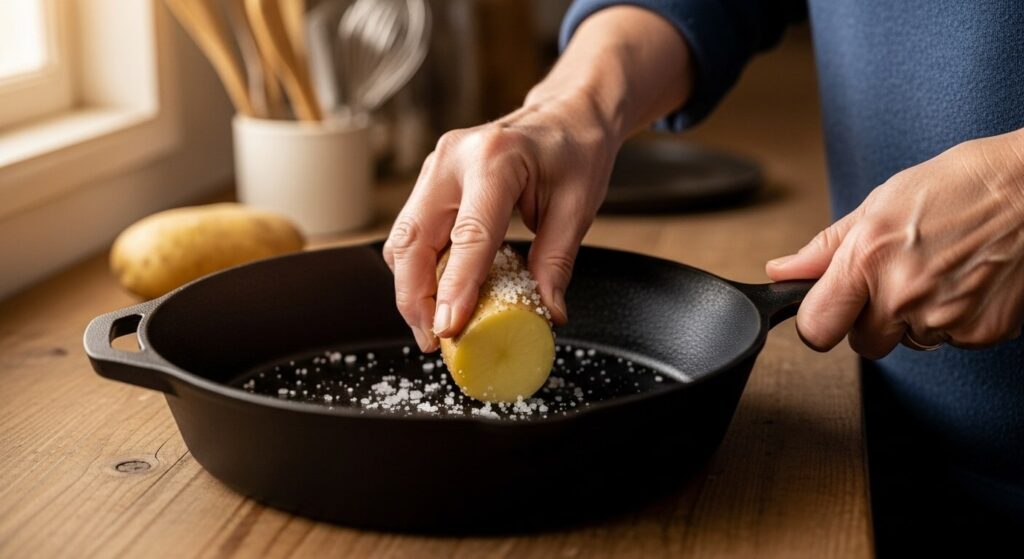
Coarse salt (kosher salt or sea salt) provides physical scrubbing without chemicals that might damage cast iron seasoning—and it requires almost no hand pressure because the salt crystals themselves are the abrasive.
The Coarse Salt Scrubbing Method with Minimal Pressure
Pour 2-3 tablespoons of coarse salt into your warm (not hot) cast iron skillet. Add about a tablespoon of oil (vegetable, canola, whatever’s handy).
Use a paper towel, soft cloth, or your chain mail scrubber to move the salt-oil mixture around the pan surface in gentle circles. The salt crystals physically scrape off stuck food. The oil helps them slide around without requiring pressure.
You’re basically exfoliating your pan. Light touch. Let the salt do the work.
After 1-2 minutes of gentle circular motion, dump out the salt (it’ll be dirty and possibly full of food particles—don’t try to save it). Rinse the pan with hot water. Dry immediately.
The oil leaves a thin protective coating. Perfect for cast iron.
Using Oil and Salt Together for Seasoned Pans
The oil isn’t just a lubricant—it’s also part of the cleaning mechanism for cast iron.
Oil dissolves polymerized fats (the hardened grease that sticks to pans). Salt provides gentle abrasion. Together they remove stuck food while maintaining and sometimes improving the pan’s seasoning.
This is one of the only cleaning methods that can actually make your cast iron more non-stick over time instead of gradually wearing away the seasoning.
Use about a 3:1 ratio of salt to oil by volume. Too much oil and it’s just greasy. Too little and the salt won’t move around easily.
When to Choose Salt Over Other Cleaning Agents
Use salt for cast iron when:
- You’ve got stuck food but don’t want to use soap (would damage light seasoning)
- The pan is still slightly warm (salt works better with heat)
- You’re dealing with protein residue (eggs, meat) rather than sugar burns
Don’t use salt for:
- Stainless steel (unnecessary—you can use harsher methods safely)
- Non-stick pans (the abrasion, however gentle, can scratch coatings)
- Cold pans (less effective, more effort required)
Enzymatic Dish Soaps That Break Down Protein Residue
Some dish soaps contain biological enzymes that literally digest protein and starch residue—the same technology used in laundry detergent for removing food stains from clothing.
How Enzyme Cleaners Work on Cooked-On Food
Enzymes are biological catalysts (proteins that speed up chemical reactions). The ones in dish soap are specifically chosen to break down other proteins and starches.
When you soak a pan with enzyme dish soap, the enzymes attach to protein molecules in the stuck-on food and break them apart into smaller, water-soluble pieces. It’s like biological scrubbing that happens at the molecular level.
Key point: Enzymes need time to work. They’re not instant. A 30-minute soak with enzyme soap works way better than 5 minutes of scrubbing with regular soap.
Temperature matters too. Enzymes work best in warm water (not hot—heat can deactivate them). Around 100-120°F is ideal.
Best Enzyme-Based Products for Skillet Maintenance
Look for dish soaps that specifically mention “enzymes,” “protease,” “amylase,” or “enzymatic action” on the label.
Brands that actually work:
- Dawn Platinum (contains enzymes, though they don’t advertise it loudly)
- Seventh Generation dish soap (enzyme-based, plant-derived)
- Biokleen dish soap (heavy on enzymes, works great)
Regular Dawn? No enzymes. Blue Dawn is just a good surfactant. Works fine for general cleaning but won’t digest proteins like enzyme versions do.
Price difference is minimal—usually $1-2 more per bottle. Worth it if you regularly deal with stuck proteins (eggs, meat, cheese).
Soaking Times for Maximum Enzyme Effectiveness
Minimum effective soak: 20-30 minutes (enzymes need time to work)
Optimal soak: 1-2 hours (maximum breakdown with standard enzyme concentration)
Extended soak: Overnight (won’t hurt, might help with really stubborn residue)
After soaking, the stuck food should wipe away with minimal pressure. If it doesn’t, the food might not be protein-based (enzymes don’t break down fats or sugars as effectively—different enzyme types are needed for those).
For burnt sugar or pure grease, use baking soda or vinegar instead. Enzymes won’t help much.
Modified Cleaning Techniques for Different Skillet Types
Each skillet material requires slightly different cleaning approaches because they respond differently to heat, chemicals, and abrasion—using the wrong technique can damage your pan or make cleaning harder than necessary.
Not all pans are created equal.
Arthritis-Friendly Cast Iron Skillet Care
Cast iron can be cleaned with just hot water and a stiff brush after cooking because well-maintained seasoning makes food slide off naturally—no harsh chemicals or heavy scrubbing needed.
Maintaining Seasoning Without Heavy Scrubbing
Your goal is removing stuck food while keeping the polymerized fat layer (seasoning) intact.
The basic routine:
- Clean while the pan is still warm (food comes off easier)
- Use hot water and a brush or chain mail scrubber
- Avoid soap unless absolutely necessary (modern soaps won’t destroy seasoning, but they can remove light layers)
- Dry immediately and thoroughly (prevents rust)
- Rub a tiny bit of oil on the surface after each wash
For stuck food, use the salt-scrub method or the deglazing method. Both remove food without stripping seasoning.
If you do use soap occasionally (sometimes it’s necessary), it’s not the end of the world. Modern dish soaps aren’t made with lye anymore. They won’t destroy your seasoning instantly. Just don’t make it a daily habit.
The No-Soap Cleaning Method for Sensitive Joints
Hot water + stiff brush = clean cast iron. That’s it.
While the pan is still warm, rinse it under hot running water. Use a long-handled brush to scrub any stuck bits. The heat from the pan plus the heat from the water soften residue. It comes off easily.
No soap means no need to rinse thoroughly afterward. Just brush, rinse, done. Fewer steps = less time with your hands in water = less joint stress.
Dry the pan on the stove over low heat for 30 seconds (evaporates all water, prevents rust). Add a drop of oil. Wipe it in. Put the pan away.
Total time: 60-90 seconds. Barely any hand effort required.
Re-seasoning Techniques That Prevent Future Sticking
If your cast iron has lost its non-stick properties (food sticks regularly, pan looks dull and dry), it needs re-seasoning.
Low-effort re-seasoning process:
- Clean the pan thoroughly (this one time, use soap)
- Dry completely
- Rub a very thin layer of oil over the entire surface (inside and outside)
- Wipe off excess oil until the pan looks almost dry (too much oil causes sticky spots)
- Place in a 450-500°F oven for 1 hour
- Turn off oven, let pan cool inside
Repeat this 2-3 times and you’ll have excellent seasoning that makes cleaning way easier going forward.
The initial time investment (about 3-4 hours total, though you’re not actively working) saves hundreds of hours of difficult cleaning over the pan’s lifetime.
Stainless Steel Skillet Cleaning for Seniors
Stainless steel can be cleaned with Bar Keeper’s Friend cleanser and minimal scrubbing because the oxalic acid in the product dissolves stuck food and stains chemically rather than requiring mechanical force.
Using Bar Keeper’s Friend with Minimal Effort
Bar Keeper’s Friend is a powder cleanser that contains oxalic acid. It’s magic for stainless steel.
Low-effort application:
- Wet the pan surface
- Sprinkle Bar Keeper’s Friend powder directly onto stuck-on food
- Add a few drops of water to make a paste
- Let it sit for 1-2 minutes (no longer—the acid is pretty strong)
- Wipe with a soft sponge or cloth
- Rinse thoroughly
The acid does the actual cleaning. You’re just wiping away dissolved residue. Almost no pressure needed.
For really stuck food, let the paste sit longer (up to 5 minutes max). Don’t let it dry on the pan completely—keep it slightly damp.
Caution: Use gloves if you have sensitive skin or open cuts. The oxalic acid can irritate.
The Boiling Method Specifically for Stainless Steel
Stainless steel loves the boiling water cleaning method because it can handle high heat without any concerns about seasoning damage or coating degradation.
Add 1-2 inches of water to your dirty stainless steel pan. Add a tablespoon of baking soda (optional but helpful). Bring to a rolling boil. Let it boil hard for 10-15 minutes.
The combination of boiling water, steam, and (if used) alkaline baking soda will remove almost anything. Including burnt-on carbon deposits that have been there for years.
Let it cool. Dump the water. What’s left will wipe away easily.
For rainbow heat stains (those colorful patterns that appear on stainless steel from high heat), use vinegar instead of baking soda in the boiling water. The acid removes the oxidation that causes the staining.
Preventing and Removing Heat Stains Without Scrubbing
Heat stains on stainless steel are purely cosmetic (they don’t affect cooking performance) but they bother some people.
Prevention:
- Don’t preheat empty pans for too long
- Keep heat at medium or below when possible
- Add oil before the pan gets screaming hot
Removal (no scrubbing required):
- Soak the pan in straight white vinegar for 15-30 minutes
- Or use Bar Keeper’s Friend paste, let sit 2-3 minutes
- Wipe with soft cloth
- Rinse
The stains come right off. They’re just oxidation on the surface, not permanent damage.
Non-Stick Pan Maintenance Without Damaging Coatings
Non-stick pans should only be cleaned with soft sponges and gentle dish soap because any abrasive scrubbing—even mild—creates microscopic scratches that reduce the coating’s effectiveness and lifespan.
Gentle Cleaning Tools That Preserve Non-Stick Surfaces
Use only:
- Soft sponges (the yellow part, never the green scrubby side)
- Microfiber cloths
- Silicone scrubbers
- Soft-bristle brushes
Never use:
- Steel wool
- Green scrubby pads
- Stiff brushes
- Baking soda (too abrasive for non-stick)
- Salt scrubs
The coating on non-stick pans is softer than most food residue. Anything abrasive enough to remove stuck food will also remove coating. Not worth it.
If food is stuck, soak longer. Or use the boiling water method (gentle on non-stick). Or throw the pan away and buy a new one (honestly, if a non-stick pan has food welded to it, the coating is probably already damaged).
When and How to Replace Aging Non-Stick Skillets
Replace non-stick pans when:
- Food starts sticking regularly (coating is worn)
- You see visible scratches or flaking
- The pan is more than 3-5 years old (even with gentle use, coatings degrade)
- Any coating has come off in your food (definitely time)
Non-stick pans are semi-disposable. They’re not heirloom cookware. Think of them as having a shelf life like running shoes.
When the coating goes, cleaning becomes harder (food sticks), cooking performance drops, and you might be ingesting coating particles. Just replace it.
Buy mid-range pans, not the cheapest or most expensive. A $25-35 non-stick skillet will last just as long as a $100 one with proper care. Save your money.
Restoring Non-Stick Properties Between Replacements
You can’t truly restore worn non-stick coating. But you can improve performance temporarily:
The oil seasoning trick:
- Wash the pan thoroughly
- Dry it completely
- Coat the entire cooking surface with a thin layer of vegetable oil
- Heat the pan on medium-low for 2-3 minutes
- Turn off heat, let cool completely
- Wipe out excess oil
This creates a temporary non-stick layer (like cast iron seasoning, but it won’t last as long). Repeat every few uses to maintain improved performance.
It’s a band-aid, not a fix. But it might buy you a few more months before replacement.
Carbon Steel Skillet Care for Arthritic Hands
Carbon steel cleans almost identically to cast iron because both materials rely on polymerized oil seasoning for non-stick properties—use the same gentle, soap-free methods to maintain the coating.
Similarities to Cast Iron Maintenance
Everything that works for cast iron works for carbon steel:
- Hot water and brush cleaning
- Salt scrub method for stuck food
- Deglazing while warm
- Dry immediately to prevent rust
- Oil lightly after washing
The only real difference is carbon steel is usually thinner and lighter than cast iron (easier on your joints for lifting and handling) but also more prone to rust if you don’t dry it thoroughly.
Quick Cleaning Methods After Each Use
Carbon steel wants to be cleaned while still warm. Don’t let it sit around.
The 60-second method:
- Wipe out excess oil with paper towel
- Rinse under hot water
- Brush any stuck bits quickly
- Dry on the stove (30 seconds over low heat)
- Done
No soap. No soaking. Barely any effort. The key is doing it immediately after cooking while the pan is warm and nothing has hardened yet.
Building Seasoning That Reduces Cleaning Effort
New carbon steel (or stripped carbon steel) requires building up seasoning before it becomes truly easy to clean.
Accelerated seasoning method:
- Cook fatty foods for the first dozen uses (bacon, burgers, skin-on chicken)
- After each use, clean minimally and add a thin oil layer
- Within 2-3 weeks of regular use, you’ll have solid seasoning
- Once well-seasoned, the pan becomes nearly as non-stick as Teflon
Well-seasoned carbon steel is actually easier to clean than cast iron because it’s thinner and lighter (easier to handle) while being just as non-stick.
Worth the initial investment of time.
Kitchen Setup Modifications for Easier Skillet Cleaning
Installing a pull-down spray faucet provides strong water pressure for rinsing pans without requiring hand strength—the water force does the work of removing loosened food particles.
Change your setup, change your life. Or at least your cleaning experience.
Optimal Sink Height and Configuration
Standard sink height (36 inches from floor to rim) forces most people to bend slightly while washing dishes—this puts extra strain on your lower back and means you’re washing from a mechanically disadvantaged position.
If you’re renovating or have any control over sink installation, consider raising it to 38-40 inches. This lets you stand more upright. Less back strain. Better leverage for any cleaning tasks.
Can’t change sink height? Use a mat or low platform to raise yourself instead.
Using Sink Mats to Reduce Required Pressure
A cushioned sink mat on the bottom of your sink serves two purposes:
- Protects pans from getting scratched or dented if you drop them
- Provides a non-slip surface so the pan doesn’t slide around while you’re cleaning it
That second point matters for arthritis. When the pan slides away from your brush, you need to grip it harder to stabilize it. More grip = more joint stress.
A good sink mat keeps the pan stationary. You can use lighter hand pressure for holding while cleaning.
Silicone mats work better than rubber (don’t get slimy, dry faster, last longer). Get one that’s thick (at least 1/4 inch) for actual cushioning.
Installing a Pull-Down Faucet Sprayer for Rinsing Power
A pull-down sprayer lets you direct high-pressure water exactly where you need it without moving the pan around much.
Regular faucets force you to position the pan under the stream and hold it there. Sprayers let you keep the pan stationary (resting in the sink) while you move the water stream. Way easier on your hands.
Best features for arthritis:
- Lightweight spray head (some are heavy and hard to maneuver)
- Easy-pull mechanism (shouldn’t require strong grip to pull down)
- Multiple spray patterns (strong stream for rinsing, gentle for filling)
- Magnetic docking (head snaps back into place easily—no fiddling required)
Installation is usually straightforward if you’re replacing an existing faucet. Or hire a plumber for $100-150. Worth it for daily quality of life improvement.
Basin Depth Considerations for Comfortable Cleaning
Deeper sinks (9-10 inches) are better for soaking large pans but force you to reach down farther (harder on back and shoulders).
Shallower sinks (6-7 inches) are easier to reach into but can’t accommodate large skillets for soaking without water splashing everywhere.
Ideal depth for arthritis-friendly cleaning: 7-8 inches. Deep enough for practical soaking, shallow enough to reach without straining.
If you’re stuck with a very deep sink, use a plastic basin inside it to raise the working level. Sounds silly. Actually helps.
Organizational Systems That Support Joint Health
Keeping cleaning tools within easy reach without requiring uncomfortable stretching or gripping reduces the cumulative joint stress of daily kitchen tasks.
Storing Cleaning Tools Within Easy Reach
Your dish brush, sponges, and scrubbers should be stored right next to or in the sink—not under the sink where you have to bend and dig around.
Good storage locations:
- Caddy on the back of the sink
- Magnetic strip on the wall behind the sink (for metal-handled tools)
- Suction cup holder on the inside wall of the sink
- Countertop container immediately beside the sink
The goal: grab what you need without changing your body position or having to open cabinets.
Every unnecessary reach or grip adds up over time.
Wall-Mounted Brush Holders Near the Sink
Mount brush holders at the same height as your elbow when standing at the sink. This lets you grab tools using a natural, comfortable arm motion.
Too high = stretching (shoulder strain). Too low = bending (back and shoulder strain).
Look for holders that:
- Don’t require you to “squeeze” the tool in (spring-loaded holders can be hard to use with weak grip)
- Allow tools to drip-dry (water shouldn’t pool in the holder)
- Hold tools securely but release easily
Simple hooks often work better than specialized “holders” that require too much manipulation.
Lazy Susans for Cleaning Product Access
Store your cleaning products (dish soap, baking soda, vinegar, Bar Keeper’s Friend) on a lazy Susan under the sink or on the counter.
Spin to access what you need instead of moving bottles around and reaching past things. Especially helpful if you have wrist or hand arthritis that makes gripping and moving multiple bottles difficult.
This is a tiny change that adds up to significant daily ease.
Lighting and Workspace Adjustments
Adequate task lighting lets you see whether your pan is clean without having to scrub extra “just to make sure”—reducing unnecessary work.
Adequate Lighting to See Residue Without Excessive Scrubbing
Poor lighting makes you scrub more than necessary because you can’t tell what’s stuck food and what’s just shadows or discoloration.
Install bright LED under-cabinet lighting directly above your sink. You want 400-600 lumens minimum for good task visibility.
With proper lighting, you’ll immediately see when food is actually gone versus when you’re just scrubbing a clean pan out of uncertainty.
Less guesswork = less scrubbing = less joint pain.
Using Magnification for Precision Cleaning
If you have vision issues on top of arthritis (common combination), consider keeping a small magnifying glass near the sink.
Sounds excessive. But if you can clearly see that a spot is gone, you stop scrubbing. Without magnification, you might scrub for another minute “just to be safe.”
That extra minute happens multiple times per day, every day. Adds up to significant unnecessary joint stress over time.
Anti-Fatigue Mats for Extended Standing Comfort
Standing on hard floors while washing dishes compresses the joints in your feet, ankles, knees, and hips—this systemic discomfort makes you rush through cleaning, which often means scrubbing harder to get it done faster.
A thick (3/4 to 1 inch) anti-fatigue mat in front of your sink lets you stand more comfortably for longer. When you’re not in a hurry to get off your feet, you can use gentler cleaning methods that take slightly more time but require less force.
Look for mats with beveled edges (won’t trip you) and non-slip backing (won’t slide on your floor).
Timing Strategies: When to Clean for Minimum Joint Stress
Cleaning during times when your arthritis pain is lowest—typically mid-morning after morning stiffness subsides but before afternoon fatigue sets in—requires significantly less effort and causes less joint inflammation.
Timing isn’t everything. But it’s something.
Understanding Your Arthritis Patterns
Most people with arthritis have predictable daily pain patterns based on inflammation cycles, medication timing, and activity levels.
Cleaning During Low-Inflammation Times of Day
For many people with arthritis:
- Worst time: First thing in the morning (joints are stiff from inactivity)
- Best time: Late morning to early afternoon (body is warmed up, medications have kicked in)
- Second worst: Late evening (accumulated fatigue from the day)
Your pattern might be different. Track your pain levels for a week or two. Notice when your hands feel most functional. Schedule skillet cleaning for those windows when possible.
Avoiding Skillet Maintenance During Flare-Ups
When you’re having a flare-up (increased pain, swelling, stiffness beyond your normal baseline), skip anything non-essential.
Use paper plates. Order takeout. Ask someone else to cook and clean. Whatever it takes.
Pushing through during flare-ups extends the flare-up and can cause additional joint damage. Not worth it for clean cookware.
Let dishes soak for days if needed. Or use the dishwasher exclusively (if you have one). Or buy a disposable aluminum pan and throw it away after cooking.
Your joints matter more than a clean kitchen.
Building Flexibility Into Your Cleaning Schedule
The “clean immediately after cooking” advice is good for preventing stuck food. But if your hands are screaming after you finish cooking, immediate cleaning might not be realistic.
Compromise approach:
- Wipe the pan quickly and add warm water (15 seconds)
- Let it soak for hours or overnight
- Clean when your hands feel better
Yes, this sometimes means doing dishes the next morning. That’s fine. Soaked pans clean easily even after extended soaking.
Rigid rules about immediate cleaning set you up for failure and unnecessary pain.
The “Two-Stage” Cleaning Approach
Breaking cleaning into two separate sessions—initial soak/wipe right after cooking, then thorough cleaning later when your joints feel better—reduces peak joint stress.
Initial Soak After Cooking, Deep Clean Later
Right after cooking (while pan is warm):
- Wipe out loose debris (30 seconds)
- Fill with warm soapy water
- Leave it
Later (when your hands cooperate):
- Actually clean the pan properly
- Most stuck food will have dissolved during soaking
This spreads the work over time instead of concentrating all the joint stress in one session.
Breaking Cleaning Tasks Into Smaller Sessions
If you cooked three meals in three different pans, you don’t have to clean all three at once.
Clean one. Rest. Clean another. Rest. Clean the third.
Or clean one per day over three days while the others soak.
There’s no rule that says all cleaning must happen in one continuous session.
Allowing Overnight Soaking When Needed
Cast iron shouldn’t soak overnight (rust risk). Everything else? Soak away.
Stainless steel, non-stick, ceramic, enamel—all perfectly fine to soak for 8-12 hours. Often the stuck food will literally float off on its own by morning.
You’ll spend 30 seconds wiping the pan in the morning versus 5 minutes scrubbing at night. Easy trade-off.
Batch Cooking and Strategic Skillet Use
Cooking multiple meals in one skillet session means you only have to clean once for several days’ worth of food—reducing overall cleaning frequency and cumulative joint stress.
Minimizing Cleaning Frequency Through Meal Planning
Cook large batches instead of single servings. One big batch of stir-fry provides 4-6 meals. One pan to clean versus four separate cooking and cleaning sessions.
The math is simple: fewer cooking sessions = fewer cleaning sessions = less joint stress overall.
Using the Same Skillet for Multiple Dishes
If you’re cooking several items in sequence (breakfast eggs, then lunch vegetables, then dinner meat), use the same skillet without washing between.
Just wipe it out with a paper towel between dishes. Quick rinse if needed. But save the full wash for after the last item.
One thorough cleaning beats three quick cleanings (in terms of total joint stress).
Coordinating Cooking Days with Better Joint Days
If your arthritis follows a predictable pattern (worse on certain days, better on others), do your cooking on good days.
Cook double or triple portions. Refrigerate or freeze extras. On bad joint days, just reheat. No cooking. No cleaning.
This requires planning ahead. But it massively reduces your average daily joint stress.
Professional and Product Solutions for Severe Arthritis Cases
Some high-quality non-stick and ceramic-coated skillets are dishwasher-safe, allowing seniors with severe arthritis to eliminate hand-washing entirely by using an appliance to clean their cookware.
When your joints are too far gone for even modified cleaning methods, it’s time for different solutions entirely.
Dishwasher-Safe Skillets: What Seniors Should Know
Not all pans can go in the dishwasher—but knowing which ones can handle it opens up a zero-scrubbing cleaning option.
Which Skillet Types Can Be Dishwashed
Safe for dishwasher:
- Stainless steel (check manufacturer’s instructions, but most are fine)
- Many ceramic non-stick pans (look for “dishwasher safe” label)
- Some hard-anodized aluminum pans (again, check the label)
- Enameled cast iron (usually safe but can chip if knocked around)
Never dishwasher:
- Traditional cast iron (will rust and lose seasoning)
- Carbon steel (same problem as cast iron)
- Non-stick pans with Teflon coating (unless specifically labeled dishwasher-safe—the harsh detergent and high heat degrade the coating)
- Copper (discolors badly)
When in doubt, check the manufacturer’s care instructions. They’ll explicitly state if dishwasher use is okay.
Proper Dishwasher Loading for Skillets
Load skillets on the bottom rack (more water pressure, better cleaning). Position them at an angle so water can reach the cooking surface fully.
Don’t crowd them against other dishes. Pans need water and detergent circulation to clean effectively.
For really dirty pans, run the dishwasher with the pan alone (or with other dirty cookware). It’s not water-efficient but it ensures maximum cleaning power reaches the pan.
If your dishwasher has a “pots and pans” cycle, use it. The extended wash time and higher heat handle stuck food better.
Trade-Offs Between Convenience and Pan Longevity
Dishwashing is harsh on cookware. Even “dishwasher-safe” pans will wear out faster with regular machine washing than with gentle hand washing.
Stainless steel might discolor or develop a rainbow tint (doesn’t affect performance, just appearance).
Non-stick coatings will degrade faster. A pan that would last 5 years with hand washing might last 3 years with dishwasher use.
For severe arthritis, this trade-off is worth it. Replace pans more frequently. Your joints are more important than cookware longevity.
Professional Cleaning Services for Cookware
Some areas have mobile cleaning services or housekeeping help that will specifically tackle kitchen cleaning tasks—worth considering if your arthritis is severe enough that cooking and cleaning cause multi-day flare-ups.
When to Consider Outside Help
If cleaning a single skillet causes pain that lasts more than 24 hours, you’re past the point where techniques and tools alone are sufficient.
If you’re avoiding cooking because you can’t face the cleanup afterward, you’re losing quality of life and probably not eating as well as you should.
If you’ve had to stop cooking entirely due to arthritis, professional help might let you resume some cooking.
These are all valid reasons to consider paying for cleaning help.
Mobile Services That Clean Kitchen Items
Some professional organizers and housekeepers offer kitchen-specific deep cleaning services. They’ll come to your home and handle your dishes, pans, and kitchen cleanup.
Costs vary widely by location ($30-60 per hour typically). Some people hire help once a week. Others only when they’ve had a particularly messy cooking session.
Ask friends for recommendations. Check senior services in your area (sometimes subsidized help is available). Look for housekeeping services that specifically mention kitchen cleaning.
Cost-Benefit Analysis for Seniors on Fixed Incomes
Paying $40 to have someone clean your kitchen once a week adds up to about $160 per month. That’s real money on a fixed income.
But consider:
- Medical costs from arthritis flare-ups caused by cleaning
- Quality of life value of being able to cook your own food
- Cost of eating out versus cooking at home (home cooking is usually cheaper)
For some people, the cleaning service pays for itself by preventing flare-ups that would otherwise require doctor visits and medications. For others, it’s a pure expense but worth it for independence and quality of life.
Only you can determine if it fits your budget and priorities.
Alternative Cooking Methods That Reduce Skillet Use
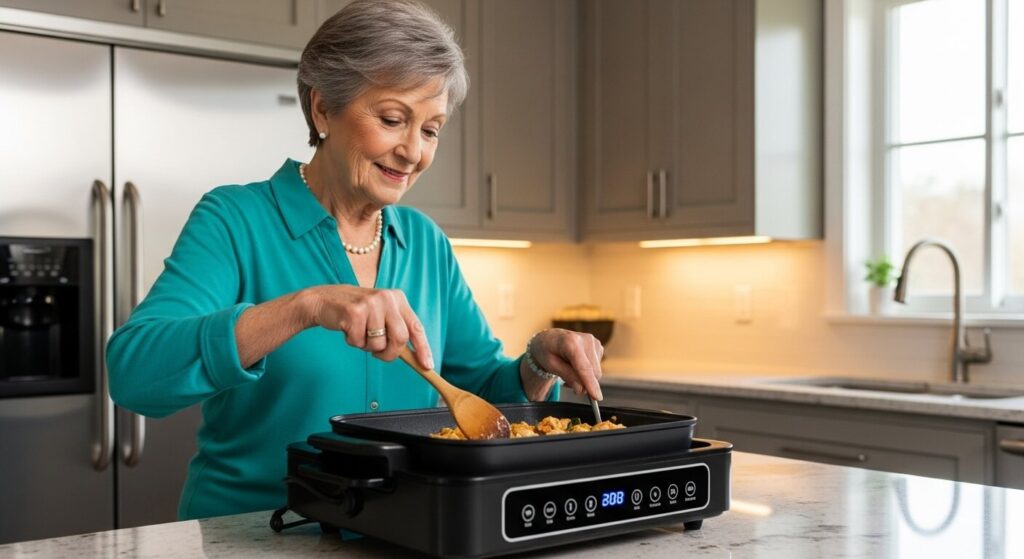
Slow cookers, electric pressure cookers, and sheet pan cooking eliminate or reduce the need for skillets entirely—and most of these alternatives are easier to clean.
Slow Cookers and Instant Pots with Easy-Clean Inserts
Slow cooker inserts and Instant Pot inner pots have smooth, non-porous surfaces that rarely get stuck-on food.
Plus they’re usually dishwasher safe. Or they clean with a simple soak and wipe.
You can cook almost anything in these appliances. Meats, vegetables, soups, sauces, even some baked goods. Significantly reduces the need for skillet cooking.
Additional benefit: Less active cooking time means less standing in the kitchen, which means less overall joint stress even before you get to cleaning.
Sheet Pan Cooking with Parchment Paper
Line a sheet pan with parchment paper. Put your food on the paper. Roast or bake. Throw away the paper afterward.
The pan itself barely gets dirty. Quick rinse. Done.
This works for vegetables, fish, chicken, even some cuts of beef and pork. Not everything—you can’t sauté on parchment paper—but a surprising number of dishes.
One-Pot Meals That Transfer to Storage Containers
Cook a soup, stew, or casserole in one pot (or slow cooker, or Instant Pot). Portion it directly into storage containers for the week.
You eat from the containers. The only thing you clean is the cooking vessel (and your fork).
One cleaning session provides multiple meals. Massively reduced cleanup frequency.
Hand Care and Joint Protection During Skillet Cleaning
Performing gentle finger and wrist stretches for 2-3 minutes before cleaning skillets increases blood flow to arthritic joints and improves range of motion, making the cleaning task less painful and reducing post-activity inflammation.
Taking care of your hands before, during, and after cleaning matters as much as the cleaning technique itself.
Warm-Up Exercises Before Cleaning Tasks
Cold, stiff joints are injury-prone joints—and they hurt more when you use them.
Gentle Finger and Wrist Stretches
Before you start cleaning, spend 60-90 seconds on simple stretches:
Finger stretches:
- Make a fist, hold 5 seconds, release
- Spread fingers wide, hold 5 seconds, relax
- Touch each fingertip to your thumb in sequence
- Repeat each 3-5 times
Wrist stretches:
- Rotate wrists in circles (both directions, 5 circles each)
- Bend wrist forward and back gently (hold each position 5 seconds)
- Side-to-side wrist movement (hold each side 5 seconds)
These aren’t hard stretches. Just gentle movements through your comfortable range of motion. You’re encouraging blood flow and synovial fluid distribution.
Hand-Warming Techniques for Better Mobility
Warm joints move better and hurt less than cold joints.
Quick warming methods:
- Run hands under warm water for 30-60 seconds
- Rub hands together vigorously for 30 seconds
- Wear warm gloves for a few minutes before starting
- Use a heating pad on hands for 2-3 minutes
The goal is increasing tissue temperature by just a few degrees. That’s enough to improve flexibility and reduce pain significantly.
Duration and Frequency of Pre-Cleaning Exercises
Total warm-up time: 2-3 minutes max. You’re not training for a marathon. Just preparing joints for activity.
Do this before any extended hand use (cleaning, cooking, typing, crafting). Make it automatic.
Most people skip warm-ups because they seem unnecessary. Then they wonder why their hands hurt for two days after washing dishes.
Proper Grip Techniques to Minimize Joint Stress
How you hold tools matters almost as much as which tools you use—small adjustments in grip position and pressure can reduce joint loading by 40-50%.
Using Palm Pressure Instead of Finger Gripping
Whenever possible, press with your palm rather than gripping with your fingers.
For example: Instead of gripping a sponge in your fist and squeezing, place it flat on your palm and press down with your whole hand.
Instead of gripping a brush handle tightly, rest it across your palm and use gentle finger pressure just to keep it from sliding (not to actively squeeze).
Palm pressure distributes force across the larger bones and joints of your hand. Finger gripping concentrates force on small, vulnerable finger joints.
Two-Handed Methods for Larger Skillets
Use both hands for everything heavier than about 2 pounds.
One hand supports from underneath. The other steadies from the side or handle. Neither hand has to grip tightly because you’re sharing the load.
This is especially important for large cast iron skillets. Trying to lift or maneuver a 7-8 pound pan with one arthritic hand is asking for a flare-up.
When to Use Adaptive Aids vs. Direct Contact
If you can complete a task comfortably with your bare hands, do so. Direct contact gives you better feedback and control.
But the moment you notice pain, switch to an adaptive aid (long-handled tool, grip-builder, etc.).
Don’t push through pain “to finish the job.” Pain is information. It’s telling you that you’re damaging tissue.
Post-Cleaning Hand Care Routine
What you do after cleaning affects how much your hands hurt later—proper post-activity care can reduce next-day stiffness and pain by 30-40%.
Cold Therapy for Inflammation Management
If your hands feel warm or swollen after cleaning, apply cold for 10-15 minutes.
Ice pack, bag of frozen vegetables, or even just running cold water over your hands all work.
Cold reduces blood flow to the area (temporarily), which limits inflammatory response. You’re preventing tomorrow’s pain by managing today’s inflammation.
Don’t use heat after activity that’s caused inflammation. Heat increases blood flow, which can worsen swelling.
Moisturizing to Maintain Skin Integrity
Repeated exposure to dish soap and water strips natural oils from your skin. Dry, cracked skin is more prone to painful splits and infections.
Apply hand cream after every cleaning session. Get it into your cuticles, between your fingers, over your knuckles.
Healthy skin is one less source of pain.
Recognizing When You’ve Overdone It
If your hands are still painful 2-3 hours after cleaning, you overdid it.
If you wake up the next morning with significantly worse pain and stiffness than usual, you overdid it.
If you pushed through pain to finish the task, you almost certainly overdid it.
Learn your limits. When you hit them, stop. The remaining dishes can wait.
Ignoring these signals causes cumulative damage. Your arthritis will progress faster. Not worth it.