Table of Contents
- 1 What Is Polymerization in Cast Iron Seasoning
- 2 The Molecular Structure of Cooking Oils Before Polymerization
- 3 What Happens When You Heat Oil for Seasoning
- 4 The Chemical Transformation: From Liquid Oil to Solid Polymer
- 5 How Cast Iron Catalyzes the Polymerization Reaction
- 6 Temperature Science: The Heat Required for Proper Polymerization
- 7 Time Requirements: How Long Polymerization Actually Takes
- 8 Different Oils Polymerize Differently: The Molecular Explanation
- 9 The Layer-Building Process: Multiple Polymerization Events
- 10 The Role of Atmosphere: Why Polymerization Needs Air
- 11 Polymerization vs. Carbonization: Understanding the Difference
- 12 The Surface Chemistry of Seasoned Cast Iron
- 13 Factors That Affect Polymerization Quality
- 14 Why Some Oils Create Better Seasoning: The Chemical Reality
- 15 The Flaxseed Oil Paradox: Great Chemistry, Poor Results
- 16 Polymerization During Cooking vs. Dedicated Seasoning
- 17 What Breaks Down Polymerized Seasoning
- 18 The Science Behind Sticky or Tacky Seasoning
- 19 Understanding Seasoning Color Through Chemistry
- 20 The Physics of Non-Stick: How Polymerization Creates Slickness
- 21 How Multiple Layers Improve Seasoning: The Cumulative Chemistry
- 22 Environmental Factors Affecting Polymerization Quality
- 23 Measuring Polymerization Success: Scientific Indicators
- 24 The Irreversibility of Polymerization: Why Seasoning Is Permanent
- 25 Modern Science vs. Traditional Knowledge in Seasoning
- 26 Comparing Polymerization to Other Coating Processes
- 27 The Future of Seasoning Science: Research and Developments
What Is Polymerization in Cast Iron Seasoning
Polymerization is the chemical process where heat transforms liquid cooking oil into a hard, plastic-like coating bonded to cast iron through molecular cross-linking and oxidation reactions that occur above 400°F.
It’s not magic. It’s chemistry.
Defining Polymerization: The Chemical Process Behind Seasoning
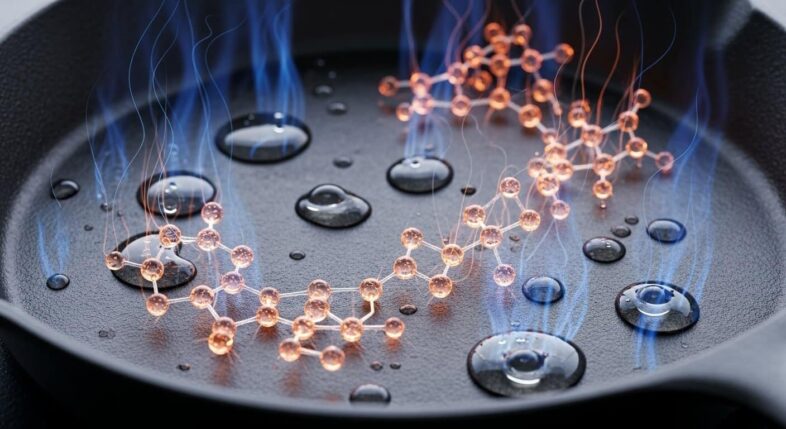
Polymerization occurs when individual oil molecules break apart under high heat, bond with oxygen, and recombine into long-chain molecular structures (polymers) that attach permanently to the iron surface through chemical bonds.
Think of it like this: you start with millions of small, independent molecules floating around in liquid form. Heat breaks them apart. They grab oxygen from the air. They link together into chains—sometimes hundreds of molecules long. Those chains bond to the iron and to each other, creating a network of connected molecules.
That network is your seasoning. It’s solid. Durable. Chemically bonded to the metal.
How Polymerization Differs From Simple Oil Coating
Oil coating sits on the surface as liquid fat that wipes away easily, while polymerization chemically transforms the oil into a different substance entirely—a solid polymer permanently bonded to iron that can’t be removed without breaking chemical bonds.
Just oiling your pan? That’s not seasoning. That’s temporary lubrication.
The oil will wash off. It’ll go rancid. It’s not protecting anything—it’s just sitting there being oily.
Polymerized oil has undergone a chemical reaction. The molecular structure is different. It’s no longer “oil” in any meaningful sense—it’s a polymer coating that happens to have started as oil.
Why Understanding Polymerization Improves Your Seasoning Results
Knowing how polymerization actually works lets you control temperature more effectively, choose oils based on molecular structure rather than marketing, avoid common mistakes like thick applications, and troubleshoot problems by understanding what went wrong chemically.
When you understand the chemistry, everything makes sense.
Why does thick oil create sticky seasoning? Because the outer layers can’t polymerize properly—they’re too far from the iron catalyst.
Why does temperature matter so much? Because polymerization is a heat-activated chemical reaction with specific temperature requirements.
Why do different oils perform differently? Different molecular structures, different polymerization characteristics.
It’s not mysterious once you know the science.
The Molecular Structure of Cooking Oils Before Polymerization
Before heat transforms them, cooking oils are triglycerides—complex molecules made of glycerol backbones with three fatty acid chains attached—and understanding this starting structure explains everything about how seasoning forms.
Chemistry class time. Don’t worry, I’ll keep it simple.
Understanding Triglycerides: The Building Blocks of Cooking Fats
Triglycerides consist of one glycerol molecule (a simple three-carbon chain) bonded to three fatty acid chains (long carbon chains ranging from 4 to 24 carbons), creating a structure that looks like an uppercase E with three prongs.
The glycerol is the backbone. The three fatty acids are the arms extending off it. All fats and oils—vegetable oil, olive oil, lard, butter—share this basic structure.
What varies is the length and saturation of those fatty acid chains. That’s where differences between oils come from.
Fatty Acid Chains and Their Role in Seasoning
Fatty acid chains are long carbon chains with hydrogen atoms attached—these chains can be saturated (all single bonds between carbons), monounsaturated (one double bond), or polyunsaturated (multiple double bonds), and these double bonds are where polymerization happens.
The double bonds are reactive. They’re the weak points where chemistry happens.
Single bonds (saturated fats) are stable. Hard to break. Don’t polymerize easily.
Double bonds (unsaturated fats) are reactive. Easy to break. Polymerize readily when heated.
This is why unsaturated oils create better seasoning than saturated fats like coconut oil or lard.
Why Different Oils Have Different Molecular Structures
Plant oils, animal fats, and specialty oils contain different ratios of saturated to unsaturated fatty acids based on their biological source, creating molecular diversity that directly affects polymerization speed, polymer hardness, and seasoning durability.
Flaxseed oil? Loaded with polyunsaturated fats. Lots of double bonds. Polymerizes fast.
Coconut oil? Mostly saturated. Few double bonds. Polymerizes poorly.
Vegetable oil? Mix of saturated and unsaturated. Balanced performance.
The source matters because different plants and animals produce different fats for different biological purposes.
Saturated vs. Unsaturated Fats at the Molecular Level
Saturated fats have carbon chains with all single bonds (C-C), making them chemically stable and less reactive, while unsaturated fats contain one or more double bonds (C=C) that make them chemically reactive and prone to breaking, oxidizing, and cross-linking during heating.
Molecular reactivity comparison:
| Fat Type | Bond Structure | Polymerization Speed | Seasoning Quality |
|---|---|---|---|
| Polyunsaturated | Multiple C=C double bonds | Fast, aggressive | Can be brittle (flaxseed) or excellent (grapeseed) |
| Monounsaturated | One C=C double bond | Moderate | Good, balanced performance |
| Saturated | All C-C single bonds | Slow, incomplete | Poor, soft seasoning |
More double bonds = more reactive = faster polymerization. But also potentially more brittleness, which is the flaxseed problem.
What Happens When You Heat Oil for Seasoning
When you apply heat to oil on cast iron, you’re triggering a complex series of chemical reactions that permanently alter the oil’s molecular structure and bond it to the metal surface.
Let’s break down what’s actually happening.
The Initial Heating Phase: Breaking Down Triglycerides
As temperature rises above 300°F, triglyceride molecules begin vibrating intensely, weakening the bonds between glycerol and fatty acids until they break apart, releasing free fatty acids and glycerol into what chemists call the “breakdown phase.”
Heat is energy. Molecular energy. It makes molecules move faster and faster.
Eventually they’re moving so fast the bonds holding them together can’t hold. Pop. The triglyceride breaks into its component parts.
Now you’ve got free fatty acids floating around. These are way more reactive than intact triglycerides. They’re ready to do chemistry.
The Critical Role of Temperature in Polymerization
Temperature determines whether oil simply gets warm, starts breaking down, fully polymerizes, or burns and carbonizes—each 50°F increment creates dramatically different chemical outcomes, making precise heat control essential for proper seasoning formation.
Why Smoke Point Matters for the Polymerization Process
The smoke point (the temperature where oil visibly smokes) indicates when triglyceride breakdown accelerates and free fatty acids volatilize into the air—polymerization requires exceeding the smoke point by 50-100°F to ensure complete molecular transformation.
Smoke is your visual indicator that chemistry is happening. The oil is breaking down. Free radicals are forming. Polymerization is starting.
Below the smoke point? Not much happening. The oil is hot but mostly intact.
At the smoke point? Breakdown begins. You’re entering the polymerization zone.
Above the smoke point? Full polymerization. This is where you want to be.
The Temperature Range Where Polymerization Actually Occurs
Effective polymerization happens between 400°F and 500°F for most cooking oils, with the sweet spot around 450-475°F where breakdown is complete, cross-linking is rapid, and carbonization hasn’t yet begun to dominate.
Below 400°F: Incomplete. The reaction is too slow. You’ll get soft, sticky seasoning.
400-500°F: Perfect. Fast polymerization, complete chemical transformation, hard durable coating.
Above 500°F: You’re pushing into carbonization territory. The polymers start breaking down into carbon. Different process, worse results.
Oxygen’s Essential Role in Creating Seasoning
Polymerization requires oxygen to form the cross-links between fatty acid chains—without adequate oxygen exposure, the chemical reaction can’t complete, resulting in incomplete seasoning that remains soft or oily.
Oxidation vs. Polymerization: Understanding the Difference
Oxidation is the chemical reaction where fatty acids bond with oxygen atoms, while polymerization is when oxidized fatty acids bond with each other creating long chains—both processes occur simultaneously during seasoning, and you can’t have polymerization without oxidation.
They’re related but different. Oxidation comes first. It’s the trigger.
Oxygen atoms attack the double bonds in unsaturated fatty acids. They insert themselves into the carbon chains. This creates reactive sites.
Those reactive sites then bond to other fatty acids. That’s polymerization. The chains link together.
You need both. Oxidation enables polymerization.
How Air Exposure Affects the Polymerization Process
Abundant oxygen availability accelerates polymerization by providing more oxidation sites for cross-linking, which is why seasoning in a well-ventilated oven works better than sealed containers—the oxygen-rich environment promotes complete chemical transformation.
Lots of air = lots of oxygen = fast, complete polymerization.
Limited air = oxygen-starved = slow, incomplete polymerization.
This is why you never season cast iron in a sealed plastic bag or airtight container. The reaction needs oxygen from the atmosphere.
The Chemical Transformation: From Liquid Oil to Solid Polymer
The actual transformation from liquid to solid is where things get really interesting chemically.
Free Radical Formation During High-Heat Oil Breakdown
Heat causes carbon-carbon double bonds to break, creating highly reactive molecules called free radicals—unpaired electrons looking to bond with anything nearby—that drive the entire polymerization process forward aggressively.
Free radicals are chemistry’s desperados. Unstable. Reactive. Looking to grab onto something—anything—to stabilize themselves.
They form when heat breaks those double bonds. Suddenly you’ve got molecules with unpaired electrons. That’s unstable. Nature hates that.
So they immediately start bonding with whatever’s available. Other fatty acids. Oxygen. The iron surface. Anything.
This chaos is what creates seasoning.
Cross-Linking: How Oil Molecules Bond Together
Free radicals bond to neighboring fatty acid chains through carbon-carbon bonds, creating cross-links that connect individual molecules into larger and larger structures like a molecular net spreading across the iron surface.
Picture a chain-link fence. Each link connects to multiple other links. The structure is interconnected, strong, rigid.
That’s what’s happening at the molecular level. Individual fatty acids are linking to each other. Then those linked pairs link to other pairs. Those link to more. You’re building a three-dimensional network of connected molecules.
That network is solid. It can’t flow. It’s not liquid anymore—it’s a polymer.
The Creation of Long-Chain Polymers From Fat Molecules
As cross-linking continues, molecules connect into chains hundreds or thousands of units long, creating the same type of long-chain polymers found in plastics, resins, and other synthetic materials—except these are made from cooking oil.
You’re literally creating a plastic coating. Just from organic materials instead of petroleum.
The chemistry is similar to making polyethylene or polystyrene. Heat, pressure (or in our case, catalytic iron), reactive starting materials, and you get polymers.
The result? A hard, durable, chemically inert coating bonded to your pan.
Why Polymerized Oil Becomes Hard Like Plastic
Polymer chains can’t move freely like individual molecules—they’re locked together in a rigid three-dimensional network that prevents flow, creating the hardness and solidity characteristic of both cast iron seasoning and commercial plastics.
Liquid oil flows because the molecules can slide past each other. They’re independent.
Polymerized oil can’t flow. The molecules are all connected. They’re stuck in place. The network is rigid.
Same reason a plastic bottle is solid while petroleum is liquid. Polymerization creates rigidity.
How Cast Iron Catalyzes the Polymerization Reaction
The iron itself isn’t passive in this process—it’s actively speeding up the chemistry.
Iron as a Catalyst in the Seasoning Process
Iron atoms on the pan’s surface act as a catalyst (a substance that speeds up reactions without being consumed) by providing an electrically charged surface that attracts fatty acids and facilitates their oxidation and cross-linking.
Catalysts are chemistry’s speed boosters. They don’t participate in the reaction—they just make it happen faster.
Iron is particularly good at catalyzing oxidation reactions. The metal surface provides electrons that help break bonds and form new ones.
Without the iron, polymerization would still happen. Just way slower. The iron accelerates everything.
The Metal Surface’s Role in Accelerating Polymerization
The rough, porous structure of cast iron provides enormous surface area at the microscopic level where oil molecules can settle, orient themselves properly, and undergo catalyzed polymerization faster than they would in open air or on non-reactive surfaces.
Microscopic view of cast iron? It’s rough. Lots of peaks and valleys. Tons of surface area.
Oil seeps into those valleys. Spreads across those peaks. Makes intimate contact with the metal.
That contact is where catalysis happens. The closer the oil is to iron, the faster it polymerizes.
Chemical Bonding Between Iron and Polymerized Oil
Polymerizing fatty acids form actual chemical bonds with iron atoms on the surface through a process called coordination bonding, where oxygen atoms in the polymer share electrons with iron, creating permanent molecular-level attachment.
This isn’t glue. It’s not mechanical adhesion. It’s a chemical bond. Molecular-level attachment.
The oxygen in the polymerized oil literally bonds to iron atoms. Shares electrons with them. Forms a coordination complex.
That’s why seasoning is permanent. You can’t just wipe it off. You’d have to break chemical bonds—which requires significant energy or aggressive chemicals.
Why Seasoning Bonds Permanently to Cast Iron
Once formed, iron-oxygen-carbon bonds in seasoned cast iron are thermally and chemically stable at normal cooking temperatures, requiring either extreme heat (800°F+), strong acids, or mechanical abrasion to break—making the coating essentially permanent under normal use.
You’d have to really try to remove polymerized seasoning. Self-cleaning oven cycle (900°F+) will do it. Strong lye will do it. Electrolysis will do it.
Normal cooking? Cleaning? Not even close. The bonds are too strong.
That’s the beauty of the chemistry. Once it’s formed, it’s there to stay.
Temperature Science: The Heat Required for Proper Polymerization
Let’s get specific about numbers.
Minimum Temperature Thresholds for Oil Polymerization
Most cooking oils require minimum temperatures of 375-400°F to initiate breakdown and 400-450°F for significant polymerization, with anything below 375°F producing incomplete reactions that create sticky, unpolymerized coatings.
Below 375°F? Chemistry is too slow. Barely happening.
375-400°F? Starting to work. Marginal polymerization.
400°F+? Now we’re cooking (literally and figuratively). Real polymerization is occurring.
This is why “low and slow” doesn’t work for seasoning. You need heat. Real heat.
The Optimal Temperature Range for Seasoning (450-500°F)
The 450-475°F range provides ideal conditions where triglyceride breakdown is complete, free radical formation is abundant, cross-linking happens rapidly, and carbonization remains minimal—creating hard, durable seasoning efficiently.
450°F is the floor for optimal results. 475°F is the sweet spot. 500°F is the ceiling before problems start.
This range gives you fast, complete polymerization without burning the oil before it can form proper polymer chains.
What Happens Below Ideal Polymerization Temperature
At temperatures between 300-400°F, oil breaks down incompletely, creating a mixture of polymerized and unpolymerized molecules that results in soft, tacky seasoning that feels sticky to the touch and performs poorly.
Sticky seasoning = incomplete polymerization. Period.
The oil got warm enough to break down partially. Some molecules polymerized. Others didn’t. You’ve got a gummy mix of transformed and untransformed oil.
It never fully hardens. It’s soft. Tacky. Annoying.
What Happens Above Optimal Temperature (Carbonization vs. Polymerization)
Above 500-525°F, polymer chains begin breaking down into pure carbon through carbonization, creating a rough, brittle coating that’s more charcoal than polymer—functional but inferior to properly polymerized seasoning.
Too much heat breaks the very chains you’re trying to create. The polymers destabilize. They break into smaller and smaller fragments. Eventually you’re left with just carbon.
Carbon makes a decent coating (it’s why charcoal grills don’t rust). But it’s not as smooth or durable as properly polymerized oil.
Stay below 500°F.
Time Requirements: How Long Polymerization Actually Takes
Temperature is half the equation. Time is the other half.
The Polymerization Timeline at Different Temperatures
At 450°F, significant polymerization begins within 15-20 minutes, reaches 80-90% completion by 45 minutes, and finishes fully by 60 minutes—higher temperatures accelerate this timeline slightly, lower temperatures extend it significantly.
Approximate polymerization timeline at 450°F:
- 0-10 minutes: Oil heating, beginning to break down
- 10-20 minutes: Active breakdown, free radicals forming
- 20-40 minutes: Rapid cross-linking and polymerization
- 40-60 minutes: Final polymerization, hardening continues
- 60+ minutes: Essentially complete
One hour is the standard recommendation because it ensures the reaction goes to completion.
Why One Hour at Temperature Is Standard Recommendation
Sixty minutes ensures complete triglyceride breakdown, abundant cross-linking throughout the oil layer, and full hardening of the polymer matrix—shorter times may leave unreacted oil that stays soft, while longer times provide minimal additional benefit.
Less than an hour? You’re risking incomplete polymerization. Some of the oil hasn’t fully transformed. You’ll get soft spots.
More than an hour? Not hurting anything. But you’re not gaining much either. The reaction is basically done by 60 minutes.
One hour is the Goldilocks duration. Just right.
Can You Speed Up Polymerization Safely
Increasing temperature to 475-500°F can reduce polymerization time to 45 minutes while still producing quality seasoning, but going hotter or shorter risks carbonization or incomplete transformation—patience generally produces better results than speed.
You can shave 10-15 minutes by going hotter. But the risk-reward ratio isn’t great.
Mess up the timing or temperature and you get carbonization or incomplete polymerization. For 15 minutes of savings? Not worth it.
Just set it at 450-475°F for an hour. Walk away. Do something else.
Incomplete Polymerization and Its Consequences
Pulling seasoning out too early leaves unreacted or partially reacted oil that remains liquid or semi-liquid, creating sticky patches that never harden, attract dust, go rancid, and perform poorly for cooking.
Sticky seasoning is almost always a time or temperature failure. The chemistry didn’t finish.
You can sometimes fix it by heating again for a full hour. Sometimes the reaction completes and the tackiness disappears.
But prevention is better. Give it the full time.
Different Oils Polymerize Differently: The Molecular Explanation
Not all oils are created equal at the molecular level.
Why Unsaturated Fats Polymerize More Readily
Double bonds in unsaturated fatty acids are chemically reactive sites where oxidation and cross-linking occur easily—oils with more double bonds (polyunsaturated fats) polymerize faster and more completely than saturated fats with fewer reactive sites.
Double bonds are weak points. Reactive spots. Where chemistry happens.
Saturated fat: All single bonds. Stable. Not much happening.
Monounsaturated fat: One double bond per molecule. Some reactivity.
Polyunsaturated fat: Multiple double bonds per molecule. Highly reactive. Fast polymerization.
This is basic chemistry. More reactive sites = faster reaction.
The Science Behind High vs. Low Smoke Point Oils
Smoke point correlates with molecular stability—oils with shorter fatty acid chains or more unsaturated bonds break down at lower temperatures, while oils with longer chains or more saturation remain stable to higher temperatures before volatilizing.
Low smoke point = unstable molecules = breaks down easily = smokes early.
High smoke point = stable molecules = resists breakdown = smokes later.
For seasoning, you want the oil to break down (that’s the point). So smoke point is about timing, not quality.
Molecular Structure Comparison: Flaxseed vs. Vegetable vs. Avocado Oil
Flaxseed oil contains 55-70% alpha-linolenic acid (three double bonds per molecule) making it extremely reactive but producing brittle polymers, vegetable oil blends contain balanced mono and polyunsaturated fats creating flexible durable polymers, and avocado oil’s predominantly monounsaturated structure (one double bond) polymerizes slowly but reliably.
| Oil Type | Primary Fatty Acid | Double Bonds | Polymerization Speed | Polymer Quality |
|---|---|---|---|---|
| Flaxseed | Alpha-linolenic acid | 3 per molecule | Very fast | Brittle, flakes over time |
| Grapeseed | Linoleic acid | 2 per molecule | Fast | Excellent, hard and durable |
| Vegetable | Mixed polyunsaturated | 1-2 per molecule | Moderate-fast | Very good, balanced |
| Avocado | Oleic acid | 1 per molecule | Moderate | Good, very stable |
The molecular structure determines everything about performance.
Iodine Value and Its Relationship to Polymerization Speed
Iodine value measures the total number of double bonds in an oil—higher iodine values (flaxseed at 180-200) indicate more reactive sites and faster polymerization, while lower values (olive oil at 75-94) mean slower, gentler polymerization.
Iodine value is chemistry nerd speak for “how unsaturated is this fat?”
High number = lots of double bonds = highly reactive.
Low number = few double bonds = not very reactive.
It’s a useful metric if you’re comparing oils scientifically. For practical purposes, just know: more unsaturated = faster polymerization.
The Layer-Building Process: Multiple Polymerization Events
One layer isn’t enough. Here’s why.
Why Single Layers Are Molecularly Thin
A single application of properly wiped oil creates a polymer layer only 0.5-2 microns thick (about 1/100th the width of a human hair)—far too thin to fill surface irregularities or provide robust protection alone.
We’re talking molecular-scale thickness. Incredibly thin.
One layer is barely there. It’s protection, barely. It’s certainly not filling in the rough texture of cast iron.
You need accumulation. Multiple layers building on each other.
How Subsequent Layers Bond to Previous Polymer Layers
New oil applications bond to existing polymerized layers through the same oxidation and cross-linking chemistry, with fresh polymers forming chemical bonds to the underlying polymer matrix—creating a progressively thicker, more interconnected coating.
Layer 2 bonds to layer 1 chemically. Same process as layer 1 bonding to iron.
Layer 3 bonds to layer 2. Layer 4 to layer 3. And so on.
Each layer strengthens the whole structure. The bonding is cumulative.
The Cumulative Effect of Multiple Polymerization Cycles
Six layers at 1-2 microns each create 6-12 microns of total coating thickness—enough to fill microscopic surface irregularities, provide substantial rust protection, and create the smoothness needed for non-stick properties.
One layer: Barely functional.
Three layers: Workable.
Six layers: Actually good.
Ten+ layers: Excellent.
The accumulation matters. Each layer adds thickness, smoothness, and durability.
Thickness Limitations: Why Thick Oil Applications Fail
Polymer layers thicker than 2-3 microns don’t form properly because outer regions are too distant from the iron catalyst, can’t reach polymerization temperature efficiently, and lack the oxygen contact needed for complete transformation—resulting in soft, gummy outer layers.
Remember earlier—iron catalyzes the reaction. Distance from iron = slower reaction.
Thick oil means the outer layers are far from the catalyst. They don’t polymerize as well. They stay soft.
Also, heat has to penetrate through the oil layer. Thick oil insulates. The outer parts don’t get hot enough.
Result: sticky mess.
The Role of Atmosphere: Why Polymerization Needs Air
You can’t do this in a vacuum. Literally.
Oxygen Availability During the Seasoning Process
Polymerization consumes oxygen from the atmosphere as fatty acids oxidize and cross-link—adequate air circulation ensures continuous oxygen supply, while enclosed spaces with limited air exchange can starve the reaction and slow or prevent proper seasoning formation.
Each oxidation reaction uses up oxygen molecules. The air around the pan gets depleted.
Fresh air needs to replace what’s used. If it can’t—if you’re in a sealed container—the reaction stalls.
This is why you never season in a sealed bag or airtight container. The oxygen runs out.
What Happens in Oxygen-Starved Environments
Limited oxygen produces incomplete oxidation where fatty acids can’t fully cross-link, creating soft, poorly polymerized coatings that may never fully harden even with extended heating times.
No oxygen = no oxidation = no cross-linking = no proper polymerization.
You might get some heat-induced breakdown of the oil. But without oxidation, you’re not getting polymer chains. You’re just getting hot, broken-down oil.
Moisture’s Interference With Polymerization Chemistry
Water vapor competes with oxygen for reactive sites on fatty acids and can interfere with cross-linking chemistry—completely dry conditions promote better polymerization than humid environments or wet pan surfaces.
Water and oil don’t mix. That extends to the chemical level.
Water molecules can occupy reactive sites that should be bonding with oxygen or other fatty acids. They get in the way. They slow things down.
Dry pan, dry environment = best results.
Why Sealed Containers Prevent Proper Seasoning
Enclosed spaces trap moisture, limit oxygen availability, and prevent the continuous air exchange needed for complete polymerization—attempting to season in sealed containers universally produces poor results regardless of temperature or oil choice.
Sealed container = chemistry disaster.
Can’t get oxygen. Can’t remove moisture. Can’t vent the volatile breakdown products.
Everything about the reaction is compromised.
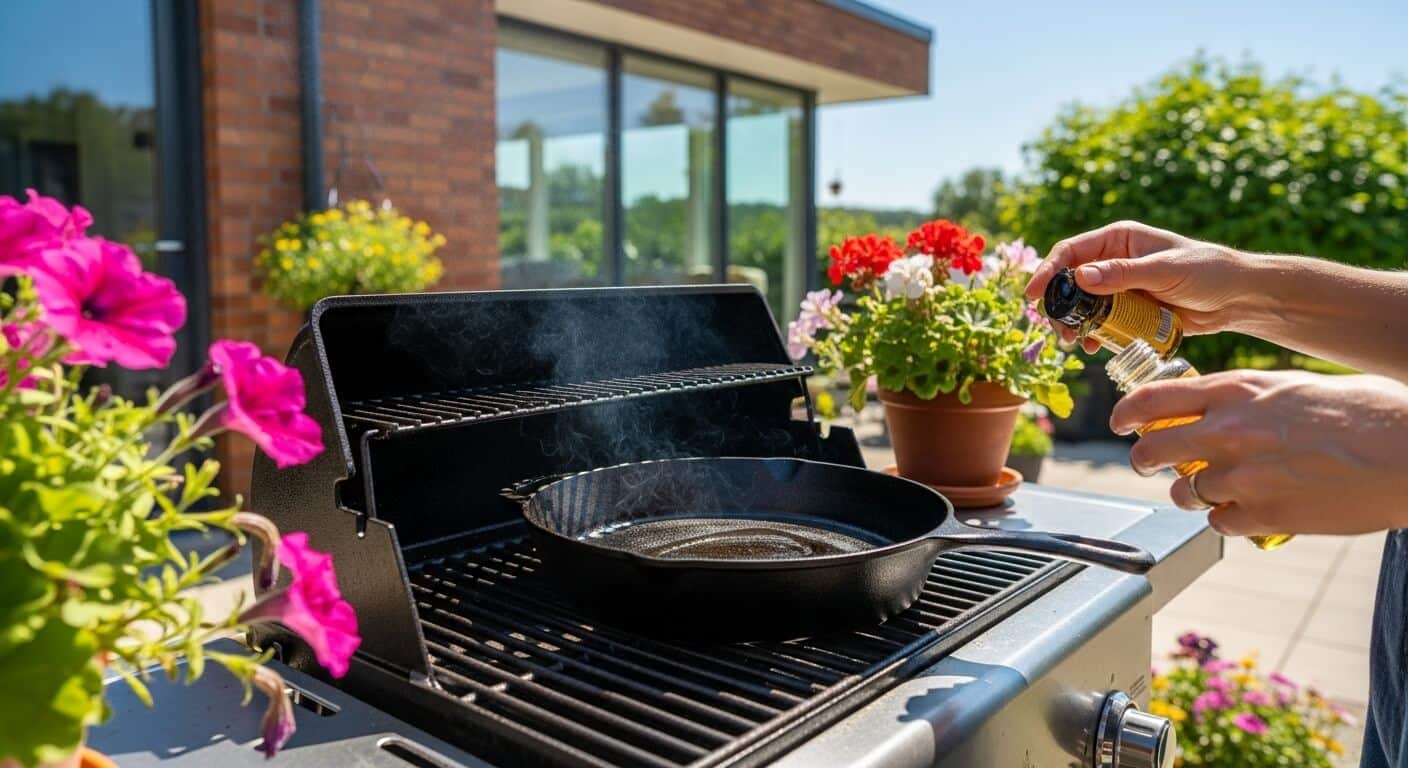
Always season in open air. Oven with the door closed is fine—there’s still air exchange. Plastic bag? Not happening.
Polymerization vs. Carbonization: Understanding the Difference
These are two different chemical processes. Both can happen to oil. Only one makes good seasoning.
What Carbonization Is at the Molecular Level
Carbonization occurs when polymer chains are heated beyond thermal stability (typically above 500-550°F) and break down into progressively smaller fragments until only elemental carbon remains in a charcoal-like structure.
Too much heat doesn’t just stop polymerization. It reverses it.
The polymer chains you just built? They start breaking. Snapping into smaller pieces. Those pieces break further.
Eventually you’re left with just carbon atoms. No more chains. No more polymer structure. Just carbon.
That’s carbonization.
Temperature Points Where Polymerization Becomes Carbonization
Most polymerized oils remain stable up to approximately 500-525°F but begin carbonizing at 550°F and above—this narrow temperature band makes precise oven control important for avoiding carbonization while ensuring complete polymerization.
450-500°F: Polymerization zone. Good.
500-550°F: Transition zone. Polymerization still happening but carbonization starting.
550°F+: Carbonization zone. Bad.
The window is narrower than you’d think. This is why 450-475°F is recommended—it’s safely in the polymerization zone with no risk of carbonization.
Why Carbonized Oil Doesn’t Create Good Seasoning
Carbon provides some rust protection and heat resistance but lacks the smooth, interconnected polymer structure needed for non-stick properties—carbonized coatings tend to be rough, brittle, and inferior to properly polymerized seasoning.
Carbon works as a barrier. It’ll prevent rust. It handles heat fine.
But it’s not smooth. It’s not flexible. It doesn’t have the right molecular structure for non-stick performance.
It’s the difference between charcoal and plastic. Both are useful. But for different purposes.
Visual and Tactile Differences Between the Two Processes
Properly polymerized seasoning appears smooth, semi-glossy, and feels almost plastic-like to the touch, while carbonized coating looks matte black, feels slightly rough or dusty, and may flake or powder when scratched.
Touch test works here. Polymerized = smooth, hard, plastic feel. Carbonized = rougher, more brittle, sometimes powdery.
Visual test: Polymerized has a slight sheen. Carbonized is completely matte.
If you’ve carbonized instead of polymerized, the pan still works. Just not as well.
The Surface Chemistry of Seasoned Cast Iron
Let’s look at what you’ve actually created.
The Polymer Matrix Structure of Mature Seasoning
Fully developed seasoning consists of interconnected three-dimensional polymer networks layered on top of each other, creating a matrix structure similar to cross-linked plastics or epoxy resins—rigid, durable, and chemically inert.
Multiple layers of cross-linked polymers. Each layer bonded to the one below. All of them interconnected.
It’s like a molecular jungle gym. Complex three-dimensional structure. Strong. Stable.
That’s what you’re building over months of cooking and seasoning.
How Seasoning Fills Microscopic Surface Imperfections
Cast iron’s rough surface (especially modern pans) contains peaks and valleys at the microscopic level—successive polymer layers flow into valleys, coat peaks, and gradually create a smoother plane that overrides the underlying texture.
The iron itself is rough. Bumpy. Lots of surface texture.
Each seasoning layer fills in the low spots a bit. Coats the high spots. Smooths things out incrementally.
After 20-30 layers (from seasoning and cooking), you’ve built up enough polymer to actually smooth over most of the texture.
That’s why old, well-used pans feel smoother than new ones. The accumulated seasoning has filled in the roughness.
Why Polymerized Seasoning Is Non-Stick at the Molecular Level
The polymer surface presents a low-energy, hydrophobic (water-repelling) barrier that food proteins and fats can’t easily bond to—water and oil bead up rather than spreading, and proteins slide off rather than sticking at the molecular level.
Non-stick is about surface energy. Teflon works because it has incredibly low surface energy. Nothing wants to stick to it.
Polymerized oil has lower surface energy than bare iron (though not as low as Teflon). Water beads up. Food releases more easily.
It’s not magic. It’s just physics and chemistry working together.
The Hydrophobic Properties of Polymerized Oil
Polymerized fatty acids retain the hydrophobic (water-fearing) character of their oil origin, creating a surface that repels water, resists moisture penetration, and prevents rust formation by blocking water-iron contact.
Oil and water don’t mix. Even when the oil has been transformed into a polymer, it still repels water.
This is why seasoned cast iron resists rust. The hydrophobic coating keeps moisture away from the iron.
Drop water on good seasoning and it beads up. Doesn’t soak in. Doesn’t reach the metal.
Factors That Affect Polymerization Quality
Getting it right requires controlling multiple variables.
Oil Application Thickness and Molecular Bonding
Ultra-thin oil layers (barely visible after wiping) polymerize most completely because all molecules remain within 1-2 microns of the catalytic iron surface where reaction efficiency is highest—thicker applications create outer layers too distant for proper bonding.
The wiping step isn’t about removing oil. It’s about creating the right thickness for chemistry.
Too thick = outer layers don’t bond well = sticky mess.
Too thin (properly wiped) = everything bonds = hard, smooth coating.
Even Heat Distribution and Uniform Polymerization
Consistent temperature across the entire pan surface ensures simultaneous polymerization everywhere—hot spots polymerize (or carbonize) faster while cool spots may remain unpolymerized, creating uneven seasoning with variable color and performance.
Uneven heat = uneven chemistry = splotchy results.
Center too hot? Might carbonize. Edges too cool? Might not polymerize fully.
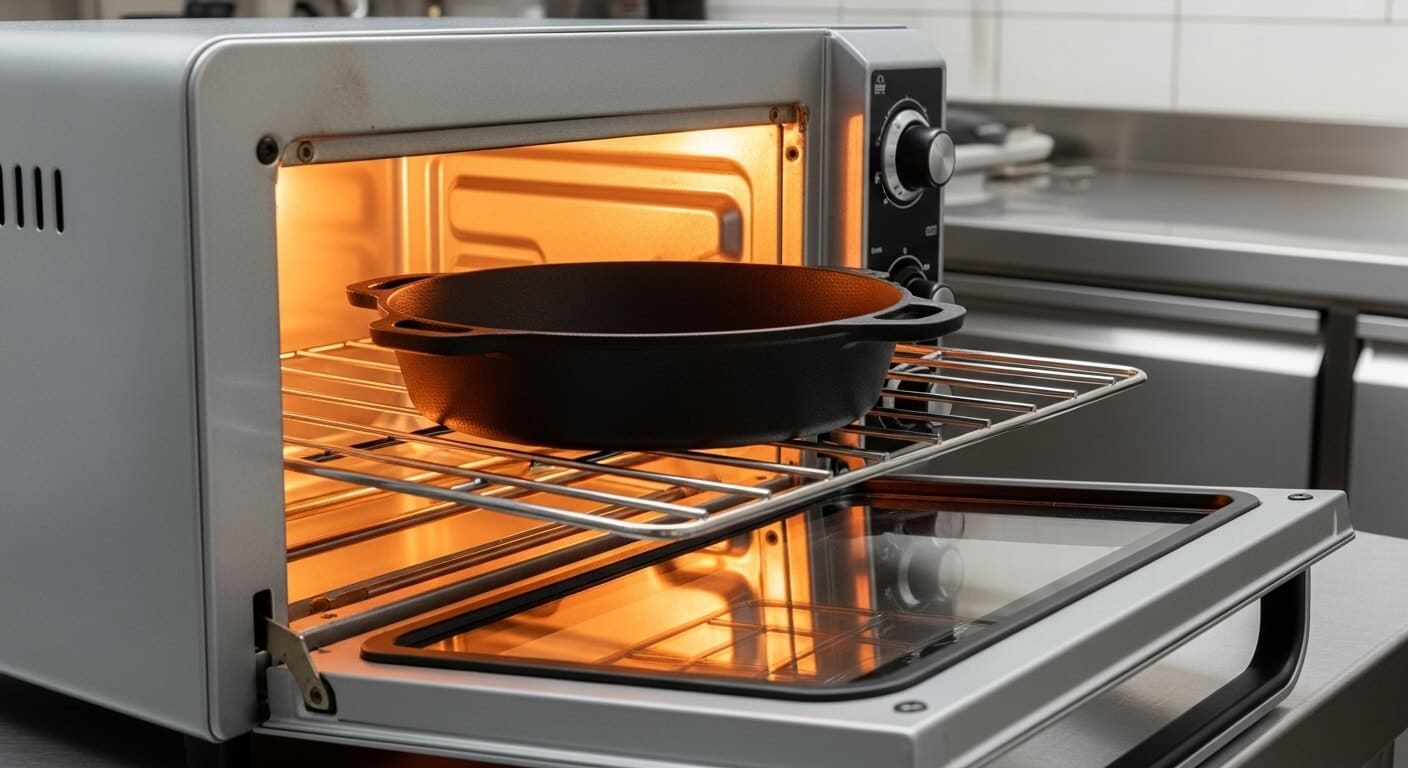
Even oven heat is one reason oven seasoning works better than stovetop for beginners. More uniform temperature distribution.
The Impact of Rapid vs. Gradual Heating
Gradual heating to polymerization temperature allows triglycerides to break down in controlled fashion, while rapid heating can cause premature smoking, uneven breakdown, and inferior polymer formation—patience during heat-up produces better chemistry.
Don’t shock the oil with sudden heat. Let it warm up gradually.
Slow heating gives the chemical reactions time to proceed in proper sequence. Breakdown happens evenly. Polymerization starts uniformly.
Fast heating creates chaos. Some areas polymerize while others are still liquid. Inconsistent results.
Cooling Rate Effects on Final Polymer Structure
Slow cooling allows polymer chains to settle into optimal configurations and complete final cross-linking reactions, while rapid cooling can freeze the structure before full hardening occurs—leaving the oven off and cooling gradually produces marginally better seasoning.
Let it cool in the turned-off oven. Don’t rush it.
The chemistry doesn’t stop the instant you turn off the heat. Final cross-linking continues as temperature drops. Polymer chains settle into their final positions.
Rapid cooling interrupts this. You get slightly softer, less organized polymer structure.
Why Some Oils Create Better Seasoning: The Chemical Reality
The internet argues endlessly about oil choice. Here’s the actual chemistry.
Molecular Weight and Polymer Chain Formation
Oils with medium-length fatty acids (16-18 carbons) create optimal polymer chains that are neither too short (brittle) nor too long (soft)—this sweet spot explains why common vegetable oils often outperform specialty options.
Chain length matters. Too short, the polymers are rigid and brittle. Too long, they’re flexible and soft.
16-18 carbon chains? Just right. Hard enough, flexible enough. Balanced.
Most common cooking oils fall in this range. Flaxseed has unusually reactive but short chains—hence the brittleness.
Double Bond Availability in Unsaturated Fats
Oils need adequate double bonds for cross-linking but not so many that polymers become over-cross-linked and brittle—2-3 double bonds per fatty acid (linoleic acid) appears optimal, while 4+ (flaxseed’s alpha-linolenic) creates brittleness problems.
Double bond sweet spot:
- 0-1 bonds: Under-cross-linked, soft
- 2-3 bonds: Optimal cross-linking, durable
- 4+ bonds: Over-cross-linked, brittle
Grapeseed oil (high in linoleic acid with 2 bonds) hits the sweet spot. Flaxseed (alpha-linolenic with 3 bonds) overshoots it.
Oxidative Stability During High-Heat Exposure
Some polyunsaturated oils oxidize so aggressively at high heat that they begin breaking down before forming stable polymers—oils with balance between reactivity and stability (grapeseed, vegetable) outperform highly unstable (flaxseed) or overly stable (avocado) options.
Too reactive = breaks down too fast = unstable polymers.
Not reactive enough = polymerizes too slowly = takes forever.
Just right = reacts at the right speed = stable, durable polymers.
Brittleness vs. Flexibility in Different Oil Polymers
Polymer flexibility depends on cross-link density—highly cross-linked polymers (flaxseed) are hard but brittle and crack under thermal stress, while moderately cross-linked polymers (grapeseed, vegetable) provide hardness with enough flexibility to withstand temperature cycling without cracking.
You need some flex. Cast iron expands and contracts with temperature changes.
If the seasoning is too rigid, it can’t flex with the metal. Thermal stress cracks it. It flakes off.
Moderate cross-linking gives you hardness with just enough flexibility to move with the pan.
The Flaxseed Oil Paradox: Great Chemistry, Poor Results
This deserves its own section because it confuses everyone.
Why Flaxseed Oil Polymerizes So Effectively
Flaxseed oil’s high concentration of alpha-linolenic acid (55-70%) with three double bonds per molecule makes it the most reactive common cooking oil—it polymerizes faster and more completely than any alternative, creating beautiful dark seasoning quickly.
On paper, flaxseed is perfect. Maximum double bonds. Extreme reactivity. Fast, thorough polymerization.
Food scientists love it. The chemistry is elegant. It works exactly like theory predicts.
And it looks amazing. Dark, glossy, professional-looking seasoning after just 2-3 layers.
The Molecular Brittleness Problem With Flaxseed Polymers
The same high reactivity that makes flaxseed polymerize well creates excessive cross-linking density, producing rigid polymer structures that can’t flex with thermal expansion and contraction—leading to micro-cracks that propagate into visible flaking over time.
Too much cross-linking = too rigid = brittle.
Heat the pan, it expands. Cool it, it contracts. The metal moves. The seasoning needs to move with it.
Flaxseed polymers can’t. They’re too rigid. Thermal stress cracks them. Small cracks become bigger cracks. Eventually it flakes off in sheets.
Alpha-Linolenic Acid and Its Polymerization Characteristics
Alpha-linolenic acid’s three double bonds create more cross-link points than other fatty acids, resulting in a tighter, denser polymer matrix that’s extremely hard but lacks the molecular flexibility needed for long-term durability on cast iron.
Three double bonds per molecule = three potential cross-link sites.
Linoleic acid (in grapeseed/vegetable oil) = two potential sites.
Oleic acid (in olive/avocado oil) = one potential site.
More sites = tighter network = harder but more brittle.
Why Theoretical Best Doesn’t Equal Practical Best
Flaxseed demonstrates that optimal chemistry in isolation doesn’t guarantee optimal real-world performance—practical seasoning must balance polymerization speed, hardness, flexibility, and thermal stability, making “good enough” chemistry with balanced properties superior to “perfect” chemistry with brittleness issues.
Theory said flaxseed should be the best. Theory was wrong.
Because theory didn’t account for real-world use. Temperature cycling. Thermal stress. The need for flex.
Grapeseed and vegetable oil work better in practice despite being theoretically inferior. Because they have the right balance of properties.
This is why you test in the real world, not just on paper.
Polymerization During Cooking vs. Dedicated Seasoning
Different contexts, same chemistry. Mostly.
How Normal Cooking Temperatures Trigger Polymerization
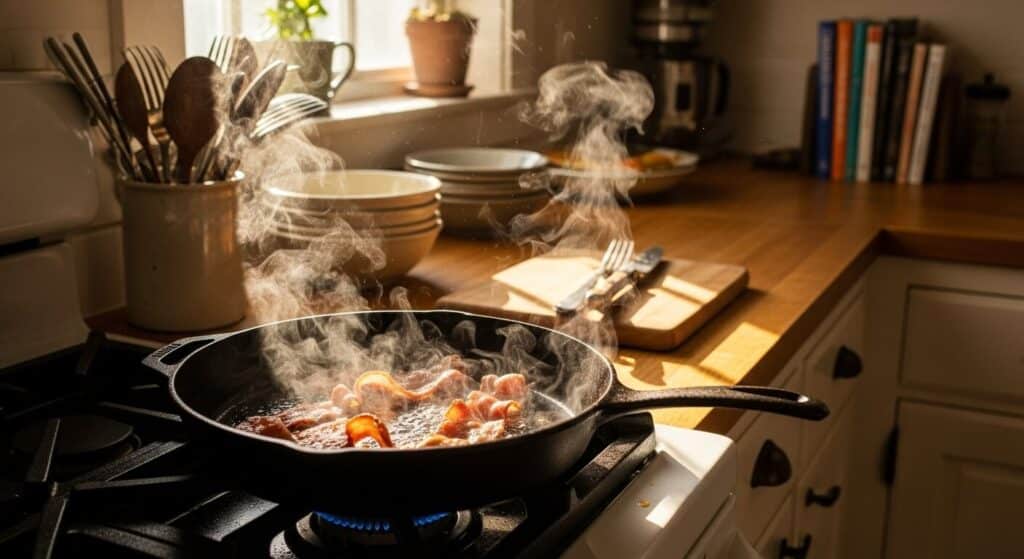
High-heat cooking methods (searing, stir-frying) reach 400-500°F pan surface temperatures—identical to dedicated seasoning—causing any oil in the pan to undergo the same polymerization chemistry while you cook food.
Sear a steak at 475°F? That’s seasoning temperature. The oil polymerizes while the steak cooks.
Stir-fry at 500°F? Definitely polymerizing. You’re building layers.
The pan doesn’t know whether you’re “cooking” or “seasoning.” It just responds to heat and oil.
The Difference Between Stovetop and Oven Polymerization
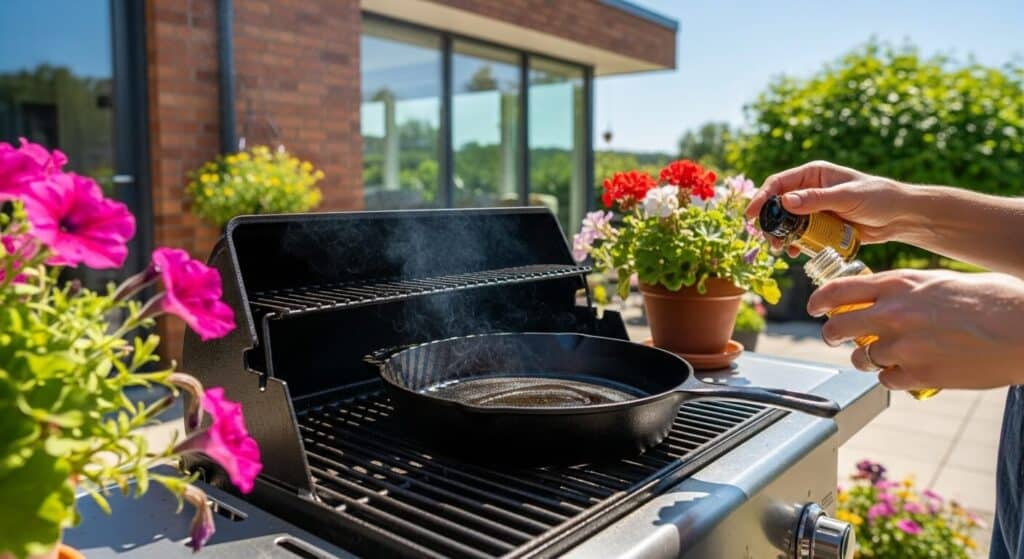
Stovetop cooking polymerizes the cooking surface quickly but often misses the exterior and upper sides, while oven seasoning heats the entire pan uniformly—same chemistry, different coverage patterns.
Burner heat is localized. Bottom and lower sides get hot. Upper sides and exterior? Not as much.
Oven heat is even. Everything reaches temperature. Complete coverage.
This is why dedicated oven seasoning looks more uniform than cooking-based seasoning, especially early on.
Why Cooking Builds Seasoning More Slowly
Cooking sessions last 15-30 minutes versus 60-minute dedicated seasoning, the oil is mixed with food particles and moisture that complicate chemistry, and only the actively heated cooking surface receives adequate temperature—resulting in thinner layers per session.
Cooking adds variables. Food releases moisture. Sugars caramelize. Proteins interact with the oil. It’s messy chemistry.
Also shorter duration. Most cooking is done in 20 minutes. Polymerization continues the whole time, but it’s not a full hour of ideal conditions.
Each cooking session adds a thinner layer than dedicated seasoning. But it adds up over time.
The Chemistry of Seasoning Maintenance Through Use
Regular cooking continuously deposits micro-layers that repair minor damage, fill microscopic gaps, and progressively smooth the surface—this ongoing polymerization makes well-used pans superior to freshly seasoned ones despite identical starting chemistry.
The maintenance is self-correcting. Small scratches get filled in. Thin spots get reinforced. The seasoning regenerates.
After a year of cooking, you’ve got way more layers than any initial seasoning session could create. And they’re work-hardened—optimized through actual use.
What Breaks Down Polymerized Seasoning
The bonds are strong but not invincible.
Chemical Reactions That Reverse or Damage Polymerization
Strong bases (lye, oven cleaner), concentrated acids (vinegar, citric acid), and oxidizing agents (bleach, hydrogen peroxide) can break carbon-carbon bonds in polymer chains, degrading seasoning at the molecular level.
Lye attacks the polymer backbone. Breaks the carbon chains. Dissolves the coating.
Strong acid can penetrate weak spots, reach the iron, and disrupt the iron-oxygen bonds holding seasoning to the metal.
Bleach oxidizes the polymers in ways that weaken the structure.
These are the chemical methods for stripping seasoning intentionally.
How Acids Affect Polymer Bonds in Seasoning
Mild acids (tomatoes, wine) can penetrate thin or damaged seasoning and react with exposed iron beneath, causing the coating to lift or degrade from underneath—well-established thick seasoning resists this through multiple protective layers.
Acid doesn’t attack the polymer directly (usually). It attacks the iron underneath.
Iron + acid = reaction. The iron corrodes slightly. The seasoning loses its anchor points. It can lift or flake.
Thick seasoning prevents the acid from reaching iron. That’s why mature seasoning handles acidic foods better.
Heat Extremes and Polymer Degradation
Extreme heat (self-cleaning oven cycle at 800-900°F) causes polymer chains to break down through carbonization and eventual oxidation to CO2, while thermal shock from rapid heating/cooling can create micro-cracks in rigid polymers.
You can burn off seasoning with enough heat. Self-cleaning cycle does it. The polymers literally decompose.
Thermal shock (hot pan, cold water) stresses the coating. Can crack brittle polymers. Usually doesn’t damage well-made seasoning, but it’s a risk.
Mechanical Stress and Polymer Chain Breakage
Metal utensils, abrasive scrubbers, and aggressive scraping can physically break polymer chains through mechanical force—while the coating is hard, it’s not impervious to strong direct impact or grinding force.
You can scrape off seasoning with a metal spatula if you try hard enough. Chip it with aggressive scrubbing.
The polymer is hard. But it’s thin. Concentrated force can break through it.
This is why people recommend gentler tools for cast iron. Protect the coating from unnecessary mechanical damage.
The Science Behind Sticky or Tacky Seasoning
When things go wrong, here’s why.
Incomplete Polymerization at the Molecular Level
Tacky seasoning contains unpolymerized or partially polymerized triglycerides mixed with fully polymerized regions—these unreacted molecules remain liquid or semi-liquid, creating the sticky feel while fully reacted areas are hard.
You’ve got a mixture. Some polymerized (hard), some not polymerized (sticky).
The unpolymerized oil is just sitting there being oily. Tacky. Gross.
It needed more heat, more time, or better application to fully transform.
Excess Oil and Unbound Triglycerides
Thick oil layers contain outer molecules too distant from the iron catalyst and heat source to polymerize—they break down partially but don’t cross-link, remaining as viscous liquid or semi-solid gunk.
The outer oil never got the conditions it needed. Too far from the iron. Not hot enough. Not enough oxygen.
It’s broken down (so it’s not really “oil” anymore) but not polymerized (so it’s not seasoning either). It’s stuck in a chemical limbo. And it’s sticky.
Why Thick Layers Don’t Fully Polymerize
Heat and catalytic activity decrease with distance from the iron surface—molecules more than 2-3 microns from the metal don’t receive adequate conditions for complete polymerization regardless of oven temperature or time.
Physics and chemistry both work against thick applications.
Heat: Has to penetrate through the oil. Thick oil insulates. Outer layers stay cooler.
Catalysis: Iron catalyzes the reaction. Distance reduces catalytic effect. Outer layers react slower.
Oxygen: Has to diffuse through the oil to reach inner layers. Thick oil blocks it.
All three factors combine to prevent outer layers from polymerizing.
Temperature-Related Polymerization Failures
Seasoning below 400°F produces incomplete breakdown where triglycerides partially decompose but don’t polymerize fully, creating the exact molecular conditions for tackiness—proper temperature is essential for complete transformation.
Too cool = incomplete chemistry = tacky coating.
You got partway there. The oil heated up. Broke down partially. But didn’t polymerize properly.
The solution is always the same: heat it properly at 450-475°F for a full hour.
Understanding Seasoning Color Through Chemistry
Why is it black? Or brown? Or bronze?
Why Polymerized Oil Darkens During Formation
Oxidation reactions create conjugated double bond systems in the polymer chains that absorb light differently than the original triglycerides, shifting color from clear/yellow (liquid oil) to brown/black (polymerized coating).
Light interaction changes as molecular structure changes. The polymer absorbs light differently than liquid oil.
Specific wavelengths get absorbed. Others reflect. The net result is darkening.
It’s not burning (that would be carbonization). It’s oxidation creating new molecular structures with different optical properties.
The Role of Oxidation in Seasoning Color Development
Higher oxidation levels create darker colors as more oxygen atoms incorporate into the polymer structure—fresh thin seasoning appears bronze or brown, while heavily oxidized mature seasoning turns deep black.
More oxygen = darker color.
First layer: Light bronze (minimal oxidation).
Sixth layer: Dark brown (moderate oxidation).
Fiftieth layer: Deep black (extensive oxidation over time).
Molecular Changes That Create Black vs. Brown Seasoning
Brown seasoning contains shorter polymer chains with moderate oxidation, while black seasoning has longer chains, higher cross-link density, and extensive oxidation that absorbs nearly all visible light wavelengths.
Brown = less polymerization, less oxidation.
Black = more polymerization, more oxidation.
It’s a spectrum. As you add layers and cook more, the color darkens progressively.
Color as an Indicator of Polymerization Completeness
Very light bronze or gold seasoning often indicates incomplete polymerization where transformation is partial, while dark brown to black suggests complete chemical transformation—color serves as a rough visual guide to seasoning maturity.
Pale = probably undercooked.
Dark = probably fully polymerized.
Not a perfect correlation. But good enough for practical purposes.
If your seasoning is still very light after a full seasoning cycle, it probably needs more heat or time.
The Physics of Non-Stick: How Polymerization Creates Slickness
Why does food release better from seasoned iron?
Surface Energy and Food Release Properties
All surfaces have molecular-level energy that determines how readily other substances adhere—polymerized oil creates a low-surface-energy barrier (though not as low as Teflon) that proteins and fats bond to less readily than high-energy bare iron.
High surface energy = stuff sticks.
Low surface energy = stuff slides off.
Bare iron: High surface energy. Food sticks aggressively.
Polymerized oil: Lower surface energy. Food releases better.
Teflon: Extremely low surface energy. Almost nothing sticks.
Seasoning falls in the middle. Better than bare metal, not quite as good as Teflon.
Polymer Smoothness at the Microscopic Level
Accumulated seasoning layers fill microscopic peaks and valleys in cast iron’s rough surface, creating a smoother plane at the micro-scale where food proteins have fewer mechanical anchor points to grip.
Rough surface = mechanical interlocking. Food gets caught in the texture.
Smooth surface = less interlocking. Food slides more easily.
Seasoning creates smoothness by filling in roughness. Progressive smoothing with each layer.
Why Properly Polymerized Layers Repel Food
The hydrophobic nature of polymerized fatty acids means water-based foods and proteins (which contain significant moisture) bead up rather than spreading across the surface—reduced contact area means reduced sticking.
Hydrophobic = water-fearing. Polymerized oil retains this property.
Wet foods (most proteins, vegetables) don’t spread on hydrophobic surfaces. They bead up. Less contact with the pan.
Less contact = less opportunity to stick.
Comparing Polymerized Oil to Teflon at the Molecular Level
Teflon (polytetrafluoroethylene) creates near-perfect non-stick through fluorine atoms that generate extremely low surface energy, while polymerized oil achieves moderate non-stick through carbon-hydrogen chains with inherent hydrophobic character—both are polymers but with vastly different surface chemistry.
Teflon: Fluorine-based polymer. Extreme hydrophobic properties. Almost nothing sticks.
Polymerized oil: Carbon-based polymer. Good hydrophobic properties. Most things release well.
Both are polymers. Both work through surface energy reduction. Teflon is just way more effective at it.
But polymerized oil is natural, doesn’t degrade at high heat, and lasts indefinitely. Different tradeoffs.
How Multiple Layers Improve Seasoning: The Cumulative Chemistry
More layers = better performance. Here’s the chemistry of why.
Cross-Linking Between Seasoning Layers
New polymer layers don’t just sit on top of old ones—they chemically bond through the same cross-linking reactions, creating an integrated multi-layer structure where all layers are molecularly connected.
Layer 2 bonds to layer 1. Actual chemical bonds, not just mechanical adhesion.
The free radicals in the new oil form cross-links with the existing polymer. You’re building an interconnected structure.
Six layers isn’t six separate coatings. It’s one integrated coating that was built in six stages.
Progressive Surface Smoothing Through Layer Accumulation
Each layer fills microscopic gaps left by previous layers, progressively reducing surface roughness—by layer 6-10, the accumulated polymer creates measurably smoother topology than the underlying iron.
Layer 1: Fills the deepest valleys partially.
Layer 2: Fills more of the valleys, coats the peaks better.
Layer 3-5: Progressive smoothing continues.
Layer 6-10: Surface is noticeably smoother than bare iron.
Layer 20+: Significantly smooth, approaching glass-like in well-used spots.
Why 6 Thin Layers Outperform 2 Thick Layers Chemically
Six properly polymerized thin layers total 6-12 microns of fully cross-linked polymer, while two thick layers create the same total thickness but with incompletely polymerized outer regions—complete polymerization throughout beats greater thickness with incomplete transformation.
2 thick layers: 12 microns total, but maybe only 4-6 microns fully polymerized. Outer regions soft.
6 thin layers: 12 microns total, all of it fully polymerized. Completely hard throughout.
Better chemistry beats greater thickness every time.
The Point of Diminishing Returns in Layer Building
After approximately 6-8 dedicated seasoning layers (12-16 microns total), additional oven layers provide minimal functional improvement—further development is better achieved through cooking use which adds layers optimized for actual food contact and use patterns.
6-8 layers is enough for initial seasoning. More doesn’t hurt. But returns diminish.
Your time is better spent cooking than adding layer 9 and 10. Cooking builds better seasoning anyway (more varied, more durable, more adapted to actual use).
Get to 6 layers. Start cooking. Let use take it from there.
Environmental Factors Affecting Polymerization Quality
Your environment matters more than you’d think.
Humidity’s Impact on the Polymerization Process
High humidity introduces moisture into the atmosphere that can interfere with oxidation reactions and occupy reactive sites on forming polymers—seasoning in dry conditions (below 50% relative humidity) produces marginally better results than humid environments.
Water vapor competes with oxygen. Takes up space in the air. Can occupy reactive sites.
Not a huge effect. But measurable. Dry air polymerizes slightly better.
Winter (low humidity) might be marginally better for seasoning than summer (high humidity). Though temperature control matters way more.
Altitude and Atmospheric Pressure Considerations
Higher altitude means lower atmospheric pressure and reduced oxygen partial pressure—polymerization may proceed slightly slower at high elevations, potentially requiring extended heating times for equivalent results.
Less air pressure = less oxygen available = slower oxidation.
At sea level, this doesn’t matter. At 8,000 feet? Might need an extra 10-15 minutes to compensate.
Not a major factor for most people. But worth knowing if you’re in the mountains.
Air Circulation and Oxygen Availability
Still air around the pan becomes depleted of oxygen during active polymerization—gentle air circulation (like convection oven settings) replenishes oxygen and removes volatile breakdown products, potentially improving polymerization quality.
The reaction uses up nearby oxygen. Fresh air needs to replace it.
Still oven: Oxygen depletion in the immediate area around the pan.
Convection oven: Constant air movement, continuous oxygen supply.
Convection might produce marginally better seasoning. Not essential, but helpful if you have it.
Why Oven vs. Stovetop Environments Matter
Ovens provide enclosed environments with stable temperature and atmospheric conditions, while stovetop seasoning occurs in open air with variable conditions—the more controlled environment of oven seasoning produces more consistent polymerization chemistry.
Oven: Controlled temp, stable atmosphere, predictable results.
Stovetop: Variable temp, open air, less predictable.
Both work. Oven is just more reliable for chemistry.
Measuring Polymerization Success: Scientific Indicators
How do you know it worked?
Visual Cues of Complete Polymerization
Fully polymerized seasoning appears matte to semi-glossy (never wet-looking), shows even dark coloration, and has no visible light spots, streaks, or shiny patches that indicate unpolymerized oil.
Properly done: Dark, dry-looking, even color.
Not done right: Shiny spots, wet appearance, very light color, streaks.
Your eyes tell you most of what you need to know.
Tactile Testing for Proper Polymer Formation
Running your hand over properly polymerized seasoning feels dry and smooth (almost plastic-like), never sticky, tacky, or oily—the touch test instantly reveals incomplete polymerization.
Touch it. Does it feel dry? Good.
Does it feel sticky, tacky, or oily? Problem. The polymerization didn’t finish.
Your fingers are excellent chemical sensors for this.
The Water Bead Test: Surface Chemistry in Action
Dropping water onto polymerized seasoning causes beading (hydrophobic response) where droplets maintain spherical shape and roll freely—spreading or soaking indicates incomplete hydrophobic coating development.
Water test:
- Beads up and rolls? Properly polymerized.
- Spreads out? Incomplete polymerization or thin coverage.
- Soaks in? Definitely not polymerized properly.
This tests the hydrophobic character that proper polymerization creates.
Temperature Stability as a Polymerization Indicator
Properly polymerized seasoning remains stable and unchanged during subsequent high-heat cooking (450°F+), while incomplete polymerization continues to transform, potentially becoming sticky or changing appearance during first use.
Cook something hot. Does the seasoning stay the same? Good—it’s fully polymerized.
Does it get sticky or change appearance? The polymerization wasn’t complete. It’s finishing now (which is late).
Stable seasoning = complete chemistry.
The Irreversibility of Polymerization: Why Seasoning Is Permanent
Once formed, it’s not going anywhere easily.
Chemical Bonds vs. Physical Adhesion
Polymerized seasoning attaches to iron through actual chemical bonds (coordination bonds between iron and oxygen atoms in the polymer), not mere physical sticking—this molecular-level attachment requires significant energy or aggressive chemistry to reverse.
It’s not glued on. It’s chemically bonded. Big difference.
Glue can be dissolved. Chemical bonds can’t—at least not easily.
You need serious intervention to remove polymerized seasoning. Heat (800°F+), strong base (lye), electrolysis, or aggressive mechanical removal.
Why Polymerized Seasoning Can’t Simply Wash Off
Water and soap affect surface-level grease but can’t break carbon-carbon or iron-oxygen bonds—the polymer structure is chemically inert to mild detergents, making it effectively permanent under normal cleaning conditions.
Dish soap breaks down grease through surfactant action. It surrounds oil molecules and carries them away.
But polymerized oil isn’t oil anymore. It’s a polymer. Soap doesn’t affect it.
This is why the “never use soap” rule is outdated. Modern soap can’t hurt polymerized seasoning. The chemistry doesn’t work that way.
The Energy Required to Reverse Polymerization
Breaking polymer chains requires either extreme heat (carbonization at 800°F+ releases CO2 and leaves carbon residue) or strong bases that attack carbon bonds (lye), chemical methods, or electrochemical reduction—all involve significant energy input or aggressive reagents.
Normal cooking: ~500°F max. Not enough to break polymer bonds.
Self-cleaning cycle: 900°F. Enough to carbonize and burn off the seasoning completely.
That’s the energy difference required. Huge.
Stripping Methods and Their Chemical Mechanisms
Lye (sodium hydroxide) breaks polymer chains through nucleophilic attack on carbon bonds, electrolysis reduces the polymer by adding electrons that destabilize bonds, and high-heat carbonization breaks chains through thermal decomposition—each works through different chemistry but all require aggressive conditions.
Stripping chemistry:
- Lye bath: Chemical attack on polymer backbone
- Electrolysis: Electrochemical reduction of bonds
- Heat (900°F+): Thermal decomposition
- Vinegar (long soak): Slow acid attack, mostly on iron-polymer bonds
All of these are intentional, aggressive interventions. Seasoning doesn’t come off accidentally.
Modern Science vs. Traditional Knowledge in Seasoning
What did tradition get right? What did it miss?
What Our Ancestors Got Right Without Knowing the Chemistry
Traditional methods—thin oil application, high heat, multiple layers, regular use—align perfectly with polymerization chemistry despite being developed through empirical observation rather than molecular understanding.
They didn’t know about polymers. Or oxidation. Or cross-linking.
But they figured out thin layers work better. High heat is necessary. Multiple coats beat one thick coat. Regular use maintains the coating.
All correct. All supported by chemistry. Just discovered through trial and error.
Where Modern Chemistry Confirms Traditional Methods
Scientific analysis validates that 450-500°F traditional oven temperatures optimize polymerization, that “wipe it off” instincts create ideal layer thickness, and that cooking-based maintenance through regular use builds superior seasoning—tradition got it right empirically.
Tradition said: Make it hot. Wipe off excess. Use it regularly.
Science says: Yes, exactly. That’s optimal polymerization chemistry.
Nice when empirical observation and theoretical understanding agree.
Where Science Contradicts Common Seasoning Myths
Chemistry disproves the “never use soap” absolutism (soap can’t break polymer bonds), challenges flaxseed oil recommendations (brittleness issues), and shows that “more oil is better” thinking contradicts polymerization mechanics—science corrects folk wisdom where it’s wrong.
Myths chemistry debunks:
- Soap ruins seasoning (nope, can’t break polymer bonds)
- Flaxseed is best (nope, too brittle despite great theory)
- Thick oil layers are better (nope, won’t polymerize completely)
- Never cook acidic foods (well-seasoned pans handle them fine)
Tradition isn’t always right. Science helps separate good practices from outdated superstition.
Applying Scientific Understanding to Improve Traditional Techniques
Understanding polymerization lets you optimize variables tradition couldn’t precisely control—exact temperatures for different oils, application thickness measured in microns, time requirements based on molecular transformation rates—making informed improvements to time-tested methods.
Knowing the chemistry lets you dial everything in.
You’re not just “heating it until it looks right.” You’re controlling temperature to optimize polymerization while avoiding carbonization.
You’re not just “wiping off excess.” You’re creating a 1-2 micron layer optimized for complete polymerization.
Science makes tradition better.
Comparing Polymerization to Other Coating Processes
How does this stack up against industrial coatings?
Polymerized Oil vs. Powder Coating Chemistry
Powder coating applies pre-polymerized thermoplastic particles that melt and fuse at 350-400°F, while cast iron seasoning polymerizes liquid oil in situ at 450-500°F—both create polymer coatings but through reversed processes (pre-made vs. made-in-place).
Powder coating: Polymer first, apply second.
Seasoning: Apply oil first, create polymer in place.
Different approaches. Similar end result (polymer coating protecting metal).
How Seasoning Compares to Industrial Polymer Coatings
Industrial coatings (epoxy, polyurethane) are engineered for specific properties and applied in controlled conditions, while seasoning creates similar polymer structures through simple heat and oil using iron as catalyst—surprisingly, home seasoning can match or exceed industrial coatings for food-contact applications.
Cast iron seasoning is basically DIY polymer coating. Using kitchen ingredients and a home oven.
It works because the chemistry is fundamentally sound. You’re creating legitimate polymer coatings through proper chemical processes.
The fact that it matches industrial coatings is testament to how good the chemistry is.
Enamel vs. Polymerized Oil: Different Chemistry, Different Properties
Enamel is powdered glass fused to iron at extreme temperatures (1,500°F+), creating a completely different material (silica-based ceramic) through glass formation rather than polymer chemistry—more durable but less repairable than organic seasoning.
Enamel: Glass coating. Incredibly hard. Can’t be repaired if it chips.
Seasoning: Polymer coating. Hard but repairable. Builds continuously through use.
Different materials, different properties, different trade-offs.
Why Natural Polymerization Outperforms Some Synthetic Coatings
Polymerized oil naturally creates food-safe, heat-stable, self-repairing coatings that improve with use—synthetic non-stick coatings (Teflon) degrade at high heat and can’t self-repair, while seasoning thrives on heat and rebuilds through cooking.
Teflon: Great non-stick. But degrades above 500°F. Can’t be repaired. Has a lifespan.
Seasoning: Good non-stick. Thrives at 500°F. Self-repairs through use. Basically permanent.
For cast iron cookware, polymerized oil is actually superior to many alternatives.
The Future of Seasoning Science: Research and Developments
Where is this going?
Current Scientific Research on Cast Iron Seasoning
Recent food science studies examine polymer structure at the molecular level using spectroscopy, analyze cross-link density in different oil polymers, and investigate how cooking use modifies seasoning chemistry—expanding theoretical understanding beyond empirical tradition.
Researchers are actually studying this. Taking seasoned pans, analyzing them with spectrometers and electron microscopes.
We’re learning the exact molecular structures. The polymer chain lengths. The cross-link densities.
It’s moving from folk art to actual materials science.
Potential Improvements Based on Polymer Science
Polymer chemistry suggests potential for engineered oil blends that balance polymerization speed with flexibility, temperature-programmed seasoning cycles that optimize each reaction phase, or surface treatments that enhance catalytic activity—though traditional methods already work remarkably well.
Could we create a custom oil blend optimized for seasoning? Probably.
Could we design better heating cycles based on reaction kinetics? Maybe.
But traditional methods are already like 95% optimal. Hard to improve much.
Industrial Applications of Seasoning Chemistry Knowledge
Understanding polymerization chemistry helps manufacturers create better pre-seasoning (Lodge’s recent improvements), develop oil-based metal protectants, and apply similar principles to other cookware materials—the basic science has broader applications than just cast iron.
If you understand how to polymerize oil onto iron, you can apply that knowledge elsewhere.
Industrial pre-seasoning has improved because manufacturers now understand the chemistry better.
Metal preservation products use similar concepts.
The science has value beyond home cooking.
What We Still Don’t Fully Understand About Polymerization
Exact molecular structures of different oil polymers remain incompletely characterized, the role of minor oil components (antioxidants, free fatty acids) isn’t fully mapped, and why cooking-based seasoning sometimes outperforms oven seasoning despite identical chemistry lacks complete explanation—there’s still research to be done.
We know the basics. Heat, oil, oxygen, catalyst = polymerization.
But the fine details? Still being worked out.
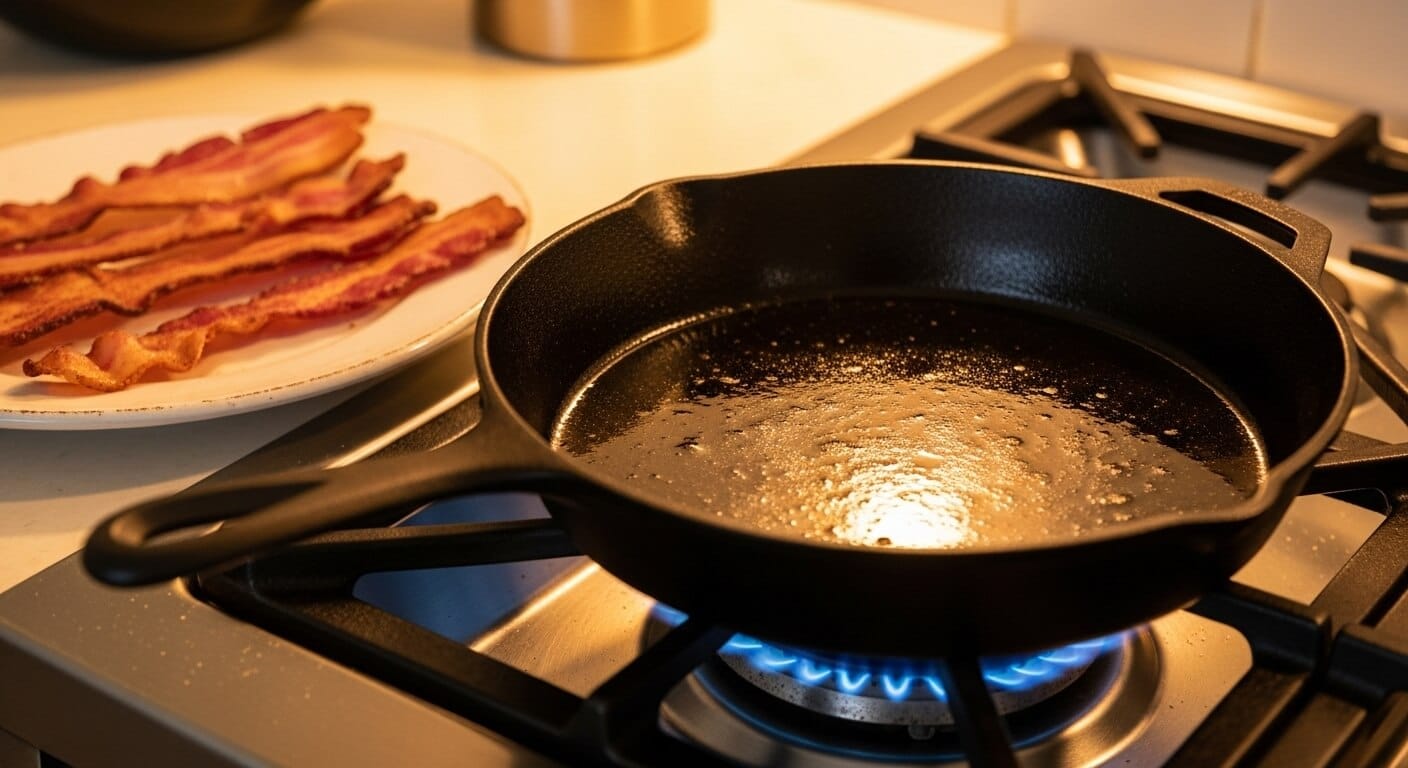
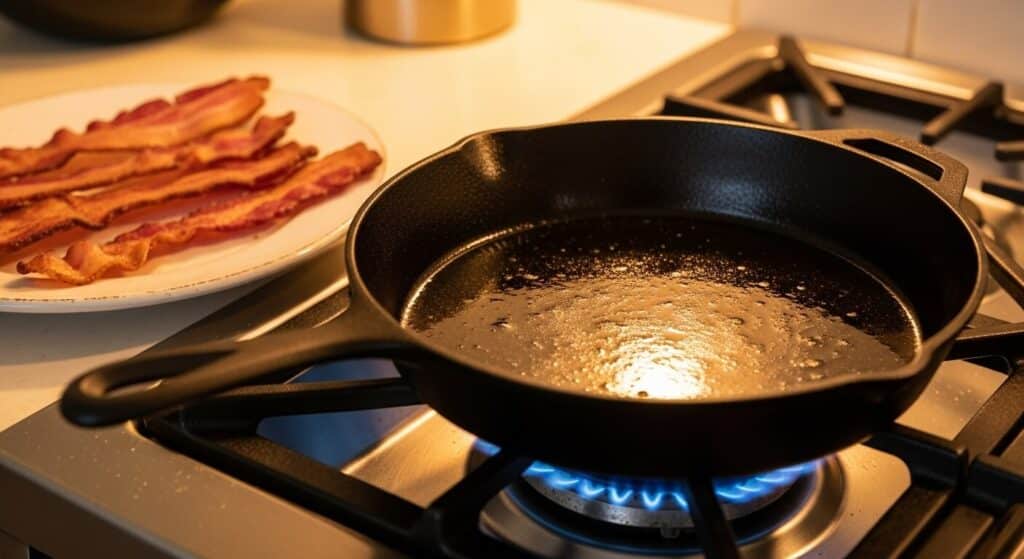
Why does bacon build better seasoning than pure lard at the same temperature? Protein interactions? Maillard products? Something else?
Nobody knows for sure yet. There’s complexity we’re still unraveling.