Understanding the Self-Sustaining Seasoning Process
Your cast iron skillet maintains and improves its seasoning automatically through regular cooking—no special treatments required.
Here’s the thing: seasoning isn’t a one-time event. It’s happening every single time you cook. Every time you heat oil in that pan, you’re building layers. The process feeds itself.
What Makes Cast Iron Seasoning “Never-Ending”
The seasoning on your skillet regenerates with each use because cooking naturally replicates the seasoning process.
Think about what you do when you formally season a pan. You apply oil, heat it past its smoke point, let it polymerize. Right?
Now think about cooking dinner. You add fat to the pan, crank up the heat, cook your food. Same process. Just with the bonus of eating something delicious at the end.
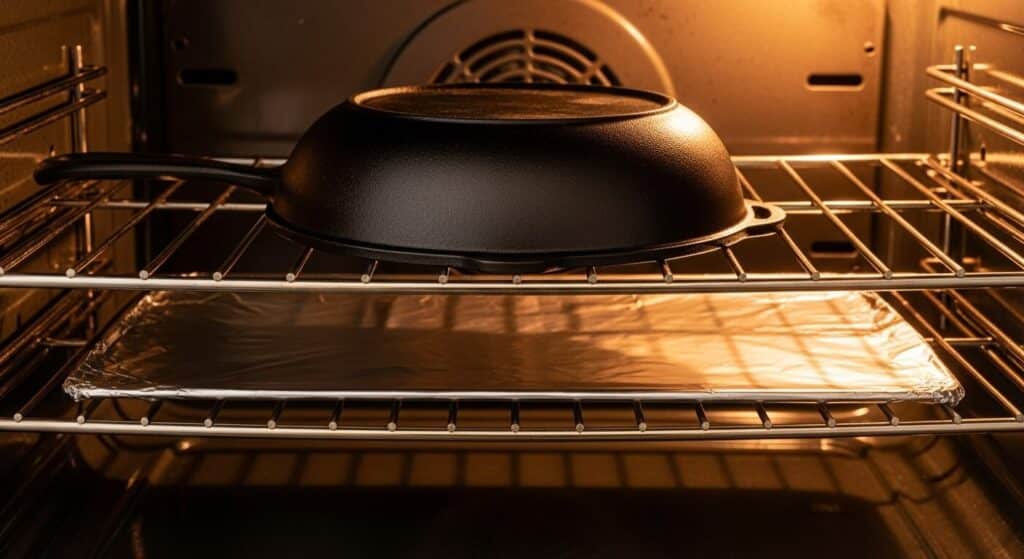
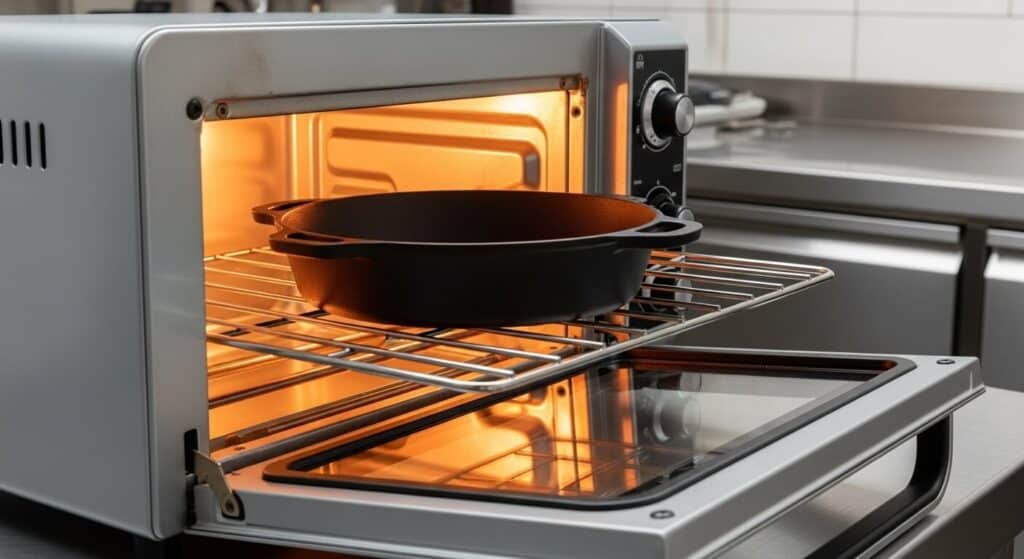
The layers you built during that initial oven seasoning? They’re the foundation. But they’re not the whole story. Every stir-fry adds a whisper-thin layer. Every seared steak contributes. Over months and years, these microscopic additions create a surface that outperforms any factory seasoning.
Some pans have been in daily use for 50+ years. Never been stripped and re-seasoned. Just cooked in, cleaned, repeat.
The Science Behind Polymerization During Cooking
Polymerization occurs when fats heated above 400°F bond to iron at the molecular level, creating a hard, slick surface—and this happens during normal stovetop cooking, not just in the oven.
When oil gets hot enough, its molecules break down and reform into something new. They cross-link. They attach to the iron surface and to each other, building a polymer chain similar to plastic.
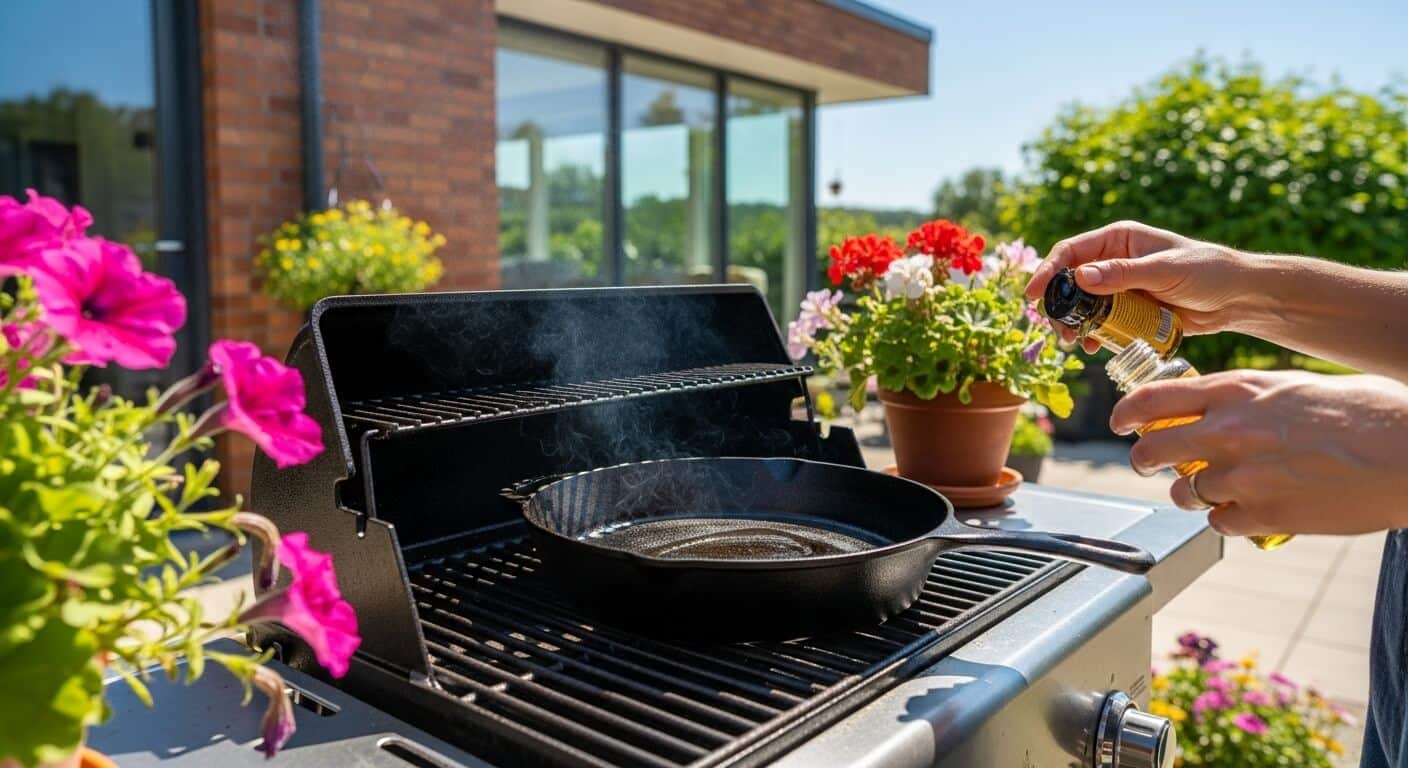
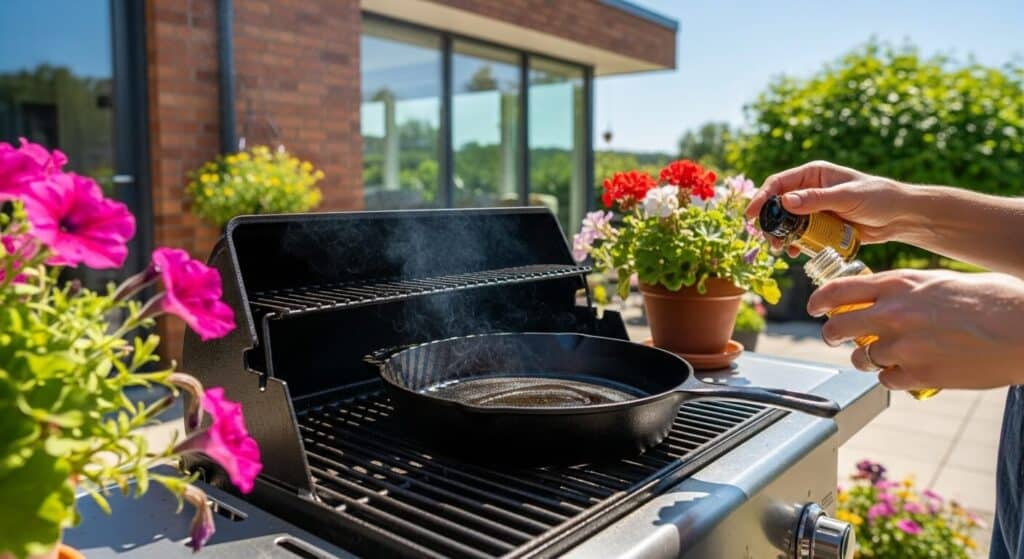
You don’t need an oven for this. A hot burner works just fine.
The smoke point matters here. When oil starts smoking, polymerization accelerates. That’s why high-heat cooking builds seasoning faster than gentle simmering. You’re literally watching the process happen when you see that shimmer and smoke.
But even below the smoke point, you’re still building layers. Slower, sure. But it’s happening.
Why Your Skillet Gets Better With Age and Use
Cast iron skillets improve over time because accumulated cooking layers create an increasingly smooth, non-stick surface that’s more durable than any single seasoning session could produce.
New seasoning is thin. Fragile, even. It’ll work, but it’s not robust yet.
A pan that’s been used for years? That thing has hundreds of micro-layers. They fill in the rough spots in the iron. They build on each other. The surface gets smoother, darker, more naturally non-stick with every meal.
This is why vintage cast iron is so prized. A 1950s Griswold that’s been in constant use has a seasoning you can’t replicate in a weekend. It takes time. It takes cooking.
And here’s what’s sneaky good about this process—it’s self-correcting. Small damage repairs itself. A spot that gets scraped during cleaning? The next few cooking sessions will fill it back in. The seasoning wants to be there.
How Everyday Cooking Naturally Maintains Your Skillet’s Seasoning
Regular cooking maintains your skillet’s seasoning by continuously depositing thin layers of polymerized fat with each use, making formal re-seasoning largely unnecessary.
You’re not trying to maintain the seasoning. You’re just making dinner. The maintenance is the side effect.
The Role of Cooking Oils and Fats in Continuous Seasoning
Cooking oils and fats maintain seasoning by polymerizing onto the pan’s surface during heating, with each meal adding microscopic protective layers.
Animal fats are traditional. And they work. But they’re not necessarily better for seasoning despite what your grandmother might’ve said. They create softer layers that can get tacky if you don’t cook frequently enough.
Refined vegetable oils? They’re actually superior for building hard, durable seasoning. Higher smoke points help. Neutral flavor doesn’t hurt either.
Temperature Ranges That Promote Seasoning During Normal Use
Cooking temperatures between 375°F and 500°F actively build seasoning, with higher temperatures creating faster polymerization.
Low and slow doesn’t cut it for seasoning maintenance. You need heat.
Braising at 275°F? You’re not building much. Searing a steak at 475°F? Now we’re talking. The difference is dramatic.
This doesn’t mean you can’t use your pan for gentle cooking. It just means those low-temp sessions aren’t contributing much to your seasoning. They might even be neutral—not building, not removing, just using.
The sweet spot is medium-high to high heat with adequate fat. That’s where the magic happens during everyday cooking.
Foods That Actively Improve Your Skillet’s Surface
Certain foods naturally enhance seasoning by releasing fats during cooking while requiring high heat, making them ideal for maintaining your pan.
Duck breast — Massive fat content, seasons like crazy (if you’re fancy)
Stir-fried vegetables — Not high-fat themselves, but cooked in lots of oil at extreme heat
Notice a pattern? Protein and fat, high heat. That’s the formula.
Vegetables can work great too if you use enough oil and get the heat up. A proper stir-fry at screaming hot temps will build seasoning faster than a gently cooked piece of fish.
Why Searing and Sautéing Build Superior Layers
Searing and sautéing build excellent seasoning because they combine high surface temperatures with constant fat contact, creating ideal polymerization conditions.
When you sear a steak, the pan hits 450°F+. The beef fat mingles with whatever oil you started with. Both polymerize onto the surface.
Sautéing keeps food moving. Oil coats the entire cooking surface. Nothing sits dry. The constant motion spreads the fat evenly, and high heat does its thing.
Compare that to baking cornbread in your skillet. Sure, there’s some fat in the batter. But it’s not the same. The heat’s lower, the fat contact is different, the process doesn’t build seasoning the same way.
Active cooking methods beat passive ones. Always.
The Daily Cooking Cycle: Clean, Cook, Repeat
The clean-cook-repeat cycle maintains seasoning by removing food residue without damaging underlying layers, then immediately rebuilding during the next cooking session.
This is the rhythm that keeps cast iron healthy. It’s simple.
Cook dinner. Clean the pan while it’s still warm. Dry it completely. Maybe wipe it with a thin layer of oil (more on that later). Cook breakfast the next morning. Repeat.
Each cycle removes the food particles that could go rancid or interfere with the seasoning. Each cooking session adds back a fresh micro-layer. The seasoning stays clean, smooth, and constantly renewing.
Break the cycle—let the pan sit unused for weeks—and things get wonky. The seasoning isn’t getting reinforced. Moisture in the air can cause issues. You might get surface rust (which is fixable, but annoying).
Daily use is protective. The cooking itself is the best preservation method.
Cooking Methods That Strengthen Your Never-Ending Seasoning
Different cooking methods affect seasoning quality, with high-heat techniques using adequate fat providing the most significant seasoning benefits during everyday use.
Not all cooking is created equal when it comes to seasoning maintenance.
Pan-Frying: The Ultimate Seasoning Maintenance Technique
Pan-frying maintains seasoning exceptionally well because it submerges the cooking surface in hot fat for extended periods, maximizing polymerization.
When you pan-fry, the oil level comes up the sides of whatever you’re cooking. Maybe 1/4 inch deep. Maybe more. The entire cooking surface is bathed in fat that’s at or above its smoke point.
This is basically continuous seasoning. The whole time your chicken cutlets are frying, your pan is getting better.
How Oil Temperature Creates Durable Bonds
Oil between 350°F and 375°F creates the strongest seasoning bonds because this temperature range promotes complete polymerization without burning or degrading the fat.
Too cold, the oil doesn’t break down properly. Too hot, it carbonizes before it can form proper polymer chains.
That middle zone? Perfect. And it happens to be exactly where most pan-frying occurs. Coincidence? Nope. Generations of cooks figured out what worked, even if they didn’t know the chemistry.
When you hear that gentle sizzle—not violent popping, not quiet bubbling—you’re in the right range. The oil is hot enough to polymerize but not so hot that it’s destroying itself.
The Perfect Balance of Heat and Fat
Ideal seasoning during cooking requires enough fat to coat the surface (about 1-2 tablespoons for a 10-inch skillet) and temperatures between 375°F and 450°F.
Skimping on fat is a mistake. You need enough to coat the cooking surface. If there are dry spots, those spots aren’t getting seasoned.
But drowning the pan isn’t necessary either unless you’re deep frying. A thin, even coating works for most cooking.
The temperature matters more than the amount. Hot fat in constant contact with iron—that’s the goal.
Searing Meats and Building Protective Layers
Searing meat builds seasoning rapidly because the combination of rendered animal fats and high surface temperatures (450°F+) creates immediate polymerization.
Drop a steak in a screaming hot pan. It sizzles violently. Fat renders out instantly. The surface is so hot that polymerization happens in real-time.
You can actually see the pan get darker and more lustrous after a good searing session. That’s fresh seasoning.
And it’s durable stuff. High-heat polymerization creates tight, hard layers that resist scratching and wear. These layers are doing serious work protecting your pan.
Shallow Frying and Its Seasoning Benefits
Shallow frying with 1/4 to 1/2 inch of oil provides excellent seasoning maintenance by keeping the cooking surface continuously coated in polymerizing fat.
This is like pan-frying’s bigger sibling. More oil, slightly lower temp usually, longer cooking times.
Think fried chicken. Schnitzel. Fish fillets. You’re cooking for 5-10 minutes per side with constant oil contact. The seasoning is basically bathing in exactly what it needs to stay healthy and build new layers.
The oil you pour off after shallow frying has done its job. It’s fed you and maintained your pan. Win-win.
Roasting Vegetables: An Underrated Seasoning Method
Roasting vegetables in cast iron maintains seasoning effectively when done with adequate oil at temperatures above 400°F, though it works more slowly than stovetop methods.
Toss Brussels sprouts in oil. Spread them in your skillet. Roast at 425°F for 30 minutes.
During that time, the oil is polymerizing. Slowly, yes. It’s not as intense as stovetop searing. But it’s happening. And the vegetables protect the seasoning from direct oven heat while contributing their own moisture and sugars to the process.
Roasted vegetables won’t build seasoning as fast as searing a steak. But they’re absolutely contributing. And they’re delicious, so that helps.
The Chemistry of How Everyday Cooking Maintains Your Skillet
Everyday cooking maintains seasoning through the same chemical process as formal seasoning—heat-triggered polymerization of fats—but in countless small increments rather than a few intensive sessions.
The chemistry doesn’t care whether you’re “seasoning” or “cooking dinner.” It just responds to heat and fat.
Oil Oxidation and Carbon Bond Formation During Cooking
When cooking oils are heated above 400°F in the presence of iron, they oxidize and form carbon-carbon bonds that attach to the metal surface and cross-link with each other, creating a durable polymer coating.
Oxidation sounds bad. Usually it is—think rancid oil or rusty iron. But controlled oxidation during high-heat cooking is exactly what you want.
The fat molecules break apart. They grab oxygen from the air. They recombine in new configurations. The iron surface catalyzes the reaction. The new polymers bond to the metal at the molecular level.
This isn’t oil sitting on top of iron. This is a chemical bond. The seasoning is part of the pan now.
And because it happens during cooking, you’re building layers that have food particles, sugars, proteins, and various cooking residues incorporated into them. This creates a more complex, multi-layered seasoning than pure oil alone.
Some people think that makes it inferior. They’re wrong. That complexity is what gives well-used pans their superior performance.
How Heat Transforms Cooking Fats Into Seasoning
Heat above the smoke point breaks down triglyceride molecules in cooking fats, releasing free fatty acids that polymerize into a hard, plastic-like coating bonded to the iron surface.
Below the smoke point, oil is just oil. It gets hot, it cooks your food, it mostly stays liquid.
Above the smoke point, chemistry happens. The triglycerides—that’s the structure of all cooking fats—fall apart. Free fatty acids go wild. They cross-link. They form long-chain polymers.
You’ve turned food into something closer to a hard plastic. Which sounds weird. But that’s exactly what seasoning is. A food-grade polymer coating.
Every time you cook hot enough to see a little smoke, you’re running this reaction. The coating gets thicker, harder, smoother.
The Difference Between Initial Seasoning and Maintenance Seasoning
Initial oven seasoning creates a base layer in controlled conditions, while maintenance seasoning from cooking adds varied, complex layers incorporating different fats and cooking residues that ultimately perform better.
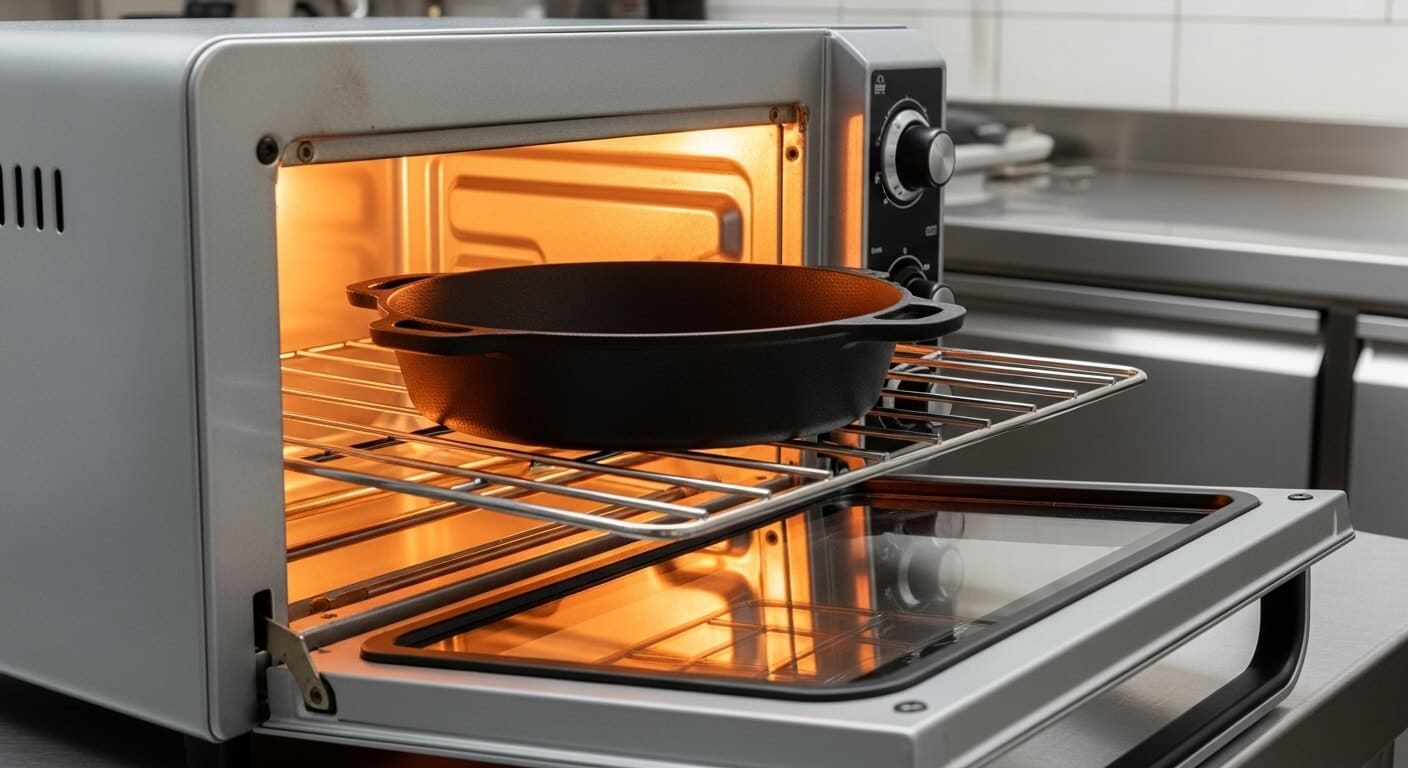
When you season a pan in the oven, you control everything. One type of oil, specific temperature, precise timing. You get consistent layers.
When you cook, it’s chaos. Different oils, varying temperatures, proteins and sugars from food, moisture, everything mixed together. The layers are inconsistent, varied, imperfect.
And somehow, those imperfect layers work better.
Maybe it’s the variety of fats. Maybe it’s the proteins filling in gaps. Maybe it’s just that cooking layers are work-hardened—they’re built while the pan is being used, so they’re optimized for actual use.
Whatever the reason, a pan that’s been cooked in for a year beats a freshly-seasoned pan every time. The foundation matters. But the accumulated cooking layers are what make it truly great.
Why Multiple Thin Layers Beat Thick Applications
Thin layers from repeated cooking create harder, more durable seasoning than thick applications because they polymerize more completely and bond more tightly to the metal surface.
Thick layers are tempting. More is better, right?
Wrong.
Thick seasoning is brittle. It flakes. It can peel if you look at it wrong. The outer parts don’t bond well because they’re too far from the iron surface to form strong chemical bonds.
Thin layers bond completely. Every molecule is close enough to the metal to attach. The polymer chains are tight and strong.
Cooking naturally produces thin layers. You’re not pouring a quarter-inch of oil in your pan (usually). You’re using just enough. Each session adds a microscopic layer. Over time, those add up to something substantial but still properly bonded.
It’s the difference between one coat of thick paint and ten coats of properly applied finish. The latter wins every time.
Common Cooking Practices That Support Never-Ending Seasoning
Several everyday cooking habits support continuous seasoning maintenance, with proper preheating and adequate fat being the most critical factors.
You don’t need special techniques. Just good habits.
Proper Preheating for Optimal Seasoning Development
Preheating your skillet for 3-5 minutes before adding oil ensures even heat distribution and brings the surface to the temperature needed for effective polymerization during cooking.
Cold pan, cold oil, add food—that’s the wrong sequence for seasoning maintenance (though it works fine for some foods).
Better sequence: Heat the empty pan over medium to medium-high for a few minutes. Let the entire surface come up to temperature. Then add your fat.
Why? Because an evenly heated pan polymerizes evenly. A pan with hot and cold spots builds uneven seasoning. Also, adding oil to a hot pan prevents it from sitting on the surface too long at low temps, which can make it gummy.
You’ll know the pan is ready when water droplets dance across the surface. That’s around 400°F. Perfect.
The Importance of Adequate Fat in Every Cook
Using sufficient cooking fat (1-2 tablespoons minimum for a 10-inch skillet) ensures the entire cooking surface contacts polymerizable oil during heating.
Dry cooking is the enemy of seasoning maintenance.
If you’re trying to cut calories by using cooking spray or a bare pan, that’s your choice. But you’re not doing your seasoning any favors. Those dry spots? They’re not getting maintained. They might even deteriorate slightly.
Enough fat means:
Complete surface coverage
No dry patches during cooking
Proper heat transfer (which helps cooking performance too)
Continuous seasoning deposition
Don’t drown the pan. But don’t be stingy either.
How Cooking Frequency Impacts Seasoning Quality
Frequent cooking—ideally daily or every other day—maintains seasoning better than occasional use because regular polymerization prevents oxidation and keeps the surface stable.
A cast iron pan that’s used daily is essentially self-cleaning at the molecular level. Food residue gets cooked off. Fresh layers cover old ones. The surface stays active and protected.
A pan that sits unused for weeks? The seasoning goes dormant. It’s not getting reinforced. Environmental moisture can penetrate. You might get a sticky surface or even light rust.
Daily Use vs. Occasional Use: What Changes
Daily cooking builds consistent, hard layers while weekly or monthly use allows seasoning to degrade between sessions, requiring more intensive maintenance.
Daily use pans:
Smooth, glossy surface
Darkens quickly
Develops natural non-stick properties fast
Self-repairing (minor damage fixes itself)
Rarely needs extra attention
Occasional use pans:
Slower seasoning development
May develop sticky spots between uses
Surface can look dull or matte
Might need periodic stovetop seasoning sessions
More prone to rust if storage isn’t perfect
The difference isn’t huge. But it’s real. If you can’t cook daily, just be aware your seasoning will develop more slowly.
The Minimum Cooking Frequency for Maintenance
Using your skillet at least twice per week provides enough polymerization activity to maintain existing seasoning and prevent degradation.
Twice a week is the floor. Below that, you’re in occasional-use territory. The seasoning will hold, but it won’t improve much.
Three to four times per week is better. You’ll see steady improvement.
Daily? That’s when cast iron really shines. The seasoning becomes almost indestructible.
Temperature Control and Even Seasoning Distribution
Maintaining consistent medium to medium-high heat during cooking creates even seasoning distribution, while temperature extremes or hot spots cause uneven layer development.
Cast iron heats slowly but holds heat aggressively. This is a feature, not a bug. But it means you need to preheat properly and avoid blasting it on high heat constantly.
Cranking your burner to maximum doesn’t make cast iron heat faster. It just creates a screaming hot spot in the center and cool zones around the edges. Your seasoning develops unevenly. Food cooks unevenly. Nothing good comes from it.
Medium to medium-high heat handles most cooking. High heat is for specific tasks like searing. Low heat works for gentle cooking but doesn’t build seasoning.
Heat level guide:
Low (1-3) — Warming, melting butter, keeping food hot (no seasoning benefit)
Medium (4-5) — Eggs, pancakes, gentle sautés (minimal seasoning benefit)
Medium-high (6-7) — Most cooking, sautéing, pan-frying (active seasoning zone)
High (8-9) — Searing, stir-fry, bringing water to boil (maximum seasoning benefit)
Foods and Techniques That Work Against Your Seasoning
Certain foods and cooking methods can temporarily damage seasoning, though well-established seasoning from regular use can handle occasional challenging cooks without significant degradation.
Not everything is good for your pan. Some things actively strip seasoning.
Acidic Foods: Understanding the Impact on Seasoning Layers
Acidic ingredients can break down seasoning by chemically reacting with the iron surface, but brief cooking times and well-established seasoning minimize this effect.
Acid is cast iron’s traditional enemy. And yeah, it can cause problems.
Tomatoes, Wine, and Vinegar in Cast Iron
Tomato-based sauces, wine, and vinegar can strip new seasoning but barely affect well-seasoned pans used regularly, especially if cooking time is under 30 minutes.
Here’s the truth: acidic foods won’t destroy your seasoning if your pan has a solid foundation and you’re not simmering them for hours.
A quick pan sauce with wine? Fine. Some crushed tomatoes in your sauté? No problem. A three-hour marinara from scratch? Maybe use a different pan.
The acid reacts with iron (not the seasoning directly, but it can penetrate weak spots). With new or thin seasoning, you might get a metallic taste in your food and some damage to the coating. With thick, well-established seasoning from months of cooking, the acid can’t penetrate easily.
Guidelines for acidic foods:
Well-seasoned pan (6+ months regular use) — can handle most acidic cooking under 45 minutes
Moderately seasoned pan (2-6 months use) — keep acidic cooking under 20 minutes
And look, if you occasionally cook something acidic and your seasoning gets a little damaged, it’s not the end of the world. Your next few regular cooking sessions will repair it. That’s the whole point of never-ending seasoning.
How Long-Established Seasoning Handles Acidity
Seasoning that’s been built up through a year or more of regular cooking can resist acidic foods effectively because multiple layers provide barriers between acid and bare iron.
A pan with 50+ layers of seasoning (which happens naturally after consistent use) is basically acid-resistant. The tomato sauce can’t get through all those layers to reach the iron.
You still wouldn’t want to store acidic leftovers in the pan overnight. But cooking with acidity becomes a non-issue once your seasoning is mature.
This is another reason why cooking-based seasoning beats oven seasoning. The complexity and depth of the layers provides better protection.
Boiling and Simmering: When Water Interferes
Boiling water and prolonged simmering don’t build seasoning and can soften existing layers, making these cooking methods neutral or slightly negative for maintenance.
Water and oil don’t mix. Water and seasoning maintenance don’t mix either.
When you boil water in cast iron, the pan is hot but wet. There’s no fat to polymerize. No new layers forming. The heat is also typically lower—212°F at sea level—which is well below the seasoning zone.
Worse, extended simmering in liquid can actually soften seasoning layers slightly. They don’t wash away or anything dramatic. But they’re not getting stronger either.
Boiling water for pasta? Not ideal, but whatever. Making soup occasionally? Fine. Using your cast iron as your primary stockpot? You’re not doing the seasoning any favors.
Sticky Sauces and Sugary Glazes: Managing Difficult Cooks
Sugar-heavy foods can carbonize onto the cooking surface, creating buildup that requires thorough cleaning and may temporarily disrupt the seasoning layer.
Teriyaki glaze. Barbecue sauce. Honey. Anything with significant sugar content.
These can be tricky. The sugar caramelizes, which is great for flavor. But it can also bond to your seasoning in ways that are hard to clean. You end up with carbonized sugar deposits that feel rough and can make subsequent cooking sticky.
It’s not permanent damage. But it’s annoying. You might need to scrub harder than usual, which can remove some seasoning along with the sugar.
How to handle sugary foods:
Use adequate oil to prevent direct sugar-to-pan contact
Don’t let glazes sit in the hot pan after cooking (serve immediately)
Clean thoroughly while the pan is still warm
Accept that you might need to rebuild a thin layer or two after
Or just use a different pan for sticky-sweet stuff. Stainless steel doesn’t care about sugar.
The Cleaning Process That Preserves Never-Ending Seasoning
Proper cleaning removes food residue without damaging seasoning layers, making it essential for maintaining the never-ending seasoning cycle.
Cleaning is where people get weird about cast iron. They overthink it.
Why Proper Cleaning After Cooking Maintains Layers
Cleaning removes food particles that would otherwise carbonize or go rancid, keeping the seasoning surface clean and ready to accept new polymerized layers during the next cooking session.
Dirty pan = bad seasoning environment. Food residue sitting on the surface can:
Turn rancid (gross)
Carbonize into hard, rough spots during next use
Prevent new seasoning from bonding properly
Make food stick during subsequent cooking
Smell weird
Clean pan = good seasoning environment. The smooth surface is ready for the next layer. No interference. No problems.
The Hot Water and Scrubbing Method
Washing cast iron with hot water and a stiff brush or scrubber while the pan is still warm removes food residue effectively without soap, preserving seasoning through mechanical action alone.
The basic method works great:
Let the pan cool slightly (not cold, just not screaming hot)
Run hot water over it
Scrub with a brush, scrubber, or chainmail scrubber
Rinse
Dry immediately
That’s it. The heat helps loosen stuck-on food. The hot water and scrubbing do the rest.
No soap needed for most cleaning. The seasoning is polymerized—it’s not going to dissolve in water. But food residue? That’ll come off with mechanical action.
When to Use Salt as an Abrasive
Coarse salt works as a gentle abrasive for stuck-on food when combined with a small amount of oil, scrubbing without damaging seasoning layers.
Got something really stuck? Salt scrub.
Add a tablespoon of coarse salt to the warm pan. Add a tiny bit of oil (or use the pan while it’s still slightly oily from cooking). Scrub with a paper towel or cloth. The salt acts like gentle sandpaper.
This works on carbonized bits that won’t come off with just water and a brush. And it’s way less aggressive than metal scrubbers (though those are fine too if you’re not going crazy with them).
Rinse out the salt after. Dry the pan. Done.
The Role of Minimal Soap in Modern Cast Iron Care
Modern dish soap won’t harm polymerized seasoning because it’s designed to cut grease, not break chemical bonds, making small amounts of soap acceptable for occasional deep cleaning.
Here’s where the internet fights happen.
Traditional advice: Never use soap on cast iron. It’ll strip the seasoning.
Modern reality: A little soap is fine. Today’s dish soaps aren’t lye-based like old soaps were. They can’t actually break the polymer bonds in seasoning.
If your pan is really greasy or you cooked something fishy, a drop of soap and a quick scrub won’t hurt anything. Just don’t soak the pan in soapy water for an hour.
Most of the time, hot water and scrubbing are enough. But soap isn’t forbidden. Use it if you need it.
Drying Techniques That Prevent Damage
Immediate, thorough drying prevents rust formation on exposed iron while leaving seasoned surfaces unaffected, making it essential after every wash.
Water on bare iron = rust. Fast.
Cast iron is porous. Water can get into tiny gaps in the seasoning. If you let it air dry, you’re asking for rust spots.
Drying methods that work:
Wipe thoroughly with a towel immediately after washing
Place on a warm burner for 1-2 minutes to evaporate any remaining moisture
Heat in a low oven (200°F) for 5-10 minutes if you’re paranoid
That second method—putting the washed pan on a warm burner—is the best. It dries everything completely, including moisture you can’t see. Plus it’s fast.
The Post-Cleaning Oil Wipe: Essential or Optional?
Wiping a thin layer of oil onto a clean, dry pan after washing provides protection between uses but isn’t strictly necessary if you cook daily.
This is controversial. Some people never skip it. Others never do it.
Truth? It depends on your cooking frequency.
Oil wipe is helpful if:
You cook less than 3-4 times per week
You live in a humid climate
Your seasoning is still developing (under 6 months old)
You have storage issues (stacking pans, limited air circulation)
Oil wipe is optional if:
You cook daily
Your seasoning is well-established
You store the pan properly
You live in a dry climate
If you do wipe oil on, use the tiniest amount. Seriously. A few drops. Wipe it on, then wipe it off like you’re trying to remove it. There should be no visible oil left. Just a whisper of protection.
Too much oil sitting on the surface goes rancid or gets sticky. Thin coat or nothing.
Real-World Cooking Scenarios and Seasoning Maintenance
Different daily cooking scenarios provide varying seasoning benefits, with high-heat protein cooking building the strongest layers and gentle breakfast cooking providing moderate maintenance.
Let’s get practical. What actually happens when you cook real food?
Breakfast Cooking: Eggs, Bacon, and Seasoning Development
Breakfast cooking provides excellent seasoning maintenance when it includes fatty proteins like bacon but requires proper technique for eggs to avoid damage.
Morning cooking can go either way for your seasoning.
Why Bacon is Called “Cast Iron’s Best Friend”
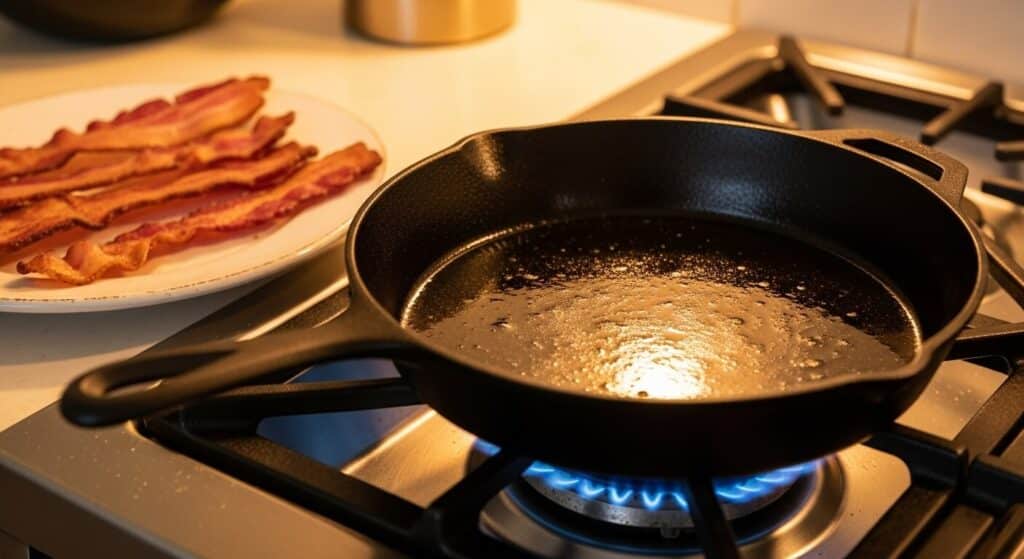
Bacon continuously releases fat while cooking at moderate-high heat, coating the pan’s surface with polymerizable grease that builds seasoning layers while you cook breakfast.
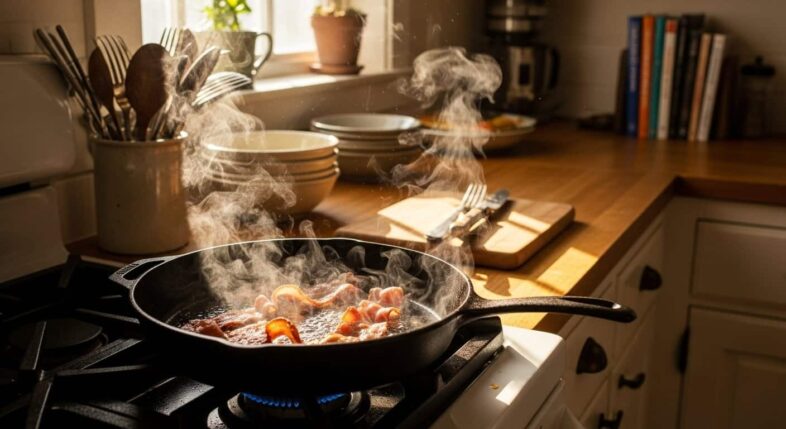
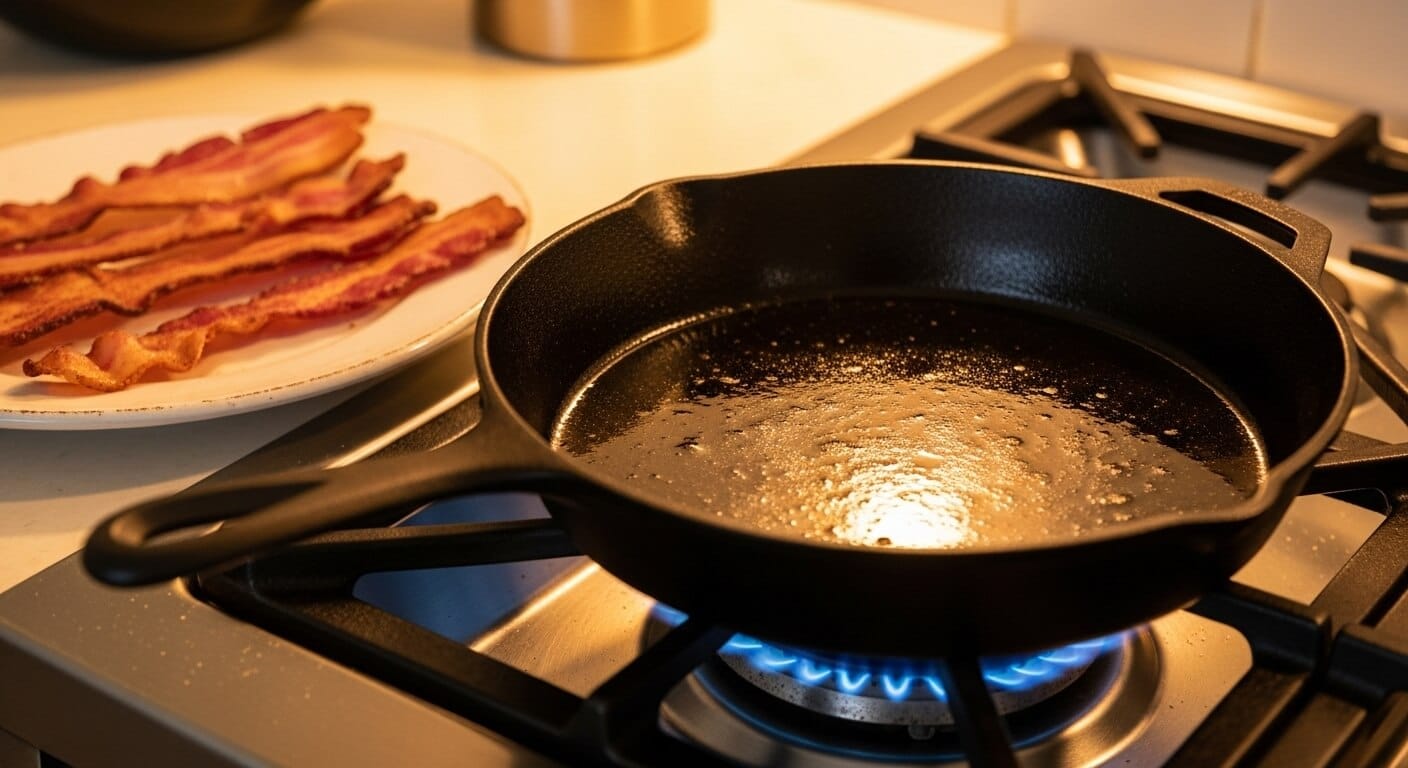
Bacon is perfect. It’s fatty. It needs heat. It takes several minutes to cook properly. During that time, it’s basically seasoning your pan for you.
The fat renders out. It coats the entire surface. The temperature is right in the seasoning zone (around 375°F for proper bacon cooking). By the time your bacon is crispy, your pan has a fresh micro-layer of seasoning.
People who cook bacon daily in cast iron have the best-seasoned pans. This is not a coincidence.
Plus you get bacon. Hard to beat that.
Achieving Non-Stick Eggs Through Regular Use
Eggs become truly non-stick in cast iron after 6-12 months of regular cooking builds enough seasoning layers to create an ultra-smooth surface that releases eggs easily with adequate fat and proper heat.
Eggs are the cast iron test. Everyone wants to cook eggs without sticking.
New pan? Eggs stick. Accept it.
Pan with a few months of cooking? Eggs work okay if you’re careful with temperature and fat.
Pan with a year of daily use? Eggs slide around like the pan is Teflon.
The egg technique that works:
Preheat pan properly (2-3 minutes on medium-low)
Add fat (butter or oil, don’t be stingy)
Let the fat heat until shimmering
Add eggs
Don’t touch them for the first 30-60 seconds
Cook gently, don’t crank the heat
It’s not magic. It’s adequate seasoning plus proper technique.
Weeknight Dinners That Build Your Skillet’s Surface
Quick weeknight cooking with adequate fat and medium-high heat provides consistent seasoning maintenance that gradually improves your pan over months of regular use.
This is where the never-ending seasoning really happens. Not in special cooking sessions. In regular Tuesday night dinner.
Stir-Fries and Quick Sautés
Stir-frying at high heat with oil coating the pan’s sides builds seasoning rapidly while quick sautés at medium-high heat provide steady maintenance during everyday cooking.
A proper stir-fry might be the single best thing you can do for cast iron seasoning.
High heat—like, really high. Smoking oil. Food moving constantly. The oil gets flung up the sides of the pan. Every surface gets coated. The polymerization is happening in real-time.
Ten minutes of stir-frying beats an hour of gentle simmering for seasoning development. Not even close.
Quick sautés are nearly as good. Chicken and vegetables, maybe 15 minutes total, medium-high heat, couple tablespoons of oil. Your pan is getting a workout and building layers.
One-Pan Meals and Seasoning Benefits
One-pan meals that start with searing protein and finish with vegetables cooked in the rendered fat provide comprehensive seasoning coverage across the entire cooking surface.
Sear chicken thighs. Remove them. Cook vegetables in the rendered fat. Put the chicken back. Finish in the oven if needed.
This type of cooking is beautiful for seasoning because:
High initial heat (searing phase)
Plenty of fat (from the protein)
Complete surface coverage (vegetables get pushed around everywhere)
Extended cooking time (more polymerization)
You’re getting dinner and maintaining your skillet simultaneously. Efficient.
Weekend Projects: Deep Frying and Intensive Seasoning
Deep frying submerges the cooking surface in hot oil for extended periods, building thick seasoning layers faster than any other cooking method.
Want to fast-track your seasoning? Fry some chicken.
Deep frying means the entire interior of your skillet is covered in 350-375°F oil for 20-30 minutes. The seasoning is literally bathing in perfect conditions.
One deep-frying session can add as much seasoning as a week of regular cooking. It’s intense.
The catch? You need enough oil to cover your food (2-3 cups depending on pan size). And you’re committing to the whole fried food experience. But if you’re doing it anyway, know that your pan is getting absolutely spoiled with fresh seasoning.
Recognizing a Well-Maintained, Never-Ending Seasoning
Well-maintained seasoning displays specific visual and performance characteristics that indicate healthy continuous development through regular cooking.
How do you know it’s working?
Visual Indicators of Healthy Seasoning
Healthy seasoning appears as a dark, smooth, semi-glossy surface with even coloration and no sticky, flaky, or rough patches.
Look at your pan. What do you see?
The Dark, Glossy Finish of Regular Use
Seasoning darkens from golden-brown to deep black over months of use, developing a slight sheen that indicates properly polymerized layers.
New seasoning might be bronze or brown. That’s fine. Keep cooking.
After a few months, it’ll darken to deep brown. Eventually, black. Really well-used pans are almost mirror-black in the cooking surface.
The glossy finish comes from the layers smoothing out. New seasoning is a bit matte. Established seasoning has a subtle shine—not wet-looking, just smooth and light-reflective.
If your pan is getting darker and smoother over time, you’re doing it right.
Understanding Seasoning Color Variations
Uneven coloring is normal during seasoning development, with high-use areas darkening faster than edges or sides that receive less direct heat and fat contact.
Your pan doesn’t have to be perfectly uniform in color. The center, where you cook most food, will probably be darker than the edges. The sides might be lighter than the bottom.
That’s fine. It just means the center is getting more seasoning action because that’s where the heat and fat concentrate.
What’s not fine: Light spots that are rough or rusty. Those indicate seasoning breakdown. They need attention.
But color variation itself? Normal. Don’t stress about it.
Performance Signs: When Your Skillet Is Properly Maintained
Properly seasoned cast iron releases food easily with minimal sticking, heats evenly, and requires less oil over time as the surface becomes increasingly non-stick.
Performance tells you more than appearance.
Natural Non-Stick Qualities
Food releases cleanly from well-seasoned cast iron when cooked with proper heat and adequate fat, with less force required to unstick food as seasoning matures.
You know your seasoning is working when:
Eggs slide around instead of welding themselves to the pan
Pancakes flip easily with a spatula
Seared meat releases when it’s ready (doesn’t rip or tear)
Vegetables move freely when stirring
Clean-up takes 30 seconds instead of 10 minutes
It won’t be Teflon. Cast iron never is. But it should be easy. If you’re fighting the pan constantly, your seasoning needs work.
Even Heat Distribution and Retention
Well-maintained cast iron with proper seasoning heats evenly across the cooking surface and maintains steady temperature during cooking, indicating healthy layer development.
Seasoning actually improves heat distribution slightly by filling in microscopic surface irregularities. Weird but true.
A well-seasoned pan should:
Heat relatively evenly (cast iron will never be perfectly even, but it shouldn’t have wild hot spots)
Hold temperature steady when you add food
Brown food uniformly if preheated properly
If everything cooks faster on one side, you might have uneven seasoning development. Or you might just need to preheat longer.
Texture: What a Mature Seasoning Feels Like
Mature seasoning feels smooth and slightly slick to the touch, not rough, sticky, or dusty, with a surface texture smoother than the underlying iron.
Touch your pan. What does it feel like?
Good seasoning: Smooth, maybe a tiny bit of texture from the iron underneath, dry to the touch, slightly slippery feeling (like touching plastic or resin).
Bad seasoning: Sticky or tacky (oil hasn’t polymerized), rough with hard bumps (carbonized food), dusty or flaky (seasoning breaking down), super rough all over (needs more layers).
The pan should feel pleasant to touch. That’s not a technical term, but you’ll know it when you feel it.
Troubleshooting Seasoning Issues During Everyday Cooking
Common seasoning problems during regular use can usually be fixed through minor technique adjustments rather than complete re-seasoning.
Something’s not right. Now what?
Dealing With Sticky Spots After Cooking
Sticky residue after cooking usually indicates excess oil that didn’t polymerize or sugar-based food residue, both fixable through additional heating or thorough cleaning.
Your pan feels tacky after cleaning. Annoying.
What Causes Tackiness During Normal Use
Stickiness occurs when too much oil sits on the surface at low temperatures, creating partially polymerized gummy residue instead of hard seasoning layers.
This happens when:
You apply too much oil after cleaning and don’t heat it properly
You cooked something sugary and didn’t clean thoroughly
You used too much fat during cooking and it pooled in spots
The pan didn’t get hot enough to fully polymerize the oil
Quick Fixes Without Full Re-Seasoning
Heat the sticky pan on medium for 5-10 minutes to complete polymerization, or scrub with coarse salt and a small amount of oil to remove the tacky layer.
Option 1: Heat it out. Put the pan on a burner, medium heat, let it sit for 10 minutes. The sticky oil will either polymerize fully (problem solved) or burn off (also problem solved, though it might smoke a bit).
Option 2: Scrub it off. Salt scrub like mentioned earlier. Gets rid of the sticky layer. Then cook something fatty at high heat to rebuild that spot.
Neither approach requires stripping and re-seasoning from scratch. Just fix the problem and move on.
Uneven Seasoning From Regular Cooking Patterns
Seasoning develops unevenly when food consistently cooks in the same spots, leaving other areas with thinner layers that may appear lighter or perform differently.
Most people cook in the center of the pan. Makes sense. But it means the center gets great seasoning while the edges get neglected.
Hot Spots and Their Effect on Maintenance
Hot spots cause accelerated seasoning in specific areas while cooler zones develop slower, creating uneven coloration and performance.
Cast iron heated on a small burner develops a hot center and cooler perimeter. The hot center gets great seasoning. The edges, not so much.
Fix: Use the right size burner for your pan. A 10-inch skillet needs a medium burner, not a small one. Preheat longer to let heat spread. Or just accept that some unevenness is normal.
Adjusting Your Technique for Even Development
Rotate the pan occasionally during preheating, use appropriately sized burners, and consciously cook across the entire surface to develop even seasoning.
Simple tricks:
Rotate the pan 180° halfway through preheating
Deliberately move food to different areas while cooking
Use larger burners when possible
Cook foods that spread across the surface (pancakes, big batches of vegetables)
Or don’t worry about it. Uneven seasoning doesn’t affect cooking performance that much.
When Food Sticks Despite Regular Use
Persistent sticking despite regular cooking usually indicates insufficient preheating, inadequate fat, or premature food movement rather than seasoning failure.
Everything’s sticking. You’re doing everything “right” but nothing works.
Identifying the Root Cause
Test whether sticking results from technique issues by cooking bacon or another fatty protein at medium heat—if this doesn’t stick, your seasoning is fine and you need to adjust your cooking method.
Bacon test. Seriously.
Cook bacon at medium heat. If it sticks badly, your seasoning might actually need work. If it releases fine, your technique is the problem, not the seasoning.
Most sticking is technique:
Pan not hot enough (most common)
Not enough fat
Food moved too soon (let it sear and release naturally)
Heat too high (food burns onto the surface)
Wrong food for the pan’s current seasoning level (eggs need better seasoning than steak)
Temperature and Fat Adjustments
Increase preheating time to 4-5 minutes, use 50% more cooking fat than you think necessary, and avoid moving food for the first 1-2 minutes of cooking.
Try this:
Preheat 5 full minutes. Time it. Don’t guess.
Add more oil or butter than feels right. Use it.
Let food sit undisturbed until it naturally releases (meat will let go when it’s properly seared).
If this fixes the sticking, it was never the seasoning. It was your technique.
The Difference Between Maintenance and Restoration
Never-ending seasoning from cooking handles minor wear automatically but cannot fix severe damage or completely stripped surfaces, which require intentional restoration.
There’s a difference between maintaining what you have and fixing what’s broken.
How Never-Ending Seasoning Reduces Need for Formal Re-Seasoning
Regular cooking naturally repairs minor scratches and thin spots by depositing fresh layers during each use, making complete oven re-seasoning rarely necessary.
Small damage disappears on its own. You scrape the spatula too hard, remove a tiny bit of seasoning. Next three cooking sessions fill it back in. Self-healing.
This is why people with well-used cast iron rarely need to formally re-season. The cooking maintains everything automatically. Minor issues get fixed before they become major problems.
Recognizing When Everyday Cooking Isn’t Enough
Extensive rust, large flaking areas, or completely bare metal spots require intentional seasoning sessions because regular cooking cannot rebuild seasoning fast enough to protect exposed iron.
If you have:
Rust patches bigger than a dime
Bare metal visible across significant areas
Thick, flaking seasoning coming off in chunks
A pan that’s been neglected for years
Then normal cooking won’t fix it. You need to actually address the problem. Strip the pan, re-season from scratch, then start the cooking maintenance cycle.
But if you’ve been cooking regularly, you’ll never reach this point.
Spot Treatment vs. Full Oven Seasoning
Small problem areas can be fixed by scrubbing the affected spot and cooking fatty foods at high heat, while extensive damage requires multiple oven seasoning sessions.
Got one rough spot? Scrub it with salt or steel wool until you’re down to smooth metal (or smooth seasoning, whichever comes first). Cook something fatty. Problem solved.
The cooking-based maintenance can’t fix everything. But it handles way more than people think.
Building an Optimal Cooking Routine for Seasoning Maintenance
Strategic meal planning and cooking method selection can maximize seasoning development while maintaining a practical everyday cooking routine.
Want the best seasoning possible? Think about your cooking patterns.
Weekly Cooking Patterns That Maximize Seasoning Health
Cooking 4-7 times per week with a mix of high-heat and moderate-heat methods maintains excellent seasoning while occasional deep frying or extensive searing accelerates layer development.
Ideal week:
4-5 regular meals (medium-high heat, sautés, quick-cooked protein and vegetables)
1-2 high-heat sessions (searing steaks, stir-fry)
Optional: one fatty breakfast (bacon and eggs)
This gives you consistent maintenance plus periodic intensive seasoning sessions. Your pan will improve steadily.
Don’t have time for fancy cooking? Even 4 simple meals a week with proper heat and fat will maintain good seasoning. It’s about consistency more than complexity.
Balancing Different Cooking Methods for Best Results
Combining high-heat searing (for rapid layer building) with moderate-heat sautéing (for steady maintenance) creates optimal seasoning development without requiring extreme cooking methods daily.
You don’t need to sear steaks every night. That’s exhausting and expensive.
But if your weekly routine includes mostly gentle cooking, throw in one high-heat session when you can. It accelerates development.
Conversely, if you only do high-heat cooking, your seasoning will be great but you might burn out on intensity. Balance it out with easier meals that still maintain the layers.
Strategic Food Choices for Continuous Improvement
Regularly cooking fatty proteins, using generous amounts of cooking oil, and occasionally including high-heat cooking sessions builds superior seasoning without requiring special maintenance routines.
Foods that help your seasoning:
Any fatty meat (especially with skin or fat cap)
Vegetables cooked in plenty of oil
Pan-fried or shallow-fried anything
Stir-fried dishes
Anything requiring a hot sear
Foods that don’t hurt but don’t help much:
Lean proteins cooked gently
Foods cooked mostly dry
Low-temperature braises (if kept short)
Foods to minimize if your seasoning is new:
Extended acidic cooking
Boiled or simmered dishes
Sugar-heavy sauces
It’s not complicated. Cook fatty stuff hot, and your seasoning will thrive.
The Long-Term Benefits of Never-Ending Seasoning Through Cooking
Years of cooking-based seasoning maintenance create performance characteristics and surface qualities that exceed any artificially applied seasoning method.
This is what you’re working toward. The long game.
How Decades of Use Create Superior Surfaces
Cast iron used consistently for 10+ years develops hundreds of microscopic layers that create an ultra-smooth, naturally non-stick surface impossible to replicate through oven seasoning alone.
You can’t rush this. A pan that’s been used for 30 years has something special. The surface is smooth as glass. Food slides around effortlessly. The coating is thick enough to be truly durable but still properly bonded.
Compare that to a pan you’ve oven-seasoned three times. It works. But it’s not the same.
Time and use create something unique. Every meal adds complexity. Every layer fills in tiny imperfections. After thousands of cooking sessions, you have a tool that’s genuinely better than new.
Heirloom Skillets: The Ultimate Proof of Concept
Vintage cast iron from the 1950s-1970s still cooking beautifully today demonstrates that never-ending seasoning from regular use can last generations without complete restoration.
Those old Griswolds and Wagners people collect? They’ve been cooking for 50-70 years. Many have never been stripped. Just used, cleaned, used again, for decades.
That’s the proof. The seasoning from regular cooking doesn’t just work—it’s the most durable method we know.
Some of these pans have outlasted their original owners. They’re still cooking. The seasoning is still smooth and functional. That’s what you’re building when you cook regularly.
Cost and Time Savings of Maintenance Through Use
Never-ending seasoning eliminates the time and expense of regular re-seasoning sessions, chemical stripping, or replacing pans with damaged coatings, while improving performance with each use.
Teflon pans last maybe 2-5 years before the coating fails. Then you buy another one.
Cast iron with good cooking-based seasoning? Essentially permanent. You’re cooking anyway. The maintenance happens automatically. No extra time investment. No buying new pans every few years.
The only cost is using adequate cooking fat. And you were going to use that anyway for proper cooking.
Over a lifetime, this saves hundreds of dollars and countless hours of active maintenance. Plus you get better cooking performance. Win all around.
Adapting Modern Cooking Habits to Traditional Seasoning Principles
Contemporary cooking styles can support traditional seasoning maintenance by emphasizing adequate fat, proper heat control, and regular pan use despite busier schedules.
Modern life doesn’t always align with cast iron’s needs. But you can make it work.
Transitioning From Non-Stick to Cast Iron Maintenance
Successfully switching to cast iron requires adjusting to higher fat use, longer preheating times, and accepting initial imperfect performance while seasoning develops over 2-4 months.
If you’re used to non-stick, cast iron feels like a step backward at first.
Things stick. You need more oil than you’re used to. Preheating takes longer. Eggs are frustrating for the first few weeks (or months).
Push through. Give it 90 days of regular use. The seasoning will develop. Your technique will improve. By month three or four, you’ll wonder why you ever used non-stick.
Transition tips:
Start with easier foods (bacon, sautéed vegetables, seared meats)
Avoid eggs and pancakes until month 2-3
Use more fat than feels necessary
Don’t judge performance until you’ve cooked 30+ meals
Accept that there’s a learning curve
Cooking More Often: The Key to Never-Ending Seasoning
Increasing cooking frequency from 2-3 times per week to 5-7 times dramatically accelerates seasoning development and maintains cast iron with minimal special attention.
The absolute best thing you can do for your cast iron is use it more.
Home cooking has declined. People eat out more, meal prep less. That’s fine for life, but it’s bad for cast iron. These pans need use.
If you can increase your cooking frequency—even simple meals count—your seasoning will respond dramatically. The difference between cooking twice a week and cooking daily is massive in terms of how quickly your pan develops.
Making Cast Iron Your Primary Cookware
Using cast iron for 70%+ of your cooking tasks provides enough regular use to maintain excellent seasoning while developing the technique and familiarity needed for best performance.
You don’t have to use cast iron for everything. But if it’s your first choice—your default—instead of a special occasion pan, the seasoning will take care of itself.
Keep it on the stove. Use it for dinner most nights. Grab it for weekend breakfast. Let it be your workhorse.
When cast iron is your primary pan instead of an occasional tool, you stop thinking about seasoning maintenance. It just happens. That’s the goal.