What Is Seasoning and Why Your Cast Iron Skillet Needs It
Seasoning is a protective layer of polymerized oil bonded to cast iron that prevents rust and creates a naturally non-stick cooking surface—without it, your skillet will rust within hours and food will stick to bare metal relentlessly.
You can’t skip this. Not negotiable.
Understanding the Seasoning Layer on Cast Iron
The seasoning layer is a molecularly-bonded coating of fat that’s been transformed through heat into a hard, plastic-like surface that protects the iron and improves cooking performance.
It’s not just oil sitting on the surface. That would wash off. This is chemistry—the oil has literally changed into something else entirely and attached itself to the metal at the molecular level.
Think of it like a food-grade polymer coating. Because that’s exactly what it is.
The Science Behind Polymerization and Protection
Polymerization occurs when cooking oils are heated above their smoke point (typically 400-500°F), causing fat molecules to break down, oxidize, and recombine into cross-linked chains that bond permanently to iron surfaces.
Heat breaks apart the triglycerides in oil. They grab oxygen. They reform into new structures—long polymer chains. These chains bond to the iron and to each other, building a hard coating.
It’s the same basic process that creates plastics and resins. Just edible and formed from cooking fat instead of petroleum.
Pretty cool, actually.
What Happens If You Skip Initial Seasoning
Unseasoned cast iron rusts within hours of exposure to moisture and air, creates metallic-tasting food, sticks aggressively to everything you try to cook, and can leach iron into acidic foods at unsafe levels.
Water turns it orange instantly. Food welds itself to the surface. Tomatoes turn black and taste like pennies. The pan is basically unusable.
First-time seasoning isn’t optional. It’s the difference between a functional cooking tool and an expensive paperweight that slowly turns into rust dust.
Assessing Your New Cast Iron Skillet Before First-Time Seasoning
Before you start seasoning, you need to know what you’re actually working with—not all new cast iron arrives in the same condition.
Pre-Seasoned vs. Unseasoned Cast Iron Skillets
Pre-seasoned skillets come with 1-3 factory-applied seasoning layers and can be used immediately but benefit significantly from additional home seasoning, while unseasoned skillets arrive as bare iron requiring complete seasoning from scratch before any use.
Most modern cast iron (Lodge, Victoria, etc.) comes pre-seasoned. They’ve already applied basic layers at the factory. It’s functional out of the box—barely.
Vintage or boutique brands sometimes ship unseasoned. You’re starting from zero. More work, but you get to build the foundation exactly how you want it.
Identifying Factory Seasoning Quality
Factory seasoning appears as a dark gray or black coating that looks slightly matte or semi-glossy, feels dry to the touch, and covers all surfaces including the exterior and handle.
Good factory seasoning: Even dark color, smooth feel, no sticky spots, ready to cook on (with caution).
Bad factory seasoning: Splotchy appearance, rough texture, tacky or oily feel, uneven coverage with bare metal showing through.
Lodge’s seasoning is usually solid. Cheaper brands? Hit or miss.
When Pre-Seasoned Skillets Still Need Additional Layers
Pre-seasoned cast iron benefits from 2-4 additional home-applied layers before serious cooking because factory seasoning is typically thin, inconsistent, and optimized for shelf stability rather than cooking performance.
The factory gave you the minimum. Just enough to prevent rust in the warehouse and make it technically “ready to use.”
But that thin coating won’t handle eggs. Won’t give you proper non-stick performance. Won’t protect the pan during aggressive cooking.
Add your own layers. Make it actually good instead of barely functional.
Checking for Protective Wax Coatings or Shipping Residue
Some manufacturers apply food-grade wax or oil-based protective coatings during shipping that appear as a slightly greasy film or dull residue—these must be removed completely before seasoning.
Run your hand over a new pan. Does it feel slightly waxy or greasy? That’s shipping protection, not seasoning.
Smells weird or chemical-y? Definitely protective coating.
This stuff prevents rust during shipping and storage. But it’s not bonded to the metal. It’ll interfere with your seasoning if you don’t remove it first.
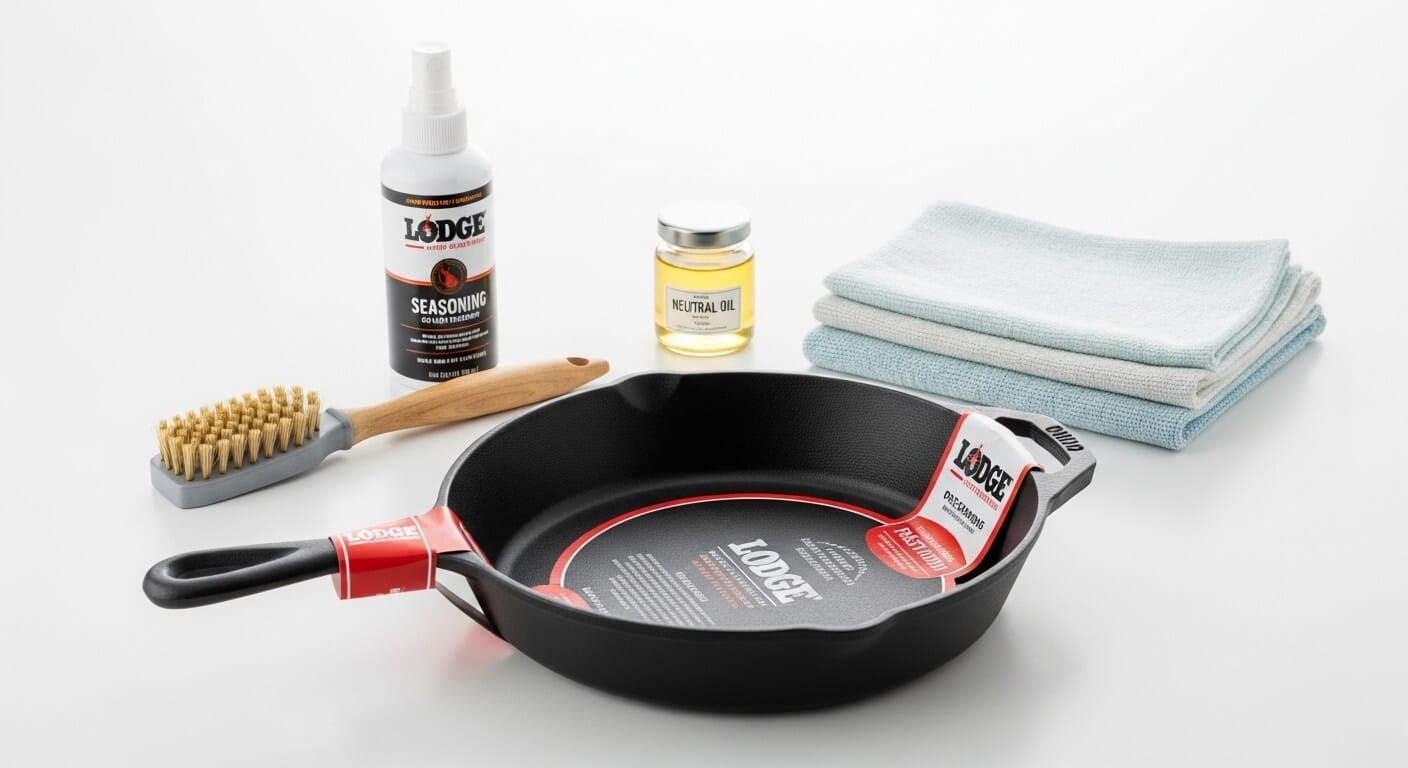
Essential Supplies for Seasoning a Cast Iron Skillet the First Time
Grab what you actually need. It’s not complicated.
Choosing the Right Oil for First-Time Cast Iron Seasoning
Use neutral-flavored oils with smoke points above 400°F for first-time seasoning because they polymerize reliably without burning, creating hard and durable initial layers that protect your skillet properly.
Oil choice matters more than you’d think. Different fats behave differently under high heat.
Best Oils for Beginner Cast Iron Seasoning
Top choices for first-time seasoning:
Oil Type
Smoke Point
Beginner Rating
Why It Works
Grapeseed oil
420°F
Excellent
Polymerizes beautifully, affordable, widely available
Vegetable oil
400-450°F
Excellent
Cheap, reliable, you probably already have it
Canola oil
400°F
Very good
Budget-friendly, works consistently
Avocado oil
520°F
Very good
Handles any temp, bit expensive but foolproof
Grapeseed is probably the best balance of performance and price. But honestly? Generic vegetable oil works great and costs almost nothing.
Don’t overthink this part.
Oils to Avoid When Seasoning for the First Time
Skip olive oil (smoke point too low, inconsistent polymerization), butter (burns before polymerizing), coconut oil (wrong type of fat structure), and flaxseed oil (creates brittle seasoning that flakes off despite internet recommendations).
The flaxseed trap: Everyone online swears by it. Food scientists love it in theory. And it creates beautiful dark seasoning that flakes off in sheets after a few months.
It’s too brittle. The molecular structure doesn’t flex. One temperature change and it cracks. Don’t use it for initial seasoning. Just don’t.
Olive oil sounds healthy but smokes at low temps and creates softer, less durable layers. Save it for cooking, not seasoning.
Why Smoke Point Matters for Initial Seasoning
Oils must be heated well above their smoke point (typically 50-100°F higher) to achieve complete polymerization, making high smoke point oils more forgiving and reliable for beginners who may struggle with oven temperature control.
If your oven is at 450°F and your oil smokes at 400°F, you’re in the polymerization zone. Perfect.
If your oven is at 450°F and your oil smokes at 475°F, you might not get complete polymerization. The coating could end up soft or sticky.
Higher smoke point = bigger margin for error. That matters when you’re doing this for the first time.
Tools and Materials You’ll Need
Here’s the actual shopping list.
Cleaning Supplies for Pre-Seasoning Prep
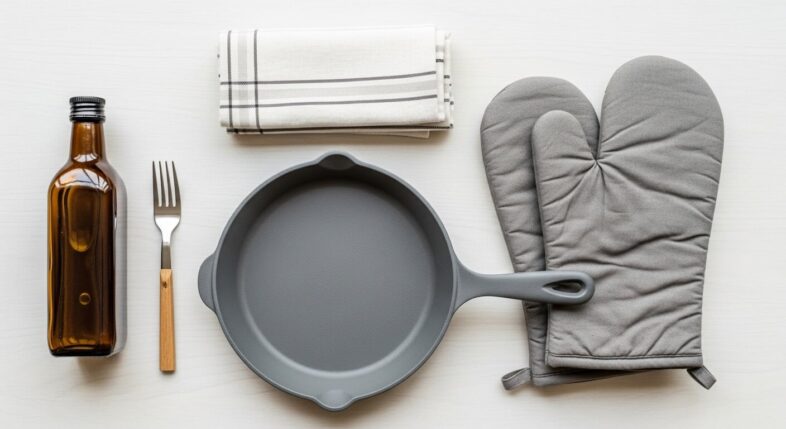
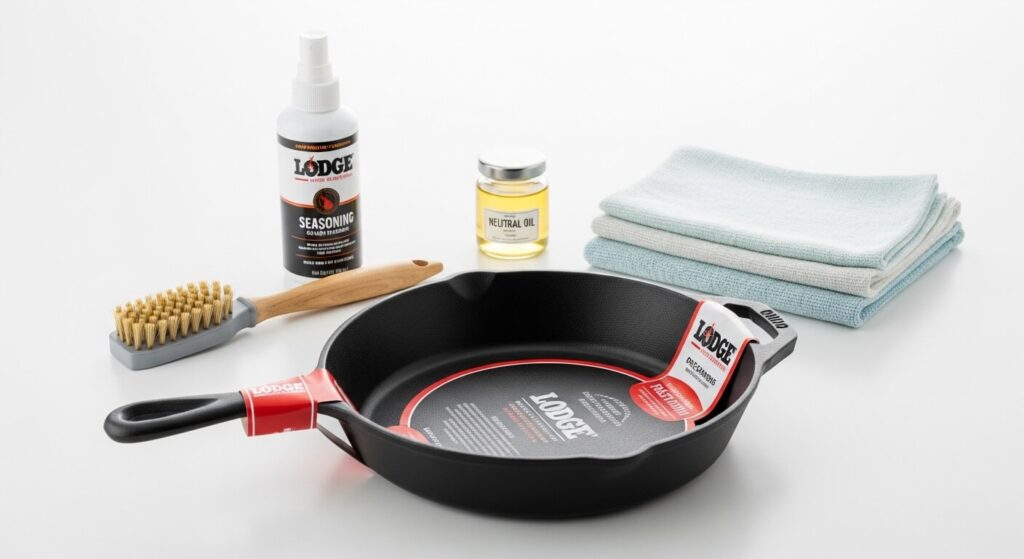
You need dish soap (yes, soap), a stiff brush or scrubber, paper towels or clean rags, and optionally steel wool or a scrubby sponge for removing stubborn coatings.
Dish soap — any brand, you’re just removing factory gunk
Scrub brush — stiff bristles, not a gentle sponge
Paper towels — lots of them, for drying and oil application
Steel wool (optional) — only if you’re removing wax or dealing with rust
Don’t skip the soap. Old wisdom says never use soap on cast iron, but that applies to seasoned pans, not brand-new ones you’re preparing for first seasoning.
Application Tools for Even Oil Coverage
Paper towels work for most people, but clean cotton rags or lint-free cloths give better control and don’t leave fibers—whatever you use, make sure it can handle being soaked in oil and rubbed aggressively.
Paper towels are fine. They’re disposable. No cleanup afterward. Most beginners should use these.
Cotton rags are better if you’re doing multiple pans or multiple layers. More durable. Can scrub harder. But you have to wash them after.
Avoid anything that sheds lint or has printing that might transfer.
Heat-Resistant Equipment and Safety Gear
Heavy-duty oven mitts rated for 500°F+ are essential because you’ll be handling screaming hot cast iron—regular potholders will smoke or catch fire at seasoning temperatures.
Required safety gear:
Thick oven mitts (rated for 500°F minimum)
Foil or baking sheet to catch drips
Well-ventilated space or windows you can open
Optional but helpful:
Welding gloves (if you’re handling the pan a lot during the process)
Safety glasses (if you’re paranoid about hot oil)
The oven mitts aren’t negotiable. Cast iron at 475°F will burn through cheap potholders in seconds.
Step 1: Preparing Your Cast Iron Skillet for First-Time Seasoning
Prep work matters. Maybe more than the actual seasoning.
Removing Factory Coatings and Shipping Wax
Factory wax and protective oils must be completely removed before seasoning or they’ll create sticky, unpolymerized patches that never harden properly and interfere with food release.
How to Identify Protective Wax on New Skillets
Wax coating feels slightly greasy or slick when you run your finger across the surface, may appear as a dull film, and sometimes has a faint chemical or petroleum smell.
Touch test: Run your palm over the pan. Does it feel like there’s a thin film? That’s wax.
Visual test: Does the surface look dull or cloudy? Not just matte—actually looks like something’s on it? That’s wax.
Smell test: Weird chemical odor? Definitely wax or protective oil.
Safe Removal Methods for Beginners
Wash the skillet with hot water and dish soap, scrubbing vigorously with a stiff brush for 2-3 minutes, then dry completely and heat on the stovetop for 5 minutes to burn off any remaining residue.
Process:
Hot water, plenty of dish soap
Scrub hard—you’re not going to hurt bare iron
Rinse thoroughly
Dry with towels
Put on stovetop burner, medium heat, 5 minutes
Any remaining coating will smoke off
If scrubbing doesn’t remove it, use steel wool. You can’t damage unseasoned iron with aggressive scrubbing.
Deep Cleaning Your Skillet Before Initial Seasoning
Even pre-seasoned skillets need a thorough cleaning before adding your own layers to remove any manufacturing oils, dust, or contaminants that accumulated during shipping and storage.
Using Soap on Cast Iron (Yes, It’s Okay Initially)
Modern dish soap won’t harm unseasoned iron or factory seasoning because it’s designed to cut grease, not break chemical bonds—use it freely during initial prep, then be more cautious once you’ve built your own layers.
The “never use soap” rule is for maintaining seasoned pans. It doesn’t apply to prep work before first-time seasoning.
Soap won’t hurt bare iron. Can’t. Iron doesn’t care about soap. What you’re protecting is polymerized oil, and there isn’t any yet (or the factory stuff is meant to handle cleaning anyway).
Scrub away. Get it clean. Really clean.
Scrubbing Techniques That Won’t Damage Raw Iron
Iron is hard—much harder than scrubbers—so you can use steel wool, scrubby pads, or stiff brushes aggressively without scratching or damaging the metal surface.
You cannot hurt bare cast iron with normal cleaning tools. Period.
Steel wool? Fine. Green scrubby pads? Fine. Stiff brush? Totally fine. You’d need a grinding wheel or serious power tools to actually damage the iron.
Scrub as hard as you want. The goal is completely clean metal ready to accept seasoning.
Drying Your Skillet Completely Before Seasoning
Any moisture left on the iron will cause rust spots during the seasoning process and create barriers that prevent oil from bonding properly to the metal surface.
Why Moisture Prevents Proper Seasoning
Water and oil don’t mix, so wet spots block the oil from contacting the iron, preventing molecular bonding and creating gaps in your seasoning layer where rust can form.
Moisture also flash-evaporates when the pan heats up, potentially causing oil to sputter or puddle unevenly.
And here’s the kicker: even tiny amounts of water cause flash rust on bare iron. Within minutes. Then you’re trying to season over rust, which doesn’t work well.
Dry means bone dry. Not “mostly dry” or “dry enough.” Actually dry.
Oven Drying vs. Stovetop Drying Methods
Stovetop drying (5 minutes on medium heat) evaporates all moisture quickly and thoroughly, while oven drying (10 minutes at 200°F) works but takes longer and wastes energy you’ll need for actual seasoning.
Best approach: Stovetop
Towel dry the pan thoroughly
Put on burner at medium heat
Let it sit for 5 minutes
Any remaining water evaporates completely
You can see when it’s ready (no more steam, pan looks dry)
This is faster and more reliable than hoping you got everything with a towel.
Step 2: Applying Your First Seasoning Layer to Cast Iron
Here’s where beginners screw up most often. Not in the heating—in the application.
How Much Oil to Use for First-Time Seasoning
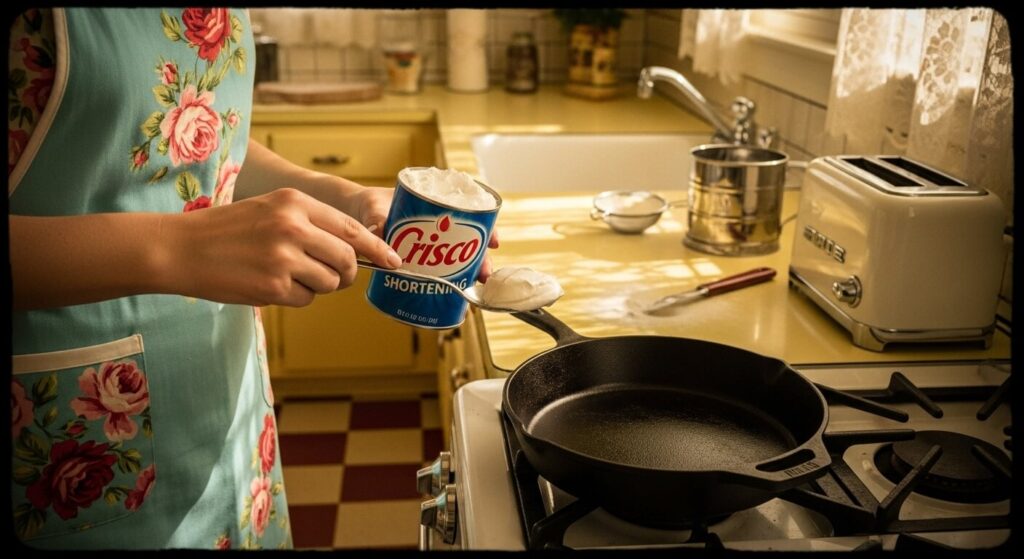
Use approximately 1/2 to 1 teaspoon of oil total for a 10-12 inch skillet—this seems impossibly small, but you’ll wipe off most of it anyway, and excess oil creates sticky, gummy seasoning that never fully hardens.
A little goes a long way. Way, way farther than you think.
If you pour oil in like you’re cooking with it, you’ve used 10x too much. Maybe 20x.
Proper Oil Application Techniques for Beginners
Apply a thin coat of oil to all surfaces using a paper towel or cloth, then wipe aggressively as if trying to remove all the oil—what remains after this “removal” step is the correct amount for seasoning.
The process:
Put a small amount of oil on your cloth (like, drops)
Rub it all over the pan—inside, outside, handle, everything
Get another clean cloth or paper towel
Wipe it off like you’re trying to remove it all
Wipe again
The pan should look almost dry
That thin film you can barely see? That’s perfect.
Coating Every Surface Including Handle and Exterior
The entire pan needs seasoning—exterior walls, bottom, handle, every inch of exposed iron—because unprotected areas will rust and create weak points in your pan’s overall protection.
Don’t just season the cooking surface. That’s amateur hour.
The outside rusts too. The handle rusts. The bottom rusts. Every bit of exposed iron is vulnerable.
Cover everything. It takes an extra 30 seconds and prevents future problems.
The Critical “Wipe It Off” Step Most Beginners Skip
Wiping off excess oil after initial application is the single most important step beginners miss—the oil that remains after aggressive wiping is all you need, and anything more creates problems.
This is the step that makes or breaks your first seasoning attempt.
Too much oil = sticky, gummy coating that never fully hardens and feels tacky forever.
Wipe it off. Then wipe it again. You cannot wipe too much at this stage.
Why Less Oil Creates Better First-Time Seasoning
Thin oil layers polymerize more completely because all molecules remain close to the iron surface where bonding occurs, while thick layers create a soft outer region that can’t bond properly and stays gummy or flakes off.
Chemistry: Polymerization works best when the oil is in direct contact with iron. The metal surface catalyzes the reaction.
Oil that’s far from the iron—sitting on top of other oil—doesn’t polymerize as well. It’s not touching the catalyst. The reaction is incomplete.
Result: soft, sticky outer layers that perform poorly.
Thin layers bond completely. Everything’s touching iron or touching already-bonded polymer. The reaction goes to completion.
Common Oil Application Mistakes to Avoid
Mistakes that ruin first-time seasoning:
Pouring oil directly onto the pan instead of applying with a cloth
Using too much and not wiping off the excess aggressively
Missing exterior surfaces and the handle
Leaving visible puddles or drips anywhere on the pan
Applying oil to a pan that’s still slightly damp
Every one of these creates problems you’ll spend the next hour trying to fix.
Step 3: Heating Your Cast Iron Skillet for Initial Polymerization
Time to apply heat and transform that oil into actual seasoning.
Oven Method for First-Time Cast Iron Seasoning
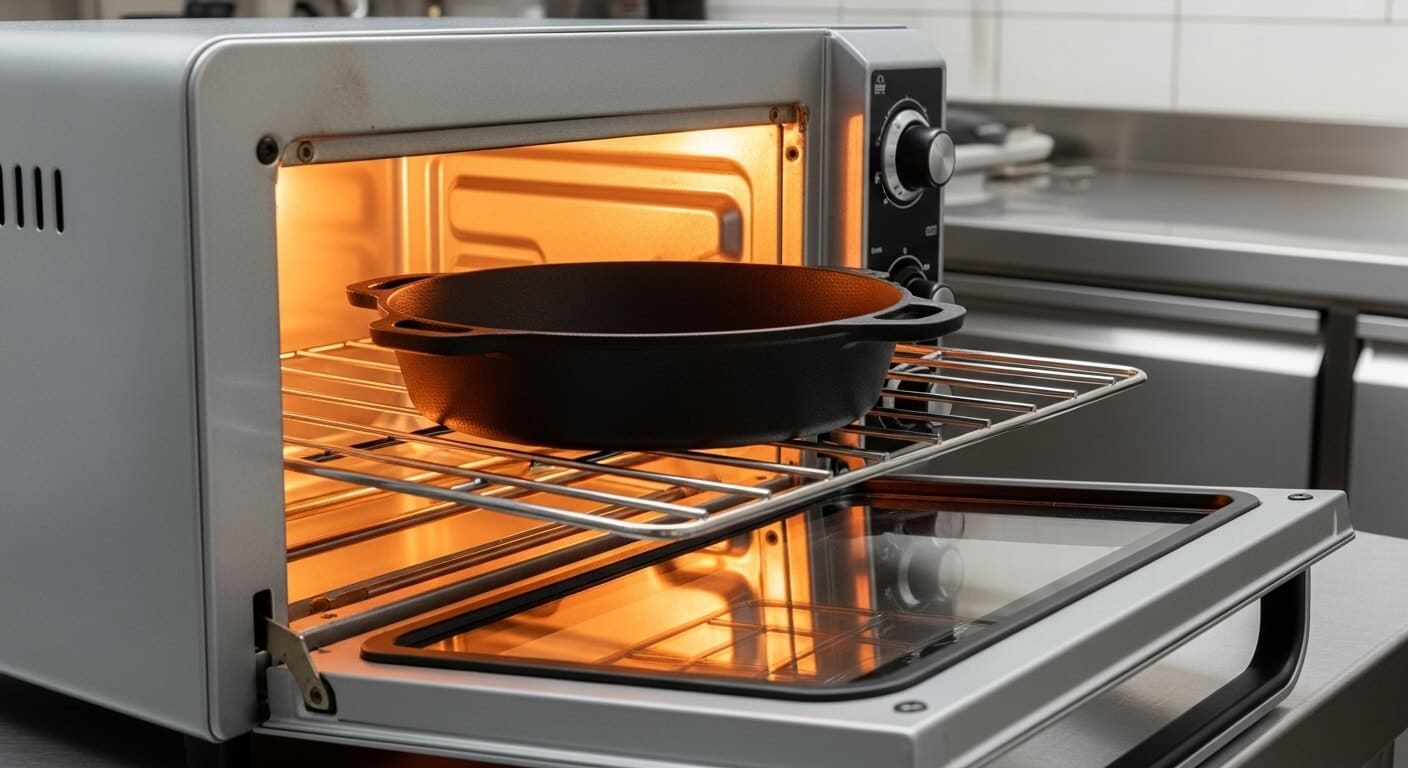
Oven seasoning heats the entire pan evenly to 450-500°F for one hour, creating uniform polymerization across all surfaces—this is the most reliable method for beginners doing their first seasoning.
Most people should use the oven. It’s foolproof (mostly). Set the temp, set a timer, wait.
Optimal Temperature for Beginner Seasoning
Set your oven to 450-475°F for reliable polymerization that’s hot enough to fully transform the oil but not so extreme that it burns off before bonding or creates excessive smoke.
450°F is the minimum for most oils. 475°F is the sweet spot. 500°F works but smokes more and isn’t necessary.
Don’t go higher. Above 500°F you risk burning the oil instead of polymerizing it. Different chemical process, worse results.
Don’t go lower. Below 425°F and polymerization is incomplete. You’ll get sticky, soft seasoning.
Positioning Your Skillet in the Oven
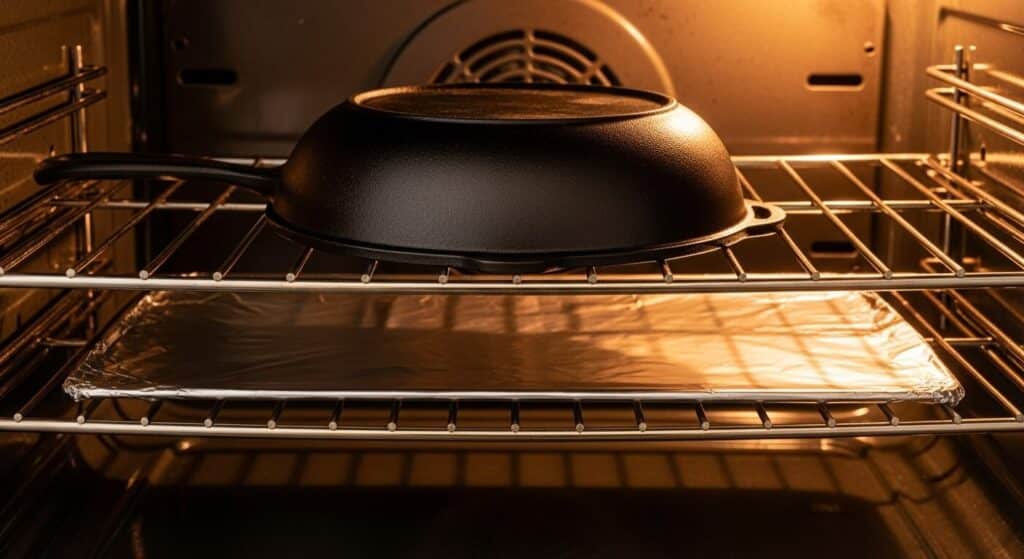
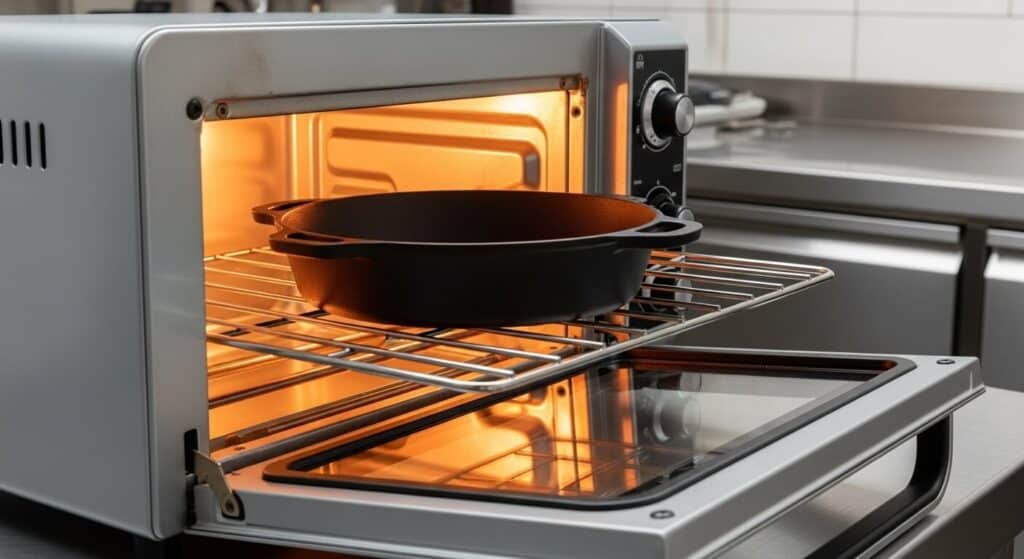
Place the skillet upside down on the center oven rack with a sheet of aluminum foil on the rack below to catch any oil drips that occur during heating.
Upside down prevents oil from pooling in the cooking surface. Any excess drips out instead of sitting there getting gummy.
Foil below catches those drips so you’re not cleaning baked-on oil from your oven floor later.
Center rack gives the most even heating. Too high or too low and you might get temperature variations.
How Long to Heat for Complete Polymerization
Heat for 60 minutes at your target temperature to ensure complete polymerization, though the transformation mostly occurs in the first 30-40 minutes—less time creates incomplete seasoning, more time doesn’t hurt but isn’t necessary.
One hour. Set a timer. Walk away.
30 minutes isn’t enough. The polymerization is still happening. The coating is still hardening. Pull it out early and you get soft, incomplete seasoning.
90 minutes doesn’t hurt anything. But it’s overkill. After an hour, the chemistry is basically done.
Using Foil or Baking Sheets to Catch Drips
Place aluminum foil or an old baking sheet on the rack directly below your skillet to catch any oil that drips during heating, preventing smoke and making cleanup easier.
Even if you wiped the pan thoroughly, you might get a drop or two. The heat causes oil to run slightly before it polymerizes.
Those drops hit your foil instead of burning onto the oven floor. Way easier cleanup.
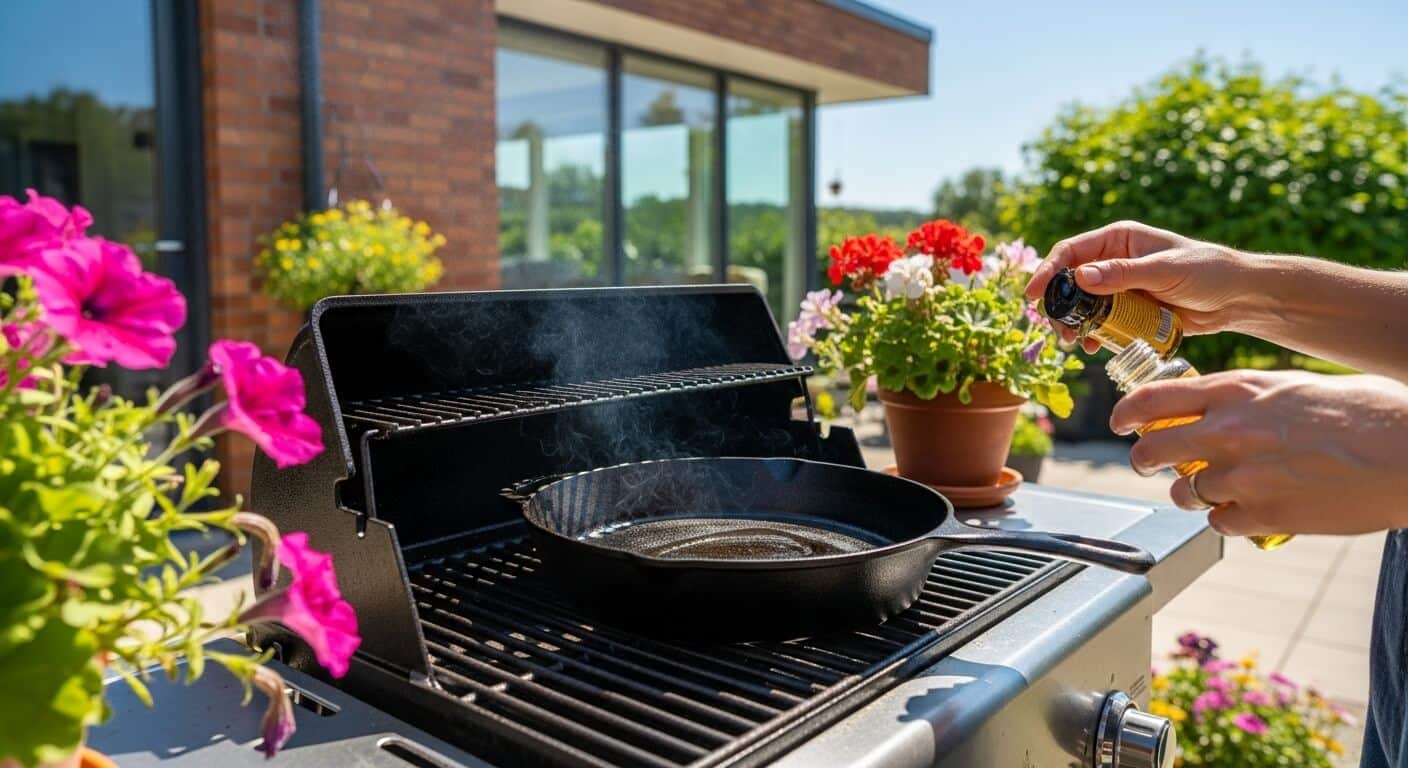
Alternative Stovetop Method for First Seasoning
Stovetop seasoning heats only the bottom and lower sides through direct burner contact, making it faster but less even than oven seasoning—workable for first-time seasoning but not ideal unless you can’t use your oven.
Oven is better for first-timers. But if your oven is broken, or it’s summer and you’re trying to avoid heating the house, stovetop can work.
When to Use Stovetop for Initial Layers
Choose stovetop for first seasoning only when your oven is unavailable, when you want to avoid heating your whole house, or when you’re comfortable monitoring temperature and rotating the pan for even coverage.
Stovetop is the compromise method. It works. But it requires more attention and produces less uniform results.
If you’ve got a working oven and no reason to avoid it, use the oven for your first seasoning session.
Temperature Control for Burner Seasoning
Heat the pan over medium-high until oil begins smoking (indicating 400°F+ temperature), then maintain that smoking point for 15-20 minutes while rotating the pan every 3-4 minutes for more even heat distribution.
You’re watching for smoke. That’s your temperature indicator.
Oil starts smoking = you’re in the polymerization zone. Keep it there. Not hotter (oil burns), not cooler (incomplete polymerization).
Rotate frequently. The center gets way hotter than the edges on a burner. You need to even that out manually.
Recognizing Proper Polymerization During Heating
Properly polymerizing oil progresses from liquid to smoking to dry/matte appearance as heating continues—by the end, the surface should look darker and completely dry with no shiny or wet areas remaining.
15-30 min: Surface darkens, oil dries out, less smoke
30-45 min: Looks matte and dry, minimal smoke
45-60 min: Clearly different from when you started, properly bonded
If it still looks shiny at 45 minutes, your temp is too low.
If it’s smoking violently the whole time, you used too much oil.
Step 4: Cooling and Evaluating Your First Seasoning Layer
Don’t rush this part. Let chemistry finish its work.
Safe Cooling Procedures After Initial Seasoning
Turn off the oven and leave the skillet inside for 30-60 minutes to cool gradually, preventing thermal shock that could damage fresh seasoning or cause warping in extreme cases.
Gradual cooling lets the polymer finish setting up. The chemical bonds stabilize. Everything hardens completely.
Rapid cooling—like running cold water over a hot pan—stresses the coating and the metal. Can cause micro-cracks in new seasoning. Can theoretically warp the pan (rare, but possible).
Just leave it in the oven. Turn off the heat. Come back in an hour.
What Properly Seasoned Cast Iron Should Look Like
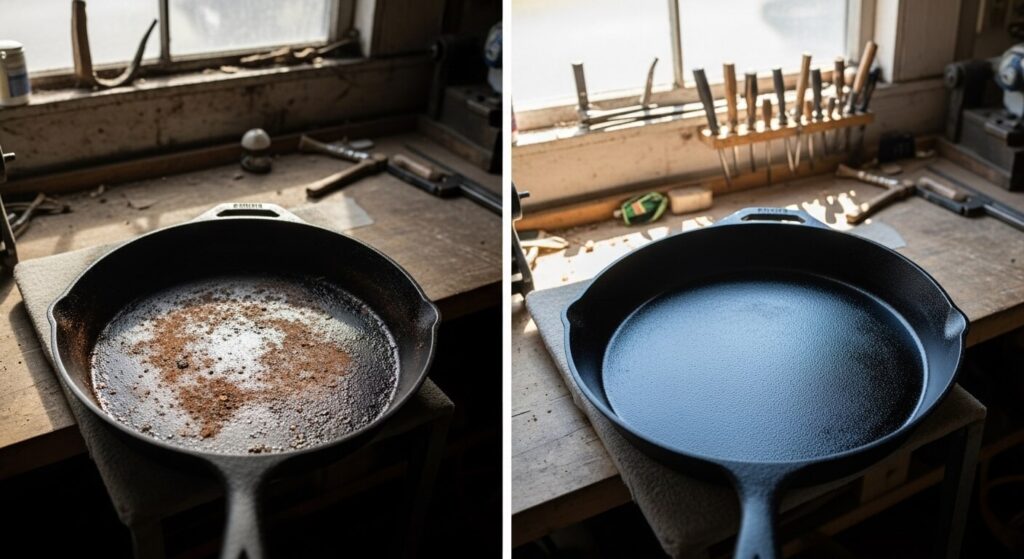
Well-polymerized first seasoning appears dark brown to black with a matte or semi-glossy finish, feels completely dry to the touch (not tacky or sticky), and shows even coverage across the entire surface.
Color Expectations for First-Time Seasoning
First layers typically produce a bronze, dark brown, or mottled appearance rather than jet black—this is normal, and the color darkens with additional layers and cooking use over time.
Don’t expect black after one layer. That’s not happening.
Bronze or brown is normal. Even desirable. It means the seasoning is thin (good) and properly bonded.
Black comes later. After 4-6 layers, or after months of cooking. It’s the accumulation of many thin layers that creates that dark color.
Texture and Feel of a Good Initial Layer
Properly seasoned cast iron feels dry and smooth (though not perfectly slick after just one layer), with no sticky or tacky areas that indicate unpolymerized oil.
Run your hand over it. Should feel like dry, slightly textured plastic. Not wet. Not sticky. Not oily.
If it feels tacky anywhere, that oil didn’t polymerize completely. You’ve got problems to fix.
If it feels bone dry and smooth, you nailed it.
Identifying Common First-Layer Problems
Things go wrong. Often. Here’s how to know.
Sticky or Tacky Residue After First Seasoning
Tackiness indicates excess oil that didn’t polymerize completely—caused by applying too much oil initially, insufficient wiping before heating, or oven temperature too low for complete polymerization.
This is problem #1 for beginners. Everyone uses too much oil the first time.
The good news? It’s fixable. Heat the pan again at 475°F for another hour. Sometimes the incomplete polymerization finishes and the tackiness disappears.
If that doesn’t work, you’ll need to scrub off the gummy layer and start over with less oil.
Uneven Coverage and Blotchy Appearance
Splotchy seasoning with light and dark areas results from uneven oil application or temperature variations in your oven—it’s mostly cosmetic at this stage and evens out with additional layers.
Doesn’t look pretty. But it’s not a performance problem.
The light areas might be slightly less protected. The dark areas might have thicker coating. But it all works.
Additional layers will even things out. Or just accept that first attempts are rarely perfect.
Flaking or Peeling on First Attempt
Flaking seasoning indicates too much oil applied as a thick layer rather than a thin film—the outer portions dried without bonding properly and now separate from the pan easily.
If you can pick at it and it comes off in flakes, you used way too much oil.
Strip it off. Start over. Use less oil. Wipe more aggressively.
There’s no salvaging badly flaking seasoning. It’ll just keep getting worse.
Step 5: Building Additional Layers for Complete Protection
One layer is not enough. Never has been, never will be.
Why Multiple Layers Are Essential for First-Time Seasoning
Single seasoning layers are too thin to provide adequate rust protection or non-stick properties—multiple layers build thickness, fill in microscopic surface imperfections, and create the durable coating cast iron actually needs for cooking.
Think of it like paint. One coat is transparent. You can see through it. It doesn’t protect well.
Three to six coats? Now you’ve got proper coverage. Durable. Protective. Actually functional.
Same with seasoning. Layer 1 is a foundation. Layers 2-6 build the protection you actually need.
How Many Seasoning Layers Beginners Should Apply
Apply 3-6 thin layers for effective initial seasoning, with 3 being the functional minimum for basic use and 6 providing robust protection that handles all but the most delicate foods right away.
Minimum: 3 layers (barely adequate, but workable)
Recommended: 4-5 layers (good protection, ready for most cooking)
More than 6 is overkill for initial seasoning. You’ll build additional layers through cooking anyway.
Timing Between Seasoning Layers
Allow the pan to cool completely between layers (30-60 minutes in the turned-off oven or 20-30 minutes if removed to cool at room temperature) before applying fresh oil and reheating.
Why wait? You can’t apply oil evenly to a hot pan. It’ll smoke immediately, run everywhere, create uneven coating.
Cool pan = controlled application. You can take your time, wipe properly, get it right.
How cool? Cool enough to handle comfortably with your bare hands. Not cold, but not hot.
Repeating the Process for Durable Initial Seasoning
Each additional layer follows the identical process—apply thin oil coat, wipe off excess aggressively, heat at 450-475°F for one hour, cool completely, repeat until you’ve built 3-6 total layers.
Same process every time:
Apply oil
Wipe it off (like you’re removing it)
Heat for one hour at 450-475°F
Cool completely
Repeat
By layer 3-4, you should see noticeable darkening. By layer 5-6, the pan looks legitimately seasoned.
The Complete First-Time Seasoning Timeline for Beginners
Let’s talk actual time investment so you’re not surprised.
Hour-by-Hour Breakdown of Initial Seasoning
Complete first-time seasoning with 4-6 layers requires 6-10 hours of elapsed time including heating and cooling periods, though active hands-on work totals only 30-45 minutes spread across the entire process.
Timeline for 4 layers (minimum recommended):
Hour 0-0.5: Clean, dry, apply first oil coat
Hour 0.5-1.5: Heat first layer (oven at 450°F)
Hour 1.5-2.5: Cool in oven
Hour 2.5-3.5: Apply and heat second layer
Hour 3.5-4.5: Cool
Hour 4.5-5.5: Apply and heat third layer
Hour 5.5-6.5: Cool
Hour 6.5-7.5: Apply and heat fourth layer
Hour 7.5-8.5: Final cool
That’s 8-9 hours total. But you’re only actively working for maybe 20 minutes total (5 minutes per layer to apply oil).
Total Time Commitment for Proper First Seasoning
Plan for a full day to season a new cast iron skillet properly—you can do other things during heating and cooling periods, but the process requires you to be home and available to monitor and apply subsequent layers.
This is a weekend project. Start Saturday morning, finish Saturday evening.
You’re not tied to the oven the whole time. Go watch TV. Do laundry. Work on your laptop. Just stick around to handle the next layer when it’s ready.
Can You Speed Up First-Time Seasoning Safely
You can reduce cooling time to 20-30 minutes by removing the pan from the oven after heating (carefully, it’s 450°F) and cooling on a heat-safe surface, potentially cutting 2-3 hours from the total timeline.
Faster cooling = faster overall process. If you’re impatient, pull the pan out (with proper mitts!) and let it cool on the stovetop or a trivet.
But don’t rush the heating. That hour at temperature is necessary for complete polymerization. Shortening it creates inferior seasoning.
Cool faster if you want. Heat for the full time. That’s the rule.
Testing Your First-Time Seasoning Before Cooking
How do you know if it worked?
Simple Tests to Verify Seasoning Quality
Test your seasoning by running your hand over the surface (should feel dry and smooth, not sticky), checking for even color (variations are fine, but no bare metal should show), and performing a water drop test.
Touch test: Dry and smooth? Good. Tacky or oily? Problem.
Visual test: Dark and even-ish? Good. Bare metal showing? Problem.
Those two tests tell you 90% of what you need to know.
The Water Droplet Test for Beginners
Drop a few drops of water onto the seasoned cooking surface—they should bead up and roll around rather than soaking in or spreading flat, indicating a properly sealed and protected surface.
Good seasoning: Water beads like it’s on wax, rolls around when you tilt the pan.
Inadequate seasoning: Water spreads out, soaks into the rough iron surface.
This tests whether you’ve created a proper barrier layer. If water can’t penetrate, neither can rust.
Visual Inspection Checklist for New Seasoning
Your properly seasoned pan should have:
Dark brown to black color (lighter is okay after just first layers)
Matte to semi-glossy appearance
No visible bare metal anywhere
No sticky or wet-looking spots
Even coverage on interior, exterior, and handle
Smooth feel when touched
If you can check most of these boxes, you’re good to start cooking.
What to Cook First in Your Newly Seasoned Cast Iron Skillet
First meals matter. Don’t screw this up by getting ambitious too fast.
Best First Foods for Breaking In New Seasoning
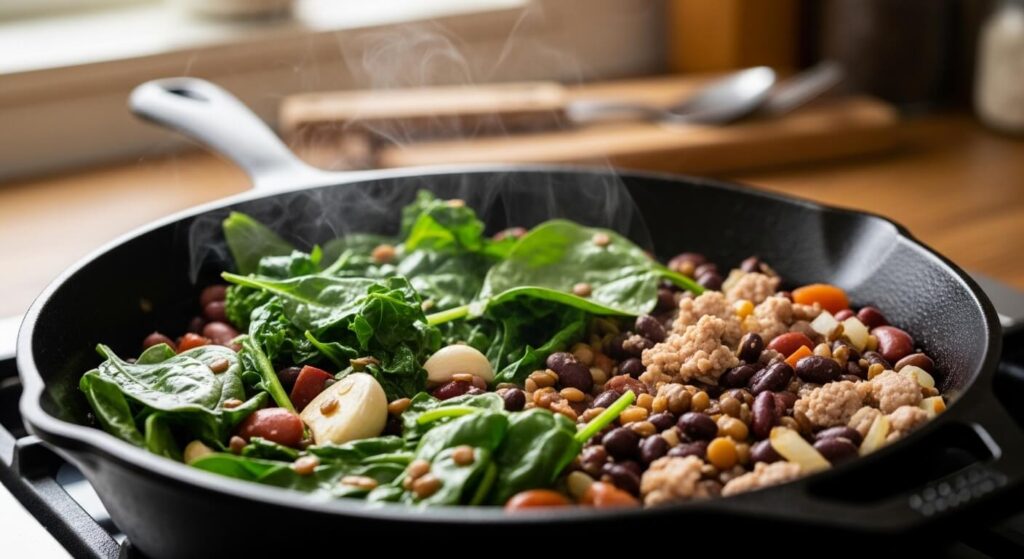
Start with fatty, high-heat foods like bacon, sausages, or well-marbled steaks that release grease during cooking and further build your seasoning while being forgiving if your coating isn’t perfect yet.
Why Bacon Is Recommended for First Cooks
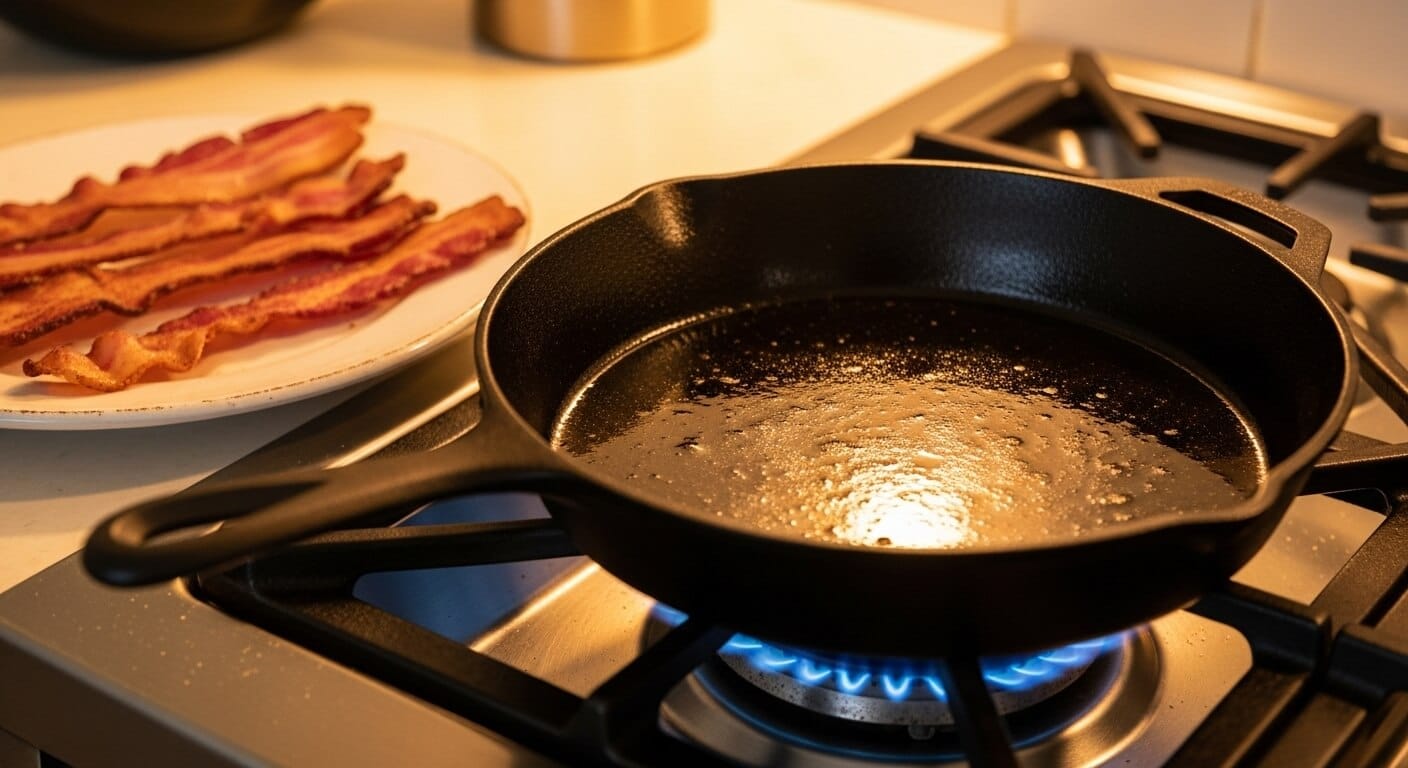
Bacon releases copious fat during cooking that continuously bastes the pan’s surface, essentially performing a natural seasoning session while you cook breakfast—it’s nearly impossible to damage seasoning with bacon.
Bacon is training wheels for cast iron.
It renders so much fat that the pan stays lubricated the entire time. Sticking is almost impossible. And that fat polymerizes at cooking temperature, adding another micro-layer to your seasoning.
Your first 3-5 meals should include bacon if possible. Your seasoning will thank you.
Other Beginner-Friendly First Foods
Good choices for early cooking:
Sausages (lots of fat, hard to mess up)
Burgers (ground beef releases grease)
Skin-on chicken thighs (fat renders from skin)
Stir-fried vegetables in plenty of oil
Pan-fried pork chops
All of these are high-fat or cooked with generous oil. All help build seasoning. All are forgiving if your coating isn’t perfect yet.
Foods to Avoid Immediately After First-Time Seasoning
Skip eggs, delicate fish, pancakes, acidic tomato sauces, and any simmering or braising for the first 2-3 weeks while your seasoning matures through use—these foods either stick easily to new seasoning or can damage fresh layers.
Why Eggs Aren’t Good for New Seasoning
Eggs stick aggressively to anything less than perfectly smooth, well-established seasoning because their proteins bond readily to microscopic rough spots that new seasoning hasn’t filled in yet.
Fresh seasoning isn’t smooth enough for eggs. It just isn’t.
You need months of cooking or a dozen+ layers before eggs work reliably. Trying too early just frustrates you and potentially damages your new coating when eggs weld themselves to it.
Wait. Build more layers through normal cooking. Try eggs in month 2-3.
Acidic Foods That Can Damage Fresh Layers
Tomato-based sauces, wine reductions, and vinegar-heavy dishes can penetrate and break down new seasoning that hasn’t fully hardened and developed multiple protective layers.
New seasoning is vulnerable. Acid can get through it, react with the iron underneath, damage the coating.
Well-established seasoning (6+ months old with 20+ layers) handles acid fine. Your 3-day-old seasoning? Not so much.
Give it a month minimum before cooking anything acidic.
Building Seasoning Through Early Cooking Sessions
Each cooking session adds microscopic layers that strengthen and smooth your initial seasoning—plan to cook 10-15 high-fat or high-heat meals in the first month to develop robust protection quickly.
Every time you cook, you’re building. The initial 4-6 oven layers are the foundation. The next 20 cooking sessions are what make your pan truly functional.
After a month of regular use, your seasoning will be way better than it was after that initial weekend of dedicated seasoning. The cooking layers are what matter most.
Caring for Your Cast Iron After First-Time Seasoning
Don’t undo your work with bad cleaning habits.
Cleaning Your Skillet After Initial Use
Clean your newly seasoned cast iron while it’s still warm using hot water and a brush or scrubber, avoiding soap for the first few weeks while your seasoning hardens and matures fully.
Post-cooking cleaning process:
Let the pan cool slightly (not cold, just not scorching)
Run hot water over it
Scrub with a stiff brush or scrubby pad
Rinse clean
Dry immediately and thoroughly
That’s it. No soap needed yet (though it wouldn’t destroy anything—more on that in a second).
Gentle Cleaning Methods That Preserve New Seasoning
Use hot water and physical scrubbing rather than soap for the first 2-3 weeks, employing coarse salt as an abrasive for stuck-on food rather than harsh detergents that might soften still-curing seasoning layers.
Salt scrub works great on new seasoning. Add a tablespoon of coarse salt to the warm pan, add a tiny bit of water or oil, scrub with a paper towel or cloth. The salt acts like gentle sandpaper.
Gets food off without chemicals. Doesn’t harm the seasoning. Rinses away cleanly.
When Soap Is Acceptable on Fresh Seasoning
Modern dish soaps won’t destroy seasoning (even fresh seasoning) because they’re designed to cut grease, not break polymer bonds—a small amount is fine if needed for greasy residue, but water and scrubbing handle most cleaning.
The no-soap rule is overblown. Modern soap isn’t lye-based like old soaps were.
That said, for the first few weeks, water usually works fine. Why use soap if you don’t need it?
Once your seasoning is a month old, soap becomes a complete non-issue. Use it or don’t, whatever cleans the pan.
Post-Cooking Maintenance for New Seasoning
After cleaning and drying, some people apply a thin layer of oil to fresh seasoning for extra protection—this is optional for well-established seasoning but helpful during the first month when layers are still developing.
Should You Oil After Every Use Initially
Wiping a thin layer of oil onto your cleaned, dried skillet after each use provides extra protection for developing seasoning and prevents rust between cooking sessions—this becomes unnecessary after 2-3 months of regular use.
For the first month: Yeah, probably oil it after cleaning.
After 3-4 months of cooking: Optional, probably not necessary.
After a year: Definitely not necessary unless you’re storing it long-term.
The oil wipe is training wheels. It helps while your seasoning is immature. Eventually you won’t need it.
Storage Tips for Newly Seasoned Skillets
Store your newly seasoned cast iron in a dry location with good air circulation, avoiding enclosed humid spaces and ensuring the pan is bone-dry before storing to prevent rust formation.
Storage rules:
Completely dry (heat it on the stove if you’re not sure)
Room temperature location
Good airflow (not sealed in plastic)
Away from moisture sources
Stacking pans is fine, but put paper towels between them to absorb any residual moisture and prevent the weight from damaging seasoning.
Troubleshooting First-Time Cast Iron Seasoning Problems
When things go sideways.
Fixing Sticky Seasoning After Your First Attempt
Sticky seasoning from excess oil can often be corrected by heating the tacky pan in a 450-475°F oven for another hour to complete polymerization, or if that fails, scrubbing off the gummy layer with steel wool and re-seasoning with less oil.
Try heating first. Put it back in the oven. Sometimes incomplete polymerization finishes and the problem disappears.
Didn’t work? The layer is too thick. Scrub it off with steel wool or a scrubby pad. Get back to smooth surface. Start over.
This time: less oil, wipe more aggressively.
What Causes Tackiness in New Seasoning
Tackiness results from too much oil creating thick layers where outer portions can’t reach polymerization temperature or can’t bond to anything because they’re too far from the iron surface.
Too much oil = gummy mess. Always.
The outer layer of a thick oil application is just oil sitting on oil. No iron contact. No catalyst for polymerization. It partially dries but never fully hardens.
Result: sticky, tacky coating that never improves.
How to Remove and Redo Problem Layers
Scrub sticky layers off with steel wool or a coarse scrubby pad using hot water and some elbow grease, then re-season following the original process but with more aggressive oil removal before heating.
You’re not starting completely over. You’re just removing the bad layer and replacing it.
Scrub until the tackiness is gone and you’re back to a smooth (even if thin) surface. Dry thoroughly. Season again with way less oil.
Learn from the mistake. Don’t repeat it.
Dealing With Uneven First-Time Seasoning Results
Splotchy seasoning is mostly cosmetic and will even out over time through cooking use—if it bothers you, apply 2-3 additional thin layers focusing on lighter areas to create more uniform appearance.
Uneven color doesn’t mean uneven protection (usually). It’s just visual.
If it bugs you aesthetically, add more layers. They’ll help even things out.
If you don’t care how it looks, just start cooking. It’ll darken and even out naturally.
Rust Spots After Initial Seasoning
Small rust spots on newly seasoned cast iron indicate microscopic gaps in coverage or areas where seasoning was too thin—scrub off the rust with steel wool, re-season that specific area, and ensure complete coverage in future layers.
Why New Seasoning Sometimes Allows Rust
Thin or uneven first seasoning leaves microscopic bare spots where iron remains exposed to air and moisture, allowing rust to form in those gaps despite overall seasoning appearing complete.
Even tiny gaps let moisture through. Iron rusts fast when exposed.
This is why multiple layers matter. Layer 1 has gaps. Layer 2 covers most of them. Layer 3 fills in the rest.
Quick Fixes Without Starting Over
Scrub rust spots with steel wool until you’re back to clean metal or clean seasoning, then apply 2-3 seasoning layers to those specific areas to patch the protection without re-doing the entire pan.
Spot treatment works fine. You don’t have to strip the whole pan because of one rusty spot.
Clean the problem area. Season just that area (or the whole pan if you want, but it’s not required). Problem solved.
When to Strip and Re-Season from Scratch
Complete seasoning removal and restart is only necessary if you have extensive rust coverage (more than 25% of surface), thick flaking seasoning across most of the pan, or contamination from burnt food that won’t scrub off.
Most problems don’t require starting over. Really.
Sticky spot? Heat it or scrub it. Rust patch? Spot-treat it. Uneven color? Cook with it.
Only strip and restart if things are truly messed up beyond spot repairs.
Understanding Seasoning Development Over Time
Your pan will keep getting better. That’s the point.
How First-Time Seasoning Improves With Use
Initial oven seasoning provides a functional foundation that cooking gradually enhances through accumulated micro-layers, filling in surface roughness and developing the ultra-smooth, non-stick properties cast iron is known for over months of use.
What you have after first seasoning: Basic protection, functional but not amazing.
What you have after 3 months of cooking: Noticeably better, smoother, darker, more non-stick.
What you have after a year: Excellent performance that rivals Teflon for most foods.
Time and use improve the pan beyond what any initial seasoning session can achieve.
Realistic Expectations for New Cast Iron Performance
Freshly seasoned cast iron won’t perform like Teflon immediately—expect some sticking with eggs and delicate foods, adequate release with fatty proteins, and gradual improvement over the first 20-30 cooking sessions.
Don’t expect perfection on day one. That’s not realistic.
Expect functional. Workable. Getting better each time you use it.
Bacon will work great immediately. Eggs will stick for a couple months. Somewhere in between for most other foods.
The First Month: What to Expect as Seasoning Matures
During the first month, your seasoning will darken noticeably, become smoother to the touch, develop better food release properties, and may show some uneven wear in high-use areas that fills in with continued cooking.
Week 1: Still looks a bit rough, food might stick occasionally.
Week 2: Noticeably darker, smoother, working better.
Week 3-4: Actually good now, you’re getting the hang of it.
Month 2-3: Legitimately great performance, you wonder why everyone doesn’t use cast iron.
It’s a process. Be patient.
Different First-Time Seasoning Approaches Compared
Not everyone uses the oven. Here’s how other methods stack up.
Oven Seasoning vs. Stovetop for First-Time Users
Oven seasoning provides more even heat distribution and hands-off convenience making it ideal for beginners, while stovetop seasoning offers faster cycles but requires active monitoring and rotation for even results.
Oven wins for: Even coverage, ease of use, better results for beginners, complete exterior seasoning.
Stovetop wins for: Speed, avoiding whole-house heat in summer, smaller energy use.
For your first time, use the oven unless there’s a compelling reason not to.
Single Long Session vs. Multiple Short Sessions
Applying all 4-6 layers in one day creates better immediate protection and gets your pan cooking-ready faster, while spreading seasoning across multiple days allows more flexibility but extends the timeline before your pan is fully ready.
One-day approach: Commit the time upfront, get it done, start cooking tomorrow.
Multi-day approach: Do a layer or two each evening over several days, less intense but drags out the process.
Most people should just knock it out in one session. Get it done. Move on with life.
Field Seasoning Method for Beginners
Field seasoning applies initial layers through high-heat stovetop cooking with generous oil rather than dedicated oven sessions—this works but takes longer and produces less consistent results than formal oven seasoning for first-timers.
Field seasoning is basically “season it by cooking with it.” More oil than you’d normally use, high heat, let the layers build.
It works. But it’s slower and less predictable.
If you’re experienced, field seasoning is fine. If you’re a beginner doing this for the first time, oven seasoning is more reliable.
Special Considerations for Different Cast Iron Types
Not all cast iron is created equal.
Seasoning Smooth Vintage Cast Iron for the First Time
Smooth vintage pans (Griswold, Wagner, old Lodge) season faster and more evenly than modern rough cast iron because their polished surfaces have fewer imperfections to fill and create better oil-to-metal contact.
Old pans were machined smooth. The surface is almost polished.
Modern pans are rough—you can see the sand casting texture.
Smooth surface = fewer layers needed for good performance, faster path to non-stick.
Rough surface = more layers needed to fill in the texture, slower development.
First-Time Seasoning for Rough Modern Cast Iron
Modern rough-textured cast iron (Lodge, Victoria) requires 6+ seasoning layers and months of cooking use to fill in surface texture and achieve the smoothness that vintage pans provide naturally through machining.
Modern Lodge is bumpy. That’s not poor quality—it’s just not machined smooth.
Your first 6 oven layers fill in some of the texture. The next 6 months of cooking fill in more. Eventually it smooths out.
Be patient. Or sand it smooth yourself if you’re motivated (people do this).
Lodge vs. Other Brands: Does It Change the Process
The seasoning process remains identical across brands—only the starting surface texture varies, with Lodge and similar brands requiring more layers to achieve equivalent smoothness compared to boutique machined options like Stargazer or Field.
Same oil. Same temperature. Same process. Same number of initial layers.
The difference shows up later. Smooth pans get non-stick faster. Rough pans take longer to mature.
But the actual seasoning steps don’t change.
Seasoning Cast Iron Cookware Other Than Skillets
Dutch ovens, griddles, and other cast iron pieces season identically to skillets—apply thin oil coats, heat at 450-475°F, build multiple layers, paying special attention to lids which need seasoning on both sides.
A pan is a pan is a pan. The shape doesn’t matter.
Dutch oven? Season it like a skillet. Griddle? Season it like a skillet. Weird specialty piece? Season it like a skillet.
The only difference is lids—season both sides since both are exposed iron.
Building Confidence as a First-Time Cast Iron Owner
You’re going to mess up. Everyone does. It’s fine.
Normal Learning Curve for Cast Iron Beginners
Expect the first 2-3 weeks to involve some sticking food, uncertainty about cleaning methods, and worrying you’re doing everything wrong—this is completely normal and improves rapidly with experience and seasoning maturation.
Week 1: Everything feels wrong. Did I ruin it? Is this sticky spot bad? Why is food sticking?
Week 2: Starting to get the hang of it. Still some issues but improving.
Week 3-4: Actually working now. Building confidence.
Month 2: You’ve got this. Cast iron makes sense now.
Everyone goes through this. The pan isn’t broken. You’re not incompetent. It’s a learning curve.
When Imperfect Seasoning Is Good Enough to Start
You don’t need perfect seasoning to start cooking—3-4 reasonably applied layers with no major flaking or sticking provide adequate protection to begin using your pan, and cooking use will improve it beyond what additional oven sessions could achieve anyway.
Perfectionism is the enemy here.
Your seasoning doesn’t need to look like a 50-year-old heirloom. It needs to be functional enough to cook on without rusting.
Three decent layers? Start cooking. The cooking will improve it faster than more oven layers will.
Developing Your Cast Iron Skills Beyond Initial Seasoning
Cast iron proficiency comes more from learning proper cooking techniques (preheating, heat management, adequate fat) than from perfect seasoning—focus on building cooking skills alongside seasoning development for best results.
The pan is half the equation. Your technique is the other half.
Great seasoning + poor technique = food sticks.
Adequate seasoning + good technique = food releases perfectly.
Learn to preheat properly. Use enough fat. Don’t crank the heat to maximum. These matter as much as seasoning quality.
Common Myths About First-Time Cast Iron Seasoning
Let’s kill some bad information.
Debunking “Never Use Soap” for New Skillets
Modern dish soap won’t harm seasoning because it’s designed to cut surface grease, not break chemical bonds—the “never soap” rule originated when soaps contained lye that could strip seasoning, which hasn’t been true for decades.
Lye soap strips seasoning. Modern soap doesn’t contain lye.
You can use soap on cast iron. Even fresh seasoning. It’s fine.
That said, hot water and scrubbing work for most cleaning. So soap is often unnecessary, not forbidden.
The Truth About Flaxseed Oil for Beginners
Flaxseed oil creates beautiful initial seasoning that unfortunately flakes off within months because its molecular structure produces brittle polymer chains—despite scientific backing and internet recommendations, it’s unreliable for first-time seasoning.
The food science nerd in me loves flaxseed oil. The chemistry is elegant. The theory is sound.
The reality? It flakes. Badly. After 3-6 months, it starts coming off in sheets.
Use grapeseed or vegetable oil. They’re boring but they work reliably.
Do You Really Need 6+ Layers Initially
Three layers provide minimum adequate protection while 4-5 create robust seasoning—more than 6 initial layers offers diminishing returns because cooking use builds superior layers anyway, making excessive oven seasoning a time investment that doesn’t pay off proportionally.
Six layers is fine. Eight layers is overkill.
The difference between layer 6 and layer 8 is minimal. Your time is better spent cooking than adding more oven layers.
Get to 4-5 layers. Start cooking. Let use take it from there.
Vintage Skillets Don’t Need Different First Seasoning
Vintage and modern cast iron season identically despite surface texture differences—smooth vintage pans develop non-stick properties faster but follow the same oil, temperature, and layer-building process as rough modern skillets.
Old pans aren’t magic. They’re just smoother.
Season them the same way. They’ll just perform better sooner because they start with better surface finish.
But the chemistry is identical. Same oil, same heat, same process.
Cost and Time Investment for First-Time Seasoning
Let’s talk numbers.
Actual Costs: Oil, Energy, and Supplies
First-time seasoning costs $5-15 total including oil ($2-5), energy consumption ($2-4 for 4-6 hours of oven use), paper towels ($1), and optional steel wool or scrubbers ($2-3) if starting from bare metal.
This is cheap. Remarkably cheap considering you’re creating a cooking surface that lasts decades.
The oil is the main expense, and even expensive avocado oil is under $10. Most people use vegetable oil at $3-4.
Energy cost depends on your rates, but figure $0.30-0.50 per oven hour. Four layers = maybe $3 in electricity or gas.
Time Requirements: Active vs. Passive
First-time seasoning requires 6-10 hours elapsed time but only 30-45 minutes of active work spread across oil applications and pan handling—the majority of time is passive oven heating and cooling that requires no attention.
Active time: Maybe 40 minutes total across the whole project Passive time: 6-9 hours of heating and cooling
You can do other stuff during passive time. Watch TV. Clean the house. Work. Whatever.
Just be home to apply the next layer when it’s ready.
Is Professional Seasoning Service Worth It for Beginners
Professional seasoning services ($20-40) produce excellent results but aren’t necessary for beginners because DIY oven seasoning is straightforward, costs less than $10, and teaches you the process you’ll need for future maintenance anyway.
Some people offer seasoning as a service. They’ll season your pan for you for $20-40.
Is it worth it? Only if your time is worth way more than the cost difference, or if you’re genuinely unable to use your oven.
For most people, DIY is fine. The process isn’t hard. Save the money.
Setting Up for Long-Term Cast Iron Success
Think beyond the first seasoning.
Creating a Seasoning Maintenance Routine
After initial seasoning, maintain your cast iron through regular cooking use (4-7 times weekly ideal), gentle cleaning after each use, complete drying, and optional thin oil wipes during the first month while seasoning matures.
Simple maintenance routine:
Cook regularly (this is the actual maintenance)
Clean while warm with water and brush
Dry completely every time
Oil occasionally in the first month
Just cook after that
That’s it. Maintenance is mostly just using the pan.
When to Add Supplemental Seasoning Layers
Add extra seasoning layers only when you notice degradation (rust spots, loss of non-stick properties, rough patches developing) or after cooking acidic foods that may have damaged existing layers—otherwise regular cooking maintains seasoning adequately.
Most people never need to formally re-season after that initial session.
Cooking maintains the seasoning. Small damage repairs itself through use.
Only re-season if something goes actually wrong. Rust. Major flaking. Extended non-use causing degradation.
Transitioning from Beginner to Confident Cast Iron Cook
Cast iron confidence develops through consistent use over 2-3 months as you learn heat management, build cooking-specific skills, and watch your seasoning improve—commit to using your pan 3-4 times weekly and you’ll master it faster than you expect.
Give it 90 days of regular use. That’s the timeline.
By month 3, you’ll understand your pan. You’ll know how it heats. How much oil you need. What foods work well. How to clean it efficiently.
The pan will also be way better. The seasoning will have developed significantly through all that cooking.
After 3 months, cast iron stops feeling like a project and starts feeling like your favorite pan.