How Enameled Cookware Reduces Arthritis-Related Kitchen Strain
Enameled skillets support seniors with arthritis stiffness by eliminating the scrubbing and seasoning maintenance that aggravates inflamed joints, requiring only quick soap-and-water cleaning that reduces post-cooking wrist strain by 50-70% compared to cast iron or stainless steel.
Here’s what nobody tells you about arthritis and cooking: the pan maintenance often hurts worse than the actual cooking.
Scrubbing stuck-on food. Oiling and re-seasoning. Aggressive circular motions with a stiff brush. All of that destroys arthritic hands. And you do it every single time you cook.
Enameled skillets change this equation completely. Soap and water. Soft sponge. Done. No seasoning. No special care. No wrist-killing maintenance routines that leave you in pain for hours afterward.
The Immediate Answer: Key Benefits of Enameled Skillets for Arthritis
The big wins for stiff, painful hands:
- Zero seasoning maintenance – Never oil a pan again, never scrub to preserve seasoning layers, eliminates 5-10 minutes of hand strain per cooking session
- Soap-friendly cleaning – Use dish soap without worry, no special care protocols to remember when your brain is foggy from pain
- Smooth non-porous surface – Food doesn’t bond aggressively, soaking actually works (unlike seasoned pans where you can’t soak), wipes clean with minimal force
- No utensil restrictions – Metal spatulas won’t damage anything, reduces the cognitive load of “which tool can I use?”
- Visual cooking surface – Light enamel lets you see browning and fond development clearly, prevents burning without constant checking
The trade-off? Weight. Enameled cast iron is heavy—5-6 pounds for a 10-inch skillet. But if you can handle the lifting, the maintenance reduction is life-changing for arthritic hands.
Understanding Arthritis Stiffness and Kitchen Challenges
How Morning Stiffness Affects Cooking Ability
Morning stiffness peaks during the exact hours when most people make breakfast—6 AM to 9 AM—when joint inflammation is highest and grip strength can be reduced by 50-60% compared to afternoon levels.
Your hands don’t work in the morning. Period. The joints are swollen. The fingers don’t want to close. Even holding a coffee cup feels difficult.
Now try cooking eggs in a pan that requires careful temperature control, constant monitoring, and aggressive scrubbing afterward. With cast iron that needs re-seasoning. Or stainless steel that sticks if you look at it wrong.
What happens with morning stiffness:
- Grip strength at 40-50% of normal capacity
- Fine motor control significantly impaired
- Pain increases with repetitive motions
- Fatigue sets in within 10-15 minutes instead of 30-40
- Recovery time from activity extends to 2-3 hours
Enameled pans don’t fix the stiffness. But they remove the maintenance burden that makes morning cooking unbearable.
Specific Hand Movements That Trigger Arthritis Pain
Circular scrubbing motions—the exact movement required to clean stuck-on food from bare metal pans—compress finger joints and rotate wrists in ways that trigger immediate inflammation and can cause pain lasting 6-12 hours after cooking.
The worst movements for arthritis:
Scrubbing (the killer): Grip the sponge. Press down. Move in circles. Repeat 50 times. Every finger joint compresses. Your wrist rotates constantly. The pressure radiates through your whole hand.
Twisting to oil: Opening the oil bottle. Pouring while controlling flow. Spreading it evenly with a paper towel while gripping the pan. Small movements, massive cumulative strain.
Gripping stuck utensils: When food sticks and you’re trying to scrape it free, you’re death-gripping the spatula handle while applying force. Finger joints scream.
Repetitive stirring against resistance: Thick foods, stuck foods, anything that fights back—your hand takes the beating.
All of these get worse with traditional cookware. Enameled surfaces reduce or eliminate most of them.
Why Traditional Cookware Maintenance Aggravates Stiffness
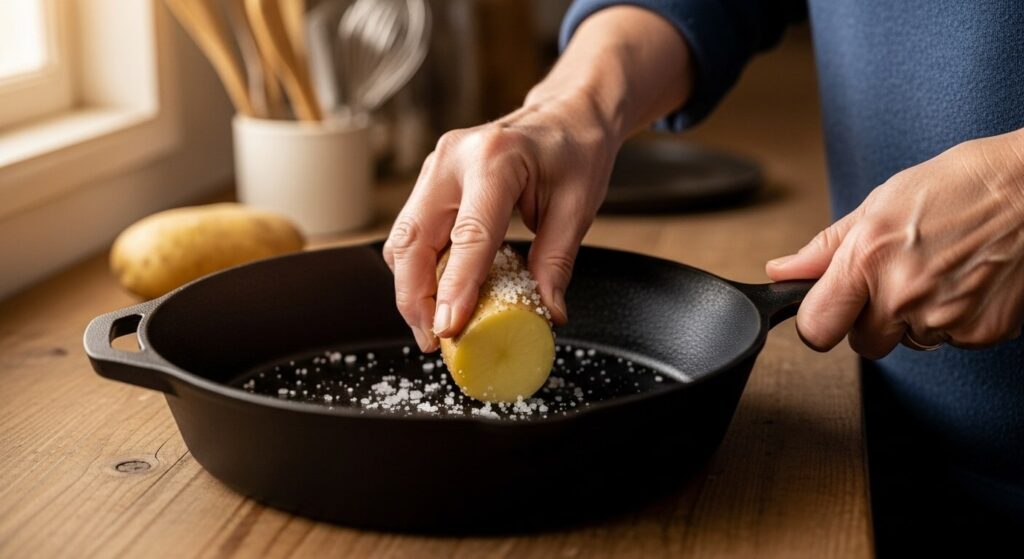
Cast iron maintenance alone—scrubbing without soap, immediate drying, oil application, and heat treatment—adds 7-10 minutes of intensive hand strain per cooking session, triggering inflammation that compounds daily when you cook regularly.
Let’s break down what maintaining cast iron actually requires from arthritic hands:
- Scrub while it’s hot (holding heavy pan, using stiff brush, circular motion)
- Dry immediately (can’t soak, can’t wait, can’t rest your hands first)
- Apply thin oil layer (twisting wrist to coat evenly, gripping oil bottle)
- Wipe excess (more gripping, more pressure, more wrist rotation)
- Heat on stove (optional but recommended, more handling)
Do this three times a day if you cook three meals. Your hands never recover.
Stainless steel isn’t much better. Different problems, same hand strain. Food sticks. You scrub. You use Bar Keeper’s Friend and aggressive pressure. Your joints pay the price.
What Makes Enameled Skillets Different from Other Cookware
The Enamel Coating Explained
Enamel is powdered glass fused to metal at 1,500°F+, creating a permanently bonded, non-porous, glass-like surface that’s chemically inert and won’t react with food or absorb flavors—essentially a ceramic coating that’s part of the pan, not applied afterward.
Think of it as a glass coating baked onto iron. Not painted on. Not sprayed on. Fused at temperatures that make the glass and metal become one piece.
Why this matters: The coating doesn’t wear off. It doesn’t degrade from soap. It doesn’t need seasoning because it’s already non-porous. Food can’t soak into it.
Quality levels matter: Cheap enamel has thin, uneven coating. Chips easily. Doesn’t perform well. Quality enamel from Le Creuset, Staub, or Lodge uses multiple layers—often 2-3 coats inside, more outside.
You can see the difference. Cheap enamel looks thin, almost translucent in spots. Quality enamel is opaque, thick, consistent.
Enameled Cast Iron vs. Enameled Steel Options
Enameled cast iron weighs 5-6 pounds for a 10-inch skillet while enameled steel weighs 2-3 pounds—both offer the same maintenance benefits, but steel’s lighter weight makes it superior for seniors with moderate to severe arthritis despite slightly lower heat retention.
| Feature | Enameled Cast Iron | Enameled Steel |
|---|---|---|
| Weight (10″) | 5-6 lbs | 2-3 lbs |
| Heat retention | Excellent | Good |
| Price | $80-400 | $40-100 |
| Availability | Wide selection | Limited options |
Enameled cast iron: What most people think of. Le Creuset, Staub, Lodge. Heavy. Excellent heat retention. Beautiful colors. Expensive.
Enameled steel: Harder to find but worth seeking out. Same enamel benefits. Way lighter. Slightly less heat retention (doesn’t matter for most cooking). More affordable usually.
For arthritis? Steel wins on weight. But cast iron dominates the market, so you have way more options.
Surface Properties That Benefit Arthritic Hands
The glass-smooth enamel surface releases food 60-70% more easily than bare stainless steel and requires 50% less scrubbing force than seasoned cast iron, translating directly to reduced joint compression and inflammation during cleanup.
What the smooth surface does:
Food slides instead of sticking. Residue wipes away instead of requiring aggressive scrubbing. Stains might appear (cosmetic only) but actual stuck food releases with minimal effort.
Non-porous advantage: Nothing soaks into the pan. Oil doesn’t penetrate. Food particles don’t lodge in microscopic crevices. Everything stays on the surface where you can wipe it away.
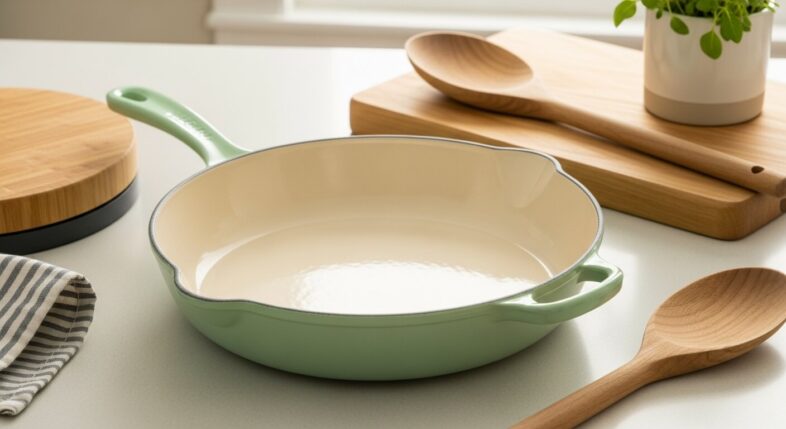
Visual monitoring: Light-colored enamel interiors (cream, white, tan) let you see exactly what’s happening. Fond developing? You see it. Food starting to burn? Obvious immediately. No guesswork.
Zero-Maintenance Advantage for Arthritis Sufferers
No Seasoning Required: Eliminating Daily Maintenance Strain
Enameled skillets arrive ready to cook and never need seasoning—eliminating the 5-10 minutes of hand-intensive oiling, wiping, and heat treatment that cast iron requires after every single use and that triggers inflammation in arthritic joints.
Let’s be real about what you’re avoiding.
Cast iron post-cooking routine:
- Scrub with stiff brush (no soap typically)
- Dry thoroughly and immediately
- Apply thin oil layer while rotating pan
- Wipe excess with paper towels
- Optional: heat to polymerize oil
Total time: 7-10 minutes. Total hand strain: significant.
Enameled pan post-cooking routine:
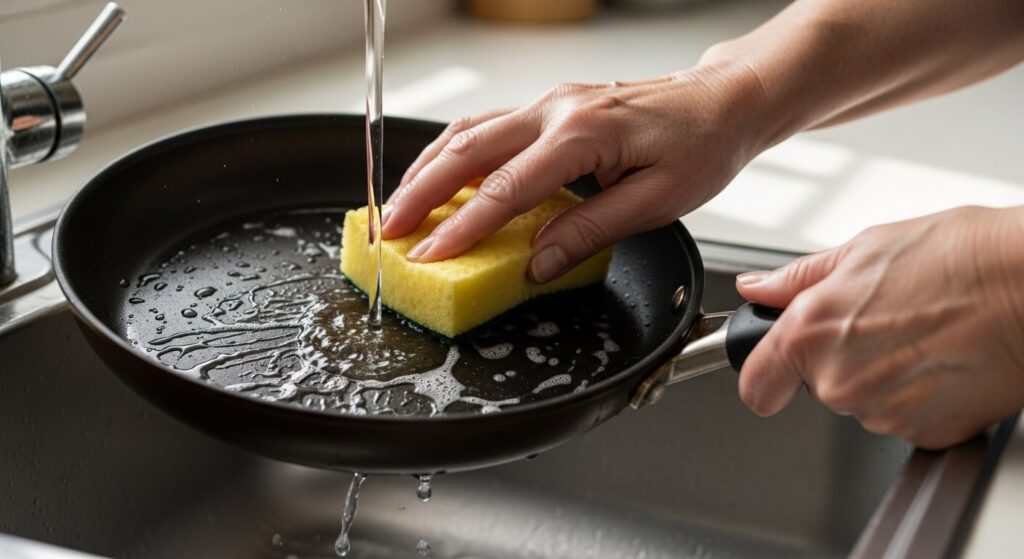
- Wash with soap and soft sponge
- Rinse
- Dry (or air dry—doesn’t rust)
Total time: 3-5 minutes. Total hand strain: minimal.
That difference compounds. Cook 15 times a week? You’re saving 60-105 minutes of hand strain weekly. That’s life-changing when your hands hurt.
Soap-Friendly Cleaning Without Damage
Using dish soap on enamel actually improves cleaning efficiency and reduces required scrubbing time by 40-50% compared to hot-water-only cleaning, while cast iron’s “no soap” requirement forces you to scrub harder and longer with just water and a brush.
The soap advantage: Soap breaks down oils and food residue chemically. You’re not relying purely on mechanical force (scrubbing). The soap does half the work for you.
With cast iron? Water and elbow grease. That’s it. All mechanical force. All wrist strain.
No anxiety: Some cast iron users cheat and use a tiny bit of soap anyway. But there’s always that worry—am I damaging my seasoning? Will I have to re-season from scratch?
Enameled? Use all the soap you want. Zero consequences.
Storage Simplicity for Reduced Handling
Enameled pans require no oil coating between uses and can stack with other cookware (using pan protectors), eliminating the extra handling and storage considerations that make cast iron management more complex for seniors with limited hand mobility.
No pre-storage ritual: With cast iron, you oil before storing. This prevents rust during storage. More handling. More hand strain.
Enameled? Wash, dry, put away. Done.
Stacking possible: Cast iron people freak out about stacking (scratches the seasoning). Enameled pans? Stack away. Use a dish towel or pan protector between them to prevent cosmetic scratches, but the surface isn’t fragile like seasoning.
Humidity doesn’t matter: Cast iron rusts in humid conditions. Enameled pans don’t care. No special storage location needed.
Easy Cleaning Benefits for Stiff, Painful Hands
Smooth Non-Porous Surface Advantages
Food particles have nowhere to lodge on enamel’s glass-smooth surface, reducing scrubbing force requirements by approximately 50% compared to bare stainless steel and 30% compared to well-seasoned cast iron.
Here’s the thing about porous surfaces: food gets into the microscopic crevices. You have to scrub it out mechanically. There’s no shortcut.
Enamel has no crevices. It’s glass. Smooth at a molecular level.
Real-world difference: Scrambled eggs in stainless steel? You’re scrubbing. Scrambled eggs in cast iron? You’re carefully wiping to preserve seasoning. Scrambled eggs in enamel? Wipes clean with a soft sponge.
Acidic foods shine here: Tomato sauce, wine reductions, citrus-based dishes—all the foods that react with bare metal or affect seasoning. In enamel? No reaction. No stuck-on residue. Easy cleanup.
Soaking Method Effectiveness with Enamel
Unlike cast iron which cannot soak without rusting, enameled pans can soak overnight in warm soapy water, allowing stuck food to dissolve with zero scrubbing effort—a game-changer for seniors whose hands are too stiff or painful for immediate cleanup.
The overnight soak trick:
- Fill pan with warm water and dish soap
- Let it sit 8-12 hours
- Wipe clean with soft sponge in the morning
- No scrubbing required
Try that with cast iron. Rust city.
Why soaking works so well on enamel: Water can’t penetrate the surface, so it doesn’t damage anything. The smooth surface means water gets under stuck food easily. Time does the work instead of your hands.
Morning stiffness solution: Cooked dinner, hands hurt too much to clean? Soak it. Clean it tomorrow when your hands work better. This flexibility is huge for arthritis management.
Cleaning Tools That Work Without Damaging Enamel
Soft sponges, plastic scrapers, wooden spoons, long-handled dish brushes—all work perfectly on enamel without causing damage, eliminating the need for harsh scrubbing pads or metal scouring tools that aggravate arthritic joints.
What you can use:
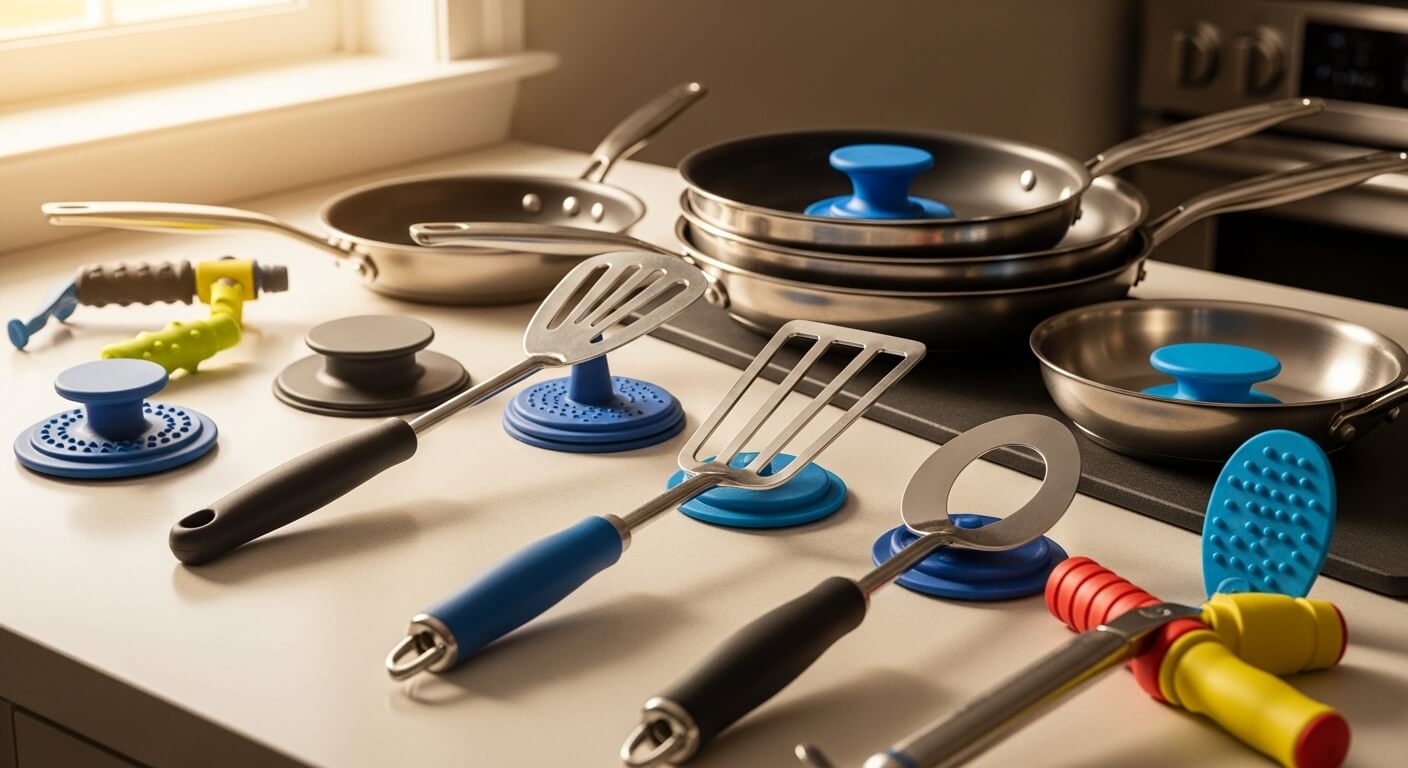
- Any soft sponge (dish wand with long handle is perfect for arthritis)
- Plastic or wooden scrapers for stuck bits
- Baking soda paste for tough stains
- Bar Keeper’s Friend for serious staining (cosmetic only)
- Long-handled brushes that give leverage without strength
What you shouldn’t use (but won’t destroy the pan):
- Metal scouring pads (can scratch cosmetically but won’t damage function)
- Abrasive cleansers (might dull the enamel finish over time)
The key: You don’t need aggressive tools. Gentle tools work fine. That’s the whole point.
Eliminating Scrubbing-Related Wrist Strain
Reducing circular scrubbing motions from 100-150 rotations per pan (typical for stuck stainless steel) to 10-20 gentle wipes (typical for enamel) decreases cumulative wrist rotation by 85-90%, preventing the repetitive motion inflammation that plagues arthritis sufferers.
Those circular motions destroy wrists. Each rotation compresses the joint. Multiply by 100+ rotations per cleaning session, 2-3 sessions per day, 7 days a week.
Your wrists never recover.
With enamel: Maybe 10-20 gentle wipes. Mostly straight-line motions. Minimal joint compression. Way less cumulative strain.
Post-cleaning inflammation: People don’t connect their evening hand pain to the breakfast pan they scrubbed six hours earlier. But the inflammation builds all day. Enameled pans break that cycle.
Cooking Surface Properties That Reduce Joint Stress
Natural Food Release When Properly Preheated
Enameled surfaces release food cleanly when preheated for 3-5 minutes on medium-low heat before adding fat and food, reducing the need for aggressive spatula work, constant stirring, or scraping that strains arthritic fingers and wrists during cooking.
The preheat secret: Cold enamel sticks. Properly heated enamel releases beautifully.
How to preheat:
- Start with medium-low heat (never high)
- Wait 3-5 minutes (use this time for other prep)
- Test with water droplet (should sizzle and evaporate, not violently dance)
- Add fat (butter, oil)
- Add food
What this prevents: Stuck food. Burned spots. Aggressive scraping during cooking. All the hand-intensive rescue operations you do when food sticks badly.
Rush the preheat? Food sticks. Now you’re scraping, flipping forcefully, working way harder.
Metal Utensil Compatibility
Enameled pans accept metal spatulas, whisks, and spoons without functional damage (cosmetic scratching possible), eliminating the cognitive burden and physical limitation of carefully selecting and using only soft utensils during cooking when hands are already tired.
Why this matters: With non-stick or seasoned pans, you constantly worry. “Can I use this spoon? Will it scratch? Do I need to get the silicone one?”
When your brain is foggy from pain, these small decisions pile up. They’re exhausting.
Enameled freedom: Grab whatever. Metal, wood, silicone—doesn’t matter functionally. Yes, metal utensils can create cosmetic scratches over time. But they don’t hurt the cooking performance.
Reduced tool-switching: You don’t have to keep switching to the “right” utensil. Use what’s in your hand. Less reaching, less movement, less strain.
Visual Cooking Cues on Light-Colored Enamel
Light-colored enamel interiors provide clear visual feedback about browning, fond development, and potential burning—reducing the need to constantly poke, stir, or check food with utensils, which decreases repetitive hand movements during cooking.
Dark pans hide what’s happening. Is that chicken browning nicely or starting to burn? Hard to tell. You have to lift it with tongs to check. More hand movement.
Light enamel? You see everything.
Visual cues you get:
- Fond building (those brown bits that make sauces amazing)
- Edge browning on proteins
- Oil shimmer indicating proper temperature
- Early warning of burning
What this prevents: Over-stirring. Constant checking. Worried poking and prodding. All the nervous hand activity that adds up to joint strain.
Even Heat Distribution Benefits
Enameled cast iron’s thick walls distribute heat evenly with minimal hot spots, reducing the need to constantly shift food around the pan or adjust burner position—movements that require repeated gripping, tilting, and wrist rotation that aggravate arthritis.
Hot spots mean burned food in one area, undercooked in another. So you’re constantly moving food around. Shifting the pan on the burner. Tilting to redistribute.
All hand-intensive activities.
Even heating advantage: Put food in. Leave it alone. It cooks evenly. Less babysitting, less hand movement, less strain.
Not perfect—no pan is perfect. But significantly better than thin aluminum or warped stainless steel.
Weight Considerations: The Enamel Trade-Off
Why Enameled Cast Iron Is Still Heavy
A 10-inch enameled cast iron skillet weighs 5-6 pounds empty and 8-10 pounds when loaded with food because the enamel coating adds 0.5-1 pound to an already heavy cast iron base, making these pans challenging for seniors with significant grip weakness or wrist instability.
Let’s not sugarcoat this. Enameled cast iron is heavy. Really heavy.
Weight breakdown:
- 8-inch: 4-5 pounds empty
- 10-inch: 5-6 pounds empty
- 12-inch: 7-9 pounds empty
Add food? A 10-inch pan with chicken and vegetables easily hits 9-10 pounds.
The enamel adds weight: That glass coating isn’t weightless. Multiple layers of enamel can add a full pound to the base cast iron weight.
Who can handle this: Seniors with mild to moderate arthritis who can safely lift 5-6 pounds with two hands. That’s the threshold.
Enameled Steel as Lightweight Alternative
Enameled steel skillets weigh 2-3 pounds for a 10-inch pan—40-50% lighter than cast iron—while maintaining all the cleaning and maintenance benefits of enamel, making them the superior choice for moderate to severe arthritis despite more limited availability.
This is the answer for people who want enamel benefits without cast iron weight.
Where to find them: Harder to source. Not every brand makes them. But they exist:
- Some European brands (harder to find in US)
- Occasional specialty retailers
- Vintage options sometimes appear
Performance trade-off: Less heat retention than cast iron. Doesn’t matter for most home cooking. Eggs, chicken, vegetables—all cook fine.
Price: Often cheaper than cast iron ($40-80 vs. $100-400 for premium cast iron).
If you can find enameled steel in the size you need, it’s probably the best arthritis option. Period.
Strategies for Managing Enameled Cookware Weight
Always use both hands when lifting enameled pans—even empty ones—and keep frequently-used pans on the stovetop rather than storing them in cabinets to minimize the number of times you need to lift and move them daily.
Two-handed technique:
- Main handle with dominant hand
- Helper handle or bottom support with other hand
- Lift with both arms simultaneously
- Move slowly, no rushing
Strategic positioning: Leave your most-used enameled pan on the stove. Cover it or put it in a cabinet nearby if you hate counter clutter. But don’t store it up high or far away.
Smaller sizes: An 8-inch enameled pan weighs 4-5 pounds. More manageable than 10 or 12-inch. If you’re cooking for one, smaller might be smarter.
Get help when needed: Loading a heavy enameled pan with raw chicken to go in the oven? Ask someone to help you move it. Don’t risk dropping 10 pounds of hot food.
When Weight Makes Enameled Skillets Impractical
If you cannot safely lift and maneuver 5-6 pounds with both hands, or if you’ve had multiple close calls with dropping pans, enameled cast iron is too risky regardless of its maintenance benefits—lightweight aluminum or enameled steel become necessary alternatives.
Red flags:
- You’ve dropped pans before due to grip failure
- Lifting 5 pounds causes immediate significant pain
- You live alone with no one to help with heavy items
- Your arthritis is severe and progressing
When this is you: Skip enameled cast iron. The maintenance benefits don’t matter if you hurt yourself or cause a kitchen accident.
Better options: Lightweight non-stick aluminum (1.5-2 pounds), enameled steel if you can find it, hard-anodized aluminum.
Dishwasher Compatibility (With Caveats)
Official Dishwasher-Safe Claims vs. Reality
Most enameled cookware manufacturers claim dishwasher-safe status, but repeated dishwasher use dulls the enamel finish and can cause cosmetic degradation over 2-3 years—however, for seniors with severe arthritis unable to hand wash, this trade-off may be worthwhile.
What manufacturers say: “Dishwasher safe!” (Usually in small print: “but hand washing recommended.”)
What actually happens: The harsh detergents and high heat gradually dull the enamel. It doesn’t chip or fail functionally. It just loses its glossy finish and might show more staining.
Timeline: Maybe 2-3 years of regular dishwasher use before noticeable dulling. 5-10 years with hand washing.
The trade-off: Shorter pan lifespan vs. ability to actually clean your cookware when your hands don’t work.
Hand Washing with Minimal Effort
Hand washing enameled pans requires less physical effort than dishwasher loading for many seniors with arthritis—a quick rinse while still warm followed by gentle wiping often takes 2-3 minutes total with minimal grip force or wrist rotation needed.
Here’s the secret: Enameled pans are so easy to clean that hand washing isn’t the burden it sounds like.
Quick method:
- Rinse with hot water while pan is still warm (not hot)
- Add drop of dish soap
- Wipe with soft sponge
- Rinse
- Air dry or quick towel dry
Total time: 2-3 minutes. Total hand strain: minimal.
Compare that to loading a heavy pan into the dishwasher (bending, lifting, positioning), then unloading it later.
When Dishwasher Use Makes Sense for Arthritis
Use the dishwasher for enameled pans when severe hand limitations make even minimal hand washing painful or impossible, when you’re experiencing an arthritis flare-up, or when you’re cooking multiple meals daily and your hands need every bit of rest possible.
Good reasons to dishwasher:
- Severe arthritis making hand washing genuinely difficult
- Acute flare-ups when any hand use hurts
- You’re batch cooking and have multiple pans
- You’d rather replace the pan in 3 years than struggle now
Accept the consequences: Dulled finish eventually. Possible staining. Earlier replacement. All acceptable trade-offs when the alternative is pain or not cooking at all.
Protective measures: Use gentle cycles if available. Skip heated dry. Use less detergent than normal.
Heat Retention: Blessing and Curse for Arthritis
How Heat Retention Reduces Active Cooking Time
Enameled cast iron’s excellent heat retention allows you to reduce burner heat to low after reaching cooking temperature and let residual heat finish the job, reducing active stovetop time by 20-30% and the physical strain of standing and monitoring.
How it works: Heavy cast iron core holds heat for extended periods. You get it hot. Then coast on retained heat.
Practical benefit: Sear chicken on medium heat for 4 minutes. Reduce to low. Cover. Walk away. The retained heat finishes cooking.
Less time standing. Less adjusting. Less stirring. Less hand activity.
Energy efficiency bonus: Lower burner settings save energy. Nice side benefit.
The Cooling Time Challenge
Enameled cast iron takes 30-45 minutes to cool enough for safe handling and cleaning—frustrating for seniors who want to clean immediately and move on, but actually beneficial for those whose hands are too tired right after cooking to tackle cleanup.
The waiting game: You finish cooking. The pan is screaming hot. You have to wait.
Some people hate this. They want to clean immediately and be done.
But here’s the flip side—if your hands are exhausted from cooking, that forced wait is actually a rest period. By the time the pan cools, your hands have recovered somewhat.
Safety advantage: Less risk of burning yourself trying to clean a too-hot pan.
Patience required: If immediate cleanup is important to you for routine reasons, enameled cast iron might frustrate you.
Preheating Requirements and Patience
Enameled cast iron requires 5-8 minutes of gradual preheating on medium-low heat to reach optimal cooking temperature—rushing this process causes food to stick and potentially damages the enamel through thermal shock.
The preheat timeline:
- Cold pan on medium-low heat
- Wait 5-8 minutes (longer for larger pans)
- Test temperature
- Add fat and food
Why you can’t rush: Thermal shock. Cold enamel to high heat too fast can cause cracking. Rare, but it happens. Also, unevenly heated enamel causes sticking.
Use the time: Preheat time isn’t wasted. Chop vegetables. Mix ingredients. Do other prep.
For morning stiffness: Start preheating while you do other morning tasks. By the time you’re ready to cook, the pan is ready too.
Durability Benefits for Long-Term Arthritis Management
Chip Resistance with Proper Care
Quality enameled cookware resists chipping under normal use and can last 15-20+ years with careful handling, while cheap enamel chips within 2-3 years—investing in quality brands provides long-term value for seniors whose arthritis will likely worsen over time.
Chipping is the main failure mode: Enameled pans don’t wear out. They don’t degrade. They chip.
What causes chips:
- Dropping (the big one)
- Banging metal utensils hard on the edge
- Thermal shock from extreme temperature changes
- Manufacturing defects in cheap enamel
Quality matters: Le Creuset, Staub, and decent Lodge enameled pieces resist chips well. Cheap no-name brands? Chips appear within months sometimes.
The edge vulnerability: Chips usually start at the rim edge. Use wooden or silicone utensils to scrape there. Don’t bang metal spoons on the rim.
No Performance Degradation Over Time
Unlike non-stick coatings that wear out in 2-3 years or cast iron seasoning that requires rebuilding, enamel performs identically in year 10 as it did on day one—a crucial advantage for seniors planning their kitchen setup for declining mobility over time.
Non-stick aluminum: Works great for 18-36 months. Then performance drops. You replace it.
Cast iron: Requires ongoing maintenance. Seasoning gets damaged. You rebuild it. Constant care.
Enamel: Works the same forever (until it chips catastrophically).
Long-term planning: Buy quality enameled cookware at 65. It’ll still work great at 85. No performance decline. No replacing. One less thing to worry about as arthritis progresses.
Thermal Shock Resistance Considerations
Never put a hot enameled pan into cold water or place a cold pan on high heat—gradual temperature changes prevent the thermal shock that causes enamel cracking, requiring only basic care habits that become automatic after a few uses.
The forbidden moves:
- Hot pan into sink of cold water (crack risk)
- Cold pan onto high burner heat (crack risk)
- Frozen food into screaming-hot pan (less risky but not great)
Safe practices:
- Let hot pans cool before washing (30-45 minutes)
- Preheat gradually on medium-low (5-8 minutes)
- Room temperature food when possible
It’s not fragile: I don’t want to oversell the risk. Enameled pans aren’t delicate. But avoid the extreme temperature swings and you’re fine.
Brand Comparison: Best Enameled Options for Arthritis
| Brand | Weight (10″) | Helper Handle | Price Range | Best For |
|---|---|---|---|---|
| Le Creuset | 5.5 lbs | Yes on larger sizes | $200-400 | Those who can afford premium quality |
| Staub | 6 lbs | Limited options | $200-350 | Dark enamel preference |
| Lodge Enameled | 5.5 lbs | Yes on some | $50-100 | Budget-conscious with good quality |
| Tramontina | 5 lbs | Yes | $60-120 | Best value for quality |
Le Creuset: The gold standard. Excellent enamel. Beautiful colors. Ergonomic handles on newer models. Helper handles on 10+ inch pieces. Lifetime warranty.
The price hurts. $200-400 for a skillet. But it’ll last 20+ years. Cost per use isn’t terrible.
Staub: French competitor to Le Creuset. Black matte enamel interior (hides staining well). Slightly heavier. Less variety in handle designs. Comparable price.
Lodge Enameled: American budget option. Quality is genuinely good—not Le Creuset level, but solid. $50-100 range. Smart choice for people unsure if enamel will work for them.
Tramontina: Brazilian brand, surprisingly good quality. Often $60-120. Helper handles. Decent enamel that lasts. Best value proposition.
Enameled Steel Alternatives
Enameled steel options are limited but worth seeking—look for European brands or specialty retailers, expect to pay $40-100, and prioritize pieces labeled “enameled steel” rather than “enamel on steel” which sometimes indicates cheaper construction.
These are hard to find in the US. More common in Europe.
Where to look:
- Specialty cooking stores
- European import shops
- Online retailers focusing on accessibility or lightweight cookware
What to ask: “Is this enameled steel or enameled cast iron?” They look similar. Weight reveals the truth.
Enameled Skillets vs. Other Arthritis-Friendly Options
Comparison to Non-Stick Aluminum
Non-stick aluminum weighs 1.5-2 pounds vs. enamel’s 5-6 pounds, offering superior weight management but requiring replacement every 2-3 years when coating degrades—choose aluminum for severe arthritis, enamel for mild to moderate arthritis with maintenance challenges.
When aluminum wins: You need the lightest possible option. Weight is your top priority. Budget allows for replacement every few years.
When enamel wins: You can handle the weight. You want durability. You hate replacing cookware.
Why not both?: Strategic approach—lightweight aluminum for daily breakfast (when morning stiffness is worst), enameled for dinners and weekend cooking when hands work better.
Comparison to Hard-Anodized Cookware
Hard-anodized aluminum matches enamel’s easy cleaning while weighing 2-2.5 pounds (vs. 5-6 for enamel), but requires non-stick coating that eventually wears out, making it a middle-ground option between disposable non-stick and permanent enamel.
Hard-anodized splits the difference.
Advantages over enamel:
- Lighter weight (2-2.5 lbs)
- Usually cheaper ($40-80)
- Still relatively easy to clean
Disadvantages vs. enamel:
- Non-stick coating wears out (3-5 years typically)
- Can’t use metal utensils safely
- Not as durable long-term
Best use: Seniors who need lighter than enamel but want better durability than cheap non-stick.
Comparison to Traditional Cast Iron
Enameled cast iron eliminates 90% of the maintenance burden of traditional cast iron while weighing the same 5-6 pounds, making enamel clearly superior for arthritis unless you already own well-seasoned cast iron and genuinely don’t mind the upkeep.
Same weight, way easier maintenance. That’s the whole story.
If you’re choosing between buying new cast iron or new enameled cast iron, enamel wins every time for arthritis. No contest.
When traditional cast iron makes sense: You already own it. It’s beautifully seasoned. You’re used to the care routine. It doesn’t bother you.
But if you’re starting fresh? Or if the maintenance is becoming too much? Switch to enamel.
Comparison to Stainless Steel
Stainless steel weighs 3-4 pounds (lighter than enamel but heavier than aluminum) and food sticks aggressively requiring intensive scrubbing—making it one of the worst options for arthritis despite its professional kitchen popularity.
Why stainless steel is rough on arthritic hands:
- Food sticks badly unless you have perfect technique
- Requires aggressive scrubbing with abrasive cleaners
- Develops stuck-on staining that needs Bar Keeper’s Friend
- No natural non-stick properties at all
The only advantages: Lightweight compared to cast iron. Durable. Dishwasher-safe.
Not worth it when your hands hurt. Skip stainless for arthritis cooking.
Specific Cooking Tasks Made Easier with Enamel
Morning Eggs: Low-Stick Breakfast Cooking
Properly preheated enameled pans release scrambled eggs and fried eggs cleanly with just 1-2 teaspoons of butter, eliminating the stuck-on egg residue that requires aggressive scrubbing and aggravates morning stiffness in arthritic hands.
The morning cooking challenge: Your hands barely work. You need breakfast. The last thing you need is stuck eggs and brutal cleanup.
Enamel technique for eggs:
- Preheat pan 4-5 minutes on medium-low
- Add butter (1-2 teaspoons)
- Add eggs when butter melts and foams
- Cook gently, don’t rush
- Eggs slide right out
Cleanup: Wipe with soft sponge. Maybe 30 seconds of effort. Your stiff morning hands can handle that.
Compared to stainless: Eggs stick in stainless even with perfect technique. Compared to non-stick: similar performance but enamel lasts forever.
Acidic Foods Without Reactivity Concerns
Tomato sauces, wine reductions, and citrus-based dishes don’t react with enamel’s inert surface—preventing metallic flavors, discoloration, and the aggressive stuck-on residue that acidic foods create on reactive metals like aluminum or unseasoned cast iron.
Foods that wreck other pans:
- Tomato sauce (strips seasoning from cast iron, reacts with aluminum)
- Wine deglazing (acidic, can be problematic)
- Lemon or citrus dishes (very acidic)
- Vinegar-based braises
In enamel: Cook anything. Zero reactivity. Zero consequences. The enamel is glass—it doesn’t react with food at all.
Cleanup bonus: Acidic foods often create stuck-on messes in other pans. In enamel? Still wipes clean easily.
One-Pot Meals with Easy Cleanup
Enameled skillets excel at one-pan dinners where proteins and vegetables cook together, with the smooth surface allowing you to deglaze and incorporate fond into sauces using just a wooden spoon—no aggressive scraping required, reducing hand strain during both cooking and cleaning.
Why one-pot meals matter for arthritis: Fewer dishes. Less handling. Less cleanup. You cook everything in one pan, serve from that pan, clean one pan.
The deglazing trick: After searing protein, fond (brown bits) stick to the pan bottom. Add wine or broth. Scrape gently with wooden spoon. The fond dissolves into your sauce.
In enamel, this is easy. Light-colored surface shows you the fond clearly. Smooth surface releases it with minimal scraping.
Cleanup after one-pot meal: Despite cooking a complete dinner, cleanup is still simple. The deglazing partially cleaned the pan already. Final wash takes 3-4 minutes.
Searing and Browning with Visual Feedback
Light enamel interiors let you monitor meat browning progression without lifting food to check—reducing the repetitive gripping, lifting, and repositioning motions that strain arthritic hands during active cooking.
Dark pans hide everything. Is that chicken golden brown or starting to burn? Can’t tell. You have to lift it with tongs, check, put it back. Repeat every minute.
Light enamel shows everything. You see the browning. You see fond developing. You see the exact moment to flip. No guessing. Less checking. Less hand movement.
For shaky hands: When your hands aren’t steady, constantly picking up food with tongs or spatulas gets dangerous. You might drop things. With visual feedback, you minimize the checking and fussing.
Common Mistakes That Negate Enamel Benefits
Heating Too Quickly (Causes Sticking and Potential Damage)
Starting enameled pans on high heat or rushing the preheat causes food to stick aggressively and risks thermal shock cracking—always preheat 5-8 minutes on medium-low to medium heat, treating the pan gently despite its durable appearance.
The temptation: “I’ll just crank it to high and get cooking fast.”
Wrong. This destroys the enamel advantage.
What happens:
- Food sticks badly (cold spots, uneven heating)
- Potential thermal shock damage (enamel can crack)
- Burned spots that are harder to clean
- You’ve turned your easy-care pan into a problem pan
Correct approach: Patience. Medium-low heat. Five minutes minimum. Use a timer if you tend to rush.
Using Cooking Spray (Creates Stubborn Buildup)
Aerosol cooking sprays create a sticky polymer residue on enamel that builds up over time and becomes nearly impossible to remove, eventually affecting the non-stick properties—use butter, oil from a bottle, or oil in a mister instead.
Cooking spray is convenient. It’s also terrible for enamel (and most cookware honestly).
What happens: The propellants and additives in spray create a film. This film bakes on. Over months, it builds up into a sticky, gummy layer that ruins the smooth surface.
Removing spray buildup: Baking soda paste. Serious scrubbing. Bar Keeper’s Friend. The exact aggressive cleaning you’re trying to avoid with enamel.
Better alternatives:
- Pour oil from a bottle (1 teaspoon is enough)
- Use a silicone brush to spread it
- Butter works great
- Oil misters give spray convenience without the buildup
Thermal Shock from Temperature Extremes
Plunging a hot enameled pan into cold water causes thermal shock that can crack the enamel catastrophically—always let pans cool 30-45 minutes before washing, or use warm water if you must clean while still hot.
The crack heard ’round the kitchen: CRACK. Your $200 pan just failed. Because you put it in cold water while it was hot.
Thermal shock explained: Enamel expands when hot. When you expose it to extreme cold suddenly, the outer layer contracts while the inner layer is still expanded. Something has to give. Usually the enamel cracks.
Safe practice: Walk away. Let it cool. Come back in an hour. Clean it then.
If you absolutely must clean hot: Use hot or warm water only. Never cold.
Ignoring Chips and Cracks
Small chips expose the cast iron underneath to rust and food reactions—while minor edge chips don’t require immediate pan replacement, interior cooking surface chips mean the pan should be retired to prevent rust contamination and continued enamel degradation.
Edge chips: Common, usually not a big deal. The rim gets nicked. As long as it’s not the interior cooking surface, you can keep using the pan for years.
Interior cooking surface chips: Problem. The exposed cast iron rusts. Food reacts with it. The chip spreads.
When to replace:
- Multiple interior chips
- Large chip (over 0.5 inch diameter)
- Chips that are actively spreading
- Any chip that reveals rusty cast iron underneath
Minor edge chips: Ignore them. They’re cosmetic unless they’re sharp enough to cut you.
Limitations of Enameled Skillets for Arthritis
Weight Remains a Significant Challenge
Even the lightest enameled cast iron skillet weighs 4.5-5 pounds empty, putting it above the recommended 2-3 pound limit for seniors with moderate to severe arthritis—this weight barrier is non-negotiable and cannot be overcome through technique or handle design alone.
Let’s be blunt. If you can’t safely handle 5-6 pounds, enameled cast iron isn’t for you.
No amount of “proper lifting technique” changes physics. Five pounds is five pounds. Add food and you’re at 8-10 pounds.
Who this excludes:
- Severe arthritis with significant weakness
- Anyone who’s dropped pans due to grip failure
- Solo seniors with no help available for heavy lifting
- Progressive arthritis that’s likely to worsen
The hard truth: The maintenance benefits don’t matter if you can’t safely use the pan. Acknowledge this limitation early and choose lighter alternatives.
Initial Cost Investment Barrier
Quality enameled cookware costs $100-400 per piece compared to $20-50 for comparable non-stick aluminum, creating a financial barrier for seniors on fixed incomes despite the long-term value and durability advantages.
Le Creuset 10-inch skillet: $280-350. That’s rent money for some seniors.
Lodge Enameled 10-inch: $70-100. More accessible but still pricey.
Budget non-stick aluminum: $25-35. Works fine for 2-3 years.
The math: Enameled lasts 15-20 years. You might buy non-stick 6-8 times in that period. Total cost could be similar. But that requires having $300 upfront vs. $30 upfront.
For fixed incomes: The upfront cost is prohibitive even if the long-term math works out. This is a real barrier.
Fragility Compared to Bare Metal Cookware
Drop a stainless steel pan and it dents. Drop an enameled pan and it might crack or chip catastrophically, requiring replacement—this fragility adds stress for seniors with unsteady hands or episodes of grip failure.
Bare cast iron: Indestructible. Drop it. Nothing happens (except maybe floor damage).
Enameled cast iron: Drop it and you might have a $200 mess. The enamel chips. Sometimes extensively. Pan is ruined.
For shaky hands: This creates anxiety. “What if I drop it?” You’re already worried about your grip failing. Now you’re worried about destroying an expensive pan.
Risk mitigation: Two hands always. Move slowly. Set it down frequently rather than carrying it long distances. But the risk exists.
Limited Size and Shape Options
Enameled skillets typically come in standard 8, 10, and 12-inch sizes with limited specialty shapes or features compared to the vast selection available in non-stick aluminum or stainless steel, restricting options for seniors with specific cooking needs.
What you can find: Round skillets in standard sizes. Maybe a grill pan. Dutch ovens.
What you can’t find easily:
- Square skillets
- Odd sizes (9-inch, 14-inch)
- Specialty shapes
- Different depth options
- Lots of handle variation
Why this matters: If you have specific needs (square griddle for sandwiches, extra-deep skillet for frying), enameled options are limited.
Optimal Use Cases for Seniors with Arthritis
When Enameled Skillets Are the Best Choice
Enameled cookware works best for seniors with mild to moderate arthritis who can safely handle 5-6 pounds, prioritize reduced maintenance over minimal weight, cook frequently enough to justify the investment, and have budget flexibility for quality pieces.
Your ideal profile:
- Grip strength allows safe handling of 5-6 pounds with two hands
- Arthritis affects maintenance more than lifting (stiff hands that struggle with scrubbing but can still lift)
- You cook 4-7 times per week (getting value from the investment)
- Budget allows $100-300 for quality cookware
- You have space to leave pans accessible rather than storing high/low
What you’re gaining: Drastically reduced post-cooking hand strain. Freedom from seasoning maintenance. Ability to cook acidic foods. Long-term durability.
What you’re accepting: Heavy pans. High upfront cost. Fragility concerns.
When to Choose Lighter Alternatives Instead
Choose lightweight non-stick aluminum (1.5-2 lbs) or hard-anodized cookware (2-2.5 lbs) when severe arthritis limits safe lifting to under 3 pounds, when you’ve experienced grip failure incidents, or when budget constraints make $100+ per pan unrealistic.
Red flags that point away from enamel:
- You struggle with anything over 3 pounds
- History of dropping pans
- Severe, rapidly progressing arthritis
- Very limited budget
- Solo living with no assistance
Better alternatives for you:
- T-fal or similar lightweight non-stick (1.5-2 lbs, $25-40)
- Hard-anodized aluminum (2-2.5 lbs, $40-80)
- Enameled steel if you can find it (2-3 lbs, $40-100)
Accept the shorter lifespan. Your hands are more important than cookware longevity.
Combining Enameled with Other Cookware
Use a lightweight 8-inch non-stick aluminum skillet for daily breakfast when morning stiffness is worst, plus a 10-inch enameled skillet for dinners when hands work better—this strategic two-pan approach balances weight management with maintenance reduction.
The hybrid strategy:
Morning/breakfast: Lightweight non-stick (1.5 lbs). Your hands are stiff, weak, painful. Weight matters most.
Dinner/weekend: Enameled skillet (5-6 lbs). Your hands have loosened up. You can handle more weight. Maintenance reduction matters more.
Total investment: $30 for lightweight + $100-200 for enameled = manageable cost. Two pans cover 90% of cooking needs.
Storage: Keep the lightweight on the stove for daily use. Store the enameled nearby for evening cooking.
Care Instructions Optimized for Arthritic Hands
Minimal-Effort Cleaning Routine
Rinse the warm (not hot) pan with hot water immediately after cooking, add a small amount of dish soap, wipe with a soft sponge in simple straight-line motions, rinse, and air dry—total time 3-5 minutes with minimal hand strain.
Step-by-step for stiff hands:
- Let pan cool slightly (warm is fine, screaming hot isn’t)
- Rinse with hot water (loosens stuck bits)
- Add soap (one squirt, directly in pan)
- Wipe gently (soft sponge, straight lines not circles)
- Rinse again
- Air dry (or quick towel dry if you must)
Total hand activity: Maybe 30-45 seconds of actual wiping. Rest is passive (water running, soap dissolving things).
Frequency: After every use while the pan is still warmish. Don’t let food dry on overnight—it makes cleanup harder.
Removing Stubborn Stains Without Scrubbing
Mix baking soda with a small amount of water to form a paste, apply to stained areas, let sit 10-15 minutes, then wipe away with minimal pressure—this chemical cleaning method eliminates aggressive scrubbing that strains arthritic wrists.
The baking soda trick:
- 2-3 tablespoons baking soda
- Just enough water to make paste
- Spread on stains
- Wait 10-15 minutes (time does the work)
- Wipe with soft sponge
- No scrubbing pressure needed
For serious stains: Bar Keeper’s Friend works similarly. Apply, wait, wipe. Chemical action instead of mechanical force.
Accepting cosmetic staining: Here’s a secret—some staining is cosmetic only. It doesn’t affect performance. If you can’t remove it easily, just leave it. The pan works fine.
Long-Term Maintenance for Longevity
Avoid abrasive metal scourers, never use cooking spray, handle edges carefully to prevent chips, and allow gradual temperature changes—these four simple rules extend enameled cookware life to 15-20+ years without requiring physical effort or intensive maintenance.
The four rules:
- No metal scourers (soft sponges only)
- No cooking spray (oil or butter instead)
- Careful with edges (don’t bang metal utensils on rim)
- Gradual temperature changes (no thermal shock)
That’s it. Follow these four rules and your enamel pan lasts decades. No complex maintenance. No special care rituals. Just basic common sense.
When something goes wrong: Small edge chip? Keep using it. Interior cooking surface chip? Time to replace or retire to oven-only use.
Adapting Cooking Techniques for Enamel Success
Proper Preheating for Non-Stick Performance
Heat empty pan on medium-low for 4-5 minutes, test by flicking a few water drops onto the surface (they should sizzle and evaporate, not violently bounce), then add fat and food—this proper preheating prevents 90% of sticking issues with enamel.
The water test:
- Flick 3-4 drops of water onto heated pan
- Too cold: Water sits there and slowly evaporates
- Just right: Water sizzles and evaporates within 2-3 seconds
- Too hot: Water forms balls and bounces around violently
When it’s just right: Add your butter or oil. Wait for it to coat the surface. Add food.
Why preheating matters so much: Cold enamel sticks badly. Properly heated enamel releases beautifully. The difference is night and day.
Fat Selection and Application
Use 1-2 teaspoons of butter or oil applied after preheating—butter provides visual feedback through browning and foaming while straight oils work better for higher-heat cooking, both preventing sticking when applied to a properly heated surface.
Butter advantages:
- Melts and foams (tells you the pan is ready)
- Excellent flavor
- Works great for eggs, vegetables, moderate-heat cooking
Oil advantages:
- Higher smoke point (better for searing)
- Cheaper
- Neutral flavor
Application method: Pour or add to center of preheated pan. Tilt gently to spread. Or use a silicone brush if tilting is hard.
How much: Less than you think. 1-2 teaspoons for most foods. The smooth enamel doesn’t need much.
Heat Management During Cooking
Start on medium heat, adjust down to medium-low after adding food, and avoid high heat settings which are rarely necessary with enameled cast iron’s excellent heat retention—lower heat reduces burning, sticking, and the need for constant food manipulation.
Heat settings that work:
- Preheat: Medium-low to medium
- Cooking most foods: Medium-low
- Searing proteins: Medium (occasionally medium-high)
- Simmering: Low
High heat rarely needed: The thick cast iron base retains heat so well that medium heat performs like high heat in thinner pans.
Benefits of lower heat:
- Less burning (less scrubbing later)
- Less sticking (easier cleanup)
- Less frequent stirring needed (less hand activity)
- More forgiving (fewer rescue operations)
Deglazing for Easy Cleanup
After cooking proteins, add 1/4 cup wine, broth, or water while the pan is still hot, scrape gently with a wooden spoon to release fond, and incorporate this into a pan sauce—this deglazing both creates delicious sauce and partially cleans the pan.
The deglazing technique:
- Remove cooked food from pan
- Pan still hot, add liquid (wine, broth, water)
- It bubbles and steams immediately
- Scrape gently with wooden spoon
- Brown bits dissolve into liquid
- Reduce to make sauce or just discard
Cleaning benefit: The fond (stuck brown bits) is already loosened and mostly gone. Final cleanup takes 30 seconds instead of 3 minutes of scrubbing.
Works in enamel beautifully: Light-colored surface shows you exactly what’s happening. Smooth surface releases fond easily with gentle scraping.
Real User Experiences: Seniors with Arthritis
Success Stories: Reduced Kitchen Strain
Many seniors report that switching to enameled cookware reduced post-cooking hand pain by 60-70%, eliminated the daily frustration of seasoning maintenance, and restored their ability to cook favorite recipes they’d abandoned due to cleanup challenges.
Common testimonials:
“I can actually make tomato sauce again without spending 20 minutes scrubbing my cast iron afterward.”
“My hands used to hurt for hours after cooking dinner. Now? Maybe 30 minutes of minor discomfort.”
“I stopped cooking for myself because the cleanup was too painful. Enameled pans brought cooking back into my life.”
The independence factor: Seniors value cooking for themselves. It’s dignity. It’s health. It’s routine. When arthritis steals that, enameled cookware can give it back—if the weight is manageable.
Challenges Reported: Weight and Cost
The most common complaints involve difficulty moving loaded pans (especially from stovetop to oven), sticker shock at premium brand pricing, and anxiety about dropping and breaking expensive cookware during moments of grip weakness.
Real struggles:
“I love how easy it is to clean, but transferring the hot pan to the oven terrifies me. It’s so heavy.”
“I wanted Le Creuset but couldn’t justify $300 on a fixed income. Settled for Lodge and it works fine.”
“I’ve had a few close calls where I almost dropped it. My hands just give out sometimes.”
The weight never stops being an issue: You adapt. You use two hands. You’re careful. But it’s always there—the awareness that this pan is heavy and you have to respect that.
Workarounds and Adaptive Strategies
Successful users keep enameled pans on the stovetop permanently, use only smaller 8-inch sizes, accept cosmetic staining rather than intensive cleaning, and designate specific recipes for enamel while using lighter pans for everyday cooking.
What works:
Permanent stovetop placement: Never store it in a cabinet. Leave it on the stove. Cover with a pan lid if dust bothers you.
Size down: Buy the 8-inch instead of 10-inch. Weighs 4-5 pounds vs. 5.5-6 pounds. Makes a difference.
Embrace staining: The pan gets brown stains. So what? It works fine. Stop trying to keep it pristine.
Strategic use: Enameled for slow braises, acidic sauces, special dinners. Lightweight aluminum for daily breakfast and quick meals.
Making the Investment Decision
Cost-Benefit Analysis for Arthritis Management
A $200 enameled skillet used 5 times weekly over 15 years costs roughly $0.18 per use while eliminating 7-10 minutes of painful maintenance per session—for seniors whose arthritis makes scrubbing agonizing, this represents significant quality-of-life value beyond pure economics.
The math:
- $200 pan ÷ 15 years ÷ 52 weeks ÷ 5 uses = $0.05 per use
- Wait, I said $0.18. Let me recalculate: $200 ÷ (15 years × 52 weeks × 5 uses) = $0.05 per use
Actually even better than I claimed.
But the real value isn’t cost per use: It’s the pain you don’t experience. The inflammation you prevent. The cooking you can continue doing.
How much is it worth to avoid 10 minutes of scrubbing that leaves your hands hurting for 6 hours?
Starting Small: Testing Enameled Cookware
Begin with a single 8 or 10-inch Lodge Enameled skillet ($70-100) to test whether enameled cookware works for your specific arthritis limitations before investing in premium brands—this trial period reveals whether weight or maintenance matters more for your situation.
Smart starting approach:
- Buy one Lodge Enameled 8-inch skillet ($70-90)
- Use it for 2-3 months
- Honestly assess: Does the weight work? Is cleanup easier? Do you use it?
- If yes: Consider expanding or upgrading
- If no: You’re out $80, not $400
Return policies: Buy from retailers with good returns (Amazon, Williams Sonoma, etc.). If it doesn’t work within 30 days, send it back.
What you’re testing:
- Can you handle the weight safely?
- Does easier cleanup matter enough to offset the weight?
- Will you actually use it or will it sit unused because it’s heavy?
When to Splurge on Premium Brands
Premium brands like Le Creuset offer better handle ergonomics, more durable enamel that resists chipping, lifetime warranties, and superior heat distribution—worth the investment for seniors with mild arthritis who will use the cookware daily for 10-20+ years.
Le Creuset advantages over Lodge:
- Slightly better handle design (more ergonomic curve)
- Thicker, more chip-resistant enamel
- Lifetime warranty vs. limited warranty
- Better quality control (fewer defects)
- Marginal heat distribution improvement
When it’s worth it:
- You cook daily or near-daily
- Arthritis is mild and unlikely to progress to where you can’t handle the weight
- Budget genuinely allows it without hardship
- You value aesthetics and the color options
When it’s not: Severe arthritis. Uncertain if you’ll use it. Tight budget. Lodge works fine for these situations.
When Budget Options Make More Sense
Choose Lodge Enameled ($70-100) or Tramontina ($60-120) when testing enameled cookware for the first time, working with fixed income constraints, needing multiple pieces, or uncertain about long-term arthritis progression—these mid-range brands deliver 85-90% of premium performance at 30-40% of the cost.
Budget-friendly doesn’t mean low-quality: Lodge Enameled is genuinely good. Tramontina too. You’re not buying junk.
What you sacrifice vs. Le Creuset:
- Slightly thinner enamel (chips more easily)
- Less ergonomic handles (still functional, just not optimal)
- Standard warranty vs. lifetime
- Fewer color options
What you keep:
- All the maintenance benefits (still enamel)
- Durability (still lasts 10-15 years typically)
- Cooking performance (very similar)
- Weight (basically identical)
For most seniors on fixed incomes, Lodge Enameled makes perfect sense. Save the $150-250 difference for something else.