What Is Seasoning and Why Crisco Works Best for Cast Iron Skillets
Seasoning a cast iron skillet with Crisco creates a non-stick, protective coating by baking thin layers of fat onto the iron surface until they polymerize into a hard, slick finish.
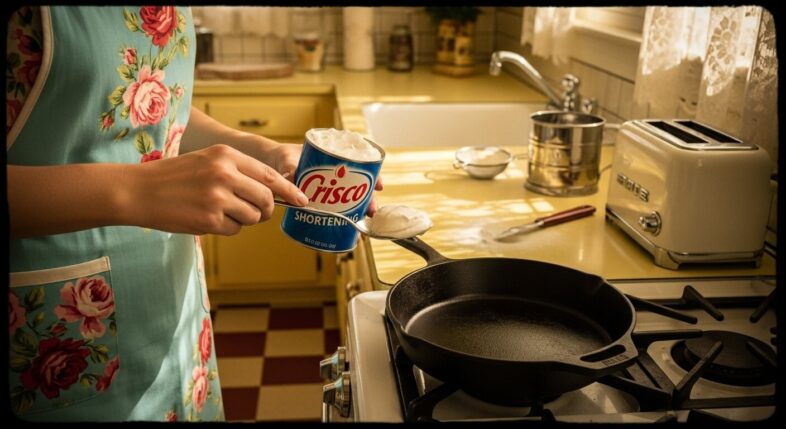
Here’s the thing—your grandmother wasn’t wrong about Crisco. Turns out, solid vegetable shortening has been the secret weapon for cast iron maintenance since the early 1900s, and there’s actual science backing up why it works so damn well.
Understanding Cast Iron Seasoning
Think of seasoning as plastic coating. Sort of.
When you heat fat on cast iron past its smoke point, the fat molecules break down and bond with the iron at a molecular level. This creates a layer that’s no longer grease—it’s polymerized oil. Hard as rock. Slick as glass (if you do it right).
Cast iron is porous. Microscopic holes everywhere. Without seasoning, food sticks to these tiny craters, rust forms, and you’re stuck with a useless hunk of metal. The seasoning fills these pores and builds up layer after layer until you’ve got a cooking surface that rivals any non-stick pan on the market.
But here’s what most people get wrong: they think seasoning happens once. Wrong. It’s an ongoing process that starts with your initial seasoning and continues every single time you cook.
Why Crisco Has Been the Go-To Choice for Generations
Crisco works because it’s pure fat with zero additives, no water content, and a high smoke point of around 490°F.
Your great-grandmother used it. Her mother used it. There’s a reason this method stuck around for over a century—it’s reliable, cheap, and produces a seasoning that actually lasts. No fancy flaxseed oil that flakes off after three uses. No boutique blends that cost $20 a bottle.
Solid shortening has advantages liquid oils don’t:
- Stays where you put it (doesn’t run off before you can spread it)
- Easier to control thin applications
- Room temperature storage—no rancidity issues
- Consistent results every single time
- Works on any cast iron, vintage or modern
And let’s be honest—it’s probably already in your pantry.
The Science Behind Seasoning a Cast Iron Skillet with Crisco
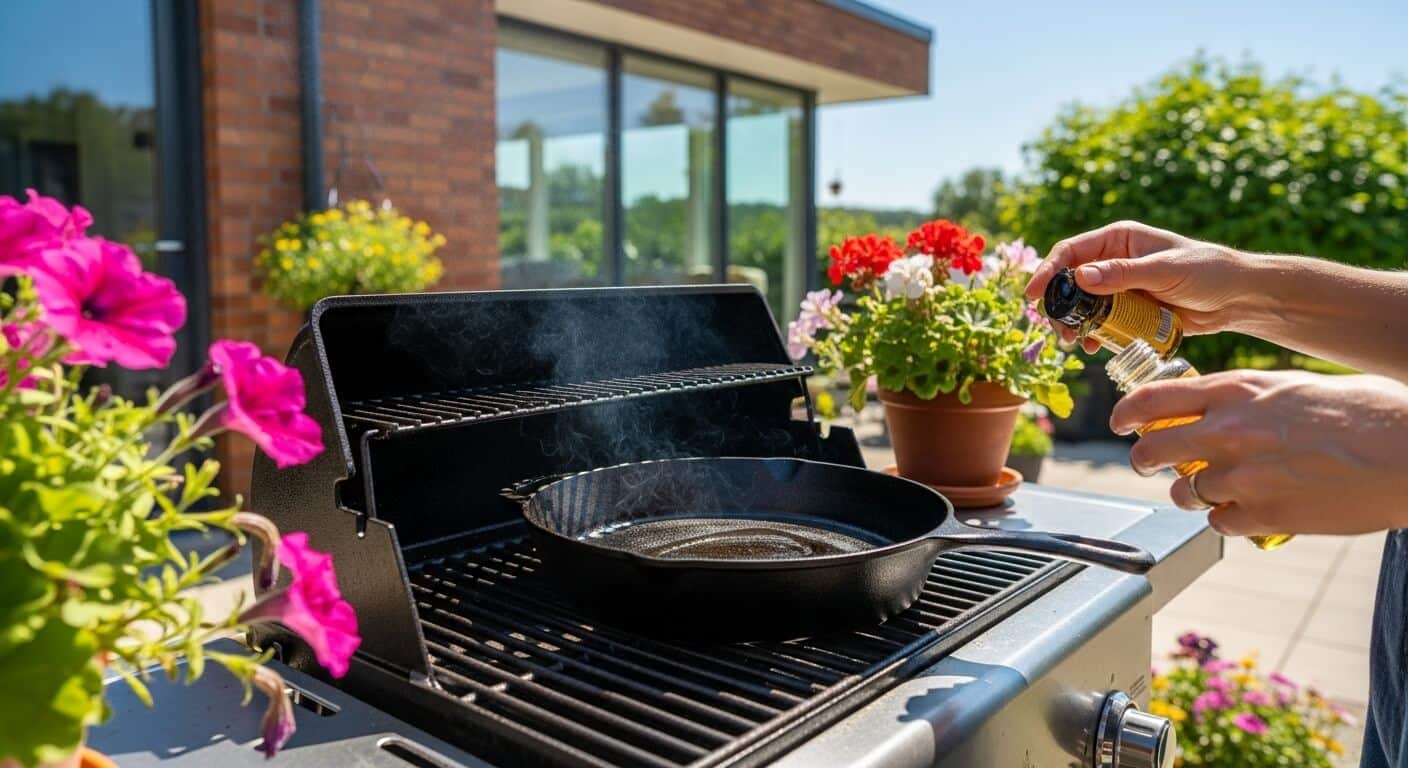
The polymerization process happens when triglycerides in Crisco break apart under heat and form new bonds with iron oxide on your skillet’s surface.
Get this: when you heat Crisco above 400°F, the fatty acid chains literally rearrange themselves into a cross-linked polymer network. Same basic chemistry that creates plastics and varnishes. You’re essentially creating a food-safe coating through controlled heat exposure.
Why Crisco specifically? Its molecular composition is ideal for this transformation. The shortening contains a mix of saturated and unsaturated fats that polymerize at different rates, creating layers with different properties. Bottom layers bond to iron. Top layers provide the slickness.
Temperature matters here. Too low? The fat just sits there getting sticky. Too high? It burns before bonding properly. The sweet spot for Crisco seasoning is 450-475°F—hot enough for complete polymerization but not so hot you’re burning off the coating as fast as you’re building it.
What You’ll Need to Season Your Cast Iron Skillet with Crisco
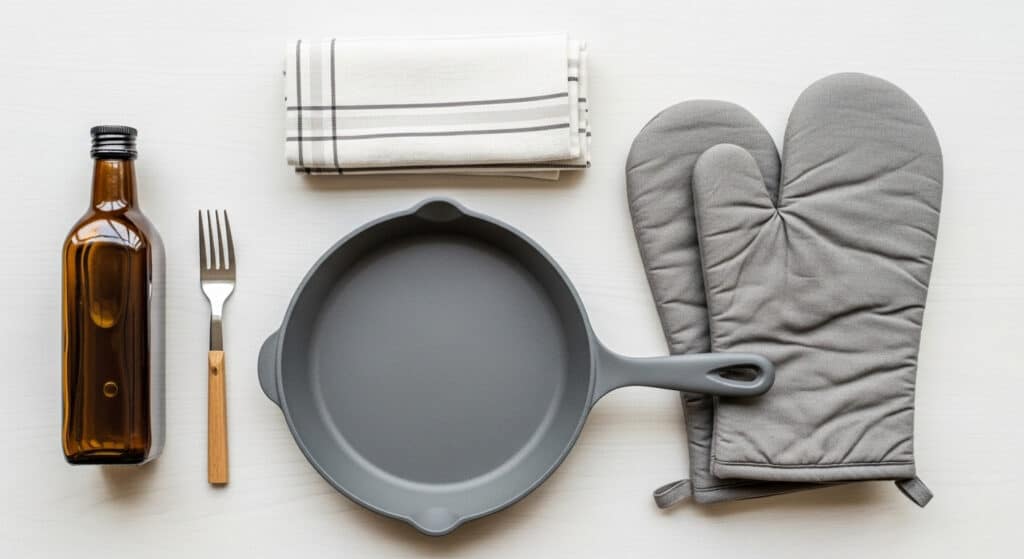
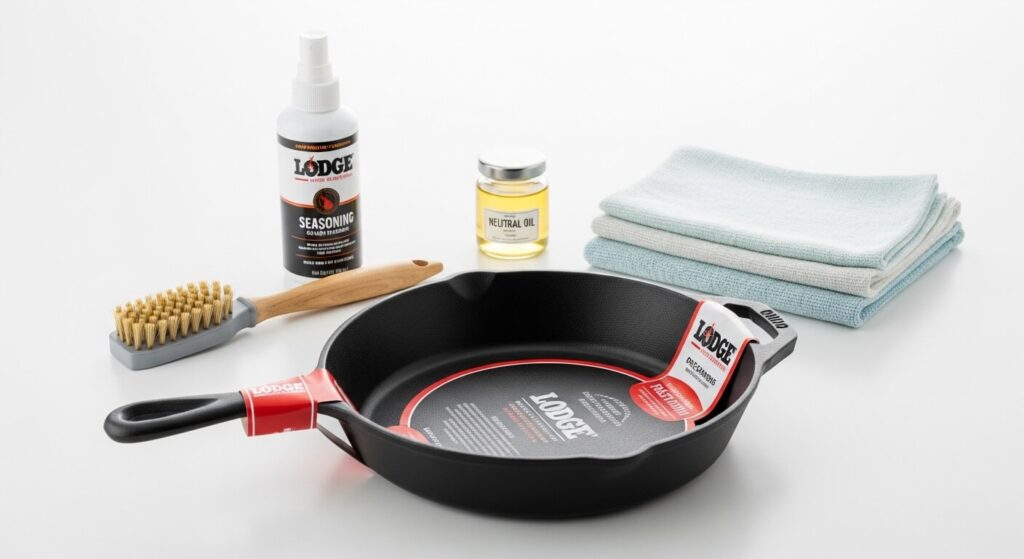
You need Crisco shortening, your cast iron skillet, an oven that reaches 450°F, paper towels, and about 90 minutes of time.
Essential Materials and Tools
The absolute must-haves:
- Crisco vegetable shortening (the blue can—original formula)
- Cast iron skillet (any size, any condition)
- Paper towels or clean lint-free cloths
- Oven with accurate temperature control
- Aluminum foil or a large baking sheet
- Hot pads or oven mitts
That’s it. Seriously.
You don’t need special applicators, fancy brushes, or expensive tools. Paper towels work perfectly because they don’t leave lint and you can toss them when you’re done. Some people swear by old t-shirts cut into squares—fine, use those if you want. Just make sure whatever cloth you use won’t leave fibers behind.
Choosing the Right Crisco Product
Original Crisco All-Vegetable Shortening is what you want—the one in the blue can that’s been around since your grandmother’s kitchen.
Not butter-flavored. Not the baking sticks. Not the spray. The plain, unflavored shortening in the wide can. Period.
Why does this matter? Because flavored versions contain additives that don’t polymerize correctly. They leave sticky residues. They smell weird when heated. They’re formulated for baking, not for creating rock-hard coatings on iron.
One 48-ounce can will season multiple skillets dozens of times. You’re using tiny amounts per application—maybe a tablespoon max for a 12-inch skillet.
Optional Items for Best Results
Want to go the extra mile? These help but aren’t required:
- Chain mail scrubber (for removing old seasoning or rust)
- White vinegar (rust removal)
- Coarse salt (gentle scrubbing)
- Dish soap—yeah, you can use it on cast iron despite what purists claim
- Wire brush for stubborn rust spots
- Steel wool (0000 grade only) for vintage pieces
Most people won’t need these unless they’re starting with a rusty flea market find.
Preparing Your Cast Iron Skillet Before Seasoning
Before seasoning with Crisco, your cast iron must be completely clean, dry, and free of rust, old flaking seasoning, or manufacturing residues.
Skip this step and you’re building your seasoning on a bad foundation. It’ll flake. It’ll peel. You’ll be back to square one in a month wondering what went wrong.
Inspecting Your Skillet’s Current Condition
Look at your pan. Really look at it.
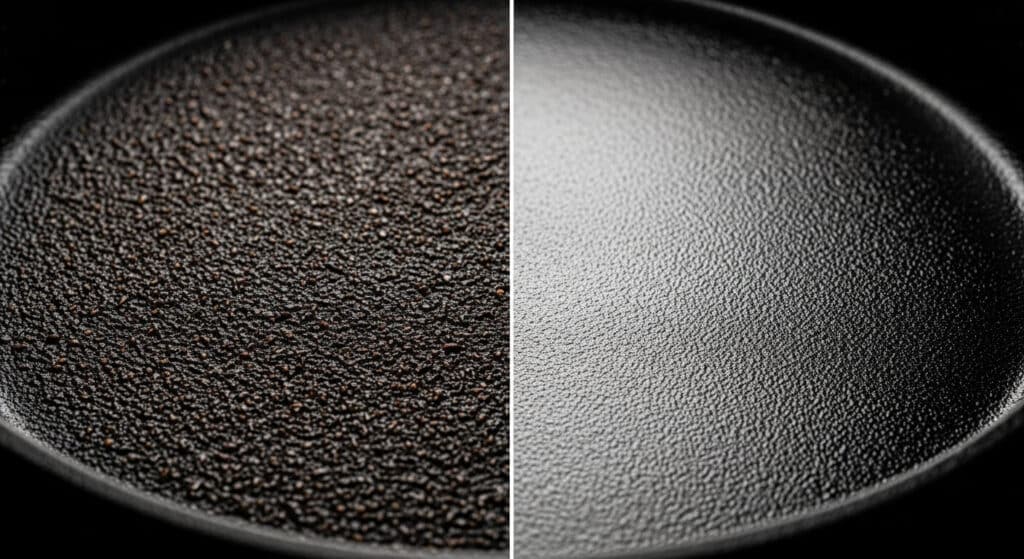
What are you seeing? Smooth, even black surface? Great—you might just need a light cleaning. Rust spots? Flaking patches? Sticky residue? Different story. You’ve got work to do before seasoning.
Run your hand across the cooking surface (carefully if there’s rust). Should feel relatively smooth. If you’re feeling bumps, sticky patches, or rough spots, those need addressing first.
What you’re looking for:
- Rust (orange or red spots)
- Uneven coloring (blotchy black and gray areas)
- Flaking or peeling old seasoning
- Sticky or tacky feeling
- Gray patches (exposed iron)
Brand new skillets come with a temporary coating from the factory. This isn’t seasoning—it’s a protective wax or oil to prevent rust during shipping. Needs to come off completely.
How to Clean a New Cast Iron Skillet Before Seasoning
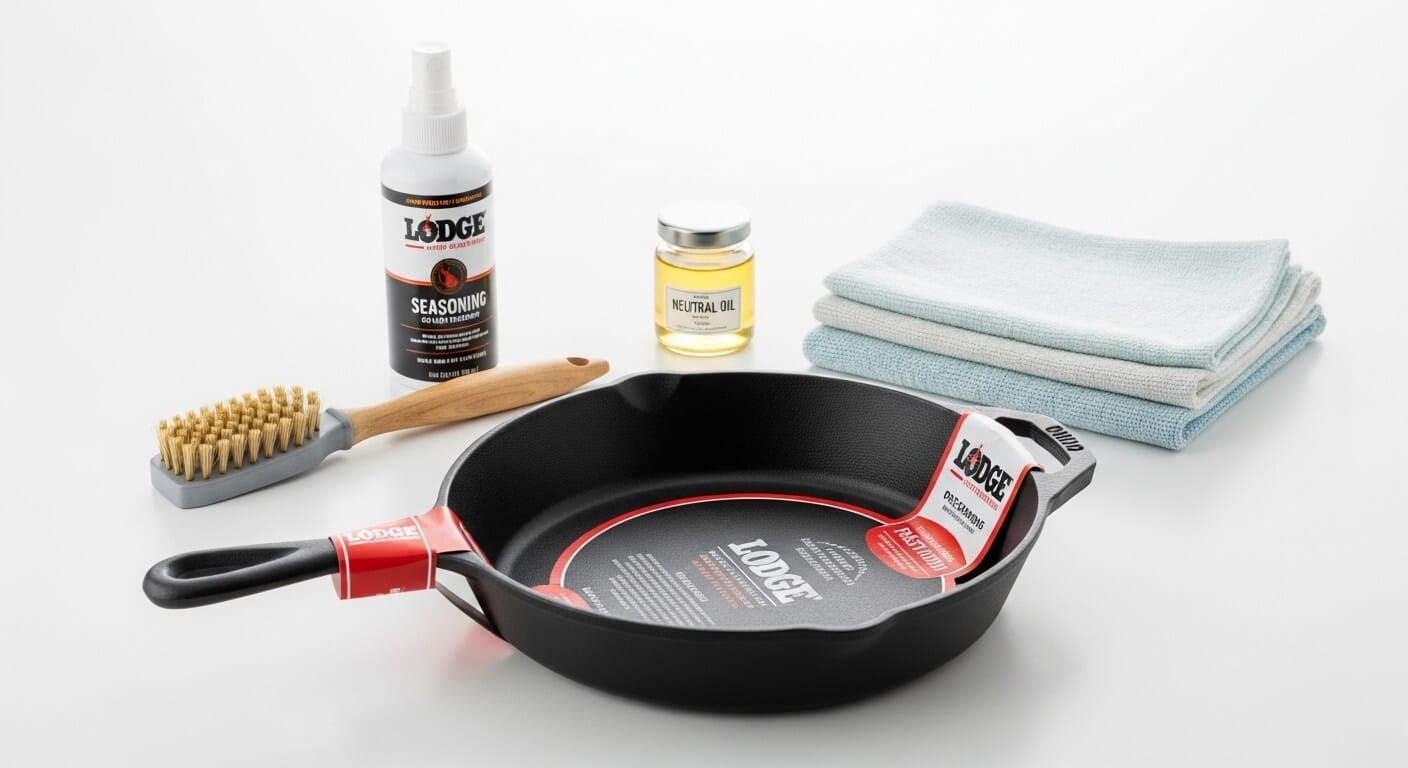
New cast iron requires a thorough scrubbing with hot water and dish soap to remove the factory coating—yes, soap is fine for this step.
Here’s what works: hot water, a drop of dish soap, and a stiff brush or scrubbing pad. Scrub the entire surface—inside, outside, handle, everything. The factory coating should come off easily with a little elbow grease.
Rinse thoroughly. And I mean thoroughly.
Soap residue will interfere with seasoning, so keep rinsing until the water runs completely clear and you don’t feel any slickness on the surface. Then dry it immediately—either with towels or by placing it on a warm burner for a few minutes.
Any moisture left on bare cast iron means rust. And rust means you’re starting over.
Removing Old Seasoning or Rust from Vintage Skillets
Strip old seasoning by scrubbing with coarse salt and oil, using a chain mail scrubber, or—for heavy buildup—running a self-cleaning oven cycle with the skillet inside.
Got a crusty vintage piece? The self-cleaning oven method is controversial but effective. Place your skillet in the oven, run the self-clean cycle, and the extreme heat burns off everything down to bare metal. Let it cool completely (this takes hours), then wash and proceed to seasoning.
Rust requires different treatment. Make a 50/50 mix of white vinegar and water, soak the rusty areas for 30 minutes to an hour, then scrub with steel wool or a wire brush. Check every 15 minutes—vinegar can etch the iron if left too long.
For light rust, just scrub with coarse salt and a potato half. Sounds weird. Works great. The salt acts as an abrasive and the potato’s oxalic acid neutralizes rust.
Whatever method you use, wash thoroughly afterward with hot water and soap.
Drying Your Cast Iron Completely
After washing, dry your skillet immediately by toweling it off and then heating it on the stovetop or in a warm oven for 5-10 minutes to evaporate any remaining moisture.
This step is non-negotiable. Cast iron rusts the second water touches bare metal. Even if you towel-dry thoroughly, there’s still microscopic moisture in those pores.
Put your wet skillet on a burner set to medium-low, or stick it in an oven at 200°F. You’ll see any remaining water evaporate off. Once the skillet is completely dry and slightly warm to the touch, it’s ready for Crisco.
Some people heat until the skillet is smoking hot before applying shortening. Not necessary for the Crisco method—room temperature or slightly warm works fine.
Step-by-Step Guide: How to Season a Cast Iron Skillet with Crisco
To season a cast iron skillet with Crisco, apply a paper-thin layer of shortening to every surface, wipe off all visible excess until the pan looks almost dry, then bake upside-down at 450°F for one hour before letting it cool completely in the oven.
This process seems simple. It is simple. But people screw it up constantly by using too much Crisco or pulling the pan out too early.
Step 1: Preheat Your Oven to the Correct Temperature
Set your oven to 450°F and let it preheat for at least 15 minutes to ensure even, consistent temperature throughout.
Why 450°F? Because that’s the temperature where Crisco fully polymerizes without burning. Too low (350-400°F) and you get sticky, partially-polymerized gunk. Too high (500°F+) and you’re burning the coating faster than you’re building it.
Some grandmothers used 475°F. Some used 425°F. Anywhere in the 425-475°F range works, but 450°F is the sweet spot that produces consistent results across different oven types and altitudes.
Make sure your oven temperature is accurate—cheap ovens can be off by 50°F or more. If you’ve got an oven thermometer, use it.
Step 2: Apply a Thin Layer of Crisco to Your Cast Iron
Scoop out about a teaspoon of Crisco and rub it all over your skillet’s cooking surface, outside, bottom, and handle using a paper towel or cloth.
The Crisco should be soft but not melted. Room temperature works perfectly. If your shortening is rock-hard from being stored in a cold pantry, warm it slightly between your hands or leave the can out for 10 minutes.
Rub in circular motions, making sure you’re covering every single square inch of exposed iron. And I mean everything:
- Cooking surface
- Sidewalls
- Bottom
- Handle
- The little helper handle (if your skillet has one)
- Around the pour spouts
- That awkward spot where the handle meets the pan
Miss a spot and that’s where rust shows up a week later.
How Much Crisco to Use
Less than you think—a teaspoon covers a 12-inch skillet completely when spread thin.
You’re not frosting a cake here. You’re creating an invisibly thin coating. Think of it like rubbing lotion into your skin—you want coverage, but you don’t want visible globs sitting on the surface.
For a 10-12 inch skillet: 1 teaspoon
For an 8-inch skillet: 1/2 teaspoon
For a 14-inch skillet: 1.5 teaspoons
These are starting points. You’re going to wipe most of it off anyway (more on that in a second).
Proper Application Technique
Work the Crisco into the iron with firm pressure and circular motions, as if you’re buffing a car rather than just smearing oil around.
Don’t just swipe it on and call it done. Really work it in. The friction from rubbing helps the shortening get into those microscopic pores. You want the surface to look uniformly coated—no thick spots, no dry patches.
Pay extra attention to rough areas, old rust spots that you’ve cleaned up, or places where seasoning has worn off. These spots need good coverage because they’re more prone to future issues.
The cast iron should look wet but not dripping.
Coating Every Surface Including the Handle
The handle needs seasoning too—exposed iron anywhere on your skillet will rust, and rust spreads.
Yeah, you’re not cooking on the handle. Doesn’t matter. Unprotected cast iron is vulnerable cast iron. The handle rusts just as easily as the cooking surface, and once rust starts, it migrates. Plus, a well-seasoned handle develops a better grip texture over time.
Don’t forget the underside of the handle where it curves into the pan body. That spot collects moisture when you wash the skillet and rusts quickly if left bare.
Step 3: Wipe Off Excess Crisco Thoroughly
After coating the entire skillet, take a clean paper towel and wipe off the Crisco like you’re trying to remove all of it—the pan should look almost dry when you’re done.
This is where most people fail. They leave too much shortening on the pan, thinking more is better. Wrong. More is worse.
Here’s what happens when you leave excess Crisco: it pools in certain areas during baking, never fully polymerizes, and leaves sticky patches that feel tacky even after cooling. You end up with an uneven, gummy surface that needs to be stripped and redone.
Why This Step Is Critical
Thick layers of fat don’t polymerize properly—they turn into sticky, brown gunk instead of hard, slick seasoning.
Only the thinnest possible layer will transform into that glass-like finish you’re after. Anything thicker stays partially liquid, traps itself between hardened layers, and creates problems.
Think of it this way: you’re aiming for molecular-level coverage, not visible coverage. The Crisco should be so thin you can barely tell it’s there.
The “Dry to the Touch” Rule
After wiping, your skillet should feel dry and look like bare metal—if you can see shiny oil or feel slickness, keep wiping.
Take a fresh paper towel. Wipe again. And again. Keep wiping until the paper towel comes away almost clean and the skillet looks like it did before you applied any Crisco.
This feels wrong. You’ll think you’ve removed all the shortening and there’s nothing left to polymerize. Trust the process—there’s still plenty of fat in those pores, and that’s exactly the amount you want.
Some people buff their skillets for 5-10 minutes after the initial application. Not overkill. That extra buffing creates the thinnest, most even coating possible.
Step 4: Place Your Skillet Upside Down in the Oven
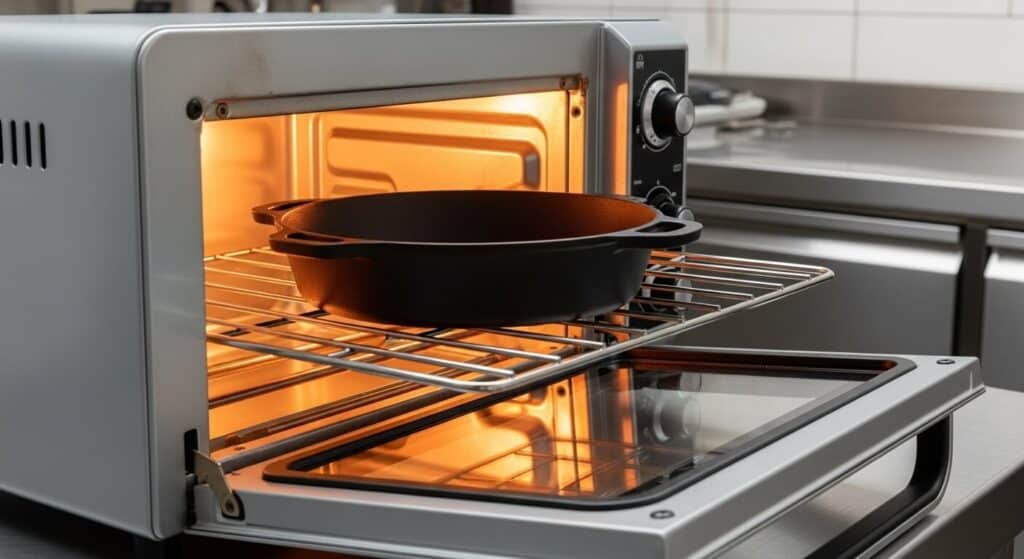
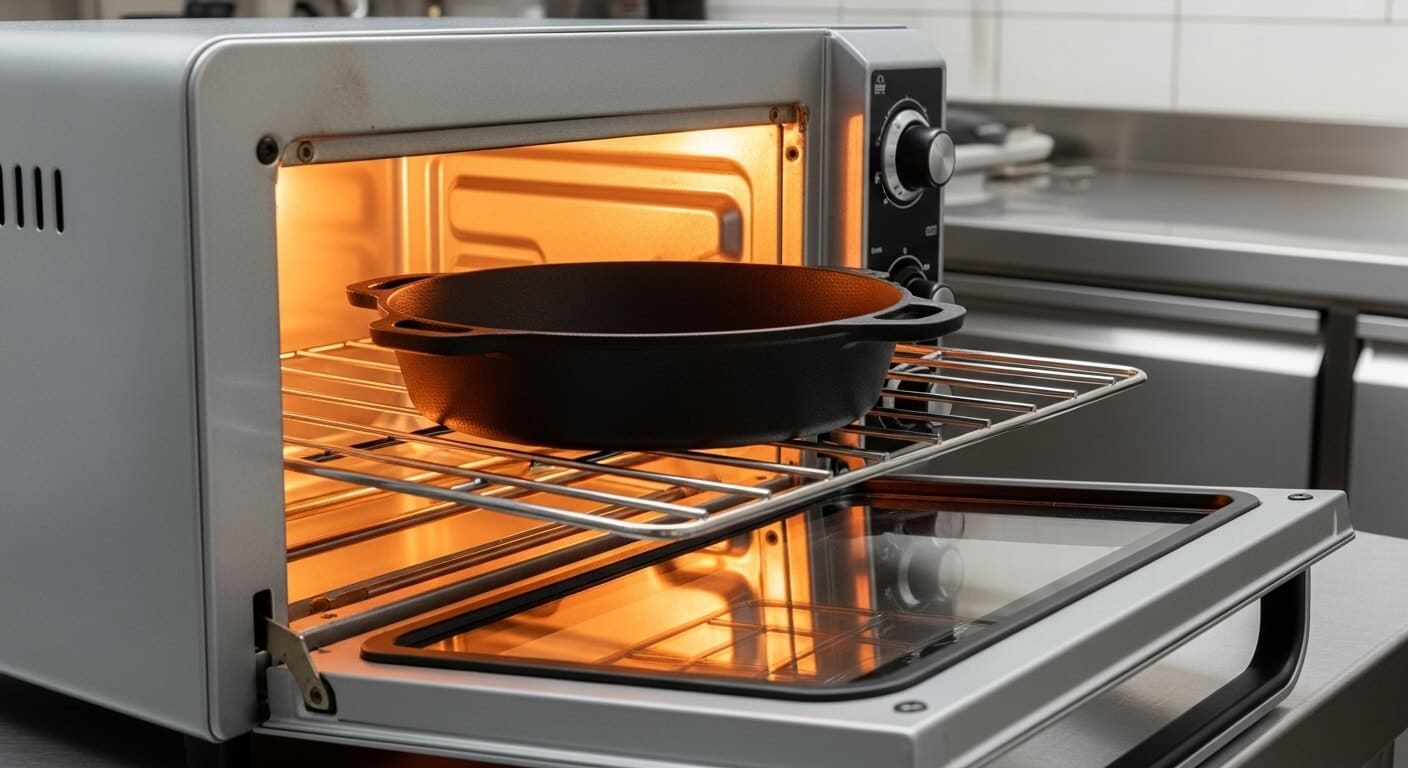
Put your Crisco-coated skillet upside-down on the middle oven rack to prevent any excess oil from pooling on the cooking surface during the baking process.
Upside-down is key. Gravity is not your friend when you’re trying to build even seasoning layers. Any excess Crisco (and there’s always a tiny bit of excess) will drip away from the cooking surface instead of collecting in the center of the pan.
Position the skillet so it’s centered on the rack with good air circulation around it. Don’t shove it in the back corner or push it against the oven walls.
Why Upside Down Matters
Right-side-up allows oil to pool in the center, creating uneven seasoning with a sticky middle and a properly-seasoned rim—upside-down prevents this entirely.
Physics does the work for you. The tiny amount of mobile Crisco that hasn’t bonded yet flows toward the rim (which is now pointing down) and drips onto your foil instead of staying on the pan.
You end up with uniform coverage. No thick spots. No thin spots. Just consistent seasoning across the entire surface.
Using Foil or a Baking Sheet to Catch Drips
Place a sheet of aluminum foil or a baking sheet on the rack below your skillet to catch any dripping oil and save yourself from cleaning a gross oven later.
Even with proper wiping, a few drops usually fall. Better on foil than on your oven bottom where they’ll smoke and stink up your kitchen.
Leave at least 2-3 inches of clearance between the foil and your skillet. You want air to circulate freely—blocking airflow can create hot spots and uneven polymerization.
Step 5: Bake Your Cast Iron Skillet for One Hour
Let your Crisco-coated skillet bake at 450°F for exactly one hour to allow complete polymerization of the fat into a hard, bonded coating.
Set a timer. Don’t guess.
During this hour, the Crisco goes through a transformation. First 15 minutes: it liquefies and spreads. Next 20 minutes: it starts smoking and bonding. Final 25 minutes: full polymerization occurs and the coating hardens.
Your kitchen will smell. This is normal. The smell comes from the fatty acids breaking apart and rearranging. Crack a window, turn on your vent fan, or both. The smell isn’t harmful (unless you’re burning off old paint or something crazy), just strong.
Don’t open the oven to check on it. Temperature fluctuations interrupt the polymerization process. Leave it alone for the full hour.
Step 6: Allow the Skillet to Cool Completely in the Oven
After one hour, turn off the oven and let your skillet cool down inside for at least another hour—pulling it out while hot can cause warping or cracking and also ruins your new seasoning layer.
Patience here. I know it’s tempting to crack that oven open and see your beautiful newly-seasoned pan. Don’t.
The seasoning is still setting as it cools. The molecular bonds are finishing their formation. Rapid temperature changes—like pulling a 450°F skillet into a 70°F kitchen—can cause microfractures in your fresh seasoning layer.
Let the oven cool naturally. When you can touch the skillet without gloves and it feels just barely warm, it’s ready to come out.
Your skillet should look darker than it did going in. The surface should feel dry and smooth, not sticky or tacky. If you notice stickiness, you used too much Crisco and need to do another round with better wiping.
Step 7: Repeat the Seasoning Process
One coat of Crisco seasoning isn’t enough—repeat the entire process (apply thin Crisco layer, wipe thoroughly, bake upside-down for an hour, cool completely) at least 3-5 times for durable, non-stick seasoning.
Yes, this takes time. 3-5 hours minimum if you’re doing back-to-back sessions. But here’s the thing—each layer builds on the previous one, creating a seasoning that’s thick enough to withstand actual cooking.
After the first coat, your skillet will look somewhat seasoned but still have gray or dull patches. Second coat fills in more. Third coat starts looking legitimately seasoned—dark, smooth, with a slight sheen. Fourth and fifth coats make it bulletproof.
How Many Coats You Need
Three coats minimum for functional seasoning, five coats for excellent seasoning that rivals factory pre-seasoned pans, and 6+ coats if you’re starting with a rusty vintage piece or stripped skillet.
Quick reference:
| Starting Condition | Minimum Coats | Recommended Coats |
|---|---|---|
| New skillet | 3 | 5 |
| Previously seasoned (maintenance) | 1-2 | 2-3 |
| Stripped/restored vintage | 4 | 6-7 |
| Rusty flea market find | 5 | 7-8 |
More coats don’t hurt. Some people do 10+ coats on special vintage pieces. But you hit diminishing returns after about 6-7 layers—the difference between coat 7 and coat 10 is minimal.
Building Up Multiple Layers of Seasoning
Each additional layer should follow the exact same process—thin application, thorough wipe-down, one hour at 450°F, complete cooling before the next coat.
Don’t rush between coats. Let each layer cure completely. If you’re doing multiple rounds in one day, make sure the skillet has cooled to room temperature before applying the next round of Crisco.
Some people season one day, cook a few meals, then add another coat a week later. Also fine. The seasoning you build through cooking is just as valid as oven seasoning—it just happens more gradually.
By the fifth coat, your skillet should be noticeably darker (deep brown to black depending on your iron), feel smooth and dry to the touch, and have a subtle sheen that catches light at certain angles.
Common Mistakes When Seasoning Cast Iron with Crisco
The most common mistake when seasoning cast iron with Crisco is leaving too much shortening on the pan, which creates sticky, gummy patches instead of smooth, hard seasoning.
People screw this up constantly. They think cast iron needs to be “well-oiled” so they glob on the Crisco, skip the thorough wipe-down, and wonder why their pan feels tacky three hours later.
Using Too Much Crisco
Excess Crisco pools, doesn’t polymerize completely, and leaves sticky brown residue that feels like partially-dried glue rather than the slick, hard surface you want.
I’ve seen skillets with so much Crisco they’re practically dripping. No. That’s not going to work.
The fix is simple: use less. Way less than your instincts tell you. That teaspoon of shortening for a 12-inch skillet? That’s a starting amount before you wipe most of it off. You should remove at least 80% of what you initially apply.
Not Wiping Off Excess Oil Properly
If you can see shiny oil sitting on your skillet’s surface after wiping, you haven’t wiped enough—keep buffing until the pan looks nearly dry and feels that way too.
Here’s a test: take a clean paper towel and wipe your “finished” surface. Does the towel pick up visible oil? Then you’re not done wiping. Keep going until the towel comes away barely discolored.
This feels counterintuitive. You’re supposed to be adding seasoning, not removing it. But the microscopic amount of Crisco left after aggressive wiping is exactly the right amount for perfect polymerization.
Think of it like staining wood—you apply stain liberally, then wipe off the excess. Same concept.
Seasoning at Incorrect Temperatures
Temperatures below 400°F don’t fully polymerize Crisco (leaving it sticky), while temperatures above 500°F burn the coating faster than it can bond properly.
Too cool and you’re basically baking shortening onto your pan without the chemical transformation that creates real seasoning. The fat stays partially liquid at the molecular level. It never hardens completely. You get a surface that feels tacky and attracts dust and crud.
Too hot and you’re burning off the fat before it can polymerize. The coating turns brown, smells acrid, and flakes off easily. You’re damaging the coating instead of building it.
Stick with 450°F. If your oven runs hot or cold, adjust accordingly—aim for an actual temperature of 450°F inside the oven, not whatever your dial says.
Skipping Multiple Coats
One coat of seasoning is barely enough to prevent rust—it won’t give you the non-stick surface or durability that multiple layers provide.
Single-coat seasoning is thin. Fragile. It’ll wear off quickly once you start cooking, especially with acidic foods or metal utensils. You’ll be back to a gray, patchy surface within a few weeks.
Build it up properly from the start. Three coats minimum. Five coats if you want seasoning that lasts.
Yeah, it takes time. Would you rather spend an extra few hours now or have to re-season every month because your coating keeps failing?
Removing the Skillet Too Soon
Pulling your skillet out of the oven while it’s still hot disrupts the final stages of polymerization and can cause your fresh seasoning to crack or peel.
The cooling phase is part of the process, not just waiting around for safety. As the temperature drops, the molecular bonds in your new seasoning complete their formation and stabilize. Interrupt this and you get weak seasoning that doesn’t hold up.
Thermal shock is also a risk. Cast iron is brittle despite being thick and heavy. Rapid temperature changes can cause warping (rare but possible) or microcracks in your seasoning (common if you’re careless).
Leave it in the oven. Go do something else. Watch TV. The skillet will still be there in an hour when it’s properly cooled.
Crisco vs Other Oils: Why the Traditional Method Still Works
Crisco creates more durable, reliable cast iron seasoning than most modern alternatives because its specific fat composition and high smoke point produce consistent polymerization without the flaking issues common to trendy oils like flaxseed.
The internet loves to debate seasoning oils. Flaxseed oil gets hyped because it has the highest percentage of unsaturated fats. Grapeseed oil has its fans. Canola, vegetable oil, lard—everyone’s got an opinion.
But grandma’s Crisco method keeps working. Why mess with success?
Crisco vs Flaxseed Oil for Cast Iron Seasoning
Flaxseed oil creates an initially beautiful, glass-like finish but tends to flake and chip with regular use, while Crisco builds more flexible seasoning that handles temperature changes and cooking stress better.
Flaxseed became popular because someone posted about it online and claimed it created the “best” seasoning. Problem is, flaxseed seasoning is brittle. That perfect black finish everyone shows off in photos? Give it a few months of actual cooking and watch it chip away.
The high percentage of alpha-linolenic acid in flaxseed oil creates a very hard coating—maybe too hard. It doesn’t have the slight flexibility that makes Crisco seasoning so durable. Think of the difference between glass and plastic—glass looks better, plastic survives being dropped.
Flaxseed also costs 10x more than Crisco. For worse results.
Crisco vs Vegetable Oil
Liquid vegetable oil runs off the pan before you can spread it evenly, making it harder to achieve the thin, uniform coating that Crisco’s solid consistency provides naturally.
Can you season with vegetable oil? Sure. People do it all the time. But it’s messier and less consistent.
The solid form of Crisco stays exactly where you put it during application. You have complete control over placement and thickness. Liquid oils want to run toward the lowest point, creating thick spots and thin spots.
You’ll use way more paper towels wiping off liquid oil too. It’s just harder to work with.
Crisco vs Canola Oil
Canola oil works fine for seasoning but offers no real advantages over Crisco while being harder to apply in consistently thin layers because of its liquid form.
Canola has a decent smoke point (400°F), polymerizes reasonably well, and costs less than boutique oils. It’s not a bad choice. But it’s not better than Crisco—just different.
If you’ve got canola oil and no Crisco, go ahead and use it. You’ll get okay results. But if you’re buying supplies specifically for seasoning, grab the Crisco. It’s literally designed for high-heat applications and has been tested on millions of cast iron pans over decades.
The Benefits of Using Solid Shortening Over Liquid Oils
Solid shortening gives you better control during application, doesn’t require as much wiping to remove excess, and creates more consistent seasoning layers because it stays in place rather than running around the pan.
Why solid beats liquid:
- Easier to apply exactly where you want it
- Less mess on your hands and counter
- Better control over layer thickness
- Doesn’t pool in the center while you’re working
- Room temperature storage with no rancidity worries
- Lasts forever in the pantry
That last point matters more than you’d think. Bottles of flaxseed oil go rancid in a few months once opened. Crisco sits in your cabinet for years without issues. Way more practical for occasional seasoning maintenance.
Maintaining Your Crisco-Seasoned Cast Iron Skillet
After seasoning your cast iron with Crisco, maintain it by cleaning gently after each use, drying immediately and completely, and applying a thin rub of oil while the pan is still warm to continuously build the seasoning through regular cooking.
Good seasoning is never “done.” You’re not creating a permanent coating and forgetting about it. Seasoning is a living surface that improves with use and degrades with neglect.
Treat it right and your seasoning gets better with every meal. Ignore basic maintenance and you’ll be back to square one, wondering why your “seasoned” pan is rusting and sticking.
Daily Cleaning Best Practices
Clean your Crisco-seasoned skillet while it’s still warm (not hot) using hot water and a stiff brush or chain mail scrubber, then dry immediately on the stove over low heat.
Forget everything you’ve heard about never using soap. You can use a tiny drop of mild dish soap if the pan is actually greasy—it won’t destroy your seasoning unless you’re scrubbing with steel wool for 20 minutes. Modern dish soap doesn’t contain lye. It’s fine.
But honestly, you usually don’t need soap. Hot water and scrubbing removes most food residue. For stuck-on bits, use coarse salt as an abrasive—dump a tablespoon of salt in the pan, add a tiny bit of water to make a paste, and scrub with a paper towel or brush.
The routine that works:
- Clean while slightly warm (easier to remove food)
- Rinse thoroughly—no food bits left behind
- Dry immediately with a towel
- Place on warm burner for 2-3 minutes to evaporate all moisture
- While still warm, rub in a super-thin layer of oil (any cooking oil works)
- Wipe off excess oil until pan looks dry
- Store in a dry place
That thin oil rub after each use is maintenance seasoning. You’re adding microscopic layers every time. Over months and years, this builds seasoning that’s inches thick at the molecular level.
When to Re-Season Your Cast Iron
Re-season your cast iron skillet with Crisco when you notice gray patches where seasoning has worn off, if food starts sticking consistently, or if rust spots appear despite normal care.
Signs you need to re-season:
- Dull gray areas where black seasoning used to be
- Food sticking where it never stuck before
- Any visible rust (even tiny orange specks)
- Rough texture instead of smooth
- Water doesn’t bead up on the surface anymore
Minor wear is normal. You don’t need to strip and re-season from scratch if you’ve got one small worn spot. Just clean that area well, apply Crisco, wipe thoroughly, and do a single seasoning round at 450°F.
Major wear means stripping and starting over with the full 5-coat process.
Cooking Tips for Newly Seasoned Skillets
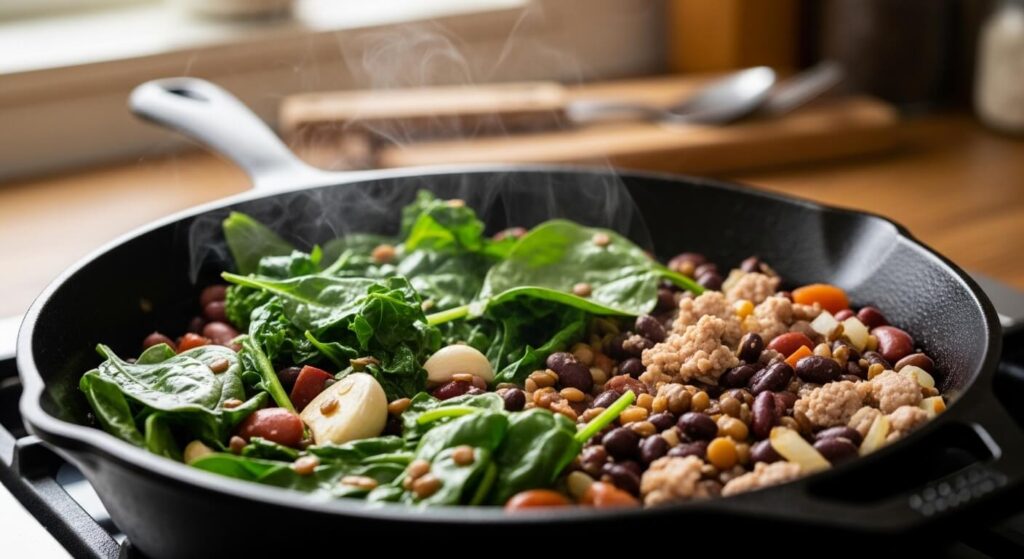
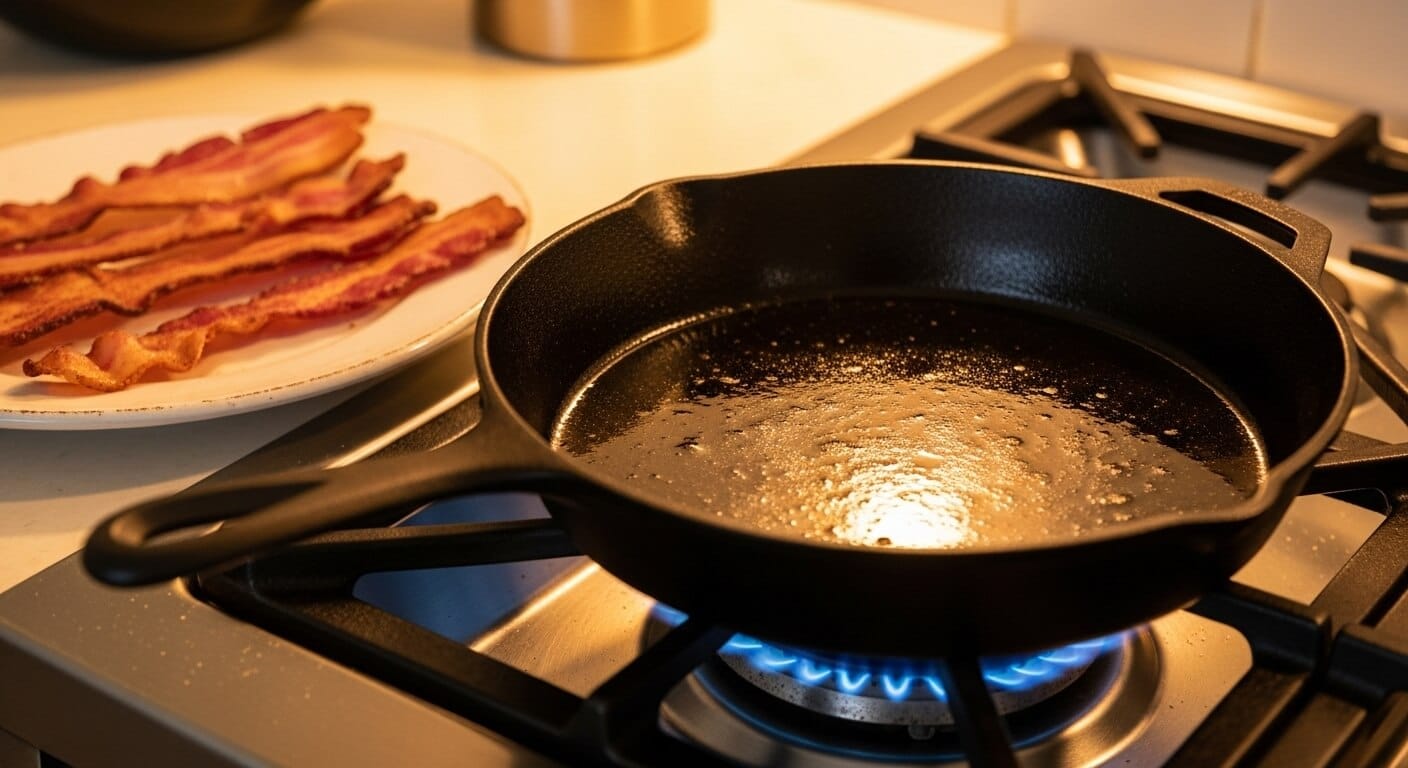
Break in your newly Crisco-seasoned cast iron by cooking fatty foods like bacon, sausage, or pan-fried chicken for the first few uses—these help build additional seasoning layers naturally while you cook.
Your fresh seasoning is good but still somewhat fragile. Baby it for the first few meals. Cook foods that add fat to the surface instead of foods that strip it away.
Great first meals:
- Bacon (classic for good reason)
- Fried eggs with butter
- Sautéed vegetables in oil
- Pan-fried potatoes
- Grilled cheese sandwiches
- Cornbread
Each of these adds to your seasoning instead of testing it. The combination of fat and heat continues the polymerization process started in your oven.
After 10-15 uses, your seasoning will be much more robust. That’s when you can start cooking anything without worrying.
Foods to Avoid in Freshly Seasoned Cast Iron
Don’t cook acidic foods like tomato sauce, chili, citrus-based dishes, or vinegar-heavy recipes in your newly seasoned skillet for at least the first month—acids break down fresh seasoning before it’s fully cured.
Tomato sauce is the big one. It’ll strip new seasoning right off. Wait until your pan has at least 20-30 cooking sessions under its belt before you’re simmering marinara or making chili.
Other foods to avoid initially:
- Lemon or lime-based dishes
- Wine-braised anything
- Vinegar-heavy preparations
- Long-simmered tomato-based sauces
- Anything with a lot of citrus
Once your seasoning is well-established (2-3 months of regular use), you can cook whatever you want. The seasoning will be thick enough to handle occasional acid exposure. But give it time to build up first.
Troubleshooting Seasoning Issues
When cast iron seasoning goes wrong, you’ll typically see either sticky/tacky surfaces from too much oil, flaking from weak polymerization, or uneven coloring from inconsistent application—most problems can be fixed without completely stripping and restarting.
Something went wrong. Don’t panic.
Most seasoning problems are fixable. You rarely need to strip everything and start from scratch unless you’ve got major rust or completely failed seasoning covering the entire pan.
Dealing with Sticky or Tacky Surfaces
Fix sticky seasoning by placing your skillet back in a 450°F oven for another hour to finish polymerizing the excess oil, or—if that doesn’t work—by scrubbing off the sticky layer and re-seasoning properly with less Crisco.
Stickiness means incomplete polymerization. Either you used too much Crisco, your oven wasn’t hot enough, or you didn’t bake long enough. The fat is stuck in a partially-transformed state—not liquid, not solid, just gross and tacky.
Try this first: put the sticky pan back in a 450°F oven for another hour. Sometimes the extra heat time is all it needs to finish the job.
Still sticky after that? You need to remove the failed layer. Scrub with coarse salt and oil until the stickiness is gone, wash thoroughly, dry, and re-season with a properly thin coat of Crisco.
Fixing Uneven Seasoning
Patch uneven seasoning by cleaning the entire surface, applying a thin Crisco layer to the whole pan (not just worn spots), and doing a single seasoning round—this evens out the coating better than trying to spot-treat individual areas.
Blotchy seasoning is mostly cosmetic. Dark spots and light spots don’t affect cooking performance as long as the surface is smooth and nothing is flaking.
But if it bothers you, or if the uneven areas are causing food to stick, do a full-surface seasoning round. Don’t try to just hit the light spots—you’ll make the problem worse by building up thick spots elsewhere.
One or two complete seasoning rounds will blend everything together into a more uniform appearance.
Addressing Flaking or Peeling Seasoning
When seasoning flakes off, scrub away all loose pieces with a stiff brush, clean the exposed areas thoroughly, and re-season just those spots with 2-3 Crisco layers to rebuild the coating.
Flaking usually means you’re dealing with old seasoning that wasn’t bonded well in the first place, or you got seasoning too thick and it’s separating in sheets.
Don’t leave flaky bits on the pan hoping they’ll settle down. They won’t. They’ll keep peeling and get into your food. Scrub them off.
Once the loose stuff is gone, you’ll probably see gray patches of exposed iron. Re-season those areas. If the flaking is extensive (more than 30% of the surface), consider stripping and starting fresh.
What to Do If Your Seasoning Looks Blotchy
Blotchy seasoning with light and dark patches is normal and doesn’t affect performance—it’s caused by variations in heat distribution, iron composition, or layer thickness, and will even out over time with regular cooking.
Seriously, don’t stress about this. My best-performing skillet looks like a patchwork quilt—dark brown in the center, black around the edges, with some gray spots near the handle. Cooks perfectly.
Vintage cast iron especially tends to develop multi-colored seasoning because different parts of the pan heat differently and the iron itself isn’t perfectly uniform.
If you absolutely can’t stand the look, do another 2-3 seasoning rounds and it’ll darken up. But functionally? It’s fine as-is.
The History of Seasoning Cast Iron Skillets with Crisco
Crisco became the preferred shortening for seasoning cast iron in the early 1900s when Procter & Gamble marketed it as a versatile, shelf-stable cooking fat that worked better than lard for both baking and maintaining cookware.
Before Crisco hit the market in 1911, people used lard or bacon grease to season their cast iron. These worked okay but had downsides—animal fats go rancid quickly, smell strong when heated repeatedly, and aren’t vegetarian-friendly.
Crisco changed everything. It was revolutionary for its time—a fat that stayed fresh at room temperature indefinitely, had no animal odor, and produced consistent results whether you were baking a pie or seasoning a skillet.
Why Grandmothers Swore by This Method
Grandmothers used Crisco for seasoning because it was already in their kitchens for baking, it was affordable during tough economic times, and—most importantly—it worked reliably every single time without fancy techniques or temperature precision.
During the Depression and World War II, when resources were scarce, Crisco was often cheaper and more available than butter or lard. Women learned to use it for everything. Seasoning cast iron was just one more practical application of a pantry staple.
The method got passed down because it had a proven track record. Your grandmother’s cast iron lasted 50+ years using nothing but Crisco seasoning. That kind of durability speaks for itself.
And here’s the thing—grandmothers weren’t measuring temperatures with digital thermometers or timing sessions with phone apps. They were eyeballing everything. Crisco was forgiving enough to work even with imprecise methods.
How Crisco Became a Kitchen Staple
Procter & Gamble spent millions marketing Crisco as a modern, scientific improvement over traditional animal fats, distributing free recipe books and even hosting cooking demonstrations to convince American households to switch.
The company literally gave away cookbooks featuring recipes specifically designed for Crisco. They positioned it as cleaner, healthier, and more modern than lard. The campaign worked—by the 1950s, Crisco was in nearly every American kitchen.
Part of the marketing emphasized versatility. One product for pie crusts, fried chicken, AND maintaining your cookware? That appealed to budget-conscious home cooks.
The cast iron seasoning application wasn’t official P&G guidance (they sold shortening for food, not cookware care), but it became folk wisdom shared between neighbors and written in the margins of those free cookbooks.
Traditional vs Modern Seasoning Approaches
Traditional Crisco seasoning emphasizes simplicity and forgiveness—thin coats, high heat, multiple layers—while modern methods often overcomplicate the process with specific oil ratios, precise temperatures, and complicated theories that don’t necessarily produce better results.
Today’s cast iron enthusiasts can get obsessive. They’ll argue for hours about whether grapeseed oil at 475°F produces better polymerization than avocado oil at 500°F. They’ll track humidity levels and cooling rates.
None of that is necessary.
The traditional method works because it’s based on decades of trial and error by millions of home cooks. It’s been refined through actual use, not laboratory testing. The instructions are simple because they don’t need to be complicated.
Modern approaches aren’t wrong, exactly. But they often add complexity without adding results. Your grandmother’s Crisco method will give you the same quality seasoning with half the fuss.
Special Considerations for Different Cast Iron Cookware
The Crisco seasoning method works identically on all cast iron cookware regardless of size or shape, though larger pieces may need slightly more shortening to cover their surface area and deeper pieces like Dutch ovens require seasoning on both interior and exterior surfaces.
Cast iron is cast iron. The basic chemistry doesn’t change whether you’re seasoning a tiny 6-inch skillet or a massive 15-inch griddle.
But there are some practical differences worth knowing about.
Seasoning Cast Iron Skillets of Different Sizes
Small skillets (6-8 inches) need less Crisco and heat more evenly, while large skillets (14+ inches) require more shortening for coverage and may develop slight seasoning variations because they heat less uniformly in typical home ovens.
That 6-inch skillet you use for single eggs? Half a teaspoon of Crisco covers it completely. Your monster 15-inch pizza pan? You’re using closer to 2 teaspoons.
Adjust your amounts based on surface area. The “wipe until it looks dry” rule stays the same regardless of size.
Large skillets sometimes end up with slightly darker seasoning in the center because that’s where the most direct heat concentrates in your oven. This is normal and doesn’t affect performance.
How to Season Cast Iron Dutch Ovens with Crisco
Dutch ovens require seasoning on the interior cooking surface, the exterior body, the bottom, and the lid (both inside and outside)—basically every exposed iron surface—using the same Crisco method but potentially needing two separate oven sessions if the piece is too large to fit upside-down with lid.
A Dutch oven is just a skillet with tall sides and a lid. Season it exactly the same way.
The process:
- Season the pot body upside-down (same as a skillet)
- Season the lid separately, also upside-down, placed on the oven rack next to the pot
- Or season both together if they fit without touching
- Don’t forget the exterior and the knob on the lid
The inside of the lid needs seasoning because condensation drips back into your food. An unseasoned lid will rust and contaminate whatever you’re cooking with rusty water. Gross.
Some Dutch ovens are big enough that you can’t flip them upside-down in a standard oven. Season them right-side-up instead, just be extra careful about wiping off all excess Crisco so it doesn’t pool.
Seasoning Cast Iron Griddles and Grill Pans
Flat griddles and ridged grill pans follow the same Crisco seasoning process but make sure to get shortening into the grooves of grill pans with a small brush or corner of a paper towel to ensure complete coverage.
Grill pans are tricky because those raised ridges create valleys that are hard to reach. Use a wadded paper towel and really work the Crisco into those grooves. Food sticks like crazy in unseasoned valleys.
For flat griddles, the challenge is size. Many are too big to fit in a standard oven. You might need to season them on the stovetop instead—wipe on thin Crisco, heat the griddle until it starts smoking, let it cool, repeat. Not quite as even as oven seasoning but it works.
Vintage vs Modern Cast Iron: Does It Matter?
Vintage cast iron often has a smoother surface that takes seasoning slightly better than modern cast iron’s rougher texture, but both season equally well with Crisco—modern skillets just need a few extra coats initially to fill in their pebbly surface.
Old Griswold and Wagner skillets from the early 1900s were machined smooth after casting. Modern Lodge and other brands skip this step to reduce costs, leaving a slightly rough, sandy texture.
This roughness doesn’t prevent seasoning—it just means you need more layers to build up a truly smooth cooking surface. Start with 5-6 coats on modern cast iron instead of the 3-4 that works on vintage.
Eventually (after years of use), modern cast iron develops a surface just as smooth as vintage pieces. The seasoning fills in the texture gradually.
Vintage iron isn’t “better” for seasoning. It’s just prettier right out of the gate.
Building and Protecting Your Seasoning Over Time
Cast iron seasoning improves continuously through regular cooking—each time you cook with fat at medium-high heat or higher, you’re adding microscopic seasoning layers that make your skillet more non-stick, darker, and more durable.
The oven seasoning you did with Crisco is just the foundation. The real seasoning—the kind that makes cast iron legendary—comes from actually cooking in your pan.
Every time you fry bacon, sauté vegetables in oil, sear a steak, or bake cornbread, you’re building seasoning. This is why well-used 50-year-old skillets outperform brand new ones. Decades of cooking creates seasoning depth you can’t replicate in an oven.
How Cooking Builds Natural Seasoning
Regular cooking adds seasoning because the combination of fat, heat, and time causes the same polymerization process that happens in your oven—except it happens more slowly and builds up gradually with each meal.
Think of oven seasoning as the primer coat. Cooking seasoning is the finish paint. You need both.
Foods cooked with adequate fat at medium or higher temperatures contribute most. Dry roasting or low-temperature simmering doesn’t add much seasoning. But pan-frying, searing, and sautéing? Those are actively improving your surface with every use.
This is why cast iron enthusiasts say their pans get better with age. It’s literally true.
Best Foods to Cook in Newly Seasoned Cast Iron
After your initial Crisco seasoning, cook fatty meats, eggs fried in butter, vegetables sautéed in oil, or cornbread regularly to accelerate seasoning development and create a bombproof non-stick surface within a few months.
Foods that build seasoning fast:
- Bacon (still the champion)
- Fried chicken
- Pan-seared steaks
- Burgers
- Hash browns cooked in oil
- Quesadillas
- Grilled cheese
- Any stir-fry with adequate oil
Notice the pattern? Fat plus heat. That’s the formula.
Eggs are actually a test, not a builder. Once your seasoning is good enough to fry eggs without sticking, you’ve arrived. But don’t start with eggs—use them to verify your seasoning is working, not to create it.
Storing Your Cast Iron to Preserve Seasoning
Store seasoned cast iron in a dry location with good air circulation, placing paper towels between stacked pieces to prevent moisture buildup and scratching, and avoiding sealed plastic bags or containers that trap humidity and cause rust.
Moisture is the enemy. Store your skillets somewhere dry—inside a cabinet works great if it’s not under the sink where plumbing could leak.
If you stack multiple cast iron pieces, put a paper towel, coffee filter, or cloth between them. This prevents the pieces from scratching each other’s seasoning and absorbs any residual moisture.
Never store cast iron with the lid on (for Dutch ovens) or sealed in any way. Air needs to circulate. Trapped moisture = rust, especially in humid climates.
Some people store their skillets in the oven. Fine, just remember to remove them before preheating for other cooking. Nothing worse than discovering your skillet the hard way when it comes crashing out at 400°F.
Signs Your Seasoning Is Well-Established
You know your Crisco seasoning is mature when water beads up and rolls off the surface instead of spreading out, eggs slide around freely with just a small amount of fat, and the entire pan has developed a deep, uniform dark brown or black color.
Benchmarks of good seasoning:
- Water drops bead up like on a waxed car
- Fried eggs release easily with minimal oil
- Surface feels smooth, almost slippery when clean
- Color is dark and relatively uniform
- No rust appears even if the pan sits unused for weeks
- Metal spatulas don’t scratch or damage the surface
Once you hit all these markers, your seasoning is solid. You can cook pretty much anything without babying the pan. Acidic foods occasionally? Fine. Metal utensils? No problem. Proper seasoning is remarkably durable.
Getting there takes time though. Even with perfect initial Crisco seasoning and regular use, expect 3-6 months before you hit this level of development. Can’t rush it. Just keep cooking.