Table of Contents
- 1 Why Lightweight Skillets Matter for Arthritis Sufferers
- 2 Understanding Arthritis and Wrist Strain in the Kitchen
- 3 Key Features to Look for in Arthritis-Friendly Skillets
- 4 Top Lightweight Skillet Recommendations for Seniors with Arthritis
- 5 Size Guide: Choosing the Right Skillet Size for Your Needs
- 6 Material Deep Dive: Best Options for Reducing Wrist Strain
- 7 Handle Design Features That Reduce Wrist Strain
- 8 Cooking Techniques to Minimize Wrist Strain
- 9 Maintenance and Care for Lightweight Skillets
- 10 Safety Considerations for Seniors with Arthritis
- 11 Adaptive Cooking Tools to Complement Your Lightweight Skillet
- 12 Comparing Popular Lightweight Skillet Brands
- 13 Making the Transition to Lightweight Cookware
Why Lightweight Skillets Matter for Arthritis Sufferers
The best lightweight skillets for seniors with arthritis weigh under 2 pounds and feature ergonomic handles that reduce wrist strain during everyday cooking.
Cooking with arthritis? It’s rough. Every lift, every flip, every transfer from stove to counter sends pain shooting through your wrists and hands. And here’s the thing—most people don’t realize how much their cookware is working against them.
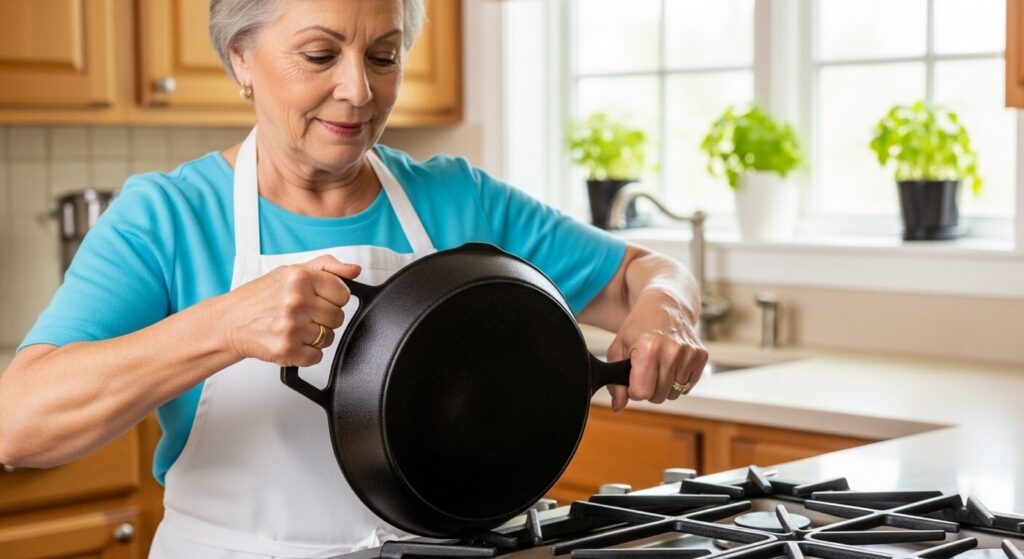
Traditional cast iron skillets weigh 5-8 pounds empty. Add food? You’re looking at 10+ pounds of strain on already inflamed joints. Not happening.
The difference between a 5-pound skillet and a 1.5-pound skillet isn’t just numbers. It’s the difference between cooking dinner and ordering takeout because your hands hurt too much. It’s independence versus frustration.
What makes a skillet truly arthritis-friendly:
- Weight under 2 pounds (some go as low as 1.2 pounds)
- Ergonomic handles with soft-grip coating
- Balanced design so the weight doesn’t pull forward
- Non-stick surface (less scrubbing, less wrist movement)
- Helper handles on larger sizes
You don’t need to give up cooking. You need better tools.
Understanding Arthritis and Wrist Strain in the Kitchen
Arthritis turns simple cooking tasks into painful challenges because inflamed joints can’t handle the repetitive gripping, lifting, and maneuvering that normal cookware demands.
How Arthritis Affects Cooking Activities
Osteoarthritis and rheumatoid arthritis hit the hands and wrists hard. The cartilage breaks down. Joints swell. Grip strength drops by 50% or more in severe cases.
Here’s what happens when you try to cook with standard cookware:
- Gripping: Inflammation makes it painful to close your hand around handles—especially cold metal or thin grips
- Lifting: Weakened wrists can’t support heavy pans, even for the 10 seconds it takes to move from stove to table
- Maneuvering: Tilting a pan to flip eggs? That twisting motion compresses already damaged joints
- Holding: Even lightweight pans become heavy after 5-10 minutes of continuous holding
And it’s cumulative. One painful dinner prep session means worse inflammation tomorrow. Then the next day. The cycle feeds itself.
Weight Thresholds: How Heavy is Too Heavy?
Under 2 pounds when empty. That’s your target.
Most arthritis specialists and occupational therapists recommend skillets weighing 1.5-2 pounds maximum. Some seniors with severe arthritis need to go even lighter—down to 1-1.5 pounds.
But here’s what nobody tells you: empty weight is only part of the story.
| Skillet Size | Empty Weight (Target) | Loaded Weight (Approx.) |
|---|---|---|
| 8-inch | 1-1.5 lbs | 2.5-3.5 lbs |
| 10-inch | 1.5-2 lbs | 3.5-5 lbs |
| 12-inch | 2-2.5 lbs | 5-7 lbs |
A 10-inch skillet with scrambled eggs for two? You’re holding 4+ pounds. A 12-inch pan with chicken breasts and vegetables? Could hit 6-7 pounds.
Compare that to traditional cookware. Cast iron 10-inch skillet weighs 5 pounds empty. Loaded? 8-10 pounds. Your wrists don’t stand a chance.
Even half a pound makes a difference. Seriously. The difference between a 2-pound skillet and a 2.5-pound skillet is the difference between cooking comfortably and feeling pain.
Key Features to Look for in Arthritis-Friendly Skillets
Arthritis-friendly skillets combine three essential elements: weight under 2 pounds, ergonomic handles with soft grips, and non-stick surfaces that minimize the effort needed for cooking and cleaning.
Weight and Material Considerations
Material matters more than anything else.
Aluminum—The Lightweight Champion
Pure aluminum skillets weigh as little as 1.2 pounds for a 10-inch pan. They heat fast (sometimes too fast). They’re cheap. They work.
Downsides? They’re soft. Scratch easily. Not dishwasher-safe usually. But if you need the absolute lightest option and you’re gentle with your cookware, aluminum beats everything else.
Hard-Anodized Aluminum—The Sweet Spot
Take aluminum and put it through an electrochemical process. You get a harder surface that’s more scratch-resistant but stays light. A 10-inch hard-anodized skillet typically weighs 1.8-2.2 pounds.
Better durability than regular aluminum. Still way lighter than stainless steel or cast iron. Can handle metal utensils (though silicone is still better for your non-stick coating).
Worth the extra $20-30 over regular aluminum? Usually, yes.
Carbon Steel—Cast Iron’s Lighter Cousin
Carbon steel gets overlooked. Shame, because a 10-inch carbon steel skillet weighs around 2-3 pounds versus 5+ for cast iron.
You get similar heat retention and natural non-stick properties (once seasoned). But—and this is important—carbon steel requires maintenance. Seasoning. Hand washing. Some babying.
If you’re comfortable with that learning curve, carbon steel works great for seniors who miss their cast iron but can’t handle the weight anymore.
Titanium—Ultra-Light But Pricey
Titanium skillets weigh almost nothing. A 10-inch pan might hit 1 pound. Strong as hell. Lasts forever.
The catch? Price. You’re paying $100-200+ for a single skillet. And availability is limited—mostly specialty retailers and outdoor cooking brands.
For most seniors, the cost doesn’t justify the weight savings over hard-anodized aluminum. But if budget isn’t a concern and you want the absolute lightest option, titanium delivers.
Skip These Materials
- Cast iron: 5-8 pounds empty. Just no.
- Thick stainless steel: 3-4 pounds minimum, often more
- Copper: Beautiful, heavy, high-maintenance, expensive
Handle Design for Reduced Wrist Strain
Wrong handle = pain. Right handle = you can actually cook.
What Makes a Handle Ergonomic
The handle needs to fit your hand like it was custom-made. Look for:
- Contoured shape that follows your palm’s natural curve
- Thumb rest on top (distributes pressure away from your grip)
- Slightly wider grip (thin handles concentrate pressure on fewer points)
- Angled slightly upward (reduces wrist bending)
Some handles have finger grooves. Mixed bag. They work great if your hand fits perfectly. Otherwise they create pressure points in weird spots.
Handle Materials That Help
Silicone-coated handles win for arthritis. The soft surface cushions your grip and stays cool longer than bare metal. Easier to hold. Less painful.
Bakelite and phenolic handles (that vintage-looking brown material) stay cool and provide decent grip. Not as comfortable as silicone but solid.
Rubberized grips fall somewhere in between. They help, but they can get sticky or degraded over time.
Length and Balance Matter More Than You’d Think
Longer handles give you better leverage. Sounds good, right? But here’s the problem—if the handle is too long and the pan isn’t balanced properly, the whole thing tips forward. Now you’re fighting gravity while your wrist screams at you.
Best balance point: roughly where the pan connects to the handle. The weight should feel neutral when you hold it at a natural angle.
Short handles (under 6 inches) put more strain on your wrist because you lose leverage. Long handles (over 9 inches) can create balance issues. Sweet spot? 7-8 inches for most 10-inch skillets.
Helper Handles Change Everything
Any skillet over 10 inches should have a helper handle opposite the main handle. Period.
Why? Because using both hands distributes the weight across both wrists instead of destroying one. Lifting, pouring, moving—all of it gets easier.
The helper handle doesn’t need to be big. Even a small loop or stub handle works. Just needs to give you something to grab.
Non-Stick Coatings and Ease of Use
Non-stick surfaces reduce wrist strain by cutting the effort needed for cooking and cleaning in half—seriously, in half.
No scraping stuck eggs off the pan. No scrubbing burnt cheese. Less stirring because food doesn’t stick. Less gripping force needed because your spatula slides easily.
Ceramic Non-Stick
Ceramic coatings are PFOA-free, PTFE-free, and generally considered “safer” by people who worry about traditional non-stick. They work well when new—very slick, easy release.
The problem? They don’t last. Most ceramic coatings start degrading after 12-18 months of regular use. Food starts sticking. Performance drops.
If you’re gentle and don’t mind replacing your pan every couple of years, ceramic works fine. Just know what you’re getting into.
Traditional PTFE (Teflon) Non-Stick
Modern PTFE coatings are PFOA-free (that’s the chemical people freaked out about). They last longer than ceramic—typically 2-3 years or more with proper care.
Better food release. More durable. Proven track record.
The key is keeping temperatures under 500°F (PTFE starts breaking down above that). For stovetop cooking, this isn’t hard. Don’t preheat an empty pan on high heat and you’re fine.
Which One for Arthritis?
PTFE lasts longer, which means less frequent pan replacement (less money, less hassle). But some people prefer ceramic for peace of mind.
Honestly? Either works. The difference in effort required is minimal. Pick based on your comfort level with the coating type, not the performance—they’re both easy on your wrists.
Top Lightweight Skillet Recommendations for Seniors with Arthritis
Best Overall Lightweight Skillet: 8-10 Inch Options
The T-fal E93808 Professional nails the balance between weight, performance, and price for most seniors with arthritis.
Weight: 1.7 pounds for the 10-inch version. Light enough to handle comfortably even when loaded with food.
Handle: Silicone-coated, ergonomic grip that stays cool and feels comfortable. No sharp edges. Decent length (about 7.5 inches) with good balance.
Performance: PTFE non-stick coating works reliably. Heats evenly (thanks to the aluminum construction). The Thermo-Spot indicator tells you when it’s preheated—nice touch that prevents overheating.
Price: Usually $25-35. Sometimes cheaper on sale.
Not perfect. The non-stick coating will eventually wear out (2-3 years typically). And it’s not dishwasher-safe despite what some listings say—hand washing extends the life significantly.
But for the money? Hard to beat for everyday cooking.
Best Budget-Friendly Lightweight Skillet
Need something cheaper? The Amazon Basics Non-Stick Skillet does the job for under $20.
Weight: 1.5 pounds (10-inch). Lighter than the T-fal.
Handle: Basic but functional. Bakelite material that stays cool. Not the most ergonomic shape but it works.
Performance: Adequate non-stick for the price. Don’t expect it to last more than 12-18 months with regular use, but at this price, replacing it doesn’t hurt.
The aluminum is thinner, which means less even heating and more hot spots. You’ll need to adjust your technique—lower heat, more attention to food placement.
Worth it? If you’re on a tight budget, absolutely. If you can swing the extra $15 for the T-fal, do it—the better construction pays off.
Best Ceramic Non-Stick Lightweight Skillet
GreenPan Rio leads the ceramic category for seniors who want PTFE-free cooking.
Weight: 1.9 pounds (10-inch). Slightly heavier than pure aluminum options but still well within the arthritis-friendly range.
Handle: Comfortable Bakelite handle with decent ergonomics. Stays cool during cooking.
Coating: Thermolon ceramic non-stick derived from sand (their marketing is a bit much, but the coating works). Free from PFAS, PFOA, lead, and cadmium if that matters to you.
Price: $35-45 typically.
The ceramic coating performs well initially—excellent food release, easy cleaning. But like all ceramic, it degrades faster than PTFE. Expect 12-18 months of optimal performance.
Oven-safe to 350°F (handle limits this). Dishwasher-safe according to the manufacturer, but hand washing still extends coating life.
Best Hard-Anodized Aluminum Skillet for Arthritis
Calphalon Classic combines durability with manageable weight for seniors who want cookware that lasts.
Weight: 2.1 pounds (10-inch). At the upper end of the lightweight range but still manageable for most people with moderate arthritis.
Handle: Long, stay-cool stainless steel handle. Not the softest grip (no silicone coating) but the length provides good leverage.
Construction: Hard-anodized aluminum is twice as hard as stainless steel. Resists scratches and wear significantly better than regular aluminum.
Non-stick: Dual-layer PTFE coating holds up well. Many users report 3-4 years of good performance with proper care.
Price: $40-50.
The extra weight and cost buy you longevity. If replacing pans every couple of years sounds annoying (it is), the Calphalon justifies the investment.
Metal utensil safe (though silicone is still recommended). Dishwasher-safe. Oven-safe to 450°F.
Best Small Lightweight Skillet (6-8 Inches)
Nordic Ware Italian Frittata Pan (8-inch) is perfect for single servings and minimal wrist strain.
Weight: 1.2 pounds. Incredibly light.
Why it works: Smaller cooking surface means less food weight. The 8-inch size handles one egg, a grilled cheese, reheating a single portion—all the tasks that don’t need a full-size pan.
Handle: Simple but effective design. Comfortable enough for arthritic hands.
Non-stick: PTFE coating. Works well. Lasts reasonably long given the price point ($20-25).
Who should get this? Seniors living alone who cook small portions. People with severe arthritis who need the absolute lightest option. Anyone who wants a second, super-light pan for quick tasks.
Best Large Lightweight Skillet (12 Inches) with Helper Handle
Cuisinart 722-36H Chef’s Classic delivers the space you need without destroying your wrists.
Weight: 2.4 pounds (12-inch). Heavier than smaller options, obviously, but lighter than most 12-inch pans by a full pound or more.
Helper Handle: This is why you buy this pan. The small loop handle opposite the main handle makes two-handed lifting possible. Game changer for larger pans.
Main Handle: Stainless steel, stay-cool design. Could be more ergonomic (no silicone coating) but functional.
Construction: Hard-anodized aluminum. Durable, even heating, built to last.
Price: $50-60.
The 12-inch size makes sense if you’re cooking for two, doing meal prep, or making one-pan dinners. But don’t get it if you’re living alone and cooking small portions—the extra weight isn’t worth it.
Oven-safe to 500°F. Dishwasher-safe (though hand washing is still better for longevity).
Best Carbon Steel Lightweight Skillet
Lodge Carbon Steel Skillet works for seniors who miss cast iron but can’t handle the weight.
Weight: 2.8 pounds (10-inch). Heavier than aluminum options but significantly lighter than Lodge’s cast iron equivalent (5+ pounds).
Performance: Once seasoned properly, carbon steel develops a natural non-stick surface. Great heat retention. Excellent searing.
Handle: Basic steel handle. Gets hot—you’ll need a pot holder. Not the most ergonomic design.
Price: $25-35.
Here’s the deal: carbon steel requires maintenance. You need to season it. Hand wash and dry immediately. Re-season occasionally. It’s work.
Worth it? Only if you enjoy the process or really want that cast iron-style cooking without the weight. Most seniors with arthritis should stick with non-stick aluminum—less hassle, easier on the joints.
But if you’re up for it, carbon steel delivers excellent performance at a reasonable weight.
Size Guide: Choosing the Right Skillet Size for Your Needs
6-8 Inch Skillets for Minimal Wrist Strain
Small skillets weigh 1-1.5 pounds and work perfectly for single-portion cooking when you need the absolute lightest option.
Best for:
- One egg (fried or scrambled)
- Single grilled cheese sandwich
- Reheating individual portions
- Warming up small amounts of leftovers
- Toasting small batches of nuts or spices
Average weight? 1-1.5 pounds empty. Even fully loaded, you’re rarely exceeding 2.5 pounds total.
Who needs this size? Seniors living alone. People with severe arthritis who struggle with anything heavier. Anyone wanting a second pan for quick tasks without pulling out the bigger skillet.
The limitation is obvious—you can’t cook for more than one person. But that’s fine if you’re the only one eating.
10 Inch Skillets: The Sweet Spot for Most Seniors
The 10-inch skillet handles 90% of everyday cooking tasks while weighing just 1.5-2 pounds—it’s the Goldilocks size for arthritis sufferers.
Cooking surface: Big enough for two servings of most foods. Three chicken breasts. Four eggs. Two pork chops. Vegetables for two.
Weight range: 1.5-2 pounds empty for quality lightweight options.
Why it’s ideal: Large enough to be useful, small enough to stay manageable. You’re not constantly switching between multiple pans, but you’re not wrestling with unnecessary weight either.
Most common uses:
- Scrambled eggs or omelets for 1-2 people
- Sautéed vegetables
- Pan-fried chicken, fish, or pork chops
- Stir-fries (small to medium batches)
- Quesadillas or grilled sandwiches
- Reheating leftovers
If you’re only buying one skillet, this is the size. Period.
12 Inch Skillets: When You Need More Space
A 12-inch skillet makes sense for cooking larger portions, but only choose this size if you regularly cook for two or more people and can handle 2.5+ pounds.
When to choose 12-inch:
- Cooking for two people regularly
- Meal prep (making multiple servings at once)
- One-pan dinners with protein and vegetables
- Foods that need space (like pancakes—you can fit 4-5 at once)
Weight reality: Even lightweight 12-inch skillets hit 2.3-2.5 pounds empty. Add food and you’re holding 5-7 pounds.
This is where helper handles become non-negotiable. Don’t buy a 12-inch pan without one. Seriously.
And be honest with yourself—if you’re cooking for one, you don’t need this size. The extra weight will just aggravate your arthritis for no reason.
Material Deep Dive: Best Options for Reducing Wrist Strain
Aluminum Skillets: Lightest Weight Champion
Pure aluminum skillets weigh 30-40% less than other materials, making them the top choice when minimizing wrist strain is the absolute priority.
A quality 10-inch aluminum skillet hits 1.2-1.5 pounds. That’s incredibly light. For comparison, the same size in stainless steel runs 3-4 pounds. Cast iron? 5+ pounds.
Heat conductivity: Aluminum heats fast and evenly. No hot spots if you buy decent quality. The downside? It heats almost too fast—you need to adjust to lower temperatures than you’re used to.
Durability concerns: Pure aluminum is soft. It scratches. It dents if you drop it. The non-stick coating wears out faster because the base material doesn’t provide as much support.
Metal utensils? Bad idea. Dishwasher? Also bad (though some are marketed as dishwasher-safe, hand washing extends life significantly).
The aluminum health debate: Some people worry about aluminum exposure and Alzheimer’s. Current research doesn’t support a connection, but if you’re concerned, hard-anodized aluminum or other materials make sense.
Bottom line: If you have severe arthritis and need the lightest possible skillet, aluminum delivers. Just accept that you’ll replace it more frequently than heavier options.
Hard-Anodized Aluminum: Durability Meets Light Weight
Hard-anodized aluminum gives you aluminum’s light weight with significantly better scratch resistance and longevity—usually adding only 0.3-0.5 pounds.
The anodizing process creates a hard oxide layer on the surface. This layer is harder than stainless steel (not marketing hype—it actually is). Result? The pan resists scratches, doesn’t react with acidic foods, and lasts longer.
Weight comparison: A 10-inch hard-anodized skillet typically weighs 1.8-2.2 pounds versus 1.2-1.5 for regular aluminum. The trade-off is worth it for most people.
What you gain:
- Can use metal utensils without destroying the pan (though silicone is still recommended for non-stick coating)
- Longer-lasting non-stick performance
- More even heat distribution (thicker construction)
- Better resistance to warping
What you don’t gain: It’s still not dishwasher-safe despite what manufacturers claim. The harsh detergents degrade the non-stick coating over time.
Price difference: Expect to pay $10-20 more than regular aluminum. Worth it if you want your pan to last 3-4 years instead of 12-18 months.
Carbon Steel: Cast Iron Alternative
Carbon steel weighs 40-50% less than cast iron while delivering similar heat retention and cooking performance—but it requires seasoning and maintenance.
A 10-inch carbon steel skillet weighs around 2.8 pounds. A 10-inch cast iron skillet weighs 5-6 pounds. That 2-3 pound difference matters when you’re lifting and maneuvering the pan dozens of times per week.
Seasoning requirements: Carbon steel needs to be seasoned just like cast iron. Build up layers of polymerized oil to create a natural non-stick surface. It’s not hard, but it takes time and some practice.
Maintenance routine:
- Hand wash only (no soap if you want to preserve seasoning, or use minimal soap)
- Dry immediately and thoroughly
- Light oil coating after each use
- Re-season every few months
Who should choose carbon steel: Seniors who enjoyed cooking with cast iron but can’t handle the weight anymore. People comfortable with maintenance routines. Anyone wanting a lightweight pan that develops better performance over time.
Who should skip it: People wanting maximum convenience. Seniors with severe arthritis who need the easiest possible option.
The learning curve frustrates some people. But if you’re willing to invest the time, carbon steel rewards you with excellent performance at a manageable weight.
Titanium: Ultra-Lightweight Premium Option
Titanium skillets weigh as little as 1 pound for a 10-inch pan, but the $100-200+ price tag puts them out of reach for most people.
Strength-to-weight ratio: Titanium is incredibly strong for its weight. A titanium skillet is nearly indestructible—no warping, no denting, no degradation.
Heat performance: Here’s the catch—titanium doesn’t conduct heat as well as aluminum. You get hot spots unless the pan has an aluminum or copper core (which adds weight and cost).
Availability: Limited. Mostly specialty outdoor cooking brands and high-end kitchenware retailers. You won’t find these at Target.
Is it worth it? Probably not for most seniors. The weight savings over hard-anodized aluminum (maybe 0.5-1 pound) doesn’t justify spending 3-5x more money.
Unless budget truly isn’t a concern and you want the absolute lightest, longest-lasting option possible, stick with aluminum or hard-anodized aluminum.
Materials to Avoid for Arthritis Sufferers
Cast Iron—Too Heavy, Period
A 10-inch cast iron skillet weighs 5-6 pounds empty. With food? 8-10 pounds. Your wrists can’t handle that if you have arthritis. End of discussion.
Yes, cast iron lasts forever. Yes, it has excellent heat retention. Doesn’t matter if you can’t lift it without pain.
Thick Stainless Steel—Heavy and Sticky
Stainless steel skillets weigh 3-4+ pounds for a 10-inch pan. They’re also not non-stick unless you preheat perfectly and use enough fat—which means more scrubbing when food sticks.
Bad combination for arthritis: heavy weight plus increased cleaning effort.
Copper—Beautiful But Impractical
Copper pans are gorgeous. They conduct heat beautifully. They’re also heavy (3-4 pounds minimum), expensive, and require polishing to maintain appearance.
Skip it. The added weight and maintenance aren’t worth it when you’re dealing with joint pain.
Handle Design Features That Reduce Wrist Strain
Ergonomic Handle Shapes
Handles designed for arthritis feature contoured grips that follow your hand’s natural shape, dramatically reducing the grip force and pressure needed to hold the pan.
What “ergonomic” actually means (because manufacturers throw this word around loosely):
The handle should have a slight curve that fits into your palm. Not too curved (creates pressure points), not too straight (requires more grip force).
Thumb rests make a difference. A small depression or raised area on top where your thumb naturally falls distributes pressure across more of your hand. Less strain on individual joints.
Width matters: Handles that are too thin (under 1 inch) concentrate all the pressure on a small area. Too thick (over 1.5 inches) and you can’t get a comfortable grip. Sweet spot? 1-1.25 inches in diameter.
Angled handles: Some handles angle slightly upward (5-10 degrees). This keeps your wrist in a more neutral position when holding the pan. Less bending = less pain.
Finger grooves? Hit or miss. If your hand size matches the molded shape perfectly, they’re great. Otherwise they create uncomfortable pressure points in weird spots.
Handle Materials for Comfortable Gripping
Silicone-coated handles reduce wrist strain by providing cushioning and better grip control, requiring 30-40% less gripping force than bare metal or hard plastic.
Silicone coating: Wins for arthritis. The soft material cushions your grip and stays relatively cool during cooking. Easier to hold. More comfortable. Less painful.
Some silicone handles are removable (they slide off for oven use or cleaning). Convenient but watch for slipping during use.
Bakelite and phenolic handles: That brown or black vintage-looking material that stays cool. Provides decent grip. Not as comfortable as silicone but solid.
The advantage? Durability. These handles last decades without degrading. Silicone can eventually wear out or get sticky.
Rubberized grips: Middle ground between silicone and hard plastic. Better than nothing. Not as good as silicone.
Watch for degradation over time—some rubberized coatings get tacky or peel after a year or two.
Stay-cool technology: Marketing term for handles designed to conduct less heat. Usually means:
- Hollow handle construction (air gap insulates)
- Materials with low thermal conductivity
- Length that keeps your hand farther from heat source
Most modern skillets have some version of this. It works reasonably well for stovetop cooking. Don’t trust it completely—pot holders are still your friend.
Handle Length and Balance
A handle that’s 7-8 inches long with the balance point near the connection point reduces wrist strain by preventing the pan from tipping forward while providing adequate leverage.
Too short (under 6 inches): You lose leverage. Need more grip force. More wrist strain.
Too long (over 9 inches): Can create balance issues. The pan wants to tip forward, especially when loaded with food. Now you’re fighting gravity.
Finding the balance point: Hold the pan by the handle at a natural angle (like you would while cooking). Where does the weight feel neutral—not pulling forward, not falling back?
Best case? Right where the handle meets the pan body. This means the pan’s weight and the handle’s weight cancel each other out.
Some manufacturers add weights inside hollow handles to improve balance. Sounds counterproductive (adding weight to a lightweight pan), but a small weight in the handle can make a heavier cooking surface feel lighter.
Testing before buying: If possible, hold the pan before purchasing. Does it feel balanced? Or does it immediately tip forward?
Can’t test in person? Check reviews for mentions of balance issues.
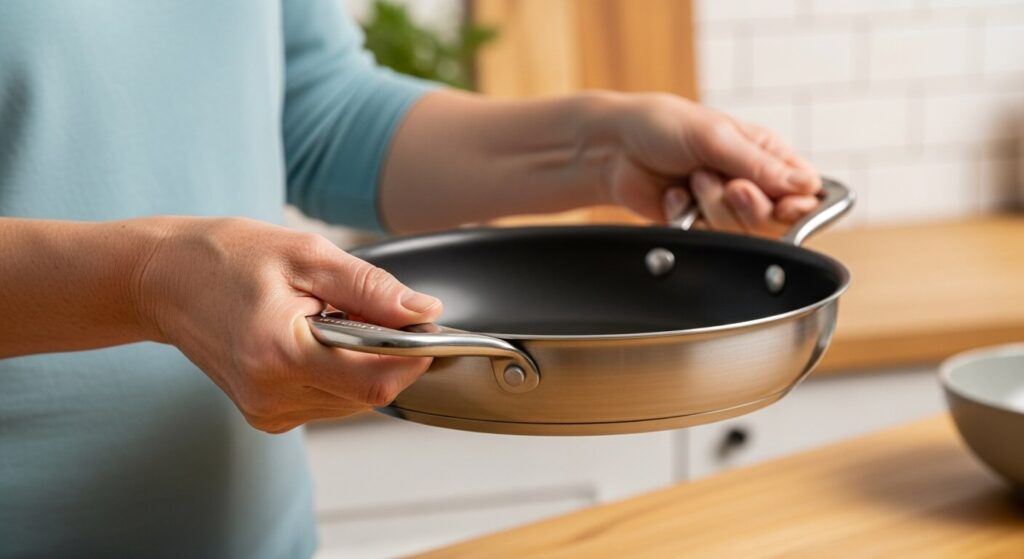
Helper Handles and When They’re Essential
Helper handles reduce wrist strain by 50% or more on skillets 10 inches and larger by distributing the weight across both hands instead of one.
Non-negotiable for 12-inch pans. Period. If you’re looking at a 12-inch skillet without a helper handle, keep looking.
Recommended for 10-11 inch pans if you have moderate to severe arthritis. The extra handle makes lifting, pouring, and moving significantly easier.
Not necessary for 8-inch or smaller unless you have very severe arthritis. The small size and light weight make helper handles unnecessary.
Helper handle styles:
| Style | Description | Pros | Cons |
|---|---|---|---|
| Loop handle | Small loop opposite main handle | Easy to grab, stays cool | Limited grip options |
| Stub handle | Short second handle | Comfortable grip, good control | Can conduct heat |
| Extended lip | Reinforced edge for gripping | Integrated design | Can get hot, awkward grip |
The loop style works best for most people. Stays cooler (more air gap from pan). Easy to grab even if your hands aren’t very flexible.
Using helper handles correctly: Grab both handles. Lift with both hands simultaneously. Distribute the weight evenly across both wrists.
Sounds obvious. But many people default to one-handed handling even when a helper handle is available. Retrain yourself to use both.
Cooking Techniques to Minimize Wrist Strain
Proper Lifting and Handling Methods
Always use both hands when moving a skillet—even lightweight pans become heavy when loaded with food, and single-handed lifting puts unnecessary stress on inflamed joints.
Two-handed lift technique:
- Grab main handle with dominant hand
- Support the bottom or helper handle with other hand
- Lift with both arms, keeping wrists neutral
- Move slowly and deliberately
Supporting from underneath: For pans without helper handles, slide your non-dominant hand under the pan (use a pot holder). This distributes weight better than grabbing the rim.
Avoid these movements:
- One-handed flipping or tossing (looks cool, destroys wrists)
- Holding the pan with one hand while stirring with the other
- Pouring while gripping only the main handle
- Tilting the pan at extreme angles
When you must use one hand: Keep the movement brief. Lift, move, set down. Don’t hold the pan in the air while you do something else.
And keep the pan close to your body. Extended arm + heavy pan = maximum wrist strain.
Stovetop Setup for Easier Access
Position your skillet on the front burner closest to your dominant side to minimize reaching, twisting, and awkward angles that increase wrist strain.
Burner selection matters: Front burners require less reaching than back burners. Right-side burners (if you’re right-handed) reduce the twisting motion needed to check food or stir.
Prep station setup: Keep a trivet or heat-safe surface immediately next to your stove. This gives you a landing spot when you need to move the pan—minimal distance, minimal time holding weight.
Height considerations: If your stovetop is too low, you’re bending your wrist at an uncomfortable angle. Too high? You’re lifting with poor leverage.
Can’t change stovetop height easily. But be aware of it. Adjust your stance to keep wrists neutral.
Reduce transfer frequency: Plan your cooking so you’re not constantly moving the pan on and off the heat. Each transfer is an opportunity for pain.
Tools and Accessories That Help
Long-handled utensils reduce wrist movement by keeping your hand farther from the heat source, letting you reach across the pan without tilting or maneuvering it.
Spatulas with 10-12 inch handles: Standard 8-inch spatulas force you to tilt the pan to reach the far side. Longer handles reach across the cooking surface while the pan stays flat.
Reduces wrist bending and twisting significantly.
Lightweight lids: If you need a lid, choose tempered glass or lightweight aluminum. Some lids weigh nearly as much as the pan itself—ridiculous when you’re trying to minimize strain.
Or skip the lid entirely for many dishes. Splatter screens work for most purposes and weigh almost nothing.
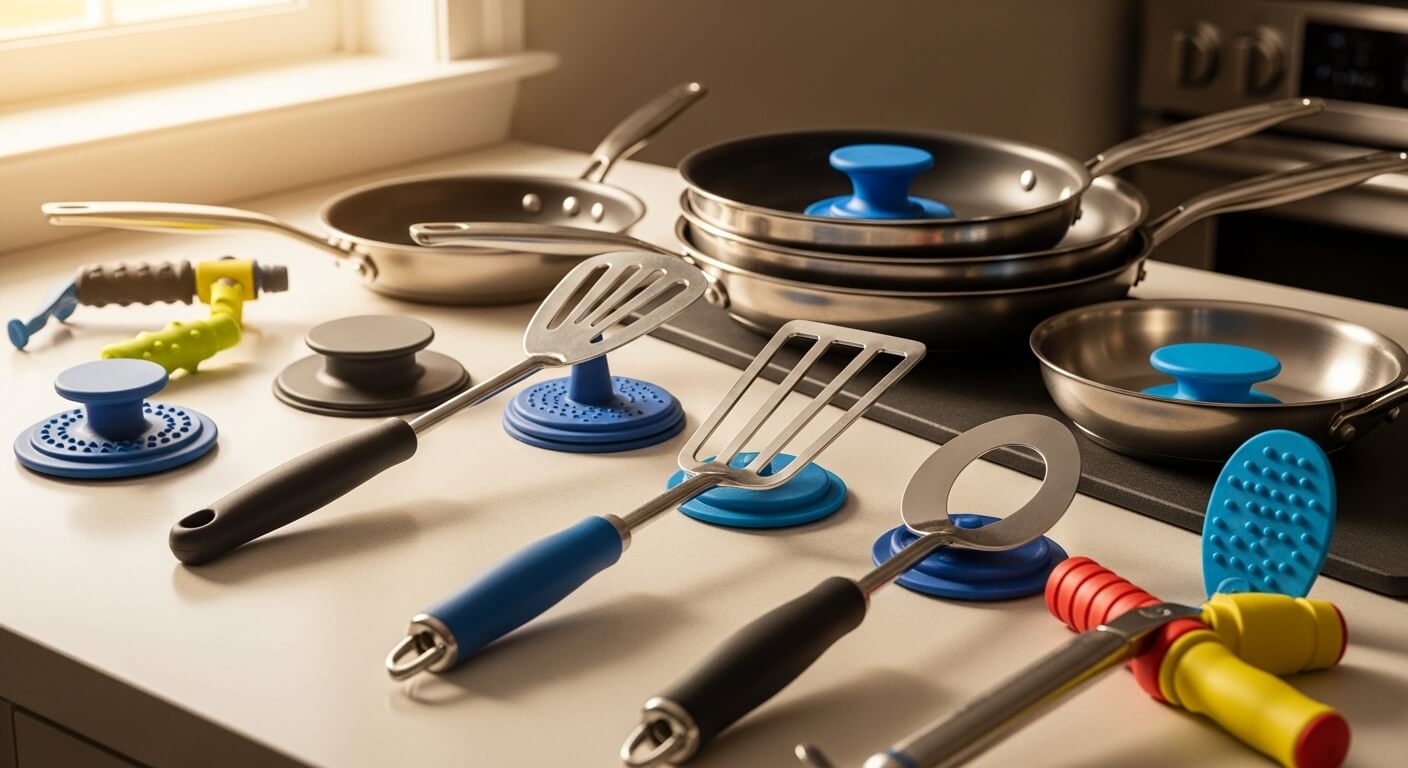
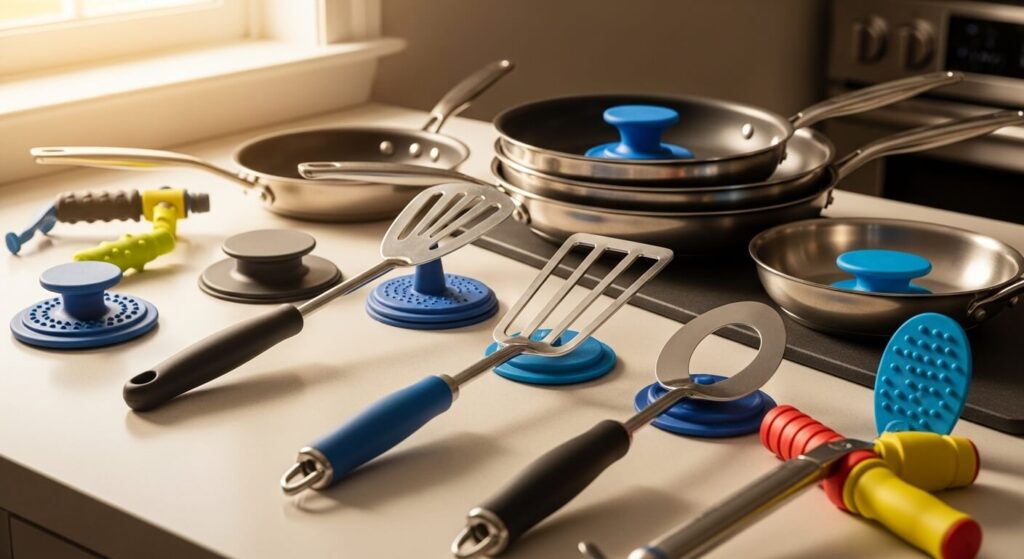
Pan grippers and holders: Silicone handle grips that slide over the existing handle. Add cushioning and width to thin, uncomfortable handles.
Cost $5-10. Worth trying if your pan’s handle is too thin or hard.
Pot holders with grip texture: Fabric pot holders with silicone dots or rubber grips prevent slipping, which means you don’t need to squeeze as hard.
Less grip force = less joint stress.
Maintenance and Care for Lightweight Skillets
Cleaning Methods That Protect Your Joints
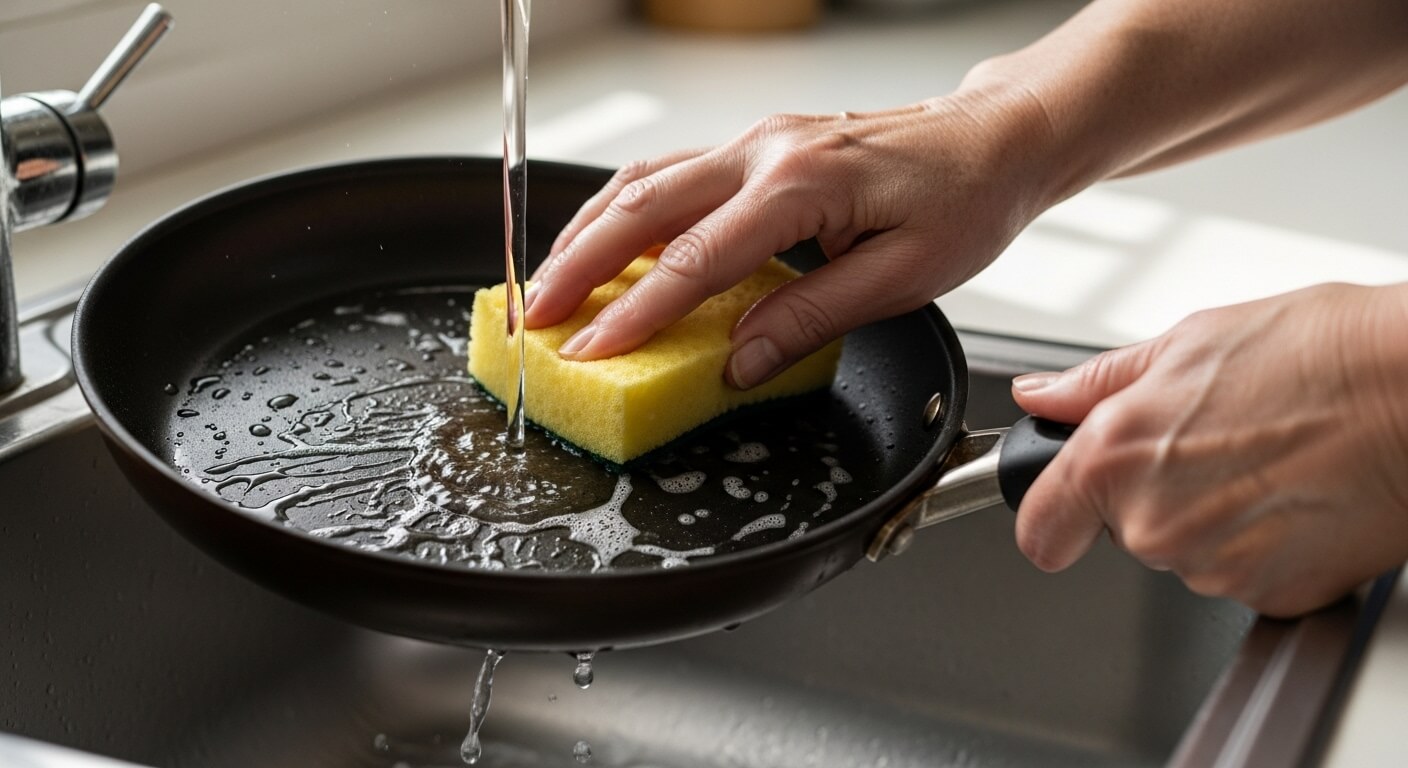
Soak stuck-on food for 10-15 minutes before cleaning rather than scrubbing hard, which reduces the wrist movement and grip force needed to get your skillet clean.
Immediate cleaning is easier: Wipe out the pan while it’s still warm (not hot). Food hasn’t bonded yet. Takes minimal effort.
Wait until food is dried and stuck? Now you’re scrubbing. That’s hell on arthritic wrists.
The soak method:
- Fill pan with warm soapy water
- Let sit 10-15 minutes (30 minutes for really stuck food)
- Wipe clean with minimal scrubbing
Works for 90% of cleanup situations. The few times it doesn’t work, use a plastic scraper or sponge—not heavy-duty scrubbing.
Dishwasher debate: Some lightweight skillets are marketed as dishwasher-safe. Convenient, right? No scrubbing required.
But (there’s always a but): dishwasher detergent is harsh. It degrades non-stick coatings faster. Your pan might last 18 months instead of 3 years.
Trade-off: convenience now versus replacement cost later. For seniors with severe arthritis, the convenience might be worth it. For others, gentle hand washing preserves the pan.
Tools that reduce scrubbing:
- Non-scratch sponges with good surface area
- Long-handled dish brushes (keep wrist straighter)
- Plastic pan scrapers for stuck bits
- Bar Keeper’s Friend for stains (not food stuck-on)
Extending Non-Stick Coating Life
Use silicone, wood, or nylon utensils instead of metal to prevent scratching the non-stick surface, which extends coating life from 12-18 months to 2-3 years or more.
Metal utensils destroy non-stick coatings. Even “metal utensil safe” pans get scratched. Those scratches become places where food sticks, which means more scrubbing, which means more wrist strain.
Just use silicone. They’re cheap. They work. They don’t damage your pan.
Temperature management: Non-stick coatings start breaking down above 450-500°F. On the stovetop, this means:
- Don’t preheat on high heat
- Don’t leave an empty pan on a hot burner
- Medium to medium-high heat for most cooking
Lower temperatures also extend coating life by reducing thermal stress.
Storage without scratching: Stack pans with paper towels, cloth napkins, or pan protectors between them. Stacking pans directly on each other scratches the non-stick surface.
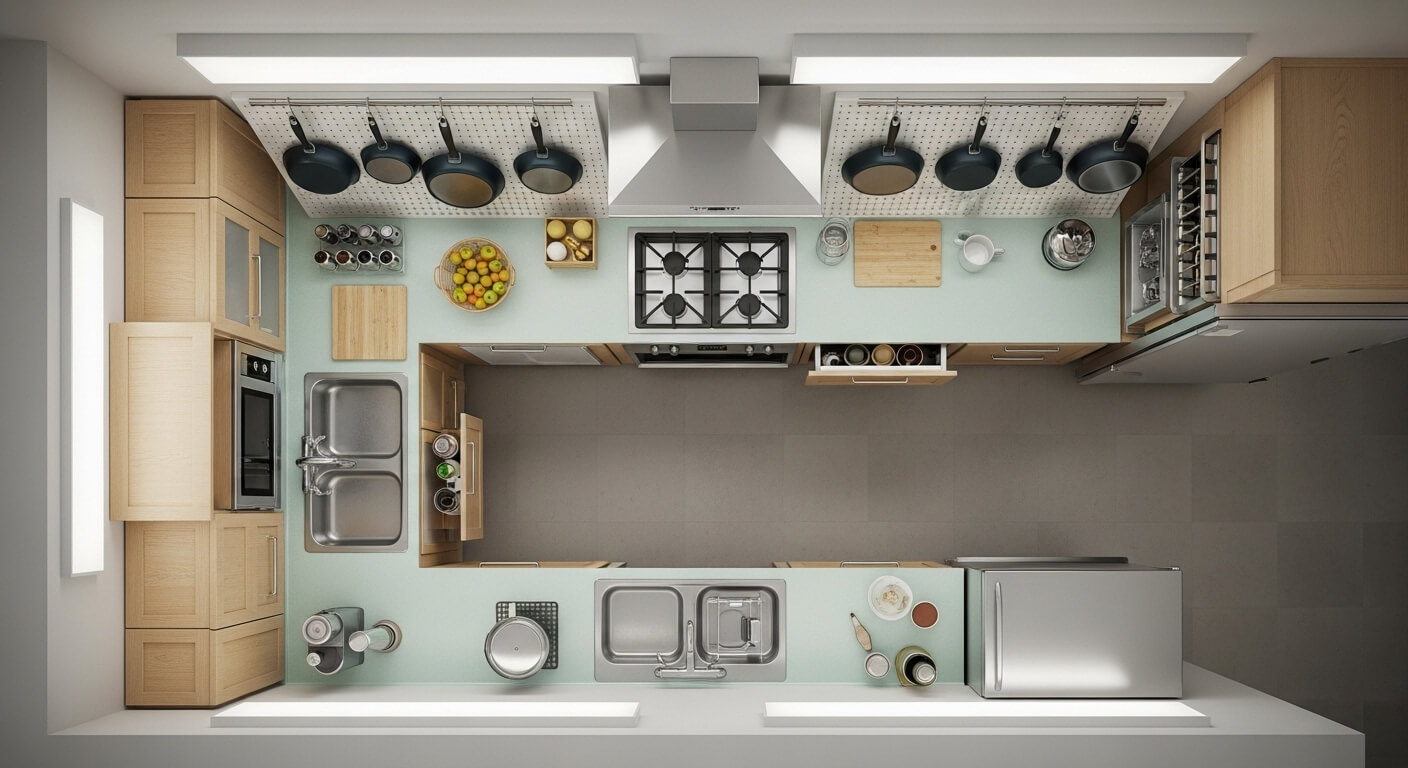
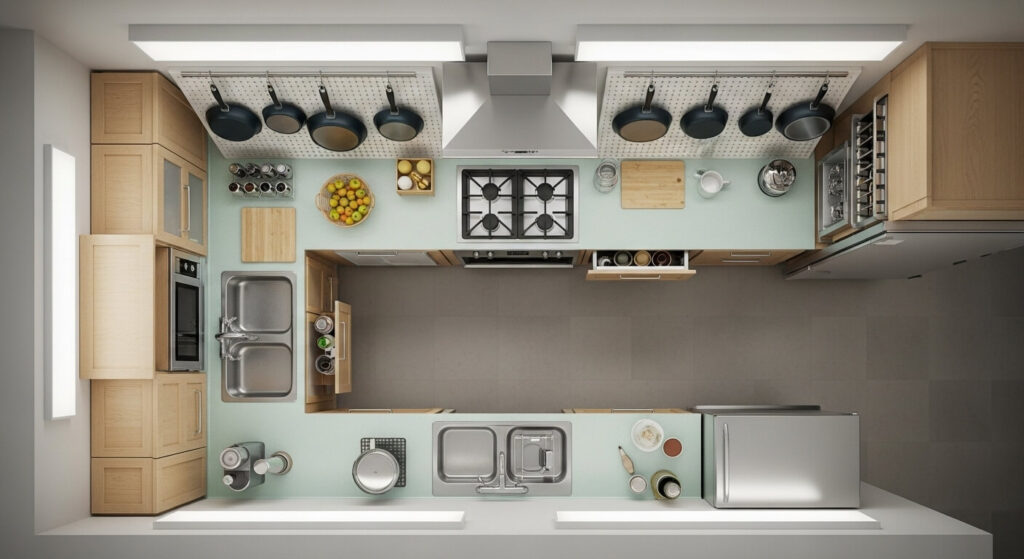
Or hang them. Wall-mounted pot racks keep pans separated and make access easier (no digging through stacked cookware).
Storage Solutions for Easy Access
Wall-mounted racks or drawer storage keeps your most-used skillet within easy reach at waist height, eliminating the painful bending and overhead lifting required when pans are stored in cabinets.
Worst storage: High cabinets. Now you’re lifting a pan above your head with already painful wrists. Not happening without significant strain.
Also bad: Low cabinets. Bending down, reaching back, pulling out a heavy stack of pans to get to the one you want.
Better options:
Wall-mounted racks: Hang your skillet on the wall near the stove. Grab it. Use it. Hang it back. No bending, no digging.
Some people hate the look. But if arthritis pain is significant, aesthetics take a back seat to function.
Drawer storage: Wide, shallow drawers at waist height work well if you use pan protectors between layers. Pull the drawer. Lift straight up. Done.
Countertop storage: For your most-used pan, just leave it on the counter near the stove. Adds clutter but eliminates storage/retrieval strain entirely.
Keep it simple: Don’t own 8 skillets if you only use 2. Fewer pans = easier storage = less handling of heavy cookware you don’t need.
Safety Considerations for Seniors with Arthritis
Preventing Drops and Spills
Recognize when your hands are fatigued before attempting to move a loaded skillet—most drops happen in the last few minutes of cooking when grip strength has declined.
Warning signs of grip fatigue:
- Trembling or shaking while holding the pan
- Needing to readjust your grip frequently
- Pain increasing noticeably from beginning to end of cooking
- Feeling like the pan is getting heavier
When you notice these? Stop holding the pan. Set it down immediately. Take a break or finish cooking with the pan stationary.
Two-handed transfer for everything: Never trust a one-handed grip with a loaded pan. Both hands. Always.
Even if it’s “just” moving from the burner to the trivet two feet away. That’s when accidents happen.
Pot holders with grip enhancement: Those silicone-dotted pot holders or oven mitts with textured grips prevent slipping without requiring you to squeeze harder.
Critical when your grip strength is already compromised.
Clear the landing zone: Before you lift the pan to move it, make absolutely sure the landing spot is clear and accessible. No reaching over obstacles. No awkward angles.
Heat Safety with Lightweight Materials
Lightweight aluminum skillets heat up in 30-45 seconds compared to 2-3 minutes for cast iron, requiring faster adjustment to prevent overheating food or damaging non-stick coatings.
Preheat time is minimal: You can’t walk away to do something else while the pan heats. By the time you come back, it’s already too hot.
30-60 seconds on medium heat. That’s it. Then add your food.
Handle heat conductivity: Metal handles can get hot faster on lightweight pans because there’s less mass to absorb the heat. Some handles claim to stay cool—they help, but don’t trust them completely after 10+ minutes of cooking.
Always use a pot holder when in doubt.
Oven-safe temperature limits: Most lightweight non-stick skillets max out at 350-450°F for oven use. The handles or non-stick coating can’t handle higher temps.
Check before you buy if you plan to finish dishes in the oven.
Non-Stick Coating Safety
Modern PFOA-free non-stick coatings are safe for cooking when kept under 500°F, but should be replaced when the coating becomes scratched, peeling, or when food starts sticking regularly.
PFOA-free means what? PFOA (perfluorooctanoic acid) was a chemical used in older non-stick production. It’s been phased out since 2013 in the US. Modern non-stick coatings don’t contain it.
PTFE safety: The current non-stick material is safe at normal cooking temperatures. Above 500°F, it starts releasing fumes. Don’t heat an empty pan on high and you’re fine.
When to replace:
- Coating is visibly peeling or flaking
- Food sticks where it used to release easily
- Visible scratches down to the metal
- Discoloration that doesn’t clean off
Using a damaged non-stick pan means more scrubbing (bad for wrists) and possibly ingesting coating particles (bad for everything else).
Replace it. Lightweight pans are inexpensive enough that replacement every 2-3 years makes sense.
Adaptive Cooking Tools to Complement Your Lightweight Skillet
Ergonomic Spatulas and Utensils
Spatulas with angled handles and cushioned grips reduce wrist bending by up to 40% compared to straight utensils, making stirring and flipping less painful for arthritis sufferers.
Angled handles: The handle bends 15-20 degrees from the utensil head. This lets you keep your wrist straight while the spatula sits flat against the pan surface.
Straight utensils force you to bend your wrist to get the right angle. Angled ones don’t.
Cushioned grips: Soft silicone or foam padding on the handle. Requires less grip force. More comfortable to hold.
OXO Good Grips makes a whole line of these. They work. Worth the extra $3-5 per utensil.
Lightweight utensil materials:
- Silicone (won’t scratch your non-stick pan, very light)
- Nylon (also safe for non-stick, slightly stiffer)
- Wood (heavier but good for some tasks)
Skip stainless steel utensils—they scratch non-stick surfaces and they’re heavier than necessary.
Long handles help: 10-12 inch handles keep your hand farther from heat and reduce how much you need to tilt the pan.
Pan Holders and Grippers
Silicone handle covers add 0.5-0.75 inches of cushioned diameter to thin pan handles, dramatically improving comfort and reducing the grip force needed for arthritic hands.
Slip-on silicone grips: Cost $5-10. Slide right over your existing handle. Instant improvement for handles that are too thin or hard.
They work surprisingly well. The added diameter distributes pressure across more of your hand.
Detachable pot holders: Some designs clip onto the handle and provide both heat protection and grip cushioning. Convenient for switching between pans.
Magnetic silicone grips: Attach to the pan’s metal handle magnetically. Stay in place during cooking. Remove for oven use or storage.
Gimmicky? Maybe. But they work if your pan’s handle is uncomfortable.
Plate and Serving Aids
Tipping aids and pouring spouts reduce the need to lift and tilt heavy loaded skillets, letting you serve food directly from the pan with minimal wrist strain.
Pouring spouts: Some skillets have molded pouring spouts on opposite sides. Makes transferring liquids easier without precise tilting.
Not essential but helpful if you make a lot of sauces or gravies.
Serving directly from the pan: Use trivets to bring the whole pan to the table. Let people serve themselves. You’re not lifting and serving individual portions.
Less handling = less wrist strain.
Offset spatulas for serving: The angled design lets you slide under food and lift it out without tilting the pan as much.
Standard spatulas require more pan maneuvering to get under the food.
Comparing Popular Lightweight Skillet Brands
| Brand | Weight (10″) | Handle Type | Price Range | Coating | Best For |
|---|---|---|---|---|---|
| T-fal | 1.7 lbs | Silicone, ergonomic | $25-35 | PTFE | Best overall value |
| GreenPan | 1.9 lbs | Bakelite | $35-45 | Ceramic | PTFE-free preference |
| Calphalon | 2.1 lbs | Stainless steel | $40-50 | PTFE | Durability priority |
| Amazon Basics | 1.5 lbs | Bakelite | $15-20 | PTFE | Tight budget |
| Nordic Ware | 1.6 lbs | Phenolic | $20-30 | PTFE | Reliable mid-range |
Brand comparison notes:
T-fal consistently delivers lightweight options with good ergonomics at reasonable prices. Their Professional line specifically targets the 1.5-2 pound range.
GreenPan leads the ceramic non-stick market. Good for people avoiding PTFE. Just remember ceramic coating doesn’t last as long.
Calphalon’s hard-anodized aluminum construction adds some weight but significantly improves durability. Worth it if you don’t want to replace pans every 18 months.
Amazon Basics works fine for basic needs. Don’t expect it to last more than a year or two, but at $15-20, replacement isn’t painful.
Nordic Ware falls in the middle—decent quality, reasonable price, nothing spectacular but reliable.
Warranty considerations: Most lightweight non-stick pans come with limited lifetime warranties that don’t cover non-stick coating degradation. Read the fine print. The warranty probably doesn’t protect what you think it does.
Making the Transition to Lightweight Cookware
Adjusting Cooking Habits
Lightweight aluminum skillets heat 3-4 times faster than cast iron or stainless steel, requiring you to reduce burner temperature by 25-30% to prevent burning food.
Temperature adjustment: What you cooked on medium-high in your old pan? Try medium or even medium-low with lightweight aluminum.
The pan reaches cooking temperature much faster. Food can burn before you realize the pan’s too hot.
Timing changes: Preheat time drops from 3-5 minutes to 30-60 seconds. Everything happens faster.
This isn’t bad—it’s actually more convenient once you adjust. Just requires recalibrating your internal cooking timer.
Oil/butter requirements: Good non-stick surfaces need less fat. What took a tablespoon of oil before might only need a teaspoon now.
Start with less. Add more if needed. Most people over-oil because they’re used to pans with worse non-stick properties.
Heat distribution: Quality lightweight pans distribute heat evenly. Cheap ones create hot spots in the center.
If you notice burning in the middle while edges stay cool, reduce heat and give food more time.
Building an Arthritis-Friendly Kitchen
Replace your most-used skillet first, then gradually transition other pieces as budget allows—the 10-inch skillet makes the biggest daily impact.
Priority order for replacement:
- 10-inch skillet (your workhorse pan—use it daily)
- 8-inch skillet (for smaller portions and single servings)
- Large pot (lightweight aluminum or hard-anodized for soups, pasta)
- 12-inch skillet (only if you regularly cook larger meals)
- Smaller saucepan (for heating liquids, making sauces)
Don’t buy a whole set at once unless you’ve tested the pieces individually. Sets often include sizes you’ll never use.
Budget-friendly transition: One piece every 2-3 months. Gives you time to adjust to each new piece and spread the cost.
Or replace items as they wear out rather than all at once.
What to keep from your old cookware: Baking sheets, roasting pans, and specialized items you don’t lift frequently. Focus the lightweight transition on items you handle constantly.
When to Seek Occupational Therapy Guidance
Consult an occupational therapist if cooking causes pain severe enough to make you avoid meal preparation, or if you’ve experienced multiple drops or accidents due to grip weakness.
Warning signs you need professional help:
- You’re eating mostly prepared foods because cooking hurts too much
- You’ve dropped pans multiple times (safety risk)
- Pain persists for hours after cooking
- Standard adaptive equipment hasn’t helped
What OT can provide: Custom assessment of your kitchen setup. Recommendations for specific adaptive tools. Techniques for conserving energy and reducing joint stress.
They might suggest modifications you haven’t considered—different counter heights, alternative cooking methods, specialized grips.
Insurance often covers: Especially if you have a documented arthritis diagnosis and your doctor writes a prescription for occupational therapy.
Worth checking before assuming it’s too expensive.