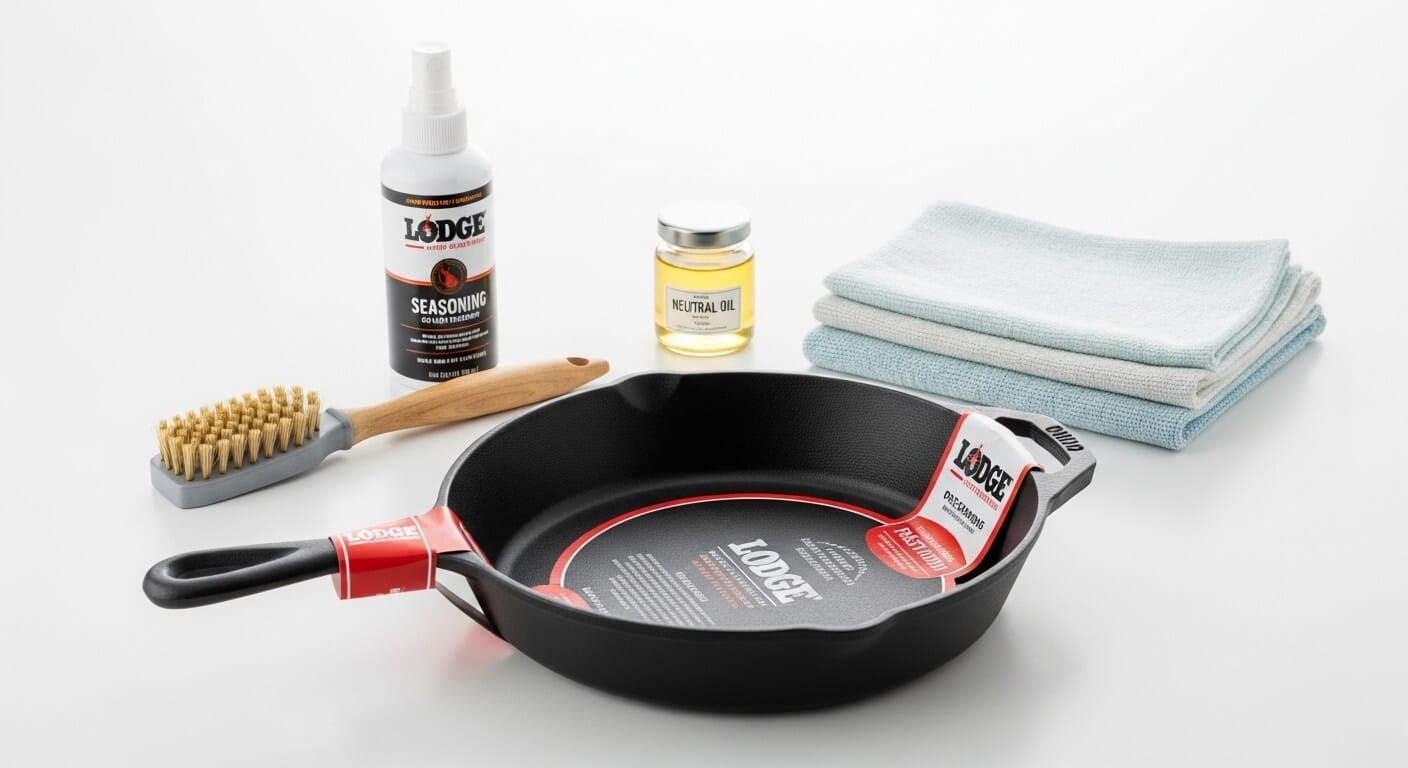
What Is Flaxseed Oil Seasoning and Why It Became Popular
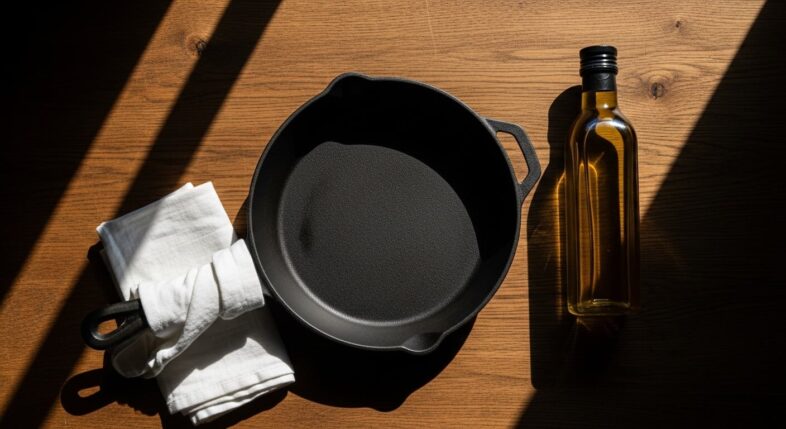
Seasoning a cast iron skillet with flaxseed oil means applying ultra-thin layers of this food-grade drying oil and baking at 500°F to create an extremely hard polymerized, non-stick coating—a method popularized by a 2010 blog post claiming it produces the best possible seasoning.
Back in 2010, a blogger named Sheryl Canter published an article that went viral. The chemistry of cast iron seasoning, she called it. Her claim? Flaxseed oil creates the hardest, most durable seasoning possible. The article spread like wildfire through cast iron communities.
Here’s what got people excited. Flaxseed oil is a food-grade drying oil—the same category as linseed oil used in oil painting. When heated, it polymerizes into an incredibly hard coating. Canter argued this made it perfect for cookware.
The science seemed solid. Drying oils form strong polymer chains when exposed to heat and oxygen. Unlike regular cooking oils that just get sticky, these oils actually cure into something resembling plastic. Food-safe plastic on your pan? Sounded revolutionary.
Problem is, reality didn’t always match the hype.
The Science Behind Flaxseed Oil for Cast Iron Seasoning
Flaxseed oil polymerizes harder than most cooking oils because it’s loaded with alpha-linolenic acid—about 55% of its composition.
This matters because alpha-linolenic acid has multiple double bonds. More double bonds mean more cross-linking during polymerization. More cross-linking creates denser, harder polymer structures. It’s basic chemistry.
But here’s the weird part. Flaxseed oil has a smoke point of just 225°F. That’s low. Really low. You’d think this disqualifies it for seasoning (which happens at 400-500°F), but it doesn’t. The smoke point tells you when the oil breaks down during cooking—not when it polymerizes for seasoning. Different processes entirely.
When you season cast iron, you’re not cooking with the oil. You’re transforming it chemically. The polymerization temperature and cooking temperature aren’t related. Flaxseed oil smokes early but polymerizes beautifully at high heat.
The result? Extremely hard polymer chains. Way harder than what you get from canola or vegetable oil.
Iodine value measures how many double bonds an oil contains—basically, how “reactive” it is.
Flaxseed oil clocks in at 170-200. That’s drying oil territory. For comparison:
Canola oil: 110-126
Grapeseed oil: 124-143
Soybean oil: 124-139
Crisco: 80-115
Higher iodine value equals harder finish. The double bonds create more connection points during polymerization. Think of it like Velcro—more hooks mean stronger attachment.
This is why flaxseed oil creates such a hard coating. It’s not marketing hype (well, not entirely). The chemistry backs it up.
But hard isn’t always better. We’ll get to that.
Temperature Requirements for Flaxseed Oil Seasoning
You need 400-500°F to properly season with flaxseed oil, despite that pathetic 225°F smoke point.
Why so hot? Complete polymerization requires heat. At lower temperatures, the oil might partially cure but won’t form those dense polymer networks. You’ll end up with sticky, tacky seasoning that never fully hardens.
Most people use 500°F. Some ovens can’t hit that (mine maxes at 475°F). Anything above 450°F works, though 500°F gives the most consistent results.
The low smoke point becomes irrelevant. Yes, the oil smokes like crazy during seasoning. That’s normal. That’s the polymerization happening. You’re not cooking—you’re transforming the oil into something new.
Just make sure your kitchen is well-ventilated. The smoke can be intense.
Here’s the complete process from Canter’s original article:
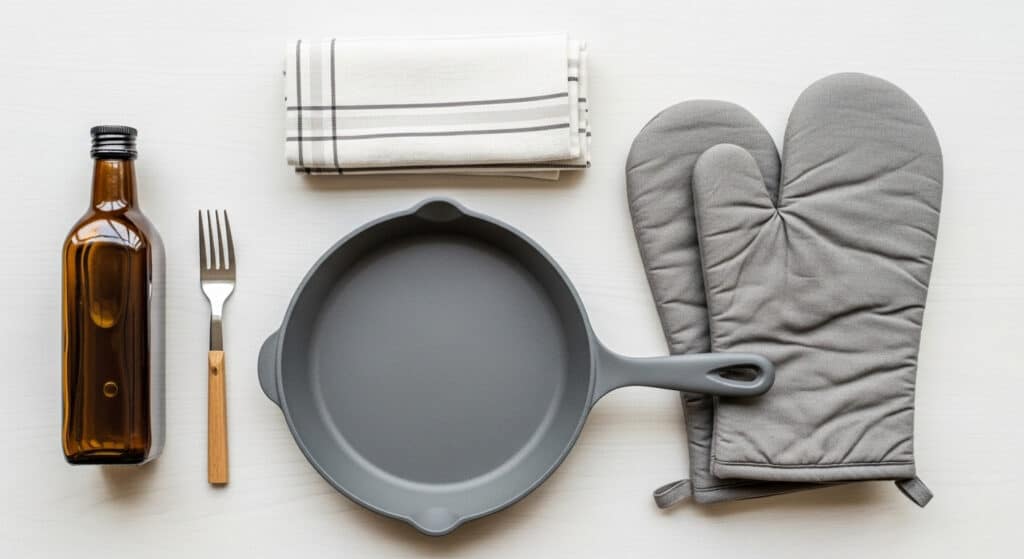
Strip pan to bare metal (or start with new, unseasoned pan)
Dry completely in 200°F oven
Apply tiny amount of flaxseed oil to entire surface
Wipe off ALL excess—pan should look dry
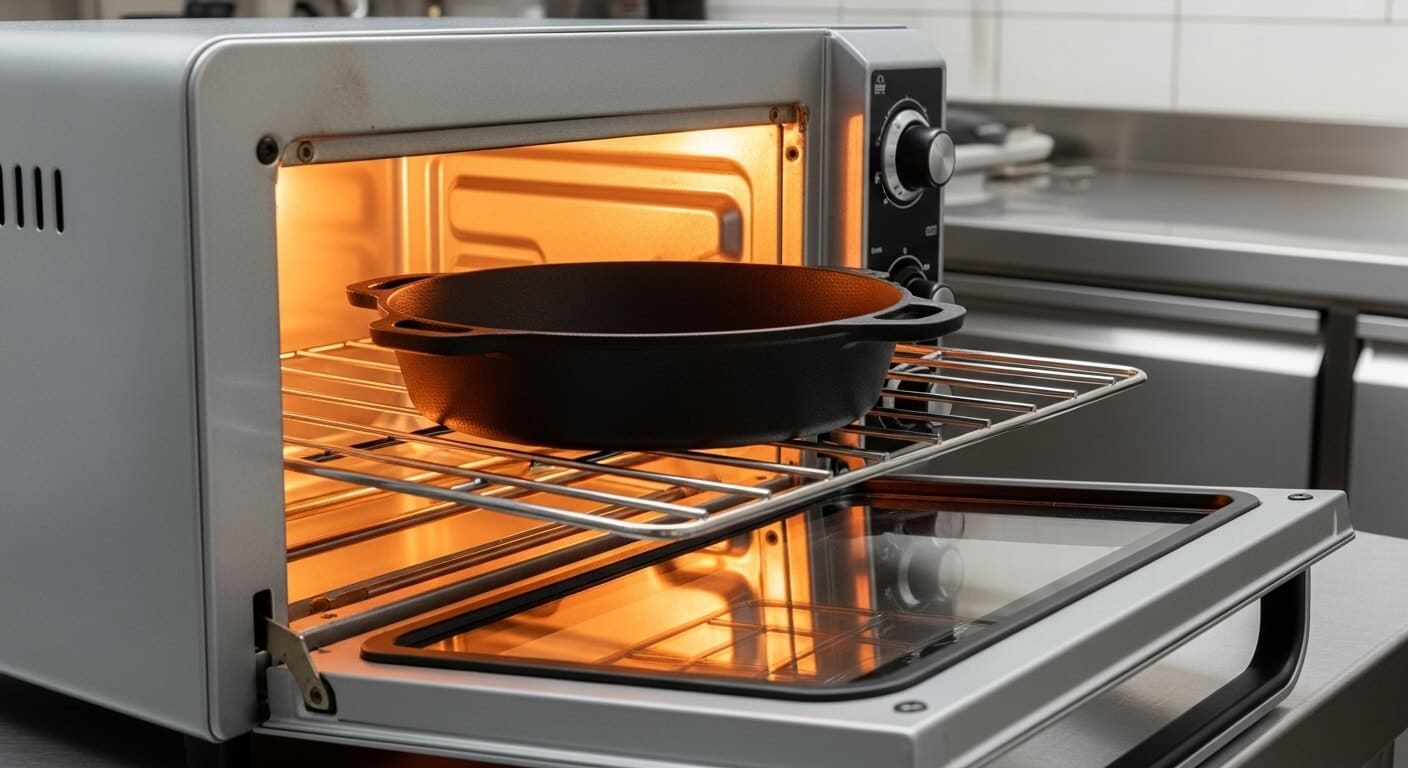
Place upside-down in cold oven
Heat to 500°F, bake for 1 hour
Cool completely in oven (2+ hours)
Repeat steps 3-7 five more times
Six coats total. No shortcuts.
Why six? Canter claimed this builds enough layers for durability while maintaining the smooth finish. Fewer coats leave the seasoning too thin. More coats show diminishing returns.
Each layer should darken the pan progressively. First coat looks brownish. By coat six, you’ve got deep black.
The visual progression matters. If it’s not darkening, something’s wrong.
Why This Method Differs from Traditional Seasoning
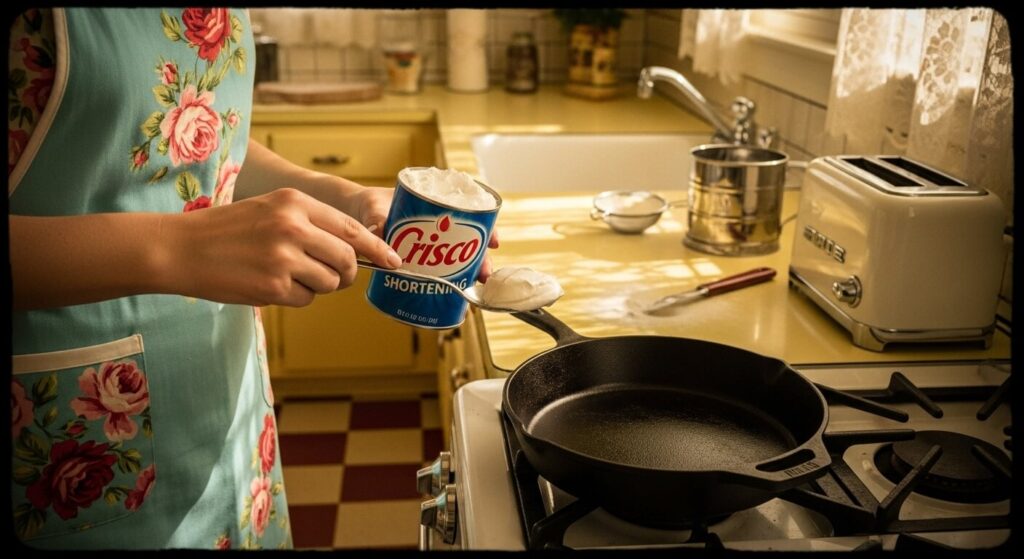
Traditional seasoning is more forgiving. Slap on some Crisco, bake at 350-400°F for an hour, call it done. Maybe do two or three coats.
Flaxseed oil demands precision:
Application must be ultra-thin (wipe until it looks dry)
Temperature must be higher (500°F vs. 350°F)
Process takes forever (12+ hours vs. 2-3 hours)
Cooling between coats is mandatory (not optional)
More coats required (6 vs. 2-3)
It’s high-maintenance. No question.
The Claims About Flaxseed Oil Superiority
Canter made bold promises:
Hardest possible seasoning coating (true, technically)
Glass-like smooth finish (achievable with perfect technique)
Superior non-stick properties (debatable)
Food-safe and natural (absolutely true)
Long-lasting durability (this is where things get controversial)
That last claim caused all the problems.
The Flaxseed Oil Controversy: Problems Users Report
Here’s the dirty secret. Flaxseed oil seasoning flakes. A lot.
Not immediately. It looks perfect for weeks, sometimes months. Then you heat the pan for searing, and the seasoning chips off in sheets. Or you notice black flecks in your eggs. Or the coating just starts peeling at the edges.
The timeline varies. Some people see flaking within 2-3 weeks. Others make it 6 months. But the pattern is consistent—flaxseed seasoning tends to fail eventually.
Why? Brittleness. That ultra-hard coating doesn’t flex. Cast iron expands and contracts with temperature changes. A flexible seasoning moves with it. A brittle one cracks.
This isn’t universal. Some people use flaxseed successfully for years. But the failure rate is high enough that the cast iron community is deeply divided.
Brittleness vs. Durability Debate
Hard doesn’t mean durable. This is the core misunderstanding.
Think about it. Diamond is the hardest natural material. It’s also brittle—hit it with a hammer at the right angle, and it shatters. Rubber is soft but durable—it flexes, absorbs impact, lasts forever.
Flaxseed oil creates diamond-like seasoning. Extremely hard. Also prone to chipping under stress.
Cast iron cookware faces constant thermal stress:
Room temperature to 500°F in minutes
Back down to room temperature
Repeat daily (or multiple times per day)
The metal expands when hot, contracts when cool. A flexible coating stretches and compresses with these changes. A rigid coating fights them—and eventually loses.
Impact resistance matters too. Drop a spatula on canola-seasoned cast iron? Usually fine. Drop it on flaxseed-seasoned iron? You might chip the coating.
Temperature Sensitivity Issues
Flaxseed seasoning degrades faster at high heat than other oils.
Ironic, right? You season it at 500°F, but cooking above 400°F damages it. The coating that requires extreme heat to create can’t always handle extreme heat in use.
High-heat searing is especially problematic. Get your pan to 500-550°F for a good steak sear, and the flaxseed seasoning might start breaking down. You’ll see discoloration, loss of non-stick properties, or outright flaking.
Thermal shock is another issue. Cold water on a screaming-hot flaxseed-seasoned pan? Recipe for coating failure. The brittle surface can’t handle the sudden contraction.
User Experience: Mixed Results
The online cast iron community is polarized. Hard.
Success stories: “I’ve used flaxseed for 3 years, zero problems, best seasoning ever.”
Failure stories: “Followed the method perfectly, seasoning flaked off after one month, total waste of time.”
Both are telling the truth. Variables matter:
Pan surface texture (smooth vintage vs. rough modern)
Application technique (truly wiped dry vs. slightly too much oil)
Oven temperature accuracy (actual 500°F vs. poorly calibrated oven)
Cooking style (gentle vs. aggressive heat)
Maintenance habits
Some people hit the sweet spot. Others don’t. There’s no middle ground—it either works great or fails spectacularly.
Comparing Flaxseed Oil to Other Seasoning Oils
Flaxseed Oil vs. Vegetable Oil
Cost: Flaxseed runs $15-25 per bottle. Vegetable oil costs $3-5. That’s 5-10x more expensive.
Durability: In real-world cooking, vegetable oil often outlasts flaxseed because it doesn’t flake. It might need more frequent touch-ups, but it doesn’t catastrophically fail.
Application: Both apply the same way (thin coat, hot oven). Flaxseed demands higher heat and more coats.
After 6 months: Vegetable oil shows some wear but remains intact. Flaxseed either looks perfect or has started flaking—rarely anything in between.
Flaxseed Oil vs. Grapeseed Oil
Grapeseed is often called the “compromise oil.”
Iodine value: Grapeseed hits 130-140. Lower than flaxseed (170-200) but higher than canola (110-126).
Polymerization: Creates harder coating than canola but softer than flaxseed.
Flexibility: This is where grapeseed shines. Hard enough for good durability, flexible enough to avoid flaking.
Cost: $8-12 per bottle. Middle ground between flaxseed and cheap oils.
Performance: Many cast iron enthusiasts consider grapeseed the best balance. You get decent hardness without brittleness. It’s sneaky good.
Flaxseed Oil vs. Canola Oil
Canola is the reliable workhorse.
Hardness: Not even close. Flaxseed wins. Canola creates softer seasoning.
Flaking: Rare with canola. Common with flaxseed.
Maintenance: Canola needs touch-ups every few months. Flaxseed either needs none or requires complete re-seasoning after failure.
Long-term buildup: Canola builds excellent seasoning over time through cooking. Each use adds a micro-layer. After a year, canola-seasoned pans often outperform flaxseed.
Bottom line? Canola might not give you the hardest initial coating, but it gets the job done. Consistently.
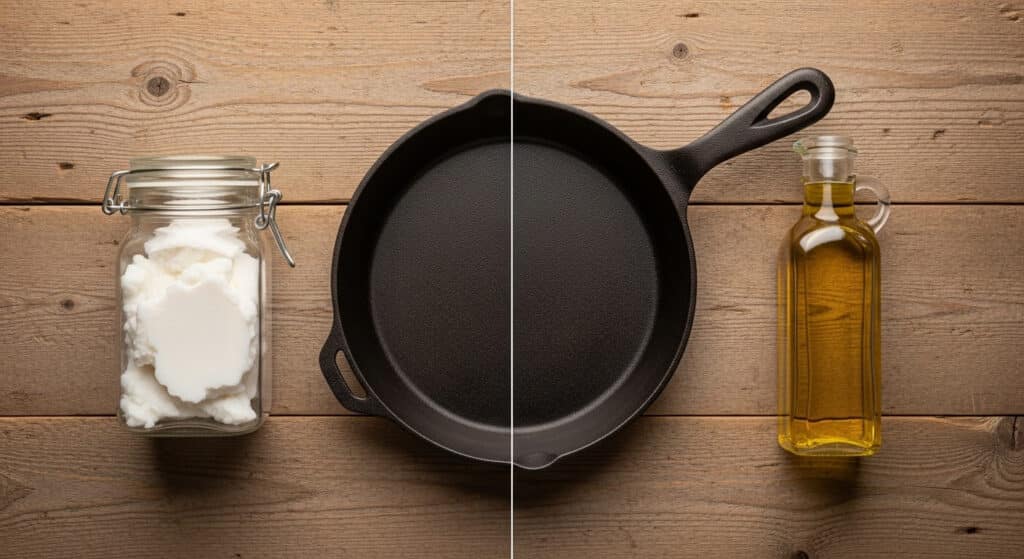
Flaxseed Oil vs. Crisco and Other Solid Fats
Crisco (and similar shortenings) dominated cast iron seasoning for decades.
Tradition: Your grandmother used Crisco. Her grandmother used lard. Solid fats have history.
Texture: Crisco creates a slightly rougher finish than flaxseed. Not as glass-like smooth.
Modern preferences: People want smooth finishes now. Aesthetics matter more than they used to. Flaxseed wins on looks—when it works.
Cost: Crisco is dirt cheap. You can season 20 pans for what one bottle of flaxseed costs.
Step-by-Step: How to Season Cast Iron with Flaxseed Oil
Selecting the Right Flaxseed Oil
You need food-grade, cold-pressed flaxseed oil. Not industrial linseed oil (same plant, but processed differently and not food-safe).
Look for:
“Cold-pressed” or “unrefined” on the label
Stored in refrigerator section (flaxseed oil spoils fast at room temp)
Dark glass bottle (light degrades the oil)
Recent production date
Organic certification? Doesn’t matter for seasoning performance. Buy it if you want, but regular food-grade works fine.
Storage: Keep refrigerated. Flaxseed oil goes rancid quickly—we’re talking weeks at room temperature. Smell it before each use. Rancid oil smells like old paint or fish. Don’t use it.
Where to buy: Health food stores, some grocery stores (check the supplements section), Amazon. Expect to pay $15-25 for a 16-ounce bottle.
Preparing Your Cast Iron for Flaxseed Oil Seasoning
Starting with bare metal gives best results. If your pan already has seasoning, you’ve got choices:
Option 1 – Strip completely:
Use lye bath (Yellow Cap Easy-Off in trash bag, 24-48 hours)
Or use electrolysis tank
Or use self-cleaning oven cycle (risky—can crack vintage pans)
Option 2 – Clean thoroughly:
Scrub with steel wool and dish soap
Remove any rust spots
Get surface as clean as possible
After stripping or cleaning:
Wash with hot soapy water
Dry completely with towel
Place in 200°F oven for 10 minutes
Remove and cool until handleable
Inspect the surface. Any rust? Remove it with steel wool. Any grease? Wash again. You want clean, dry metal.
First Layer Application Technique
This is where most people screw up. You’re using way less oil than you think.
The process:
Pour nickel-sized amount of flaxseed oil in pan
Use paper towel to spread across entire surface (inside, outside, handle, everything)
Get second clean paper towel
Wipe. Hard.
Keep wiping until pan looks dry
Seriously—it should look like there’s no oil left
Wipe some more
If the surface looks shiny or wet, you’ve got too much oil. It’ll pool and create sticky spots or uneven coating.
The pan should look barely different than before you applied oil. That’s how thin the layer needs to be.
Oven Temperature and Timing for Flaxseed Seasoning
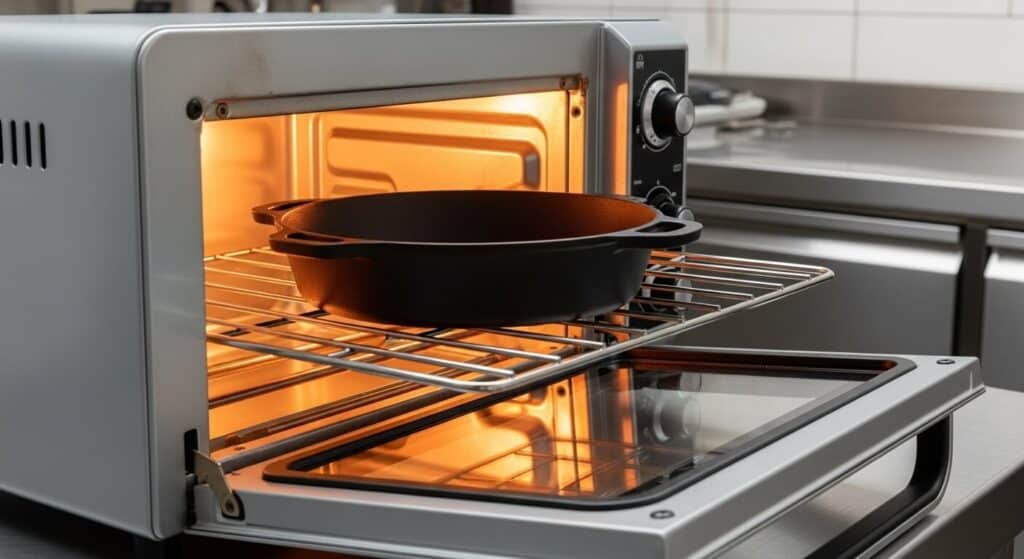
Preheat oven to 500°F. If your oven maxes out lower (mine goes to 475°F), use maximum temperature. Anything above 450°F works.
Setup:
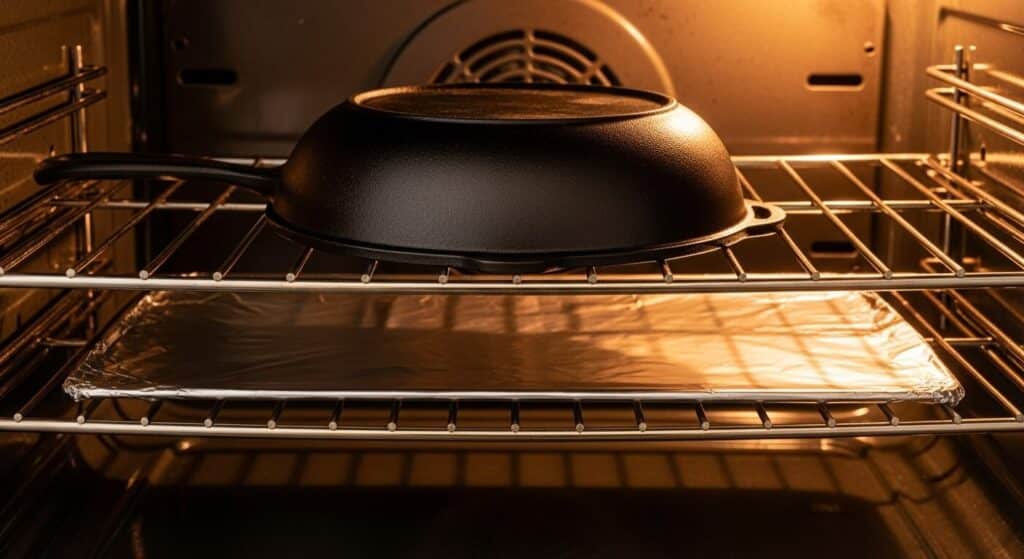
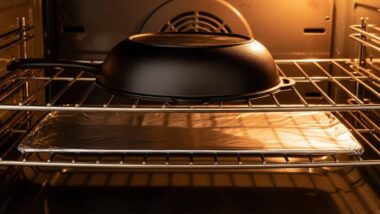
Place aluminum foil on bottom rack (catches drips)
Put pan upside-down on middle or top rack
Upside-down prevents oil pooling on cooking surface
Bake for 1 hour minimum. Some people go 90 minutes. I stick with 60 minutes—works fine.
Don’t open the oven during baking. Let it do its thing.
After an hour, turn off oven but leave pan inside. Let it cool completely in the closed oven. This takes 2-3 hours.
Patience. I know. But rushing this causes problems.
Cooling Protocol Between Coats
Complete cooling matters more than you’d expect.
Why: Applying new oil to warm pan affects how the next layer bonds. Room temperature ensures consistent results across all six coats.
The wait: 2 hours minimum in closed oven. Some people leave it overnight. Either works.
Inspection: Before applying the next coat, check the layer. It should be:
Smooth (not sticky or tacky)
Evenly colored (brown after first coat, darker with each coat)
Fully hardened (no soft spots)
Sticky or tacky? Put it back in the oven at 500°F for another hour. The oil didn’t fully polymerize.
Building Six Layers of Flaxseed Seasoning
Repeat the process six times total:
Apply oil (barely-there thin)
Wipe until dry
Bake at 500°F for 1 hour
Cool completely in oven (2+ hours)
Repeat
Visual progression:
Coat 1: Light brown, transparent
Coat 2: Medium brown
Coat 3: Dark brown
Coat 4: Very dark brown, almost black
Coat 5: Black
Coat 6: Deep black, smooth
Total time: 12-18 hours depending on cooling time. This isn’t a quick process.
Shortcuts? Don’t. Each coat needs full baking and cooling. Skip steps, get inferior results.
Final Inspection and Quality Check
After coat six, you should see:
Uniform deep black color across entire surface
Smooth, hard coating (feels almost like plastic)
Matte finish (not glossy—glossy means too much oil)
No sticky spots anywhere
Even coverage with no thin patches
Touch test: Run your finger across the surface. Should feel smooth and dry. Any tackiness means incomplete polymerization—needs another hour at 500°F.
If it passes inspection, you’re done. Let it cool completely before first use.
Troubleshooting Flaxseed Oil Seasoning Problems
Preventing Flaking During the Seasoning Process
You can’t completely prevent flaking (it’s inherent to flaxseed’s brittleness), but you can minimize risk:
Application thickness: Ultra-thin coats are crucial. Any excess oil creates weak spots that flake easily.
Temperature consistency: Use oven thermometer. “500°F” on your dial might be 450°F or 550°F actually. Know your real temperature.
Complete polymerization: Each coat must fully cure. If time’s limited, do fewer coats properly rather than six coats rushed.
Avoid temperature spikes: Don’t crank oven higher thinking it’ll work better. Excessive heat can damage the polymerization process.
Fixing Sticky or Tacky Flaxseed Seasoning
Sticky seasoning means incomplete polymerization. The oil didn’t fully cure.
Causes:
Too much oil applied
Oven temperature too low
Baking time too short
Oil was rancid (check that smell)
Fix: Put pan back in 500°F oven for another hour. Then cool completely. Check again.
Still sticky after second baking? You’ve got too much oil. Options:
Keep baking (sometimes 2-3 hours total works)
Strip and start over (annoying but effective)
Prevention: Next time, wipe more aggressively. The pan should look dry.
Addressing Uneven Coverage
Hot spots in your oven cause uneven polymerization. Some areas cure darker than others.
Solutions:
Rotate pan 180° halfway through baking (quick oven open, turn pan, close)
Use convection setting if available
Accept slight unevenness (it usually evens out after multiple coats)
Touch-ups: If you’ve got a thin spot after all six coats, apply extra oil just to that area, wipe, bake again.
Flaking after 2-3 weeks usually means the coating was too thick or didn’t fully polymerize.
Spot repair: Sand flaked area lightly with fine steel wool, clean, apply new thin coat of flaxseed, bake. Might not match surrounding seasoning perfectly.
Full re-season: If flaking is widespread, strip and start over. Frustrating but sometimes necessary.
Switching oils: Many people build flaxseed base (2-3 coats), then switch to grapeseed or canola for remaining coats. This creates hard base with flexible top layers.
The Case FOR Flaxseed Oil Seasoning
When Flaxseed Oil Works Best
Flaxseed shines in specific scenarios:
Display pieces: Collectible cast iron that sits on shelves looking pretty. The glass-like finish is stunning.
Light cooking: Eggs, delicate fish, low-temperature sautéing. If you’re not blasting the pan with heat, flaxseed performs well.
Cook at moderate temperatures (rarely exceed 400°F)
Store pans carefully (no dramatic temperature swings)
Maintain religiously (re-oil after every use)
It’s not impossible. It’s just demanding.
The Aesthetic Advantage
No other oil creates such a smooth, mirror-like finish. Period.
Flaxseed-seasoned cast iron looks gorgeous. Deep black. Glass-smooth. Professional. The kind of finish that makes people say “whoa” when they see your pan.
For vintage Griswold or Wagner collectors, this matters. These pans were famous for smooth cooking surfaces. Flaxseed seasoning complements that aesthetic perfectly.
If appearance is a priority, flaxseed delivers.
Arguments from Flaxseed Oil Advocates
“Works perfectly if you do it right.”
“I’ve been using it for 5 years with zero issues.”
“The people who have problems didn’t follow the method correctly.”
These aren’t wrong. Success stories exist. Real people achieve long-term durability with flaxseed.
The question is whether the success rate justifies the effort and cost.
The Case AGAINST Flaxseed Oil Seasoning
Why Many Experienced Users Avoid Flaxseed Oil
Cast iron enthusiasts and restoration experts increasingly recommend against flaxseed. Here’s why:
Failure rate: Too many people report flaking. Even with perfect technique, brittleness causes problems.
Better alternatives exist: Grapeseed offers 80% of the hardness with better flexibility. Canola builds great seasoning through use.
Cost vs. benefit: $20 oil that might flake in 6 months vs. $4 oil that lasts years? Math doesn’t work.
Time investment: 15 hours of seasoning for coating that might fail feels wasteful.
Real-world cooking: Most home cooks need seasoning that handles high heat, acidic foods, and daily use. Flaxseed struggles here.
The Flexibility Argument
This is the scientific core of the anti-flaxseed position.
Cast iron expands when heated. A 12-inch skillet grows measurably larger at 500°F than at room temperature. Contracts back when cooled. This happens every time you cook.
Flexible seasoning: Expands and contracts with the metal. Absorbs thermal stress. Lasts longer.
Rigid seasoning: Fights the expansion/contraction. Creates internal stress. Eventually cracks or delaminates.
Flaxseed creates the most rigid seasoning. Therefore, it’s most vulnerable to thermal cycling damage.
You wouldn’t use brittle plastic for something that expands and contracts constantly. Same logic applies here.
Cost-Benefit Analysis
Let’s do the math:
Item
Flaxseed
Canola
Oil cost
$20
$4
Seasoning time
15 hours
4 hours
Coats needed
6
3
Flaking risk
High
Low
Re-season frequency
Potentially every 6-12 months
Every 2-3 years
Storage needs
Refrigeration
Pantry
Flaxseed costs 5x more, takes 4x longer, and might require re-doing the whole process annually.
Worth it for that glass-smooth finish? You decide.
Expert Opinions Against Flaxseed
Cast iron restoration specialists—people who season hundreds of pans—rarely use flaxseed for clients.
Why? Reliability. They can’t risk callbacks about flaking seasoning. Canola, Crisco, or grapeseed deliver consistent results.
Lodge (America’s main cast iron manufacturer) doesn’t recommend flaxseed. They pre-season with soybean oil—similar properties to canola.
Commercial kitchens don’t use flaxseed. Ever. Too finicky, too expensive, too unreliable.
Historical perspective: Flaxseed seasoning didn’t exist before 2010. Cast iron worked great for 200 years without it.
Alternative Approaches to Flaxseed Oil Seasoning
Modified Flaxseed Method: Lower Temperature
Some people report better results at 450°F instead of 500°F.
Theory: Slightly lower temperature produces less brittle polymerization. Coating stays hard but gains tiny bit of flexibility.
Process: Everything same as original method, just reduce temp to 450°F.
Baking time: Increase to 75-90 minutes to ensure complete polymerization at lower temp.
Results: Mixed reports. Some people see reduced flaking. Others notice no difference. Worth trying if you’ve got time and oil to spare.
Flaxseed Base with Different Oil Top Coats
This hybrid approach makes sense theoretically:
Coats 1-2: Flaxseed (creates hard foundation) Coats 3-6: Grapeseed or canola (adds flexibility)
You get hardness from flaxseed base without full brittleness of all-flaxseed seasoning. The top layers protect the flaxseed while providing flexibility.
Benefits:
Hard base provides smooth foundation
Flexible top layers resist flaking
Easier maintenance (top layers easier to touch up)
Drawbacks:
More complicated process
Mixing oils might create weak bonding between layers
Unproven long-term
Starting with Traditional Oils Then Switching
Flip the script. Build foundation with reliable oil, finish with flaxseed for aesthetics.
High-heat searing (500°F+) will likely damage flaxseed seasoning. Not immediately, but over time.
Practical implications:
No screaming-hot steak sears
Gentle heat for everything
Preheat gradually (don’t blast from cold to hot)
Avoid thermal shock (no cold water on hot pan)
This limits what you can cook. That’s the trade-off.
Cleaning Flaxseed-Seasoned Pans
Treat it gently. The hard coating is also brittle—aggressive scrubbing can chip it.
Method:
Hot water and soft brush or sponge
No metal scrubbers or abrasive pads
No harsh detergents (dish soap is fine, despite what purists say)
Dry immediately and thoroughly
Re-oil lightly after each use
Stuck-on food? Boil water in pan to loosen. Don’t attack it with steel wool.
Touch-Up Seasoning Frequency
Flaxseed requires more frequent maintenance than other oils.
Inspection: After each use, check for dull spots or areas where non-stick is declining.
Re-oiling: Wipe thin coat of flaxseed oil after cleaning, heat pan on stovetop for a few minutes. Helps maintain coating.
Full touch-up: Every 4-6 weeks, do a single oven coat (thin application, 500°F for 1 hour).
More work than canola or Crisco. But necessary to prevent degradation.
When to Re-Season Completely
Strip and start over when you see:
Widespread flaking (not just one spot)
Loss of non-stick across entire surface
Rust appearing through seasoning
Sticky or tacky coating that won’t fix with re-baking
Sometimes you can patch problems. Sometimes you can’t. Don’t waste time patching if the whole coating is failing.
Real-World Performance Testing
Cooking Tests: Eggs and Delicate Foods
Flaxseed-seasoned pans handle eggs beautifully. When they work, they work great.
Fresh flaxseed coating (1-2 weeks old) releases eggs perfectly. Barely any oil needed. Slide right out. It’s impressive.
After 3-6 months? Results vary. Some pans maintain performance. Others start sticking. The brittleness affects non-stick properties as coating ages.
Compared to canola: Fresh flaxseed wins on smoothness. Aged canola (6+ months with regular cooking) often performs better due to built-up layers.
High-Heat Searing Tests
This is where flaxseed fails.
Heat pan to 500°F for steak. Sear for 3-4 minutes. You’ll probably see:
Smoke (normal)
Discoloration of seasoning (concerning)
Small chips or flakes appearing (bad)
After 5-10 high-heat searing sessions, flaxseed seasoning often shows significant degradation.
Canola or grapeseed: Handle high heat better. More forgiving of temperature extremes. The flexibility prevents damage.
Long-Term Durability Assessment
6 months: Flaxseed coating might look perfect or might be flaking. Depends heavily on cooking style and maintenance.
1 year: Success rate drops. Many people have re-seasoned by this point, either due to flaking or declining performance.
Comparison: Canola-seasoned pans typically improve with age. Each cooking session adds micro-layers. At 1 year, they’re often better than when freshly seasoned.
Flaxseed peaks early. Canola builds slowly but lasts longer.
Flaxseed’s brittleness makes it vulnerable. Acidic foods can etch the hard coating, creating weak spots that flake.
Recovery: Canola-seasoned pans bounce back from acidic food damage with simple re-oiling. Flaxseed often needs full re-seasoning.
Not a deal-breaker for occasional acidic cooking. But if you make tomato sauce weekly, flaxseed isn’t ideal.
Scientific Analysis of Flaxseed Oil Claims
Examining the “Hardest Seasoning” Claim
True. Flaxseed does create the hardest polymerized coating among common food oils.
But hardness testing usually happens in labs under controlled conditions. Real cookware faces thermal cycling, mechanical stress, acidic foods, and daily abuse.
Laboratory hardness ≠ practical durability.
Think of it this way: Tempered glass is harder than plastic. Drop your phone with tempered glass screen protector—it might shatter. Plastic screen protector? Scratches but doesn’t shatter.
Harder isn’t always better.
Polymerization Chemistry Deep Dive
The chemistry is legit. Alpha-linolenic acid does polymerize into dense networks. The high iodine value creates extensive cross-linking.
But chemistry doesn’t account for:
Differential thermal expansion between coating and metal
Mechanical flexibility requirements
Real-world cooking stress
The science explains why flaxseed creates hard coating. It doesn’t prove hard coating is ideal for cookware.
The Food-Grade Drying Oil Concept
Here’s the thing. Linseed oil (industrial form of flaxseed oil) has been used for centuries—in oil painting. Wood finishing. Rust protection.
These applications don’t involve thermal cycling or mechanical stress. A painted canvas doesn’t heat to 500°F repeatedly.
Just because drying oils work great for some applications doesn’t mean they’re optimal for cookware. Different use cases, different requirements.
Common Myths and Misconceptions
Myth: Flaxseed Oil is the Only Food-Grade Drying Oil
Wrong. Several food oils have high iodine values:
Walnut oil: Iodine value 140-150
Hemp seed oil: Iodine value 155-165
Perilla oil: Iodine value 190-200
Perilla actually has higher iodine value than flaxseed. It’s just less available in the US.
Walnut oil seasons cast iron well—creates hard finish without extreme brittleness.
Myth: Low Smoke Point Means Poor Seasoning
This confusion persists everywhere.
Smoke point = temperature where oil breaks down during cooking
Polymerization temperature = temperature where oil transforms into polymer coating
These aren’t related. Flaxseed’s 225°F smoke point is irrelevant to seasoning at 500°F.
Myth: Six Coats is Mandatory
Canter recommended six. Doesn’t mean it’s required.
Three coats of flaxseed might work fine for your needs. Ten coats won’t hurt (though diminishing returns kick in).
The six-coat recommendation provided framework. It’s not holy law.
Myth: Only Works at 500°F
450°F works. 475°F works. Even 425°F can work if you extend baking time.
500°F is optimal—gives most consistent results in shortest time. But ovens vary. Use what you’ve got.
Professional and Commercial Perspectives
What Cast Iron Manufacturers Recommend
Lodge: Uses soy-based vegetable oil. Pre-seasons at factory with this. Recommends vegetable oil for home seasoning too.
Finex: Suggests grapeseed or organic flaxseed. Acknowledges flaxseed brittleness issue.
Smithey: Recommends grapeseed. Specifically mentions avoiding flaxseed due to flaking problems.
Notice the pattern? Major manufacturers either avoid flaxseed or mention it with caveats.
Restaurant and Commercial Kitchen Practices
Walk into professional kitchen. Ask what they use for cast iron. You’ll hear:
Canola
Vegetable oil blend
Whatever’s cheap and available
Never flaxseed. Why?
Cost: Can’t justify premium oil prices at commercial scale
When your business depends on satisfied customers, you choose reliability over novelty.
Special Considerations for Different Cast Iron Types
Vintage vs. Modern Cast Iron with Flaxseed Oil
Vintage (Griswold, Wagner): Smooth polished surfaces. Flaxseed works better here because:
Less surface roughness means better adhesion
Smooth surface shows off flaxseed’s glass-like finish
Collectors care about aesthetics
Modern (Lodge, Camp Chef): Rough pebbly texture. Flaxseed challenges:
Harder to achieve even coating on rough surface
Less visual payoff (you can’t see the smoothness through the texture)
Better served by regular vegetable oil
If you’ve got vintage iron and want museum-quality finish, flaxseed makes more sense.
Enameled Cast Iron (Does Not Apply)
Just to be clear: Enameled cast iron (Le Creuset, Staub) doesn’t get seasoned. Ever.
The enamel coating is permanent. It’s already non-stick (ish). Adding seasoning would just create gunky buildup.
This should be obvious but people ask surprisingly often.
Specialty Cast Iron Pieces
Dutch ovens: Flaxseed works same as skillets. Interior seasoning follows same rules. Exterior (if unseasoned cast iron) can use flaxseed but it’s overkill—exterior doesn’t need glass-smooth finish.
Griddles: Large flat surface means more area for potential uneven heating and flaking. Consider grapeseed instead.
Grill pans: Raised ridges make even flaxseed application tricky. Possible but annoying.
Cost Analysis: Flaxseed Oil vs. Alternatives
Price Comparison Per Seasoning Session
For seasoning one 12-inch skillet (6 coats):
Oil Type
Price
Amount Needed
Cost Per Session
Flaxseed
$20/16oz
~4 oz
$5
Grapeseed
$10/16oz
~4 oz
$2.50
Canola
$4/32oz
~4 oz
$0.50
Crisco
$6/48oz
~6 oz
$0.75
Flaxseed costs 10x more than canola per seasoning session.
Long-Term Cost Considerations
But wait, there’s more (costs, that is):
Flaxseed:
Initial seasoning: $5
Storage in fridge (takes space, electricity)
Potential spoilage (oil goes bad faster)
Re-seasoning if flaking (another $5 every 6-12 months?)
Total yearly cost: $10-15
Canola:
Initial seasoning: $0.50
No special storage
Touch-ups occasional (minimal cost)
Re-season every 2-3 years
Total yearly cost: $1-2
Over 5 years, you’re looking at $50-75 for flaxseed vs. $5-10 for canola.
For what benefit? Smoother finish that might flake.
Where to Buy Flaxseed Oil for Best Value
If you’re determined to use flaxseed:
Best prices:
Costco (if you’ve got membership): ~$12-15 for larger bottle
Trader Joe’s: ~$8-10 for smaller bottle (decent quality)
Amazon: $15-20 (convenient but not cheapest)
Avoid:
Specialty health food stores: Often $25-30
Supplement shops: Overpriced
Buy smallest bottle that’ll cover your needs. Flaxseed oil doesn’t last long, even refrigerated.
Making the Decision: Should You Use Flaxseed Oil?
Factors That Favor Flaxseed Oil
Use flaxseed if:
Aesthetics matter more than performance
You cook at low-medium temps only
You’re willing to re-season frequently if needed
You want that glass-like smooth finish
This is a display piece or collectible
You’ve got time and patience for meticulous process
Budget isn’t a concern
Factors That Favor Alternative Oils
Use canola, grapeseed, or Crisco if:
Daily cooking workhorse needed
High-heat cooking methods used regularly
Budget matters
Simplicity preferred
Reliability more important than aesthetics
You don’t want to think about seasoning constantly
Hybrid Approach Recommendations
Best of both worlds:
2 coats flaxseed (smooth foundation)
4 coats grapeseed (flexible protection)
Or:
3 coats canola (reliable base)
2 coats flaxseed (aesthetic finish)
Hybrid methods hedge your bets. You get some hardness, some flexibility, some durability.
Personal Preference and Experimentation
Here’s the truth: Your cooking style, climate, pan type, and maintenance habits will affect results more than which oil you choose.
Try flaxseed if you want. Document what happens. If it works for you, great. If it flakes, you’ve learned something.
Test on one pan before committing your whole collection. Don’t season all five skillets with flaxseed on faith.
Advanced Flaxseed Oil Seasoning Techniques
The Cold Oven Start Method
Instead of preheating oven, start cold:
Apply oil to pan
Place in cold oven
Set to 500°F
Let it heat gradually (45-60 minutes to reach temp)
Bake for 1 hour at 500°F
Cool in oven
Theory: Gradual temperature increase reduces thermal shock, creating less brittle polymerization.
Reality: Minimal difference in most cases. Some people swear by it. Others see no benefit.
Worth trying? Sure. Will it revolutionize your seasoning? Probably not.