Why Dual-Handle Pans Are Essential for Seniors with Arthritis
Dual-handle pans distribute weight evenly across both hands, eliminating the dangerous wrist torque and single-point strain that makes pouring with traditional single-handle cookware painful and hazardous for seniors with arthritis.
Here’s what happens with a regular pan. You grip one handle. All the weight—the pan, the food, the liquid—concentrates on one wrist joint. Then you tilt to pour, which adds rotational force on top of the lifting force. Your arthritic wrist screams. Or gives out completely.
Not good.
The Wrist Strain Problem with Single-Handle Cookware
Single-handle pans create a cantilever effect. Physics working against you.
The further the weight is from the handle, the more torque on your wrist. A pot of soup 8 inches away from your grip point creates massive rotational stress—way more than the actual weight would suggest.
What this means for arthritic wrists:
- Extreme pressure on already-inflamed joints
- Unnatural wrist angles during the pouring motion
- All weight borne by one side of your body
- Compensation by elbow and shoulder (which spreads the damage)
- High risk of involuntary release when pain spikes
And you know what? That’s assuming you can even lift it in the first place.
How Dual Handles Distribute Weight and Reduce Joint Stress
Two handles change everything.
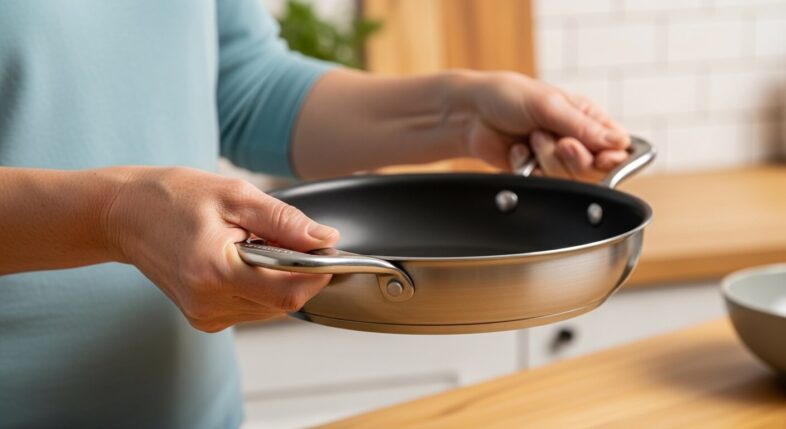
Weight splits 50/50 between your hands. Each wrist handles half the load. And because you’re gripping on opposite sides of the pan, the balance is natural—no torque, no twisting, no leveraged stress.
The biomechanical advantage:
- Force distributed across two wrists instead of one
- Symmetrical loading (your body’s designed for this)
- Both arms work together (stronger combined than one arm alone)
- Wrists stay in neutral alignment (not bent backward or sideways)
Think about carrying a heavy box. You don’t hold it with one hand out to the side. You grip both sides and hold it in front of you. Same principle.
Preventing Common Pouring Accidents in Arthritic Hands
Most kitchen accidents involving seniors happen during pouring or draining.
Hot soup spills. Pasta water dumps on the floor—or worse, on you. The pan slips from your grip mid-pour because the weight shifted or your wrist gave out.
Dual handles prevent this by:
- Giving you a secure grip even when pain hits unexpectedly
- Allowing controlled, stable tilting motion
- Providing a bailout option (if one hand weakens, the other maintains control)
- Reducing the shaky, uncertain movements that lead to spills
The Biomechanics of Two-Handed Lifting for Arthritis Safety
Your body’s strongest when both sides work together.
Bilateral movement (using both arms symmetrically) activates more muscle groups, provides better stability, and reduces injury risk compared to unilateral movements.
For arthritic joints specifically, bilateral lifting means:
- Lower peak force on any single joint
- Better postural alignment (you stand centered, not twisted)
- Improved balance and stability
- Natural compensatory mechanisms if one side is weaker
It’s not just about making things easier. It’s about making them possible.
Understanding Arthritis-Related Pouring Challenges
Arthritis affects pouring ability through multiple mechanisms—wrist pain during tilting, weakened grip strength, restricted range of motion, coordination problems from inflammation, and the ever-present risk of involuntary drops when handling hot liquids.
Let’s break down what’s actually going wrong.
Wrist Pain and Weakness During Tilting Motions
Pouring requires wrist extension. You’re tilting your wrist backward while supporting weight.
This motion compresses the joints on the back of your wrist—exactly where arthritis inflammation lives. Every degree of tilt increases the compression and the pain.
With single-handle pans, you’re tilting AND twisting simultaneously. That’s two pain-inducing movements at once.
Dual handles? You tilt the pan, but your wrists stay relatively neutral. The tilting happens at your elbows and shoulders (stronger, larger joints that can handle it better).
Reduced Grip Strength Affecting Pour Control
Grip strength drops 50-70% with moderate to severe arthritis.
When you’re pouring, you’re not just holding—you’re controlling. Slight adjustments to pouring speed and angle. Corrections when liquid starts to drip. Recovery if the pan shifts unexpectedly.
All of that requires grip strength you might not have.
What weak grip causes during pouring:
- Overcorrection (jerky movements because you can’t make small adjustments)
- Speed control issues (too fast, too slow, erratic)
- Spills from the pan rotating in your hand
- White-knuckling to maintain hold (which increases pain)
Two handles give you redundancy. One hand weakens, the other compensates.
Range of Motion Limitations and Awkward Angles
Arthritis limits how far you can move your wrists and elbows.
Standard pouring often requires:
- Full wrist extension (tilting back 45-60 degrees)
- Forearm rotation (twisting motion)
- Elbow flexion while supporting weight
- Shoulder abduction if reaching over something
Can’t do some of those movements? You compensate with awkward body positions—bending, twisting, reaching in ways that stress other joints.
Dual-handle pans let you pour with minimal wrist movement. The pan tilts, your wrists don’t have to.
The Risk of Dropping Hot Liquids with Single Handles
Pain causes involuntary releases. Your brain says “hold on,” your hand says “absolutely not” and lets go.
This is dangerous with anything. It’s catastrophic with boiling water or hot soup.
Single-handle pans fall immediately when you lose grip. Dual-handle pans? If one hand releases, the other’s still holding. You’ve got a split-second to recover or at least control the descent.
That split-second prevents burns.
How Inflammation Affects Coordination and Stability
Inflamed joints don’t just hurt. They mess with proprioception—your sense of where your body is in space.
You think you’re holding the pan level. You’re not. You think you’re pouring slowly. It’s actually gushing.
Coordination issues from arthritis:
- Delayed reaction time to weight shifts
- Difficulty judging pour speed visually
- Tremors from muscle compensation
- Fatigue that builds rapidly during sustained holds
Dual handles improve stability through redundancy and bilateral control. Two points of contact give your brain better spatial feedback.
Key Features of Arthritis-Safe Dual-Handle Pans
Arthritis-safe dual-handle pans combine ergonomic handle design, cool-touch materials, balanced weight distribution, controlled pour spouts, and integrated lids—features that work together to minimize wrist stress and maximize pouring safety.
Not all dual-handle pans are created equal.
Ergonomic Handle Design and Positioning
Handle design matters as much as having two handles.
Handle angle and wrist alignment
Best handles angle slightly upward from the pan body. This lets your wrists stay in neutral position (straight, not bent) during lifting.
Ideal angle: 15-30 degrees up from horizontal. Your hands naturally grip upward—the handles should match that.
Avoid handles that stick straight out or angle downward. Those force your wrists into extension (bent backward), which aggravates arthritis.
Distance between handles for optimal grip
Too close together, and you can’t get a stable two-handed grip. Too far apart, and you’re stretching or straining.
Optimal spacing:
- Small pans (1-2 qt): 8-10 inches between handles
- Medium pans (3-4 qt): 10-12 inches
- Large pans (5+ qt): 12-14 inches
Your hands should be slightly wider than shoulder-width when gripping. Natural, comfortable, stable.
Height positioning for natural hand placement
Handles should sit high enough that your knuckles don’t hit the pan body during gripping.
Check the clearance between the bottom of the handle and the pan rim. You want at least 1.5-2 inches for comfortable finger placement, especially if you’re using pot holders or have swollen knuckles.
Handle Material and Grip Surface
Handle material affects both safety and comfort.
Heat-resistant materials that stay cool
Best options:
- Silicone-coated handles (stay cool, soft grip)
- Bakelite handles (vintage but effective)
- Stainless steel with heat-break design (stay relatively cool)
- Phenolic resin (heat-resistant plastic)
Avoid:
- Bare metal handles (conduct heat, burn you)
- Thin plastic (melts or gets hot)
- Wood (gets hot, degrades over time)
Textured vs. smooth grip surfaces
Textured handles provide better grip with less force required. Ridges, bumps, or soft-touch coatings increase friction.
Smooth handles slip, especially when wet or if you’re using pot holders. Not ideal for weak hands.
Silicone coating benefits for arthritis
Silicone-coated handles are sneaky good for arthritis.
They stay cool. They’re tacky (high friction). They cushion your grip. They’re easy to clean. And they can be thick enough to fill your hand comfortably without adding much weight.
Pan Weight Distribution and Balance
A well-designed dual-handle pan balances empty or full.
The center of gravity should fall between the two handles, not shifted toward one end. This means equal weight on each hand regardless of fill level.
Test for balance: Hold the pan by one handle when empty. If it tips heavily to one side, the balance is off.
Pour Spout Design for Controlled Flow
Good pour spouts let you control liquid flow precisely.
What makes a good spout:
- Smooth lip (no drips running down the outside)
- Defined channel (liquid goes where you aim it)
- Multiple spouts on opposite sides (pour from either handle)
- Straining slots if integrated with colander function
Some dual-handle pans have rolled rims instead of spouts. That works for soups and stews (smooth pouring all around) but not for precision pouring.
Lid Integration with Dual-Handle Systems
Lids on dual-handle pans need their own handle that doesn’t interfere with the pan handles.
Best lid designs:
- Center knob handle (lifts straight up, clears both pan handles)
- Large, cool-touch knob (easy to grip with weak hands)
- Glass lids (see inside without lifting)
- Straining lids with holes (drain without removing completely)
Avoid lids with small, metal knobs that get hot and are hard to grip.
Types of Dual-Handle Pans Best Suited for Seniors
Different dual-handle pan styles serve different cooking needs—saucepans for liquids, stockpots for batch cooking, sauté pans for versatility, roasting pans for larger meals, and specialty pans with helper handles for transitional needs.
Match the pan type to what you actually cook.
Dual-Handle Saucepans for Soups and Liquids
These are your workhorses. Tall sides, smaller diameter, designed for liquids.
Small capacity (1-2 quart) options
Perfect for:
- Single servings of soup or oatmeal
- Heating water for tea or instant foods
- Warming sauces
- Cooking for one person
Weight when full: 3-5 lbs typically. Manageable even with significant arthritis.
Medium capacity (3-4 quart) for versatility
The sweet spot for most seniors.
Big enough to cook meals for two or batch-cook for the week. Small enough to handle comfortably.
Uses:
- Family-size soup portions
- Pasta for 2-3 people
- Steaming vegetables
- Reheating leftovers
Weight when full: 6-9 lbs. Requires decent strength, but dual handles make it doable.
Large capacity (5+ quart) considerations
Only get these if you regularly cook for multiple people or do serious batch cooking.
They’re heavy when full (10-15+ lbs). Even with dual handles, that’s a lot for arthritic wrists. Consider whether you really need this size or if cooking in smaller batches works better.
Dual-Handle Stockpots for Batch Cooking
Stockpots are wider and taller than saucepans. Big capacity.
Great for:
- Making large batches of soup or stew to freeze
- Cooking stocks and broths
- Boiling corn on the cob
- Canning (if you’re into that)
Honestly? Most seniors with arthritis should skip stockpots. Too heavy when full. Use a medium saucepan and cook in batches instead.
Two-Handled Sauté Pans and Skillets
Shorter sides than saucepans, wider diameter. Good for cooking where you need to access food easily.
Best for:
- Browning meat
- Sautéing vegetables
- One-pan meals
- Stir-fries
The dual handles on sauté pans help when you need to move the pan to the sink for deglazing or to the table for serving. They’re not typically for pouring (use a spatula or serving spoon instead).
Dual-Handle Roasting Pans and Baking Dishes
These usually have two small handles on opposite ends.
Heavy when loaded with a roast or casserole. But dual handles let you get it in and out of the oven safely.
Tip: Get ones with handles that extend beyond the pan body. Makes gripping with oven mitts way easier.
Specialty Pans with Helper Handles
Some pans have a full handle on one side and a smaller “helper handle” opposite.
This is a compromise between single-handle and dual-handle designs. The helper handle gives you stability and control during pouring without committing to full dual-handle design.
When they work:
- You have one stronger hand and one weaker hand
- You’re transitioning from single-handle use
- You want the option of one-handed use when the pan’s not full
When they don’t work:
- Both wrists are equally affected by arthritis
- You need true bilateral weight distribution
- The helper handle is too small to grip properly with pot holders
Material Choices That Benefit Arthritic Wrists
Pan material directly affects weight, and weight determines whether you can safely pour with arthritic wrists—aluminum is lightest, stainless steel is heaviest, and various combinations offer different tradeoffs between weight, durability, and cooking performance.
Material matters. A lot.
Lightweight Aluminum Construction
Pure aluminum is the lightest option for cookware.
Weight comparison: An aluminum 3-quart saucepan weighs about 1.5-2 lbs empty. The same size in stainless steel weighs 3-4 lbs.
Pros:
- Incredibly light (easiest on arthritic wrists)
- Heats quickly and evenly
- Affordable
Cons:
- Bare aluminum reacts with acidic foods (needs non-stick coating or anodizing)
- Dents and scratches easily
- Less durable than other materials
For arthritis, the weight advantage often outweighs the durability concerns.
Hard-Anodized Aluminum Benefits
Hard-anodized aluminum is aluminum that’s been electrochemically treated. Creates a hard, non-reactive surface.
Benefits for arthritis:
- Still lightweight (slightly heavier than bare aluminum, much lighter than stainless)
- More durable than regular aluminum
- Non-reactive cooking surface
- Often has non-stick coating
Downsides:
- Can’t go in dishwasher (hand-wash only, usually)
- More expensive than regular aluminum
- Dark surface makes it harder to see food browning
Stainless Steel with Aluminum Core
Stainless steel exterior with aluminum core (tri-ply or multi-clad construction).
This combines even heating (from aluminum) with durability (from stainless). But it’s heavy.
When to consider despite weight:
- You have mild arthritis and can handle 3-4 lb pans
- Durability is priority (these last decades)
- Dishwasher-safe is important
- You do high-heat cooking
When to skip:
- Moderate to severe arthritis
- Weight is your primary concern
- You’re downsizing and simplifying
The extra weight might be worth it if you’re only buying one nice pan. But if you’re buying several, go lighter.
Ceramic and Non-Stick Coated Options
Non-stick coatings add negligible weight but significantly reduce cooking and cleaning effort.
For arthritis, non-stick is clutch because:
- Food slides off with minimal stirring (less sustained gripping)
- Cleanup requires almost no scrubbing force
- You can use less oil (lighter food = lighter pan)
Ceramic non-stick is more durable than traditional Teflon-type coatings. Both work fine for arthritis purposes.
Weight Comparison: Traditional vs. Lightweight Materials
| Pan Type (3 qt) | Material | Empty Weight | Full Weight (approx) |
|---|---|---|---|
| Traditional | Stainless steel | 3-4 lbs | 9-11 lbs |
| Mid-weight | Hard-anodized aluminum | 2-2.5 lbs | 8-9 lbs |
| Lightweight | Aluminum with non-stick | 1.5-2 lbs | 7-8 lbs |
Two pounds might not sound like much. When you’re pouring with arthritic wrists, it’s massive.
Proper Pouring Techniques with Dual-Handle Pans
Correct dual-handle pouring technique involves two-handed lifting, strategic body positioning, counter support when possible, knowing when to ladle instead, and safe draining methods—technique matters as much as equipment.
Having dual handles doesn’t automatically make pouring safe. You’ve gotta use them right.
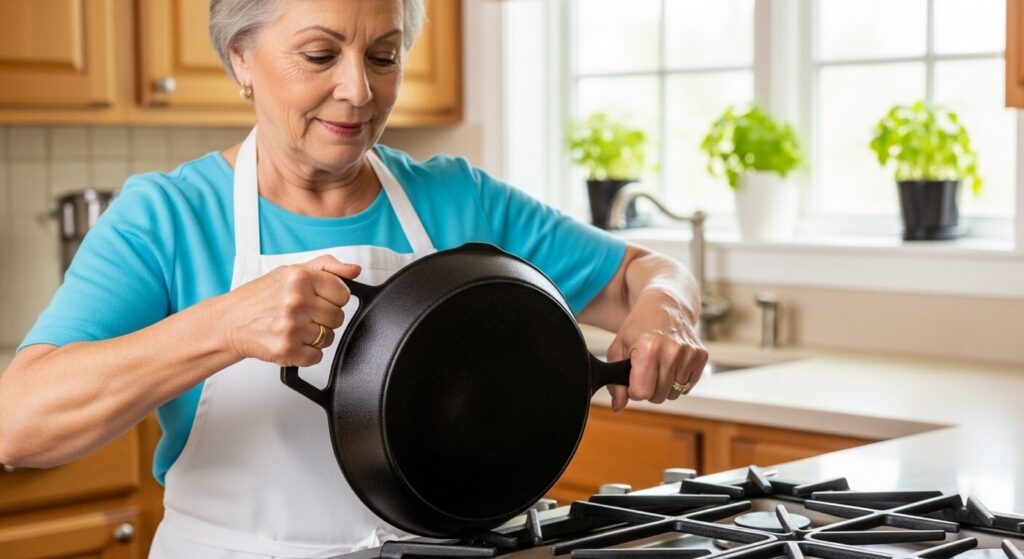
The Two-Handed Lift and Tilt Method
Step-by-step proper technique:
- Grip both handles firmly (but not death-grip tight)
- Lift straight up using both arms equally
- Move the pan over the target (sink, bowl, whatever)
- Lower until stable (don’t hold it suspended in air)
- Tilt by raising one handle and lowering the other (not by bending wrists)
- Pour slowly with controlled tilting
- Return to level before setting down
The key: your wrists stay straight throughout. All the motion happens at elbows and shoulders.
Using Body Positioning to Minimize Wrist Strain
Stand centered with the pan. Don’t twist or reach.
Optimal stance:
- Feet shoulder-width apart
- Pan centered in front of your body
- Target (bowl, sink, etc.) directly in front of you
- No twisting at the waist
If you have to twist to reach the sink, move your whole body instead. Pivot your feet. Twisting while holding weight is how you hurt yourself.
Leveraging Counter Edges for Support
Rest the pan rim on the counter edge during pouring when possible.
This lets the counter support the weight while you just control the tilt. Way easier on your wrists.
How to do it:
- Set the pan on the counter with the pour spout hanging over the edge
- Place your bowl or sink under the spout
- Use the handles to tilt, but the counter bears the weight
- Pour at your own pace
Only works when your counter height and target location cooperate, but when they do, it’s a huge help.
When to Use Ladles Instead of Pouring
Sometimes you shouldn’t pour at all.
Use a ladle when:
- The pan’s more than 2/3 full (too heavy to control the pour safely)
- You’re serving individual portions (more precise than pouring)
- The liquid has chunks (vegetables, meat) that might clog pour spouts
- Your wrists are having a particularly bad day
There’s zero shame in ladling. It’s often smarter than risking a spill or burn.
Safe Draining Techniques for Pasta and Vegetables
Draining pasta or boiled vegetables is where most accidents happen.
Safest method with dual-handle pans:
- Put a colander in the sink
- Carry the pan to the sink using both handles
- Set it on the counter next to the sink
- Use one handle to tilt gradually while keeping bottom edge on counter
- Let gravity do the work (slow drain is safer than fast dump)
Even safer: Use a pasta insert or straining lid. Lift out the pasta/vegetables, leave the water in the pan. No pouring required.
Handle Grip Strategies for Weak or Painful Wrists
Effective gripping with arthritic hands requires optimal hand placement, proper use of pot holders, aftermarket grip enhancements, correct thumb positioning, and avoiding excessive grip pressure that increases pain.
How you grip matters as much as what you’re gripping.
Optimal Hand Placement on Dual Handles
Your palms should face each other, thumbs pointing up or slightly forward.
Grip technique:
- Wrap all four fingers around the underside of the handle
- Thumb rests on top or wraps around from the other side
- Handle sits in the crook where fingers meet palm (strongest grip position)
- Wrists stay straight (not bent up, down, or sideways)
Avoid gripping with just fingertips. You need the whole hand engaged for stability and to distribute pressure.
Using Pot Holders and Oven Mitts Effectively
Pot holders add bulk, which can actually help arthritic hands by increasing handle diameter.
Best options for arthritis:
- Silicone oven mitts (textured grip, don’t slip)
- Thick cotton pot holders (cushion grip, reduce pressure points)
- Mitts with non-slip silicone dots
- Long-cuffed mitts (protect forearms from steam)
Avoid:
- Thin, flimsy pot holders (provide no cushioning)
- Smooth fabric that slips
- Pot holders that are too small to grip comfortably
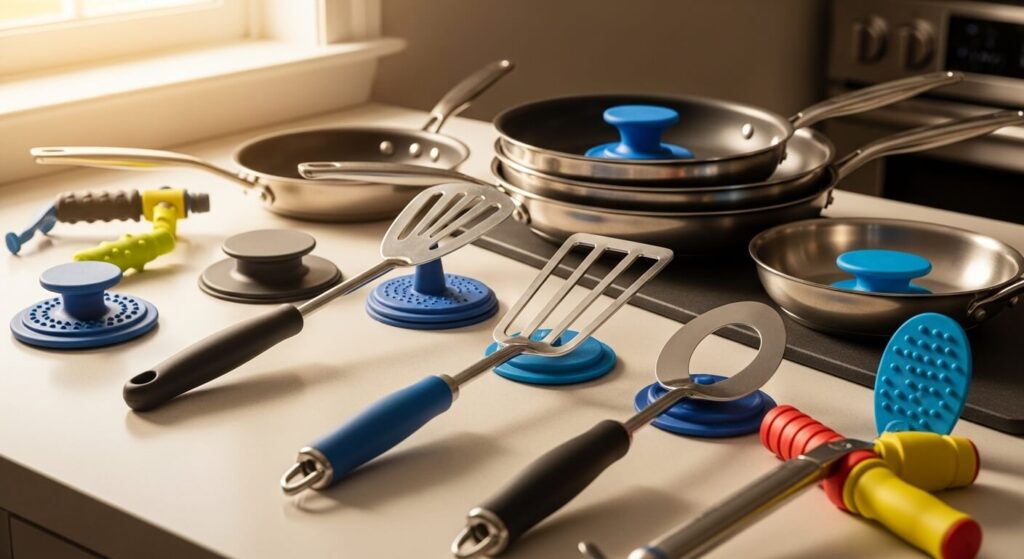
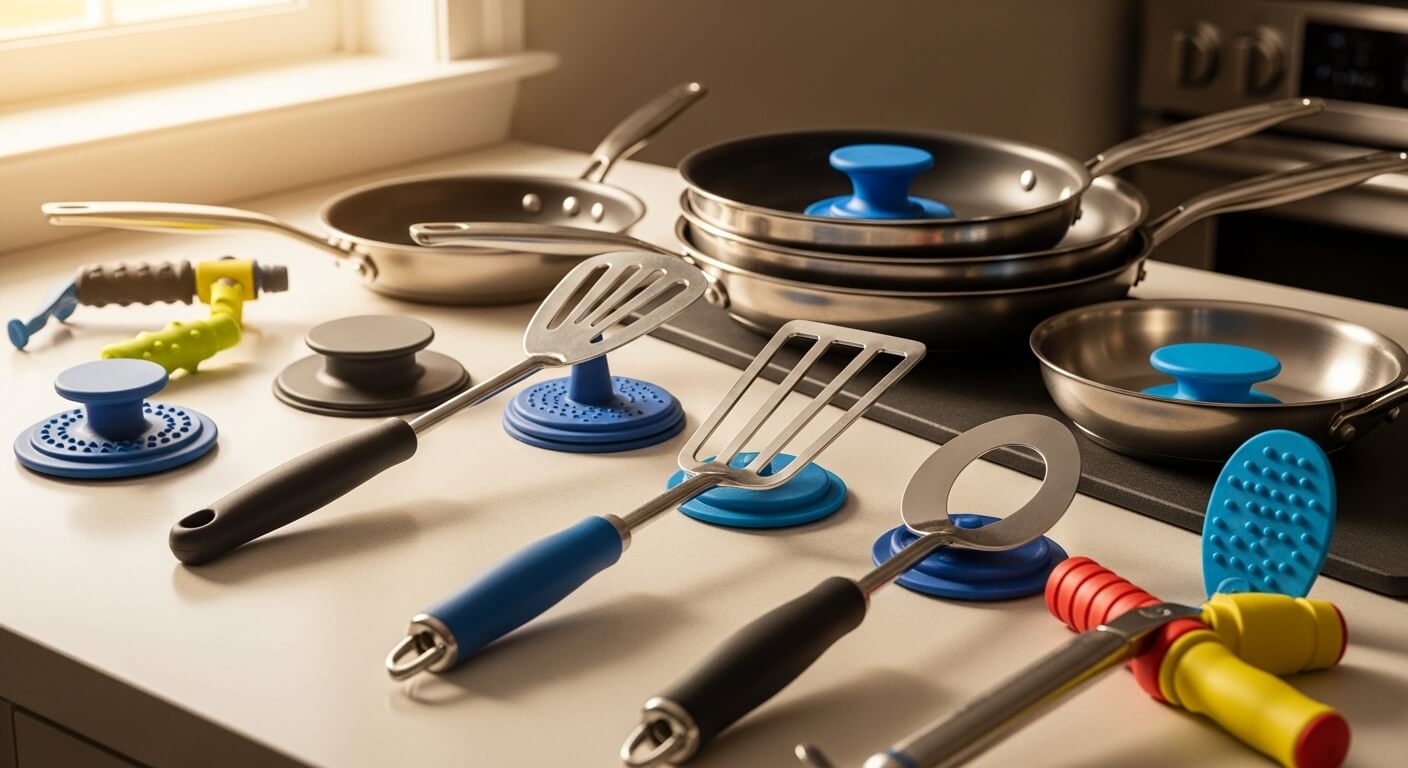
Adding Aftermarket Grip Enhancements
You can modify existing handles with aftermarket grips.
Options:
- Silicone handle covers (slip-on sleeves)
- Heat-resistant foam tubing
- Bicycle handlebar tape (works surprisingly well)
- Custom grips from medical supply stores
These increase handle diameter and add cushioning. Both help arthritic hands maintain grip with less force.
Thumb Position and Pressure Distribution
Where you put your thumb affects how much force you need.
Two main options:
Thumb on top: Creates a “pinch” grip. Good for light pans, requires more thumb strength.
Thumb wrapped around: Creates a “power” grip. Better for heavier pans, distributes force across entire hand.
For arthritis, the power grip usually works better. Less pressure on any single point.
Avoiding Death Grips That Increase Pain
White-knuckling the handles causes more pain, not less.
When you grip too hard:
- You fatigue faster
- Joint inflammation increases
- Tremors get worse
- You lose fine motor control
Grip only as tight as needed. The pan’s not trying to escape. Minimal effective force, not maximum possible force.
Comparing Dual-Handle Pans to Single-Handle Alternatives
Dual-handle pans distribute weight bilaterally and eliminate torque stress, providing superior safety and control compared to single-handle pans for seniors with arthritis—though single handles remain appropriate for small, lightweight pans and quick-use scenarios.
Let’s do a real comparison.
Weight Distribution Differences
Single-handle pan:
- 100% of weight on one wrist
- Cantilever effect multiplies perceived weight
- Uneven loading on one side of body
Dual-handle pan:
- 50/50 split between wrists
- No cantilever (weight balanced)
- Symmetrical body loading
For a 3-quart pan full of soup (about 8-9 lbs total), your single wrist experiences maybe 12-15 lbs of effective force due to leverage. With dual handles, each wrist handles 4-4.5 lbs. Huge difference.
Control and Stability During Pouring
Single-handle pans want to rotate in your hand during pouring. The weight shifts as liquid moves, creating dynamic torque.
Dual-handle pans stay stable because you’re controlling rotation from both sides. Like steering a car—two hands is way more stable than one.
Safety Advantages for Seniors with Arthritis
Dual handles prevent:
- Dropping from single-point grip failure
- Spilling from uncontrolled rotation
- Burns from loss of control mid-pour
- Wrist injury from excessive torque
Single handles risk:
- All of the above, plus
- Compensatory injuries in shoulder and back
- Building anxiety around cooking (which leads to giving up)
When Single Handles Might Still Be Appropriate
Don’t ditch all your single-handle pans.
Single handles work fine for:
- Small pans (1-quart or less) that stay light even when full
- Skillets where you’re flipping/tossing food (need the freedom of movement)
- Pans you never pour from (use serving spoons instead)
- Quick tasks where you’re not holding the pan long
Balance is key. Use dual handles for heavy lifting and pouring. Single handles for everything else.
Hybrid Options: Helper Handle Designs
Helper handles (full handle plus small assist handle opposite) split the difference.
Advantages:
- Flexibility to use one or two hands
- Usually lighter than full dual-handle designs
- Less expensive
- More common (easier to find)
Disadvantages:
- Helper handle often too small for good grip
- Doesn’t provide true 50/50 weight distribution
- Can be awkward with oven mitts
Good transitional option or for people with asymmetric arthritis (one wrist worse than the other).
Selecting the Right Pan Size for Your Strength Level
Choosing pan size should prioritize your lifting capacity over ideal cooking capacity—matching pan volume to realistic strength levels, calculating full-pan weight, planning portions to avoid overfilling, and building confidence with smaller sizes first.
Bigger isn’t better when you can’t safely lift it.
Matching Capacity to Lifting Ability
Honest assessment time. How much can you comfortably lift with both hands?
Lifting capacity guidelines:
- 5 lbs or less: Stick to 1-2 quart pans
- 5-8 lbs: 2-3 quart pans work
- 8-12 lbs: 3-4 quart is your max
- 12+ lbs: You can handle larger pans
These are for FULL pans. Empty doesn’t matter—you’re pouring when they’re full.
The Empty vs. Full Weight Calculation
Quick math: 1 quart of water weighs about 2 lbs. Add the pan weight to estimate total weight when full.
Example calculation:
- 3-quart aluminum pan: 2 lbs empty
- Full of soup: 3 quarts × 2 lbs = 6 lbs liquid
- Total weight: 8 lbs
Can you safely handle 8 lbs with your current arthritis? If yes, that pan size works. If no, size down.
Portion Planning to Avoid Overfilling
You don’t have to fill the pan to capacity.
A 3-quart pan half-full weighs way less than a 2-quart pan filled to the brim (and is actually safer because there’s less slosh risk).
Strategy: Buy slightly larger than you think you need, but only fill 2/3 full. Gives you margin for safety.
Starting Small and Building Confidence
If you’re new to dual-handle pans or your arthritis has recently worsened, start with the smallest size.
Master pouring with a 1-quart pan. Build technique and confidence. Then move up to 2-quart. Then 3-quart if you need it.
There’s no rush. Better to use a small pan successfully than struggle with a large one and hurt yourself.
Dual-Handle Pans for Specific Cooking Tasks
Different cooking tasks have different pouring requirements—soup-making requires frequent pouring, pasta needs safe draining, hot cereals need controlled serving, water boiling for beverages demands precision, and reheating benefits from easy transfer to serving dishes.
Match the pan to the task.
Making Soup and Broth Safely
Soup is dual-handle pan territory. Hot liquid, significant weight, frequent pouring into bowls.
What you need:
- 2-3 quart capacity for most households
- Good pour spout to minimize drips
- Glass lid to monitor without lifting
- Lightweight material (aluminum or hard-anodized)
Make the soup in the pan, pour directly into bowls for serving. Skip the intermediate containers.
Cooking and Draining Pasta
Pasta pans benefit hugely from dual handles because of the draining step.
Best setup:
- Dual-handle pan with straining lid, OR
- Dual-handle pan plus separate colander
Carry to sink with both hands. Tilt slowly to drain. No dramatic dumping motion needed.
Some pasta pots have built-in colander inserts. You lift out the pasta, leave the water. Even better for arthritis.
Preparing Oatmeal and Hot Cereals
Oatmeal sticks. Needs stirring. Gets thick and heavy.
A small (1-2 qt) dual-handle saucepan makes this safer. You’re pouring thick, hot cereal that can cause serious burns if spilled.
Technique: Cook directly in the pan, pour into bowl, or serve from the pan at the table. The dual handles let you control even thick, clingy foods.
Boiling Water for Tea and Coffee
Honestly? An electric kettle beats a stovetop pan for this.
But if you’re using a pan, dual handles help. Boiling water is dangerous. Dual handles minimize spill risk.
Safety tip: Don’t fill more than halfway. Boiling water sloshes, and a half-full 2-quart pan is way easier to control than a full 1-quart.
Reheating Leftovers and Batch Meals
Reheating in a dual-handle pan lets you go straight from fridge to stove to bowl without transfers.
Take the pan out of the fridge. Heat on low. Pour into bowl or serve from pan.
One vessel = less cleanup, less handling, less opportunity for spills.
Safety Features to Look for Beyond Dual Handles
Additional safety features—pour spouts, straining lids, stay-cool handle technology, non-slip bases, and measurement markings—complement dual handles to create comprehensive pouring safety for seniors with arthritis.
Dual handles are the foundation. These extras push it to the next level.
Pour Spouts and Lips for Drip-Free Pouring
Drip-free pour spouts have a specific shape that cuts liquid flow cleanly.
What to look for:
- Defined V-shape or channel
- Smooth, rounded edge (not sharp or rough)
- Positioned opposite one handle for easy access
- Wide enough to pour quickly without splashing
Drips running down the outside of the pan are annoying and create slip hazards on your counter. Good spouts prevent this.
Straining Lids and Built-In Colanders
Straining lids have small holes around the edge. You drain through the lid while keeping food in the pan.
Huge benefit for arthritis: You never lift the lid off completely (avoiding steam burns) and you don’t need to coordinate a separate colander.
Just tilt the pan. Liquid drains through the holes. Pasta/vegetables stay put.
Stay-Cool Handle Technology
Advanced handle designs use heat-break technology—a gap or insulating material between the handle and pan body that prevents heat transfer.
Common designs:
- Air-gap handles (metal handle doesn’t touch metal pan)
- Silicone-coated handles (insulation layer)
- Phenolic resin handles (naturally heat-resistant)
Best handles stay genuinely cool even after extended stovetop use. You can grab them bare-handed.
Non-Slip Base Designs
The bottom of the pan should grip the stovetop burner, not slide around.
Features that improve stability:
- Encapsulated aluminum base (creates contact surface)
- Etched or textured bottom
- Flat (not warped) contact area
- Weight distribution that keeps pan level
A pan that slides while you’re trying to stir is dangerous. Non-slip bases prevent this.
Measurement Markings for Liquid Levels
Interior measurement marks (1 cup, 2 cups, etc.) help you avoid overfilling.
For arthritis, this prevents the “oops, too full, now it’s too heavy” problem.
Fill to a safe level based on what you can lift. The markings make this foolproof.
Maintenance and Cleaning Considerations
Cleaning dual-handle pans with limited hand function requires dishwasher-safe options when possible, preventive maintenance to avoid handle loosening, and accessible storage solutions—ease of maintenance directly affects whether you’ll continue using the pans.
Great pan that’s too hard to clean = pan you stop using.
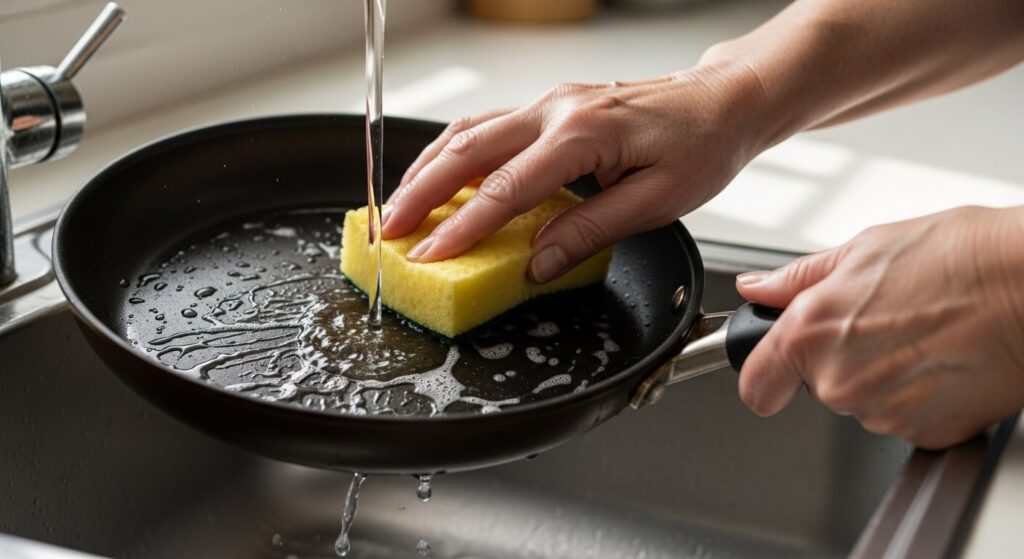
Cleaning Dual-Handle Pans with Limited Hand Function
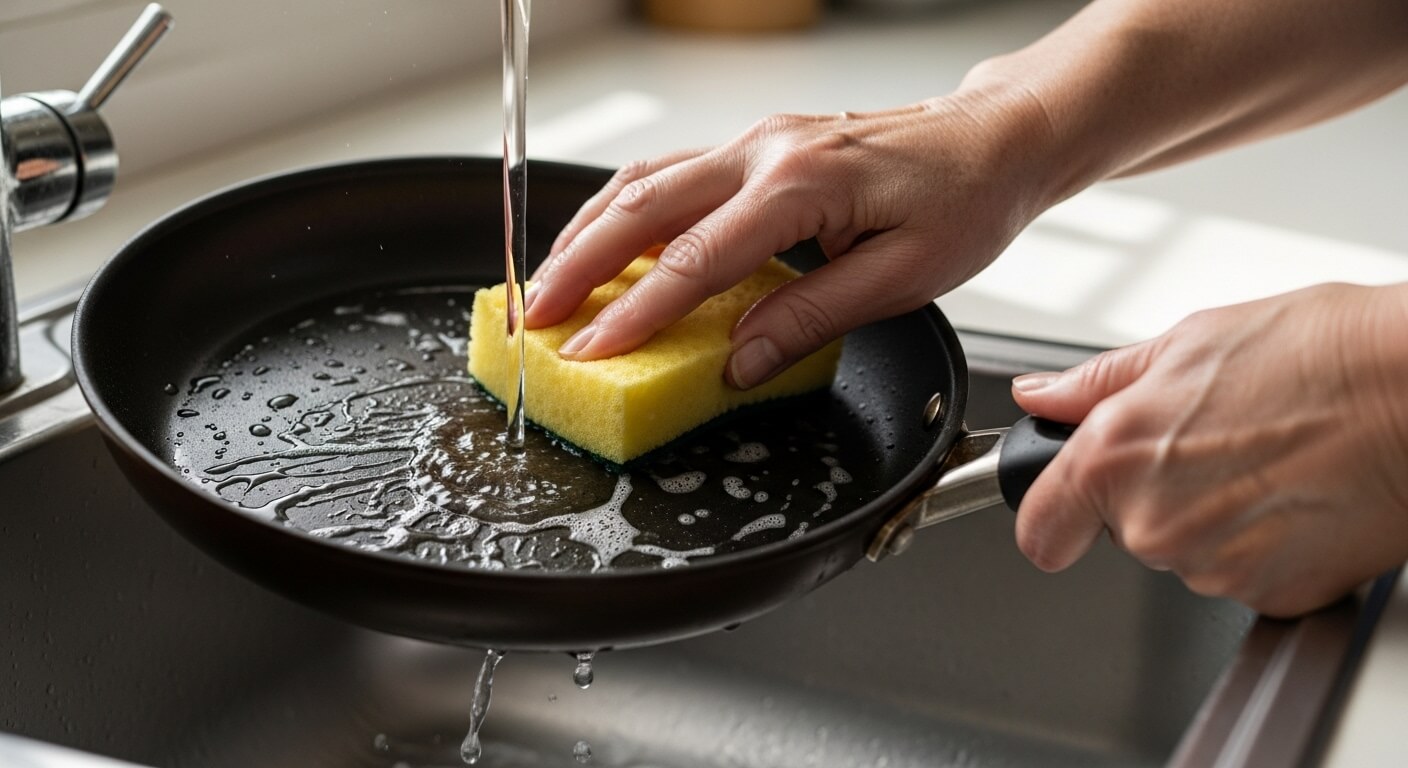
Non-stick is your friend here. Food slides off, minimal scrubbing required.
Cleaning strategy for arthritis:
- Soak if needed (let water do the work)
- Use long-handled sponge or brush (less gripping, better leverage)
- Wash in warm soapy water with gentle circular motions
- Rinse and air dry
Avoid:
- Aggressive scrubbing (hard on joints)
- Abrasive cleaners (damage non-stick)
- Steel wool (ruins surfaces)
Dishwasher Compatibility and Handle Durability
Many dual-handle pans are dishwasher-safe. Check before buying.
Dishwasher pros:
- Zero hand effort
- Thorough cleaning
- Sanitizing
Dishwasher cons:
- Can damage some non-stick coatings over time
- May loosen handle attachments with thermal cycling
- Takes up significant rack space
For severe arthritis, dishwasher-safe is almost mandatory. The ease is worth occasional handle tightening.
Preventing Handle Loosening Over Time
Riveted handles rarely loosen. Screwed-on handles sometimes do.
Maintenance:
- Check handle tightness monthly
- Tighten screws if you notice wobble
- Replace if screws strip (don’t use pans with loose handles)
Loose handles are dangerous. They shift unexpectedly during pouring, potentially causing spills or drops.
Storage Solutions for Dual-Handle Cookware
Dual handles make stacking tricky. They stick out, catch on things, take up space.
Storage options:
- Hang on wall hooks (if you can reach)
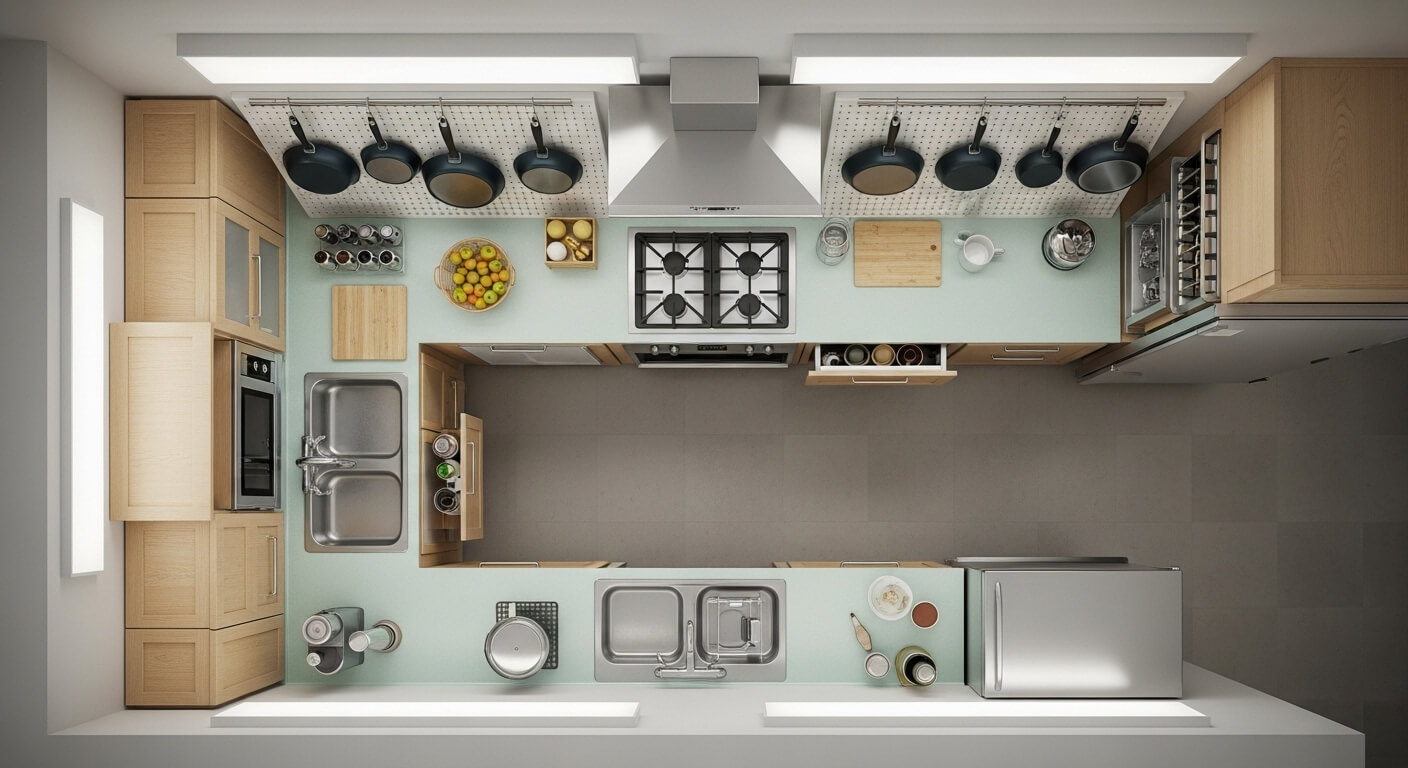
- Store on pull-out cabinet shelves (easy access, no lifting)
- Keep most-used pan on stovetop permanently
- Use a pot rack at accessible height
Avoid storing dual-handle pans in deep, low cabinets. Bending and reaching to get them out defeats the purpose.
Adapting Your Kitchen for Dual-Handle Pan Use
Kitchen setup modifications—choosing appropriate burners, establishing counter-level pouring stations, positioning the sink strategically, organizing storage for accessibility, and creating spill-safe zones—maximize the safety benefits of dual-handle pans.
Your kitchen setup enables or sabotages safe cooking.
Optimal Stovetop Burner Selection
Use front burners when possible. Less reaching, better visibility, easier access.
Front burner advantages:
- Don’t reach over other burners (safer)
- Better view of cooking progress
- Easier to access handles
- Shorter carry distance to counter/sink
Back burners are for when you’re simmering something long-term and don’t need frequent access.
Counter Height and Pouring Stations
Set up a dedicated “pouring zone” on your counter near the stove.
Elements:
- Heat-resistant trivet or mat
- Clear space for the pan to rest
- Target container (bowl, pitcher) positioned and ready
- Close to sink for draining tasks
Having everything in place means less movement with a heavy, hot pan.
Sink Positioning for Safe Draining
Ideally, your sink is immediately next to your stove. Most kitchens aren’t ideal.
If sink is far from stove:
- Set up a staging area (counter space) between them
- Rest the pan midway if needed
- Consider a smaller pan you can carry the full distance safely
Never rush the carry. Slow and stable beats fast and risky.
Storage Accessibility and Organization
Keep dual-handle pans where you can access them without bending or reaching overhead.
Best locations:
- Counter-level cabinet with pull-out shelf
- On the stovetop (if you use it daily)
- Low drawer (avoid if bending is painful)
- Wall hook at counter height
Test the storage spot. If getting the pan out is a struggle, you won’t use it.
Creating a Spill-Safe Zone
Accidents happen. Minimize damage by preparing for them.
Spill-safe setup:
- Rubber-backed rugs in cooking area (absorb spills, prevent slips)
- Keep mop/towels easily accessible
- Clear floor space (no cords, rugs that bunch, clutter to trip on)
- Good lighting (see spills immediately)
Being prepared reduces anxiety, which makes you calmer and less likely to spill in the first place.
Training and Building Confidence with New Cookware
Developing proficiency with dual-handle pans requires starting with cold water practice, gradually increasing fill levels, building strength through proper use, recognizing when to ask for help, and acknowledging daily limitations.
Don’t just buy the pan and wing it.
Starting with Cold Water Practice
Before cooking anything, practice with cold water.
Practice routine:
- Fill pan 1/4 full with cold water
- Lift using proper two-handed technique
- Carry to sink
- Practice pouring into sink
- Return to stove
- Repeat until comfortable
Cold water is safe. If you spill, no burns. If you drop it, no disaster.
Master the mechanics before adding heat and food.
Gradually Increasing Fill Levels
Once 1/4 full feels easy, try 1/2 full. Then 2/3 full.
Progression plan:
- Week 1: 1/4 full practice
- Week 2: 1/2 full practice
- Week 3: 2/3 full (this is your maximum for safety)
- Week 4: Real cooking at appropriate fill levels
Never fill more than 2/3 capacity. The top third is safety margin for sloshing.
Building Wrist Strength Through Proper Use
Using dual-handle pans correctly actually helps maintain wrist strength.
The bilateral, balanced lifting is therapeutic exercise—controlled resistance training for your wrists and forearms.
Keys to therapeutic benefit:
- Use proper technique (builds good patterns)
- Don’t overdo it (respect pain signals)
- Consistent use builds endurance
- Gradual progression prevents setbacks
This isn’t about “powering through” pain. It’s about functional strengthening through proper use.
When to Ask for Assistance
Sometimes you need help. That’s fine.
Ask for assistance when:
- The pan’s too full to safely handle
- You’re having a particularly bad arthritis day
- You’re feeling shaky or unstable
- The task requires moving the pan a long distance
- You’re nervous or uncertain
Independence doesn’t mean doing everything alone every single time. It means being able to do things yourself most of the time and knowing when to get help.
Recognizing Your Daily Limitations
Arthritis fluctuates. Good days and bad days.
On bad days:
- Use smaller pans
- Cook less
- Ladle instead of pouring
- Ask for help without guilt
On good days:
- Cook extra to freeze for bad days
- Tackle larger cooking projects
- Practice new techniques
Listen to your body. Pushing through severe pain causes setbacks.
Cost and Value Analysis of Dual-Handle Pans
Dual-handle pans range from $30-150 depending on material and quality, with mid-range options ($50-80) offering the best balance of affordability and features for most seniors with arthritis—the safety value far exceeds the monetary cost.
Let’s talk real numbers.
Price Ranges Across Different Materials
| Material | Price Range | Expected Lifespan |
|---|---|---|
| Basic aluminum non-stick | $25-45 | 2-4 years |
| Hard-anodized aluminum | $50-90 | 5-8 years |
| Stainless steel (quality) | $80-150+ | 10+ years (often lifetime) |
Best value for arthritis: Hard-anodized aluminum in the $60-80 range. Light enough to handle, durable enough to last, affordable enough to buy multiple sizes.
Longevity and Durability Considerations
Cheaper pans wear out faster. Non-stick coatings degrade. Handles loosen.
But here’s the thing—if a $35 pan lasts 3 years and makes cooking safe during those 3 years, it’s paid for itself many times over compared to medical bills from burns or the cost of pre-made meals because you couldn’t cook.
Calculate value based on:
- Cost per year of use
- Safety provided
- Independence maintained
- Quality of life improvement
Not just sticker price.
Insurance and Medical Equipment Coverage
Most insurance won’t cover dual-handle pans because they’re “standard cookware,” not “durable medical equipment.”
Possible exceptions:
- Prescription from doctor specifying “adaptive cookware for arthritis”
- FSA/HSA accounts (sometimes covers adaptive kitchen equipment)
- State programs for seniors
Worth asking, but plan to pay out-of-pocket.
Cost Per Use vs. Safety Value
If you cook 5 times a week, that’s 260 uses per year.
A $70 pan costs $0.27 per use in year one. $0.13 per use in year two. By year three, it’s basically free.
Compare that to:
- One ER visit for burns: $500-2000+
- Meal delivery services: $10-15 per meal
- Reduced nutrition leading to health issues: priceless (in the bad way)
The safety value alone justifies the cost.
Occupational Therapy Perspectives on Dual-Handle Cookware
Occupational therapists recommend dual-handle pans as standard adaptive equipment for arthritis patients because they align with joint protection principles, reduce injury risk, and enable continued cooking independence when single-handle cookware becomes unsafe.
This is clinical best practice, not just consumer advice.
How OTs Recommend Two-Handled Pans
OTs include cookware assessment in kitchen safety evaluations.
Evaluation process:
- Test grip strength and wrist range of motion
- Observe current cooking methods
- Identify high-risk activities (pouring, draining)
- Recommend specific adaptations
Dual-handle pans consistently appear in these recommendations because they address multiple risk factors simultaneously.
Joint Protection Principles Applied to Cooking
Joint protection is a core OT concept: use your joints in ways that minimize stress and prevent damage.
Principles dual-handle pans support:
- Use largest, strongest joints (shoulders/elbows instead of wrists)
- Distribute force across multiple joints (two wrists instead of one)
- Avoid positions of deformity (keep wrists straight)
- Use proper body mechanics (bilateral lifting)
- Respect pain (easier = less pain = sustainable)
Every principle points toward dual-handle design.
Ergonomic Assessments for Kitchen Tools
OTs analyze tools biomechanically. Forces, angles, grip requirements, weight distribution.
What they measure:
- Peak force required (how hard you must grip)
- Duration of force (how long you maintain grip)
- Wrist angle during use (neutral is best)
- Bilateral vs. unilateral loading
- Fatigue accumulation over typical use
Dual-handle pans score well on all metrics for arthritis.
Combining with Other Adaptive Equipment
Dual-handle pans work best as part of complete kitchen adaptation.
Complementary equipment:
- Silicone handle grips (covered earlier)
- Long-handled utensils
- Electric appliances (reduce stovetop cooking)
- Adaptive cutting boards
- Jar openers
Build a system, not just buy one pan.
Alternatives and Complementary Solutions
While dual-handle pans provide optimal pouring safety, alternatives like ladles, tilt-assist devices, spigot pans, electric kettles, and lighter serving methods each address specific aspects of the pouring challenge for different needs.
Dual handles aren’t the only solution.
Using Ladles and Serving Spoons Instead
Eliminate pouring entirely. Scoop out what you need.
When ladling works better:
- Very large or heavy pans
- Thick foods (stews, chili)
- Serving individual portions
- When you’re having a bad day
Ladle selection for arthritis:
- Lightweight (nylon or silicone, not metal)
- Ergonomic handle with good grip
- Shallow bowl (less weight per scoop)
Tilt-Assist Pot Pourers and Gadgets
Devices that grip the pan and provide mechanical advantage for tilting.
They work. They’re clunky. They’re one more thing to store and fuss with.
Better than single-handle pans? Yes.
Better than dual-handle pans? Usually not.
But if you already have pans you love and don’t want to replace them, tilt-assist devices are an option.
Countertop Spigot Pans and Dispensers
Pans with a spigot/tap at the bottom. You open the valve, liquid flows out.
Zero lifting or tilting required.
Drawbacks:
- Expensive
- Limited to liquids (won’t work for pasta, etc.)
- Cleaning the spigot mechanism is tedious
- One more failure point
Niche solution for people who make a lot of soup or broth.
Electric Kettles with Safe Pouring Features
For boiling water specifically, electric kettles beat stovetop pans.
Modern electric kettles have:
- Auto shut-off
- Cool-touch exteriors
- Ergonomic handles
- Controlled pour spouts
- Lightweight plastic construction
If you’re boiling water for tea, oatmeal, or instant foods, get an electric kettle and skip the stovetop entirely.
When to Use Lighter Weight Serving Methods
Sometimes the answer is: don’t move the hot food at all.
Alternative approaches:
- Serve directly from the cooking pan at the table
- Cook in individual portions (no transfer needed)
- Use serving spoons to transfer to plates (pan stays put)
- Cool food before transferring (no burn risk if you spill)
The best pouring technique is the one you don’t have to do.
Dual-Handle Pans for Different Arthritis Types
Different forms of arthritis benefit from dual-handle pans in specific ways—rheumatoid arthritis from symmetric bilateral loading, osteoarthritis from reduced mechanical wear, wrist arthritis from neutral positioning, and thumb arthritis from reduced pinch-grip requirements.
Customize based on your specific condition.
Rheumatoid Arthritis and Symmetric Handling
RA is often symmetric—affects both sides equally.
Dual handles work perfectly for this because you’re using both hands equally. Neither side is overloaded, neither side compensates for the other.
RA-specific benefits:
- Prevents overuse of one “good” side
- Distributes inflammation triggers across both wrists
- Allows continued cooking even during mild flares
- Reduces systemic fatigue from cooking tasks
Osteoarthritis and Mechanical Stress Reduction
OA is mechanical wear and tear. Repetitive stress accelerates cartilage breakdown.
Single-handle pouring creates massive repetitive stress—same motion, same joints, same problematic forces.
Dual-handle pouring uses larger joints (elbows, shoulders) that can better tolerate the load.
OA benefits:
- Less cumulative damage to wrist cartilage
- Distributed loading slows progression
- Reduced bone-on-bone grinding during lifting
- Better long-term joint preservation
Wrist and Hand Arthritis Specific Benefits
When arthritis hits wrists specifically, every degree of wrist extension hurts.
Dual handles let you pour while keeping wrists neutral (straight). The pan tilts, your wrists don’t have to.
Wrist arthritis advantages:
- Minimal wrist deviation required
- Force distributed across forearm muscles, not just wrist joints
- Option to use larger-joint movement patterns
- Reduced tendon irritation
Thumb Arthritis Considerations
Thumb base arthritis (CMC joint) makes pinch-gripping excruciating.
Dual handles typically use power grip (whole hand), not pinch grip (thumb-to-fingers).
How this helps thumb arthritis:
- Eliminates heavy pinch requirements
- Allows you to grip without involving thumb if needed
- Reduces pressure on CMC joint
- Power grip uses thumb in supported position
Common Mistakes When Using Dual-Handle Pans
Typical errors with dual-handle pans include overfilling beyond safe capacity, defaulting to single-hand use out of habit, poor body mechanics during pouring, failing to secure lids properly, and attempting to pour while pans are dangerously hot.
Even good equipment fails when used wrong.
Overfilling Beyond Safe Capacity
Just because a pan holds 4 quarts doesn’t mean you should fill it to 4 quarts.
Maximum safe fill: 2/3 capacity. This gives you:
- Margin for sloshing
- Reduced weight
- Space for steam expansion
- Safety buffer if you misjudge
Overfilling turns a manageable 8-lb pour into a dangerous 12-lb wrestling match.
Using Only One Handle
Habit is powerful. You’ve used single-handle pans for decades. You automatically grab one handle.
Stop. Consciously remind yourself: two hands, both handles, every time.
Using only one handle defeats the entire purpose and puts all the stress back on one wrist.
Poor Body Mechanics During Pouring
Standing twisted at the waist. Reaching across your body. Holding the pan away from your center.
All of these multiply the effective weight and stress awkward angles.
Correct mechanics:
- Face the target squarely
- Pan centered in front of you
- Elbows close to body
- No twisting
Neglecting to Secure Lids
Loose lid + tilting pan = scalding liquid in your face.
Always ensure the lid is fully seated before lifting or tilting. Better yet, remove the lid completely before pouring if you don’t need it.
Attempting to Pour While Pan Is Too Hot
Just-off-the-burner pan = dangerous steam, boiling contents, maximum spill damage if something goes wrong.
Wait 2-3 minutes after removing from heat before pouring when possible. Contents settle, steam reduces, you have better visibility and control.
Exception: dishes that must be served immediately hot. Then extra caution and slow pouring.
Transitioning from Single to Dual-Handle Cookware
Successfully switching from single-handle to dual-handle pans requires identifying priority replacements, adjusting familiar cooking techniques, overcoming psychological resistance to change, and implementing gradual integration strategies.
Change is hard. Even good change.
Identifying Which Pans to Replace First
Don’t replace everything at once.
Priority replacement order:
- Large saucepan (3-4 qt) for soups and pasta—highest risk
- Medium saucepan (2-3 qt) for daily cooking
- Small saucepan (1-2 qt) for oatmeal, hot cereal, small portions
- Specialty pans if needed
Start with what you use most often for pouring-intensive tasks.
Adjusting Cooking Habits and Techniques
Dual handles change how you interact with the pan.
Adjustments needed:
- Burner positioning (might need to rearrange which burners you use)
- Storage solutions (they don’t stack like single-handle pans)
- Serving methods (might serve directly from pan more often)
- Cleaning approach (two handles = slightly different washing process)
Give yourself 2-3 weeks to adjust. New habits take time.
Overcoming Resistance to Change
“I’ve cooked with single-handle pans for 50 years just fine.”
Until you can’t. And by then, you might have hurt yourself.
Mindset shift: This isn’t admitting defeat. It’s smart adaptation. Athletes adjust their technique when their bodies change. You’re doing the same thing.
Gradual Integration Strategies
Week 1-2: Buy one dual-handle pan. Use it alongside your existing pans.
Week 3-4: Make the dual-handle pan your default for soups and pasta.
Month 2: Add a second dual-handle pan in a different size.
Month 3+: Continue building collection as budget allows and needs dictate.
Gradual beats drastic. Let yourself adjust.
Real-World Success Stories and User Experiences
Seniors using dual-handle pans consistently report renewed cooking confidence, significantly fewer spills and burns, maintained nutritional independence, and improved quality of life—with OTs and family caregivers confirming these benefits.
This stuff works. Real people, real results.
Seniors Who Regained Cooking Confidence
Common story: Someone with arthritis stops making soup because it’s too scary. Too heavy, too hot, too likely to spill.
They switch to dual-handle pans. Suddenly soup’s back on the menu.
The psychological impact is huge. Cooking competence is tied to identity and independence. Regaining that matters.
Reduced Injury Reports with Dual-Handle Use
OTs and caregivers report significant drops in kitchen burns and spills after dual-handle pan adoption.
Not zero—accidents still happen. But the frequency and severity decrease substantially.
Fewer ER visits. Less anxiety around cooking. Better outcomes.
Occupational Therapist Case Examples
OTs consistently cite dual-handle pans as one of their most successful recommendations for arthritis kitchen adaptation.
High adoption rate (people actually use them). Clear functional benefit. Affordable. Easy to source.
That combination makes them a go-to recommendation.
Family Caregiver Observations
Adult children worry about parents cooking alone.
Dual-handle pans reduce that worry. Not eliminate—there’s always some risk—but reduce significantly.
Caregivers report feeling more comfortable letting parents cook independently when proper adaptive equipment is in place.
Modifications and Customizations for Individual Needs
Dual-handle pans can be further customized with aftermarket grips, handle angle adjustments when possible, DIY support systems, and OT collaboration for truly personalized solutions when standard options don’t quite fit.
Off-the-shelf doesn’t work for everyone.
Adding Custom Grips to Existing Handles
Silicone sleeves, foam tubing, handlebar tape—all the grip enhancements we discussed for single handles work on dual handles too.
Benefits of adding grips:
- Increases handle diameter (easier for weak hands)
- Adds cushioning (reduces pressure points)
- Improves friction (better hold with less force)
- Customizes to your specific hand size
A $50 pan with $5 worth of grip enhancements might work better than a $100 “premium” pan with handles that don’t fit your hands.
Adjusting Handle Angles When Possible
Some dual-handle pans have adjustable or repositionable handles (rare, but they exist).
If handles aren’t quite at the right angle for your wrists, check if they can be adjusted. Sometimes it’s just loosening screws, repositioning, retightening.
Don’t force it. If handles aren’t designed to adjust, forcing them damages the pan.
Creating DIY Support Systems
Simple DIY adaptations:
- Attach cup hooks under cabinet for hanging dual-handle pans
- Build a pull-out shelf at the right height for storage
- Create a padded rest area on counter with rubber mat and towel
- Add LED puck lights above cooking area for better visibility
Work with what you’ve got. Small changes add up.
Working with OTs for Personalized Solutions
If standard dual-handle pans don’t quite work for your specific arthritis presentation, an OT can help.
They might:
- Recommend specific brands/models based on your hand measurements
- Create custom handle modifications
- Suggest technique adjustments for your limitations
- Combine dual-handle pans with other equipment for complete solution
Professional guidance is worth it when you’re stuck.
Shopping Guide: Where to Find Quality Dual-Handle Pans
Quality dual-handle pans are available through kitchen specialty stores, medical supply retailers, major online marketplaces, and sometimes direct from manufacturers—knowing what to look for in product descriptions and which questions to ask ensures you get pans that actually meet arthritis needs.
Where you shop matters less than knowing what to look for.
Kitchen Specialty Stores
Williams-Sonoma, Sur La Table, local kitchen shops.
Advantages:
- Can handle pans in person (test weight, grip)
- Knowledgeable staff (sometimes)
- Quality brands
- Decent return policies
Disadvantages:
- More expensive
- Limited selection of truly lightweight options
- Not always arthritis-aware in their recommendations
Medical Supply and Adaptive Equipment Retailers
Stores specializing in adaptive living equipment.
Advantages:
- Staff understand arthritis considerations
- Products vetted for accessibility
- Can often try before buying
Disadvantages:
- Limited selection
- Sometimes higher prices
- May not have latest cookware innovations
Online Sources and Reviews
Amazon, direct from manufacturers, specialty online retailers.
Advantages:
- Huge selection
- Customer reviews (look for arthritis mentions)
- Competitive pricing
- Easy comparison shopping
Disadvantages:
- Can’t test before buying
- Harder to judge actual weight and feel
- Quality varies widely
- Return shipping can be annoying
Pro tip: Read negative reviews first. They tell you what goes wrong.
What to Look for in Product Descriptions
Key specs to check:
- Weight (empty pan weight)
- Material (aluminum = lighter)
- Handle material (heat-resistant?)
- Dishwasher-safe or not
- Pour spout presence
Red flags:
- No weight specification
- “Durable heavy construction” (heavy = bad for arthritis)
- Tiny product photos that don’t show handles clearly
- No dimensions provided
Questions to Ask Before Purchasing
For in-store:
- Can I hold this when filled with water to test weight?
- Is this dishwasher-safe?
- What’s the return policy if it’s too heavy for me?
- Do you have this in a lighter material?
For online/phone:
- What’s the exact empty weight?
- Are handles riveted or screwed on?
- Does this have a pour spout?
- What’s the handle-to-handle measurement?
Don’t be shy about asking. Better to know before buying.
Testing and Evaluating Pans Before Committing
Whenever possible, testing dual-handle pans with water before actual cooking, understanding retailer return policies, assessing key usability factors during trials, and comparing multiple options ensures you select pans that genuinely work for your arthritis limitations.
Don’t just guess. Test.
In-Store Testing When Possible
If the store allows, fill the pan with water from a water fountain or ask staff.
What to test:
- Can you comfortably lift it with both handles?
- Do the handles fit your hands well?
- Can you tilt it in a controlled manner?
- Does it feel balanced or front/back heavy?
Two minutes of testing beats buyer’s remorse.
Understanding Return Policies
Know before you buy:
- How many days for returns?
- Original packaging required?
- Restocking fees?
- Who pays return shipping?
Best policies: 30+ days, no restocking fee, free return shipping. Then you can really test at home.
Key Factors to Assess During Trial
Home testing checklist:
- Fill 2/3 full with water
- Practice lifting and carrying
- Practice pouring into sink/bowl
- Check if handles stay cool during stovetop use
- Test cleaning process
- Assess storage logistics
If any step is problematic, the pan’s not right for you.
Comparing Multiple Options
Don’t just test one. Try 2-3 different models if possible.
Comparison factors:
- Weight difference (even 1 lb matters)
- Handle comfort
- Pour spout effectiveness
- Overall balance and control
Sometimes a $40 pan works better than a $90 pan for your specific hands and strength level.
Long-Term Planning: Building a Complete Cookware Set
Building an arthritis-friendly cookware collection requires identifying essential dual-handle pieces, balancing with appropriate single-handle items, accounting for storage space constraints, and using a phased purchasing approach to spread costs and ensure each piece truly fits your needs.
Think system, not just pans.
Essential Dual-Handle Pieces for Daily Cooking
Minimum functional set:
- 2-quart saucepan (daily soups, oatmeal, small meals)
- 3 or 4-quart saucepan (pasta, larger batches, main pan)
That’s it. Two pans cover 80% of your dual-handle needs.
Expanded set if budget allows:
- 1-quart small saucepan (single servings)
- Large (5-6 quart) stockpot (batch cooking, if you can handle it)
- Dual-handle sauté pan (versatility)
Supplementary Single-Handle Items
Don’t ditch all single-handle pans.
Keep single-handle for:
- Small (8-10 inch) skillet for eggs, small portions
- Large skillet for sautéing (need the maneuverability)
- Specialty pans (crepe pan, omelet pan, etc.)
Rule: Use single-handle for pans you never pour from. Use dual-handle for anything involving lifting hot liquids.
Balancing Function with Storage Space
Dual-handle pans take up more space. Those handles stick out.
Storage reality check:
- Measure your cabinet space
- Account for handle clearance
- Don’t buy more than you can store accessibly
- Consider dedicating one cabinet to dual-handle pans
Five pans you can access easily beat ten pans stacked in a corner you can’t reach.
Phased Purchasing Approach
Year 1: Buy your primary 3-quart dual-handle pan. Use it heavily. Learn what you like/don’t like.
Year 2: Add the 2-quart based on year 1 experience. Maybe refine brand/material choice.
Year 3: Fill gaps if needed. By now you know your preferences and actual usage patterns.
This spreads cost and prevents buying wrong things. Your arthritis may change over this time too—what you need evolves.
Integration with Comprehensive Kitchen Safety
Dual-handle pans work best within a complete arthritis-adapted kitchen that includes complementary adaptive tools, strategic organization, coordinated family support, and smart equipment choices that collectively maintain cooking independence safely.
One good pan doesn’t make a safe kitchen.
Combining Dual-Handle Pans with Other Adaptations
Complete adaptive cooking setup:
- Dual-handle pans for safe pouring
- Electric kettle for boiling water
- Lightweight utensils with ergonomic grips
- Adaptive cutting boards
- Jar openers and can openers
- Non-slip mats
- Good lighting
Each piece addresses different challenges. Together they enable comprehensive cooking ability.
Complete Arthritis-Friendly Kitchen Setup
Think beyond cookware.
Workspace adaptations:
- Counter height seating
- Organized storage (frequently used items in easy reach)
- Good task lighting
- Minimal clutter
- Heat-resistant work surfaces
Safety features:
- Grab bars near sink/stove if balance is an issue
- Non-slip flooring
- Fire extinguisher within reach
- First aid kit
Coordinating with Family and Caregivers
Family should understand your system.
What they need to know:
- Which pans are dual-handle and why
- Proper usage technique
- Where things are stored
- Your capacity limits (so they know when to help)
Don’t let them “help” by putting dual-handle pans back in unreachable spots or washing them incorrectly.
Maintaining Independence Through Smart Equipment Choices
The goal isn’t perfect independence. It’s sustainable independence.
Sustainable means:
- Cooking most of your own meals
- Doing so safely without injury
- Not exhausting yourself in the process
- Knowing when to accept help
Dual-handle pans are tools for sustainable independence, not symbols of stubborn self-reliance. Use them as part of a bigger strategy for aging well while continuing to do what you love—cooking.