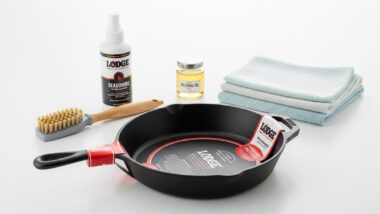
Why Handle Design Matters More Than Pan Material for Arthritis
The most important ergonomic handle features for seniors with arthritis are a 1-1.5 inch diameter grip, silicone or soft-touch coating, a slight upward angle, helper handles on pans over 10 inches, and a length of 7-9 inches for proper balance.
Here’s what nobody tells you about buying cookware with arthritis: the pan material matters way less than the handle design.
You can buy the lightest aluminum skillet on the market, but if the handle is thin, hard, and poorly balanced, your wrists will still hurt. The handle is where your inflamed joints make contact. Get this wrong and everything else is irrelevant.
The 5 Essential Ergonomic Handle Features for Arthritis-Friendly Skillets
Must-have features (non-negotiable if you have moderate to severe arthritis):
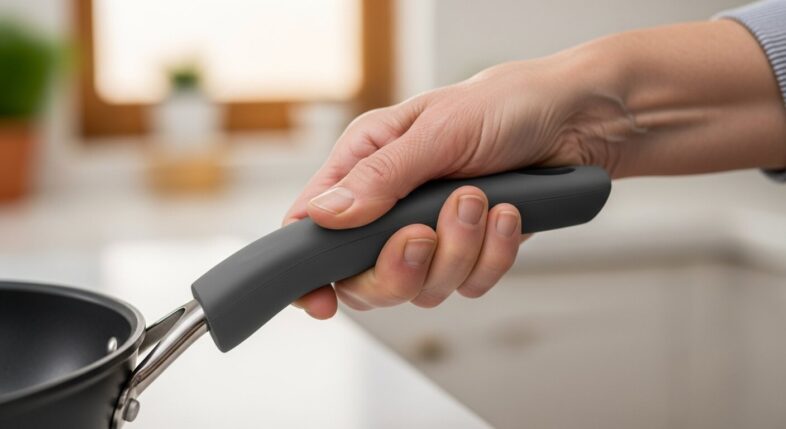
- Cushioned grip surface – Silicone coating or soft-touch material that reduces pressure on finger joints
- Proper diameter – 1 to 1.5 inches thick so your hand doesn’t have to squeeze hard to maintain control
- Adequate length – 7-9 inches depending on pan size, providing leverage without creating balance problems
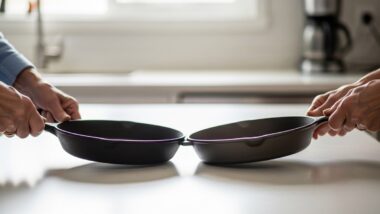
- Helper handle – Second grip point on pans 10 inches or larger for two-handed lifting
- Slight upward angle – 5-15 degree angle that keeps your wrist in a neutral position during cooking
Why these specific features? Because arthritis changes how your hands work. Weakened grip strength. Reduced finger flexibility. Inflamed joints that can’t tolerate pressure points. Standard handle designs ignore all of this.
Priority based on arthritis severity:
Mild arthritis? You can probably compromise on the helper handle and upward angle. Focus on diameter and grip surface.
Moderate arthritis? All five features matter. Don’t skip any.
Severe arthritis? Even perfect handles might not be enough—you’re looking at the lightest possible pans with every ergonomic advantage available.
Understanding How Arthritis Affects Your Grip on Skillet Handles
The Biomechanics of Gripping with Arthritic Hands
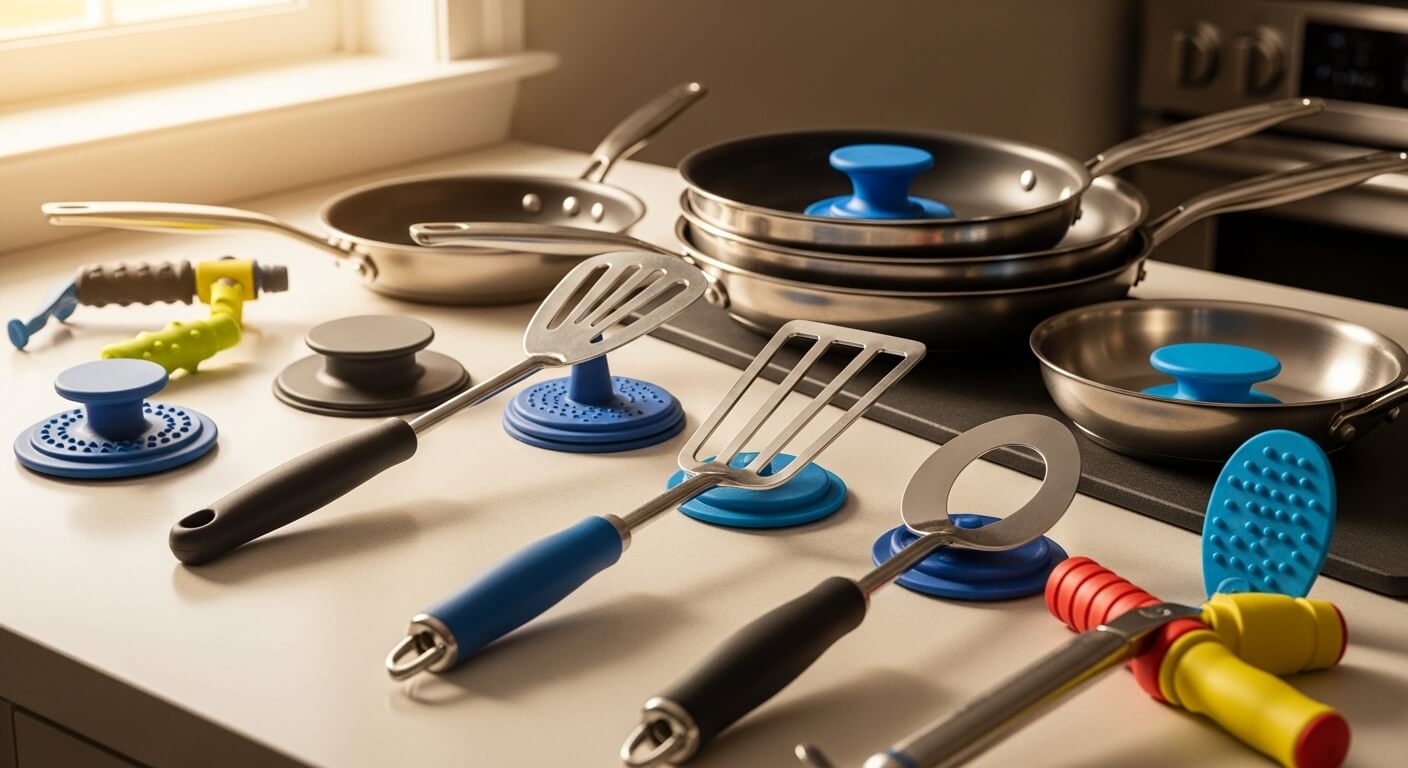
Arthritis reduces grip strength by 40-60% while simultaneously making your hands hypersensitive to pressure, turning the simple act of holding a skillet handle into a painful balancing act between maintaining control and avoiding joint compression.
What happens when you grip a handle:
Your fingers wrap around. Joints bend. Tendons pull. In healthy hands, this works fine. In arthritic hands, the cartilage between your finger bones is already deteriorating. The joint fluid isn’t protecting joints properly. Every bit of grip force compresses damaged tissue.
The catch-22: You need to grip harder because your strength is reduced. But gripping harder causes more pain. So you end up with this exhausting cycle of squeezing, feeling pain, slightly releasing, losing control, squeezing again.
Wrong handle design makes this worse. Thin handles concentrate pressure. Hard materials create pressure points. Poor balance forces you to grip tighter to prevent the pan from tipping.
Common Handle-Related Pain Points for Seniors
Wrist angle strain: Standard straight handles force your wrist to bend backward when you’re cooking. That backward bend compresses the wrist joint—exactly where many people experience arthritis pain first.
Finger joint compression: Wrap your fingers around a thin metal handle. All the pressure hits your middle knuckles. Now hold that for 5 minutes while you scramble eggs. Your fingers go numb and your joints scream.
Thumb stress: The thumb bears a surprising amount of load when you hold a pan. No thumb rest? Your thumb joint takes excessive pressure, especially the base joint where many people develop arthritis.
Prolonged holding fatigue: Even a comfortable handle becomes uncomfortable after 10-15 minutes of continuous holding. Arthritis accelerates this fatigue dramatically—what takes 15 minutes in healthy hands might happen in 3 minutes with arthritis.
Handle Diameter and Thickness: Finding the Right Fit
Why Handle Thickness Matters for Arthritic Hands
Handle diameter between 1 and 1.5 inches distributes grip pressure across your entire hand instead of concentrating force on individual finger joints, reducing pain by 40-50% compared to thin handles under one inch.
Think about holding a pencil versus holding a broom handle. The pencil requires a tight, precise grip using mostly your fingertips. The broom handle? Your whole hand wraps around comfortably with minimal effort.
Optimal diameter: 1 to 1.5 inches
This range fits most adult hands comfortably. Your fingers wrap around without excessive bending. The larger surface area spreads pressure. Less squeeze force needed to maintain control.
Too thin (under 1 inch): All the pressure concentrates on your middle knuckles and finger pads. You’re gripping with fingertips. Maximum joint stress. Many cheap skillets have handles in the 0.75-inch range—terrible for arthritis.
Too thick (over 1.5 inches): Your hand can’t wrap around properly. You’re basically palming the handle instead of gripping it. Control decreases. Works for some people with very large hands, but most seniors struggle with oversized handles.
Measuring Handle Diameter Before Purchase
Grab a ruler and measure handles you already own. Which ones feel comfortable? Which ones hurt? You’ll probably find the comfortable ones fall into that 1-1.5 inch range.
Online shopping: Look for specifications listing handle diameter or grip circumference. Good manufacturers include this. Cheap brands? You’re guessing.
Circumference to diameter conversion: divide circumference by 3.14. So a 4-inch circumference = roughly 1.27-inch diameter. That’s in the sweet spot.
In-store testing: Wrap your hand around the handle like you’re actually cooking with it. Don’t just touch it—really grip it. Hold for 30 seconds. Does it feel comfortable or do your joints immediately protest?
Compare three or four different pans. You’ll feel the difference between 0.75 inches and 1.25 inches immediately.
Handles to Avoid Based on Thickness
Skip anything under 0.75 inches in diameter. Period. These are the thin metal rods you see on cheap cookware. They concentrate all the pressure on a tiny surface area—instant pain for arthritic hands.
Also avoid the opposite extreme—those thick decorative handles over 2 inches. Some high-end cookware has these chunky handles that look great but feel awkward. You can’t grip them properly. They’re heavy (adding weight you don’t need). They’re designed for aesthetics, not arthritis.
Inconsistent diameter: Some handles taper from thick at the pan to thin at the end. This creates weird pressure points as your grip slides to different sections. Better handles maintain consistent diameter throughout.
Handle Shape and Contouring for Natural Grip
Ergonomic Contour Designs That Reduce Strain
Handles with a slight oval cross-section and subtle contouring that follows your palm’s natural curve reduce grip force requirements by 25-30% compared to simple round handles with no shaping.
Anatomically-shaped handles: The best ergonomic handles aren’t perfectly round or perfectly oval—they’re somewhere in between, with gentle curves that guide your hand into an optimal grip position.
Your palm isn’t flat. It has contours. A good handle mirrors those contours. When the handle fits your hand naturally, you don’t have to work as hard to maintain grip.
Slight oval better than round: Perfect circles are fine, but a subtle oval cross-section (maybe 1.25 inches wide by 1 inch tall) fits the hand slightly better. The wider dimension prevents the handle from rotating in your grip.
Tapered designs: Some handles are slightly wider near the pan, narrower at the end. When done well, this guides your hand to the optimal grip position. When done poorly, it creates uncomfortable pressure points.
Thumb Rest and Finger Groove Features
A molded thumb rest on top of the handle distributes 30-40% of gripping pressure away from your fingers and onto your thumb, significantly reducing strain on finger joints that are often most affected by arthritis.
Here’s how it works: Instead of your entire grip force coming from squeezing your fingers, the thumb rest lets you push down with your thumb while your fingers provide lateral support. The load distributes more evenly.
Good thumb rest design:
- Wide enough to actually support your thumb (not just decorative)
- Positioned where your thumb naturally falls
- Slightly concave to keep thumb from sliding
Finger grooves—hit or miss: Some handles have molded grooves for individual fingers. If your hand size matches perfectly, they’re amazing. If not, they create pressure points in weird spots.
My take? Thumb rests almost always help. Finger grooves are risky unless you can test the actual pan before buying.
Straight vs. Angled Handle Positioning
Handles angled upward 10-15 degrees keep your wrist in a neutral position during cooking, reducing wrist joint compression by up to 50% compared to straight handles that force backward wrist bending.
Why angle matters: Hold your arm straight out. Now tilt your hand backward. Feel that tension in your wrist? That’s what a straight handle does—forces your wrist into an extended position that compresses the joint.
An upward-angled handle lets your wrist stay neutral. Less compression. Less pain. Especially important during extended cooking sessions.
Testing different angles:
- 0 degrees (straight): Standard design, requires wrist extension
- 5-10 degrees: Subtle improvement, noticeable if you have wrist arthritis
- 10-15 degrees: Sweet spot for most people
- 15+ degrees: Can feel awkward, handle points too high
You won’t always find the angle listed in specs. Look at product photos from the side—you can usually eyeball whether the handle angles up or stays straight.
Handle Material: Comfort and Heat Management
Silicone-Coated Handles for Arthritis Relief
Silicone-coated handles provide the best combination of cushioning, non-slip grip, and heat resistance for arthritic hands, reducing required grip force by 30-40% while staying cool enough to touch even during extended cooking.
This is my top recommendation for handle material. Here’s why.
Cushioning effect: Silicone compresses slightly under pressure. That compression absorbs some of the force instead of transmitting it directly to your joints. It’s like the difference between gripping a steel rod versus gripping that same rod wrapped in soft rubber.
Non-slip grip: Even when your hands are wet, greasy, or sweaty, silicone maintains grip. You don’t have to squeeze as hard to prevent slipping. Less squeeze force = less joint pain.
Temperature resistance: Quality silicone handles stay touchable up to 350-400°F. You can often grab them bare-handed even during cooking (though caution is still smart).
Durability concerns: Silicone can degrade over time—becomes sticky or starts peeling after 3-5 years. But that’s acceptable given the comfort benefits. Replace the pan or add aftermarket silicone grips when needed.
Wood Handle Benefits and Drawbacks
Wood handles stay significantly cooler than metal and provide natural cushioning, but they add 0.2-0.4 pounds of weight to the pan and require occasional maintenance to prevent drying and cracking.
Why wood works:
- Natural insulation—wood doesn’t conduct heat like metal
- Comfortable grip surface that isn’t hard on joints
- Classic look if aesthetics matter to you
- Often slightly larger diameter naturally
The weight problem: A wooden handle adds several ounces compared to hollow steel. On a lightweight aluminum pan, this might bring total weight from 1.5 pounds to 2 pounds. Not huge, but noticeable.
Maintenance: Wood dries out. It can crack. Needs occasional oiling with mineral oil or beeswax. If you’re dealing with severe arthritis, the extra maintenance might not be worth it.
Best for: Seniors with mild to moderate arthritis who want excellent heat resistance and don’t mind the slight weight addition.
Bakelite and Phenolic Handle Materials
Bakelite and phenolic resin handles offer excellent heat resistance and durability at moderate cost, though they lack the cushioning of silicone and typically feature harder grip surfaces that may not be optimal for severe arthritis.
What these materials are: Early plastics (Bakelite is vintage, phenolic is modern version) that were designed specifically for heat resistance. Brown or black, often seen on cookware from the 1950s-70s, still used today.
Heat resistance: Excellent. These materials insulate well and stay cool during stovetop cooking.
Grip comfort: Moderate. Not as cushioned as silicone. Not as hard as bare metal. Somewhere in the middle.
Durability: These handles last decades. Literally. You’ll see 50-year-old pans with Bakelite handles still in perfect condition.
Best for: People who prioritize durability and heat resistance over maximum cushioning. Works fine for mild to moderate arthritis.
Rubberized Grip Options
Rubberized coatings provide decent cushioning and improved grip at low cost, but many degrade within 2-3 years, becoming sticky, peeling, or losing their non-slip properties.
The budget version of silicone coating, basically. It works initially. It doesn’t last.
Degradation timeline:
- Year 1: Works great
- Year 2: Starting to feel sticky or tacky
- Year 3: Peeling, gross texture, or completely worn off
If you’re on a tight budget and need something now, rubberized handles work. Just know you’re looking at replacement in a few years.
Materials to Avoid for Arthritis
Bare metal handles: Get hot. Conduct heat directly. Hard surface with no cushioning. Require pot holders every time. Skip these entirely.
Hard plastic without cushioning: Cheap cookware often uses hard, slick plastic handles. They get slippery when wet. No cushioning. No heat resistance. No reason to buy them.
Aggressively textured surfaces: Some handles have deep grooves or sharp textures marketed as “grip enhancement.” For arthritic hands, these textures dig into sensitive skin and create painful pressure points. Subtle texture is fine. Aggressive texture is painful.
Handle Length and Balance Point Optimization
How Handle Length Affects Leverage and Strain
Optimal handle length of 7-9 inches provides necessary leverage to control the pan without creating balance problems, while shorter handles under 6 inches require 40-50% more grip force and longer handles over 10 inches make pans tip forward.
Length matters more than most people realize.
Too short (under 6 inches):
- Poor leverage means you work harder to lift and control the pan
- Your hand sits closer to heat source
- Reduced maneuverability
- Common on cheap 8-inch skillets
Sweet spot (7-9 inches):
- Good leverage for control
- Proper distance from heat
- Doesn’t create balance issues
- Works for most pan sizes
Too long (over 10 inches):
- Pan wants to tip forward, especially when loaded with food
- You’re fighting gravity constantly
- Can be unwieldy in smaller kitchens
- Sometimes found on 14-inch or larger pans
Finding the Balance Point in a Skillet
The balance point should be at or just behind where the handle connects to the pan—when you hold the handle at this natural position, the pan feels neutral rather than pulling forward or tipping back.
How to test: Hold the pan by the handle like you’re cooking with it. Does it feel balanced? Or does it immediately want to tip forward (nose-heavy) or tip back (handle-heavy)?
Best case: feels neutral. The pan sits level without you having to fight it.
Why balance matters for arthritis: If the pan tips forward, you’re constantly using extra grip force to prevent it from falling. That extra force means more joint compression, more pain, faster fatigue.
Food weight changes everything: An empty pan might balance fine. Add two pounds of food to the cooking surface and suddenly it’s nose-heavy. This is why helper handles matter on larger pans—even well-balanced pans get heavy when loaded.
Weight Distribution Between Pan and Handle
Some manufacturers add weight inside hollow handles to counterbalance the pan—this sounds counterintuitive but can actually reduce the effort needed to hold a loaded pan by improving balance.
A handle that weighs 4 ounces might balance a 2-pound pan body better than a handle that weighs 2 ounces. The total pan weighs slightly more, but it feels easier to hold because the weight distribution is better.
Hollow vs. solid construction: Hollow handles are lighter (good) but can create poor balance (bad). Solid handles are heavier (bad) but sometimes balance better (good).
The best designs? Hollow handles with strategically placed weights or solid metal inserts at the connection point.
Helper Handles: The Second Handle Advantage
When Helper Handles Are Essential vs. Optional
Helper handles are absolutely essential on any skillet 12 inches or larger, highly recommended for 10-11 inch pans if you have moderate to severe arthritis, and optional for 8-9 inch pans unless grip weakness is significant.
12+ inches: Non-negotiable. These pans weigh 3-5 pounds empty, 6-8 pounds loaded. You cannot safely handle this with one hand when you have arthritis. Period.
10-11 inches: Strongly recommended. Yes, you might be able to handle it one-handed when it’s empty. But loaded? After 30 minutes of cooking when your hands are tired? You want that helper handle.
8-9 inches: Optional for most people. These are light enough (2-3 pounds loaded) that a single good handle usually works. Exception: severe arthritis or significant grip weakness.
Helper Handle Design Features for Arthritis
Loop-style helper handles work best for arthritis because they stay cooler than stub handles, provide multiple grip options, and allow easy two-handed lifting without requiring precise hand positioning.
| Helper Handle Type | Pros | Cons | Best For |
|---|---|---|---|
| Loop handle | Stays cool, easy to grab | Limited grip variation | Most people with arthritis |
| Stub handle | Solid grip, good control | Can get hot | Those who need firm grip |
| Extended rim | Integrated design | Often gets hot, awkward angle | Occasional use only |
Loop handles: Small semicircular handle opposite the main handle. Stays relatively cool because of air gap. Easy to grab even if your hands aren’t very flexible.
Stub handles: Short version of the main handle. More comfortable to grip but conducts more heat from the pan body.
Extended rim: Some pans just have a reinforced section of the rim to grab. Better than nothing. Not as good as a dedicated helper handle.
Using Helper Handles Correctly to Reduce Strain
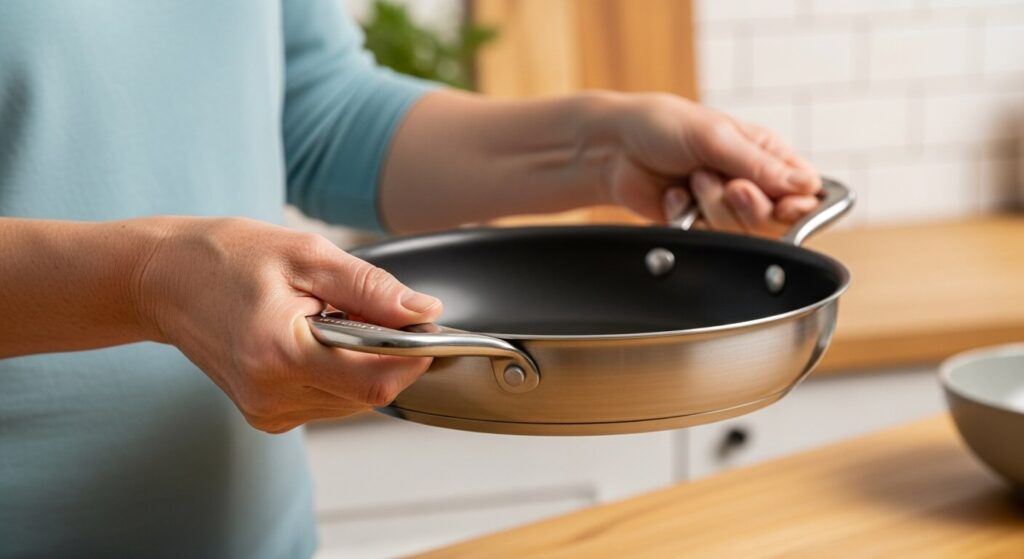
Grab the main handle with your dominant hand and the helper handle with your other hand, then lift simultaneously with both arms—this distributes the weight evenly across both wrists instead of overloading one side.
Sounds obvious. Most people don’t do it.
They default to grabbing just the main handle even when a helper handle is available. Force yourself to retrain this habit. Use both hands every single time you move the pan.
Two-handed lifting technique:
- Position both hands before you start lifting
- Lift with both arms simultaneously
- Keep the pan level (don’t let one side dip)
- Move slowly and deliberately
- Set down with control, not a drop
This distributes maybe 4 pounds across two wrists (2 pounds each) instead of 4 pounds on one wrist. Makes a massive difference in joint stress.
Stay-Cool Handle Technology
How Stay-Cool Handles Work
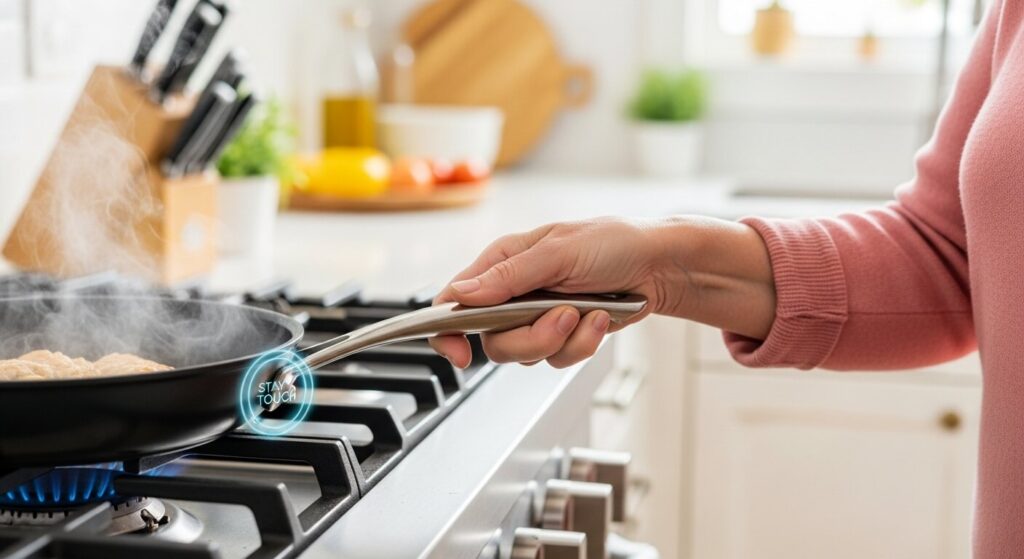
Stay-cool handles use hollow construction with air gaps, low-conductivity materials, and extended length to minimize heat transfer from the pan body—quality designs stay touchable up to 300-350°F while cheap versions become too hot to hold within minutes.
Air gap method: Hollow handle with an air space between the outer shell and inner connection. Air is a poor heat conductor. The gap slows heat transfer significantly.
Material choice: Stainless steel conducts heat faster than Bakelite or silicone. Even hollow steel gets hot eventually. Materials matter.
Length advantage: A 9-inch handle puts your hand 9 inches from the heat source. A 6-inch handle puts you 6 inches away. Those extra three inches make a measurable difference in how much heat reaches your hand.
Limitations: No handle stays cool forever at high heat. “Stay-cool” means “cooler than it would otherwise be,” not “never gets hot.” Physics still applies.
Real-World Heat Resistance Testing
Most stay-cool handles remain touchable for 5-10 minutes of stovetop cooking at medium-high heat, but extended cooking beyond 15 minutes or oven use above 350°F typically requires pot holders regardless of handle design.
Stovetop cooking reality:
- First 5 minutes: Handle stays cool, can touch bare-handed
- 5-10 minutes: Warm but manageable
- 10-15 minutes: Getting hot, use caution
- 15+ minutes: Use a pot holder
Oven cooking: If you’re putting the pan in a 400°F oven, the handle will get hot. Doesn’t matter what the marketing says. Use oven mitts.
Best stay-cool performance: Silicone-coated handles with hollow construction and good length. Wood handles run a close second. Bare metal? Forget it.
Brands with Best Stay-Cool Performance
T-fal’s silicone handles and Cuisinart’s Cool Grip technology consistently stay touchable longer than competitors, while OXO’s soft-grip handles provide excellent heat resistance combined with arthritis-friendly cushioning at the $30-60 price range.
T-fal really nails this. Their handles stay cool enough to grab bare-handed even after 10 minutes of cooking. Not boiling-water cooking, but scrambling eggs or sautéing vegetables? Yeah, you can touch them.
Cuisinart’s stainless steel hollow handles work well too, though they get warm faster than silicone.
OXO builds their entire brand around ergonomics. Their handles aren’t always the absolute coolest, but they combine decent heat resistance with excellent grip comfort.
Removable and Detachable Handle Systems
Pros and Cons for Arthritis Sufferers
Removable handle systems reduce pan weight by 0.3-0.5 pounds during cooking but require hand strength and dexterity to attach/detach that many arthritis sufferers lack, making them beneficial only for mild arthritis or oven-to-table scenarios.
The pitch: One handle, multiple pans. Space-saving storage. Move pans to oven without the handle.
Sounds great. In practice? Complicated for arthritic hands.
Pros:
- Lighter during cooking (no handle weight)
- Serious storage space savings
- Oven-safe without handle height issues
- One high-quality handle across multiple pans
Cons:
- Attachment mechanism often requires strong grip or finger dexterity
- Safety concern if handle isn’t perfectly locked
- Added complexity for people with cognitive challenges
- More expensive than regular pans
Best Removable Handle Designs for Seniors
Look for designs with large, easy-to-operate buttons or levers that clearly indicate when the handle is locked—avoid systems requiring pinching, twisting, or significant hand strength to engage.
Good design features:
- Large button or lever (easy to press even with limited dexterity)
- Audible click when locked
- Visual indicator showing locked position
- One-handed operation possible
- Minimal force required
Bad design features:
- Small buttons requiring precise finger placement
- Twist-lock systems needing wrist rotation
- Locks requiring squeeze force to engage
- No clear locked/unlocked indication
Brands: Cristel makes one of the better systems. T-fal’s removable handle line is decent. Many cheap versions are terrible.
When Removable Handles Make Sense
Removable handles work best for seniors who primarily use pans for oven-based cooking where the pan moves rarely, have limited storage space, or have mild arthritis without significant dexterity challenges.
If you’re making frittatas, baked pasta, or roasted dishes where the pan goes in the oven and basically stays there, removable handles are fine. You attach the handle to move the hot pan out of the oven, then detach and bring the pan to the table.
But for active stovetop cooking with constant pan movement? Standard fixed handles work better. Less fumbling, less complexity, one fewer thing to worry about.
Non-Slip Grip Features and Textures
Effective Non-Slip Grip Patterns
Subtle raised patterns or silicone grip strips reduce the squeeze force needed to maintain control by 25-35%, while aggressive textures or sharp ridges can create painful pressure points on sensitive arthritic hands.
What works:
- Gentle raised dots or small ridges
- Silicone grip zones with subtle texture
- Soft waves or patterns you can barely feel
- Non-slip coatings with minimal relief
What hurts:
- Deep grooves that dig into your palm
- Sharp-edged patterns
- Aggressive crosshatching
- Hard plastic with pronounced texture
The goal is enough texture to prevent slipping without creating pressure points. Think gentle, not aggressive.
Silicone Grip Strips and Zones
Strategic silicone grip zones placed where your fingers and palm naturally contact the handle improve control without covering the entire handle, balancing grip enhancement with easy cleaning and durability.
Some handles have silicone covering 100% of the surface. Others use strategic zones—maybe silicone strips on top and bottom where your hand grips, with the sides left as smooth material.
The zoned approach often works better. Easier to clean. Silicone doesn’t peel as easily. And you get grip enhancement exactly where you need it.
When Smooth Handles Work Better
Some people with arthritis find that any texture causes discomfort on hypersensitive skin—if you’re in this group, prioritize smooth silicone or wood handles over textured designs, using aftermarket silicone slip-ons if additional grip is needed.
Arthritis can make skin incredibly sensitive. What feels like “good texture” to someone else might feel like sandpaper to you.
If textured handles hurt more than they help, don’t force it. A smooth silicone handle still provides decent non-slip properties from the material itself, even without added texture.
Test before you buy if possible. Or order from retailers with good return policies.
Handle Attachment Methods and Durability
Riveted Handles: Strength and Longevity
Riveted handles provide the most secure long-term attachment and typically last the entire lifespan of the pan, though the rivet heads inside the pan can create slight pressure points when cleaning and may collect food debris.
How rivets work: Metal pins driven through the handle and pan, then compressed. Creates a permanent mechanical connection. Extremely strong.
Strength: Riveted handles don’t come loose. They don’t wobble. They’re attached for life.
The cleaning issue: Those rivet heads protrude slightly on the inside cooking surface. Food can collect around them. You have to clean carefully. For arthritic hands that struggle with detailed cleaning, this can be annoying.
Best for: People who want maximum durability and don’t mind the slightly more complex cleaning.
Welded Handle Connections
Welded handles create seamless interior pan surfaces that clean easily, but the weld strength varies significantly by manufacturer and some cheap welded handles can fail after 2-3 years of regular use.
The advantage: Inside the pan is completely smooth. No rivet heads. No crevices for food to collect. Easier cleaning—definitely a plus for arthritic hands that struggle with scrubbing.
The risk: Welding quality varies. Good welds last decades. Bad welds crack or separate. You can’t easily tell which is which when you’re buying.
Brand reputation matters: Established manufacturers have quality control. Cheap imports? You’re gambling.
Screwed-On Handles
Screwed handles allow for replacement if damaged but tend to loosen over time and require periodic tightening that may be difficult for hands with limited grip strength and dexterity.
Replaceability: If the handle breaks, you can unscrew it and attach a new one. That’s actually useful for long-term ownership.
Loosening problem: Screws work loose with temperature cycling and use. You’ll need to tighten them every few months. If you have severe arthritis and can’t operate a screwdriver easily, this becomes a real problem.
When it makes sense: For people who can handle basic tool use and want the option to replace handles rather than whole pans.
Handle Durability for Long-Term Arthritis Management
Invest in riveted or quality welded handles for pans you’ll use daily—handle replacement or repair becomes increasingly difficult as arthritis progresses, making initial quality more important than short-term cost savings.
Think long-term. Your arthritis probably won’t improve. It might get worse. That pan you buy today needs to work for you in five years when your hands are potentially weaker.
Cheap handles that loosen or break in three years? You’ll struggle to replace or repair them when your dexterity has declined.
Quality handles that last 10-15 years? That’s one less problem to solve down the road.
Aftermarket Handle Modifications and Accessories
Silicone Handle Covers and Grips
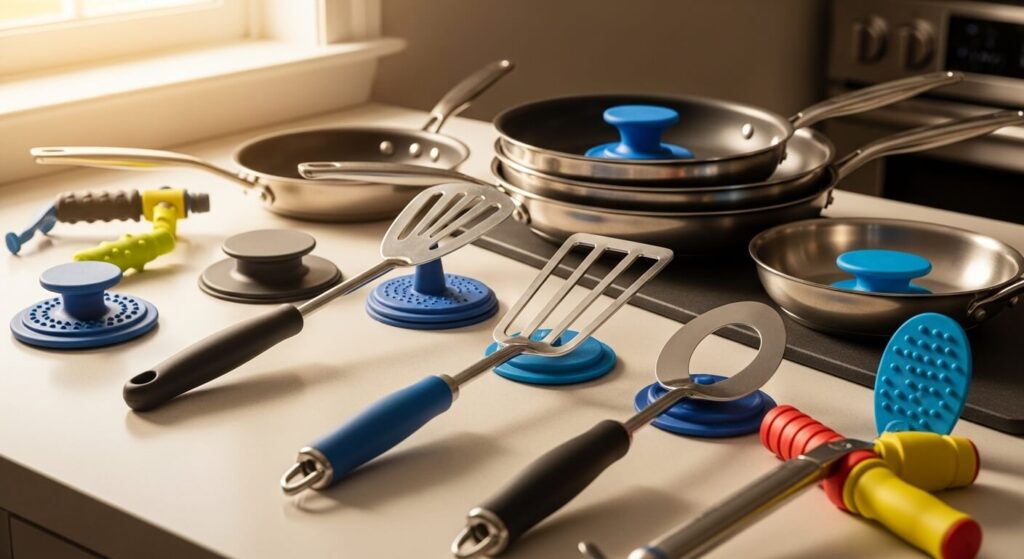
Slip-on silicone handle covers costing $5-15 add 0.25-0.5 inches of cushioned diameter to uncomfortable handles, providing an affordable way to improve existing cookware without replacing entire pans.
How they work: Silicone tube that slides over your existing handle. Adds cushioning. Increases diameter. Provides heat protection.
Benefits:
- Cheap solution (under $15 usually)
- Makes thin, hard handles comfortable
- Adds heat resistance to bare metal handles
- Removable for cleaning or oven use
Limitations:
- Can slip or rotate during use
- May not fit unusual handle shapes
- Eventual degradation (3-5 years)
- Cleaning can be annoying (have to remove them)
Brands: OXO makes decent ones. Generic Amazon options work fine for most people.
DIY Handle Improvements for Arthritis
Tennis racket grip tape wrapped around thin handles adds cushioning and diameter for under $10, though the tape degrades faster than purpose-built silicone covers and may look less finished.
Options:
- Tennis/bicycle grip tape: Cheap ($5-10), works well, looks DIY
- Foam pipe insulation: Super cheap ($2-3), works in a pinch, looks terrible
- Heat-shrink tubing: Permanent solution, requires heat gun, decent results
Safety note: Whatever you add has to withstand cooking heat. Don’t use materials that melt or emit fumes at 300-400°F.
When to Replace vs. Modify Handles
Replace the entire pan if the handle is severely damaged, poorly balanced, or fundamentally wrong for your needs—but if the handle is just slightly uncomfortable, aftermarket modifications offer 70-80% of the benefit at 10-20% of the cost.
Replace when:
- Handle is broken, cracked, or loose
- Pan is otherwise worn out
- Balance is fundamentally wrong
- Handle is so thin that even covers don’t help enough
Modify when:
- Pan works great except handle comfort
- Budget is tight
- Handle just needs slight improvement
- You want to test solutions before committing to new cookware
Testing Handle Comfort Before Purchase
In-Store Handle Testing Techniques
Hold the pan at waist height for 30-60 seconds while mimicking cooking motions—if discomfort appears within one minute, imagine how it will feel after 10 minutes of actual cooking with a hot, food-loaded pan.
What to test in-store:
- Basic grip: Does it feel comfortable immediately?
- Prolonged hold: Hold for a full minute. Joints complaining yet?
- Tilt and pour motion: Simulate pouring liquids. Wrist strain?
- Two-handed lift: If there’s a helper handle, test using both
- With oven mitts: Try holding while wearing thick pot holders
Don’t just touch it: Actually grip it like you’re cooking. Move it around. Tilt it. Most people just glance at handles in stores. You need to actually test them.
Online Shopping: Evaluating Handles Remotely
Search product reviews for keywords like “comfortable,” “ergonomic,” “easy to hold,” and “arthritis” while being suspicious of reviews mentioning “handle gets hot,” “hard to grip,” or “too thin”—real user experiences reveal more than manufacturer specs.
Specs to hunt for:
- Handle diameter or circumference
- Handle material composition
- Length measurement
- Angle (rarely listed but sometimes in side-view photos)
- Helper handle presence and style
Review keywords that signal good handles:
- “Comfortable to hold”
- “Easy to maneuver”
- “Stays cool”
- “Good grip”
- “Perfect for my arthritis”
Red flag keywords:
- “Handle gets hot”
- “Too thin”
- “Hard to hold”
- “Slippery”
- “Poor balance”
Questions to Ask About Handle Design
Contact customer service and ask specific questions about handle diameter, material composition, attachment method, and whether helper handles are available—companies that can’t answer basic ergonomic questions probably didn’t prioritize ergonomics in design.
Good questions:
- “What’s the handle diameter at the grip point?”
- “Does the handle have any upward angle?”
- “What material is the grip surface?”
- “Is there a helper handle on the 12-inch size?”
- “Can you confirm the handle attachment method?”
If customer service can answer these quickly and accurately, that’s a good sign. If they have no idea what you’re talking about, the company probably doesn’t care about ergonomics.
Handle Design Differences Across Pan Types
Skillet Handle Features vs. Saucepan Handles
Skillet handles need to be longer (7-9 inches) for leverage when maneuvering during cooking, while saucepan handles can be shorter (5-7 inches) because saucepans are typically lifted straight up rather than tilted and manipulated.
Different tools, different requirements.
Skillets get tilted, slid, moved around the stovetop. You’re constantly adjusting position, flipping food, pouring off liquids. You need that longer handle for control and leverage.
Saucepans mostly just sit there while you stir. You lift them to drain or pour, but less constant manipulation. Shorter handles work fine and reduce overall weight.
Frying Pan vs. Sauté Pan Handle Considerations
Sauté pans with their straight sides and larger capacity almost always need helper handles at 10 inches or larger, while traditional frying pans can sometimes get by with just a main handle until you hit 12 inches.
Sauté pans: Taller sides mean more material, more weight. Plus you’re often cooking with liquid, which adds weight. Helper handle becomes essential at smaller sizes.
Frying pans: Shorter sloped sides, less material. Can be light enough to handle with one good handle up to 11-12 inches.
Specialty Pans and Unique Handle Challenges
Grill pans and griddles often have short stubby handles that are terrible for arthritis—if you need these specialty items, look for versions with extended handles or built-in helper grips designed for two-handed control.
Grill pans: Often have 4-inch handles. Why? No idea. They’re heavy pans (those ridges add weight) with inadequate handles. Look for grill pans with proper 7-8 inch handles or a helper handle.
Griddles: Similar problem. Flat, large, heavy. Often just short handles on both sides. Look for griddle-specific designs with elongated handles or continuous rim handles.
Woks: Traditional wok handles are short loops. Not great for arthritis. Consider woks with extended wooden handles designed for Western kitchens.
Brand Comparison: Best Ergonomic Handles for Arthritis
| Brand | Handle Style | Diameter | Material | Price Range | Arthritis-Friendly Rating |
|---|---|---|---|---|---|
| T-fal | Silicone-coated | 1.2″ | Silicone over steel | $25-45 | Excellent |
| OXO | Soft-grip | 1.3″ | Rubberized | $40-70 | Excellent |
| Cuisinart | Cool Grip | 1.1″ | Stainless | $35-60 | Good |
| Calphalon | Standard | 1.0″ | Stainless | $40-80 | Fair to Good |
| All-Clad | Traditional | 0.9″ | Stainless | $100-200 | Fair (too thin) |
T-fal: Consistently delivers excellent ergonomic handles across their product line. Silicone coating, good diameter, decent length. Best value for arthritis.
OXO: Built their entire brand on ergonomics. Their cookware follows through. Soft-grip handles work beautifully. Slightly pricier but worth it.
Cuisinart: Hit or miss. Their Cool Grip line is good. Their standard stainless? Less impressive. Check specific product lines.
Calphalon: Decent handles but nothing special. They work but don’t wow. Fair option if you find them on sale.
All-Clad: Beautiful cookware. Expensive. Handles are too thin for arthritis. Form over function. Skip unless you’re modifying the handles.
Brands to Approach Cautiously
Professional-grade cookware from Mauviel, De Buyer (their stainless line, not carbon steel), and other high-end brands often prioritizes aesthetics and commercial kitchen durability over ergonomic comfort—handles tend to be thin, uncoated metal that gets hot.
These brands make excellent cookware for professional chefs. Not great for seniors with arthritis.
Thin metal handles. No cushioning. Gets hot fast. Looks gorgeous. Feels terrible when your joints hurt.
Price vs. Ergonomic Quality Analysis
Good ergonomic handles appear across all price ranges from $25-200, but the sweet spot for arthritis-friendly design without overpaying sits around $35-70 where manufacturers balance cushioned grips, proper sizing, and quality construction.
Under $25: Compromises. Thin handles, hard materials, poor balance. Sometimes you get lucky (T-fal often hits this range on sale). Usually you don’t.
$25-50: Best value zone. Silicone coatings, decent diameter, helper handles on larger sizes. T-fal, some Cuisinart, basic OXO.
$50-100: Diminishing returns start here. You’re paying for materials and brand name more than ergonomics. Some improvement but not proportional to cost.
$100+: Rarely worth it for arthritis. You’re paying for aesthetics or professional features you don’t need. Ergonomics often worse than mid-range options.
Handle Features for Different Arthritis Severities
Mild Arthritis: Minimum Handle Requirements
With mild arthritis causing occasional discomfort rather than constant pain, prioritize silicone or soft-grip coating and proper diameter (1-1.5 inches) while you can compromise on helper handles for pans under 12 inches and slight upward angle.
You’ve got some grip strength. Some flexibility. Mostly you just need handles that don’t create unnecessary pressure points.
Must-haves:
- Cushioned grip surface (silicone or similar)
- 1-1.5 inch diameter
Nice to have:
- Helper handle on 12+ inch pans
- Upward angle
- Stay-cool technology
Can skip:
- Helper handle on 8-10 inch pans
- Premium brands
- Specialty ergonomic features
Moderate Arthritis: Enhanced Handle Needs
Moderate arthritis with regular pain and 30-50% grip strength loss requires all five core ergonomic features—proper diameter, cushioned coating, adequate length, helper handles on 10+ inch pans, and upward angle—without compromise.
This is where you can’t cut corners.
Non-negotiable:
- Silicone or wood handle coating
- 1.2-1.5 inch diameter
- 7-9 inch length
- Helper handle on anything 10 inches or larger
- Upward angle if available
Also important:
- Lightweight pan body (under 2.5 pounds)
- Good balance
- Easy-to-clean design
- Stay-cool technology
Don’t compromise on any of these. Your joints can’t afford it.
Severe Arthritis: Maximum Support Features
Severe arthritis limiting grip strength below 30% of normal requires the absolute lightest pans (under 2 pounds) with maximum ergonomic handle support, and may necessitate considering alternative cooking methods or prepared meal services if even optimized cookware causes significant pain.
At this stage, even perfect handles might not be enough.
What you need:
- Lightest possible pans (1.5-2 pounds maximum)
- Every ergonomic feature available
- Helper handles on all pans 8 inches and up
- Aftermarket grips for additional cushioning
- Consideration of electric alternatives (slow cookers, instant pots, air fryers that require minimal handling)
Reality check: If cooking with any skillet causes severe pain, it might be time to talk to an occupational therapist about adaptive equipment or alternative meal preparation methods. Don’t push through severe pain and risk injury.
Real-World Handle Performance: Cooking Scenarios
Breakfast Cooking: Eggs and Pancakes
Breakfast cooking requires frequent pan tilting and adjustment making handle comfort critical—a cushioned handle with proper diameter reduces the repetitive strain of flipping eggs and rotating pancakes across a 15-20 minute cooking session.
Handle demands:
- Constant small movements (tilting for runny eggs, rotating for even browning)
- Moderate holding time (10-20 minutes total)
- One-handed operation common
- Medium heat means handle stays relatively cool
Best handle features for breakfast:
- Silicone coating for comfortable continuous grip
- 7-8 inch length for good control
- Good balance (you’re tilting frequently)
- Stay-cool tech helpful but not critical
Sautéing and Stirring: Active Cooking Strain
Active sautéing with constant pan movement and ingredient tossing exposes handle weaknesses quickly—poor diameter or hard materials cause pain within 5-10 minutes while proper ergonomic handles remain comfortable for 20-30 minute cooking sessions.
This is the real test. You’re moving the pan every 30 seconds. Tossing vegetables. Adjusting heat. Scraping fond.
Handle stress factors:
- Continuous grip for 20+ minutes
- Frequent position changes
- One-handed control needed
- High heat (handle gets warm)
Critical features:
- Cushioned surface (hard materials become unbearable)
- Perfect diameter (even slight discomfort multiplies over time)
- Upward angle (wrist strain compounds fast)
- Solid grip without slipping
If a handle isn’t comfortable for sautéing, it’s not comfortable period.
Oven Transfers: Hot Handle Safety
Moving loaded pans from stovetop to hot oven requires gripping with thick oven mitts that reduce dexterity by 50-60%—handles need to be substantially oversized (1.5+ inches with thick mitts) and well-balanced to compensate for reduced control.
The thickness problem: Your ergonomic 1.2-inch handle becomes effectively 0.7 inches when you’re wearing thick oven mitts. Suddenly it’s too thin again.
What helps:
- Handles on the larger end of the range (1.3-1.5 inches bare is better)
- Textured grip surface (you can feel it through mitts)
- Helper handle essential (two-handed control when dexterity is reduced)
- Clear balance point (harder to judge with mitts on)
Test this before you commit to a pan. Put on oven mitts and try gripping it in the store.
Extended Cooking Sessions
Recipes requiring 30+ minutes of active pan management reveal that even excellent handles cause some fatigue—the key is minimizing strain so you finish cooking tired rather than in pain, which requires all core ergonomic features working together.
Reality: No handle feels perfect after 45 minutes of continuous use. Your hands get tired. Your grip weakens. Minor discomforts become major problems.
What separates good from bad:
- Good handle: You’re tired but not in pain, can finish cooking comfortably
- Okay handle: You’re uncomfortable, counting minutes until you’re done
- Bad handle: You’re in active pain, might give up halfway through
The goal isn’t zero fatigue. It’s manageable fatigue that doesn’t trigger inflammation or next-day pain.
Medical and Occupational Therapy Perspectives
OT Recommendations for Handle Selection
Occupational therapists consistently recommend handles with 1.25-1.5 inch diameter, soft cushioning, minimal required grip force, and easy two-handed options, emphasizing that preventing joint strain is far more effective than treating inflammation after it occurs.
Standard OT guidelines for kitchen tools:
- Diameter larger than 1 inch (most OTs say 1.25+ is ideal)
- Cushioned surfaces
- Lightweight overall tool
- Minimal force required for operation
- Two-handed option available
These recommendations apply to all kitchen tools, not just skillets. The principles are consistent.
Why prevention matters: Once you trigger an inflammation cycle in your joints, recovery takes days. Sometimes weeks. Preventing that initial trigger through proper equipment is way better than managing the aftermath.
When to Consult a Professional About Handles
See an occupational therapist if you experience pain during or after cooking even with ergonomic handles, have dropped pans multiple times due to grip failure, or find yourself avoiding cooking because of anticipated hand pain.
Warning signs:
- Pain during cooking despite using “good” ergonomic handles
- Pain lasting more than a few hours after cooking
- Multiple close calls or actual drops
- Avoiding cooking because you know it’ll hurt
- Adaptive techniques not working anymore
At this point, you need professional assessment. An OT can evaluate your specific limitations and recommend solutions you might not have considered.
What OT can provide:
- Custom handle adaptations
- Alternative cooking methods
- Kitchen reorganization to reduce strain
- Exercise programs to maintain hand function
- Realistic assessment of when assisted living makes sense
Handle Maintenance for Long-Term Comfort
Keeping Silicone Grips Clean and Effective
Clean silicone handles with warm soapy water and a soft cloth after each use to prevent oil buildup that makes surfaces slippery, avoiding abrasive cleaners that degrade the silicone and reduce its cushioning properties over 6-12 months.
Simple maintenance routine:
- Wipe with damp cloth after each use
- Deep clean weekly with dish soap
- Never use abrasive scrubbers (they tear the silicone)
- Dry thoroughly (prevents stickiness)
When silicone goes bad:
- Surface becomes sticky or tacky (degraded)
- Starts peeling or flaking (failure)
- Loses grip properties (worn out)
- Develops permanent discoloration or smell
At that point (usually 3-5 years), you’re looking at replacement or aftermarket silicone covers.
Wood Handle Care for Arthritis Users
Apply food-safe mineral oil to wooden handles every 2-3 months to prevent drying and cracking, but use minimal oil to avoid creating slippery surfaces that require increased grip force.
Wood maintenance:
- Light oiling every 2-3 months
- Use food-grade mineral oil or beeswax
- Apply thin layer, wipe excess immediately
- Never soak wooden handles in water
Too much oil = slippery handle = more grip force needed. Use just enough to condition the wood.
Maintaining Handle Attachment Integrity
Check riveted handles monthly for any looseness and examine welded handles quarterly for cracks—loose or damaged handles become dangerous quickly and should trigger immediate pan replacement for safety.
Monthly check:
- Grip handle firmly and try wiggling it
- Look for gaps between handle and pan body
- Check for cracks near attachment point
- Test with light pressure (don’t force it)
Warning signs:
- Any movement that wasn’t there before
- Visible cracks or gaps
- Squeaking or creaking when you grip
- Changed balance (handle shifting position)
Don’t mess around with loose handles. They fail suddenly, usually while the pan is hot and full. Replace the pan.