Hard-Anodized Aluminum The Lighter Skillet Seniors Need for Arthritis Relief

Hard-Anodized Aluminum: The Lighter Skillet Seniors Need for Arthritis Relief

Why Hard-Anodized Aluminum Solves the Arthritis Cookware Dilemma

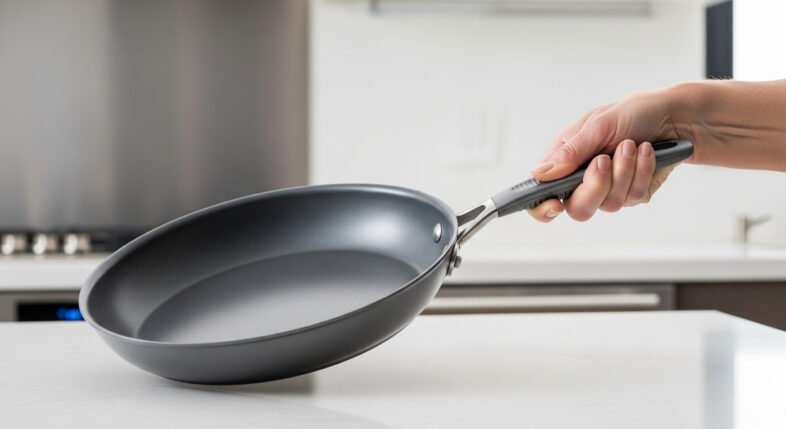
Hard-anodized aluminum skillets weigh 2-2.5 pounds for a 10-inch pan—50-60% lighter than cast iron—while offering scratch-resistant durability that lasts 3-5 years, making them the ideal middle ground between flimsy cheap non-stick and heavy traditional cookware for seniors with arthritis.

Here’s the problem with most arthritis cookware advice: it’s either “buy the lightest aluminum pan” or “invest in quality cast iron.”

Wrong on both counts.

Cheap aluminum non-stick pans weigh almost nothing (1.5 pounds). Great. But they fall apart in 12-18 months. You’re replacing them constantly. That’s exhausting when your hands barely work.

Cast iron lasts forever but weighs 5-6 pounds. Your wrists can’t handle that weight day after day, year after year, no matter how good the seasoning is.

Hard-anodized aluminum splits the difference perfectly. Light enough for arthritic hands. Durable enough to last years. Easy enough to clean that you’re not scrubbing until your joints scream.

Quick Answer: Hard-Anodized Aluminum Benefits for Arthritis

The elevator pitch for hard-anodized:

Feature Hard-Anodized Cast Iron Cheap Non-Stick Stainless Steel
Weight (10″) 2-2.5 lbs 5-6 lbs 1.5-2 lbs 3-4 lbs
Lifespan 3-5 years Decades 1-2 years Decades
Maintenance Easy Intensive Easy Difficult
Price $40-80 $20-60 $15-35 $50-150

Why choose hard-anodized for arthritis:

  • Weight sweet spot: Heavy enough to feel substantial, light enough to not destroy your wrists
  • Durability without maintenance: Lasts 3-5 years with zero special care (no seasoning, no aggressive scrubbing)
  • Scratch resistance: Twice as hard as stainless steel—use metal utensils without constantly worrying
  • Price justification: $40-80 for 3-5 years = $13-27 per year, comparable to replacing cheap pans multiple times
  • Easy cleaning: Non-stick coating (usually) plus hard surface that releases food well

Who should choose this: Seniors with mild to moderate arthritis. Can handle 2-2.5 pounds safely. Want something that lasts without intensive care. Cook 3-5+ times per week.

What Hard-Anodized Aluminum Actually Is

The Anodizing Process Explained

Hard-anodized aluminum is regular aluminum subjected to an electrochemical process that hardens the surface to be twice as hard as stainless steel, creating a durable, non-reactive oxide layer that’s permanently bonded to the base metal—not a coating that can peel off.

How it works (simplified):

Take aluminum. Submerge it in an acid bath. Run electrical current through it. The surface oxidizes and hardens. The result is a pan with an incredibly hard exterior layer that’s actually part of the metal itself.

Why this matters: You can’t scratch it off. It’s not like a non-stick coating that degrades. The hard surface is permanent—it’s the actual aluminum that’s been transformed.

The oxide layer: Creates a dark gray or charcoal appearance. Non-reactive with food. Won’t leach aluminum into your cooking (the common fear with regular aluminum pans).

Thickness: The anodized layer goes deep into the metal, not just surface-level. Makes the whole pan structure more robust without adding weight.

Hard-Anodized vs. Regular Aluminum

Hard-anodized aluminum is 30% harder than stainless steel while regular aluminum scratches easily with metal utensils, dents from drops, and can react with acidic foods—the anodizing process transforms soft aluminum into one of the most durable cookware surfaces available.

Surface hardness comparison:

Regular aluminum: Soft. Scratches if you look at it wrong. Dents easily. Utensils leave marks constantly.

Hard-anodized aluminum: Hard. Seriously hard. You can use metal spatulas. It resists scratching from normal use. Takes real abuse to damage it.

Lifespan difference:

  • Regular aluminum with non-stick: 12-24 months typical
  • Hard-anodized with non-stick: 36-60 months typical
  • That’s 2-3x longer for maybe $20-30 more upfront

Heat distribution: Both conduct heat well (aluminum is aluminum). The anodizing doesn’t significantly change thermal properties. Both heat evenly and quickly.

Weight: Hard-anodized is marginally heavier (maybe 0.2-0.4 lbs) due to the thicker construction and denser surface. Still way lighter than stainless or cast iron.

Hard-Anodized vs. Non-Stick Aluminum

Most hard-anodized pans include a non-stick coating for maximum ease of use, but the hard-anodized surface itself has natural stick-resistant properties that bare aluminum lacks—you can find both coated and uncoated versions depending on your cooking style and maintenance preferences.

Common configurations:

Hard-anodized + PTFE non-stick (most popular):

  • Hard durable base
  • Traditional non-stick coating on cooking surface
  • Best of both worlds for arthritis
  • Lasts longer than non-stick on regular aluminum

Hard-anodized + ceramic non-stick:

  • Same hard base
  • Ceramic coating instead of PTFE
  • For people avoiding traditional non-stick
  • Coating still degrades faster than the base

Bare hard-anodized (no additional coating):

  • Just the hard surface, no non-stick
  • Naturally more stick-resistant than bare aluminum
  • Requires more cooking fat and technique
  • Easier to clean than stainless, harder than non-stick

For arthritis: Go with the non-stick coating. The extra ease during cooking and cleanup outweighs any purist arguments about “natural” surfaces.

Weight Advantages for Seniors with Arthritis

Actual Weight Specifications by Pan Size

A 10-inch hard-anodized skillet weighs 1.8-2.5 pounds empty and 4-5.5 pounds loaded with food, sitting in the manageable range for moderate arthritis while providing substantially more durability than the 1.5-pound cheap aluminum pans that wear out yearly.

Real weights by size:

Pan Size Empty Weight With Single Portion With Large Portion
8-inch 1.3-1.8 lbs 2.5-3 lbs 3-3.5 lbs
10-inch 1.8-2.5 lbs 3.5-4.5 lbs 5-6 lbs
12-inch 2.5-3.5 lbs 5-6.5 lbs 7-9 lbs

Brand variations: Calphalon tends toward the lighter end (1.8-2.1 lbs for 10-inch). All-Clad hard-anodized runs heavier (2.3-2.5 lbs). Anolon sits in the middle.

Loaded weight reality: A 10-inch Calphalon at 2.1 lbs loaded with chicken breast, vegetables, and oil hits about 4 pounds. That’s manageable for most moderate arthritis. Heavy enough to feel stable, light enough to not destroy your wrists.

Comparison point: That same meal in a 10-inch cast iron skillet? 8-9 pounds total. More than double. Your joints feel that difference.

Weight Comparison Across All Cookware Materials

Hard-anodized aluminum weighs 50-60% less than cast iron, 30-40% less than stainless steel, and only 15-25% more than the cheapest non-stick aluminum—a weight increase that’s barely noticeable but delivers dramatically better durability.

The full spectrum (10-inch skillet):

From lightest to heaviest:

  1. Cheap non-stick aluminum: 1.5-2 lbs
  2. Quality non-stick aluminum (T-fal): 1.7-2 lbs
  3. Hard-anodized aluminum: 1.8-2.5 lbs
  4. Carbon steel: 2.5-3 lbs
  5. Stainless steel (tri-ply): 3-4 lbs
  6. Cast iron: 5-6 lbs
  7. Enameled cast iron: 5.5-6.5 lbs

The arthritis calculation: Going from cheap aluminum (1.7 lbs) to hard-anodized (2.1 lbs) adds 0.4 lbs. Barely noticeable. But the durability improvement is massive—2-3x longer lifespan.

Going from hard-anodized (2.1 lbs) to cast iron (5.5 lbs) adds 3.4 lbs. That’s the difference between cooking comfortably and being in pain.

How Weight Reduction Translates to Joint Protection

Reducing pan weight from 5.5 pounds (cast iron) to 2 pounds (hard-anodized) decreases wrist joint compression by approximately 60%, preventing the repetitive micro-trauma that accelerates cartilage breakdown and triggers inflammatory responses in arthritic joints.

What happens in your joints:

Every time you lift a pan, your wrist joint compresses. The cartilage (already damaged by arthritis) gets squeezed. Inflammatory markers increase. Pain follows within hours.

Lift a 5.5-pound pan three times a day for cooking and cleanup. That’s repeated compression. Your joints never fully recover. Inflammation becomes chronic.

With lighter pans: Less compression per lift. Joints get micro-breaks between cooking sessions. Inflammation stays lower. Pain reduces. Joint deterioration slows.

The compounding effect: Over weeks and months, consistently using lighter cookware measurably reduces arthritis progression. You’re protecting your joints every single time you cook.

Occupational therapy standard: Keep repeated lifting under 2-3 pounds for moderate arthritis. Hard-anodized at 2-2.5 pounds sits right at that threshold. Cast iron at 5.5 pounds blows past it dangerously.

Durability Benefits That Matter for Arthritis Management

Scratch Resistance and Metal Utensil Use

Hard-anodized aluminum’s surface hardness rating exceeds stainless steel, allowing safe use of metal spatulas and spoons without the constant worry required with standard non-stick—reducing cognitive load and physical strain from carefully selecting wooden or silicone utensils every time you cook.

The freedom factor:

With cheap non-stick, you’re constantly policing yourself. “Can I use this spoon? No, metal will scratch. Where’s the silicone one?”

When your brain is foggy from pain, these small decisions exhaust you.

With hard-anodized: Grab whatever utensil is handy. Metal spatula? Fine. The hard surface handles it. The non-stick coating might eventually show wear from metal utensils, but the base won’t get destroyed.

Reality check: Even though hard-anodized handles metal utensils better, silicone and wood still extend coating life. But the point is you’re not destroying the pan if you accidentally use metal or forget in a pain-fogged moment.

Scratch resistance testing: You can drag a metal fork across hard-anodized and it leaves minimal marking. Same action on regular non-stick aluminum? Deep gouges that ruin the surface.

Longevity Expectations and Replacement Frequency

Quality hard-anodized cookware lasts 3-5 years with daily use compared to 12-24 months for standard non-stick, reducing the burden of shopping for replacements, breaking in new pans, and managing cookware transitions as arthritis potentially worsens over time.

Lifespan breakdown:

Cheap non-stick aluminum:

  • Optimal performance: 6-12 months
  • Usable but declining: 12-24 months
  • Replacement needed: 18-24 months usually

Hard-anodized with non-stick:

  • Optimal performance: 18-30 months
  • Usable but declining: 30-48 months
  • Replacement needed: 36-60 months typically

Cost per year:

  • Cheap non-stick at $25 for 2 years = $12.50/year
  • Hard-anodized at $60 for 4 years = $15/year

Marginally more expensive annually. Massively less hassle replacing half as often.

Why this matters for arthritis: Your condition likely won’t improve. Planning shopping trips, researching pans, breaking in new cookware—all exhausting when you’re in pain. Longer-lasting pans mean fewer of these cycles.

Resistance to Warping and Damage

Hard-anodized construction resists warping from high heat better than thin aluminum and survives accidental drops without the catastrophic chipping that ruins enameled cookware—important safety features for seniors whose grip occasionally fails unexpectedly.

Warping resistance:

Cheap thin aluminum pans warp on high heat. The metal flexes. Bottom becomes uneven. Pan rocks on the burner. Annoying and potentially unsafe.

Hard-anodized uses thicker aluminum as the base, then the anodizing process adds structural rigidity. Result? Pans stay flat even with temperature fluctuations.

Drop testing (not official, just reality):

Drop cheap aluminum: Dents. Maybe becomes unusable if it lands wrong.

Drop hard-anodized: Might dent slightly. Usually survives just fine. Keep using it.

Drop enameled cast iron: Chips or cracks. Pan is ruined. $200 mistake.

For shaky hands: The forgiveness factor matters. Grip failure happens with arthritis. Hard-anodized survives accidents that would destroy more expensive cookware.

Easy Maintenance for Stiff, Painful Hands

Cleaning Advantages Over Other Materials

Hard-anodized pans with non-stick coating clean in 30-60 seconds with warm water and a soft sponge compared to 5-10 minutes of aggressive scrubbing required for stainless steel or cast iron, reducing post-cooking hand strain by 80-90%.

The cleanup comparison:

Stainless steel: Food sticks. You scrub with Bar Keeper’s Friend. Circular motions. Pressure. Your wrists are screaming. 5-10 minutes of effort.

Cast iron: Scrub with stiff brush (no soap for many people). Dry immediately. Oil coating. 5-7 minutes plus the maintenance anxiety.

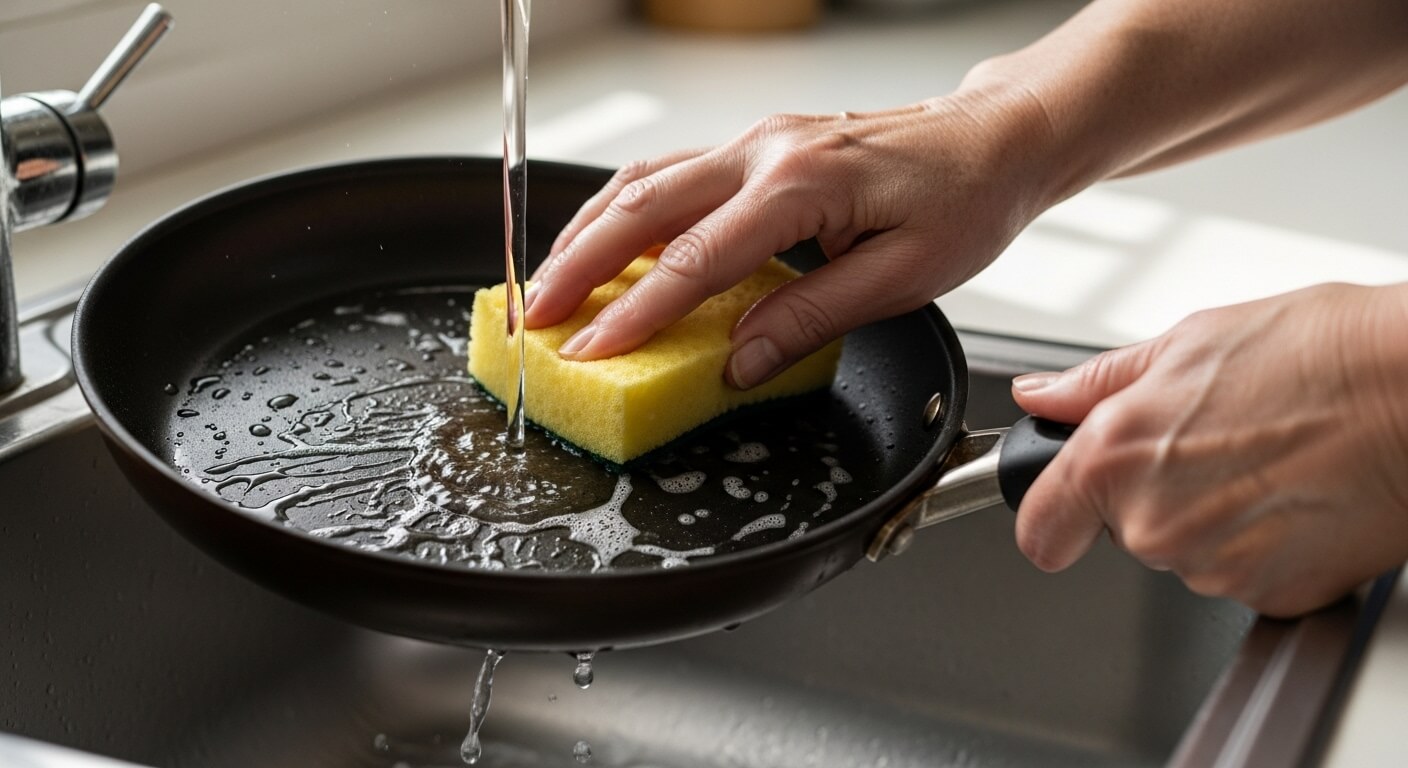
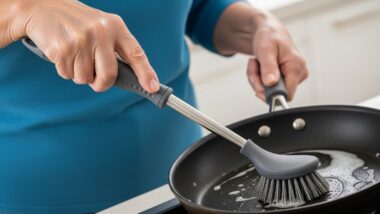
Hard-anodized with non-stick: Wipe with soft sponge under warm water. Maybe 30 seconds of actual effort. Done.

Hand activity reduction: Maybe 10-20 gentle wipes vs. 200+ aggressive scrubbing circles. The cumulative strain difference is massive.

For morning stiffness: When your hands barely work first thing in the morning, that 30-second cleanup vs. 10-minute scrubbing session is the difference between cooking breakfast and skipping it.

No Seasoning Required

Unlike cast iron which demands 5-10 minutes of post-cooking seasoning maintenance (scrubbing, drying, oiling, heating), hard-anodized aluminum requires only washing with soap and water—eliminating the hand-intensive care routine that makes traditional cookware increasingly difficult as arthritis progresses.

What you’re avoiding:

Cast iron ritual:

  1. Scrub (no soap typically, or minimal)
  2. Dry thoroughly and immediately
  3. Apply thin oil layer
  4. Wipe excess
  5. Optional: heat to polymerize

Total time: 7-10 minutes. Total wrist strain: significant.

Hard-anodized routine:

  1. Wash with soap and soft sponge
  2. Rinse
  3. Dry (or air dry)

Total time: 2-3 minutes. Total wrist strain: minimal.

No special protocols: Use soap. Don’t use soap. Doesn’t matter. The pan doesn’t care. No seasoning to preserve or rebuild. No anxiety about “doing it wrong.”

Dishwasher Compatibility Reality

Most hard-anodized cookware is technically dishwasher-safe but hand washing takes under 60 seconds and extends non-stick coating life by 50-100%, making hand washing the smarter choice for seniors who can manage it while dishwasher remains a viable option during arthritis flare-ups.

Manufacturer claims: “Dishwasher safe!”

Fine print: “But hand washing recommended for longest life.”

Reality: Dishwasher detergent is harsh. High heat is harsh. The non-stick coating degrades faster. Maybe 2-3 years instead of 4-5 years.

For arthritis: If hand washing truly hurts, use the dishwasher. A pan that lasts 2.5 years and doesn’t cause pain beats a pan that lasts 5 years but you can’t use.

But honestly? Hard-anodized with non-stick is so easy to hand wash (30-60 seconds) that most people can manage it even with moderate arthritis.

Compromise approach: Hand wash daily. Dishwasher during bad flare-ups or when you’re exhausted.

Heat Performance That Reduces Cooking Strain

Even Heat Distribution Benefits

Hard-anodized aluminum’s excellent thermal conductivity spreads heat uniformly across the cooking surface within 90-120 seconds, eliminating the hot spots common in cheap pans and reducing the need to constantly shift food positions—movements that strain arthritic wrists and fingers.

Why even heating matters for arthritis:

Hot spots mean burned food in one area, undercooked in another. So you’re constantly moving food around. Shifting. Stirring. Repositioning the pan on the burner.

All hand-intensive activities.

With even heating: Put food in pan. Leave it alone. It cooks uniformly. Less babysitting. Less hand movement. Less strain.

Compared to thin cheap aluminum: Those pans get scorching hot in the center, cooler at edges. You’re fighting the pan constantly.

Compared to cast iron: Cast iron has good heat distribution but takes 8-10 minutes to fully preheat. Hard-anodized is ready in 2 minutes and distributes heat almost as well.

Quick Heat Response for Better Control

Hard-anodized pans heat up in 90-120 seconds and cool down within 30-45 seconds when you reduce temperature, giving seniors with slower physical reactions better control over cooking compared to cast iron which retains heat stubbornly for minutes after adjustment.

Response time comparison:

Hard-anodized:

  • Heat-up: 90-120 seconds to cooking temp
  • Cool-down: 30-45 seconds for noticeable temp drop

Cast iron:

  • Heat-up: 8-12 minutes to full heat
  • Cool-down: 3-5 minutes for noticeable temp drop

Why this helps arthritis: Your reaction time is slower when you’re in pain or stiff. You notice burning food 5-10 seconds later than you used to.

With hard-anodized, you reduce heat and the pan responds quickly. Crisis averted.

With cast iron, you reduce heat and the pan keeps cooking at the same temp for 2-3 minutes. Your food burns while you watch helplessly.

Preventing rescue operations: Faster response means less burned food, less aggressive scraping during cooking, less hand strain from fixing problems.

Heat Retention vs. Responsiveness Trade-Off

Hard-anodized aluminum retains heat less than cast iron—often cited as a disadvantage but actually beneficial for arthritis sufferers who need precise temperature control and safer handling during cleanup rather than extreme heat retention for serving.

The trade-off nobody talks about:

Cast iron fans love heat retention. “Keeps food warm at the table!” “Sears meat perfectly!”

Sure. But for arthritis?

Heat retention problems:

  • Pan stays dangerously hot for 30+ minutes after cooking
  • Can’t clean it immediately (have to wait)
  • Risk of burns when grabbing what looks like a cool pan
  • Limited control during cooking (pan stays hot even when you reduce heat)

Lower retention benefits:

  • Pan cools faster (safe to handle sooner)
  • Better temperature control (responds to adjustments)
  • Can clean 10-15 minutes after cooking instead of waiting 45 minutes
  • Safer for forgetful moments common with pain-related brain fog

When retention matters: Searing thick steaks, serving dishes tableside. How often do you actually do that? For daily cooking—eggs, chicken, vegetables—quick response beats stubborn retention.

Non-Stick Coating Considerations

Hard-Anodized with PTFE Non-Stick

Most hard-anodized cookware includes PTFE (Teflon) non-stick coating that’s PFOA-free in modern pans, combining the hard-anodized durability with effortless food release that makes cooking and cleaning manageable for arthritic hands—this configuration offers the best overall value for seniors.

Why PTFE coating on hard-anodized works:

The hard base gives you scratch resistance and durability. The PTFE coating gives you non-stick convenience. Together, they last longer than either alone.

PTFE coating on regular aluminum: Wears out in 18-24 months. The soft aluminum base doesn’t support the coating well.

PTFE coating on hard-anodized: Lasts 36-60 months. The hard surface provides better support. Coating adheres stronger. Lasts longer.

PFOA-free confirmation: All PTFE coatings made after 2013 are PFOA-free. That’s the chemical people worried about. Modern non-stick is safe when used properly (under 500°F).

For arthritis: This combination (hard base + PTFE top) is ideal. Durable, easy to clean, lasts years, affordable.

Hard-Anodized with Ceramic Non-Stick

Ceramic-coated hard-anodized pans offer a PTFE-free alternative for seniors concerned about traditional non-stick, though the ceramic coating typically degrades faster (18-30 months) than PTFE while still providing the easy cleanup that arthritis demands.

The ceramic option:

Same hard-anodized base. Ceramic coating instead of PTFE. Free from PFAS, PFOA, and other chemicals people worry about.

Performance: Excellent when new. Food releases beautifully. Comparable to PTFE initially.

Degradation timeline:

  • Months 1-12: Perfect
  • Months 13-24: Starting to stick more
  • Months 25-36: Noticeably degraded
  • Beyond 36: Usually ready for replacement

Compared to PTFE: Ceramic lasts about half as long. But if chemical concerns matter to you, it’s a legitimate alternative.

Brands: GreenLife and GreenPan make hard-anodized options with ceramic. Cuisinart has some. Less common than PTFE versions.

Bare Hard-Anodized Without Non-Stick

Uncoated hard-anodized pans offer natural stick-resistance superior to stainless steel and easier cleaning than bare aluminum, but require more cooking fat and technique than non-stick versions—suitable for seniors with mild arthritis who enjoy cooking but problematic for those with significant hand limitations.

When you’d choose bare hard-anodized:

You’re comfortable with cooking technique. You don’t mind using more butter or oil. You want to avoid all non-stick coatings (PTFE and ceramic).

Performance:

  • Not non-stick, but also not aggressively sticky like stainless
  • Properly preheated with adequate fat, eggs release reasonably well
  • Easier to clean than stainless (food doesn’t bond as aggressively)

For arthritis: Honestly, skip it. The convenience of non-stick coating is too valuable when your hands hurt. Use the coated version.

Exception: Very mild arthritis and you genuinely prefer cooking without non-stick. Then bare hard-anodized is a decent option.

Handle Design in Hard-Anodized Cookware

Common Handle Configurations

Hard-anodized skillets typically feature riveted stainless steel handles that stay cooler than the pan body, with premium brands offering silicone-coated grips that provide superior comfort for arthritic hands compared to bare metal—handle design varies significantly by brand and price point.

Standard configurations:

Riveted stainless steel (most common):

  • Hollow construction for stay-cool properties
  • Bare metal surface
  • Durable but hard on hands
  • Found on Calphalon, All-Clad, most brands

Silicone-coated stainless:

  • Same internal structure
  • Soft silicone layer over handle
  • Much more comfortable for arthritis
  • Found on Anolon, some Circulon, premium lines

Phenolic/Bakelite:

  • Heat-resistant plastic material
  • Stays cool
  • Moderate comfort
  • Less common on hard-anodized

Helper handles: Many 10-inch and most 12-inch hard-anodized pans include a small helper handle opposite the main handle. Essential for two-handed lifting.

Evaluating Handle Ergonomics for Arthritis

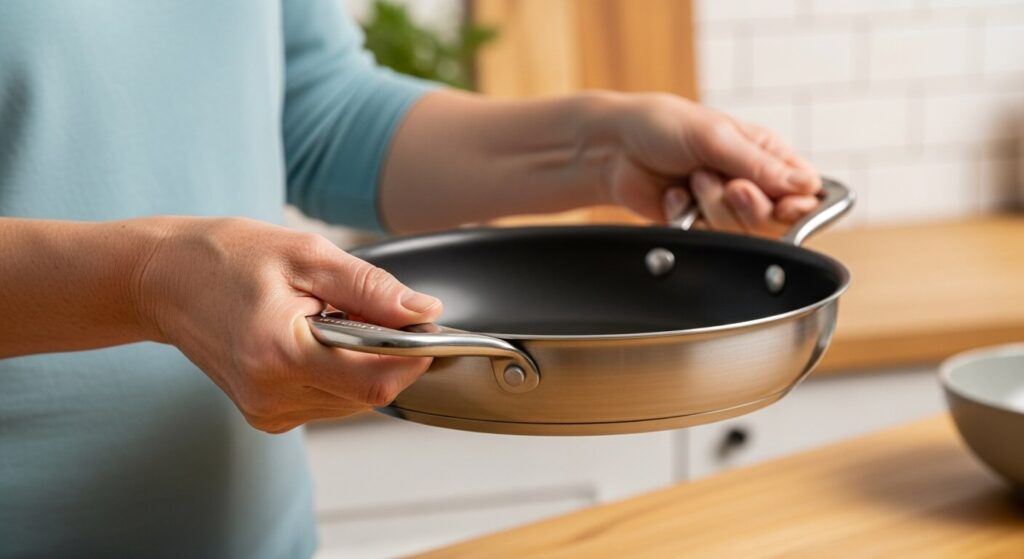
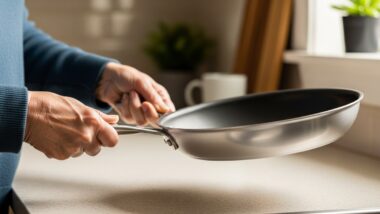
Look for hard-anodized skillets with handles at least 7 inches long, 1-1.5 inches in diameter, and featuring either silicone coating or contoured shaping that distributes pressure across your palm rather than concentrating it on finger joints.

The ergonomic checklist:

Length: 7-9 inches for 10-12 inch pans (provides leverage)
Diameter: 1-1.5 inches (thick enough to distribute pressure)
Coating: Silicone or soft material (reduces pressure points)
Contouring: Slight curves that follow hand shape
Balance: Pan doesn’t tip forward when loaded

Red flags:

  • Under 6 inches long (poor leverage)
  • Thin metal rod design (concentrates pressure)
  • Sharp edges or angles
  • Pan tilts forward significantly when you hold the handle

Testing before buying: If possible, hold the pan like you’re cooking. Does the handle feel comfortable or do you immediately notice pressure points?

Best Brands for Arthritis-Friendly Handles

Anolon Advanced hard-anodized features the best handles for arthritis with thick silicone coating and helper handles on all 10+ inch pans, while Calphalon Classic offers adequate bare stainless handles at lower prices and All-Clad HA1 provides premium construction with moderate handle comfort.

Brand-by-brand assessment:

Anolon Advanced:

  • Thick bronze-colored silicone coating
  • 1.3-1.4 inch diameter
  • Very comfortable for arthritis
  • Helper handles standard
  • Price: $50-80 for 10-inch

Calphalon Classic:

  • Bare stainless steel handles
  • Decent length and balance
  • Less comfortable than Anolon but functional
  • Helper handles on larger sizes
  • Price: $40-60 for 10-inch

All-Clad HA1:

  • Stainless steel with minimal coating
  • Good balance and length
  • Premium build quality
  • Helper handles included
  • Price: $100-130 for 10-inch

Circulon:

  • Rubberized grip (varies by line)
  • Unique raised circle design on cooking surface
  • Mixed reviews on handle comfort
  • Price: $40-70 for 10-inch

Top Hard-Anodized Skillet Recommendations for Arthritis

Best Overall: Calphalon Classic Hard-Anodized (10-inch)

The Calphalon Classic 10-inch hard-anodized skillet weighs 2.1 pounds, offers dual-layer non-stick coating, includes a stay-cool stainless handle with helper handle, and costs $40-60—delivering the best balance of weight, durability, performance, and value for seniors with moderate arthritis.

Specs:

  • Weight: 2.1 lbs (10-inch)
  • Handle: 8-inch stainless steel, stay-cool hollow design
  • Helper handle: Yes (small loop)
  • Non-stick: Dual-layer PTFE
  • Oven-safe: 450°F
  • Dishwasher-safe: Yes (but hand wash recommended)

Why it wins for arthritis:

Weight is perfect—2.1 lbs is manageable for moderate arthritis but substantial enough to feel solid and stable.

Dual-layer non-stick performs reliably for 3-4 years with proper care. Eggs slide out effortlessly. Cleanup takes 30-60 seconds.

Hard-anodized construction is durable. Handles metal utensils decently (though silicone is still better for coating longevity).

Downsides: Bare stainless handle isn’t as comfortable as silicone-coated. Gets warm after 15+ minutes of cooking (not hot, but warm).

Price justification: $45-55 typically. For 3-4 years of reliable use, that’s $11-18 per year. Excellent value.

Best for: Daily cooking, moderate arthritis, budget-conscious seniors who want quality without premium pricing.

Best Lightweight: Anolon Advanced Hard-Anodized (8-inch)

At just 1.6 pounds, the Anolon Advanced 8-inch skillet provides hard-anodized durability in an ultra-light package with silicone SureGrip handles that offer superior comfort for arthritic hands, priced at $35-50 for seniors prioritizing minimum weight without sacrificing quality.

Specs:

  • Weight: 1.6 lbs (8-inch)
  • Handle: 7.5-inch with thick bronze silicone coating
  • Non-stick: Double-layer PTFE
  • Oven-safe: 400°F
  • Bronze-colored interior

The ultra-light advantage:

1.6 lbs is incredibly light for hard-anodized. Most 8-inch hard-anodized pans hit 1.8-2 lbs. Anolon achieved lighter weight without compromising the hard-anodized benefits.

Silicone handle: Game-changer for arthritis. Thick, cushioned, stays cool. Your hand thanks you every time you pick it up.

8-inch size: Perfect for single-portion cooking. One egg. Small chicken breast. Limited vegetables. Ideal for seniors living alone.

Performance: Excellent non-stick. Even heating. Easy cleanup. The bronze interior hides staining well (purely cosmetic but some people care).

Downsides: 8-inch limits cooking capacity. Not ideal if you regularly cook for two or make larger portions.

Best for: Seniors with more severe arthritis who need minimum weight. Solo living. Breakfast and small meal focus.

Best Premium: All-Clad HA1 Hard-Anodized (10-inch)

The All-Clad HA1 10-inch skillet weighs 2.3 pounds and features three layers of PFOA-free non-stick coating that lasts 5-7 years, justifying its $100-130 price for seniors who cook daily and want maximum durability with managed weight.

Specs:

  • Weight: 2.3 lbs (10-inch)
  • Handle: Stainless steel, stay-cool design
  • Helper handle: Yes
  • Non-stick: Three-layer PTFE system
  • Oven-safe: 500°F
  • Dishwasher-safe: Yes
  • Lifetime warranty on construction

Premium features:

Three-layer non-stick: Most pans have one or two layers. All-Clad uses three. This dramatically extends coating life. Expect 5-7 years vs. 3-4 for standard dual-layer.

Hard-anodized construction: Top-tier quality. Perfectly even coating. No defects. Flawless performance.

Lifetime warranty: Construction defects covered forever. Non-stick isn’t covered (no one covers that), but the base pan is.

Downsides:

  • Weight at 2.3 lbs is manageable but heavier than cheaper options
  • Price is steep ($100-130)
  • Handle is bare stainless (no silicone coating)

Math: $115 for 6 years = $19/year. Calphalon at $50 for 3.5 years = $14/year. All-Clad costs more annually despite longer life.

When it’s worth it: You cook daily or near-daily. Arthritis is mild to moderate. Budget genuinely allows it without hardship. You value fewer replacements over time.

Best Budget: T-fal Hard-Anodized (10-inch)

T-fal’s hard-anodized line weighs 1.9 pounds for 10 inches and includes their signature Thermo-Spot heat indicator at $30-45, making it the most affordable entry into hard-anodized cookware for seniors testing whether the material works for their arthritis.

Specs:

  • Weight: 1.9 lbs (10-inch)
  • Handle: 7.5-inch stainless with slight rubber coating
  • Thermo-Spot: Red pattern shows when preheated
  • Non-stick: Standard PTFE
  • Oven-safe: 400°F

Budget advantages:

Price is unbeatable for hard-anodized. Most hard-anodized starts at $40-50. T-fal delivers it for $30-45.

Lighter weight (1.9 lbs) than premium options. Easier on moderate to severe arthritis.

Thermo-Spot takes the guesswork out of preheating. When the pattern turns solid red, add your food. Prevents sticking from too-cold pan or burning from too-hot pan.

Performance: Decent. Not amazing. The hard-anodized construction is thinner than Calphalon or All-Clad. Still way better than cheap aluminum.

Lifespan: Expect 2-3 years vs. 3-5 for premium hard-anodized. Acceptable trade-off for half the price.

Best for: Tight budgets under $40-50. Testing hard-anodized before committing to expensive options. Seniors unsure if they’ll use it long-term.

Best Set Value: Cuisinart Chef’s Classic Hard-Anodized

The Cuisinart Chef’s Classic 10-piece hard-anodized set provides multiple skillets plus pots and lids for $150-200, delivering hard-anodized benefits across your entire kitchen at $15-20 per piece compared to $40-80 for individual pans—worthwhile if you need to replace multiple items.

Set contents (typical 10-piece):

  • 8-inch skillet
  • 10-inch skillet
  • 1.5-quart saucepan with lid
  • 2.5-quart saucepan with lid
  • 3-quart sauté pan with lid
  • 6-quart stockpot with lid

Weight specs:

  • 8-inch skillet: 1.5 lbs
  • 10-inch skillet: 2 lbs
  • Pots range 2-3.5 lbs depending on size

The set economics:

Individual pricing: 10 pieces purchased separately = $400-600
Set pricing: $150-200
Savings: $200-400 (50-65% off)

When sets make sense:

  • You need multiple pieces (not just one skillet)
  • Budget allows $150-200 upfront
  • Storage space for 10 pieces exists
  • Preference for matching cookware

When to skip sets:

  • You only need 1-2 pieces
  • Limited cabinet/storage space
  • Prefer buying individually to spread cost over time
  • Already have pots, just need skillets

For arthritis: The lightweight construction across all pieces benefits your joints in every cooking task, not just skillet use.

Hard-Anodized vs. Other Arthritis-Friendly Materials

Comparison to Standard Non-Stick Aluminum

Hard-anodized weighs only 0.3-0.5 pounds more than standard non-stick aluminum for the same size pan but lasts 2-3x longer, making the minimal weight increase worthwhile for seniors who can handle an extra half-pound but want to avoid frequent pan replacement.

Side-by-side (10-inch pans):

Feature Hard-Anodized Standard Non-Stick
Weight 2-2.5 lbs 1.5-2 lbs
Lifespan 3-5 years 1-2 years
Price $40-80 $20-40
Scratch resistance Excellent Poor
Cleaning ease Easy Easy

The weight question: Is 0.5 lbs noticeable? Honestly, barely. If you can safely handle 2 lbs, you can handle 2.5 lbs.

The durability payoff: Replacing pans half as often saves shopping trips, research time, and the hassle of breaking in new cookware as your arthritis potentially worsens.

Who should choose standard non-stick: Severe arthritis where even 2 lbs is too much. Extreme budget constraints. Don’t mind replacing pans every 18 months.

Who should choose hard-anodized: Moderate arthritis that can handle the slight weight increase. Want fewer replacements. Cook frequently enough to justify better quality.

Comparison to Stainless Steel

Hard-anodized aluminum weighs 30-40% less than tri-ply stainless steel (2.2 lbs vs. 3.5 lbs for 10-inch), requires dramatically less scrubbing during cleanup, and costs less—making it superior for arthritis despite stainless steel’s reputation as professional-quality cookware.

Why stainless steel is terrible for arthritis:

Weight: 3-4 lbs empty, 6-8 lbs loaded. That’s cast iron territory.

Sticking: Food bonds aggressively to stainless. Requires perfect technique (preheat, fat, patience) or you’re scrubbing for 10 minutes.

Cleaning: Even with good technique, stainless needs Bar Keeper’s Friend and serious elbow grease for stuck-on food and discoloration.

Hard-anodized advantages:

  • 1.5 lbs lighter (massive difference for wrists)
  • Non-stick coating prevents stuck food
  • 30-second cleanup vs. 10-minute scrubbing
  • $40-60 vs. $80-150 typically

When stainless wins: Never, for arthritis. Maybe for professional chefs who need specific properties. Not for painful hands.

Comparison to Cast Iron and Enameled Cast Iron

Hard-anodized aluminum weighs 3-4 pounds less than cast iron (2.2 lbs vs. 5.5-6 lbs for 10-inch), requires zero seasoning maintenance, and cools quickly enough to clean within 15-20 minutes versus 45+ minutes for cast iron—eliminating the weight burden and maintenance routine that make traditional cookware impossible for many arthritis sufferers.

The cast iron comparison (covered earlier but worth repeating):

Factor Hard-Anodized Cast Iron Enameled Cast Iron
Weight 2-2.5 lbs 5-6 lbs 5.5-6.5 lbs
Maintenance Wash and dry Season after each use Wash only
Cleanup time 1-2 min 7-10 min 3-5 min
Price $40-80 $20-40 $100-400

Cast iron’s only advantage: it lasts forever. But “forever” doesn’t matter if you can’t use it without pain.

Enameled cast iron fixes the maintenance issue but not the weight. Still 5.5+ lbs. Still too heavy for most arthritis.

Bottom line: If you can’t handle 5-6 pounds safely (and most moderate arthritis can’t), cast iron isn’t an option regardless of its other benefits.

Comparison to Carbon Steel

Carbon steel and hard-anodized aluminum weigh similarly (both 2-3 lbs for 10-inch), but carbon steel requires ongoing seasoning maintenance like cast iron while hard-anodized offers comparable performance with zero special care—making hard-anodized the clear winner for arthritis despite carbon steel’s popularity among cooking enthusiasts.

Weight: Nearly identical. Carbon steel 10-inch: 2.5-3 lbs. Hard-anodized 10-inch: 2-2.5 lbs.

Maintenance burden:

  • Carbon steel: Season, maintain seasoning, hand wash carefully, re-season periodically
  • Hard-anodized: Wash with soap, dry, done

Performance: Both heat quickly, distribute heat well, last for years. Very similar cooking properties.

For arthritis: Hard-anodized wins easily. Same weight category, way less hand strain from maintenance.

When to choose carbon steel: You genuinely enjoy the seasoning process and building patina. Arthritis is mild. You want the “natural” non-stick of seasoned steel.

Most seniors? Hard-anodized makes more sense.

Cooking Performance for Common Senior Meals

Breakfast Eggs and Quick Morning Meals

Hard-anodized pans with non-stick coating release scrambled eggs and fried eggs effortlessly after just 90 seconds of preheating, making morning cooking manageable even during peak arthritis stiffness when grip strength can be reduced by 50-60%.

Morning cooking reality:

Your hands don’t work yet. Joints are swollen. Grip is weak. The last thing you need is eggs sticking to the pan and requiring aggressive spatula work.

Hard-anodized performance:

  1. Preheat pan 90 seconds on medium-low
  2. Add butter (1 tsp)
  3. Add eggs
  4. They slide around like magic
  5. Slide onto plate with minimal effort

Cleanup: Wipe with soft sponge for 30 seconds. Your stiff morning hands can handle that.

Compared to stainless: Eggs stick even with perfect technique. Morning brain fog plus arthritis stiffness means your technique isn’t perfect. You’re scrubbing stuck eggs while your hands scream.

Chicken, Fish, and Lean Proteins

Hard-anodized skillets brown chicken and fish beautifully without sticking when properly preheated, and the smooth non-stick surface releases proteins cleanly with a quick spatula slide rather than the aggressive scraping required in stainless steel or poorly-seasoned pans.

Protein cooking technique:

Chicken breast:

  • Preheat pan 2 minutes
  • Add 1 tsp oil
  • Place chicken (don’t move it)
  • Cook 6-7 minutes
  • Flip once (slides easily off surface)
  • Cook 5-6 minutes more
  • Remove

Hand activity: Placing chicken, flipping once, removing. Maybe 15 seconds total handling.

Cleanup: Any stuck bits (rare with good non-stick) wipe away easily. The hard-anodized base doesn’t bond with proteins like stainless does.

Fish performance: Even delicate fish (tilapia, sole) releases cleanly. No aggressive spatula work trying to scrape stuck fish off the pan.

Vegetable Sautéing and Stir-Frying

The even heat distribution of hard-anodized aluminum browns vegetables uniformly without constant stirring, while the non-stick surface prevents the stuck-on bits that require aggressive scraping—reducing active cooking hand movements by 40-50% compared to stainless steel.

Vegetable technique:

Add vegetables to preheated oiled pan. Stir every 90-120 seconds (not constantly). They brown evenly. They release easily when stirred.

Compared to stainless: Vegetables stick to hot spots. You’re stirring constantly to prevent burning. More hand movement, more wrist rotation, more fatigue.

Cleanup advantage: Browned bits in stainless bond aggressively. You’re scrubbing. Browned bits in hard-anodized non-stick wipe away with minimal effort.

One-Pan Dinners and Combination Meals

Hard-anodized pans excel at one-pan meals where you sear protein then add vegetables, with the smooth surface allowing easy deglazing to incorporate fond into pan sauces—the stovetop-to-oven capability (up to 400-500°F) enables finishing dishes without transferring to separate bakeware.

One-pan workflow:

  1. Sear chicken in hard-anodized skillet
  2. Remove chicken, add vegetables
  3. Deglaze with wine or broth (fond releases easily)
  4. Return chicken to pan
  5. Transfer whole pan to oven if needed
  6. Or finish on stovetop

Fewer dishes = less cleanup = less hand strain.

Deglazing ease: The smooth non-stick surface releases fond (browned bits) with gentle scraping. You’re not fighting stuck-on food.

Oven transfer: At 2-2.5 lbs loaded, you can safely move the pan to oven. With cast iron at 8-10 lbs loaded? Dangerous for arthritic hands.

Safety Considerations for Senior Use

Drop Risk and Breakage Concerns

Dropping a 2.5-pound hard-anodized pan causes minor denting at worst and allows continued use, unlike enameled cast iron which chips catastrophically or ceramic cookware which cracks—this forgiveness factor matters significantly for seniors experiencing occasional grip failure from arthritis.

What happens when you drop different pans:

Enameled cast iron: Chips or cracks. Enamel damage exposes bare iron underneath. Pan is functionally ruined. $150-300 loss.

Ceramic cookware: Can crack or shatter. Total loss.

Hard-anodized aluminum: Might dent slightly. Usually survives fine. Keep using it.

Standard aluminum: Dents more easily but also usually survives.

For shaky hands: Grip failure happens. You don’t plan it. It just does. Hard-anodized survives these accidents without catastrophic damage.

Floor safety: A 2.5 lb pan hitting your foot hurts. A 6 lb cast iron pan hitting your foot breaks bones. Weight matters for safety.

Handle Heat Conductivity

Stay-cool handles on hard-anodized pans remain touchable for 10-15 minutes of stovetop cooking, but longer cooking sessions or oven use requires pot holders—the hollow stainless steel construction provides better heat resistance than solid metal handles found on cheaper cookware.

Handle heat timeline:

Minutes 1-10: Handle stays cool or barely warm. Can touch bare-handed.

Minutes 10-20: Getting warm. Use caution. Pot holder smart.

20+ minutes or oven use: Use pot holder always.

Compared to cheap pans: Solid metal handles get hot within 5 minutes. You’re using pot holders from the start.

Silicone-coated handles (Anolon): Stay cooler longer. Maybe 15-20 minutes before they’re too warm to touch.

For arthritis: Stay-cool handles reduce burn risk during moments of distraction common with pain-related brain fog.

Oven-Safe Temperature Limits

Most hard-anodized cookware is oven-safe to 400-500°F depending on handle material, allowing stovetop-to-oven cooking techniques while avoiding the extreme temperatures that degrade non-stick coatings—always verify manufacturer specifications before oven use.

Temperature limits by component:

Hard-anodized pan body: Can handle 500°F+ easily. The anodized surface is stable at high temps.

Non-stick coating: Usually rated to 400-500°F. Above that, coating can release fumes and degrade.

Handle material:

  • Stainless steel: 500°F usually
  • Silicone-coated: 350-400°F (silicone limits it)
  • Phenolic/Bakelite: 350-400°F typically

Practical limit: The lowest-rated component determines max temp. Usually 400°F is safe for most hard-anodized pans.

For arthritis cooking: Most recipes requiring oven finish are under 400°F anyway (roasted chicken, frittatas, baked pasta). The limit isn’t restrictive.

Price and Value Analysis

Cost Comparison Across Quality Levels

Hard-anodized skillets range from $30 (budget T-fal) to $130 (premium All-Clad) for 10-inch sizes, with the $50-70 mid-range (Calphalon, Anolon) offering the best value balance of durability, weight, and performance for most seniors with arthritis.

Price tiers breakdown:

Tier Price Brands Lifespan Annual Cost
Budget $30-45 T-fal, store brands 2-3 years $10-22/year
Mid-range $50-70 Calphalon, Anolon, Cuisinart 3-4 years $12-23/year
Premium $80-130 All-Clad, Scanpan 5-7 years $11-26/year

Annual cost reality: They’re all similar. Budget pans cost less but need replacing more often. Premium pans cost more but last longer. The annual cost evens out.

What changes across tiers:

  • Construction quality (thicker hard-anodized layer)
  • Non-stick coating layers (1 vs. 2 vs. 3)
  • Handle comfort and design
  • Warranty coverage
  • Brand reputation and consistency

When Premium Pricing Makes Sense

Choose premium hard-anodized ($80-130) if you cook daily, have mild to moderate arthritis that allows handling 2.3-2.5 pounds safely, value fewer replacements over time, and have budget flexibility that makes $80-130 upfront affordable without financial strain.

The premium justification:

Daily cooking: Using the pan 300+ times per year for 5-7 years = 1,500-2,100 uses. Cost per use: $0.04-0.09. That’s negligible.

Arthritis stability: If your arthritis is stable (not rapidly progressing), a pan that lasts 6-7 years makes sense. If your condition is worsening quickly, you might not be able to use any skillet in 3 years—then premium isn’t worth it.

Budget comfort: Can you spend $100-130 without stressing your finances? If yes, premium might be worth it. If that $100 is rent money or medication money, absolutely not.

Replacement hassle: Premium pans reduce how often you research, shop for, and break in new cookware. For some seniors, that hassle reduction justifies the cost.

Budget-Friendly Hard-Anodized Options

T-fal and Cuisinart hard-anodized pans at $30-50 deliver 70-80% of premium pan performance at 40-60% of the cost, making them smart choices for seniors on fixed incomes, those testing hard-anodized for the first time, or anyone with progressive arthritis who may need lighter options in the future.

Budget picks that work:

T-fal Hard-Anodized: $30-45. Thinner construction but genuinely hard-anodized. Performs well for 2-3 years. Thermo-Spot indicator is helpful.

Cuisinart Chef’s Classic (individual pieces): $35-50. Decent quality. Good non-stick. Lasts 2.5-3.5 years typically.

What you’re giving up vs. premium:

  • Thinner hard-anodized layer (still way better than regular aluminum)
  • Single or dual-layer non-stick vs. triple-layer
  • Bare metal handles vs. silicone-coated
  • Shorter lifespan (2-3 years vs. 5-7)

What you’re keeping:

  • Light weight (often lighter than premium)
  • Easy non-stick cooking and cleanup
  • Hard-anodized durability advantages
  • Affordable replacement when needed

For progressive arthritis: If your condition is worsening, buying budget makes sense. You might need even lighter options in 2-3 years anyway.

Set Purchases vs. Individual Pieces

Buy hard-anodized sets only if you need 4+ pieces, have adequate storage space, and prefer matching cookware—for most seniors with arthritis, purchasing 1-2 individual skillets that perfectly match your needs delivers better value than sets containing sizes you’ll rarely use.

Set economics look good on paper:

10 pieces for $150-200 vs. $400-600 buying separately. Huge savings!

Reality for arthritis:

How many of those 10 pieces will you actually use? If you’re cooking for one with limited energy and painful hands, maybe you use:

  • One 8 or 10-inch skillet (frequently)
  • One saucepan (occasionally)
  • The stockpot (rarely)

The other 6-7 pieces sit in your cabinet taking up space.

Better approach: Buy the 10-inch skillet you’ll use daily ($50-70). Add an 8-inch if you need it ($35-50). Total: $85-120 for pieces you’ll actually use.

When sets make sense: Replacing most/all of your cookware. Have the storage. Cook frequently with varied techniques. Want matching aesthetic.

Shopping and Purchasing Guide

Where to Buy Hard-Anodized Cookware

Amazon offers the widest hard-anodized selection with easy returns and user reviews from arthritis sufferers, while Williams Sonoma and Sur La Table allow in-store handling to test weight and grip comfort before purchasing—avoid buying expensive pans from retailers with restrictive return policies.

Best retailers:

Amazon:

  • Huge selection (every brand, every size)
  • Easy returns (30 days usually)
  • Reviews often mention arthritis specifically
  • Prime shipping

Target/Walmart:

  • Limited but adequate selection (Calphalon, Cuisinart)
  • Can handle in-store before buying
  • Easy local returns
  • Regular sales

Williams Sonoma/Sur La Table:

  • Premium brands (All-Clad, Le Creuset)
  • Knowledgeable staff (sometimes)
  • Can test weight and balance
  • Higher prices, but good return policies

Manufacturer direct:

  • Calphalon, Anolon, All-Clad websites
  • Sometimes exclusive deals
  • Full product specs available
  • Good customer service usually

Avoid: Random discount stores with final sale policies. Unknown brands with no reviews.

What to Check Before Buying

Verify exact weight in product specifications, confirm handle length is at least 7 inches for 10-inch pans, check oven-safe temperature ratings if you plan stovetop-to-oven cooking, look for helper handles on 10+ inch sizes, and read return policy carefully before purchasing.

Pre-purchase checklist:

Weight listed in specs (don’t trust “lightweight” claims without numbers)
Handle length specified (7-9 inches ideal for 10-12 inch pans)
Helper handle presence (essential for 12-inch, helpful for 10-inch)
Oven-safe temperature (400°F minimum if you’ll use oven)
Non-stick coating type (PTFE vs. ceramic—know what you’re getting)
Return policy allows returns (30 days minimum)
Warranty information (lifetime construction warranties are nice)

Red flags:

  • No weight listed anywhere
  • “Final sale” or “no returns”
  • Brand you’ve never heard of with zero reviews
  • Price seems too good (if it’s $15 for “hard-anodized,” it’s probably fake)

Reading Product Specifications

Look past marketing terms like “professional grade” or “restaurant quality” and focus on hard numbers: exact weight in pounds/ounces, handle length in inches, oven-safe temperature in degrees Fahrenheit, and number of non-stick layers—these specifications matter more than subjective claims for arthritis assessment.

Decoding marketing BS:

“Lightweight”: Meaningless without actual weight. Could mean 2 lbs or 4 lbs.

“Ergonomic handle”: Every pan claims this. Look at actual handle photos and dimensions.

“Professional grade”: Often just means “more expensive.” Doesn’t tell you anything about weight or arthritis-friendliness.

“Restaurant quality”: Restaurants use pans that work in commercial kitchens. Those aren’t necessarily good for arthritis.

What to actually look for:

  • Weight: X lbs X oz
  • Handle length: X inches
  • Oven-safe: X°F
  • Coating: X-layer PTFE or ceramic
  • Dimensions: X inch diameter, X inch depth

Numbers. Not adjectives.

Return Policies and Testing at Home

Test new hard-anodized pans within the first week by cooking 3-5 meals, assessing handle comfort during use, checking actual weight when loaded with food, and evaluating cleanup ease—don’t hesitate to return pans that cause hand pain or feel heavier than expected, even if they function well.

Week-one testing protocol:

Day 1-2: Cook simple eggs. How’s the non-stick? Handle comfort during short cooking?

Day 3-4: Cook protein (chicken, fish). Test with food weight. How’s balance when loaded? Can you move it safely?

Day 5-7: One-pan dinner or longer cooking session. Does handle stay cool? Is cleanup actually easy? Are you experiencing hand pain during or after use?

Return if:

  • Handle causes pressure points or pain
  • Weight feels too heavy even though specs said it was okay
  • Balance is poor (tips forward when loaded)
  • You’re having second thoughts about whether you’ll use it

Don’t feel guilty returning: Cookware is personal. What works for someone else might not work for your specific arthritis. Return it and try something different.

Care and Maintenance Instructions

Daily Cleaning Best Practices

Clean hard-anodized pans while still warm (not hot) using soft sponges and regular dish soap, avoiding abrasive pads that can scratch non-stick coating—the entire cleaning process should take 30-90 seconds with minimal scrubbing for properly-cooked food.

The quick daily routine:

  1. Let pan cool slightly (warm to touch, not scorching)
  2. Rinse with hot water while wiping with soft sponge
  3. Add soap (one squirt directly in pan)
  4. Wipe gently (straight motions, not aggressive circles)
  5. Rinse thoroughly
  6. Dry with towel (or air dry on rack)

Total active cleaning time: 30-60 seconds usually.

Water temperature: Hot water works better than cold. Helps loosen any residue.

Sponge selection: Soft side only. Never use the abrasive scrubber side on non-stick.

Soap: Regular dish soap is fine. No need for special cleaners.

Avoiding Common Damage

Never heat hard-anodized pans above medium-high heat, avoid cooking sprays that leave sticky residue, don’t use metal utensils despite scratch resistance (preserves non-stick coating longer), and always hand wash even if labeled dishwasher-safe to maximize pan lifespan.

The don’ts:

High heat: Medium-high maximum. The hard-anodized base can handle higher temps, but the non-stick coating can’t. Degradation starts above 450-500°F.

Cooking spray: PAM and similar sprays create a sticky polymer buildup over time. Use real butter or oil.

Metal utensils: Yes, the hard-anodized surface handles them. But the non-stick coating still wears faster with metal. Stick to silicone or wood.

Dishwasher: Harsh detergents gradually degrade the non-stick. Hand washing takes 60 seconds and extends life by years.

Thermal shock: Don’t put hot pan in cold water. Let it cool first.

Restoring Performance Over Time

When food begins sticking after 2-3 years, try deep cleaning with baking soda paste to remove invisible residue buildup—if performance doesn’t improve, the non-stick coating has degraded and replacement is needed, typically after 3-5 years of daily use.

When non-stick starts failing:

First, try deep cleaning:

  • Make paste: 3 tbsp baking soda + water
  • Spread on cooking surface
  • Let sit 15-20 minutes
  • Wipe with soft sponge
  • Rinse thoroughly

Sometimes there’s invisible buildup (cooking spray residue, polymerized oils) that regular washing doesn’t remove. Baking soda can break it down.

If that doesn’t work: The coating is degraded. Time to replace.

Replacement timeline:

  • Budget pans: 2-3 years
  • Mid-range: 3-4 years
  • Premium: 5-7 years

No restoration possible: Unlike cast iron where you can re-season, you can’t re-coat non-stick. Once it’s done, it’s done.

Transitioning from Other Cookware Types

Switching from Cast Iron

Adjust cooking temperatures down by 25-30% when switching from cast iron to hard-anodized aluminum because the lighter material heats faster and responds quicker—what you cooked on medium-high in cast iron cooks on medium in hard-anodized.

The technique adjustment:

Cast iron takes forever to heat, holds heat forever. You use higher settings to get it hot, then it stays hot.

Hard-anodized heats in 2 minutes, responds quickly. Lower settings work better.

Temperature translation:

  • Cast iron medium-high = Hard-anodized medium
  • Cast iron high = Hard-anodized medium-high (rarely needed)

Preheat time: 90-120 seconds vs. 8-12 minutes for cast iron. Set a timer or you’ll overheat the pan out of habit.

Mental adjustment: The pan will feel “wrong” at first because it’s so light. You’re used to hefting 6 pounds. Now it’s 2 pounds. Feels toy-like initially. You’ll adapt.

Switching from Stainless Steel

Hard-anodized’s non-stick surface eliminates the precise preheating and fat requirements of stainless steel, allowing more forgiving cooking techniques and dramatically easier cleanup—expect a 1-2 week adjustment period as you learn to trust the non-stick properties.

What changes:

Stainless technique: Preheat precisely. Add fat. Wait for fat to reach exact temp. Add food. Don’t move it. Hope it releases when ready.

Hard-anodized technique: Preheat briefly. Add fat. Add food. It releases. Done.

The trust issue: You’re used to food sticking and requiring careful management. With good non-stick, food just slides around. It feels wrong initially.

Cleanup shock: You’ve been scrubbing stainless for years. Suddenly cleanup takes 30 seconds. Your brain doesn’t trust it. Keep checking to make sure the pan is actually clean (it is).

Switching from Basic Non-Stick

The slight weight increase from basic non-stick (1.7 lbs) to hard-anodized (2.2 lbs) is barely noticeable but the improved durability and scratch resistance feel immediately better—cooking technique remains identical so there’s virtually no learning curve.

Easiest transition:

Both are non-stick. Both heat similarly. Both clean easily. The technique is identical.

What you’ll notice:

  • Slightly heavier feel (0.4-0.6 lbs more)
  • Sturdier, more solid construction
  • Better balance usually
  • Can be slightly more aggressive with utensils

What stays the same:

  • Cooking technique
  • Cleanup method
  • Preheat time
  • Temperature settings

Adjustment period: Maybe one cooking session. That’s it.

Special Considerations by Arthritis Type and Severity

Rheumatoid Arthritis Specific Benefits

RA’s impact on finger joints makes grip force reduction critical—hard-anodized pans with silicone-coated handles (Anolon) and excellent non-stick performance minimize the gripping pressure required during cooking and cleanup, reducing finger joint inflammation.

RA finger joint damage:

Fingers are often severely affected in RA. Gripping anything—even a 2 lb pan—can be excruciating.

What helps:

  • Silicone-coated handles (distribute pressure, require less grip force)
  • Excellent non-stick (less force needed to move food)
  • Smooth cleanup (minimal scrubbing = minimal gripping)
  • Lighter weight (every ounce matters with RA hand involvement)

Best hard-anodized for RA: Anolon Advanced 8-inch (1.6 lbs, silicone handle, excellent non-stick).

Osteoarthritis Considerations

OA primarily affects wrist joints rather than fingers—prioritize handle length and balance over grip cushioning, making pans like Calphalon Classic with long handles and helper handles ideal despite bare metal handles being less comfortable than silicone options.

OA wrist damage:

Wrists bear the brunt. Lifting, tilting, maneuvering—all compress damaged wrist joints.

What helps:

  • Lighter weight (reduces load on wrists)
  • Longer handles (better leverage, less wrist strain)
  • Helper handles (distribute weight across both wrists)
  • Good balance (prevents compensatory gripping)

Best hard-anodized for OA: Calphalon Classic 10-inch (2.1 lbs, good handle length, helper handle included).

Handle material less critical: The cushioning matters less for wrist arthritis than for finger arthritis. Leverage and balance matter more.

Mild vs. Severe Arthritis Selection

Mild arthritis allows choosing premium hard-anodized (2.3-2.5 lbs) for maximum durability while severe arthritis requires lightest options (1.6-1.8 lbs) even if it means shorter lifespan—match pan weight to your actual capabilities, not aspirational ones.

Mild arthritis (occasional pain, mostly manageable):

  • Can handle 2-2.5 lbs safely
  • Choose based on durability and features
  • All-Clad HA1 or Calphalon Classic work great
  • Prioritize longevity

Moderate arthritis (regular pain, reduced strength):

  • 2-2.2 lbs maximum comfortable weight
  • Balance durability with weight
  • Calphalon Classic or Anolon Advanced
  • Prioritize handle comfort

Severe arthritis (constant pain, significant weakness):

  • 1.6-1.9 lbs maximum
  • Weight trumps everything else
  • Anolon Advanced 8-inch or T-fal lightweight
  • Accept shorter lifespan for reduced strain

Be honest about your limitations: Don’t buy the 2.5 lb All-Clad because it lasts longer if 2.5 lbs actually hurts your hands. Buy what you can use safely today.

Real-World User Experiences

Senior User Testimonials

Users consistently report that hard-anodized aluminum’s combination of light weight and durability makes daily cooking sustainable long-term, with seniors particularly valuing the “set it and forget it” maintenance that requires no special care beyond normal washing.

Common feedback themes:

“The weight is perfect”: Repeatedly mentioned. Light enough for arthritis. Heavy enough to feel solid.

“Lasts way longer than cheap pans”: 3-4 years vs. constant replacement. This matters a lot to seniors.

“Cleanup is so easy”: The non-stick works. Food slides out. 30 seconds to clean.

“Handles get warm but not hot”: Stay-cool handles appreciated, with caveat that longer cooking needs pot holders.

“Wish I’d switched years ago”: From cast iron or stainless. The difference in daily hand strain is significant.

Common Complaints and Solutions

Most complaints center on handles getting warmer than expected during extended cooking (solution: use thin pot holders after 15 minutes) and non-stick coating eventually wearing out (expected after 3-5 years, plan for replacement rather than viewing as defect).

Issue #1: “Handle gets too hot”

Reality: Stay-cool handles work for 10-15 minutes. Longer cooking, they warm up.

Solution: Use pot holder for extended cooking or oven use. This is normal, not a defect.

Issue #2: “Non-stick stopped working after 3 years”

Reality: Non-stick coatings degrade. 3-5 years is expected lifespan.

Solution: Replace the pan. This is consumable cookware, not buy-it-for-life.

Issue #3: “Heavier than I expected”

Reality: Hard-anodized is heavier than cheap aluminum.

Solution: Check actual weight specs before buying. If 2+ lbs is too much, choose lighter materials.

Long-Term Performance Reports

After 3-4 years of daily use, hard-anodized pans typically show cosmetic wear (scratches, staining) but continue functioning well until non-stick coating fails, at which point seniors report satisfaction with the value received and willingness to repurchase the same pan.

3-year condition (typical):

Exterior: Some scratches, maybe discoloration. Purely cosmetic.

Interior: Non-stick starting to show wear in high-use center area. Still works but not like new.

Handle: Same as new (unless silicone is degrading slightly).

Performance: Still cooks well, still cleans easily, still serviceable.

4-5 year condition:

Non-stick: Degraded noticeably. Food sticks in spots. Time for replacement.

Base: Hard-anodized surface still intact and functional.

Overall: Ready for replacement after good service life.

Repurchase rate: High. Most seniors who used hard-anodized for 3-5 years buy the same pan again when replacement needed.

Environmental and Health Considerations

Aluminum Safety Concerns Addressed

Hard-anodized aluminum’s sealed oxide layer prevents aluminum from leaching into food, with the anodizing process creating a non-reactive barrier that makes hard-anodized pans as safe as stainless steel—current research shows no connection between properly-anodized aluminum cookware and health risks.

The aluminum fear:

Some people worry about aluminum exposure and potential health risks (Alzheimer’s, etc.). Current science doesn’t support these fears, but they persist.

Why hard-anodized is different:

The anodizing creates a hard oxide layer that seals the aluminum. Food doesn’t contact bare aluminum. It contacts the oxide layer (basically aluminum oxide—very stable, non-reactive).

Compared to bare aluminum: Uncoated aluminum pans can react with acidic foods. Hard-anodized doesn’t.

Scientific consensus: No credible evidence linking hard-anodized cookware to health problems. Safe to use.

If you’re still concerned: Choose stainless steel or ceramic. But know that your concern isn’t evidence-based with modern hard-anodized.

PFOA-Free Coating Status

All hard-anodized cookware manufactured after 2013 uses PFOA-free non-stick coatings that meet current safety standards when used below 500°F—the PTFE coating itself remains safe despite persistent concerns based on outdated information about chemicals no longer used.

PFOA status: Phased out in US manufacturing by 2013. Modern non-stick doesn’t contain it.

PTFE safety: The coating itself (often called Teflon) is safe at normal cooking temperatures (under 500°F). Above 500°F, it can release fumes. Don’t overheat and you’re fine.

For stovetop cooking: Hard to reach 500°F accidentally. Medium to medium-high heat keeps you well under the limit.

Ceramic alternative: If you want to avoid PTFE entirely, choose hard-anodized with ceramic coating. Performance isn’t quite as good or long-lasting, but it’s an option.

Longevity and Waste Reduction

Hard-anodized pans lasting 3-5 years reduce landfill waste by 60-70% compared to annual replacement of cheap non-stick, while the aluminum base is fully recyclable when the pan finally wears out—a more sustainable choice for environmentally-conscious seniors.

Waste calculation:

Cheap non-stick approach:

  • Replace every 18 months
  • 10 years = 6-7 pans in landfill
  • Cost: $150-200 total

Hard-anodized approach:

  • Replace every 4 years
  • 10 years = 2-3 pans in landfill
  • Cost: $120-180 total

Same cost approximately. Way less waste.

Recyclability: When the pan finally dies, the aluminum is recyclable. Most recycling programs accept it (though non-stick coating complicates things slightly).

Environmental impact: Lower is better. Fewer pans manufactured, shipped, and disposed of.

Combining Hard-Anodized with Adaptive Kitchen Tools

Complementary Ergonomic Utensils

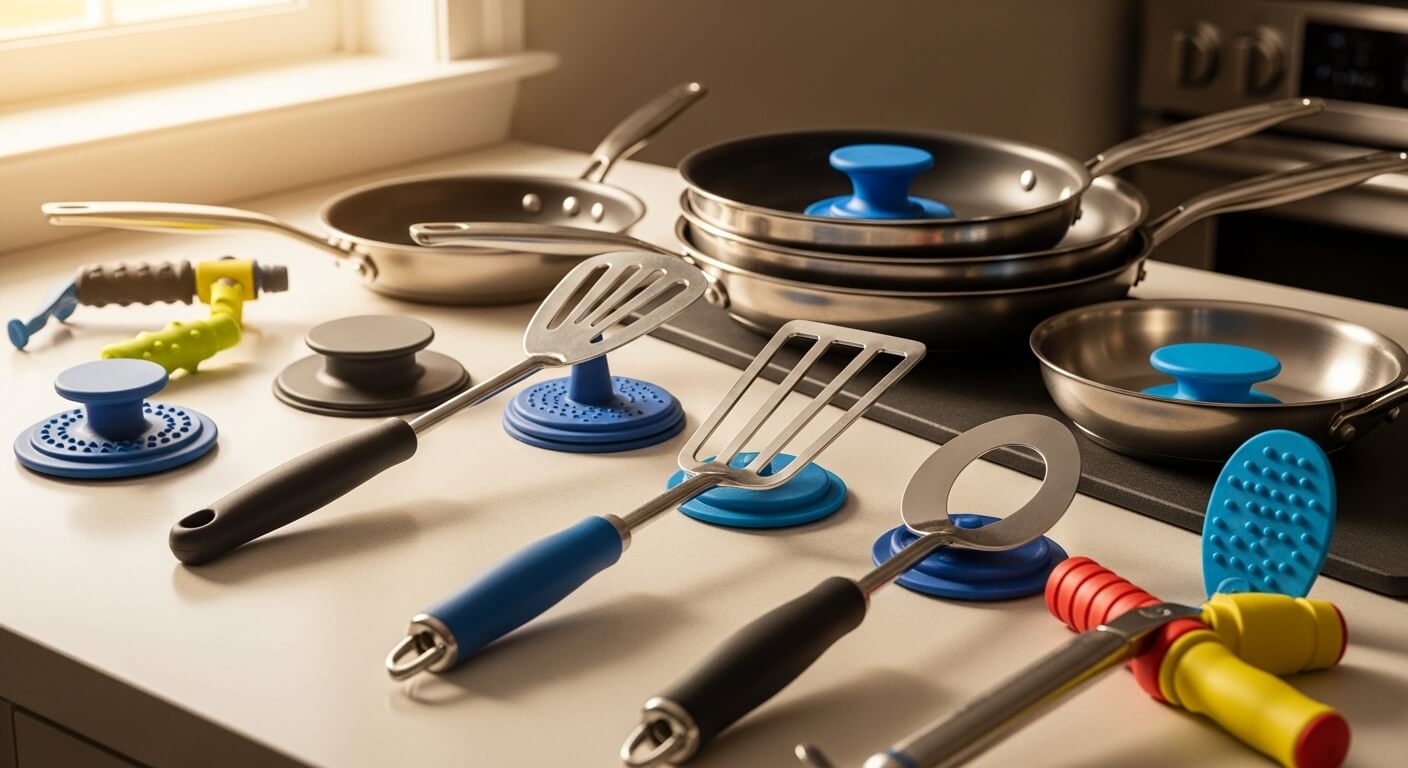
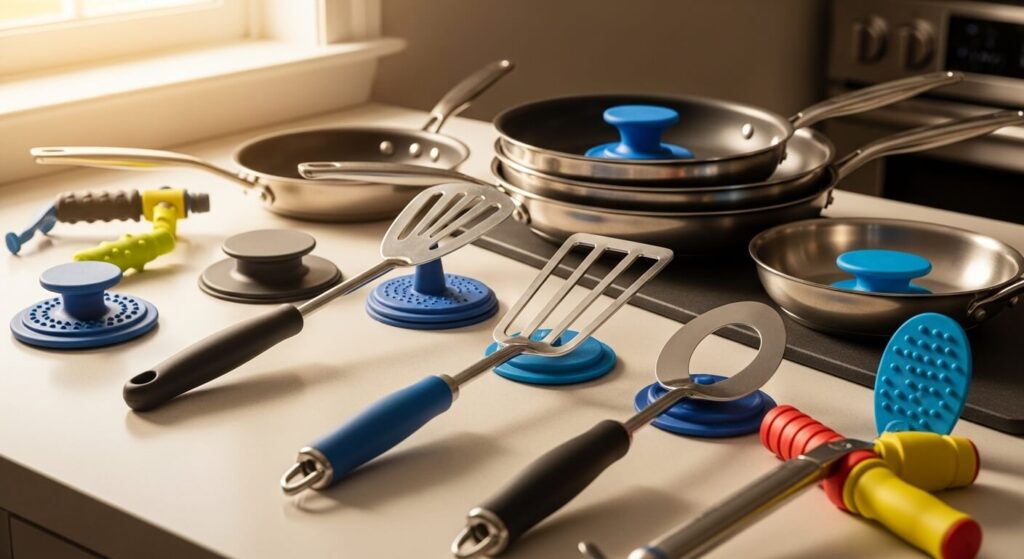
Pair hard-anodized skillets with OXO Good Grips utensils featuring large cushioned handles and 9-10 inch lengths that balance well with 10-inch pans, creating a complete arthritis-friendly cooking setup where every tool reduces joint strain.

The complete system:

Hard-anodized pan: Light weight, easy cleanup
+ Ergonomic spatulas/spoons: Large soft handles, appropriate length
+ Pot holders with grip: Thin silicone for better control
= Minimal hand strain throughout cooking process

OXO Good Grips recommendations:

  • 9-10 inch silicone spatula ($8-12)
  • Large spoon with soft handle ($8-10)
  • Whisk with cushioned grip ($10-12)

Why matching lengths matter: A 12-inch spatula in an 8-inch pan is awkward. A 6-inch spatula in a 12-inch pan makes you reach. Match tool to pan.

Storage Solutions for Heavy Cookware

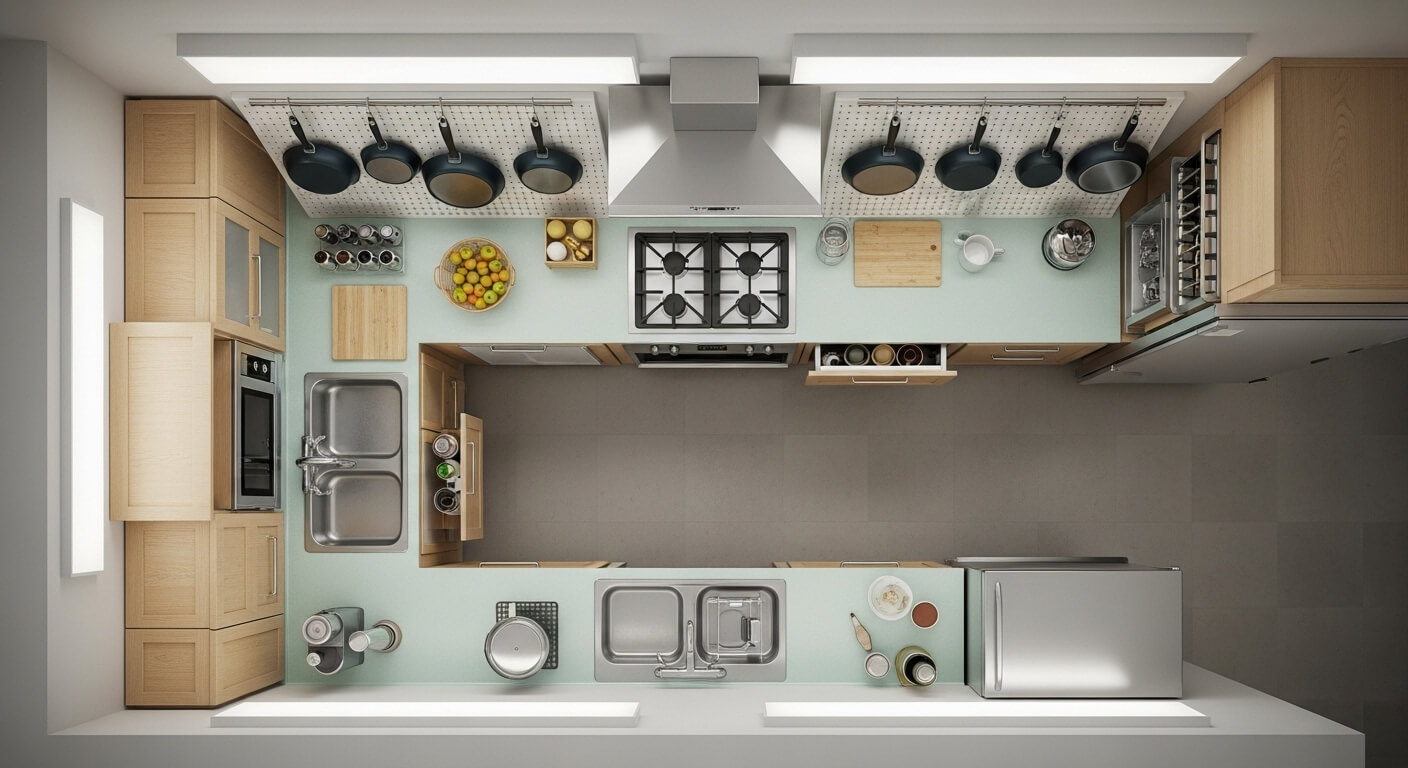
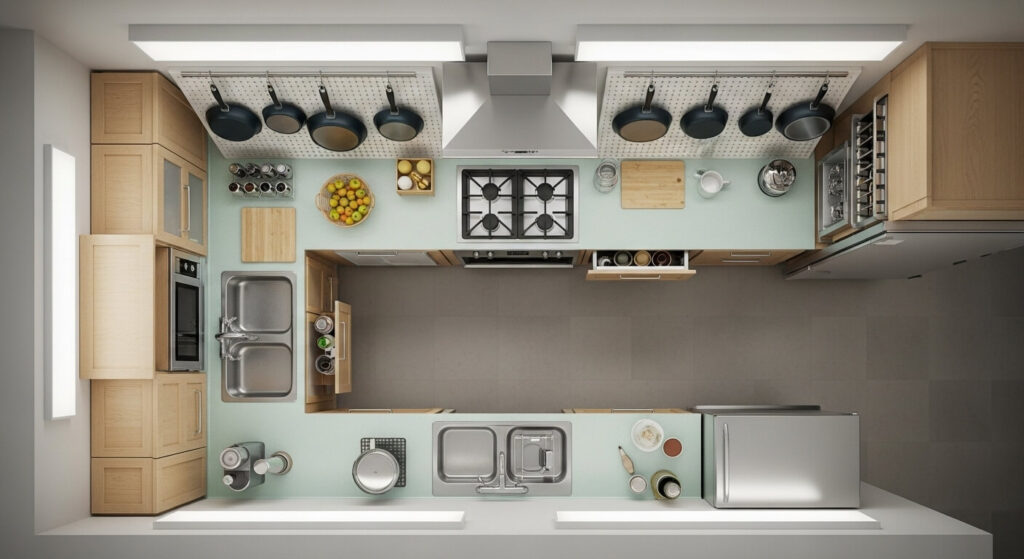
Store hard-anodized pans on wall-mounted hooks at chest height or in pull-out drawers at waist level to eliminate overhead reaching and deep cabinet bending—even 2-pound pans become difficult to access when stored poorly.

Best storage for arthritis:

Wall hooks at chest/waist height: Grab and go. No bending, no reaching up.

Pull-out drawers: Waist height ideal. Pull drawer, lift straight out.

Counter storage: For most-used pan, just leave it out. Less handling overall.

Worst storage: High cabinets, low cabinets, stacked under heavy items.

Even light pans benefit from good storage: 2 pounds is manageable during cooking. But lifting 2 pounds from a high shelf while contorted awkwardly? That’s when injuries happen.

Complete Arthritis-Friendly Kitchen Strategy

Hard-anodized cookware reduces cooking strain but works best as part of a comprehensive approach including pre-chopped vegetables, electric can openers, jar grippers, lightweight dishes, and strategic meal planning—address all sources of hand strain, not just the pan.

The bigger picture:

Cooking isn’t just the skillet. It’s:

  • Ingredient prep (chopping, opening jars)
  • Active cooking (pan handling)
  • Cleanup (washing dishes)
  • Storage (putting things away)

Complete arthritis kitchen:

  • Hard-anodized cookware (light, easy to clean)
  • Electric can opener (no twisting)
  • Jar openers (rubber grips or electric)
  • Pre-chopped vegetables when budget allows
  • Lightweight plates and bowls
  • Ergonomic utensils
  • Strategic storage (everything accessible)

The compound effect: Each small improvement reduces strain slightly. Together, they make cooking sustainable long-term despite arthritis.

Previous Post
How to Season a Cast Iron Skillet in an Air Fryer
How to Season

How to Season a Cast Iron Skillet in an Air Fryer

Next Post
Lard vs Vegetable Oil Which Traditional Fat Creates the Best Skillet Seasoning
How to Season

Lard vs Vegetable Oil: Which Traditional Fat Creates the Best Skillet Seasoning?

error: Content is protected !!