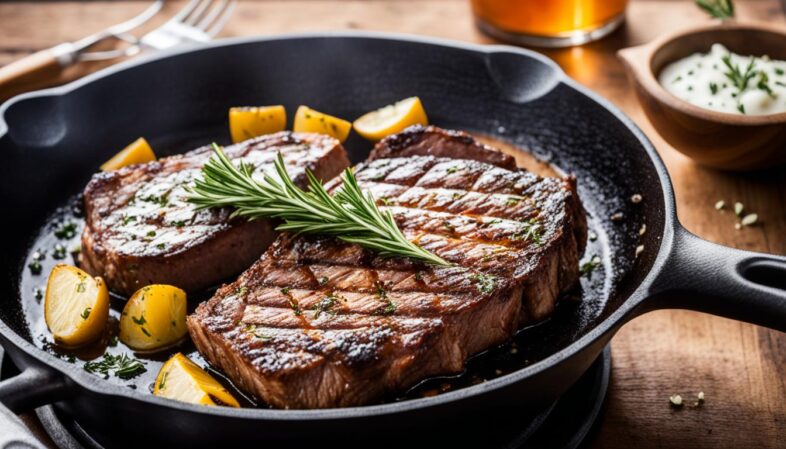
Ever wonder why restaurant steaks are better than home-cooked ones? It’s because they use a cast iron skillet. Mastering ribeye steak recipes using a cast iron skillet makes meals at home taste like those at restaurants.
Ribeye steaks are highly prized for being tender and well-marbled. Cooking them in a cast iron skillet creates a delicious crust while keeping them juicy. This method is perfect for steak fans, especially when grilling outside isn’t possible.
This guide shares 12 ribeye steak recipes for a cast iron skillet. You’ll learn traditional and creative methods, making your cast iron skillet your go-to kitchen item.
If you’re a beginner or an experienced cook, these recipes will help. They cover everything from seasoning to searing your steak perfectly. You’ll learn to use oil for searing and butter for a tasty finish, creating a steak that’s as good as any from a steakhouse.
The 12 cast iron skillet ribeye steak recipes in this article cover varieties such as Classic Cast Iron Ribeye, Herb-Crusted, Garlic Butter Basted, Pepper-Crusted with Red Wine Reduction, Special Diet-Friendly, Smoky Paprika and Cumin Rubbed, Asian-Inspired Soy and Ginger, Blue Cheese Crusted, Whiskey-Glazed, Cajun-Spiced Blackened, Mediterranean with Olive Tapenade, and Balsamic Glazed with Caramelized Onions — each one cooked in a cast iron skillet and sized to serve four.
The Fundamentals of Cooking Ribeye in Cast Iron
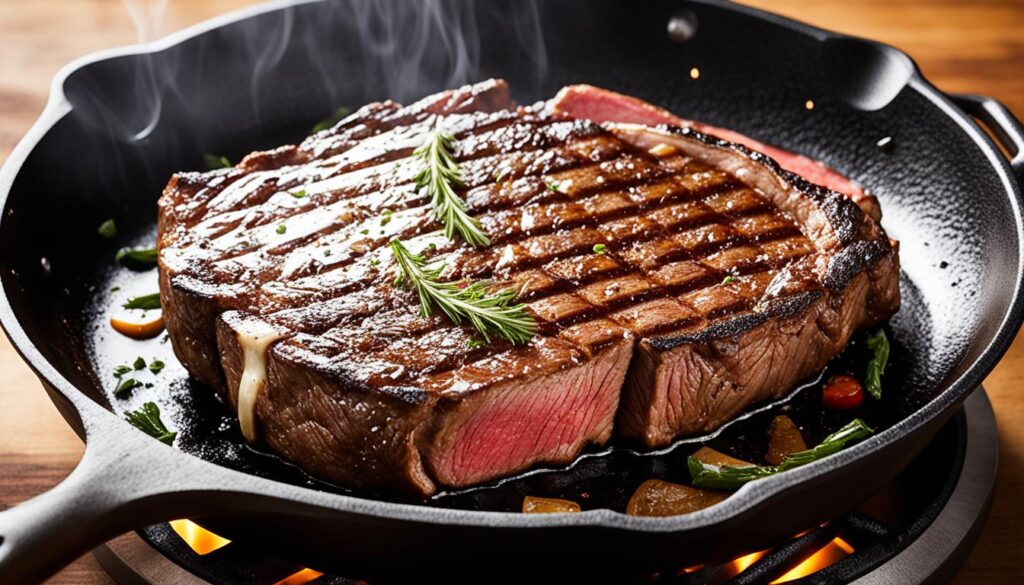
Ribeye and cast iron. Few things in a home kitchen work better together, and the reason comes down to one word: crust.
Not the interior, not the marinade, not the garnish on top. The crust. That deep mahogany exterior that forms when a dry ribeye surface hits a screaming hot cast iron pan — charred-edged, slightly crackly, tasting intensely of beef and rendered fat and Maillard reaction byproducts that no other cooking method produces as well. That’s what this is all about.
And cast iron is the only pan that reliably gets you there at home. Nonstick can’t get hot enough — the coating degrades before it reaches searing temperatures. Stainless steel drops temperature fast when cold steak hits it. Cast iron? It barely flinches. The thermal mass is too high to care about a 12-ounce ribeye. It stays hot through the whole sear, drives the moisture out of the surface, and builds a crust that a thin pan simply cannot.
The fat in ribeye does the rest. That intramuscular marbling — the white threads running through the muscle — renders during cooking and bastes the meat from the inside while the cast iron sears the outside. It’s essentially self-basting beef in the best possible pan.
| Doneness | Pull temp | After rest |
|---|---|---|
| Rare | 120°F | 125°F |
| Medium-rare | 125-130°F | 130-135°F |
| Medium | 135°F | 140°F |
| Medium-well | Don’t. Wrong cut. | — |
Medium-rare is where ribeye belongs. At that internal temperature the fat has rendered, the texture is correct, and the beef flavor is at its peak. Cooking ribeye past 145°F is expensive dry meat — you’re spending money on a cut that performs best at temperatures most people find undercooked on a cheaper cut.
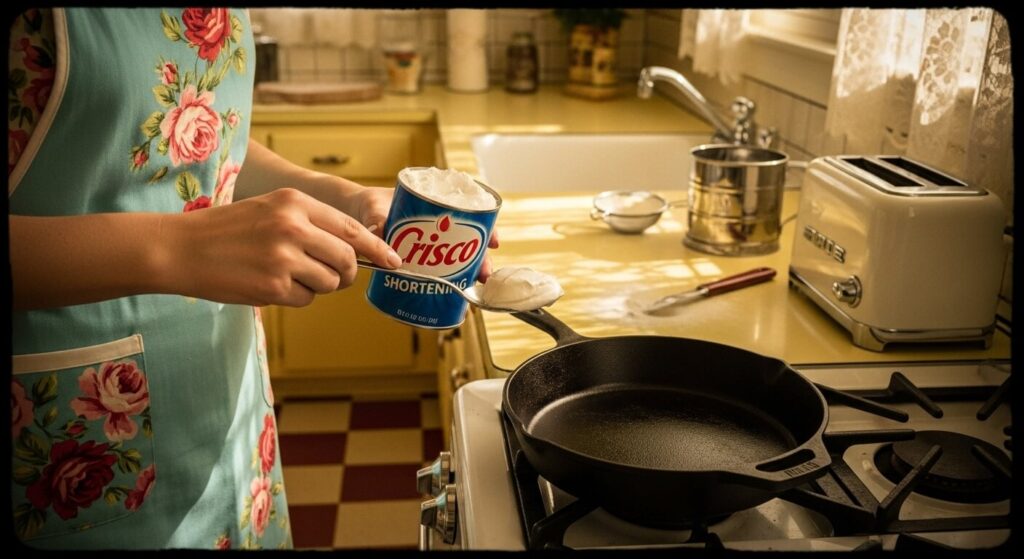
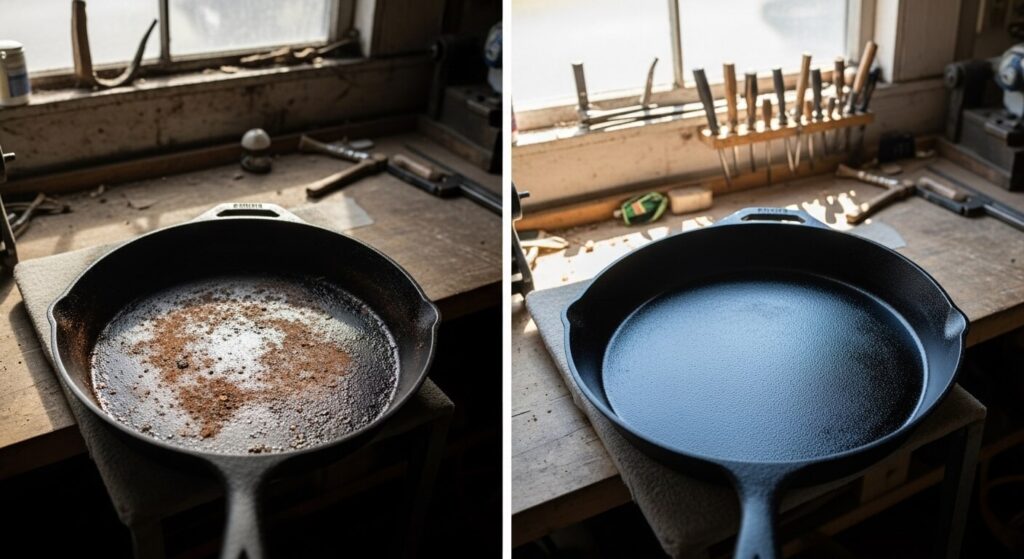
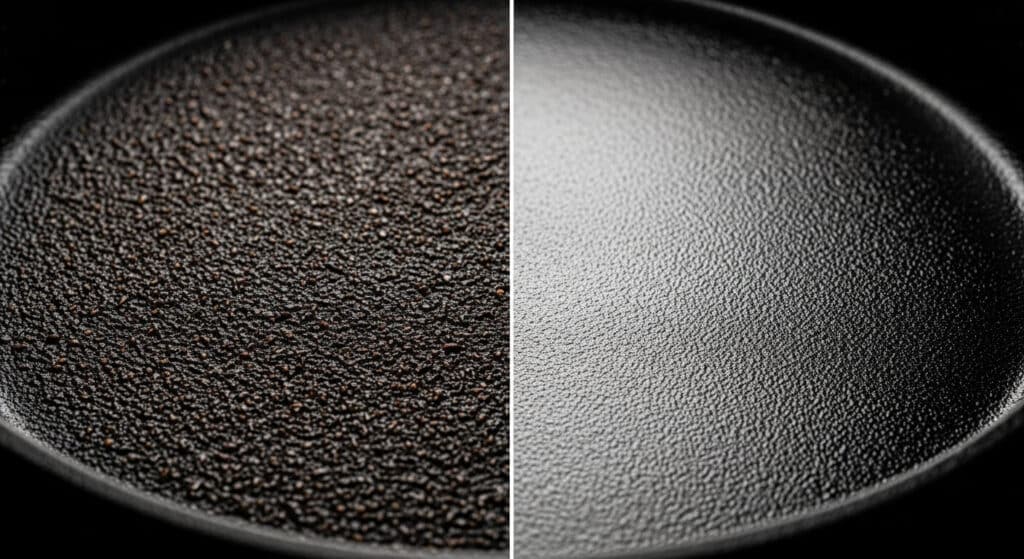
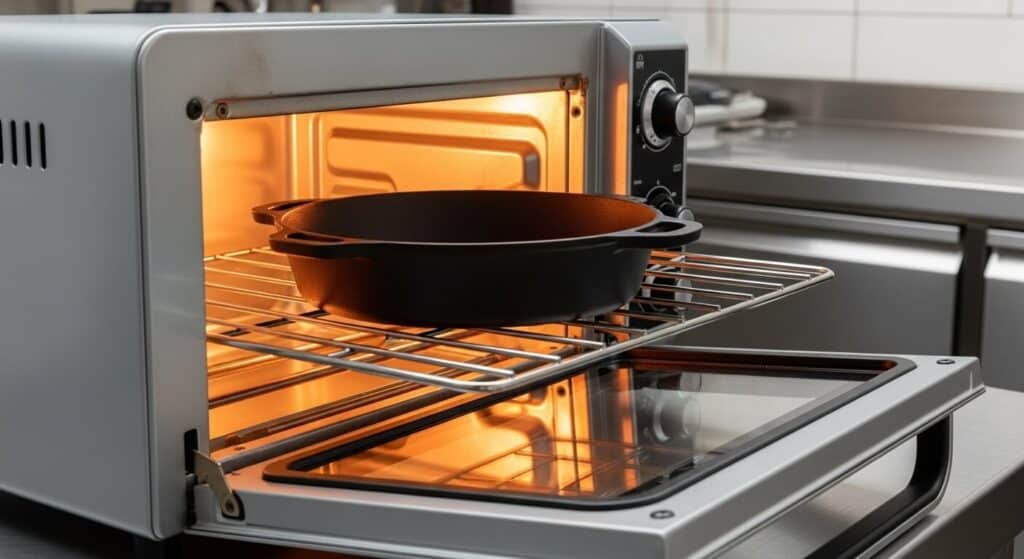
One non-negotiable before any recipe: season your cast iron skillet properly. A bare or damaged surface sticks, tears the crust right off the meat, and turns a $60 dinner into a frustrating mess. The surface has to be right before the technique matters.
Essential Tools for Cast Iron Ribeye Perfection
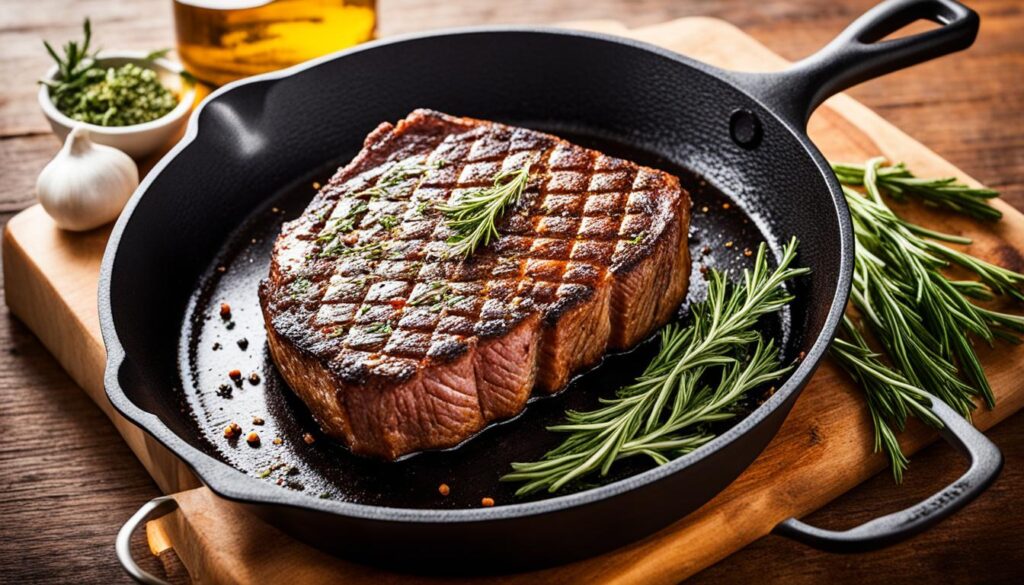
The pan matters. So does everything around it.
Twelve-inch cast iron, minimum. A 10-inch is too small for four ribeyes — the steaks crowd each other and the trapped steam turns a sear into a braise. Two steaks at a time in the 12-inch, which means two batches, which means the second batch might be slightly better than the first because the pan has even more seasoning from the first sear’s fond. Not a problem.
A decent cutting board — big enough that a resting ribeye isn’t hanging off the edges. Juice collects on the board during the rest and you want it contained. Heavy oven mitts because the skillet handle will match whatever temperature the oven is running at, and cast iron retains that heat for a long time after it comes out.
What you actually need
| Tool | Why it matters |
|---|---|
| 12-inch cast iron | Two steaks at a time without crowding |
| Instant-read thermometer | Pull at the right temp — don’t guess |
| Heavy oven mitts | That handle is 400°F, no exceptions |
| Tongs | Tongs only — a fork punctures the steak |
| Large cutting board | For resting, slicing, catching juice |
| Long-handled basting spoon | Essential for the butter-basting recipes |
The oil question
Avocado oil for the initial sear. Smoke point around 500°F, neutral flavor, won’t muddy the beef. Butter comes in after the sear, when the heat has dropped — at full searing temperatures, butter burns and turns bitter and that bitterness goes into the steak.
Olive oil for searing: don’t. Its smoke point is around 325-375°F and cast iron at searing temperature is running significantly hotter than that. Your kitchen fills with smoke, the oil burns before the crust forms, and the flavor of oxidized olive oil is not something you want on a ribeye. Skip it.
Preparing Your Ribeye for the Skillet
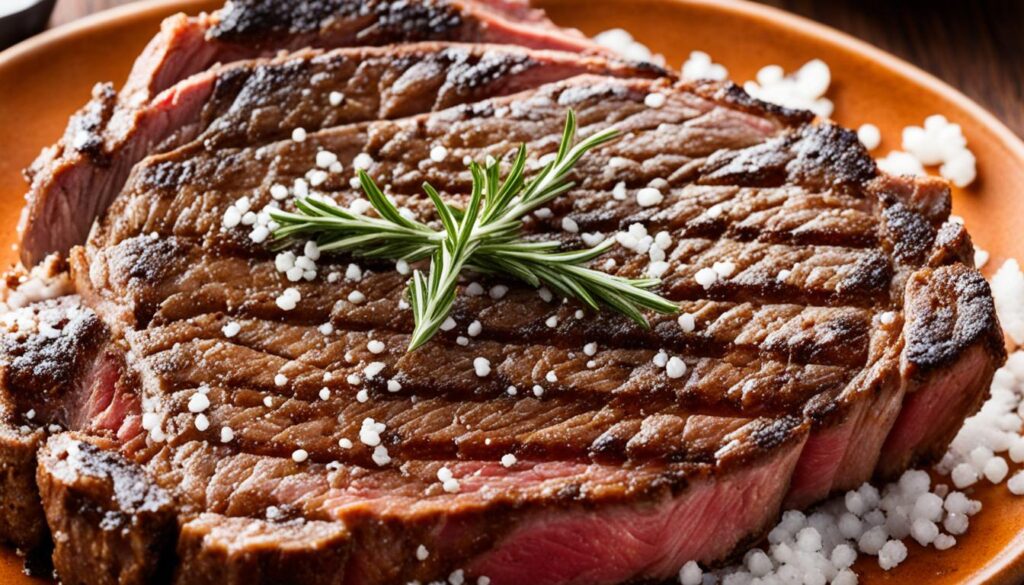
The prep is half the recipe. Get this wrong and the cooking doesn’t matter.
Steaks out of the refrigerator 30 to 45 minutes before they go in the pan. Cold steak in a hot pan cooks unevenly — the exterior reaches proper searing temperature while the interior is still cold, which means you either undercook the center to get a crust or overcook the exterior to bring the center up. Neither is good. Tempering narrows that gap. And getting the skillet genuinely hot before oil even goes in is just as important as tempering the steak — 4 full minutes over high heat, not a quick warm-up.
Salt timing
Kosher salt, applied generously. But when you apply it matters in a way most people don’t think about.
Salt draws moisture out of meat. If you salt a steak and cook it 15 minutes later, that drawn-out moisture is sitting on the surface as a thin layer of liquid — and that liquid prevents browning. You get steam instead of sear. So: either salt the steak 45 minutes or more before cooking, which gives the moisture time to be reabsorbed and leaves the surface drier than before you salted, or salt it right before it goes in the pan and cook it immediately. Don’t salt and then let it sit for 20 minutes. That’s the worst outcome.
Black pepper goes on right before the pan. At searing temperatures, pre-applied pepper burns.
The dry surface
Paper towels. Firm pressure. Every surface. The steak should feel dry to the touch — not tacky, not damp — before it goes anywhere near the pan. This is the single most impactful prep step. More than the oil, more than the pan temp, more than anything else: a dry steak makes a crust. A wet steak steams.
| Step | Timing | What happens if you skip it |
|---|---|---|
| Temper the steak | 30-45 min before cooking | Uneven cook — overcooked edge, cold center |
| Salt timing | 45 min before OR right before | Mid-range salting = moisture on surface = no crust |
| Dry the surface | Immediately before pan | Steam instead of sear |
| Pepper | Right before pan | Burns at searing temperatures |
The Classic Cast Iron Ribeye Recipe
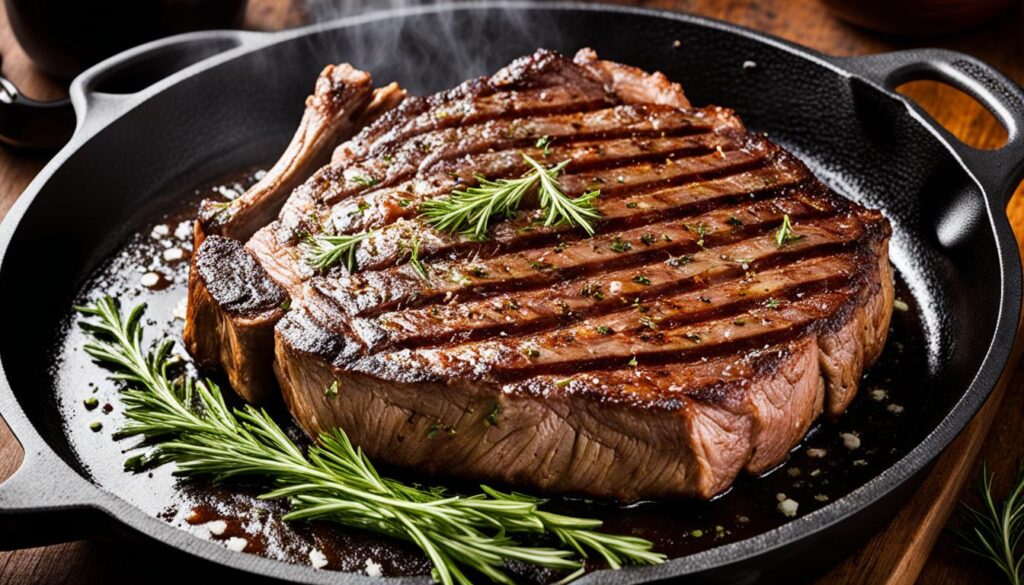
Salt. Pepper. Cast iron. High heat. Butter finish. That’s it.
The classic version doesn’t need anything else because ribeye is already doing the work — the marbling, the beef fat, the depth of flavor in a well-seared crust. Adding components to this is almost missing the point. This is the recipe I’d cook when I want the steak itself to be the entire meal, nothing to dress it up or hide behind.
Get this one right first. All the more complex recipes below become easier once you’ve done this version a few times and understand what the crust should look like, what the steak feels like at the right internal temp, how the butter behaves during basting. A stir-fry on the side keeps dinner complete without competing with the steak.
Ingredients
- 4 ribeye steaks, 1 to 1-1/2 inches thick (about 12 ounces each)
- 2 tablespoons kosher salt (about 1-1/2 teaspoons per steak)
- 1-1/2 teaspoons coarsely ground black pepper
- 2 tablespoons avocado oil
- 4 tablespoons unsalted butter
- 4 cloves garlic, smashed
- 4 sprigs fresh thyme
Instructions
Steaks out of the fridge 40 minutes early. Press paper towels firmly against every surface — both flat sides, the edges, the fat cap — until they feel genuinely dry rather than tacky. Salt all over including the edges. Set aside at room temperature.
Cast iron over high heat for 4 full minutes. Not medium-high. High. Hold a palm above the surface — the radiating heat should feel aggressive. Avocado oil in, 30 seconds for it to thin and shimmer. Two steaks in — if they’re 1-1/2-inch thick, two at a time is the right call. Crowding kills the sear. The sizzle when they hit the pan should be immediate and loud.
Three to 4 minutes on the first side, and don’t touch them. Pressing a steak is one of the more common mistakes — you’re squeezing out the moisture that’s supposed to stay inside, and the crust suffers for it. Watch the edges instead: the browning travels inward from the sides, the color deepening from gray-beige to a reddish-brown and then to mahogany. When the steak nudges slightly with tongs rather than gripping the pan, the crust has set. Flip.
Three to 4 minutes on the second side. Both sides seared — heat drops to medium-low now. Butter, smashed garlic, thyme go in around the steaks. The butter melts fast and starts foaming. Tilt the pan, spoon, and baste the top surface of each steak continuously for 2 minutes while the foam turns from white to a deeper gold and the garlic in the pan begins smelling sweet rather than sharp.
At 125-130°F internal, the steaks come off. Rest on a cutting board for 5 to 8 minutes. Don’t cut immediately. The juices redistribute during the rest — cut too soon and they run all over the board instead of staying in the steak where they belong.
Nutritional Information (Per Serving)
| Nutrient | Amount per Serving |
|---|---|
| Calories | 742 |
| Carbohydrates | 0g |
| Protein | 58g |
| Fat | 56g |
| Fiber | 0g |
| Sodium | 680mg |
Herb-Crusted Cast Iron Ribeye
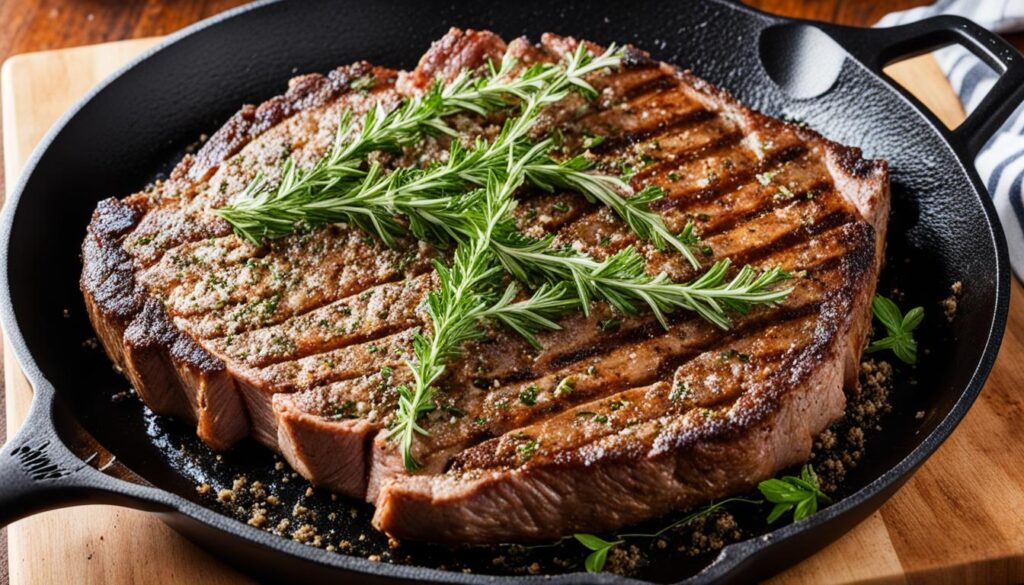
The classic version is excellent. This one is better when you want something more fragrant and textural on the exterior — fresh parsley, rosemary, thyme, and garlic pressed hard into the steak surface before searing. Those herbs hit the hot fat and bloom in a way that fills the kitchen within seconds. The crust that forms is green-flecked and slightly crunchy at the edges and smells like a proper restaurant.
Fresh herbs, not dried. This isn’t a preference thing — dried herbs have already lost most of their volatile oils and the flavor they produce in hot fat is flat compared to fresh. Also, the moisture in fresh herbs helps the paste grip the steak surface during searing instead of sliding off into the pan fat. Worth the extra two minutes of chopping.
If you want a lighter side dish while the steaks rest, a shrimp and broccoli stir-fry comes together quickly.
Ingredients
- 4 ribeye steaks, 1 to 1-1/2 inches thick (about 12 ounces each)
- 2 tablespoons kosher salt (about 1-1/2 teaspoons per steak)
- 1-1/2 teaspoons black pepper
- 2 tablespoons avocado oil
- For the herb crust:
- 1/4 cup fresh flat-leaf parsley, finely chopped
- 2 tablespoons fresh rosemary, finely chopped
- 2 tablespoons fresh thyme leaves
- 4 cloves garlic, minced
- 2 tablespoons olive oil (to bind the paste)
- 1/4 teaspoon red pepper flakes
Instructions
Herb paste first: parsley, rosemary, thyme, garlic, olive oil, and red pepper flakes into a small bowl. Stir until it looks like a rough, fragrant green paste — dense and slightly wet, smelling intensely of garlic and fresh herbs at the same time. Dry the steaks on all surfaces. Season with salt and pepper. Then press the herb paste firmly onto both flat sides of each steak, the edges, the fat cap. Press hard, harder than feels necessary. The steaks should look heavily green-coated before they go near heat.
Room temperature, 30 minutes. Cast iron high, 4 minutes. Oil in, 30 seconds, steaks down in batches of two. The herbs on the underside shift from bright green to a deeper, toasted color within the first minute — you can see it happening at the edges first — and the kitchen smells extraordinary. Three to 4 minutes until the herb crust sets and the steak releases cleanly from the pan without tearing.
Flip. Three to 4 more minutes. At 125-130°F internal, pull to a cutting board and rest 5 to 8 minutes. The herb crust firms slightly as the steak cools, and what was soft and fragrant coming out of the pan becomes almost crunchy at the edges by the time you slice it. That texture change during the rest is the reason fresh herbs are non-negotiable.
Nutritional Information (Per Serving)
| Nutrient | Amount per Serving |
|---|---|
| Calories | 768 |
| Carbohydrates | 2g |
| Protein | 58g |
| Fat | 58g |
| Fiber | 0.5g |
| Sodium | 695mg |
Garlic Butter Basted Ribeye
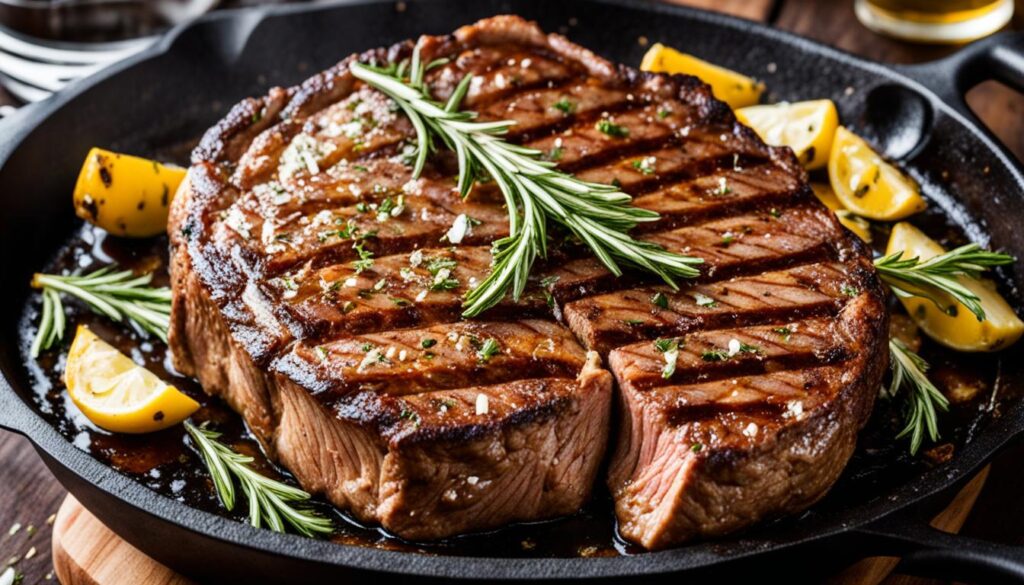
Of all the recipes on this list, this is the one I’d serve to guests. Not because it’s the most complex — it’s one of the simpler ones, actually — but because the garlic butter basting in the last two minutes of cooking does something to the surface of a ribeye that makes it look and taste genuinely restaurant-quality. The butter foams and browns. The garlic softens and goes slightly sweet in it. The steak goes glossy and glistening. It looks like more effort than it was.
The technique is straightforward but the execution matters: after searing both sides, drop the heat, add a generous pile of butter with smashed garlic and thyme and rosemary to the pan, tilt the whole skillet so the butter pools at the low end, and spoon it continuously over the top surface of each steak. Keep spooning. Two minutes of this and the flavor that’s been driven into the surface is something a simple sear doesn’t produce.

A shrimp and dumpling stir-fry alongside keeps the rest of dinner easy.
Ingredients
- 4 ribeye steaks, 1 to 1-1/2 inches thick (about 12 ounces each)
- 2 tablespoons kosher salt (about 1-1/2 teaspoons per steak)
- 1-1/2 teaspoons black pepper
- 2 tablespoons avocado oil
- 6 tablespoons unsalted butter
- 6 cloves garlic, smashed
- 4 sprigs fresh thyme
- 2 sprigs fresh rosemary
Instructions
Dry the steaks, salt and pepper them, rest at room temperature 40 minutes. Cast iron high, 4 full minutes. Oil in, shimmer, two steaks down. Three to 4 minutes per side — deep mahogany crust building from the edges inward, steak releasing cleanly when the crust has set. Repeat with the remaining two steaks.
All four steaks in the pan, heat medium-low. All the butter in at once, along with the smashed garlic, thyme, and rosemary. The butter hits the hot pan surface and melts immediately — foam appears first, white and vigorous, and then starts settling and clearing as the milk solids begin to brown. Tilt. Spoon. The butter pools at the low end and you can work quickly, getting the pooled butter over the top surface of each steak repeatedly. The garlic in the pan goes from raw and sharp to something more mellow and faintly sweet as it softens in the browning butter.
Two minutes of consistent basting. The steak surface goes from matte-brown to glossy. At 125-130°F, pull all four steaks. Rest 5 to 8 minutes. Spoon the remaining pan butter — garlic pieces, herb bits, all of it — over the steaks right before they go to the table.
Nutritional Information (Per Serving)
| Nutrient | Amount per Serving |
|---|---|
| Calories | 820 |
| Carbohydrates | 1g |
| Protein | 58g |
| Fat | 65g |
| Fiber | 0g |
| Sodium | 690mg |
Pepper-Crusted Ribeye with Red Wine Reduction
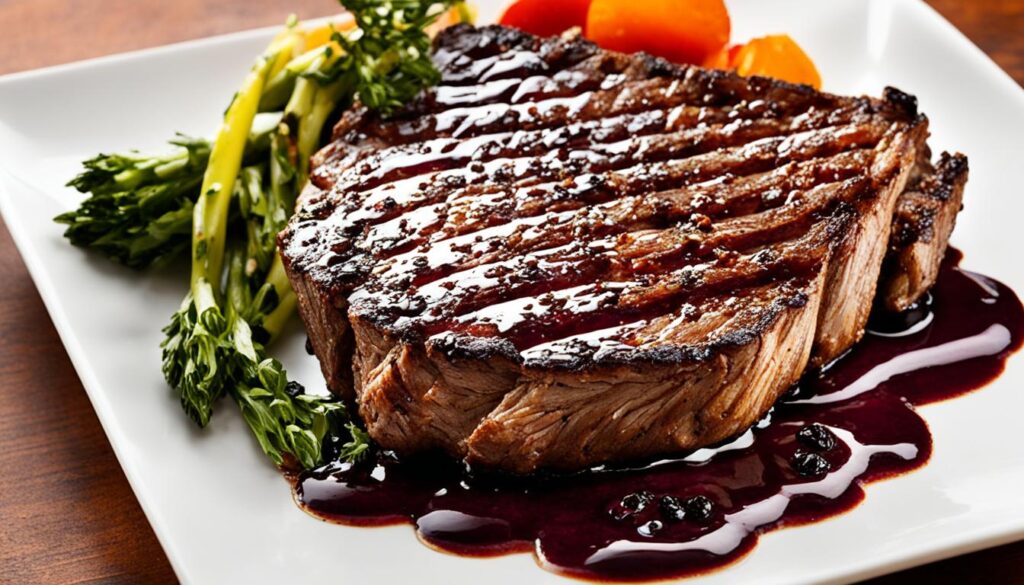
Steak au poivre, essentially. Cracked black pepper pressed aggressively into both sides of a ribeye, seared hard in cast iron until the exterior looks almost blackened in places, then finished with a red wine and beef stock reduction made in the same pan using all that pepper-flecked fond the steaks left behind.
The key word above is cracked, not ground. Ground pepper produces a uniform coating that tastes like black pepper. Coarsely cracked peppercorns — irregular, some nearly whole — char at the contact points against the hot cast iron and develop a smoky, complex quality that’s completely different from regular seasoning. It looks like too much pepper before it goes in the pan. That’s correct. Use all of it.
Ingredients
- 4 ribeye steaks, 1 to 1-1/2 inches thick (about 12 ounces each)
- 2 tablespoons kosher salt (about 1-1/2 teaspoons per steak)
- 2 tablespoons whole black peppercorns, coarsely cracked (use a zip-lock bag and a heavy pan)
- 2 tablespoons avocado oil
- 3 tablespoons unsalted butter, divided
- 1 shallot, finely minced
- 2 cloves garlic, minced
- 1 cup dry red wine (Cabernet Sauvignon or Côtes du Rhône)
- 1/2 cup beef stock
- 1 teaspoon fresh thyme leaves
Instructions
Crack the peppercorns: in a zip-lock bag, smash with a heavy pan or rolling pin until the pieces are irregular — some coarsely cracked, some nearly whole, none of them ground to powder. Press this firmly into both flat sides of each dried, salted steak. The coating looks thick and uneven. Good. Let them sit 20 minutes.
Cast iron high, 4 minutes. Oil in, shimmer, steaks — two at a time. The cracked pepper sizzles hard in the hot fat and the smell shifts immediately from raw peppercorn to something toasted and slightly smoky. Three to 4 minutes per side — the pepper-crusted surface goes from dark orange-red to very dark brown to almost black at the thickest contact points, which is the charring of the peppercorn surfaces against the cast iron and that’s exactly what you want. At 125-130°F, steaks to the board to rest.
Pan on medium now. One tablespoon of the butter in, shallot and garlic added, 2 minutes of softening in the pork fat and residual pepper fond — they go translucent and smell sweet. Red wine poured in — it steams immediately and dissolves the pepper-black fond off the bottom. Scrape as it simmers. Let it reduce by two-thirds, about 4 minutes, until it looks syrupy. Beef stock in, another 2 minutes of reducing. Off heat, remaining butter stirred in until the sauce looks glossy. Thyme in, salt to taste. Spoon over the rested steaks.
Nutritional Information (Per Serving)
| Nutrient | Amount per Serving |
|---|---|
| Calories | 798 |
| Carbohydrates | 4g |
| Protein | 59g |
| Fat | 58g |
| Fiber | 0.5g |
| Sodium | 720mg |
Cast Iron Skillet Ribeye Steak Recipes for Special Diets
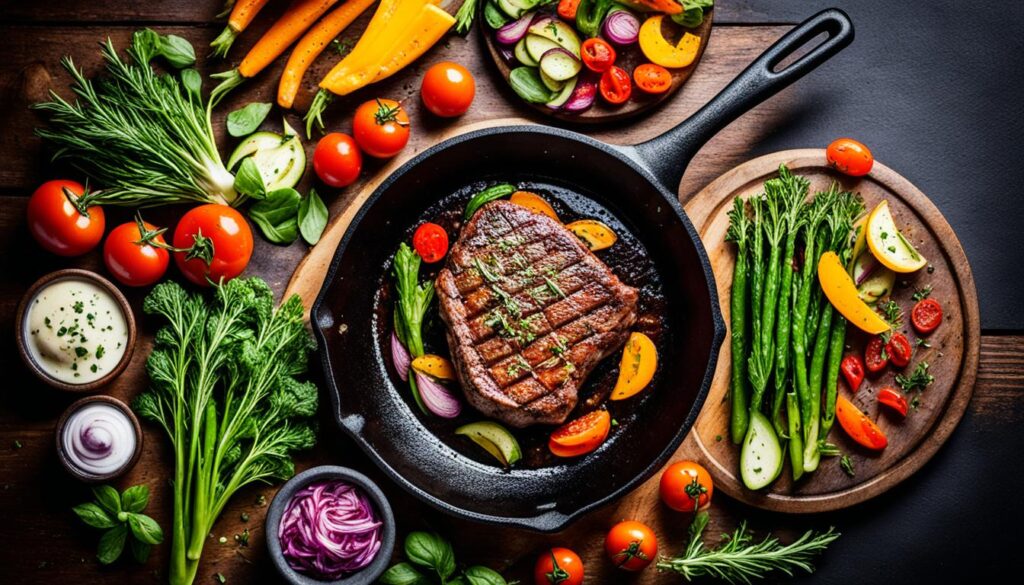
Good news for anyone eating keto, carnivore, paleo, or dairy-free: ribeye is one of the more naturally compatible cuts with all of those eating patterns. High fat, high protein, essentially zero carbohydrates. The problem is usually the sauce or finishing element, most of which contain sugar, gluten, soy, or dairy.
This version uses ghee instead of butter — higher smoke point, dairy-free, works at searing temperatures unlike regular butter — along with a compound herb and lemon zest ghee that gets sliced and melted over the resting steaks. Clean ingredients throughout. No soy, no gluten, nothing that needs to be swapped or modified.
Ingredients
- 4 ribeye steaks, 1 to 1-1/2 inches thick (about 12 ounces each)
- 2 tablespoons kosher salt (about 1-1/2 teaspoons per steak)
- 1-1/2 teaspoons black pepper
- 2 tablespoons avocado oil
- For the herb and lemon compound ghee:
- 4 tablespoons ghee, softened to room temperature
- 2 cloves garlic, minced
- 1 tablespoon fresh rosemary, finely chopped
- 1 tablespoon fresh thyme leaves
- 1 teaspoon lemon zest
- 1/4 teaspoon red pepper flakes
- 1/4 teaspoon kosher salt
Instructions
Compound ghee first — softened ghee in a small bowl with the garlic, rosemary, thyme, lemon zest, red pepper flakes, and salt. Mix until evenly combined. It should look like an herb-flecked pale yellow mixture with visible lemon zest pieces and smell citrusy and herby at the same time. Spoon onto a piece of plastic wrap, shape into a rough log, and refrigerate until firm — at least 30 minutes. You’ll slice rounds off this to finish the steaks.
Steaks dry, salted, peppered, 40 minutes at room temperature. Cast iron high, 4 minutes. Avocado oil in, shimmer, two steaks down. Three to 4 minutes per side — the same deep mahogany sear as the classic version, releasing cleanly, 125-130°F at the thickest point.
Steaks onto the cutting board while still hot from the pan. Slice a round of the compound ghee — about 1 tablespoon per steak — and put it directly on top of each hot steak. The residual heat from the steak starts melting the ghee slowly from beneath, the herbs and lemon zest releasing their fragrance as it spreads across the beef surface. Rest 5 to 8 minutes. Serve with the melted ghee pooled across the top.
Nutritional Information (Per Serving)
| Nutrient | Amount per Serving |
|---|---|
| Calories | 778 |
| Carbohydrates | 1g |
| Protein | 58g |
| Fat | 60g |
| Fiber | 0g |
| Sodium | 700mg |
Smoky Paprika and Cumin Rubbed Ribeye
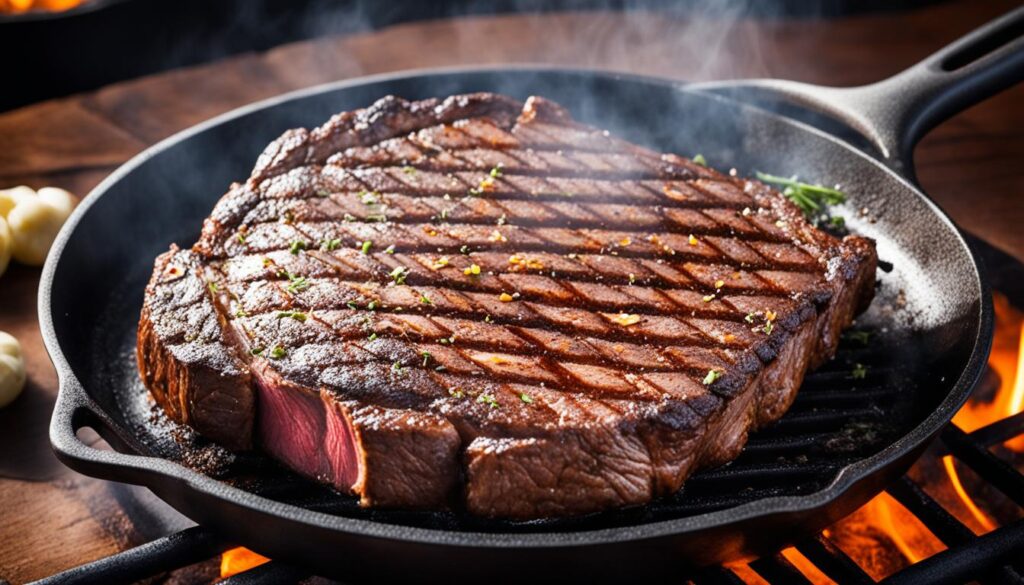
This one gets skepticism from people who haven’t tried it and then converts them on the first bite. Smoked paprika and cumin on a ribeye sounds like it’s going to overpower the beef. What actually happens: the paprika blooms in the hot fat and creates a crust that looks and smells faintly of a wood-fire grill, and the cumin adds a warm, earthy depth underneath that amplifies the beef flavor rather than competing with it.
Smoked paprika specifically. Not sweet, not regular — smoked. The distinction matters here more than in almost any other recipe on this list.
Ingredients
- 4 ribeye steaks, 1 to 1-1/2 inches thick (about 12 ounces each)
- 2 tablespoons kosher salt (about 1-1/2 teaspoons per steak)
- 2 tablespoons avocado oil
- 3 tablespoons unsalted butter
- 1 lime, cut into wedges
- Spice rub:
- 2 tablespoons smoked paprika
- 1 tablespoon ground cumin
- 1 teaspoon garlic powder
- 1 teaspoon onion powder
- 1/2 teaspoon cayenne pepper
- 1/2 teaspoon black pepper
Instructions
Smoked paprika, cumin, garlic powder, onion powder, cayenne, and pepper into a small bowl. Stir. The rub looks intensely reddish-orange and smells simultaneously smoky and earthy — the paprika and cumin in combination have a distinctive quality that’s hard to describe until you’ve smelled it. Dry the steaks, salt them, press this rub onto every surface. Both flat sides, the edges, the fat cap. No bare spots. The steaks should look uniformly deep orange-red. Twenty minutes at room temperature.
Cast iron high, 4 minutes. Oil in, shimmer. Steaks down — the paprika blooms in the hot fat within seconds and the kitchen fills with that smoky, savory smell immediately. Three to 4 minutes per side and watch the color at the edges of each steak: it shifts from bright orange-red toward a darker brownish-burgundy as the crust deepens and the spices char slightly against the cast iron surface. That darkening at the edges is the Maillard reaction working on the spiced surface. Flip when the steak releases cleanly.
Three to 4 minutes on the second side. Drop to medium-low, butter in, brief baste as it melts and foams. At 125-130°F, pull and rest 5 to 8 minutes. Lime wedges alongside at the table — the citrus against the smoky, spiced crust is the finishing move the recipe needs.
Nutritional Information (Per Serving)
| Nutrient | Amount per Serving |
|---|---|
| Calories | 756 |
| Carbohydrates | 3g |
| Protein | 58g |
| Fat | 57g |
| Fiber | 1g |
| Sodium | 690mg |
Asian-Inspired Soy and Ginger Ribeye
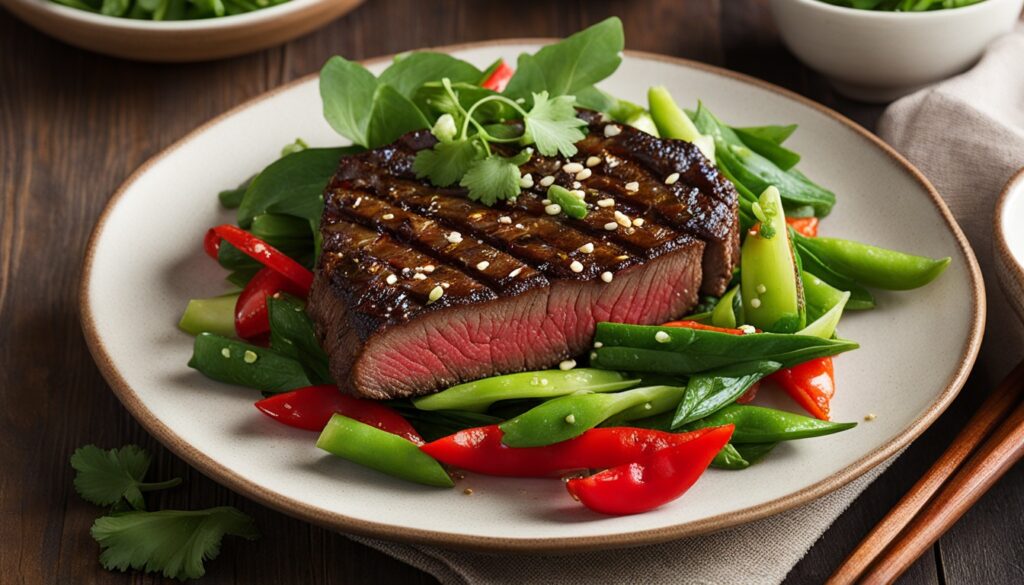
How long you marinate this directly determines how good it turns out. Twenty minutes: the surface is noticeably better than unseasoned beef. One hour: meaningfully better. Overnight: the ginger and soy and garlic have penetrated beyond the surface layer and the cast iron sear turns the exterior into something caramelized, sticky, and deeply savory with a honey sweetness that plain soy-marinated steak doesn’t produce.
Plan for it. Overnight marinade isn’t just food blogger overclaiming — it actually changes the dish.
Low-sodium soy sauce, not regular. Regular soy concentrates in a hot pan and becomes aggressively salty before the sear finishes.
Ingredients
- 4 ribeye steaks, 1 to 1-1/2 inches thick (about 12 ounces each)
- 2 tablespoons avocado oil
- 2 green onions, sliced (for serving)
- 1 teaspoon sesame seeds (for serving)
- For the marinade:
- 1/3 cup low-sodium soy sauce
- 2 tablespoons honey
- 1-1/2 tablespoons fresh ginger, grated
- 4 cloves garlic, minced
- 1 tablespoon sesame oil
- 1 tablespoon rice vinegar
- 1 teaspoon red pepper flakes
- 1 tablespoon cornstarch
Instructions
All marinade ingredients whisked together — the cornstarch dissolves into the soy-honey mixture and helps it cling to the steak during searing rather than running off in the pan. The mixture looks dark and glossy and smells of ginger and garlic and sesame at the same time, which is a good smell. Steaks into a zip-lock bag or shallow dish, marinade over them, refrigerate minimum 2 hours. Pull the marinade out when you remove the steaks — reserve it.
Steaks out 40 minutes before cooking. Blot each one lightly before it goes in the pan — not dry, just lighter. The honey in the marinade caramelizes fast and too much of it on the surface will char before the sear is done if you don’t reduce the surface layer slightly.
Cast iron high, 4 minutes. Oil in, shimmer. Steaks down, two at a time — the sizzle is more aggressive than with plain seasoned steak because of the sugars, and the color deepens faster. Three to 4 minutes per side, watching the surface shift from glossy amber to a deeper, caramelized brown. At 125-130°F, steaks to the board to rest.
Reserved marinade into the still-hot pan, off the burner. The residual heat warms it through and reduces it slightly over about 2 minutes. Spoon over the rested steaks. Green onions and sesame seeds over everything.
Nutritional Information (Per Serving)
| Nutrient | Amount per Serving |
|---|---|
| Calories | 780 |
| Carbohydrates | 10g |
| Protein | 59g |
| Fat | 56g |
| Fiber | 0.5g |
| Sodium | 820mg |
Blue Cheese Crusted Cast Iron Ribeye
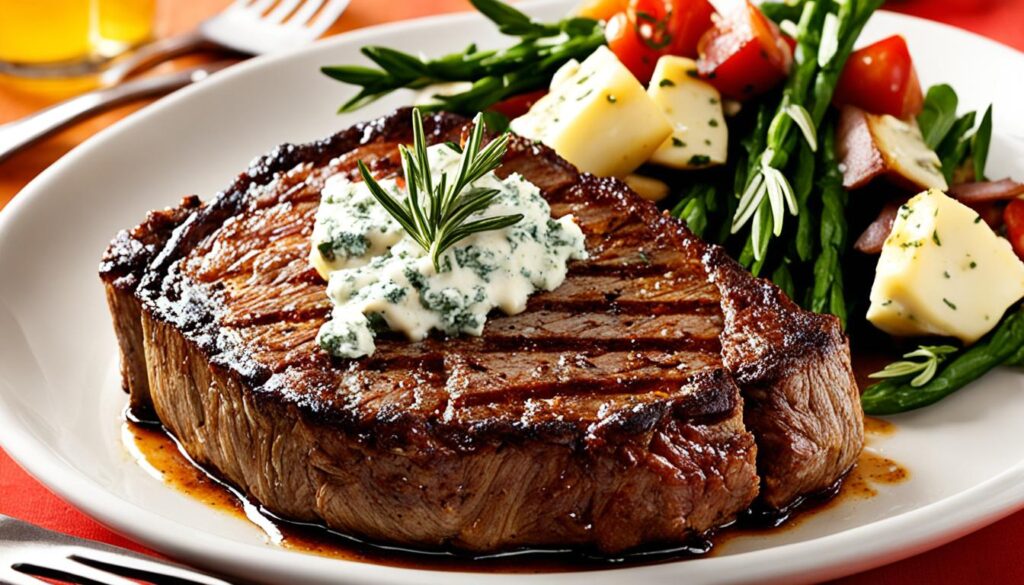
Not for everyone. If you’re not already in the camp that thinks blue cheese and beef belong together, this recipe probably won’t convert you. But if you are — if you’ve ever had a steakhouse wedge salad with blue cheese crumbles alongside a ribeye and thought about combining them — this is the recipe.
The steak gets seared in cast iron, pulled slightly under temperature, and then a crust of crumbled blue cheese mixed with panko, butter, and chives goes across the top before the whole skillet goes under the broiler for 2 to 3 minutes. The cheese melts and bubbles, the panko goes golden, and the finished top looks like something you’d pay a significant amount of money for at a restaurant.
Use a good blue cheese. Gorgonzola is creamier and more approachable. Roquefort is sharper. Stilton lands in between. All work. Don’t use a cheap option.
Ingredients
- 4 ribeye steaks, 1 to 1-1/2 inches thick (about 12 ounces each)
- 2 tablespoons kosher salt (about 1-1/2 teaspoons per steak)
- 1-1/2 teaspoons black pepper
- 2 tablespoons avocado oil
- For the blue cheese crust:
- 4 ounces blue cheese, crumbled (about 1 cup)
- 1/3 cup panko breadcrumbs
- 2 tablespoons unsalted butter, softened
- 1 tablespoon fresh chives, finely chopped
- 1 clove garlic, minced
- 1/4 teaspoon black pepper
Instructions
Blue cheese crust: crumbled blue cheese, panko, softened butter, chives, garlic, and pepper mixed together with a fork in a small bowl. It should look like a rough, crumbly paste — visible chunks of blue cheese throughout, the panko visible as distinct pieces, the butter binding it all loosely. It smells pungent and sharp. That’s correct. Leave it at room temperature so it stays spreadable while you cook the steaks.
Oven broiler on high. Dry the steaks, salt and pepper them. Cast iron high, 4 minutes. Oil in, shimmer, steaks — two at a time. Three to 4 minutes per side, building that deep mahogany crust. Pull at 115-120°F — slightly under medium-rare — because the broiler adds more heat.
Blue cheese mixture divided evenly over the top surface of each steak, spread into a thick, even layer covering the whole surface. The cast iron skillet directly under the broiler — 2 to 3 minutes, watching constantly. The cheese bubbles at the edges first, then across the whole surface, and the panko goes golden. This moves fast. Golden is the target. Another 30 seconds past golden and you’re at burned.
Rest 5 minutes. The crust firms as the cheese partially sets.
Nutritional Information (Per Serving)
| Nutrient | Amount per Serving |
|---|---|
| Calories | 890 |
| Carbohydrates | 6g |
| Protein | 64g |
| Fat | 68g |
| Fiber | 0g |
| Sodium | 980mg |
Whiskey-Glazed Ribeye Steak
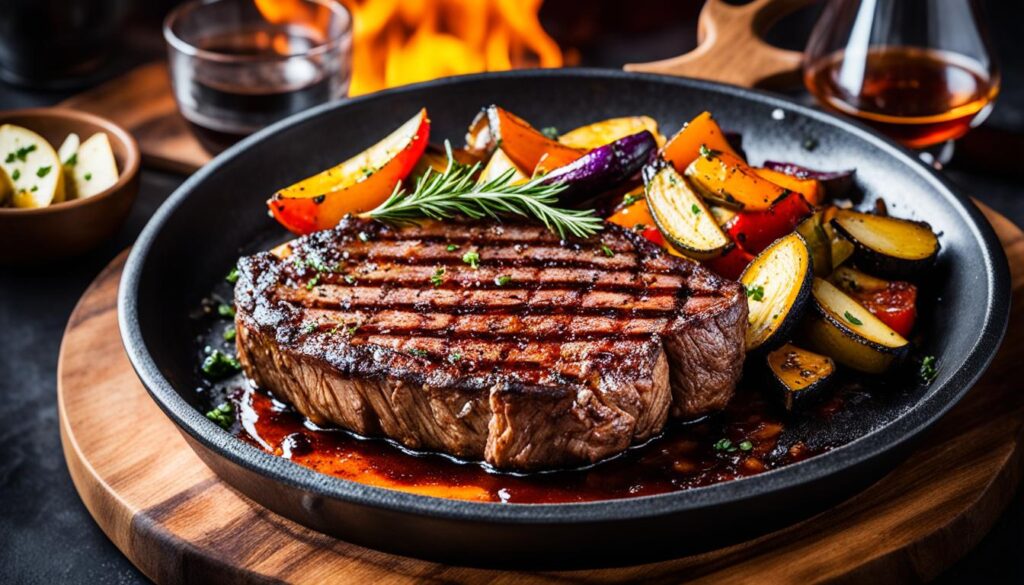
Bourbon or rye, brown sugar, beef stock, Dijon mustard, butter. Five minutes in the same pan after searing, using all the fond the ribeyes left behind. The finished sauce is sweet and slightly smoky and deeply savory — the alcohol cooks off and what’s left is the vanilla and oak character from the barrel aging, which pairs well with the beef fat in a way that’s hard to explain until you’ve tasted it.
Use a whiskey you’d actually drink. The cheapest option produces a thinner, less complex sauce, and when the liquid reduces that lack of complexity concentrates.
Ingredients
- 4 ribeye steaks, 1 to 1-1/2 inches thick (about 12 ounces each)
- 2 tablespoons kosher salt (about 1-1/2 teaspoons per steak)
- 1-1/2 teaspoons black pepper
- 2 tablespoons avocado oil
- For the whiskey glaze:
- 1/2 cup bourbon or rye whiskey
- 1/4 cup brown sugar, packed
- 1/2 cup beef stock
- 1 tablespoon Dijon mustard
- 2 tablespoons unsalted butter
- 1/2 teaspoon fresh thyme leaves
Instructions
Dry the steaks, season, rest at room temperature 40 minutes. Cast iron high, 4 minutes. Oil in, shimmer. Steaks down, two at a time, 3 to 4 minutes per side. Deep mahogany crust on both sides, releasing cleanly, 125-130°F internal. Rest on the board.
Same pan, heat medium. Stand back slightly before adding the whiskey — pour it in and if the burner is still on there’s a small chance of a brief flare. Let it sizzle and reduce for about 1 minute while you scrape the beef fond off the bottom. Brown sugar in, dissolved into the reducing whiskey as it bubbles. Beef stock added, then the Dijon mustard whisked in. Simmer and reduce for 3 to 4 minutes — watch the consistency change from thin and dark to syrupy and glossy, the kind that coats a spoon and falls off in thick slow drops rather than thin fast ones. Off heat. Butter stirred in until the glaze looks lacquered. Thyme in.
Spoon generously over the rested steaks. The glaze that pools on the cutting board isn’t wasted — that’s for dipping the sliced pieces into.
Nutritional Information (Per Serving)
| Nutrient | Amount per Serving |
|---|---|
| Calories | 830 |
| Carbohydrates | 14g |
| Protein | 58g |
| Fat | 57g |
| Fiber | 0g |
| Sodium | 710mg |
Cajun-Spiced Blackened Ribeye
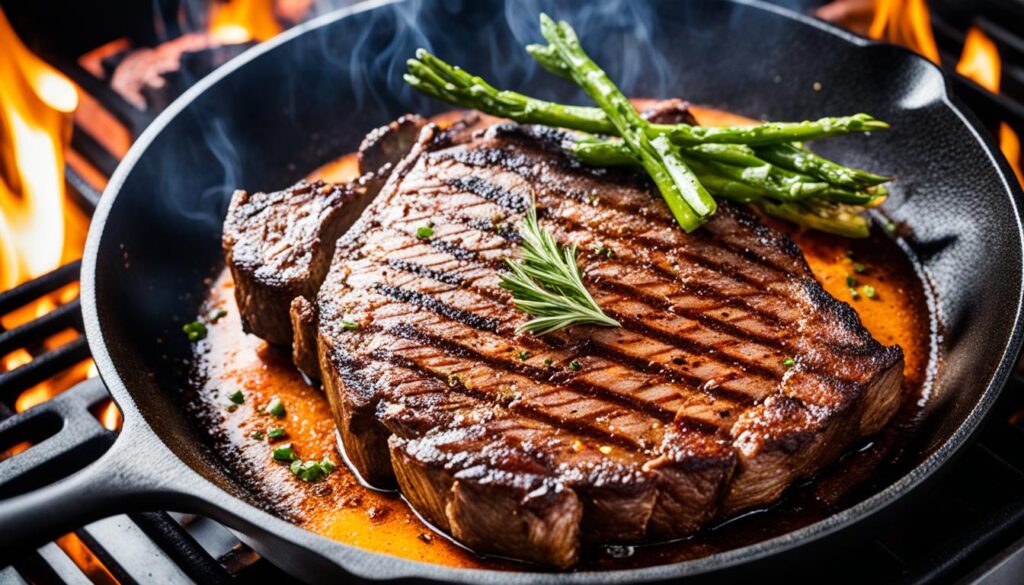
Blackening is not the same as searing with Cajun spices on the outside. The technique is different — the steak is coated in butter before the spice blend, not oil, and the pan runs even hotter than standard searing temperature. The butter carries the spices against the cast iron surface and they char — genuinely char, going black at the contact points in a way that looks alarming and tastes incredible. The interior is properly cooked. The exterior is almost carbonized. The contrast between those two things is the entire point.
Open a window. Use the exhaust fan at full speed. Blackening produces significant smoke and there’s no way around that.
Ingredients
- 4 ribeye steaks, 1 to 1-1/2 inches thick (about 12 ounces each)
- 3 tablespoons unsalted butter, melted (for coating — not for the pan)
- Blackening spice blend:
- 1 tablespoon smoked paprika
- 1-1/2 teaspoons garlic powder
- 1 teaspoon onion powder
- 1 teaspoon dried thyme
- 1 teaspoon dried oregano
- 1 teaspoon cayenne pepper
- 1 teaspoon black pepper
- 1/2 teaspoon white pepper
- 1-1/2 teaspoons kosher salt
Instructions
Spice blend: all the dry ingredients into a bowl and stirred together — dark, vivid, smelling intensely of paprika and cayenne. Dry the steaks completely. Brush the melted butter over every surface of each steak — both flat sides, edges, fat cap — until they look shiny. Press the spice blend firmly into every buttered surface. The butter holds the spices against the meat during the violent sear that’s coming.
Cast iron over high heat — as high as your stove produces — for 5 full minutes. No oil in the pan. The butter on the steak is the fat. The pan should be visibly smoking before the steaks go in. Two steaks in — the butter hits the pan surface immediately and the spices start charring within the first 30 seconds, the color going from dark orange-red to black at the contact points. Two to 3 minutes per side. This is faster than standard searing because the butter carries the heat into the spice coating more aggressively than oil does against bare meat.
At 125-130°F internal, steaks off and resting 5 minutes. The top surface looks deeply dark — almost black at the highest points — and smells smoky and slightly charred. That’s correct.
Nutritional Information (Per Serving)
| Nutrient | Amount per Serving |
|---|---|
| Calories | 780 |
| Carbohydrates | 3g |
| Protein | 58g |
| Fat | 59g |
| Fiber | 1g |
| Sodium | 740mg |
Mediterranean-Style Ribeye with Olive Tapenade
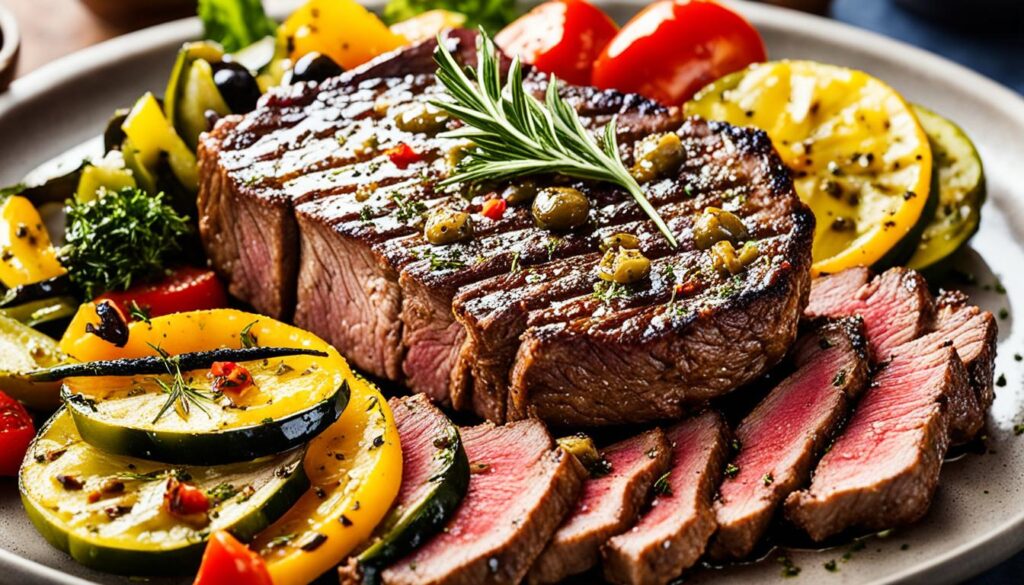
The tapenade goes on after cooking. It’s a finishing element, not a crust or a glaze — kalamata olives, capers, garlic, fresh herbs, and olive oil pulsed into a coarse paste and spooned generously over the rested steak. The saltiness and acidity of the olives and capers cuts through the richness of the ribeye fat in a way that feels clean and bright.
Make the tapenade while the steaks rest, or make it the day before — the flavors deepen overnight and it takes 5 minutes either way.
Ingredients
- 4 ribeye steaks, 1 to 1-1/2 inches thick (about 12 ounces each)
- 2 tablespoons kosher salt (about 1-1/2 teaspoons per steak)
- 1-1/2 teaspoons black pepper
- 2 tablespoons avocado oil
- 3 tablespoons unsalted butter
- For the olive tapenade:
- 1 cup kalamata olives, pitted
- 3 tablespoons capers, drained
- 2 cloves garlic
- 2 tablespoons fresh flat-leaf parsley
- 1 tablespoon fresh oregano
- 1 teaspoon lemon zest
- 1 tablespoon fresh lemon juice
- 3 tablespoons good olive oil
- 1/4 teaspoon black pepper
Instructions
Tapenade: olives, capers, garlic, parsley, oregano, lemon zest, lemon juice, olive oil, and pepper into a food processor. Pulse — don’t blend continuously — until the mixture looks coarsely chopped with visible texture, a rough dark green-black paste where you can still identify individual olive and herb pieces. Too smooth and it loses its character. Taste it: very salty and briny from the olives and capers, with the lemon cutting through and the herbs adding fragrance. Set aside.
Dry the steaks, season, rest at room temperature 40 minutes. Cast iron high, 4 minutes. Oil in, shimmer, steaks down, two at a time. Three to 4 minutes per side — the standard mahogany sear, releasing cleanly. Drop to medium-low, butter in, 2 minutes of basting as it foams and browns. At 125-130°F internal, steaks to the board to rest 5 to 8 minutes.
Two to 3 tablespoons of tapenade spooned over the top surface of each steak right before serving — cover most of the surface. The residual heat from the resting steak very slightly warms the tapenade and the olive oil in it begins looking glossy as it spreads. Don’t put it on too early or it melts into something flat.
Nutritional Information (Per Serving)
| Nutrient | Amount per Serving |
|---|---|
| Calories | 810 |
| Carbohydrates | 5g |
| Protein | 58g |
| Fat | 62g |
| Fiber | 1g |
| Sodium | 890mg |
Balsamic Glazed Ribeye with Caramelized Onions
The caramelized onions take 35 to 45 minutes. That’s not negotiable and it can’t be rushed. Higher heat produces browned onions, not caramelized onions — they’re different things. Real caramelization is a low, slow process where the natural sugars in the onion gradually convert and the whole thing collapses into something jammy, sweet, and deeply golden. Start them first. Everything else works around their timeline.
The balsamic glaze happens in the steak pan after searing and takes about 4 minutes. Between the two elements, this is the most involved recipe on the list — but the result is legitimately spectacular and worth every minute.
Ingredients
- 4 ribeye steaks, 1 to 1-1/2 inches thick (about 12 ounces each)
- 2 tablespoons kosher salt (about 1-1/2 teaspoons per steak)
- 1-1/2 teaspoons black pepper
- 2 tablespoons avocado oil
- For the caramelized onions:
- 3 large yellow onions, thinly sliced
- 2 tablespoons unsalted butter
- 1 tablespoon olive oil
- 1/2 teaspoon kosher salt
- 1 teaspoon fresh thyme leaves
- For the balsamic glaze:
- 1/3 cup balsamic vinegar
- 1 tablespoon honey
- 2 tablespoons beef stock
- 1 tablespoon unsalted butter
Instructions
Onions first — always first. Butter and olive oil into a wide pan over medium-low. Sliced onions in with the salt — they look like a mountain going in and will reduce dramatically. Stir occasionally, adjusting heat if they start browning too fast, for 35 to 45 minutes. The progress is gradual: pale and sharp-smelling in the first 10 minutes, softening and going translucent by 20, beginning to color at 30, and by 40 to 45 minutes they’re deeply golden, almost jammy, smelling sweet and slightly caramelized at the edges. Thyme in the last 5 minutes. Set aside.
Dry the steaks, season, rest 40 minutes. Cast iron high, 4 minutes. Oil in, shimmer, steaks — two at a time. Three to 4 minutes per side, mahogany crust, releasing cleanly. 125-130°F, then rest on the board.
Balsamic and honey into the still-hot steak pan over medium — immediate sizzling as the vinegar hits the hot fond. Two minutes of simmering and scraping. Beef stock in, another minute of reducing. The sauce goes from thin and very acidic to something syrupy and glossy with a depth from the fond that plain balsamic doesn’t have. Off heat, butter stirred in.
Steaks plated, caramelized onions piled over each one, balsamic glaze drizzled over everything.
Nutritional Information (Per Serving)
| Nutrient | Amount per Serving |
|---|---|
| Calories | 842 |
| Carbohydrates | 18g |
| Protein | 59g |
| Fat | 60g |
| Fiber | 1.5g |
| Sodium | 730mg |
Coffee and Brown Sugar Rubbed Ribeye
The sleeper pick on this list. Skepticism is the universal first reaction — ground coffee on a steak seems like it’s going to produce something that tastes like a breakfast plate instead of dinner. What actually happens is that the coffee creates a deeply savory, slightly roasted crust that enhances the beef flavor rather than competing with it. The brown sugar caramelizes against the cast iron and the smoked paprika adds a wood-fire quality. Together on a ribeye with proper high-heat searing, the finished crust looks almost black and tastes like something cooked over coals for much longer than 8 minutes.
Try it once before deciding it sounds wrong.
Ingredients
- 4 ribeye steaks, 1 to 1-1/2 inches thick (about 12 ounces each)
- 2 tablespoons avocado oil
- 3 tablespoons unsalted butter
- Coffee rub:
- 2 tablespoons finely ground coffee (regular ground, not espresso)
- 2 tablespoons brown sugar, packed
- 1 tablespoon smoked paprika
- 1-1/2 teaspoons kosher salt
- 1 teaspoon garlic powder
- 1/2 teaspoon cayenne pepper
- 1/2 teaspoon black pepper
- 1/2 teaspoon ground cumin
Instructions
Coffee, brown sugar, smoked paprika, salt, garlic powder, cayenne, pepper, and cumin into a small bowl and stirred together. The rub looks very dark — almost black from the coffee and brown sugar — and smells roasted and smoky and slightly sweet all at once. Dry the steaks completely on all surfaces. Press this rub firmly onto both flat sides, the edges, the fat cap. The steaks should look nearly black, uniformly coated, no bare spots. Twenty minutes at room temperature.
Cast iron over high heat, 4 minutes. Oil in, shimmer. Two steaks in — the coffee and sugar rub produces a more aggressive sizzle than most spice blends and the smell that comes off the pan immediately is extraordinary: roasted, smoky, something caramelizing. Three to 4 minutes per side. The crust goes from very dark brown to almost black at the surface contact points. When you press it with tongs it should feel rigid and set, not soft. Flip when it releases cleanly.
Three to 4 more minutes. Drop heat to medium-low, butter in, brief baste. At 125-130°F internal, pull to rest 5 to 8 minutes. The finished crust is deeply dark, almost lacquered-looking, and the cross-section when sliced shows the contrast between that near-black exterior and the pink medium-rare center underneath.
Nutritional Information (Per Serving)
| Nutrient | Amount per Serving |
|---|---|
| Calories | 795 |
| Carbohydrates | 8g |
| Protein | 58g |
| Fat | 58g |
| Fiber | 0.5g |
| Sodium | 700mg |
Troubleshooting Common Cast Iron Ribeye Issues
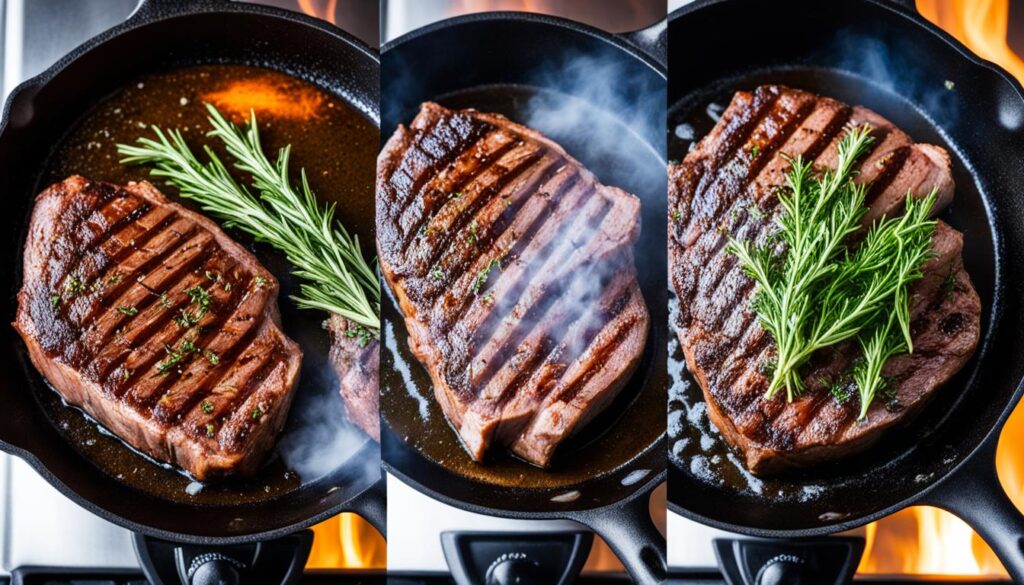
Things go wrong. Here’s what’s actually happening when they do and how to fix it — not for next time, but right now, while you’re cooking.
No crust forming
Two causes, almost always. The pan wasn’t hot enough — 4 full minutes of preheating is not a suggestion — or the steak surface was wet. A wet steak creates steam when it hits the hot oil, and steam prevents the Maillard reaction. Dry the steak aggressively with paper towels, and preheat longer than feels necessary.
A third possibility: crowding. Two ribeyes maximum in a 12-inch skillet. More than two and the steam they emit builds up between the steaks rather than escaping, and you get braised beef instead of seared steak.
Overcooked exterior, undercooked center
The steak went in too cold or the heat is too aggressive for the thickness. For 1-1/2-inch steaks: sear both sides at high heat to build the crust, then drop the temperature significantly and finish in a 300°F oven for 5 to 8 minutes. The oven heats from all sides simultaneously and brings the center up gently while the exterior stops receiving intense direct heat.
Excessive smoke
Some smoke is unavoidable at searing temperatures. But excessive, triggering-the-alarm smoke is usually: the wrong oil (anything with a low smoke point), old residue burning on the pan surface, or the heat being higher than the seasoning on the cast iron can handle. Avocado oil, a properly seasoned surface, and a functioning exhaust fan handle most of it.
Sticking
A properly preheated, properly seasoned cast iron pan releases steak cleanly when the crust has set — if it’s sticking, either the pan isn’t hot enough (sticking happens at mid-range temperatures, not at properly searing temperatures) or the seasoning needs attention. Don’t force it. Wait another 30 seconds and try again.
| Problem | Most likely cause | What to do |
|---|---|---|
| No crust | Wet surface or insufficient preheat | Dry steak aggressively, preheat 4 full minutes |
| Overcooked edge, cold center | Steak too cold going in | Temper 40 min, finish in low oven |
| Sticking | Pan not hot enough or poor seasoning | Wait 30 sec, re-season if needed |
| Too much smoke | Wrong oil or pan residue | Avocado oil, clean the pan, exhaust fan on |
Pairing Suggestions for Your Cast Iron Ribeye
Ribeye is rich. The fat content is high and the beef flavor is intense — side dishes need to either cut through that richness or be substantial enough to stand alongside it without disappearing.
What works
Acid and bitterness are the most effective contrasts. Roasted asparagus with lemon, a sharp arugula salad with good olive oil and parmesan, or a simple wedge of lemon alongside the plate. Creamed spinach is the classic choice — rich against rich, but the iron in the spinach has a specific affinity with red meat. Twice-baked potatoes are substantial enough to belong on the same plate as a ribeye without getting lost.
What doesn’t
Sweet sides compete with the natural richness of the beef fat in a way that tips the flavor balance. Glazed carrots, candied yams, sweet potato dishes with maple — all of these push toward a flavor profile where the steak tastes heavier than it should. Delicate flavors disappear entirely. A light vinaigrette salad with soft greens just evaporates next to a ribeye.
Wine
Bold red. That’s the answer. Cabernet Sauvignon, Syrah, Malbec, a Côtes du Rhône. The tannins in a bold red bind to the proteins and fat in the beef and the pairing makes both the wine and the steak taste better than either does alone. A light Pinot Noir with a ribeye is technically compatible and practically a waste of both — the wine gets overwhelmed and the steak makes it taste thin.
For something completely different alongside the steak rather than a wine recommendation, this beef and broccoli stir-fry makes an excellent beef-forward side when you want the whole table leaning in that direction.