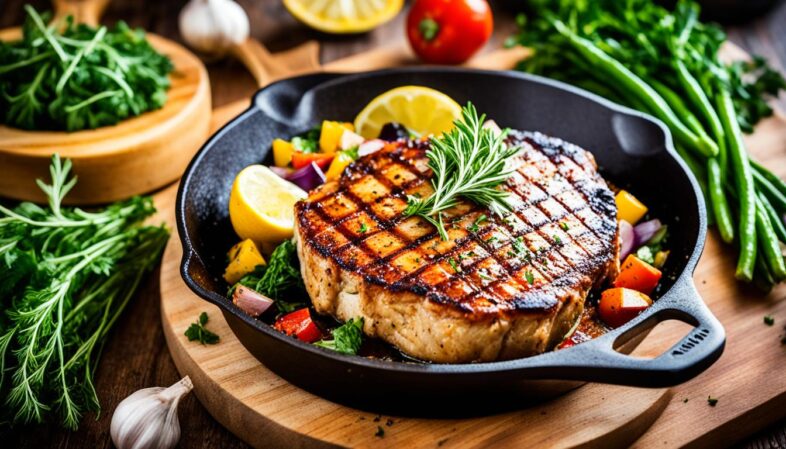
Have you ever wanted to make a pork chop taste like it came from a fancy restaurant such as Ruth’s Chris, Texas Roadhouse, Outback Steakhouse, and Fleming’s Prime Steakhouse? The secret is using a cast iron skillet. This pan helps make tasty pork chops that are juicy and full of flavor.
Let me show you 12 amazing cast iron skillet pork chop recipes. They will change the way you cook dinner. These meals are quick and easy, great for busy nights or when you have company over.
We’ll go from classic herb-crusted chops to exciting Asian flavors together. You’ll see pork in a whole new light. Plus, I’ll teach you to get that perfect outside while keeping the inside moist.
Are you ready to boost your cooking game with some new and tasty dinner recipes? These cast iron skillet pork chop dishes are juicy and ready in under 15 minutes.
The 12 cast iron skillet pork chop recipes in this article cover varieties such as Classic Herb-Crusted, Garlic Butter, Smoky Paprika and Thyme, Apple Cider Glaze, Mustard and Rosemary, Cajun-Spiced, Maple-Glazed, Asian-Inspired Soy and Ginger, Balsamic and Honey Glazed, Mediterranean with Olives and Tomatoes, Creamy Mushroom Sauce, and Low-Carb Lemon and Herb — each one cooked in a cast iron skillet and sized to serve four.
Why People Love Cooking Pork Chops in a Cast Iron Skillet
Here’s the honest answer: the crust.
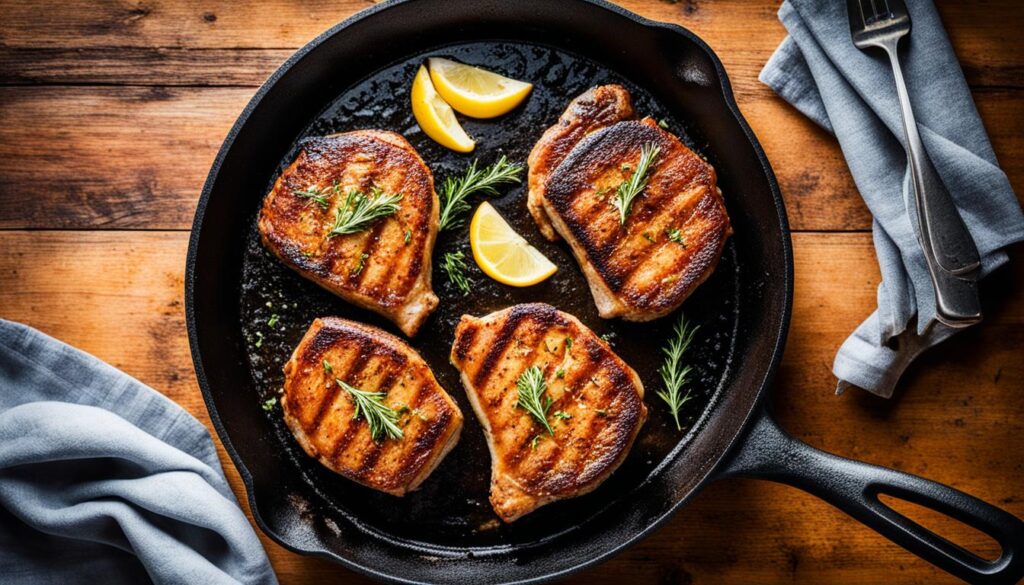
Everything else — the juiciness, the flavor, the way the fat renders into the fond that becomes your sauce — all of it traces back to what cast iron does to the surface of a pork chop that no other pan in your kitchen can replicate. Nonstick can’t get hot enough without degrading. It’s a hard ceiling. Stainless steel drops temperature the moment your cold chop hits it and you lose the sear before it even starts. Cast iron holds. It doesn’t flinch when cold meat goes in because it has so much thermal mass that a 6-ounce pork chop barely registers.
That’s the whole physics of it, honestly. Hot surface + dry meat = crust. And cast iron keeps that surface hot longer than anything else on your stovetop.
| Skillet type | Heat after cold meat hits | Sear result | Builds fond? |
|---|---|---|---|
| Cast iron | Barely drops — keeps searing | Deep, crackly crust | Yes, aggressively |
| Stainless | Noticeable drop mid-sear | Decent if you preheat well | Some |
| Nonstick | Can’t get hot enough | Pale, steamed-looking | Barely |
Bone-in chops are better than boneless. That’s just true — the fat near the bone bastes the meat from the inside during cooking and the flavor is noticeably deeper. But boneless works fine in every recipe here, so don’t stress if that’s what’s available. Just don’t go thinner than 1 inch either way. Thinner pork chops overcook before a real crust has time to form and you’re left with dry, gray meat with a disappointingly pale exterior.
Before any recipe: check your skillet’s surface. Bare or poorly seasoned cast iron sticks, tears the crust off, and turns what should be a 30-minute dinner into a frustrating mess. This guide on cleaning and maintaining a cast iron skillet is worth reading before you start.
Essential Tips for Perfectly Seared Pork Chops
These apply across all 12 recipes. Get them wrong and it doesn’t matter which recipe you pick.
Thickness
One inch. Minimum. No exceptions, no workarounds — thinner than that and the chop overcooks before any meaningful crust can form. Bone-in center-cut is the best option. Boneless loin is fine. Just give yourself enough thickness to work with.
The oil situation
| Oil | Smoke point | Use it for searing? |
|---|---|---|
| Avocado | 500-520°F | Yes — best choice |
| Grapeseed | 400-420°F | Works well |
| Canola | 400-450°F | Cheap and effective |
| Olive oil | 325-375°F | No — it burns before the sear is done |
And the skillet underneath the oil matters too. The proper seasoning process for cast iron isn’t complicated, but skipping it means food sticks and the crust tears off and all of this effort produces a mediocre result.
Temperature — the part everyone gets wrong
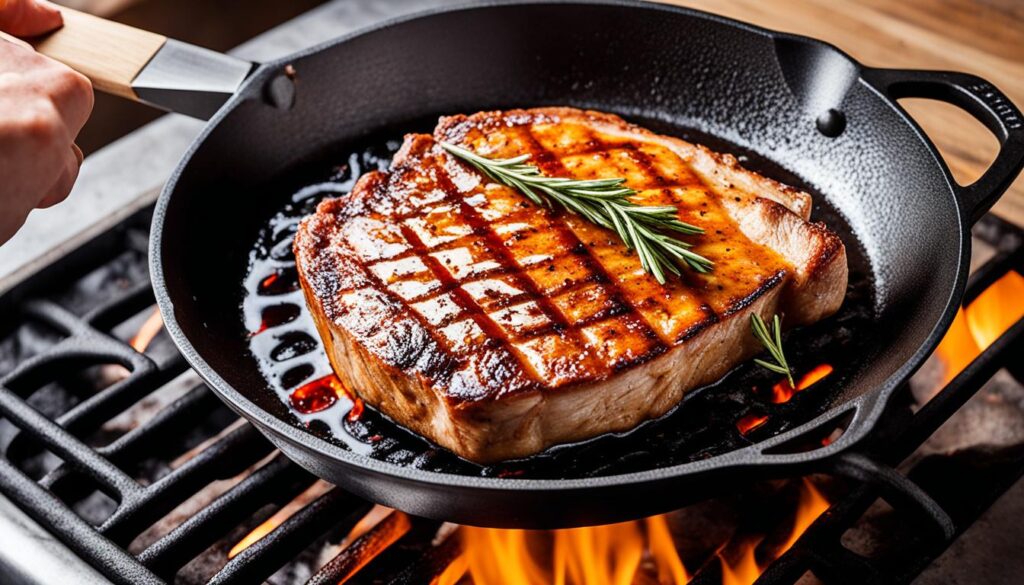
Three minutes of preheating over medium-high before anything goes in the pan. Not 90 seconds. Not “until it feels warm.” Three full minutes so the heat penetrates the entire mass of the iron, not just the cooking surface. Then oil, then 30 seconds, then meat.
The internal temperature target is 145°F — that’s the current USDA recommendation and it’s been updated from the old 160°F. At 145°F, the center of a pork chop is slightly pink. That’s correct. That’s safe. And it’s dramatically juicier than anything cooked to fully white. Stop chasing a white interior. The people who say pork has to be fully white are working from outdated food safety guidelines and producing dry meat.
Classic Herb-Crusted Cast Iron Skillet Pork Chops
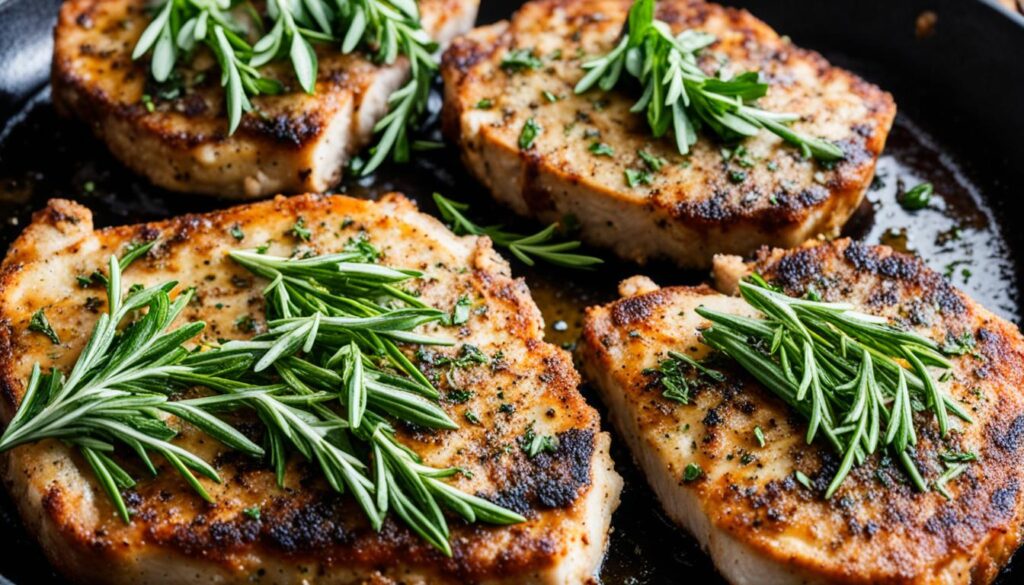
My go-to for a weeknight when I want food that tastes like I thought about it. Fresh parsley, thyme, rosemary, garlic — pounded together into a rough paste and pressed firmly into dry pork chops before searing. When the herbs hit the hot fat in the cast iron, they toast. The kitchen smells like something worth staying home for.
Dried herbs technically work. Fresh herbs are noticeably better. The moisture in fresh herbs helps the paste grip the meat during searing instead of sliding off into the pan fat, and the flavor that blooms when they hit high heat is something dried herbs — which have already lost most of their volatile oils — can’t really replicate. It takes maybe 2 extra minutes of chopping. Worth it.
While the chops rest, stir-fried vegetables and noodles come together in about the same time.
Ingredients
- 4 bone-in pork chops, about 1 inch thick
- 2 tablespoons olive oil
- 1/4 cup fresh flat-leaf parsley, roughly chopped
- 2 tablespoons fresh thyme leaves
- 2 tablespoons fresh rosemary, finely chopped
- 3 cloves garlic, minced
- 1-1/2 teaspoons kosher salt
- 1/2 teaspoon black pepper
Instructions
Parsley, thyme, rosemary, garlic, salt, and pepper go into a small bowl together. Stir until it looks like a rough paste — green, fragrant, slightly wet from the fresh herbs. Pat the pork chops completely dry on both sides. And I mean completely. Then press that paste firmly onto every surface of each chop. Both flat sides. The edges. The fat cap. Don’t be shy about it. Press hard. The chops should look generously green-flecked and smell immediately herby before they’re anywhere near the stove.
Cast iron over medium-high heat for 3 minutes. When you hold a palm a few inches above it, the radiating heat should feel almost aggressive. Olive oil in — it shimmers within seconds because the pan is that hot. Lay the chops down, away from you. Now don’t touch them.
Four to 5 minutes. The herbs on the underside transition from bright green to a deeper, toasted color as the fat renders below them and the crust builds from the bottom up. You’ll know it’s time to flip when the chop nudges slightly with tongs instead of gripping — the crust releases on its own when it’s set. The cooked underside looks amber-green with darker patches where the herbs sat directly against the cast iron surface.
Flip. Four to 5 more minutes. Thermometer at the thickest point reads 145°F and they come off. Five minutes on a plate — the herb crust firms up slightly as it cools, going from soft and fragrant to something almost crunchy at the edges. That texture change during resting is exactly why fresh herbs matter here.
Nutritional Information (Per Serving)
| Nutrient | Amount per Serving |
|---|---|
| Calories | 385 |
| Carbohydrates | 2g |
| Protein | 42g |
| Fat | 22g |
| Fiber | 0.5g |
| Sodium | 610mg |
Garlic Butter Cast Iron Pork Chops
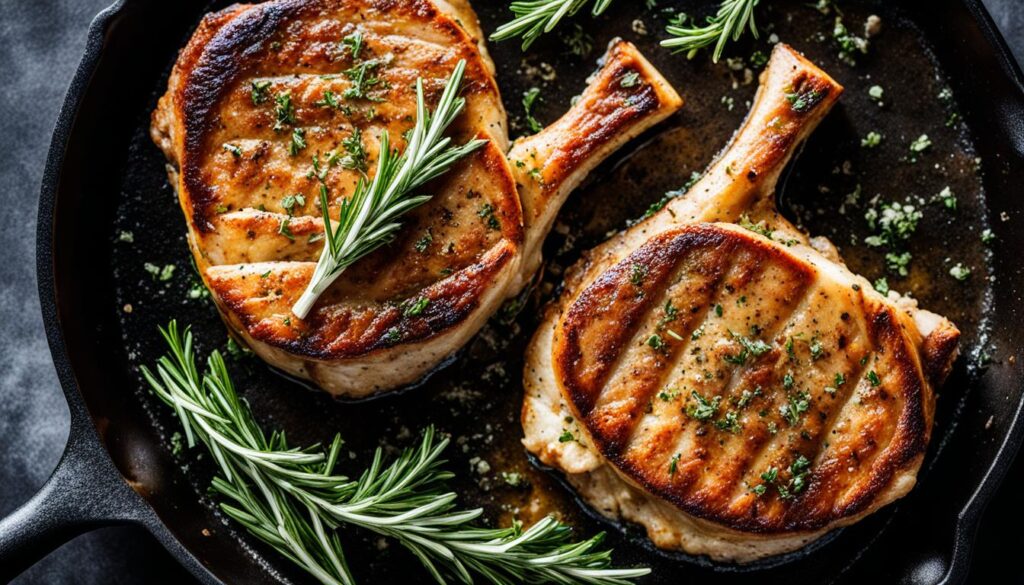
Basting with garlic butter sounds like a restaurant technique. It isn’t — or rather, it is, but it’s also completely manageable at home and it takes maybe 3 minutes after the initial sear. You drop the heat, add butter and smashed garlic and thyme to the pan, tilt the skillet so it pools, and spoon it repeatedly over the chops while the butter foams and turns golden and the garlic softens in it. The flavor that goes into the surface of the pork during those 3 minutes is the whole difference between this recipe and just a seared pork chop.
A quick cabbage stir-fry works well alongside and is ready in about the same time as the rest period.
Ingredients
- 4 bone-in pork chops, about 1 inch thick
- 1-1/2 teaspoons kosher salt
- 1 teaspoon black pepper
- 1 tablespoon avocado oil
- 4 tablespoons unsalted butter
- 4 cloves garlic, smashed
- 4 sprigs fresh thyme
Instructions
Dry the chops. Both sides, pressing firmly with paper towels until the surface feels dry rather than slick. Season all over with salt and pepper. Set aside while the pan heats — room temperature meat sears more evenly than cold meat straight from the fridge, and even 10 minutes makes a difference.
Medium-high heat, 3 full minutes on the cast iron before the avocado oil goes in. Shimmer, then the chops down. Three to 4 minutes per side — the surface builds to a deep golden-brown and when you press it with tongs it feels firm and slightly resistant, not soft or giving. That resistance is the crust telling you the fat has rendered and the exterior has set properly.
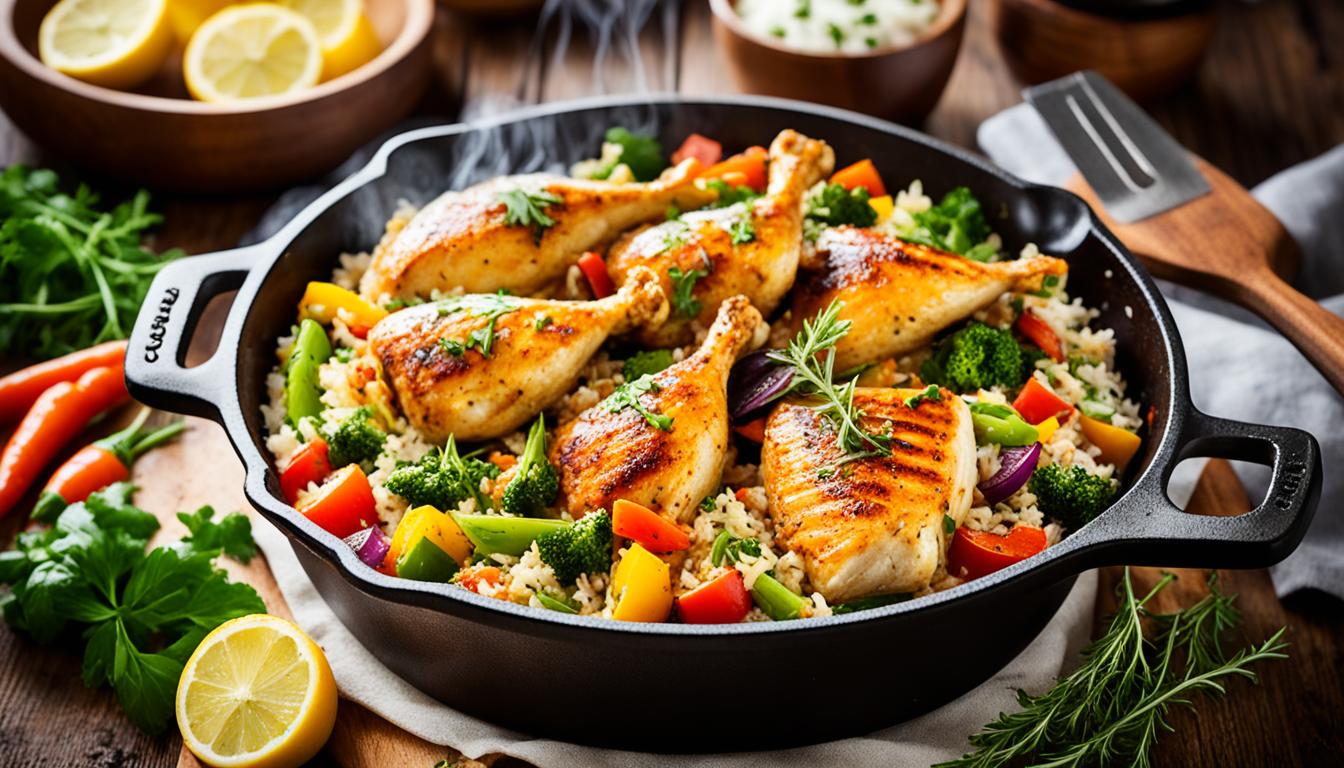
Both sides done. Heat to medium-low. Butter, smashed garlic, thyme sprigs, all of it into the pan around and between the chops. The butter melts almost immediately — foam appears first, then it starts settling and clearing as the milk solids brown. Tilt the skillet so the butter pools to one side. Spoon. Keep going. Two to 3 minutes of consistently spooning foaming golden butter over the top surface of each chop, and the garlic in the pan starts smelling faintly sweet rather than raw. That’s the sign it’s done its job.
145°F internal, then off the heat. Spoon the pan butter over everything at the table, garlic pieces and all.
Nutritional Information (Per Serving)
| Nutrient | Amount per Serving |
|---|---|
| Calories | 498 |
| Carbohydrates | 1g |
| Protein | 41g |
| Fat | 36g |
| Fiber | 0g |
| Sodium | 640mg |
Smoky Paprika and Thyme Skillet Pork Chops
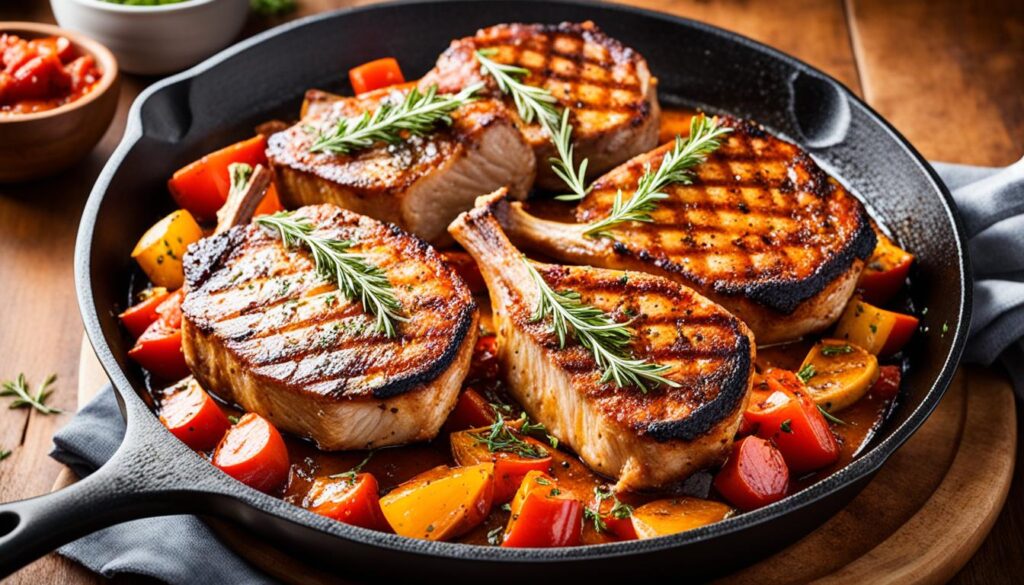
Three minutes to mix the spice blend. The cast iron handles everything after that. What smoked paprika does in a hot pan is genuinely impressive — it blooms in the fat, the kitchen fills with that wood-fire smell almost instantly, and the crust that forms on the pork chop is a deep reddish-brown that looks like something off an outdoor grill. It doesn’t taste like a weeknight dinner from a stovetop. It tastes like it was cooked somewhere intentional.
Smoked paprika. Not sweet. Not regular. The word smoked is doing real work here and substituting either of the others produces a noticeably flatter result.
The lemon squeeze at the very end is not decorative. Acid on a spiced crust changes the whole flavor balance of the bite. Try it without lemon once if you want — then try it with — and that will be the last time you question whether it’s necessary.
This skillet recipe using oyster sauce uses similar bold flavor logic if you want a seafood option on a different night.
Ingredients
- 4 bone-in pork chops, about 1 inch thick
- 2 tablespoons smoked paprika
- 1-1/2 teaspoons kosher salt
- 1/2 teaspoon black pepper
- 1 tablespoon fresh thyme leaves
- 2 tablespoons avocado oil
- Juice of 1 lemon
Instructions
Small bowl: smoked paprika, salt, pepper, thyme. Stir. The mixture is intensely red-orange and already smells smoky before it’s anywhere near heat. Dry the chops completely — more thoroughly than you think is necessary, because moisture on the surface competes with the spice rub for contact with the hot fat, and the spice rub should win. Press the seasoning into every surface of each chop. Edges, fat cap, both flat sides. No pale spots. Uniformly vivid reddish-orange.
Fifteen minutes at room temperature. This matters — cold pork in a hot cast iron pan creates a temperature gradient that produces uneven cooking from the center outward.
Cast iron over medium-high, 3 minutes. Oil in, shimmer, chops down. The paprika blooms in the hot fat immediately — that smoky, savory smell arrives within seconds and doesn’t leave. Three to 4 minutes on the first side and watch the color at the very edge of each chop, where it meets the pan surface: it shifts from bright orange-red toward a deeper brownish-burgundy as the crust deepens. The chop is ready to flip when it releases cleanly without resistance. Three to 4 minutes on the second side.

145°F at the thickest point. Plate, rest for 5 minutes, then squeeze the lemon over every surface before it goes to the table.
Nutritional Information (Per Serving)
| Nutrient | Amount per Serving |
|---|---|
| Calories | 390 |
| Carbohydrates | 3g |
| Protein | 42g |
| Fat | 22g |
| Fiber | 1g |
| Sodium | 600mg |
Cast Iron Skillet Pork Chop Recipes with Apple Cider Glaze
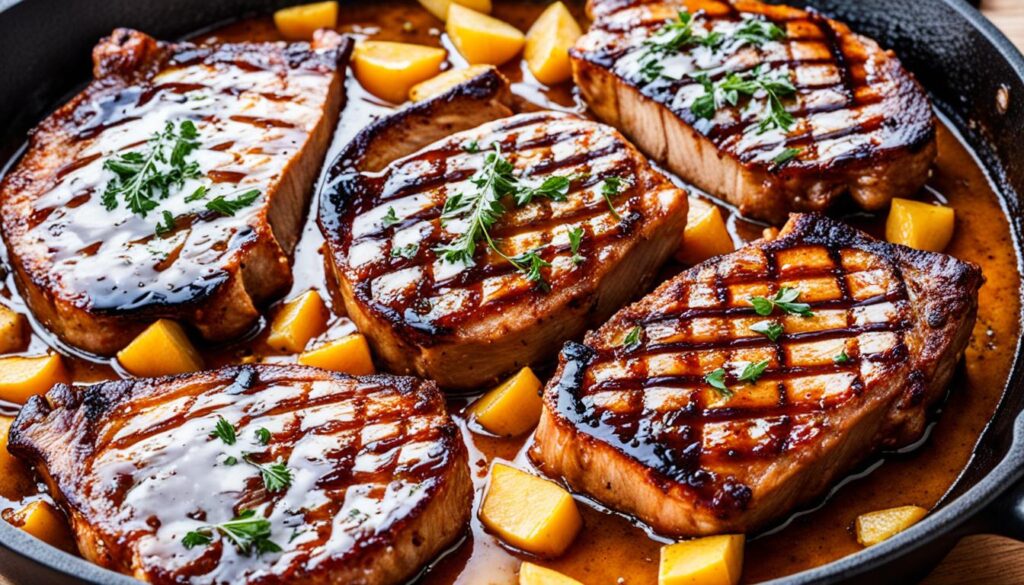
Start the glaze before anything else. It takes 15 minutes of simmering to reduce properly and you can sear the pork while it finishes, which means everything is ready at roughly the same time. Real apple cider — not apple juice, not apple cider vinegar, actual cloudy pressed apple cider — cooked down with brown sugar and cinnamon until it goes syrupy and concentrated and smells like a very good candle except it’s food.
The seared pork under that glaze is sort of incidental, in the best way. Both elements are good. Together they’re noticeably better than either one alone.
Good sides: sautéed apples in the same pan after the chops come out, roasted Brussels sprouts, or the shrimp and dumpling stir-fry for a completely different direction.
Ingredients
- 4 bone-in pork chops, about 1 inch thick
- 1-1/2 teaspoons kosher salt
- 1 teaspoon black pepper
- 1 tablespoon avocado oil
- For the apple cider glaze:
- 2 cups apple cider (not juice — actual cider)
- 1/4 cup brown sugar, packed
- 1 teaspoon ground cinnamon
- 1 tablespoon unsalted butter
- 1/2 teaspoon apple cider vinegar
Instructions
Cider, brown sugar, cinnamon into a small saucepan. Medium heat. Stir to dissolve the sugar and bring to a steady simmer — it looks thin and pale at first, almost watery, and that’s fine. Leave it at a steady simmer for 15 minutes. By the end it’s reduced by more than half and the texture has shifted from liquid to something that coats the back of a spoon and doesn’t run off immediately. Off heat: butter and vinegar stirred in. Set it aside to thicken further as it cools. (It will. Don’t worry if it still looks thin at this point.)
Pork chops dry, seasoned with salt and pepper. Cast iron over medium-high, 3 minutes. Oil in, shimmer. Chops flat-side down — 4 to 5 minutes per side. Deep golden, releasing cleanly, internal temperature around 140°F as they come off. Plate and rest.
Glaze warmed gently if it’s cooled too much — it should be brushable, not stiff. Brush generously over both sides of each chop. The glaze should look glossy and sit on the meat surface rather than running immediately off the sides. If it runs, it needs another few minutes of simmering. Spoon any excess from the pan over the top before serving.
Nutritional Information (Per Serving)
| Nutrient | Amount per Serving |
|---|---|
| Calories | 445 |
| Carbohydrates | 32g |
| Protein | 40g |
| Fat | 16g |
| Fiber | 0.5g |
| Sodium | 590mg |
Mustard and Rosemary Pan-Seared Pork Chops
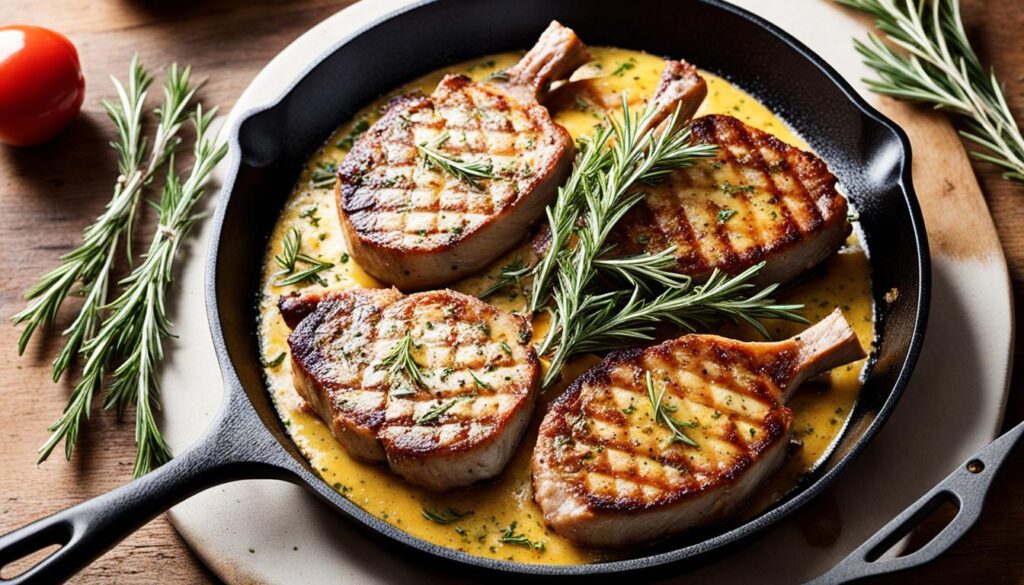
Two inches thick. Not the standard 1-inch chops — two. Thinner chops don’t carry the Dijon-rosemary marinade the way they need to, and they tend to dry out in the pan before the crust has time to develop properly with a wet marinade on the surface. The extra thickness gives you margin.
The marinade is Dijon mustard, fresh rosemary, garlic, olive oil — mixed together and slathered onto the chops for at least an hour in the fridge. During that time the mustard starts working on the surface of the meat in a way that’s hard to describe but obvious in the finished dish: the crust that forms during searing is tangy and herby and considerably more complex than four ingredients should be able to produce.
Ingredients
- 4 boneless pork loin chops, about 2 inches thick
- 2 tablespoons Dijon mustard
- 1 tablespoon fresh rosemary, finely chopped
- 2 cloves garlic, minced
- 2 tablespoons olive oil, divided
- 1/4 cup dry white wine
- 1/2 teaspoon kosher salt
- 1/4 teaspoon black pepper
Instructions
Dijon, rosemary, garlic, and 1 tablespoon of olive oil into a bowl and mix. It looks pale yellow-green and glossy. It smells sharp — the mustard and rosemary fighting for dominance, neither winning. Coat the pork chops completely and refrigerate for at least 1 hour, ideally 2. When you pull them out, the mustard coating will have darkened and dried slightly against the meat — that concentrated layer is exactly what creates the crust during searing.
Twenty minutes out of the fridge before cooking. Cast iron over medium-high, 3 minutes. Remaining olive oil in. Chops down — 4 to 5 minutes, and the mustard-rosemary coating forms a golden-brown crust that looks speckled and irregular and smells like a French bistro in a way that’s frankly a little embarrassing for a home kitchen. Another 4 to 5 minutes on the second side. 145°F internal, then the chops come off to rest.
White wine straight into the hot pan. It steams hard and lifts the mustard-flecked fond off the bottom immediately — scrape as it simmers. Five minutes of boiling and it goes from thin and acidic to syrupy and concentrated, all that fond now part of the sauce. Spoon it directly over the rested chops.
| Step | Time | What to look for |
|---|---|---|
| Marinating | 1-2 hours cold | Mustard darker, slightly dried on surface |
| Each side seared | 4-5 minutes | Speckled golden-brown, releases cleanly |
| Wine sauce reduction | ~5 minutes | Syrupy, coats the back of a spoon |
Nutritional Information (Per Serving)
| Nutrient | Amount per Serving |
|---|---|
| Calories | 410 |
| Carbohydrates | 2g |
| Protein | 44g |
| Fat | 24g |
| Fiber | 0g |
| Sodium | 480mg |
Cajun-Spiced Cast Iron Pork Chops
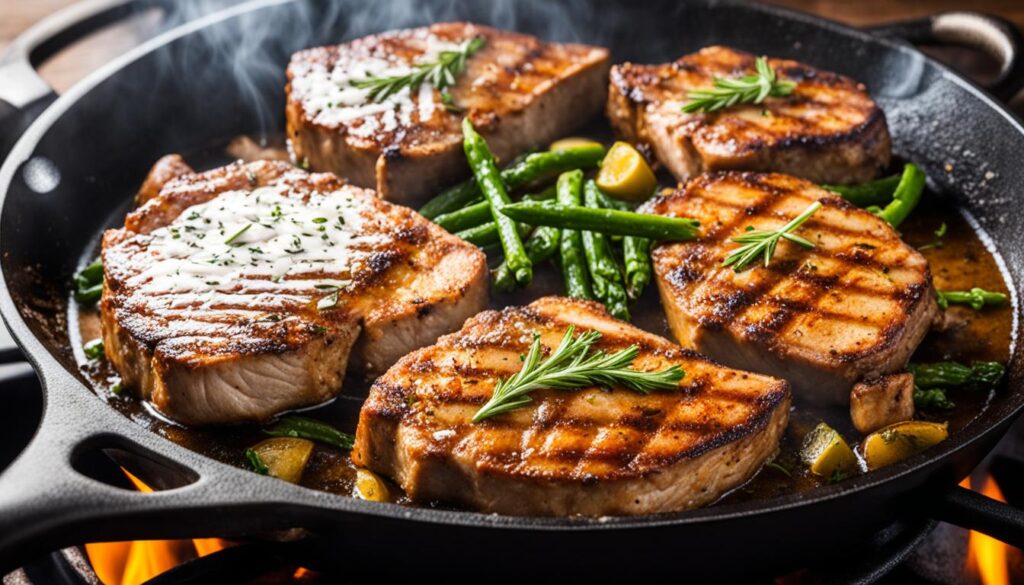
Make your own blend. Store-bought Cajun seasoning is almost always oversalted and flat — it’s designed for mass production, not for creating a genuinely complex crust on a thick pork chop in a screaming hot cast iron pan. Three minutes to mix your own, and the difference on the first bite is obvious.
Serve with dirty rice and collard greens. That’s the right call here and there isn’t really a substitute that works as well.
Ingredients
- 4 bone-in pork chops, about 1 inch thick
- 1 tablespoon avocado oil
- 1 tablespoon unsalted butter
- Cajun spice blend:
- 2 teaspoons smoked paprika
- 1 teaspoon garlic powder
- 1 teaspoon onion powder
- 1/2 teaspoon dried oregano
- 1/2 teaspoon dried thyme
- 1/4 teaspoon cayenne (add more if you want real heat — this amount is present but not aggressive)
- 1/2 teaspoon black pepper
- 1 teaspoon kosher salt
Instructions
Spice blend into a small bowl and stirred together. It should look vivid, reddish-orange, and smell complex in a way that a single spice doesn’t — the paprika and cayenne and garlic powder all contributing something different.
Dry the pork chops completely. Both flat sides, the edges, pressing with paper towels until the surface no longer feels tacky. Press the spice blend onto every surface of each chop, working it into the fat cap and edges. No pale patches at all — the chops should look uniformly deep orange-red before they go near heat. Let them sit for 15 minutes at room temperature.
Cast iron over medium-high, 3 minutes. Avocado oil in and shimmering. Chops go in — the Cajun spices bloom in the hot fat immediately, the smoky-peppery smell arriving before the sizzle even settles. Five to 6 minutes on the first side for 1-inch chops. Don’t move them. The crust builds underneath and will release naturally when it’s ready. Forcing it before that point tears the crust off the surface and it’s gone. Flip when it releases cleanly — 5 to 6 minutes on the second side.
Heat to medium-low. Butter into the pan, melting and foaming around the chops, brief basting. 145°F internal. Rest 5 minutes — the crust top looks deeply burnished, almost burgundy-brown at the thickest sections, and the whole thing smells like the best part of a New Orleans restaurant.
Nutritional Information (Per Serving)
| Nutrient | Amount per Serving |
|---|---|
| Calories | 398 |
| Carbohydrates | 2g |
| Protein | 42g |
| Fat | 23g |
| Fiber | 0.5g |
| Sodium | 620mg |
Maple-Glazed Skillet Pork Chops
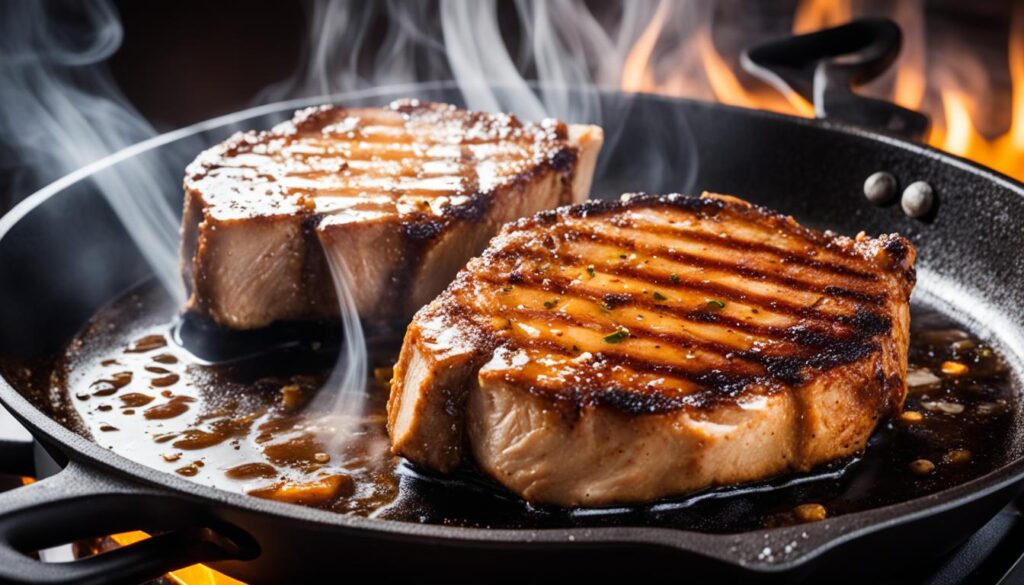
Pure maple syrup. Not pancake syrup — not “maple-flavored” syrup — pure maple syrup, which caramelizes against seared pork in a cast iron pan in a way that’s completely different from the corn-syrup version. Mixed with apple cider vinegar, Dijon mustard, and coconut aminos, and brushed onto bone-in chops midway through cooking. The edges caramelize. The surface goes lacquered and sticky. It’s the kind of thing that makes people quiet at the table.
Ingredients
- 4 bone-in center-cut pork chops, about 1 inch thick
- 1-1/2 teaspoons smoked paprika
- 1 teaspoon garlic powder
- 1 teaspoon kosher salt
- 2 tablespoons butter, ghee, or lard
- Maple glaze:
- 1/3 cup pure maple syrup
- 2 tablespoons apple cider vinegar
- 2 tablespoons coconut aminos
- 2 tablespoons Dijon mustard
Instructions
Smoked paprika, garlic powder, and salt mixed and pressed onto all surfaces of the chops. Separately, maple syrup, apple cider vinegar, coconut aminos, and Dijon mustard whisked together in a small bowl until uniform. The mixture looks dark and glossy. Taste it — sharp from the mustard and vinegar, sweet from the maple, with a soy-like depth from the coconut aminos that’s hard to place but definitely there. Set it aside.
Butter or fat into the cast iron over medium-high. When it foams and the foam starts clearing, indicating the water has cooked off and the fat is hot enough, the chops go in. Two minutes per side at high heat to build the initial sear, then heat dropped to medium-low. Three to 5 more minutes per side, and during this lower-heat phase the glaze goes on.
Brush it onto the top surface of each chop while they cook. It goes on shiny and wet-looking — as the heat works it from below, the edges begin showing a subtle shift from glossy to amber-caramelized. Flip, brush the second side. Check the temperature at this point. At 145°F internal they come off.
Rest 10 to 15 minutes — longer than most recipes because the glaze continues setting as the chops cool and the surface texture genuinely improves with that extra time. Brush any remaining glaze over the top before serving.
Nutritional Information (Per Serving)
| Nutrient | Amount per Serving |
|---|---|
| Calories | 420 |
| Carbohydrates | 22g |
| Protein | 40g |
| Fat | 18g |
| Fiber | 0g |
| Sodium | 560mg |
Asian-Inspired Soy and Ginger Cast Iron Pork Chops
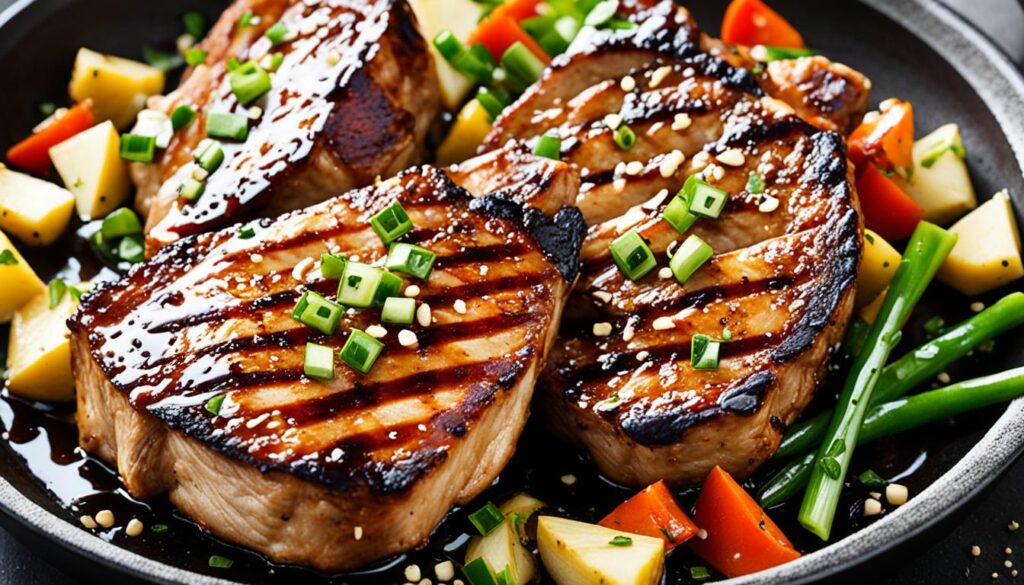
The time you spend marinating this directly determines how good the result is. Twenty minutes: noticeably better than unseasoned pork. One hour: significantly better. Overnight in the fridge: the ginger and soy have penetrated the meat surface and the cast iron sear turns it into something caramelized, lacquered, and deeply savory with a honey sweetness underneath — a completely different dish than what the same chop tastes like after 20 minutes.
Plan accordingly.
Low-sodium soy sauce only — regular soy sauce concentrates in a hot pan into something aggressively salty before the sear is even finished.
Ingredients
- 4 bone-in pork chops, about 1 inch thick
- 1 tablespoon avocado oil
- Marinade:
- 1/4 cup low-sodium soy sauce
- 2 tablespoons honey
- 4 cloves garlic, minced
- 1 teaspoon fresh ginger, minced
- 1 teaspoon sesame oil
- 2 teaspoons gochujang sauce
- 1 tablespoon rice vinegar
- 2 green onions, sliced (for serving)
- 1 teaspoon sesame seeds (for serving)
Instructions
All marinade ingredients into a shallow bowl or zip-lock bag. Pork chops in, coated on every surface. Marinate at least 20 minutes at room temperature — longer and colder is better. When they come out, reserve the marinade separately. Don’t throw it away.
Before the pan: blot the surface of each chop lightly. Not dry — lightly. The honey in the marinade caramelizes fast and too much of it sitting on the surface will char before the meat sears through. Light blot, that’s all.
Cast iron over medium-high, 3 minutes. Avocado oil in, shimmer. Chops down — the sizzle is louder and more aggressive than plain-seasoned pork because of the sugars, and the color on the surface deepens faster. Watch the edges rather than the clock: 3 to 4 minutes and the surface should look caramelized-amber rather than just browned. Flip. Another 3 to 4 minutes. 145°F internal.
Off heat — reserved marinade into the still-hot pan. Two minutes of residual heat warms it through and reduces it slightly. Spoon this over the rested chops. Green onions and sesame seeds over everything right before serving.
Nutritional Information (Per Serving)
| Nutrient | Amount per Serving |
|---|---|
| Calories | 388 |
| Carbohydrates | 12g |
| Protein | 43g |
| Fat | 18g |
| Fiber | 0g |
| Sodium | 740mg |
Balsamic and Honey Glazed Skillet Pork Chops
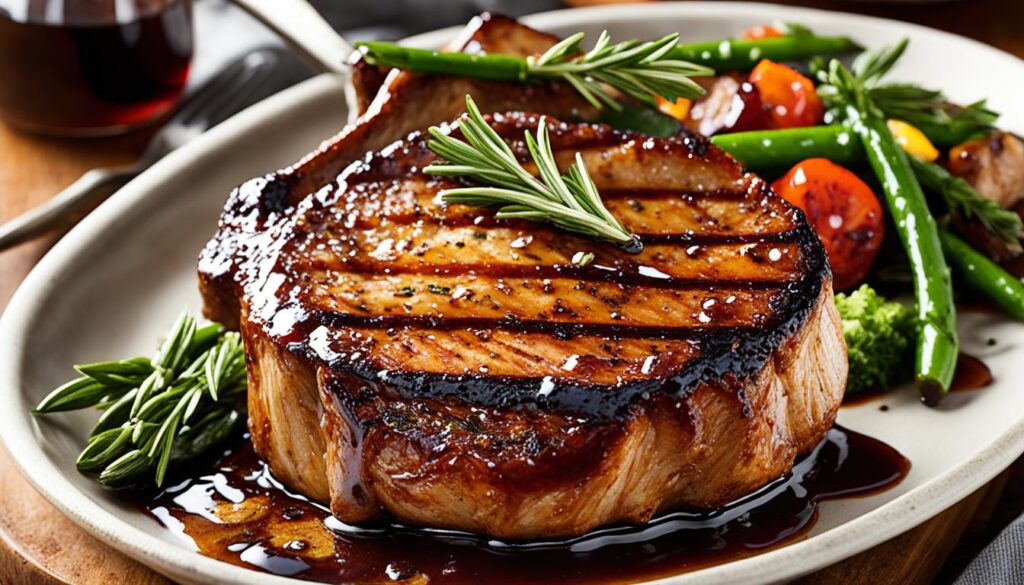
Balsamic vinegar in a hot cast iron pan with the fond from seared pork chops becomes something wine-like and concentrated — the acidity softens, the natural sugars caramelize, the fond from the sear adds savory depth. Honey gives it body. Butter finishes it glossy. The whole sauce takes under 5 minutes and the result looks like a restaurant glaze.
Thirty minutes. Looks like considerably more effort than that.
Ingredients
- 4 boneless pork loin chops, about 1 inch thick
- 1-1/2 teaspoons kosher salt
- 1 teaspoon black pepper
- 2 tablespoons avocado oil
- 2 cloves garlic, minced
- 1/4 cup balsamic vinegar
- 1/4 cup honey
- 1 tablespoon unsalted butter
Instructions
Balsamic and honey stirred together in a small bowl — dark, thin, liquid. Minced garlic set aside separately. Chops dried, salted, peppered.
Medium-high heat, cast iron, 3 minutes, oil in shimmering. Chops down. Four to 5 minutes on the first side — the surface builds up gradually from pale to golden to deep amber, and at some point in that process the chop releases cleanly from the pan surface rather than gripping it. That release point is the flip. Other side, 4 to 5 minutes. 145°F internal, chops to a plate.
Same pan, heat medium-low. Minced garlic into all that rendered pork fat — 30 seconds of stirring, pale gold, fragrant, before it has a chance to brown and turn bitter. Balsamic-honey mixture poured in. Immediate bubbling as it picks up the hot fat and fond. Wooden spoon across the bottom, scraping up everything. Two to 3 minutes of simmering and the sauce transforms — from thin and acidic to a glossy, syrupy consistency that coats the spoon thickly. Off heat, cold butter stirred in until the surface looks lacquered.
Pour over the resting chops. Give it 5 more minutes before serving. The glaze sets slightly as everything cools and the texture on the surface of the pork improves noticeably during that short wait.
Nutritional Information (Per Serving)
| Nutrient | Amount per Serving |
|---|---|
| Calories | 462 |
| Carbohydrates | 24g |
| Protein | 42g |
| Fat | 20g |
| Fiber | 0g |
| Sodium | 580mg |
Mediterranean-Style Pork Chops with Olives and Tomatoes
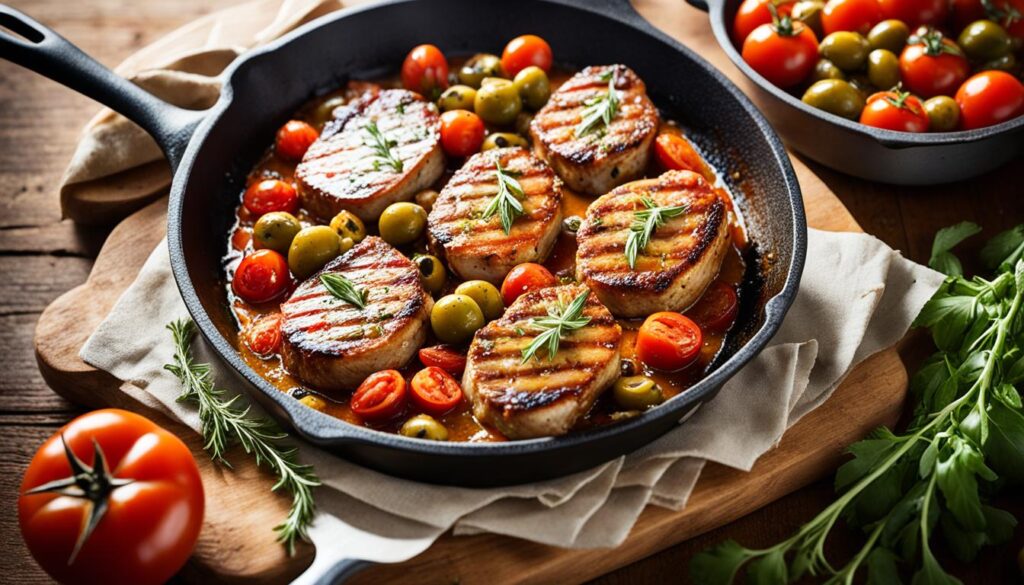
One pan. The pork sears and rests while the topping cooks in the same cast iron, using all the rendered fat and fond the chops left behind. Cherry tomatoes burst and go jammy. Kalamata olives bring brine and salt. Garlic and fresh oregano bring everything together. Then the chops go back in the pan and the feta goes on top.
The feta is not optional. Don’t omit it.
Ingredients
- 4 boneless pork chops, about 1 inch thick and 6 ounces each
- 1-1/2 teaspoons kosher salt
- 1 teaspoon black pepper
- 2 tablespoons olive oil, divided
- 1 cup cherry tomatoes, halved
- 1/2 cup kalamata olives, pitted and halved
- 3 cloves garlic, thinly sliced
- 1 tablespoon fresh oregano, roughly chopped
- 2 ounces feta cheese, crumbled
Instructions
Chops dried, seasoned with salt and pepper on all surfaces. Cast iron over medium-high, 1-1/2 tablespoons of olive oil, 3 minutes. Chops in — 4 to 5 minutes per side. The surface goes from pale to golden, the edges slightly darker where the fat has crisped up hardest against the pan. Internal at 145°F, then a plate and 5 minutes of rest.
Same pan, still on medium heat — remaining 1/2 tablespoon olive oil added. Cherry tomatoes and kalamata olives together, right into the hot pork fat. Immediate sizzling. The tomato skins start wrinkling and blistering within about 2 minutes as the cut sides caramelize against the pan surface. Sliced garlic goes in — 1 minute, stirring, the smell shifting to something more complex as garlic and olive brine combine with the pork drippings. Oregano for the last 30 seconds. Pan off the heat.
Pork chops nested back into the skillet, each one surrounded by the tomato-olive mixture. Topping spooned generously over each chop. Crumbled feta last — it softens slightly from the residual heat of the tomatoes and pork without melting fully, staying in recognizable crumbled pieces rather than going smooth.
Nutritional Information (Per Serving)
| Nutrient | Amount per Serving |
|---|---|
| Calories | 448 |
| Carbohydrates | 6g |
| Protein | 46g |
| Fat | 26g |
| Fiber | 1.5g |
| Sodium | 820mg |
Creamy Mushroom Sauce Cast Iron Pork Chops
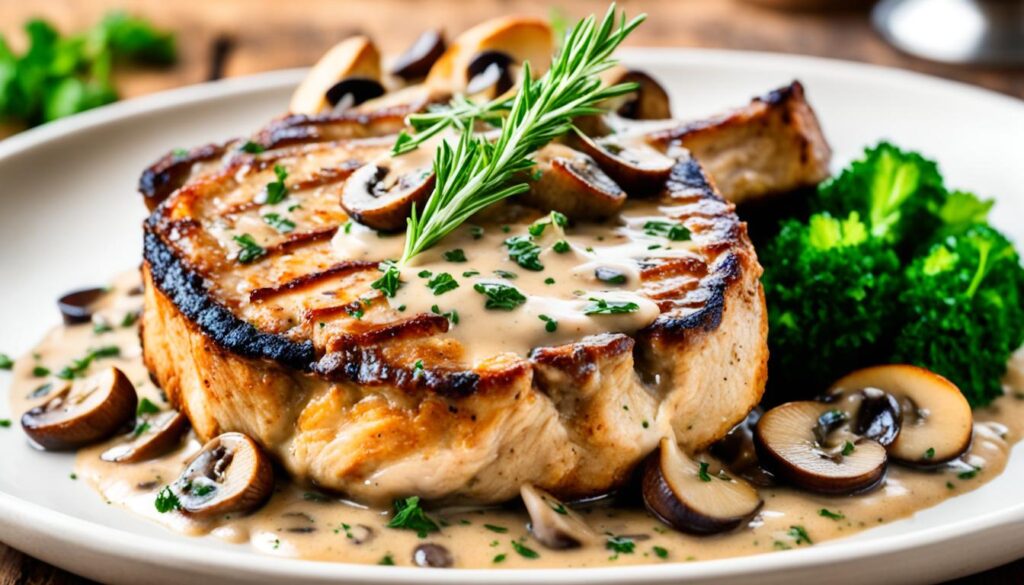
Cold night, want something that feels like real food. This is the recipe. Pork chops dredged in seasoned flour — which creates a golden-tan crust that’s slightly different from bare seared pork, thicker-textured and better at holding sauce — seared and then pulled while a cream sauce builds in the same pan. Mushrooms, garlic, heavy cream, thyme. The flour from the dredge thickens the sauce naturally as it comes off the fond. Everything finishes together.
One skillet. Thirty minutes. Enough richness to make the kitchen feel like somewhere worth being on a cold evening.
Ingredients
- 4 boneless pork loin chops, about 6 ounces each
- 2 tablespoons all-purpose flour
- 1 teaspoon Italian seasoning
- 1/2 teaspoon smoked paprika
- 1-1/2 teaspoons kosher salt, divided
- 1/2 teaspoon black pepper
- 3 tablespoons olive oil, divided
- 8 ounces cremini mushrooms, sliced
- 5 cloves garlic, minced
- 1-1/2 cups heavy cream
- 3 tablespoons fresh thyme leaves
Instructions
Flour, Italian seasoning, smoked paprika, 1 teaspoon of the salt, and the pepper into a shallow bowl. Stir into a pale, speckled powder. Dredge each chop through it on both sides, shaking off excess — lightly coated, not caked. The coating should look like a thin, even dusting. You should still be able to see the meat surface through it faintly.
Cast iron over medium-high, 2 tablespoons of olive oil, 3 minutes. Chops in — 3 to 4 minutes per side. The flour coating goes golden-tan rather than the deep amber of bare seared pork, and it feels slightly crispy when you press it. Not the same texture as a bare sear — more like a crust with some body to it. Pull the chops to a plate.
Remaining olive oil into the same pan. Sliced mushrooms in — they look pale and feel firm going in, and then spend about 2 minutes releasing liquid and looking wet before the pan dries and they start to genuinely brown. Four minutes and they’re golden at the edges, slightly crispy, and the kitchen smells like mushrooms cooking in pork fat, which is one of the better kitchen smells available. Minced garlic, 1 minute, stirring.
Heavy cream and thyme into the pan. Stir and scrape — the flour-thickened fond from the bottom lifts into the cream and begins thickening it almost immediately. Three to 4 minutes of simmering and the sauce coats a spoon heavily, running off in thick sheets rather than thin drips. Taste and adjust salt. Chops nested back in, sauce spooned over the tops, 2 more minutes of gentle simmering. Internal at 145°F. Serve directly from the skillet.
Nutritional Information (Per Serving)
| Nutrient | Amount per Serving |
|---|---|
| Calories | 680 |
| Carbohydrates | 10g |
| Protein | 44g |
| Fat | 52g |
| Fiber | 1g |
| Sodium | 690mg |
Low-Carb Lemon and Herb Cast Iron Skillet Pork Chops
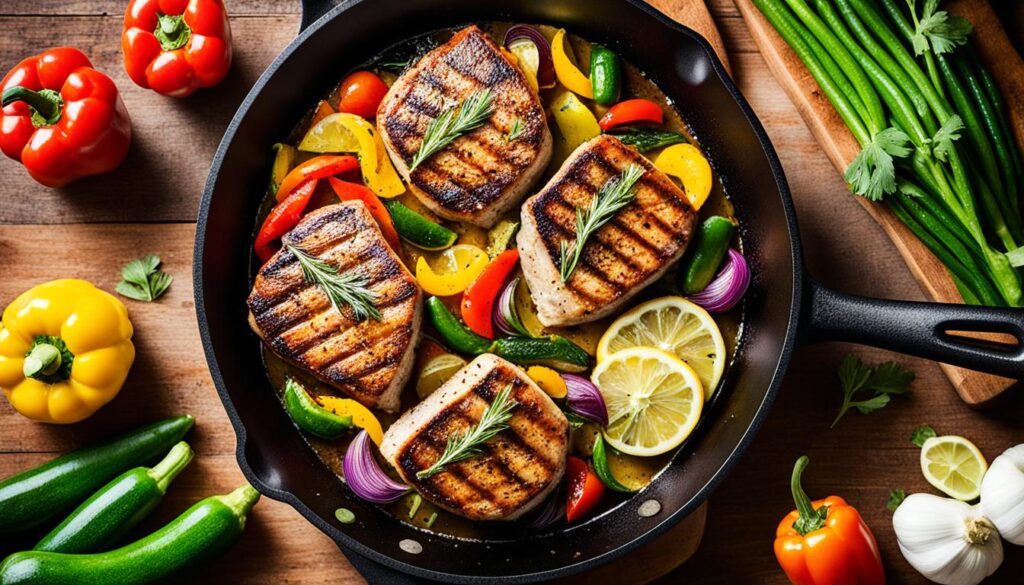
No sauce. No glaze. No reduction. Just lemon zest — not juice, zest, mixed directly into the seasoning rub so the citrus cooks into the surface of the pork rather than sitting on top of the finished chop — and fresh herbs and garlic powder and olive oil. Stovetop sear for the crust, oven finish for the interior. That’s the whole recipe.
Keto-friendly, low-carb, or just the right call when you want dinner without five components.
Ingredients
- 4 pork chops, at least 1 inch thick
- 1 tablespoon olive oil
- 1 teaspoon kosher salt
- 1/2 teaspoon black pepper
- 1 tablespoon lemon zest (from about 1-1/2 lemons)
- 1 teaspoon garlic powder
- 1 tablespoon fresh rosemary, thyme, or sage — or a combination, finely chopped
Instructions
Oven to 400°F. Salt, pepper, lemon zest, garlic powder, and chopped herbs into a small bowl and stir — citrusy and herby immediately, the lemon zest dominating the smell in a way that’s bright and slightly floral. Dry the pork chops completely on both sides. Press the seasoning into every surface. The chops should look speckled with fine yellow zest and small green herb pieces, the surface feeling slightly gritty with seasoning.
Cast iron over medium-high for 3 minutes. Olive oil in, shimmer, chops down. Two to 3 minutes per side — the goal here is a crust on the outside, not cooking through. The lemon zest darkens slightly in the hot oil, the herbs toast at the edges where they sit directly against the pan, and the whole thing smells citrusy and savory at the same time.
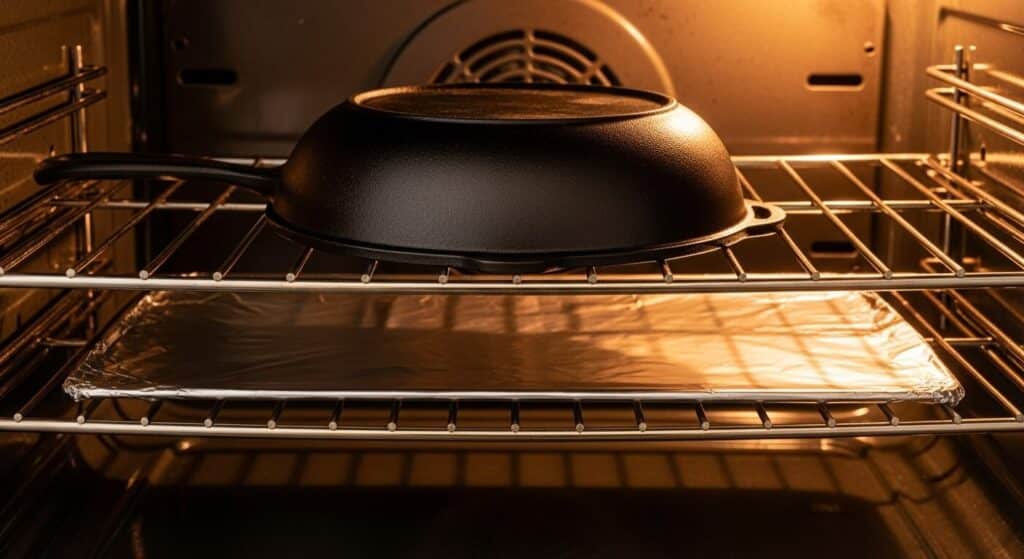
Whole skillet into the 400°F oven, 15 minutes. The oven finish is important for thick chops — stovetop-only cooking heats from one direction and the exterior can overcook before the interior reaches temperature. The oven surrounds the meat evenly and the center comes up gradually while the crust holds. 145°F internal, rest 5 minutes.
Nutritional Information (Per Serving)
| Nutrient | Amount per Serving |
|---|---|
| Calories | 433 |
| Carbohydrates | 1.5g |
| Protein | 51g |
| Fat | 24g |
| Fiber | 0.5g |
| Sodium | 520mg |
Tips for Storing and Reheating Skillet Pork Chops
Cooked pork chops keep well — better than most people expect. Ten minutes of cooling after cooking, then airtight container in the refrigerator for 3 to 4 days. For longer storage: wrap tightly in plastic, then in foil, and freeze for up to 2 to 3 months. Don’t refreeze anything that’s already been thawed once.
How to reheat without wrecking them
The oven is the best method, and it’s not particularly close. 300°F — not higher. Pork chops in a baking dish with a small splash of broth or water in the bottom, covered tightly with foil, 10 to 15 minutes. The low temperature combined with the steam from the liquid keeps the meat from drying out the way that higher heat or microwave reheating does. The crust softens a bit but the interior stays moist.
Cast iron on the stovetop is faster. Medium-low, a tablespoon of broth or butter in the pan, chops in, covered loosely. Flip once. Three to 4 minutes per side. Better than the microwave, not quite as consistent as the oven method, but perfectly acceptable.
Microwave: workable, not ideal. Fifty percent power in 60-second increments, covered with a damp paper towel — full power dries the edges before the center is warm. The crust goes soft and the texture changes but it’s fine for a quick lunch.
Whatever method: internal temperature back to 145°F before eating.